Non-Markovian Light-Matter Dynamics in the Time Fractional Jaynes-Cummings Model with Modulated Coupling
Pith reviewed 2026-05-22 00:51 UTC · model grok-4.3
The pith
Fractional order controls non-periodic evolution under sinusoidal coupling in the time fractional Jaynes-Cummings model.
A machine-rendered reading of the paper's core claim, the machinery that carries it, and where it could break.
Core claim
Under sinusoidal coupling, non-periodic dynamics is preserved for both formulations of the TFSE; however, within a certain range, the fractional order can act as a control mechanism for the non-periodic evolution, with the time-dependent couplings and fractional formulations together determining whether entanglement remains high or low.
What carries the argument
Two formulations of the time fractional Schrödinger equation applied to the Jaynes-Cummings Hamiltonian with modulated couplings, which encode memory effects that damp oscillations and shape asymptotic population inversion and entanglement.
If this is right
- Sinusoidal coupling preserves non-periodic dynamics across both TFSE formulations.
- The fractional order tunes the character of the non-periodic evolution inside a specific interval.
- Different couplings combined with each fractional formulation produce either high or low entanglement.
- Memory effects from the fractional order lead to damped oscillations and asymptotic decay in observables.
Where Pith is reading between the lines
- The fractional-order control could be tested by comparing against cavity QED experiments that use modulated atom-field interactions.
- This formulation supplies a simpler alternative to full non-Markovian master equations for simulating memory in light-matter systems.
- The same approach may extend to related models such as the quantum Rabi or Dicke Hamiltonians with fractional time evolution.
Load-bearing premise
The two specific formulations of the time fractional Schrödinger equation correctly represent the non-Markovian memory effects present in the physical light-matter system under study.
What would settle it
Numerical comparison of the fractional model's population inversion and entanglement curves for sinusoidal coupling against the corresponding solution of the standard non-Markovian Lindblad master equation for the identical Jaynes-Cummings parameters.
Figures




read the original abstract
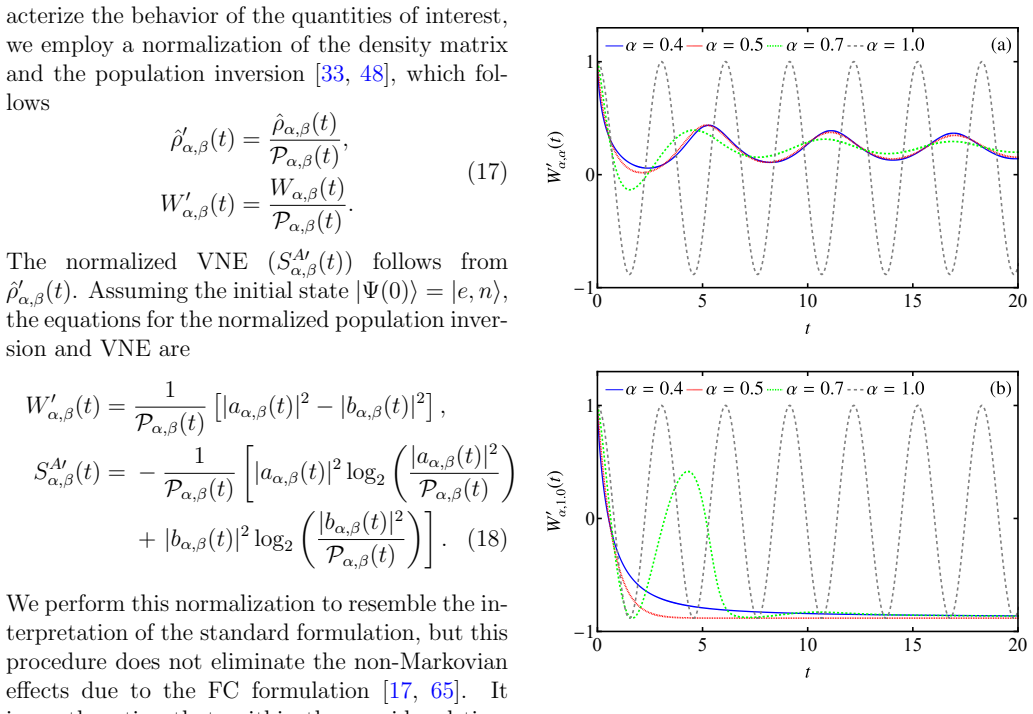
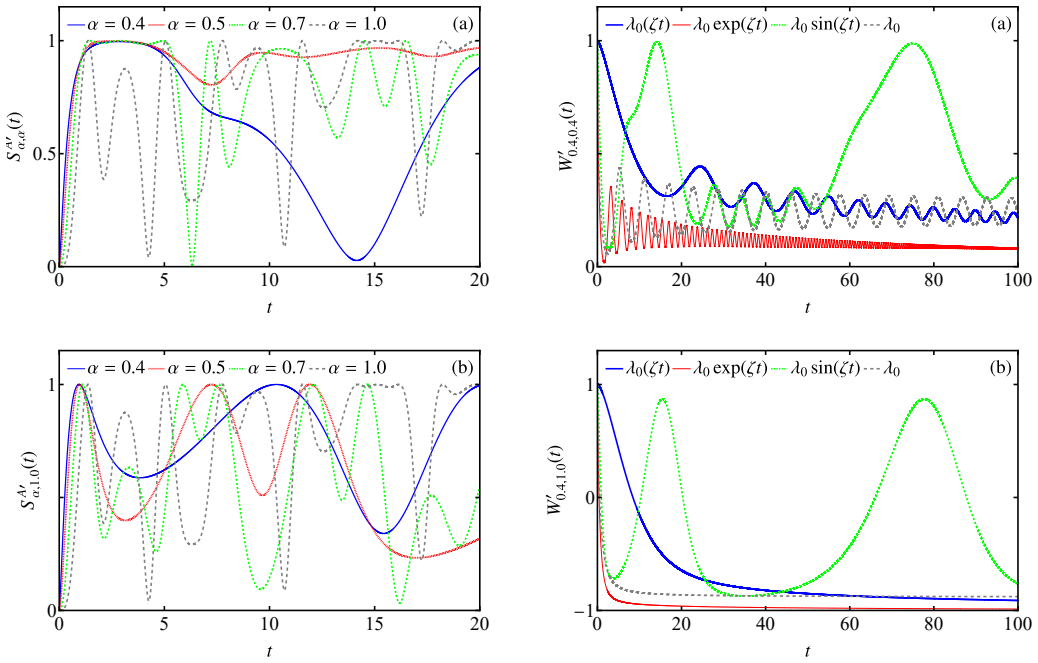
We investigate the fractional time description of a generalized quantum light-matter system modeled by a time-dependent Jaynes-Cummings (JC) interaction, with different coupling types: constant, linear, exponential, and sinusoidal. Two formulations of the time fractional Schr\"odinger equation (TFSE) are examined, with a focus on their impact on population inversion and entanglement. Our findings highlight that the introduction of fractional order introduces memory effects, associated with damped oscillations and asymptotic decay. Furthermore, we find that the time-dependent couplings, combined with distinct fractional formulations, influence how these effects occur, ultimately resulting in high or low entanglement. A key finding of our work is that, under sinusoidal coupling, non-periodic dynamics is preserved for both formulations of the TFSE; however, within a certain range, the fractional order can act as a control mechanism for the non-periodic evolution.
Editorial analysis
A structured set of objections, weighed in public.
Referee Report
Summary. The manuscript investigates non-Markovian effects in a generalized Jaynes-Cummings model using two formulations of the time-fractional Schrödinger equation (TFSE) with various time-dependent couplings, including constant, linear, exponential, and sinusoidal. It analyzes the impact on population inversion and entanglement, concluding that fractional order introduces memory effects causing damped oscillations and asymptotic decay, and that sinusoidal coupling preserves non-periodic dynamics while the fractional order α serves as a control mechanism within a certain range.
Significance. If the chosen TFSE formulations validly represent non-Markovian memory in light-matter systems, this work could offer a novel approach to controlling quantum dynamics and entanglement via fractional parameters. The exploration of multiple coupling types provides a comparative view, but the lack of microscopic derivation limits the physical interpretability of the results.
major comments (1)
- [§2] §2: The Caputo and Riemann-Liouville time-fractional Schrödinger equations are introduced directly without derivation from a system-bath Hamiltonian or explicit validation that their memory kernels reproduce established non-Markovian signatures (e.g., those obtained from a Lorentzian spectral density or Nakajima-Zwanzig projection). This is load-bearing for the central claim that the observed damping, asymptotic decay, and α-dependent control correspond to physical non-Markovian light-matter dynamics.
minor comments (2)
- The abstract states that 'within a certain range' the fractional order acts as a control mechanism but does not specify the numerical interval for α; this should be stated explicitly with reference to the relevant figures or tables.
- Notation for the two TFSE formulations should be introduced with a brief reminder of the integral kernels in the first appearance to aid readability for readers unfamiliar with fractional calculus.
Simulated Author's Rebuttal
We thank the referee for their careful reading of the manuscript and for highlighting the importance of physical interpretability. We address the single major comment below and outline targeted revisions to improve context without altering the core phenomenological approach of the work.
read point-by-point responses
-
Referee: §2: The Caputo and Riemann-Liouville time-fractional Schrödinger equations are introduced directly without derivation from a system-bath Hamiltonian or explicit validation that their memory kernels reproduce established non-Markovian signatures (e.g., those obtained from a Lorentzian spectral density or Nakajima-Zwanzig projection). This is load-bearing for the central claim that the observed damping, asymptotic decay, and α-dependent control correspond to physical non-Markovian light-matter dynamics.
Authors: We acknowledge that the TFSE formulations are introduced in §2 on a phenomenological basis rather than derived from a microscopic system-bath Hamiltonian. This choice follows the standard practice in the fractional quantum mechanics literature, where the Caputo and Riemann-Liouville operators are employed precisely because their non-local kernels encode memory effects that produce damping and asymptotic decay—features widely associated with non-Markovian evolution. While we do not claim equivalence to a specific spectral density such as Lorentzian, the fractional order α directly modulates the strength and range of the memory kernel, providing the control mechanism reported in our results. In the revised manuscript we will expand the opening of §2 with a concise paragraph that (i) cites representative works applying TFSE to quantum optics and light-matter systems, (ii) explicitly states the phenomenological nature of the model, and (iii) notes that the observed dynamical signatures are consistent with known non-Markovian phenomenology even if a full Nakajima-Zwanzig projection is not performed here. These additions will clarify the scope and limitations of our claims while preserving the comparative study of coupling types. revision: partial
Circularity Check
No circularity: numerical exploration of posited TFSE models
full rationale
The paper introduces the Caputo and Riemann-Liouville time-fractional Schrödinger equations as modeling frameworks for non-Markovian memory in the Jaynes-Cummings system and then numerically solves the resulting integro-differential equations for constant, linear, exponential, and sinusoidal couplings. All reported behaviors—damped oscillations, asymptotic decay, preservation of non-periodic dynamics under sinusoidal modulation, and α acting as a control parameter—are direct outputs of these simulations rather than quantities fitted to data or redefined by construction. No equations equate a derived observable to an input parameter, no self-citation supplies a uniqueness theorem that forces the central claim, and no ansatz is smuggled through prior work. The derivation chain is therefore self-contained as an exploratory numerical study whose validity rests on the external plausibility of the chosen fractional operators, not on internal tautology.
Axiom & Free-Parameter Ledger
free parameters (1)
- fractional order alpha
Lean theorems connected to this paper
-
IndisputableMonolith/Cost/FunctionalEquation.leanwashburn_uniqueness_aczel unclear?
unclearRelation between the paper passage and the cited Recognition theorem.
We investigate the fractional time description... two approaches for the power in the imaginary unit... Caputo fractional derivative... non-Markovian processes
-
IndisputableMonolith/Foundation/AlexanderDuality.leanalexander_duality_circle_linking unclear?
unclearRelation between the paper passage and the cited Recognition theorem.
sinusoidal coupling... non-periodic dynamics is preserved... fractional order can act as a control mechanism
What do these tags mean?
- matches
- The paper's claim is directly supported by a theorem in the formal canon.
- supports
- The theorem supports part of the paper's argument, but the paper may add assumptions or extra steps.
- extends
- The paper goes beyond the formal theorem; the theorem is a base layer rather than the whole result.
- uses
- The paper appears to rely on the theorem as machinery.
- contradicts
- The paper's claim conflicts with a theorem or certificate in the canon.
- unclear
- Pith found a possible connection, but the passage is too broad, indirect, or ambiguous to say the theorem truly supports the claim.
Reference graph
Works this paper leans on
-
[1]
J. Sabatier, O. P. Agrawal, J. A. T. Machado, Advances in Fractional Calculus: Theoretical De- velopments and Applications in Physics and Engi- neering, Springer Dordrecht, 2007. doi:10.1007/ 978-1-4020-6042-7
work page 2007
-
[2]
J. T. Machado, V. Kiryakova, F. Mainardim, Re- cent history of fractional calculus, Commun. Non- linear Sci. Numer. Simul. 16 (3) (2011) 1140–1153. doi:10.1016/j.cnsns.2010.05.027
-
[3]
M. Ali, G. Narayanan, V. Shekher, A. Alsaedi, B. Ah- mad, Global Mittag-Leffler stability analysis of im- pulsive fractional-order complex-valued BAM neural networks with time varying delays, Commun. Non- linear Sci. Numer. Simul. 83 (2020) 105088. doi: 10.1016/j.cnsns.2019.105088
-
[4]
L. R. Evangelista, E. K. Lenzi, Fractional Diffusion Equations and Anomalous Diffusion, Cambridge Uni- versity Press, 2018. doi:10.1017/9781316534649
-
[5]
E. C. Gabrick, E. Sayari, D. L. M. Souza, F. S. Borges, J. Trobia, E. K. Lenzi, A. M. Batista, Frac- tal and fractional SIS model for syphilis data, Chaos 33 (9) (sep 2023). doi:10.1063/5.0153122
-
[6]
H. Hassani, Z. Avazzadeh, J. T. Machado, P. Agar- wal, M. Bakhtiar, Optimal Solution of a Fractional HIV/AIDS epidemic mathematical model, J. Com- put. Biol. 29 (3) (2022) 276–291. doi:10.1089/cmb. 2021.0253
work page doi:10.1089/cmb 2022
- [7]
-
[8]
doi:10.1121/1.4933584
-
[9]
R. L. Bagley, P. Torvik, A theoretical basis for the application of fractional calculus to viscoelasticity, J. Rheol. 27 (3) (1983) 201–210. doi:10.1122/1. 549724
work page doi:10.1122/1 1983
-
[10]
W. Chen, S. Hu, W. Cai, A causal fractional deriva- tive model for acoustic wave propagation in lossy media, Arch. Appl. Mech. 86 (3) (2016) 529–539. doi:10.1007/s00419-015-1043-2
-
[11]
W. Cai, W. Chen, J. Fang, S. Holm, A survey on frac- tional derivative modeling of power-law frequency- dependent viscous dissipative and scattering attenua- tion in acoustic wave propagation, Appl. Mech. Rev. 70 (3) (2018). doi:10.1115/1.4040402
-
[12]
M. Rosseto, L. Evangelista, E. Lenzi, R. Zola, R. Ribeiro de Almeida, Frequency-Dependent Di- electric Permittivity in Poisson-Nernst-Planck model, J. Phys. Chem. B (2022). doi:10.1021/acs.jpcb. 2c03663
-
[13]
A. Chang, H. Sun, C. Zheng, B. Lu, C. Lu, R. Ma, Y. Zhang, A time fractional convection–diffusion equation to model gas transport through heteroge- neous soil and gas reservoirs, Physica A 502 (2018) 356–369. doi:10.1016/j.physa.2018.02.080
-
[14]
A. Chang, H. Sun, Y. Zhang, C. Zheng, F. Min, Spatial fractional Darcy’s law to quantify fluid flow in natural reservoirs, Physica A 519 (2019) 119–126. doi:10.1016/j.physa.2018.11.040
-
[15]
V. Pandey, S. Holm, Connecting the grain-shearing 14 mechanism of wave propagation in marine sediments to fractional order wave equations, J. Acoust. Soc. Am. 140 (6) (2016) 4225–4236. doi:10.1121/1. 4971289
work page doi:10.1121/1 2016
-
[16]
Laskin, Fractals and quantum mechanics, Chaos 10 (2000) 780–790
N. Laskin, Fractals and quantum mechanics, Chaos 10 (2000) 780–790. doi:10.1063/1.1050284
-
[18]
Naber, Time fractional Schr¨ odinger equation, J
M. Naber, Time fractional Schr¨ odinger equation, J. Math. Phys. 45 (8) (2004) 3339–3352. doi:10.1063/ 1.1769611
work page 2004
-
[19]
D. Cius, L. Menon, M. A. F. dos Santos, A. S. M. de Castro, F. M. Andrade, Unitary evolution for a two-level quantum system in fractional-time scenario, Phys. Rev. E 106 (5) (2022) 054126. doi:10.1103/ PhysRevE.106.054126
work page 2022
- [21]
-
[22]
H. M. Zou, M. F. Fang, Analytical solution and en- tanglement swapping of a double Jaynes-Cummings model in non-Markovian environments, Quantum Inf. Process. 14 (2015) 2673–2686. doi:10.1007/ s11128-015-1006-0
work page 2015
-
[23]
E. Gabrick, E. Sayari, A. de Castro, J. Trobia, A. Batista, E. Lenzi, Fractional Schr¨ odinger equa- tion and time dependent potentials, Commun. Non- linear Sci. Numer. Simul. 123 (2023) 107275. doi: 10.1016/j.cnsns.2023.107275
-
[24]
E. K. Lenzi, L. R. Evangelista, H. V. Ribeiro, R. L. Magin, Schr¨ odinger equation with geometric con- straints and position-dependent mass: Linked frac- tional calculus models, Quantum Rep. 4 (3) (2022) 296–308. doi:10.3390/quantum4030021
-
[25]
Laskin, L´ evy flights over quantum paths, Com- mun
N. Laskin, L´ evy flights over quantum paths, Com- mun. Nonlinear Sci. Numer. Simul. 12 (1) (2007) 2–
work page 2007
-
[26]
doi:10.1016/j.cnsns.2006.01.001
-
[27]
Iomin, Fractional-time Schr¨ odinger equation: Fractional dynamics on a comb, Chaos Solit
A. Iomin, Fractional-time Schr¨ odinger equation: Fractional dynamics on a comb, Chaos Solit. Fractals 44 (2011) 348–352. doi:10.1016/j.chaos.2011.03. 005
-
[28]
Longhi, Fractional Schr¨ odinger equation in optics, Opt
S. Longhi, Fractional Schr¨ odinger equation in optics, Opt. Lett. 40 (6) (2015) 1117. doi:10.1364/OL.40. 001117
- [29]
-
[30]
E. Jaynes, F. Cummings, Comparison of quantum and semiclassical radiation theories with application to the beam maser, Proc. IEEE 51 (1) (1963) 89–109. doi:10.1109/PROC.1963.1664
-
[31]
J. Larson, T. Mavrogordatos, The Jaynes–Cummings Model and Its Descendants, IOP Publishing, 2021. doi:10.1088/978-0-7503-3447-1
-
[32]
L. Lu, X. Yu, Time fractional evolution of the two-level system interacting with light field, Laser Phys. Lett. 14 (11) (2017) 115202. doi:10.1088/ 1612-202X/aa8bc4
work page 2017
-
[33]
L. Lu, X. Yu, The fractional dynamics of quantum systems, Ann. Phys. 392 (2018) 260–271. doi:10. 1016/j.aop.2018.03.017
work page 2018
-
[34]
K. El Anouz, A. El Allati, A. Salah, F. Saif, Quan- tum Fisher Information: Probe to Measure Fractional Evolution, Int. J. Theor. Phys. 59 (5) (2020) 1460–
work page 2020
-
[35]
doi:10.1007/s10773-020-04415-2
-
[36]
C. Zu, Y. Gao, X. Yu, Time fractional evolution of a single quantum state and entangled state, Chaos Solit. Fractals 147 (2021) 110930. doi:10.1016/j. chaos.2021.110930
work page doi:10.1016/j 2021
-
[37]
C. Zu, X. Yu, Time fractional Schr¨ odinger equation with a limit based fractional derivative, Chaos Solit. Fractals 157 (2022) 111941. doi:10.1016/j.chaos. 2022.111941
-
[38]
E. G. El-Hadidy, K. El Anouz, N. Metwally, The quantum communication efficiency of the frac- tional anti-Jaynes–Cummings model, Mod. Phys. Lett. A 38 (26n27) (sep 2023). doi:10.1142/ S0217732323501262
work page 2023
-
[39]
Cius, Unitary description of the Jaynes-Cummings model under fractional-time dynamics, Phys
D. Cius, Unitary description of the Jaynes-Cummings model under fractional-time dynamics, Phys. Rev. E 111 (2) (2025) 024110. doi:10.1103/PhysRevE.111. 024110
-
[40]
D. Wei, H. Liu, Y. Li, F. Gao, S. Qin, Q. Wen, Quantum speed limit for time-fractional open sys- tems, Chaos Solit. Fractals 175 (2023) 114065. doi: 10.1016/j.chaos.2023.114065
-
[41]
M. O. Monteiro, N. K. Bernardes, E. M. Broni, F. A. B. F. de Moura, G. M. A. Almeida, Non-Markovian to Markovian decay in structured environments with correlated disorder, Phys. Rev. A 111 (2025) 022212. doi:10.1103/PhysRevA.111.022212
-
[42]
C. Zu, X. Yu, The time-fractional Schr¨ odinger equa- tion in the context of non-Markovian dynamics with dissipation, J. Chem. Phys. 162 (7) (feb 2025). doi: 10.1063/5.0253816
-
[43]
R. R. Schlicher, Jaynes-Cummings model with atomic motion, Opt. Commun. 70 (2) (1989) 97–102. doi: 10.1016/0030-4018(89)90276-9
- [44]
-
[45]
A. Joshi, S. V. Lawande, Generalized Jaynes- 15 Cummings models with a time-dependent atom-field coupling, Phys. Rev. A 48 (3) (1993) 2276–2284. doi:10.1103/PhysRevA.48.2276
-
[46]
J. Larson, S. Stenholm, Photon filters in a microwave cavity, J. Mod. Opt. 50 (18) (2003) 2705–2714. doi: 10.1080/09500340308234580
-
[47]
J. Larson, S. Stenholm, Adiabatic state preparation in a cavity, J. Mod. Opt. 50 (11) (2003) 1663–1678. doi:10.1080/09500340308235512
-
[48]
H.-P. Breuer, E.-M. Laine, J. Piilo, B. Vacchini, Col- loquium: Non-Markovian dynamics in open quan- tum systems, Rev. Mod. Phys. 88 (2) (2016) 021002. doi:10.1103/RevModPhys.88.021002
-
[49]
C. Monroe, D. M. Meekhof, B. E. King, W. M. Itano, D. J. Wineland, Demonstration of a Fundamental Quantum Logic Gate, Phys. Rev. Lett. 75 (25) (1995) 4714–4717. doi:10.1103/PhysRevLett.75.4714
-
[50]
Laskin, Time fractional quantum mechanics, Chaos Solit
N. Laskin, Time fractional quantum mechanics, Chaos Solit. Fractals 102 (2017) 16–28. doi:10. 1016/j.chaos.2017.04.010
work page 2017
- [51]
-
[52]
P. K. Aravind, J. O. Hirschfelder, Two-state sys- tems in semiclassical and quantized fields, J. Phys. Chem. 88 (21) (1984) 4788–4801. doi:10.1021/ j150665a002
work page 1984
-
[53]
S. Phoenix, P. Knight, Fluctuations and entropy in models of quantum optical resonance, Ann. Phys. 186 (2) (1988) 381–407. doi:10.1016/ 0003-4916(88)90006-1
work page 1988
-
[54]
S. J. D. Phoenix, P. L. Knight, Establishment of an entangled atom-field state in the Jaynes-Cummings model, Phys. Rev. A 44 (9) (1991) 6023–6029. doi: 10.1103/PhysRevA.44.6023
-
[55]
F. W. Cummings, Stimulated Emission of Radiation in a Single Mode, Phys. Rev. 140 (4A) (1965) A1051– A1056. doi:10.1103/PhysRev.140.A1051
-
[56]
J. H. Eberly, N. B. Narozhny, J. J. Sanchez- Mondragon, Periodic Spontaneous Collapse and Re- vival in a Simple Quantum Model, Phys. Rev. Lett. 44 (20) (1980) 1323–1326. doi:10.1103/ PhysRevLett.44.1323
work page 1980
-
[57]
D. Meschede, H. Walther, G. M¨ uller, One-Atom Maser, Phys. Rev. Lett. 54 (6) (1985) 551–554. doi: 10.1103/PhysRevLett.54.551
- [58]
- [59]
-
[60]
doi:10.1103/PhysRevLett.76.1800
-
[61]
A. S. M. de Castro, R. Grimaudo, D. Valenti, A. Migliore, H. Nakazato, A. Messina, Analytically solvable Hamiltonian in invariant subspaces, Eur. Phys. J. Plus 138 (8) (2023) 766.doi:10.1140/epjp/ s13360-023-04375-6
-
[62]
M.-F. Fang, Effects of atomic motion and field mode structure on the field entropy and Schr¨ odinger- cat states in the Jaynes–Cummings model, Phys- ica A 259 (1-2) (1998) 193–204. doi:10.1016/ S0378-4371(98)00234-9
work page 1998
-
[63]
Dasgupta, An analytically solvable time- dependent Jaynes-Cummings model, J
A. Dasgupta, An analytically solvable time- dependent Jaynes-Cummings model, J. Opt. B 1 (1) (1999) 14–18. doi:10.1088/1464-4266/1/1/003
-
[64]
D. Maldonado-Mundo, P. ¨Ohberg, B. W. Lovett, E. Andersson, Investigating the generality of time- local master equations, Phys. Rev. A 86 (4) (2012) 042107. doi:10.1103/PhysRevA.86.042107
-
[65]
G. Arroyo-Correa, J. J. Sanchez-Mondragon, The Jaynes-Cummings model thermal revivals, Quant. Optics 2 (6) (1990) 409–421. doi:10.1088/ 0954-8998/2/6/001
work page 1990
-
[66]
von Neumann, Thermodynamik quantenmechanis- cher Gesamtheiten, Gott
J. von Neumann, Thermodynamik quantenmechanis- cher Gesamtheiten, Gott. Nachr. Math. Phys. Klass (1927)
work page 1927
-
[67]
M. A. Nielsen, I. L. Chuang, Quantum Computation and Quantum Information: 10th Anniversary Edi- tion, Cambridge University Press, Cambridge, 2010. doi:10.1017/CBO9780511976667
-
[68]
R. Horodecki, P. Horodecki, M. Horodecki, K. Horodecki, Quantum entanglement, Rev. Mod. Phys. 81 (2) (2009) 865–942. doi: 10.1103/RevModPhys.81.865
-
[69]
Shift in the velocity of a front due to a cutoff
A. Iomin, Fractional-time quantum dynamics, Phys. Rev. E 80 (2009) 022103. doi:10.1103/PhysRevE. 80.022103
-
[70]
C. Gerry, P. Knight, Introductory Quantum Op- tics, 2nd Edition, Cambridge University Press, Cam- bridge, 2004. doi:10.1017/CBO9780511791239
-
[71]
K. Diethelm, N. Ford, A. Freed, Y. Luchko, Algo- rithms for the fractional calculus: A selection of nu- merical methods, Comput. Methods Appl. Mech. En- grg 194 (2005) 743–773. doi:10.1016/j.cma.2004. 06.006
-
[72]
E. E. Nikitin, S. Y. Umanskii, Theory of Slow Atomic Collisions, Vol. 30 of Springer Series in Chemical Physics, Springer Berlin Heidelberg, Berlin, Heidel- berg, 1984. doi:10.1007/978-3-642-82045-8
- [73]
- [74]
discussion (0)
Sign in with ORCID, Apple, or X to comment. Anyone can read and Pith papers without signing in.