REVIEW 2 major objections 4 minor 135 references
HI asymmetries in spatially resolved SIMBA galaxies
T0 review · 2 major / 4 minor · reviewed 2026-08-06 · deepseek-v4-flash
Pith's one-line read In simulated galaxies, a merger or interaction within the last ~2 Gyr leaves a measurable disturbance in the projected neutral hydrogen distribution that the morphological asymmetry $A_{\mathrm{mod}}$ detects more reliably than the…
desk verdict A solid methodological paper on HI asymmetry measurements; the resolution-standardization result is convincing, but the category comparison needs a validated merger classification before it can be trusted. read the letter →
The pith
A machine-rendered reading of the paper's core claim, the machinery that carries it, and where it could break.
The reading
What carries the argument
The load-bearing tools are two asymmetry statistics and a resolution standardization. $A_{\mathrm{flux}}$ is the difference between the integrated flux in the two halves of the global H I profile divided by the total flux. $A_{\mathrm{mod}}$ is the mean over pixels of $|I - I_{180}| / |I + I_{180}|$, which up-weights faint outer-disc asymmetries such as tidal features. Because more massive H I discs contain more resolution elements at a fixed beam size, the paper smooths each moment-0 map to the resolution at which the galaxy is resolved by about 10 beams in area ($N_{\mathrm{beams}} \approx 10$), which removes a spurious mass-asymmetry trend. The dynamical classification is carried by fractional stellar and baryonic mass jumps ($R_{\star}$ and $R_{\mathrm{baryon}} \geq 5$ per cent), a star-formation correction, and neighbour separations of $\leq 50$ kpc for mergers and $\leq 100$ kpc for interactions with mass ratio $\geq 5$ per cent.
What would settle it
Re-classify the same simulated galaxies using a merger tree that identifies genuine merger events by shared stellar or dark-matter particles rather than by fractional mass jumps, then recompute the $A_{\mathrm{mod}}$ and $A_{\mathrm{flux}}$ distributions of the three categories; if the merged-isolated separation in $A_{\mathrm{mod}}$ shrinks to the level seen in $A_{\mathrm{flux}}$, the central claim is undercut.
Extended reading notes
Core claim
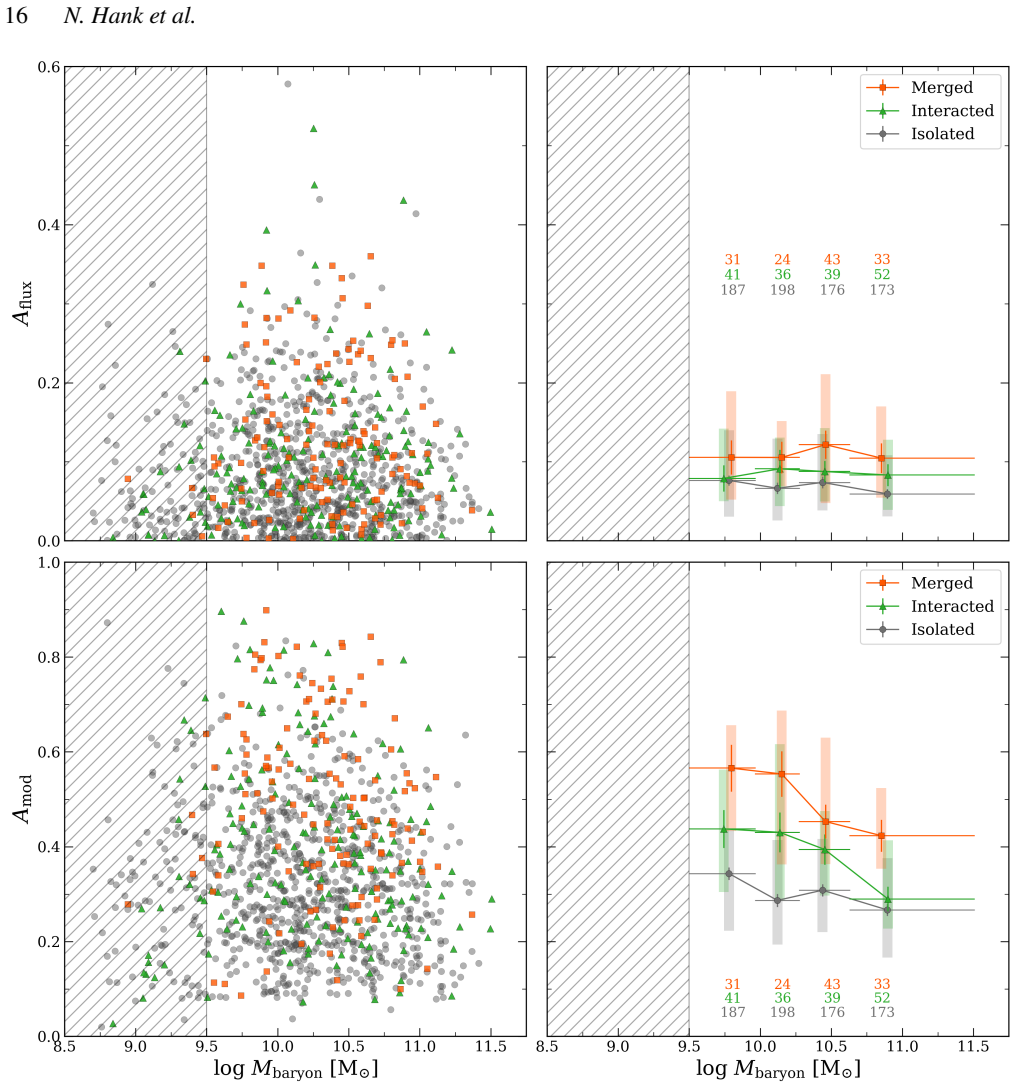
In the SIMBA cosmological hydrodynamical simulations, the paper builds synthetic H I data cubes at the resolution of a medium-deep imaging survey and measures, for each of 1,157 galaxies, the integrated spectral asymmetry $A_{\mathrm{flux}}$ and the modified morphological asymmetry $A_{\mathrm{mod}}$ (the pixel-wise normalized difference between the moment-0 map, the velocity-integrated H I intensity map, and its 180-degree rotation). Using galaxy tracking over roughly 2.2 Gyr, it assigns galaxies to isolated, interacted, or merged categories by fractional stellar and baryonic mass jumps, star-formation corrections, and neighbour separations. The paper finds that the merged and interacted categories have higher mean $A_{\mathrm{flux}}$ and $A_{\mathrm{mod}}$ than the isolated category, that the separation between category distributions is larger for $A_{\mathrm{mod}}$ than for $A_{\mathrm{flux}}$, and that the interacted category differs from isolated only in $A_{\mathrm{mod}}$, not in $A_{\mathrm{flux}}$. It also finds an inverse correlation between baryonic mass and $A_{\mathrm{mod}}$ for the interacted and merged categories, absent for $A_{\mathrm{flux}}$, and only a weak correlation between $A_{\mathrm{flux}}$ and $A_{\mathrm{mod}}$ overall. Taken together, these results imply that a recent merger or interaction leaves a detectable, ordered disturbance in the projected H I distribution, and that this disturbance is better captured by the morphology-based measure than by the flux-ratio measure.
Load-bearing premise
The load-bearing premise is that the fractional mass-jump thresholds, star-formation correction, neighbour separation cutoffs, and mass-ratio cut used to classify galaxies as isolated, interacted, or merged actually recover true merger and interaction events; the paper does not validate these thresholds, and if they mislabel many galaxies, every category comparison inherits the error.
Editorial extensions
If this is right
- Galaxies with a merged or interacted dynamical history within the last ~2 Gyr should, on average, show higher $A_{\mathrm{mod}}$ than isolated galaxies, making morphological asymmetry a candidate indicator of recent disturbance.
- Spectral asymmetry $A_{\mathrm{flux}}$ should be treated as a lower limit on intrinsic H I disturbance: a symmetric global profile does not imply an undisturbed H I disc.
- Surveys spanning a wide range of H I masses must match the relative spatial resolution (roughly equal numbers of beams across the galaxy area) before comparing $A_{\mathrm{mod}}$ values, or they will measure a spurious mass dependence.
- For interacted and merged galaxies, lower baryonic mass should be associated with higher morphological asymmetry, consistent with shallow potential wells being more easily distorted.
- The weak correlation between $A_{\mathrm{flux}}$ and $A_{\mathrm{mod}}$ limits what can be inferred about unresolved H I distributions from integrated profiles alone.
Reading between the lines
- Extension: applying the same resolution-matching procedure to existing resolved H I samples would test whether previously reported mass and environment trends in morphological asymmetry are partly resolution artefacts.
- Going beyond the paper, the weak $A_{\mathrm{flux}}$–$A_{\mathrm{mod}}$ correlation implies that unresolved H I surveys will systematically undercount recently disturbed galaxies, because $A_{\mathrm{flux}}$ misses the low-surface-brightness features $A_{\mathrm{mod}}$ is designed to catch.
- An unstated corollary: if low-mass galaxies are the most morphologically asymmetric after interactions, resolved H I surveys that reach lower H I masses should find a rising asymmetry fraction toward the faint end, a prediction the paper's sample cuts do not fully test.
Editorial analysis
A structured set of objections, weighed in public.
Referee Report
Summary. This paper uses the SIMBA cosmological simulations to generate synthetic HI data cubes that mimic Apertif Medium-Deep Survey observations, and measures spectral (A_flux) and morphological (A_mod) asymmetries for ~1150 galaxies. The authors find that SIMBA broadly reproduces the observed HI size-mass relation, albeit with slightly small discs at high HI mass. They quantify how A_mod measured at a fixed physical resolution correlates with HI mass, and show that this correlation largely disappears when the resolution is standardized to approximately 10 beams across the galaxy. They classify galaxies into isolated, interacted, and merged categories based on fractional stellar and baryonic mass jumps and neighbour separations over the preceding ~2 Gyr, and report that the interacted and merged categories have higher asymmetries than the isolated category, with a larger separation between categories in A_mod than in A_flux. For interacted and merged galaxies they find an inverse correlation between baryonic mass and A_mod, and they report a weak but significant correlation between A_flux and A_mod. The paper concludes that A_flux alone underestimates the degree of morphological disturbance in HI discs.
Significance. If the dynamical classification is trustworthy, the paper provides a valuable large-sample benchmark for interpreting resolved and unresolved HI asymmetries in upcoming surveys. The resolution-standardization procedure is a genuinely useful methodological advance, and the claim that A_mod is more sensitive than A_flux to recent interactions is a testable prediction for Apertif, WALLABY, and other HI surveys. The paper also benefits from using a simulation suite (SIMBA) that was not calibrated to asymmetry observables, so there is no direct circularity. The use of public simulation data and the martini package supports reproducibility, with data products available on reasonable request. However, the central classification step is not validated against a known-truth merger history, and the combined-sample analysis does not fully control for the different volume mixtures, so the scientific claims are not yet secured.
major comments (2)
- [Section 4, Eq. (11)] The merger and interaction classification is not validated against a known-truth merger history. The thresholds (R_star and R_baryon >= 5 per cent, R_star - R_SF >= 5 per cent, r_sep <= 50 or 100 kpc, baryonic mass ratio >= 5 per cent) are adopted from the literature, but no confusion matrix, visual verification of the merged/interacted classes, or comparison with the simulation's own merger trees is provided. The refined-isolated check only guards against false negatives in the isolated class; it says nothing about false positives in the merged and interacted classes, which can arise from smooth gas accretion, flybys, or satellite confusion. Because the central claims of Section 4.1 (higher mean A_flux and A_mod, larger A_mod separation between categories) and Section 4.3 (inverse A_mod-baryonic mass trend) depend entirely on this categorization, I request an explicit validation step, for example using true halo/galaxy merger histories from the SIMBA snapshots to compute contamination rates, or a threshold-robustness analysis varying R from 1-10 per cent, r_sep from 30-100 kpc, and the mass ratio from 1-10 per cent, demonstrating that the KS-test separations and median differences persist.
- [Section 4.1 and Figs. 5-6] The combined-sample analysis in Section 4.1 may be driven in part by the differing volume mixtures. SIMBA-25 contributes 78/513 (15 per cent) merged galaxies versus 58/644 (9 per cent) for SIMBA-100, while Figs. 5 and 6 show systematically different A_mod behaviour between the two volumes, including different regions of the A_mod-HI mass plane being populated. At face value, the merged category's higher A_mod could reflect the larger SIMBA-25 fraction in that category rather than the dynamical history itself. I request that the KS tests and median comparisons shown in Fig. 7 and Table 1 be repeated separately for SIMBA-25 and SIMBA-100, and ideally within overlapping baryonic-mass or HI-mass ranges. If the category separations persist in both volumes, the volume-mixing concern is resolved.
minor comments (4)
- [Section 4.1 and Table 1] The text in Section 4.1 repeatedly describes the categories as having 'higher mean asymmetry' and 'mean asymmetry', but Table 1 reports only medians and interquartile ranges, not means. The abstract also uses 'mean asymmetries'. Please either report both the mean and median for each category, or consistently use one statistic and state explicitly which one is used in the comparisons and in the abstract.
- [Section 2.4] The 3-sigma-MAD cut that removes 181 galaxies based on the discrepancy between cube-measured and catalogue HI masses may preferentially exclude satellites with HI bridges or interacting systems, which could in turn affect the category fractions and the asymmetry distributions. Please briefly discuss the potential selection bias and, if feasible, report the category fractions after excluding the 181 galaxies versus the full starting sample.
- [Section 3.2] The procedure for identifying the resolution at which N_beams is approximately 10 is described as smoothing to fixed beam sizes of 30, 45, 60, 90, and 120 arcseconds. Since 'approximately 10' suggests interpolation, please clarify how the exact resolution and the corresponding A_mod value are obtained between these discrete beam sizes.
- [Section 4.3 and Fig. 9] The 'clear inverse trend' between A_mod and baryonic mass for the interacted and merged categories is supported only by binned medians in Fig. 9; no Spearman correlation coefficients or significance levels are reported for these categories separately. Please provide these statistics for each category to support the statement in the abstract and conclusions.
Circularity Check
No significant circularity: the dynamical-history categories are defined from mass-growth histories independent of the asymmetry measurements, and the size-mass benchmark and resolution test are self-contained.
full rationale
This is a measurement study rather than a derivation chain. The central comparisons (A_flux/A_mod versus dynamical history) use a classification based on caesar mass-growth histories (Eq. 11), star-formation-corrected stellar mass jumps, neighbour separation, and baryonic mass ratio; none of these inputs use the asymmetry measurements, so the category separation is not forced by construction. The HI size-mass relation is benchmarked against the external Wang et al. (2016) relation, and SIMBA is not calibrated to HI scaling relations, so the agreement is an independent check. The resolution-standardization result is obtained by re-measuring A_mod at N_beams approximately 10 and is an empirical outcome, not a self-fulfilling fit. The paper does cite prior work by its own authors (e.g., Dave et al. 2020 for the HI mass function; Bilimogga et al. 2022 for the A_mod column-density threshold; Glowacki et al. 2022 for profile-asymmetry trends), but these citations provide methodological context or prior external benchmarks and are not the load-bearing step that produces the asymmetry-category separation. The unvalidated merger/interaction thresholds are a correctness risk, not a circularity: misclassification would weaken or bias the category comparison, but the comparison itself is not equivalent to the classification by definition. No fitted parameter is renamed as a prediction, and no uniqueness claim is imported from the authors' prior work.
Assumptions & free parameters
free parameters (3)
- N_beams target of ~10 for A_mod standardization =
~10 beams
- Merger and interaction classification thresholds =
R >= 5%, r_sep <= 50 and 100 kpc, mass ratio >= 5%
- Baryonic mass completeness limit =
M_baryon = 10^9.5 M_sun
assumptions (4)
- domain assumption SIMBA's HI content, including the self-shielding prescription and H2 fraction calculation, is a reliable representation of real HI disks.
- domain assumption Galaxies can be traced across the 11 snapshots via shared star particle IDs in caesar catalogues.
- domain assumption The median radial HI profile and size-mass relation of observed galaxies from Wang et al. (2016) are the correct observational benchmark.
- domain assumption Noise-free synthetic data cubes provide HI measurements that are directly comparable to real observations when interpreting asymmetry trends.
invented entities (1)
-
None
Cite this review
Pith. "Pith review of HI asymmetries in spatially resolved SIMBA galaxies." pith.science (2026). https://pith.science/paper/WZVZGQO6
@misc{pith2026250615827,
  author       = {Pith},
  title        = {Pith review of: HI asymmetries in spatially resolved SIMBA galaxies},
  year         = {2026},
  howpublished = {\url{https://pith.science/paper/WZVZGQO6}},
  note         = {Machine review of arXiv:2506.15827}
}
abstract
We present a study of the neutral atomic hydrogen (HI) content of spatially resolved, low-redshift galaxies in the SIMBA cosmological simulations. We create synthetic HI data cubes designed to match observations from the Apertif Medium-Deep HI imaging survey, and follow an observational approach to derive the HI size-mass relation. The HI size-mass relation for SIMBA is in broad agreement with the observed relation to within 0.1 dex, but SIMBA galaxies are slightly smaller than expected at fixed HI mass. We quantify the HI spectral ($A_{\mathrm{flux}}$) and morphological ($A_{\mathrm{mod}}$) asymmetries of the galaxies and motivate standardizing the relative spatial resolution when comparing values in a sample that spans several orders of magnitude in HI mass. Galaxies are classified into three categories (isolated, interacted, or merged) based on their dynamical histories over the preceding ~2 Gyr to contextualize disturbances in their HI reservoirs. We determine that the interacted and merged categories have higher mean asymmetries than the isolated category, with a larger separation between the categories' $A_{\mathrm{mod}}$ distributions than between their $A_{\mathrm{flux}}$ distributions. For the interacted and merged categories, we find an inverse correlation between baryonic mass and $A_{\mathrm{mod}}$ that is not observed between baryonic mass and $A_{\mathrm{flux}}$. These results, coupled with the weak correlation found between $A_{\mathrm{flux}}$ and $A_{\mathrm{mod}}$, highlight the limitations of only using $A_{\mathrm{flux}}$ to infer the HI distributions of spatially unresolved HI detections.
Figures


Figures from the paper (5 more)


Reference graph
Works this paper leans on
-
[1]
write newline
" write newline "" before.all 'output.state := FUNCTION fin.entry write newline FUNCTION new.block output.state before.all = 'skip after.block 'output.state := if FUNCTION new.sentence output.state after.block = 'skip output.state before.all = 'skip after.sentence 'output.state := if if FUNCTION not #0 #1 if FUNCTION and 'skip pop #0 if FUNCTION or pop #1...
-
[2]
Abraham R. G., van den Bergh S., Nair P., 2003, @doi [ ] 10.1086/373919 , http://adsabs.harvard.edu/abs/2003ApJ...588..218A 588, 218
doi:10.1086/373919 2003
-
[3]
Identifying Mergers Using Quantitative Morphologies in Zoom Simulations of High-Redshift Galaxies
Abruzzo M. W., Narayanan D., Dav \'e R., Thompson R., 2018, @doi [arXiv e-prints] 10.48550/arXiv.1803.02374 , https://ui.adsabs.harvard.edu/abs/2018arXiv180302374A p. arXiv:1803.02374
work page Pith review arXiv doi:10.48550/arxiv.1803.02374 2018
-
[4]
Adams E. A. K., van Leeuwen J., 2019, @doi [Nature Astronomy] 10.1038/s41550-019-0692-4 , https://ui.adsabs.harvard.edu/abs/2019NatAs...3..188A 3, 188
- [5]
- [6]
-
[7]
Angl \'e s-Alc \'a zar D., Dav \'e R., Faucher-Gigu \`e re C.-A., \"O zel F., Hopkins P. F., 2017, @doi [ ] 10.1093/mnras/stw2565 , https://ui.adsabs.harvard.edu/abs/2017MNRAS.464.2840A 464, 2840
-
[8]
Appleby S., Dav \'e R., Kraljic K., Angl \'e s-Alc \'a zar D., Narayanan D., 2020, @doi [ ] 10.1093/mnras/staa1169 , https://ui.adsabs.harvard.edu/abs/2020MNRAS.494.6053A 494, 6053
Show all 135 references
-
[9]
Arp H., 1966, @doi [ ] 10.1086/190147 , https://ui.adsabs.harvard.edu/abs/1966ApJS...14....1A 14, 1
1966 doi
-
[10]
Astropy Collaboration et al., 2018, @doi [ ] 10.3847/1538-3881/aabc4f , https://ui.adsabs.harvard.edu/abs/2018AJ....156..123A 156, 123
2018 doi
-
[11]
M., et al., 2016, @doi [ ] 10.1093/mnras/stv2674 , https://ui.adsabs.harvard.edu/abs/2016MNRAS.456.1115B 456, 1115
Bah \'e Y. M., et al., 2016, @doi [ ] 10.1093/mnras/stv2674 , https://ui.adsabs.harvard.edu/abs/2016MNRAS.456.1115B 456, 1115
2016 doi
-
[12]
E., Lynden-Bell D., Sancisi R., 1980, @doi [ ] 10.1093/mnras/193.2.313 , https://ui.adsabs.harvard.edu/abs/1980MNRAS.193..313B 193, 313
Baldwin J. E., Lynden-Bell D., Sancisi R., 1980, @doi [ ] 10.1093/mnras/193.2.313 , https://ui.adsabs.harvard.edu/abs/1980MNRAS.193..313B 193, 313
1980 doi
-
[14]
F., McIntosh D
Bell E. F., McIntosh D. H., Katz N., Weinberg M. D., 2003, @doi [ ] 10.1086/374389 , https://ui.adsabs.harvard.edu/abs/2003ApJ...585L.117B 585, L117
2003 doi
-
[15]
A., Pedrosa S
Bignone L. A., Pedrosa S. E., Trayford J. W., Tissera P. B., Pellizza L. J., 2020, @doi [ ] 10.1093/mnras/stz3014 , https://ui.adsabs.harvard.edu/abs/2020MNRAS.491.3624B 491, 3624
2020 doi
-
[16]
V., Oman K
Bilimogga P. V., Oman K. A., Verheijen M. A. W., van der Hulst T., 2022, @doi [ ] 10.1093/mnras/stac1213 , https://ui.adsabs.harvard.edu/abs/2022MNRAS.513.5310B 513, 5310
2022 doi
-
[17]
Bluck A. F. L., Conselice C. J., Buitrago F. o., Gr \"u tzbauch R., Hoyos C., Mortlock A., Bauer A. E., 2012, @doi [ ] 10.1088/0004-637X/747/1/34 , https://ui.adsabs.harvard.edu/abs/2012ApJ...747...34B 747, 34
2012 doi
-
[18]
Blyth S., et al., 2016, in MeerKAT Science: On the Pathway to the SKA. p. 4
2016
-
[19]
L., Gilbank D
Bok J., Blyth S. L., Gilbank D. G., Elson E. C., 2019, @doi [ ] 10.1093/mnras/sty3448 , https://ui.adsabs.harvard.edu/abs/2019MNRAS.484..582B 484, 582
2019 doi
-
[20]
Bondi H., 1952, @doi [ ] 10.1093/mnras/112.2.195 , https://ui.adsabs.harvard.edu/abs/1952MNRAS.112..195B 112, 195
1952 doi
-
[21]
J., Puerari I., 2005, @doi [ ] 10.1051/0004-6361:20052631 , https://ui.adsabs.harvard.edu/abs/2005A&A...438..507B 438, 507
Bournaud F., Combes F., Jog C. J., Puerari I., 2005, @doi [ ] 10.1051/0004-6361:20052631 , https://ui.adsabs.harvard.edu/abs/2005A&A...438..507B 438, 507
2005 doi
-
[22]
H., Rhee M
Broeils A. H., Rhee M. H., 1997, , https://ui.adsabs.harvard.edu/abs/1997A&A...324..877B 324, 877
1997
-
[23]
Catinella B., Cortese L., 2015, @doi [ ] 10.1093/mnras/stu2241 , https://ui.adsabs.harvard.edu/abs/2015MNRAS.446.3526C 446, 3526
2015 doi
-
[24]
Catinella B., et al., 2018, @doi [ ] 10.1093/mnras/sty089 , https://ui.adsabs.harvard.edu/abs/2018MNRAS.476..875C 476, 875
2018 doi
-
[25]
Chabrier G., 2003, @doi [ ] 10.1086/374879 , https://ui.adsabs.harvard.edu/abs/2003ApJ...586L.133C 586, L133
2003 doi
-
[27]
Choque-Challapa N., Aguerri J. A. L., Mancera Pi \ n a P. E., Peletier R., Venhola A., Verheijen M., 2021, @doi [ ] 10.1093/mnras/stab2420 , https://ui.adsabs.harvard.edu/abs/2021MNRAS.507.6045C 507, 6045
2021 doi
-
[28]
J., 2003, @doi [ ] 10.1086/375001 , http://adsabs.harvard.edu/abs/2003ApJS..147....1C 147, 1
Conselice C. J., 2003, @doi [ ] 10.1086/375001 , http://adsabs.harvard.edu/abs/2003ApJS..147....1C 147, 1
2003 doi
-
[29]
J., Bershady M
Conselice C. J., Bershady M. A., Jangren A., 2000, @doi [ ] 10.1086/308300 , https://ui.adsabs.harvard.edu/abs/2000ApJ...529..886C 529, 886
2000 doi
-
[30]
A., Angl \'e s-Alc \'a zar D., Yang X., 2021, @doi [Nature Astronomy] 10.1038/s41550-021-01404-1 , https://ui.adsabs.harvard.edu/abs/2021NatAs...5.1069C 5, 1069
Cui W., Dav \'e R., Peacock J. A., Angl \'e s-Alc \'a zar D., Yang X., 2021, @doi [Nature Astronomy] 10.1038/s41550-021-01404-1 , https://ui.adsabs.harvard.edu/abs/2021NatAs...5.1069C 5, 1069
2021 doi
-
[31]
F., 2016, @doi [ ] 10.1093/mnras/stw1862 , https://ui.adsabs.harvard.edu/abs/2016MNRAS.462.3265D 462, 3265
Dav \'e R., Thompson R., Hopkins P. F., 2016, @doi [ ] 10.1093/mnras/stw1862 , https://ui.adsabs.harvard.edu/abs/2016MNRAS.462.3265D 462, 3265
2016 doi
-
[32]
H., Thompson R
Dav \'e R., Rafieferantsoa M. H., Thompson R. J., Hopkins P. F., 2017, @doi [ ] 10.1093/mnras/stx108 , https://ui.adsabs.harvard.edu/abs/2017MNRAS.467..115D 467, 115
2017 doi
-
[33]
H., Appleby S., 2019, @doi [ ] 10.1093/mnras/stz937 , https://ui.adsabs.harvard.edu/abs/2019MNRAS.486.2827D 486, 2827
Dav \'e R., Angl \'e s-Alc \'a zar D., Narayanan D., Li Q., Rafieferantsoa M. H., Appleby S., 2019, @doi [ ] 10.1093/mnras/stz937 , https://ui.adsabs.harvard.edu/abs/2019MNRAS.486.2827D 486, 2827
2019 doi
-
[34]
A., Stevens A
Dav \'e R., Crain R. A., Stevens A. R. H., Narayanan D., Saintonge A., Catinella B., Cortese L., 2020, @doi [ ] 10.1093/mnras/staa1894 , https://ui.adsabs.harvard.edu/abs/2020MNRAS.497..146D 497, 146
2020 doi
-
[35]
Deb T., Verheijen M. A. W., van der Hulst J. M., 2023, @doi [ ] 10.1051/0004-6361/202244910 , https://ui.adsabs.harvard.edu/abs/2023A&A...676A.118D 676, A118
2023 doi
-
[36]
L., Hank N., Kruger S., Carignan C., 2020, @doi [ ] 10.1093/mnras/staa1368 , https://ui.adsabs.harvard.edu/abs/2020MNRAS.495.1984D 495, 1984
Deg N., Blyth S. L., Hank N., Kruger S., Carignan C., 2020, @doi [ ] 10.1093/mnras/staa1368 , https://ui.adsabs.harvard.edu/abs/2020MNRAS.495.1984D 495, 1984
2020 doi
-
[37]
L., Hank N., 2023, @doi [ ] 10.1093/mnras/stad1693 , https://ui.adsabs.harvard.edu/abs/2023MNRAS.523.4340D 523, 4340
Deg N., Perron-Cormier M., Spekkens K., Glowacki M., Blyth S. L., Hank N., 2023, @doi [ ] 10.1093/mnras/stad1693 , https://ui.adsabs.harvard.edu/abs/2023MNRAS.523.4340D 523, 4340
2023 doi
-
[38]
M., Fraternali F., 2014, @doi [ ] 10.1051/0004-6361/201423596 , https://ui.adsabs.harvard.edu/abs/2014A&A...567A..68D 567, A68
Di Teodoro E. M., Fraternali F., 2014, @doi [ ] 10.1051/0004-6361/201423596 , https://ui.adsabs.harvard.edu/abs/2014A&A...567A..68D 567, A68
2014 doi
-
[39]
Diemer B., et al., 2019, @doi [ ] 10.1093/mnras/stz1323 , https://ui.adsabs.harvard.edu/abs/2019MNRAS.487.1529D 487, 1529
2019 doi
-
[40]
D., Kannappan S
Eckert K. D., Kannappan S. J., Stark D. V., Moffett A. J., Berlind A. A., Norris M. A., 2016, @doi [ ] 10.3847/0004-637X/824/2/124 , https://ui.adsabs.harvard.edu/abs/2016ApJ...824..124E 824, 124
2016 doi
-
[41]
K., Sulentic J., Verley S., Leon S., Sabater J., 2011, @doi [ ] 10.1051/0004-6361/201016117 , https://ui.adsabs.harvard.edu/abs/2011A&A...532A.117E 532, A117
Espada D., Verdes-Montenegro L., Huchtmeier W. K., Sulentic J., Verley S., Leon S., Sabater J., 2011, @doi [ ] 10.1051/0004-6361/201016117 , https://ui.adsabs.harvard.edu/abs/2011A&A...532A.117E 532, A117
2011 doi
-
[42]
Fern \'a ndez X., et al., 2013, @doi [ ] 10.1088/2041-8205/770/2/L29 , https://ui.adsabs.harvard.edu/abs/2013ApJ...770L..29F 770, L29
2013 doi
-
[43]
Gensior J., et al., 2024, @doi [ ] 10.1093/mnras/stae1217 , https://ui.adsabs.harvard.edu/abs/2024MNRAS.531.1158G 531, 1158
2024 doi
-
[44]
Giese N., van der Hulst T., Serra P., Oosterloo T., 2016, @doi [ ] 10.1093/mnras/stw1426 , http://adsabs.harvard.edu/abs/2016MNRAS.461.1656G 461, 1656
2016 doi
-
[45]
Glowacki M., Elson E., Dav \'e R., 2020, @doi [ ] 10.1093/mnras/staa2616 , https://ui.adsabs.harvard.edu/abs/2020MNRAS.498.3687G 498, 3687
2020 doi
-
[46]
L., Hank N., Dav \'e R., Elson E., Spekkens K., 2022, @doi [ ] 10.1093/mnras/stac2684 , https://ui.adsabs.harvard.edu/abs/2022MNRAS.517.1282G 517, 1282
Glowacki M., Deg N., Blyth S. L., Hank N., Dav \'e R., Elson E., Spekkens K., 2022, @doi [ ] 10.1093/mnras/stac2684 , https://ui.adsabs.harvard.edu/abs/2022MNRAS.517.1282G 517, 1282
2022 doi
-
[47]
R., Verheijen M
Gogate A. R., Verheijen M. A. W., van der Hulst J. M., Jaff \'e Y. L., 2023, @doi [ ] 10.1093/mnras/stac3381 , https://ui.adsabs.harvard.edu/abs/2023MNRAS.519.4279G 519, 4279
2023 doi
-
[48]
E., Gott J
Gunn J. E., Gott J. Richard I., 1972, @doi [ ] 10.1086/151605 , https://ui.adsabs.harvard.edu/abs/1972ApJ...176....1G 176, 1
1972 doi
-
[49]
Haardt F., Madau P., 2012, @doi [ ] 10.1088/0004-637X/746/2/125 , https://ui.adsabs.harvard.edu/abs/2012ApJ...746..125H 746, 125
2012 doi
-
[51]
P., Hogg D
Haynes M. P., Hogg D. E., Maddalena R. J., Roberts M. S., van Zee L., 1998, @doi [ ] 10.1086/300166 , https://ui.adsabs.harvard.edu/abs/1998AJ....115...62H 115, 62
1998 doi
-
[52]
P., et al., 2018, @doi [ ] 10.3847/1538-4357/aac956 , https://ui.adsabs.harvard.edu/abs/2018ApJ...861...49H 861, 49
Haynes M. P., et al., 2018, @doi [ ] 10.3847/1538-4357/aac956 , https://ui.adsabs.harvard.edu/abs/2018ApJ...861...49H 861, 49
2018 doi
-
[53]
E., van Gorkom J
Hibbard J. E., van Gorkom J. H., Rupen M. P., Schiminovich D., 2001, in Hibbard J. E., Rupen M., van Gorkom J. H., eds, Astronomical Society of the Pacific Conference Series Vol. 240, Gas and Galaxy Evolution. p. 657 ( @eprint arXiv astro-ph/0110667 )
2001 arXiv
-
[57]
W., et al., 2023, @doi [ ] 10.1093/mnras/stad602 , https://ui.adsabs.harvard.edu/abs/2023MNRAS.521.1502H 521, 1502
Holwerda B. W., et al., 2023, @doi [ ] 10.1093/mnras/stad602 , https://ui.adsabs.harvard.edu/abs/2023MNRAS.521.1502H 521, 1502
2023 doi
-
[58]
W., et al., 2025, @doi [ ] 10.1017/pasa.2025.5 , https://ui.adsabs.harvard.edu/abs/2025PASA...42...28H 42, e028
Holwerda B. W., et al., 2025, @doi [ ] 10.1017/pasa.2025.5 , https://ui.adsabs.harvard.edu/abs/2025PASA...42...28H 42, e028
2025 doi
-
[59]
F., 2015, @doi [ ] 10.1093/mnras/stv195 , https://ui.adsabs.harvard.edu/abs/2015MNRAS.450...53H 450, 53
Hopkins P. F., 2015, @doi [ ] 10.1093/mnras/stv195 , https://ui.adsabs.harvard.edu/abs/2015MNRAS.450...53H 450, 53
2015 doi
-
[60]
F., Quataert E., 2011, @doi [ ] 10.1111/j.1365-2966.2011.18542.x , https://ui.adsabs.harvard.edu/abs/2011MNRAS.415.1027H 415, 1027
Hopkins P. F., Quataert E., 2011, @doi [ ] 10.1111/j.1365-2966.2011.18542.x , https://ui.adsabs.harvard.edu/abs/2011MNRAS.415.1027H 415, 1027
2011
-
[61]
W., et al., 2021, @doi [ ] 10.1017/pasa.2021.1 , https://ui.adsabs.harvard.edu/abs/2021PASA...38....9H 38, e009
Hotan A. W., et al., 2021, @doi [ ] 10.1017/pasa.2021.1 , https://ui.adsabs.harvard.edu/abs/2021PASA...38....9H 38, e009
2021 doi
-
[62]
D., 2007, @doi [Computing in Science and Engineering] 10.1109/MCSE.2007.55 , https://ui.adsabs.harvard.edu/abs/2007CSE.....9...90H 9, 90
Hunter J. D., 2007, @doi [Computing in Science and Engineering] 10.1109/MCSE.2007.55 , https://ui.adsabs.harvard.edu/abs/2007CSE.....9...90H 9, 90
2007 doi
-
[63]
L., Poggianti B
Jaff \'e Y. L., Poggianti B. M., Verheijen M. A. W., Deshev B. Z., van Gorkom J. H., 2013, @doi [ ] 10.1093/mnras/stt250 , https://ui.adsabs.harvard.edu/abs/2013MNRAS.431.2111J 431, 2111
2013 doi
-
[64]
Jarvis M., et al., 2016, in MeerKAT Science: On the Pathway to the SKA. p. 6 ( @eprint arXiv 1709.01901 )
2016 arXiv
-
[65]
J., Combes F., 2009, @doi [ ] 10.1016/j.physrep.2008.12.002 , https://ui.adsabs.harvard.edu/abs/2009PhR...471...75J 471, 75
Jog C. J., Combes F., 2009, @doi [ ] 10.1016/j.physrep.2008.12.002 , https://ui.adsabs.harvard.edu/abs/2009PhR...471...75J 471, 75
2009 doi
-
[66]
Johnston S., et al., 2008, @doi [Experimental Astronomy] 10.1007/s10686-008-9124-7 , https://ui.adsabs.harvard.edu/abs/2008ExA....22..151J 22, 151
2008 doi
-
[67]
S., et al., 2020, @doi [ ] 10.1007/s10509-020-03831-4 , https://ui.adsabs.harvard.edu/abs/2020Ap&SS.365..118K 365, 118
Koribalski B. S., et al., 2020, @doi [ ] 10.1007/s10509-020-03831-4 , https://ui.adsabs.harvard.edu/abs/2020Ap&SS.365..118K 365, 118
2020 doi
-
[68]
R., Gnedin N
Krumholz M. R., Gnedin N. Y., 2011, @doi [ ] 10.1088/0004-637X/729/1/36 , https://ui.adsabs.harvard.edu/abs/2011ApJ...729...36K 729, 36
2011 doi
-
[69]
Lelli F., Verheijen M., Fraternali F., 2014, @doi [ ] 10.1093/mnras/stu1804 , http://adsabs.harvard.edu/abs/2014MNRAS.445.1694L 445, 1694
2014 doi
-
[70]
S., Schombert J
Lelli F., McGaugh S. S., Schombert J. M., 2016, @doi [ ] 10.3847/0004-6256/152/6/157 , https://ui.adsabs.harvard.edu/abs/2016AJ....152..157L 152, 157
2016 doi
-
[71]
Li Q., Narayanan D., Dav \'e R., 2019, @doi [ ] 10.1093/mnras/stz2684 , https://ui.adsabs.harvard.edu/abs/2019MNRAS.490.1425L 490, 1425
2019 doi
-
[72]
M., Primack J., Madau P., 2004, @doi [ ] 10.1086/421849 , http://adsabs.harvard.edu/abs/2004AJ....128..163L 128, 163
Lotz J. M., Primack J., Madau P., 2004, @doi [ ] 10.1086/421849 , http://adsabs.harvard.edu/abs/2004AJ....128..163L 128, 163
2004 doi
-
[74]
M., Jonsson P., Cox T
Lotz J. M., Jonsson P., Cox T. J., Primack J. R., 2010b, @doi [ ] 10.1111/j.1365-2966.2010.16269.x , https://ui.adsabs.harvard.edu/abs/2010MNRAS.404..590L 404, 590
2010
-
[75]
A., et al., 2018, @doi [ ] 10.1093/mnras/sty387 , https://ui.adsabs.harvard.edu/abs/2018MNRAS.476.3744L 476, 3744
Lutz K. A., et al., 2018, @doi [ ] 10.1093/mnras/sty387 , https://ui.adsabs.harvard.edu/abs/2018MNRAS.476.3744L 476, 3744
2018 doi
-
[76]
Maddox N., et al., 2021, @doi [ ] 10.1051/0004-6361/202039655 , https://ui.adsabs.harvard.edu/abs/2021A&A...646A..35M 646, A35
2021 doi
-
[77]
D., Stevens A
Manuwal A., Ludlow A. D., Stevens A. R. H., Wright R. J., Robotham A. S. G., 2022, @doi [ ] 10.1093/mnras/stab3534 , https://ui.adsabs.harvard.edu/abs/2022MNRAS.510.3408M 510, 3408
2022 doi
-
[78]
Mapelli M., Moore B., Bland-Hawthorn J., 2008, @doi [ ] 10.1111/j.1365-2966.2008.13421.x , https://ui.adsabs.harvard.edu/abs/2008MNRAS.388..697M 388, 697
2008
- [79]
-
[80]
Marinacci F., Grand R. J. J., Pakmor R., Springel V., G \'o mez F. A., Frenk C. S., White S. D. M., 2017, @doi [ ] 10.1093/mnras/stw3366 , https://ui.adsabs.harvard.edu/abs/2017MNRAS.466.3859M 466, 3859
2017 doi
-
[81]
D., van Driel W., Gallagher J
Matthews L. D., van Driel W., Gallagher J. S. I., 1998, @doi [ ] 10.1086/300492 , https://ui.adsabs.harvard.edu/abs/1998AJ....116.1169M 116, 1169
1998 doi
-
[82]
S., Schombert J
McGaugh S. S., Schombert J. M., Bothun G. D., de Blok W. J. G., 2000, @doi [ ] 10.1086/312628 , https://ui.adsabs.harvard.edu/abs/2000ApJ...533L..99M 533, L99
2000 doi
-
[83]
Meyer M., 2009, in Panoramic Radio Astronomy: Wide-field 1-2 GHz Research on Galaxy Evolution. p. 15 ( @eprint arXiv 0912.2167 )
2009 arXiv
-
[84]
R., Staveley-Smith L., 2017, @doi [ ] 10.1017/pasa.2017.31 , https://ui.adsabs.harvard.edu/abs/2017PASA...34...52M 34, 52
Meyer M., Robotham A., Obreschkow D., Westmeier T., Duffy A. R., Staveley-Smith L., 2017, @doi [ ] 10.1017/pasa.2017.31 , https://ui.adsabs.harvard.edu/abs/2017PASA...34...52M 34, 52
2017 doi
-
[85]
Moore B., Katz N., Lake G., Dressler A., Oemler A., 1996, @doi [ ] 10.1038/379613a0 , https://ui.adsabs.harvard.edu/abs/1996Natur.379..613M 379, 613
1996 doi
-
[86]
Moreno J., et al., 2021, @doi [ ] 10.1093/mnras/staa2952 , https://ui.adsabs.harvard.edu/abs/2021MNRAS.503.3113M 503, 3113
2021 doi
-
[87]
C., Jarrett T
Naluminsa E., Elson E. C., Jarrett T. H., 2021, @doi [ ] 10.1093/mnras/stab067 , https://ui.adsabs.harvard.edu/abs/2021MNRAS.502.5711N 502, 5711
2021 doi
-
[88]
Nelson D., et al., 2018, @doi [ ] 10.1093/mnras/stx3040 , https://ui.adsabs.harvard.edu/abs/2018MNRAS.475..624N 475, 624
2018 doi
-
[89]
S., Levine S
Noordermeer E., Sparke L. S., Levine S. E., 2001, @doi [ ] 10.1046/j.1365-8711.2001.04924.x , https://ui.adsabs.harvard.edu/abs/2001MNRAS.328.1064N 328, 1064
2001
-
[90]
Nulsen P. E. J., 1982, @doi [ ] 10.1093/mnras/198.4.1007 , https://ui.adsabs.harvard.edu/abs/1982MNRAS.198.1007N 198, 1007
1982 doi
-
[91]
Obreschkow D., Croton D., De Lucia G., Khochfar S., Rawlings S., 2009, @doi [ ] 10.1088/0004-637X/698/2/1467 , https://ui.adsabs.harvard.edu/abs/2009ApJ...698.1467O 698, 1467
2009 doi
-
[92]
A., 2019, MARTINI: Mock spatially resolved spectral line observations of simulated galaxies , Astrophysics Source Code Library, record ascl:1911.005 ( @eprint ascl 1911.005 )
Oman K. A., 2019, MARTINI: Mock spatially resolved spectral line observations of simulated galaxies , Astrophysics Source Code Library, record ascl:1911.005 ( @eprint ascl 1911.005 )
2019
-
[93]
Oman K., 2024, @doi [The Journal of Open Source Software] 10.21105/joss.06860 , https://ui.adsabs.harvard.edu/abs/2024JOSS....9.6860O 9, 6860
2024 doi
-
[94]
A., Marasco A., Navarro J
Oman K. A., Marasco A., Navarro J. F., Frenk C. S., Schaye J., Ben \' tez-Llambay A., 2019, @doi [ ] 10.1093/mnras/sty2687 , https://ui.adsabs.harvard.edu/abs/2019MNRAS.482..821O 482, 821
2019 doi
-
[95]
P., 2012, @doi [ ] 10.1088/0004-637X/759/2/138 , https://ui.adsabs.harvard.edu/abs/2012ApJ...759..138P 759, 138
Papastergis E., Cattaneo A., Huang S., Giovanelli R., Haynes M. P., 2012, @doi [ ] 10.1088/0004-637X/759/2/138 , https://ui.adsabs.harvard.edu/abs/2012ApJ...759..138P 759, 138
2012 doi
-
[96]
R., Torrey P., Ellison S
Patton D. R., Torrey P., Ellison S. L., Mendel J. T., Scudder J. M., 2013, @doi [ ] 10.1093/mnrasl/slt058 , https://ui.adsabs.harvard.edu/abs/2013MNRAS.433L..59P 433, L59
2013 doi
-
[97]
D., Shostak G
Peterson S. D., Shostak G. S., 1974, @doi [ ] 10.1086/111606 , https://ui.adsabs.harvard.edu/abs/1974AJ.....79..767P 79, 767
1974 doi
-
[98]
Planck Collaboration XIII 2016, @doi [ ] 10.1051/0004-6361/201525830 , https://ui.adsabs.harvard.edu/abs/2016A&A...594A..13P 594, A13
2016 doi
-
[99]
A., et al., 2021, @doi [ ] 10.1093/mnras/stab2654 , https://ui.adsabs.harvard.edu/abs/2021MNRAS.508.1195P 508, 1195
Ponomareva A. A., et al., 2021, @doi [ ] 10.1093/mnras/stab2654 , https://ui.adsabs.harvard.edu/abs/2021MNRAS.508.1195P 508, 1195
2021 doi
-
[100]
H., Rai c evi \'c M., Schaye J., 2013, @doi [ ] 10.1093/mnras/stt066 , https://ui.adsabs.harvard.edu/abs/2013MNRAS.430.2427R 430, 2427
Rahmati A., Pawlik A. H., Rai c evi \'c M., Schaye J., 2013, @doi [ ] 10.1093/mnras/stt066 , https://ui.adsabs.harvard.edu/abs/2013MNRAS.430.2427R 430, 2427
2013 doi
-
[101]
Rajohnson S. H. A., et al., 2022, @doi [ ] 10.1093/mnras/stac693 , https://ui.adsabs.harvard.edu/abs/2022MNRAS.512.2697R 512, 2697
2022 doi
-
[102]
N., Westmeier T., Staveley-Smith L., Chauhan G., Lagos C
Reynolds T. N., Westmeier T., Staveley-Smith L., Chauhan G., Lagos C. D. P., 2020, @doi [ ] 10.1093/mnras/staa597 , https://ui.adsabs.harvard.edu/abs/2020MNRAS.493.5089R 493, 5089
2020 doi
-
[103]
G., Sancisi R., 1994, , https://ui.adsabs.harvard.edu/abs/1994A&A...290L...9R 290, L9
Richter O. G., Sancisi R., 1994, , https://ui.adsabs.harvard.edu/abs/1994A&A...290L...9R 290, L9
1994
-
[104]
D., et al., 2023, @doi [ ] 10.1051/0004-6361/202346599 , https://ui.adsabs.harvard.edu/abs/2023A&A...675A..78R 675, A78
Roberts I. D., et al., 2023, @doi [ ] 10.1051/0004-6361/202346599 , https://ui.adsabs.harvard.edu/abs/2023A&A...675A..78R 675, A78
2023 doi
-
[105]
Rodr \' guez Montero F., Dav \'e R., Wild V., Angl \'e s-Alc \'a zar D., Narayanan D., 2019, @doi [ ] 10.1093/mnras/stz2580 , https://ui.adsabs.harvard.edu/abs/2019MNRAS.490.2139R 490, 2139
2019 doi
-
[107]
Sancisi R., Fraternali F., Oosterloo T., van der Hulst T., 2008, @doi [ ] 10.1007/s00159-008-0010-0 , https://ui.adsabs.harvard.edu/abs/2008A&ARv..15..189S 15, 189
2008 doi
-
[108]
J., Crampton D., Hammer F., Le Fevre O., Tresse L., 1995, @doi [ ] 10.1086/309677 , https://ui.adsabs.harvard.edu/abs/1995ApJ...451L...1S 451, L1
Schade D., Lilly S. J., Crampton D., Hammer F., Le Fevre O., Tresse L., 1995, @doi [ ] 10.1086/309677 , https://ui.adsabs.harvard.edu/abs/1995ApJ...451L...1S 451, L1
1995 doi
-
[109]
Schaye J., et al., 2015, @doi [ ] 10.1093/mnras/stu2058 , https://ui.adsabs.harvard.edu/abs/2015MNRAS.446..521S 446, 521
2015 doi
-
[110]
Schechter P., 1976, @doi [ ] 10.1086/154079 , https://ui.adsabs.harvard.edu/abs/1976ApJ...203..297S 203, 297
1976 doi
-
[111]
Schmidt M., 1959, @doi [ ] 10.1086/146614 , https://ui.adsabs.harvard.edu/abs/1959ApJ...129..243S 129, 243
1959 doi
-
[112]
C., Brinks E., Cortese L., Boselli A., Bravo-Alfaro H., 2018, @doi [ ] 10.1093/mnras/sty063 , https://ui.adsabs.harvard.edu/abs/2018MNRAS.475.4648S 475, 4648
Scott T. C., Brinks E., Cortese L., Boselli A., Bravo-Alfaro H., 2018, @doi [ ] 10.1093/mnras/sty063 , https://ui.adsabs.harvard.edu/abs/2018MNRAS.475.4648S 475, 4648
2018 doi
-
[113]
Serra P., et al., 2024, @doi [ ] 10.1051/0004-6361/202450114 , https://ui.adsabs.harvard.edu/abs/2024A&A...690A...4S 690, A4
2024 doi
-
[114]
D., et al., 2017, @doi [ ] 10.1093/mnras/stw3291 , https://ui.adsabs.harvard.edu/abs/2017MNRAS.466.2217S 466, 2217
Smith B. D., et al., 2017, @doi [ ] 10.1093/mnras/stw3291 , https://ui.adsabs.harvard.edu/abs/2017MNRAS.466.2217S 466, 2217
2017 doi
-
[115]
Springel V., 2005, @doi [ ] 10.1111/j.1365-2966.2005.09655.x , https://ui.adsabs.harvard.edu/abs/2005MNRAS.364.1105S 364, 1105
2005
-
[116]
Stevens A. R. H., Diemer B., Lagos C. d. P., Nelson D., Obreschkow D., Wang J., Marinacci F., 2019, @doi [ ] 10.1093/mnras/stz2513 , https://ui.adsabs.harvard.edu/abs/2019MNRAS.490...96S 490, 96
2019 doi
-
[117]
A., Schoenmakers R
Swaters R. A., Schoenmakers R. H. M., Sancisi R., van Albada T. S., 1999, @doi [ ] 10.1046/j.1365-8711.1999.02332.x , https://ui.adsabs.harvard.edu/abs/1999MNRAS.304..330S 304, 330
1999
-
[118]
Thomas N., Dav \'e R., Angl \'e s-Alc \'a zar D., Jarvis M., 2019, @doi [ ] 10.1093/mnras/stz1703 , https://ui.adsabs.harvard.edu/abs/2019MNRAS.487.5764T 487, 5764
2019 doi
-
[119]
D., Bluck A
Thorp M. D., Bluck A. F. L., Ellison S. L., Maiolino R., Conselice C. J., Hani M. H., Bottrell C., 2021, @doi [ ] 10.1093/mnras/stab2201 , https://ui.adsabs.harvard.edu/abs/2021MNRAS.507..886T 507, 886
2021 doi
-
[120]
J., Smith B
Turk M. J., Smith B. D., Oishi J. S., Skory S., Skillman S. W., Abel T., Norman M. L., 2011, @doi [ ] 10.1088/0067-0049/192/1/9 , https://ui.adsabs.harvard.edu/abs/2011ApJS..192....9T 192, 9
2011 doi
-
[121]
Verdes-Montenegro L., Sulentic J., Lisenfeld U., Leon S., Espada D., Garcia E., Sabater J., Verley S., 2005, @doi [ ] 10.1051/0004-6361:20042280 , https://ui.adsabs.harvard.edu/abs/2005A&A...436..443V 436, 443
2005 doi
-
[122]
Verheijen M. A. W., 2001, @doi [ ] 10.1086/323887 , https://ui.adsabs.harvard.edu/abs/2001ApJ...563..694V 563, 694
2001 doi
-
[123]
Verheijen M. A. W., Sancisi R., 2001, @doi [ ] 10.1051/0004-6361:20010090 , https://ui.adsabs.harvard.edu/abs/2001A&A...370..765V 370, 765
2001 doi
-
[124]
Verheijen M. A. W., Oosterloo T. A., van Cappellen W. A., Bakker L., Ivashina M. V., van der Hulst J. M., 2008, in Minchin R., Momjian E., eds, American Institute of Physics Conference Series Vol. 1035, The Evolution of Galaxies Through the Neutral Hydrogen Window. pp 265--271...
2008 arXiv
-
[125]
Verheijen M., Oosterloo T., Heald G., van Cappellen W., 2009, in Panoramic Radio Astronomy: Wide-field 1-2 GHz Research on Galaxy Evolution. p. 10
2009
-
[126]
Virtanen P., et al., 2020, @doi [Nature Methods] 10.1038/s41592-019-0686-2 , https://ui.adsabs.harvard.edu/abs/2020NatMe..17..261V 17, 261
2020 doi
-
[127]
Vogelaar M. G. R., Terlouw J. P., 2001, in Harnden F. R. J., Primini F. A., Payne H. E., eds, Astronomical Society of the Pacific Conference Series Vol. 238, Astronomical Data Analysis Software and Systems X. p. 358
2001
-
[128]
Walter F., Brinks E., de Blok W. J. G., Bigiel F., Kennicutt Robert C. J., Thornley M. D., Leroy A., 2008, @doi [ ] 10.1088/0004-6256/136/6/2563 , https://ui.adsabs.harvard.edu/abs/2008AJ....136.2563W 136, 2563
2008 doi
-
[129]
Wang J., et al., 2013, @doi [ ] 10.1093/mnras/stt722 , https://ui.adsabs.harvard.edu/abs/2013MNRAS.433..270W 433, 270
2013 doi
-
[130]
Wang J., et al., 2014, @doi [ ] 10.1093/mnras/stu649 , https://ui.adsabs.harvard.edu/abs/2014MNRAS.441.2159W 441, 2159
2014 doi
-
[131]
S., Serra P., van der Hulst T., Roychowdhury S., Kamphuis P., Chengalur J
Wang J., Koribalski B. S., Serra P., van der Hulst T., Roychowdhury S., Kamphuis P., Chengalur J. N., 2016, @doi [ ] 10.1093/mnras/stw1099 , https://ui.adsabs.harvard.edu/abs/2016MNRAS.460.2143W 460, 2143
2016 doi
- [132]
-
[133]
B., Catinella B., Cortese L., Power C., 2020a, @doi [ ] 10.1093/mnras/staa094 , https://ui.adsabs.harvard.edu/abs/2020MNRAS.492.3672W 492, 3672
Watts A. B., Catinella B., Cortese L., Power C., 2020a, @doi [ ] 10.1093/mnras/staa094 , https://ui.adsabs.harvard.edu/abs/2020MNRAS.492.3672W 492, 3672
-
[134]
B., Power C., Catinella B., Cortese L., Stevens A
Watts A. B., Power C., Catinella B., Cortese L., Stevens A. R. H., 2020b, @doi [ ] 10.1093/mnras/staa3200 , https://ui.adsabs.harvard.edu/abs/2020MNRAS.499.5205W 499, 5205
-
[135]
J., Duncan K., 2021, @doi [ ] 10.3847/1538-4357/ac1422 , https://ui.adsabs.harvard.edu/abs/2021ApJ...919..139W 919, 139
Whitney A., Ferreira L., Conselice C. J., Duncan K., 2021, @doi [ ] 10.3847/1538-4357/ac1422 , https://ui.adsabs.harvard.edu/abs/2021ApJ...919..139W 919, 139
2021 doi
-
[136]
C., Wang J., 2020, @doi [ ] 10.3847/1538-4357/ab9ac5 , https://ui.adsabs.harvard.edu/abs/2020ApJ...898..102Y 898, 102
Yu N., Ho L. C., Wang J., 2020, @doi [ ] 10.3847/1538-4357/ab9ac5 , https://ui.adsabs.harvard.edu/abs/2020ApJ...898..102Y 898, 102
2020 doi
-
[137]
C., Wang J., Yu N., Shangguan J., 2022, @doi [ ] 10.3847/1538-4357/ac561f , https://ui.adsabs.harvard.edu/abs/2022ApJ...929...15Z 929, 15
Zuo P., Ho L. C., Wang J., Yu N., Shangguan J., 2022, @doi [ ] 10.3847/1538-4357/ac561f , https://ui.adsabs.harvard.edu/abs/2022ApJ...929...15Z 929, 15
2022 doi
-
[138]
A., et al., 2022, @doi [ ] 10.1051/0004-6361/202141739 , https://ui.adsabs.harvard.edu/abs/2022A&A...658A.146V 658, A146
van Cappellen W. A., et al., 2022, @doi [ ] 10.1051/0004-6361/202141739 , https://ui.adsabs.harvard.edu/abs/2022A&A...658A.146V 658, A146
2022 doi
-
[139]
J., Stein Y., Dettmar R
van Eymeren J., J \"u tte E., Jog C. J., Stein Y., Dettmar R. J., 2011a, @doi [ ] 10.1051/0004-6361/201016177 , https://ui.adsabs.harvard.edu/abs/2011A&A...530A..29V 530, A29
-
[140]
J., Stein Y., Dettmar R
van Eymeren J., J \"u tte E., Jog C. J., Stein Y., Dettmar R. J., 2011b, @doi [ ] 10.1051/0004-6361/201016178 , https://ui.adsabs.harvard.edu/abs/2011A&A...530A..30V 530, A30
-
[141]
M., Terlouw J
van der Hulst J. M., Terlouw J. P., Begeman K. G., Zwitser W., Roelfsema P. R., 1992, in Worrall D. M., Biemesderfer C., Barnes J., eds, Astronomical Society of the Pacific Conference Series Vol. 25, Astronomical Data Analysis Software and Systems I. p. 131
1992
-
[142]
M., van Albada T
van der Hulst J. M., van Albada T. S., Sancisi R., 2001, in Hibbard J. E., Rupen M., van Gorkom J. H., eds, Astronomical Society of the Pacific Conference Series Vol. 240, Gas and Galaxy Evolution. p. 451
2001
-
[143]
C., Varoquaux G., 2011, @doi [Computing in Science and Engineering] 10.1109/MCSE.2011.37 , https://ui.adsabs.harvard.edu/abs/2011CSE....13b..22V 13, 22
van der Walt S., Colbert S. C., Varoquaux G., 2011, @doi [Computing in Science and Engineering] 10.1109/MCSE.2011.37 , https://ui.adsabs.harvard.edu/abs/2011CSE....13b..22V 13, 22
2011 doi
Reviewed August 6, 2026 · model on record in the stance chip above.
Discussion (0). Continue with ORCID to comment.