REVIEW 3 major objections 4 minor 2 cited by
Accretion from a Shock-Inflated Companion: Spinning Down Neutron Stars to Hour-Long Periods
T0 review · 3 major / 4 minor · reviewed 2026-08-06 · deepseek-v4-flash
Pith's one-line read Neutron stars in close binaries can capture gas from a supernova-shocked companion and be spun down to hour-long periods, producing ultra-long period pulsars.
desk verdict A genuinely new, simulation-based channel for making isolated NS disks and slow pulsars, with a plausible mechanism and a population rate that is not yet robust because it rests on one binary separation. read the letter →
The pith
A machine-rendered reading of the paper's core claim, the machinery that carries it, and where it could break.
The reading
What carries the argument
The load-bearing mechanism is Bondi capture by the moving neutron star: a capture radius $r_B \approx 2GM_{\rm NS}/(v_{\rm rel}^2 + c_s^2)$ applied to the density and velocity fields of the shock-inflated companion envelope yields both the captured mass and, via the envelope's density gradient, enough angular momentum to circularize the gas into a disk with initial radius $R_{d,0}$ set by $L_{d,0}=M_{d,0}\sqrt{GM_{\rm NS}R_{d,0}}$. The long-term spin evolution is governed by the ordering of the Alfvén radius, corotation radius, and light cylinder; when $r_A>r_{\rm co}$ the star enters a short propeller phase and rapidly approaches the equilibrium spin $\Omega_{\rm eq}=(GM_{\rm NS})^{5/7}(2\dot M/(3B^2R^6))^{3/7}$, which sets the final ultra-long period plateau.
What would settle it
A survey of pre-supernova orbital separations of stripped-envelope binaries, using pre-explosion imaging or surviving-companion velocities, that places most such systems at separations larger than roughly 40 solar radii would reduce the predicted disk fraction and the $10^{-4}$ yr$^{-1}$ ULP formation rate by orders of magnitude, contradicting the model's population prediction.
Extended reading notes
Core claim
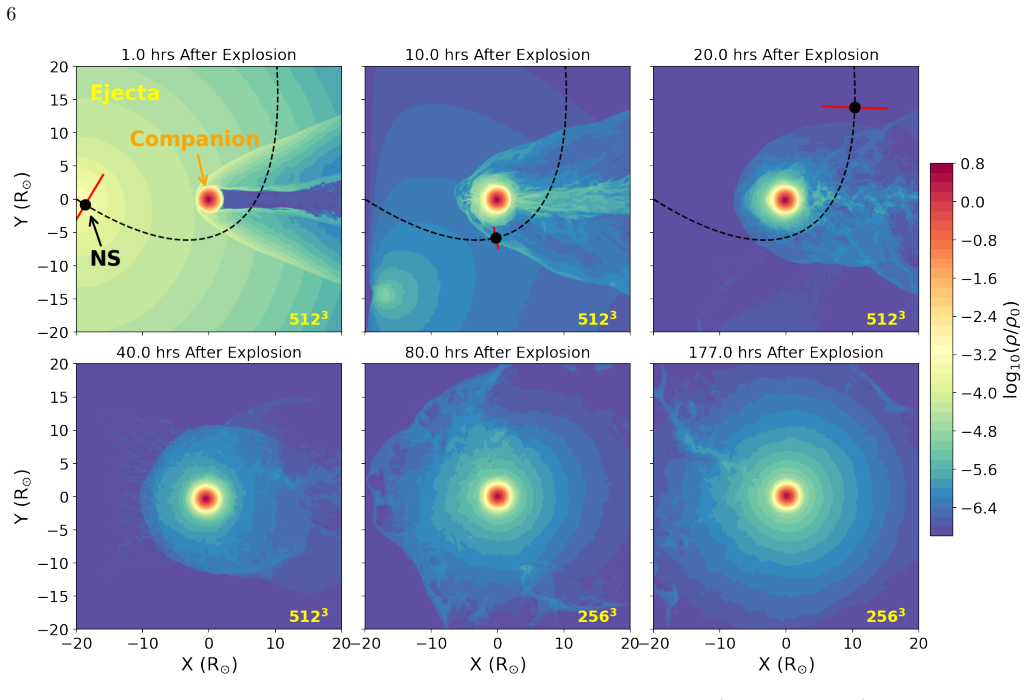
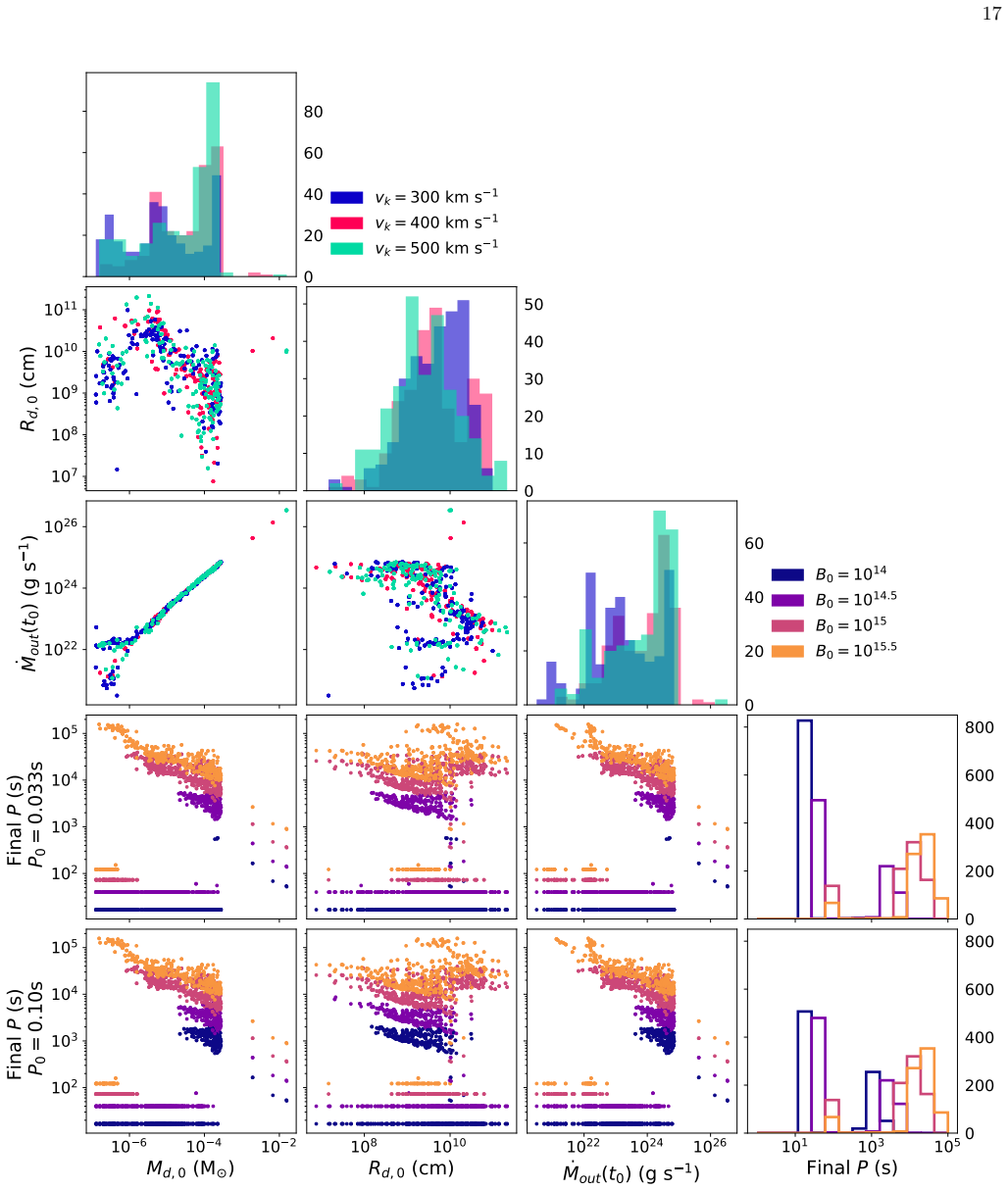
The central discovery is a new formation channel for accretion disks around isolated neutron stars: instead of supernova fallback, the disk is assembled from gas of the companion star that has been shock-inflated by the ejecta and then gravitationally captured by the moving neutron star through Bondi capture. The captured gas carries enough angular momentum from the envelope's density gradient to circularize into an extended disk with radii up to about $10^{11}$ cm and masses of $10^{-7}$ to $10^{-2}$ $M_\odot$. When the magnetosphere interacts with the disk and the inner disk rotates slower than the star's co-rotation radius, the star enters a propeller phase and is spun down on a short timescale to an equilibrium period $P_{\rm eq}\propto B^{6/7}\dot M^{-3/7}$. The resulting spin-period distribution is bimodal, and the ultra-long period mode ($P\gtrsim 10^3$ s) requires strong initial dipole fields $B_0\gtrsim 10^{14}$ G, with the longest periods ($10^4$-$10^5$ s) reached only for magnetar-like $B_0\sim 10^{15}$-$10^{16}$ G.
Load-bearing premise
The quantitative results are computed for a single pre-supernova configuration (20 solar radii separation, 4 solar mass companion), and the paper itself expects the disk fraction and ULP rate to depend strongly on the orbital separation, so the population-level predictions rest on that separation being typical.
Editorial extensions
If this is right
- Observed ULPs with no optical counterpart, such as GLEAM-J1627, GPM 1839-10, and ASKAP J1935+2148, can be interpreted as isolated neutron stars that passed through a propeller phase, provided their initial dipole fields were at least $10^{14}$ G.
- The spin-period distribution of radio pulsars should be bimodal, with a deficit of pulsars between about $10$ s and $10^3$ s, though a minority population near $10^2$ s appears for moderate fields ($10^{13}\lesssim B_0\lesssim 10^{14}$ G) and slow initial spin periods.
- Young ULPs (age $\lesssim 10$ kyr) should show large period derivatives ($10^{-9}\lesssim \dot P\lesssim 10^{-7}$) and a mid-infrared excess ($L_{\rm IR}\sim 10^{32}$ erg s$^{-1}$, $T\sim 250$ K) from an X-ray-heated disk, both fading once the disk evaporates.
- The Milky Way should host roughly $10$ to $10^3$ radio-bright ULPs with periods $\gtrsim 10^3$ s, placing the nearest such source possibly within a few hundred parsecs.
- If the neutron star remains bound rather than unbound, its repeated passages through the inflated envelope can inject energy periodically into the supernova ejecta, potentially explaining the 12.4-day modulation of SN 2022jli.
Reading between the lines
- The model's strong sensitivity to orbital separation implies that the observed ULP population could be used to constrain the pre-supernova separation distribution of stripped-envelope binaries, which is currently highly uncertain.
- The same shock-capture mechanism should apply to black holes or white dwarfs born in close binaries; extending the calculation to other compact remnants would predict whether they also acquire disks and spin down.
- The paper's post-processing Bondi-capture approach omits the neutron star's own gravity during the flythrough; a direct hydrodynamical simulation including the neutron star's potential would provide a sharper numerical test of the approximate 10% disk fraction.
Editorial analysis
A structured set of objections, weighed in public.
Referee Report
Summary. This paper proposes that isolated neutron stars can acquire accretion disks by passing through the shock-inflated envelope of a binary companion after a supernova, and that subsequent propeller-phase spin-down can spin the neutron star down to ultra-long periods. The authors run a 512^3 athena++ hydrodynamic simulation of one binary configuration (a_sep = 20 R_sun, M_C = 4 M_sun, M_ej = 5 M_sun), post-process Bondi capture for three kick speeds with isotropic directions, evolve the resulting disks with a one-zone irradiated-disk model, and compute neutron-star spin evolution under disk and magnetic torques with field decay. They find a disk-formation fraction of 8-10% around unbound neutron stars, a bimodal final period distribution, ULPs with P ~ 10^3-10^5 s for initial fields B0 >= 10^14 G (with slower initial spins needed at the lower end), and a fiducial Milky Way ULP formation rate of ~10^-4 yr^-1 (Eq. 30).
Significance. If the mechanism operates, it provides a qualitatively new source of debris disks around isolated neutron stars, complementary to supernova fallback, and yields concrete, falsifiable predictions: a bimodal period distribution, a B0-P correlation, detectable period derivatives of ~10^-9 to 10^-7 during a ~10 kyr equilibrium phase, mid-infrared disk emission with L_IR ~ 10^32 erg/s, and a predicted ULP count in the Milky Way. The paper's strengths include a resolved hydrodynamic simulation with a 256^3 convergence check, appendices testing the alpha-viscosity and field-decay prescriptions, and a spin-down calculation anchored to the standard equilibrium-period formula (Eq. 26) rather than fitted to ULP data. The central qualitative conclusion, that a short-lived propeller phase can rapidly spin a neutron star down to hour-long periods, is robust to several modeling choices. The quantitative population rate, however, is anchored to a single pre-supernova binary separation and to a few model choices that are not fully explored.
major comments (3)
- [Sec. 7.2; Eq. (30)] The headline Milky Way ULP formation rate of ~10^-4 yr^-1 is computed from one pre-supernova binary configuration (a_sep = 20 R_sun, M_C = 4 M_sun). The paper itself argues in Sec. 7.2 that the fractional outcome of ULPs should depend strongly on orbital separation because the ejecta ram pressure scales as a_sep^-3 and the solid angle subtended by the companion scales as a_sep^-2, and that pre-SN separations of stripped-envelope supernovae are highly uncertain. Since Eq. (30) multiplies the disk-formation fraction by the stripped-envelope SN rate and the magnetar fraction, a shift in the typical separation from 20 R_sun by a factor of two can plausibly change f_disk and hence N_ULP by an order of magnitude. The rate should either be accompanied by a survey of binary separations or be presented explicitly as a conditional, order-of-magnitude illustration of the mechanism rather than as a robust population prediction.
- [Sec. 4.1; Fig. 4] The fallback-removal procedure discards all capture data points for which the companion-less simulation and the full simulation agree in mass capture rate to within a factor of two, and no sensitivity test of this threshold is provided. The text states that the removed mass is of order 10^-2 M_sun, which is comparable to the upper end of the retained disk masses (10^-7 to 10^-2 M_sun), so the threshold choice can materially change the distribution of M_d,0 and hence which realizations enter the propeller phase. I recommend testing at least one alternative threshold (for example, a factor of three, or removing only data points before a fixed time) and reporting the effect on f_disk and f_ULP.
- [Abstract; Sec. 6.2; Table 3] The abstract's statement that ULPs are formed for B0 >= 10^14 G is not fully supported by Table 3 for the canonical initial spin period P0 = 0.033 s: at B0 = 10^14 G the maximum final period is about 5.8e2 s, below the 10^3 s ULP threshold. Periods above 10^3 s require B0 >= 10^14.5 G for P0 = 0.033 s, or B0 >= 10^14 G combined with P0 = 0.1 s. Because Eq. (30) adopts f_mag for B0 >= 10^14 G, the ULP rate may be overestimated if typical neutron-star birth spins are fast. The wording of the abstract and the rate estimate should be made consistent with this B0-P0 dependence.
minor comments (4)
- [Sec. 1] The text first states that ASKAP/DART-J1832 has radio polarization and spatial-coincidence evidence suggesting a neutron-star origin, then states that no ULP besides IE-1613 has yet been associated with a neutron star; this is internally inconsistent and should be reworded.
- [Abstract; Sec. 7.1] The term 'short ULPs' is used for PSR J0901-4046 with P = 76 s, which is below the paper's own ULP definition of P >= 10^3 s; a different term (e.g., 'intermediate-period pulsars') would avoid confusion.
- [Table 1] Several source names in Table 1 are truncated or inconsistent with the text, including 'PSR J0250+585' versus PSR J0250+5854 and 'ASKAP-J193' versus ASKAP J1935+2148; these should be corrected.
- [Sec. 4.1] The definition of the kick angle theta_k as 'the latitude angle away from the x-z plane, where theta is the polar angle from the y-axis' is confusing; a clearer geometric definition or a reference to Figure 3 in the text would help.
Circularity Check
No significant circularity: the spin-period predictions follow from hydrodynamically simulated disk masses and standard magnetospheric torque equations, with no observed ULP period used as a fitted input.
full rationale
The derivation chain is self-contained: (1) an Athena++ hydrodynamic simulation of the supernova ejecta interacting with a companion star (Sec. 3); (2) Bondi-capture post-processing that yields the captured disk mass and angular momentum for each kick realization (Sec. 4); (3) a one-zone viscous disk evolution model that produces the accretion rate Mdot(t) (Sec. 5); (4) integration of the NS spin under Ghosh-Lamb disk-magnetosphere torques, with Eq. 26 as the equilibrium limit r_A = r_co (Sec. 6); and (5) a population rate built from the simulated disk-formation fraction times independent Galactic supernova and magnetar fractions (Eq. 30). No observed ULP period is fitted or used to set any model parameter; observed periods appear only as comparison points in Figures 9-12 and Sec. 7.1. The bimodal period distribution is not imposed by definition: it follows from whether the system enters the propeller phase, which depends on the time-dependent ordering of r_A, r_co, and r_lc. The author self-citations (Wong et al. 2024 for the Athena++ code setup, Lu et al. 2022 for the B-field heating prescription) are not load-bearing: the hydro code is a public solver, the simulation is newly run for this paper, and Appendix D shows the final period distribution is insensitive to the field-decay model. The acknowledged limitation that the population rate rests on a single pre-supernova separation (Secs. 2 and 7.2) is a robustness concern, not circularity: adopting a different separation would change the input conditions, but the derivation does not presuppose its own output. I find no step that reduces to its own input by construction.
Assumptions & free parameters
free parameters (12)
- r_equil =
0.08 a_sep
- X-ray luminosity Lx =
1e35 erg/s
- Wind power-law exponent p =
0.5
- Disk assembly time t0 =
20 hr
- Disk truncation radius R_d,max =
3 AU
- Fallback removal threshold =
factor of 2
- Disk mass cutoff =
1e-7 M_sun
- Disk radius cutoff =
1e6 cm
- Kick velocities =
300, 400, 500 km/s
- Initial spin period P0 =
0.033 and 0.1 s
- Magnetar fraction f_mag =
10%
- Radio lifetime t_life =
1 Myr
assumptions (9)
- standard math Bondi-Hoyle capture formula (Eq. 1) with r_B = 2GM/(v_rel^2 + c_s^2)
- domain assumption The NS trajectory is determined only by the companion's gravity; gas dynamical friction and NS self-gravity are ignored.
- domain assumption Companion star is an n=3 polytrope and the gas obeys a gamma=5/3 ideal gas EOS.
- ad hoc to paper Adiabatic cooling of ejecta is modeled as U = KE * r_equil / r with r_equil = 0.08 a_sep.
- domain assumption The ULP sources considered are isolated neutron stars.
- ad hoc to paper Mass capture rate during disk assembly is M_d,0/t0 for t < t0, with t0 = 20 hr fixed for all kick angles.
- standard math Disk is one-zone, Keplerian, and vertically hydrostatic with alpha viscosity.
- domain assumption X-ray luminosity of the NS is constant at 1e35 erg/s and heats the disk surface.
- domain assumption Disk evaporates when its outer radius exceeds R_d,max = 3 AU, after which it no longer affects the NS spin.
Cite this review
Pith. "Pith review of Accretion from a Shock-Inflated Companion: Spinning Down Neutron Stars to Hour-Long Periods." pith.science (2026). https://pith.science/paper/X2YDA2OI
@misc{pith2026250710682,
  author       = {Pith},
  title        = {Pith review of: Accretion from a Shock-Inflated Companion: Spinning Down Neutron Stars to Hour-Long Periods},
  year         = {2026},
  howpublished = {\url{https://pith.science/paper/X2YDA2OI}},
  note         = {Machine review of arXiv:2507.10682}
}
abstract
Recent observations have unveiled a population of pulsars with spin periods of a few minutes to hours that lie beyond the traditional ``death line.'' If they originate from neutron stars (NSs), the existence of such ultra-long period pulsars (ULPs) challenges our current understanding of NS evolution and emission. In this work, we propose a new channel for disk formation based on NSs born in close binaries with main-sequence companion stars. Using a hydrodynamic simulation of supernova-companion interactions, we show that a newborn NS may gravitationally capture gas as it moves through the complex density field shaped by the explosion. For a binary separation of $20\rm~R_\odot$ and a companion mass of $4\rm~M_\odot$, we find the occurrence fraction for disk formation around unbound NSs to be $\sim10\%$. By modeling the disk evolution and its interaction with the NS, we find a bimodal distribution in spin periods: canonical pulsars with $P\lesssim10\rm\,s$ are the ones who lack disks or whose magnetospheres never interacted with the disk, and ULPs with $10^3\lesssim P<10^5\rm\,s$ are produced when the system undergoes a short-lived ``propeller'' phase during which the NS undergoes rapid spin-down. Such ULPs are formed under strong initial dipolar magnetic field strengths $B_0\gtrsim10^{14}\rm\,G$, with a formation rate of $10^{-4}\rm\,yr^{-1}$ in the Milky Way. We also find that a small population of pulsars with moderate magnetic field strengths ($10^{13}\lesssim~B_0\lesssim10^{14}\rm\,G$) and relatively slow initial periods ($P_0\gtrsim0.1\rm\,s$) evolve to $P\sim10^2\rm\,s$, filling the gap between the bimodal distribution. Thus, our model provides a unified explanation for pulsars beyond the ``death line.''
Figures


Figures from the paper (13 more)




Forward citations
Cited by 2 Pith papers
-
White dwarf + M dwarf Detached Binaries in Long Period Radio Transients: Observed Binary Parameters, Evolution, and Population Constraints
Two long period radio transients are detached white dwarf-M dwarf binaries with matching periods, massive cool crystallized white dwarfs, low inclinations, and an estimated population of 100-2000 such systems within 2 kpc.
-
Accretion from a shock-inflated companion: double-peaked supernova lightcurve with periodic modulations
The study proposes that accretion from a shock-inflated companion star powers the double-peaked, periodically modulated lightcurve of SN2022jli and predicts associated gamma-ray and neutrino emission.
Reference graph
Works this paper leans on
-
[1]
, " * write output.state after.block = add.period write newline
ENTRY address archivePrefix author booktitle chapter doi edition editor eprint howpublished institution journal key month number organization pages publisher school series title misctitle type volume year version url label extra.label sort.label short.list INTEGERS output.state before.all mid.sentence after.sentence after.block FUNCTION init.state.consts ...
-
[2]
write newline
" write newline "" before.all 'output.state := FUNCTION format.url url empty "" new.block "" url * "" * if FUNCTION format.eprint eprint empty "" archivePrefix empty "" archivePrefix "arXiv" = new.block " " eprint * " " * new.block " " eprint * " " * if if if FUNCTION format.doi doi empty "" " " doi * " " * if FUNCTION format.pid doi empty eprint empty ur...
-
[3]
thebibliography [1] 20pt to REFERENCES 6pt =0pt \@twocolumntrue 12pt -12pt 10pt plus 3pt =0pt =0pt =1pt plus 1pt =0pt =0pt -12pt =13pt plus 1pt =20pt =13pt plus 1pt \@M =10000 =-1.0em =0pt =0pt 0pt =0pt =1.0em @enumiv\@empty 10000 10000 `\.\@m \@noitemerr \@latex@warning Empty `thebibliography' environment \@ifnextchar \@reference \@latexerr Missing key o...
arXiv 2017
-
[4]
Aguilera , D. N., Pons , J. A., & Miralles , J. A. 2008, title The Impact of Magnetic Field on the Thermal Evolution of Neutron Stars , , 673, L167, 10.1086/527547
doi:10.1086/527547 2008
-
[5]
A., C al s kan , S ., & Ertan , \"U
Alpar , M. A., C al s kan , S ., & Ertan , \"U . 2013, title Fallback Disks, Magnetars and Other Neutron Stars , in IAU Symposium, Vol. 290, Feeding Compact Objects: Accretion on All Scales, ed. C. M. Zhang , T. Belloni , M. M \'e ndez , & S. N. Zhang , 93--100, 10.1017/S1743921312019291
-
[6]
Barbarino , C., Sollerman , J., Taddia , F., et al. 2021, title Type Ic supernovae from the (intermediate) Palomar Transient Factory , , 651, A81, 10.1051/0004-6361/202038890
-
[7]
Bauer, E. B., White, C. J., & Bildsten, L. 2019, title Remnants of Subdwarf Helium Donor Stars Ejected from Close Binaries with Thermonuclear Supernovae, The Astrophysical Journal, 887, 68, 10.3847/1538-4357/ab4ea4
-
[8]
Begelman , M. C., McKee , C. F., & Shields , G. A. 1983, title Compton heated winds and coronae above accretion disks. I. Dynamics. , , 271, 70, 10.1086/161178
doi:10.1086/161178 1983
Show all 144 references
-
[9]
2019, title Formation rates and evolution histories of magnetars , , 487, 1426, 10.1093/mnras/stz1391
Beniamini , P., Hotokezaka , K., van der Horst , A., & Kouveliotou , C. 2019, title Formation rates and evolution histories of magnetars , , 487, 1426, 10.1093/mnras/stz1391
2019 doi
-
[10]
2023, title Evidence for an abundant old population of Galactic ultra-long period magnetars and implications for fast radio bursts , , 520, 1872, 10.1093/mnras/stad208
Beniamini , P., Wadiasingh , Z., Hare , J., et al. 2023, title Evidence for an abundant old population of Galactic ultra-long period magnetars and implications for fast radio bursts , , 520, 1872, 10.1093/mnras/stad208
2023 doi
-
[11]
D., & Begelman , M
Blandford , R. D., & Begelman , M. C. 1999, title On the fate of gas accreting at a low rate on to a black hole , , 303, L1, 10.1046/j.1365-8711.1999.02358.x
1999
-
[12]
1952, title On spherically symmetrical accretion , , 112, 195, 10.1093/mnras/112.2.195
Bondi , H. 1952, title On spherically symmetrical accretion , , 112, 195, 10.1093/mnras/112.2.195
1952 doi
-
[13]
1944, title On the mechanism of accretion by stars , , 104, 273, 10.1093/mnras/104.5.273
Bondi , H., & Hoyle , F. 1944, title On the mechanism of accretion by stars , , 104, 273, 10.1093/mnras/104.5.273
1944 doi
-
[14]
2022, title Discovery of a radio-emitting neutron star with an ultra-long spin period of 76 s , Nature Astronomy, 6, 828, 10.1038/s41550-022-01688-x
Caleb , M., Heywood , I., Rajwade , K., et al. 2022, title Discovery of a radio-emitting neutron star with an ultra-long spin period of 76 s , Nature Astronomy, 6, 828, 10.1038/s41550-022-01688-x
2022 doi
-
[15]
L., et al
Caleb , M., Lenc , E., Kaplan , D. L., et al. 2024, title An emission-state-switching radio transient with a 54-minute period , Nature Astronomy, 10.1038/s41550-024-02277-w
2024 doi
-
[16]
M., Halpern , J
Camilo , F., Ransom , S. M., Halpern , J. P., et al. 2006, title Transient pulsed radio emission from a magnetar , , 442, 892, 10.1038/nature04986
2006 doi
-
[17]
2023, title Exploring the Observability of Surviving Companions of Stripped-envelope Supernovae: A Case Study of Type Ic SN 2020oi , , 949, 121, 10.3847/1538-4357/acc9af
Chen , H.-P., Rau , S.-J., & Pan , K.-C. 2023, title Exploring the Observability of Surviving Companions of Stripped-envelope Supernovae: A Case Study of Type Ic SN 2020oi , , 949, 121, 10.3847/1538-4357/acc9af
2023 doi
-
[18]
1993, title Pulsar Death Lines and Death Valley , , 402, 264, 10.1086/172129
Chen , K., & Ruderman , M. 1993, title Pulsar Death Lines and Death Valley , , 402, 264, 10.1086/172129
1993 doi
-
[19]
2024, title A 12.4-day periodicity in a close binary system after a supernova , , 625, 253, 10.1038/s41586-023-06787-x
Chen , P., Gal-Yam , A., Sollerman , J., et al. 2024, title A 12.4-day periodicity in a close binary system after a supernova , , 625, 253, 10.1038/s41586-023-06787-x
2024 doi
-
[20]
A., & Soker , N
Chevalier , R. A., & Soker , N. 1989, title Asymmetric Envelope Expansion of Supernova 1987A , , 341, 867, 10.1086/167545
1989 doi
-
[21]
I., & Goldreich , P
Chiang , E. I., & Goldreich , P. 1997, title Spectral Energy Distributions of T Tauri Stars with Passive Circumstellar Disks , , 490, 368, 10.1086/304869
1997 doi
-
[22]
S., Su , K.-Y., Narayan , R., & Natarajan , P
Cho , H., Prather , B. S., Su , K.-Y., Narayan , R., & Natarajan , P. 2024, title Multizone Modeling of Black Hole Accretion and Feedback in 3D GRMHD: Bridging Vast Spatial and Temporal Scales , , 977, 200, 10.3847/1538-4357/ad9561
2024 doi
-
[23]
A., Levan , A
Chrimes , A. A., Levan , A. J., Fruchter , A. S., et al. 2022, title Where are the magnetar binary companions? Candidates from a comparison with binary population synthesis predictions , , 513, 3550, 10.1093/mnras/stac1090
2022 doi
-
[24]
Coleman , M. S. B., Blaes , O., Hirose , S., & Hauschildt , P. H. 2018, title Convection Enhances Magnetic Turbulence in AM CVn Accretion Disks , , 857, 52, 10.3847/1538-4357/aab6a7
2018 doi
-
[25]
Davidson , K., & Ostriker , J. P. 1973, title Neutron-Star Accretion in a Stellar Wind: Model for a Pulsed X-Ray Source , , 179, 585, 10.1086/151897
1973 doi
-
[26]
A., Mereghetti , S., Tiengo , A., & Bignami , G
De Luca , A., Caraveo , P. A., Mereghetti , S., Tiengo , A., & Bignami , G. F. 2006, title A Long-Period, Violently Variable X-ray Source in a Young Supernova Remnant , Science, 313, 814, 10.1126/science.1129185
2006 doi
-
[27]
M., Bassa , C
de Ruiter , I., Rajwade , K. M., Bassa , C. G., et al. 2024, title A white dwarf binary showing sporadic radio pulses at the orbital period , arXiv e-prints, arXiv:2408.11536, 10.48550/arXiv.2408.11536
2024 doi
- [28]
-
[29]
R., Soderberg , A
Drout , M. R., Soderberg , A. M., Gal-Yam , A., et al. 2011, title The First Systematic Study of Type Ibc Supernova Multi-band Light Curves , , 741, 97, 10.1088/0004-637X/741/2/97
2011 doi
-
[30]
2013, title Stellar Multiplicity , , 51, 269, 10.1146/annurev-astro-081710-102602
Duch \^e ne , G., & Kraus , A. 2013, title Stellar Multiplicity , , 51, 269, 10.1146/annurev-astro-081710-102602
2013 doi
-
[31]
Y., Hernquist , L., & Narayan , R
Ek s i , K. Y., Hernquist , L., & Narayan , R. 2005, title Where Are All the Fallback Disks? Constraints on Propeller Systems , , 623, L41, 10.1086/429915
2005 doi
-
[32]
J., Fraser , M., Smartt , S
Eldridge , J. J., Fraser , M., Smartt , S. J., Maund , J. R., & Crockett , R. M. 2013, title The death of massive stars - II. Observational constraints on the progenitors of Type Ibc supernovae , , 436, 774, 10.1093/mnras/stt1612
2013 doi
-
[33]
Enoto , T., Sasano , M., Yamada , S., et al. 2014, title Spectral and Timing Nature of the Symbiotic X-Ray Binary 4U 1954+319: The Slowest Rotating Neutron Star in an X-Ray Binary System , , 786, 127, 10.1088/0004-637X/786/2/127
2014 doi
-
[34]
Y., Erkut , M
Ertan , \"U ., Ek s i , K. Y., Erkut , M. H., & Alpar , M. A. 2009, title On the Evolution of Anomalous X-ray Pulsars and Soft Gamma-ray Repeaters with Fall Back Disks , , 702, 1309, 10.1088/0004-637X/702/2/1309
2009 doi
-
[35]
H., Ek s i , K
Ertan , \"U ., Erkut , M. H., Ek s i , K. Y., & Alpar , M. A. 2007, title The Anomalous X-Ray Pulsar 4U 0142+61: A Neutron Star with a Gaseous Fallback Disk , , 657, 441, 10.1086/510303
2007 doi
-
[36]
E., Sukhbold , T., & Janka , H
Ertl , T., Woosley , S. E., Sukhbold , T., & Janka , H. T. 2020, title The Explosion of Helium Stars Evolved with Mass Loss , , 890, 51, 10.3847/1538-4357/ab6458
2020 doi
-
[37]
2019, title Long X-ray flares from the central source in RCW 103
Esposito , P., De Luca , A., Turolla , R., et al. 2019, title Long X-ray flares from the central source in RCW 103. XMM-Newton and VLT observations in the aftermath of the 2016 outburst , , 626, A19, 10.1051/0004-6361/201935412
2019 doi
-
[38]
2024, title Evolutionary Origin of Ultralong-period Radio Transients , , 967, 24, 10.3847/1538-4357/ad3aef
Fan , Y.-N., Xu , K., & Chen , W.-C. 2024, title Evolutionary Origin of Ultralong-period Radio Transients , , 967, 24, 10.3847/1538-4357/ad3aef
2024 doi
-
[39]
W., Alexander , D
Ferguson , J. W., Alexander , D. R., Allard , F., et al. 2005, title Low-Temperature Opacities , , 623, 585, 10.1086/428642
2005 doi
-
[40]
2002, Accretion Power in Astrophysics: Third Edition (Cambridge, UK: Cambridge University Press)
Frank, J., & King, A. 2002, Accretion Power in Astrophysics: Third Edition (Cambridge, UK: Cambridge University Press)
2002
-
[41]
2022, title The spins of compact objects born from helium stars in binary systems , , 511, 3951, 10.1093/mnras/stac317
Fuller , J., & Lu , W. 2022, title The spins of compact objects born from helium stars in binary systems , , 511, 3951, 10.1093/mnras/stac317
2022 doi
-
[42]
D., et al
Gagliano , A., Izzo , L., Kilpatrick , C. D., et al. 2022, title An Early-time Optical and Ultraviolet Excess in the Type-Ic SN 2020oi , , 924, 55, 10.3847/1538-4357/ac35ec
2022 doi
-
[43]
A., Ertan , \"U ., & Alpar , M
Gen c ali , A. A., Ertan , \"U ., & Alpar , M. A. 2022, title Evolution of the long-period pulsar GLEAM-X J162759.5-523504.3 , , 513, L68, 10.1093/mnrasl/slac034
2022 doi
-
[44]
A., Ertan , \"U ., & Alpar , M
Gen c ali , A. A., Ertan , \"U ., & Alpar , M. A. 2023, title Evolution of the long-period pulsar PSR J0901-4046 , , 520, L11, 10.1093/mnrasl/slac164
2023 doi
-
[45]
Ghosh , P., & Lamb , F. K. 1978, title Disk accretion by magnetic neutron stars. , , 223, L83, 10.1086/182734
1978 doi
-
[46]
2007, title The birthrate of magnetars , , 381, 52, 10.1111/j.1365-2966.2007.12254.x
Gill , R., & Heyl , J. 2007, title The birthrate of magnetars , , 381, 52, 10.1111/j.1365-2966.2007.12254.x
2007
-
[47]
1992, title Magnetic Field Decay in Isolated Neutron Stars , , 395, 250, 10.1086/171646
Goldreich , P., & Reisenegger , A. 1992, title Magnetic Field Decay in Isolated Neutron Stars , , 395, 250, 10.1086/171646
1992 doi
-
[48]
H., Pethick , C
Gudmundsson , E. H., Pethick , C. J., & Epstein , R. I. 1982, title Neutron star envelopes , , 259, L19, 10.1086/183840
1982 doi
-
[49]
M., Quataert , E., & Kim , C.-G
Guo , M., Stone , J. M., Quataert , E., & Kim , C.-G. 2024, title Magnetized Accretion onto and Feedback from Supermassive Black Holes in Elliptical Galaxies , , 973, 141, 10.3847/1538-4357/ad5fe7
2024 doi
-
[50]
1998, title Accretion disc outbursts: a new version of an old model , , 298, 1048, 10.1046/j.1365-8711.1998.01773.x
Hameury , J.-M., Menou , K., Dubus , G., Lasota , J.-P., & Hure , J.-M. 1998, title Accretion disc outbursts: a new version of an old model , , 298, 1048, 10.1046/j.1365-8711.1998.01773.x
1998
-
[51]
L., Wang , C., Wang , P
Han , J. L., Wang , C., Wang , P. F., et al. 2021, title The FAST Galactic Plane Pulsar Snapshot survey: I. Project design and pulsar discoveries , Research in Astronomy and Astrophysics, 21, 107, 10.1088/1674-4527/21/5/107
2021 doi
-
[52]
G., Posselt , B., et al
Hare , J., Pavlov , G. G., Posselt , B., et al. 2024, title Probing the Spectrum of the Magnetar 4U 0142+61 with JWST , , 972, 176, 10.3847/1538-4357/ad5ce5
2024 doi
-
[53]
R., Millman , K
Harris , C. R., Millman , K. J., van der Walt , S. J., et al. 2020, title Array programming with NumPy , , 585, 357, 10.1038/s41586-020-2649-2
2020 doi
-
[54]
H., Lebzelter , T., Fekel , F
Hinkle , K. H., Lebzelter , T., Fekel , F. C., et al. 2020, title The M Supergiant High-mass X-Ray Binary 4U 1954+31 , , 904, 143, 10.3847/1538-4357/abbe01
2020 doi
-
[55]
Hirai , R., & Podsiadlowski , P. 2022, title Neutron stars colliding with binary companions: formation of hypervelocity stars, pulsar planets, bumpy superluminous supernovae and Thorne- \.Z ytkow objects , , 517, 4544, 10.1093/mnras/stac3007
2022 doi
-
[56]
2018, title Comprehensive Study of Ejecta-companion Interaction for Core-collapse Supernovae in Massive Binaries , , 864, 119, 10.3847/1538-4357/aad6a0
Hirai , R., Podsiadlowski , P., & Yamada , S. 2018, title Comprehensive Study of Ejecta-companion Interaction for Core-collapse Supernovae in Massive Binaries , , 864, 119, 10.3847/1538-4357/aad6a0
2018 doi
-
[57]
2014, title The Outcome of Supernovae in Massive Binaries; Removed Mass, and its Separation Dependence , , 792, 66, 10.1088/0004-637X/792/1/66
Hirai , R., Sawai , H., & Yamada , S. 2014, title The Outcome of Supernovae in Massive Binaries; Removed Mass, and its Separation Dependence , , 792, 66, 10.1088/0004-637X/792/1/66
2014 doi
-
[58]
Ho , W. C. G., & Andersson , N. 2017, title Ejector and propeller spin-down: how might a superluminous supernova millisecond magnetar become the 6.67 h pulsar in RCW 103 , , 464, L65, 10.1093/mnrasl/slw186
2017 doi
-
[59]
R., Lyne , A
Hobbs , G., Lorimer , D. R., Lyne , A. G., & Kramer , M. 2005, title A statistical study of 233 pulsar proper motions , , 360, 974, 10.1111/j.1365-2966.2005.09087.x
2005
-
[60]
H., & Kulkarni , S
Hulleman , F., van Kerkwijk , M. H., & Kulkarni , S. R. 2004, title The Anomalous X-ray Pulsar 4U 0142+61: Variability in the infrared and a spectral break in the optical , , 416, 1037, 10.1051/0004-6361:20031756
2004 doi
-
[61]
Hunter, J. D. 2007, title Matplotlib: A 2D graphics environment, Computing in Science & Engineering, 9, 90, 10.1109/MCSE.2007.55
2007 doi
-
[62]
2022, title A radio transient with unusually slow periodic emission , , 601, 526, 10.1038/s41586-021-04272-x
Hurley-Walker , N., Zhang , X., Bahramian , A., et al. 2022, title A radio transient with unusually slow periodic emission , , 601, 526, 10.1038/s41586-021-04272-x
2022 doi
-
[63]
J., et al
Hurley-Walker , N., Rea , N., McSweeney , S. J., et al. 2023, title A long-period radio transient active for three decades , , 619, 487, 10.1038/s41586-023-06202-5
2023 doi
-
[64]
J., Bahramian , A., et al
Hurley-Walker , N., McSweeney , S. J., Bahramian , A., et al. 2024, title A 2.9 hr Periodic Radio Transient with an Optical Counterpart , , 976, L21, 10.3847/2041-8213/ad890e
2024 doi
-
[65]
1992, title Time Evolution of the Accretion Disk Radius in a Dwarf Nova , , 44, 15
Ichikawa , S., & Osaki , Y. 1992, title Time Evolution of the Accretion Disk Radius in a Dwarf Nova , , 44, 15
1992
-
[66]
A., & Rogers , F
Iglesias , C. A., & Rogers , F. J. 1996, title Updated Opal Opacities , , 464, 943, 10.1086/177381
1996 doi
-
[67]
P., & Popov , S
Igoshev , A. P., & Popov , S. B. 2018, title Is PSR J0250+5854 at the Hall Attractor Stage? , Research Notes of the American Astronomical Society, 2, 171, 10.3847/2515-5172/aae207
2018 doi
-
[68]
2005, title Self-sustained Ionization and Vanishing Dead Zones in Protoplanetary Disks , , 628, L155, 10.1086/432796
Inutsuka , S.-i., & Sano , T. 2005, title Self-sustained Ionization and Vanishing Dead Zones in Protoplanetary Disks , , 628, L155, 10.1086/432796
2005 doi
-
[69]
L., Burgay , M., Rea , N., et al
Israel , G. L., Burgay , M., Rea , N., et al. 2021, title X-Ray and Radio Bursts from the Magnetar 1E 1547.0-5408 , , 907, 7, 10.3847/1538-4357/abca95
2021 doi
-
[70]
2022, title Supernova Fallback as Origin of Neutron Star Spins and Spin-kick Alignment , , 926, 9, 10.3847/1538-4357/ac403c
Janka , H.-T., Wongwathanarat , A., & Kramer , M. 2022, title Supernova Fallback as Origin of Neutron Star Spins and Spin-kick Alignment , , 926, 9, 10.3847/1538-4357/ac403c
2022 doi
-
[71]
L., Chakrabarty , D., Wang , Z., & Wachter , S
Kaplan , D. L., Chakrabarty , D., Wang , Z., & Wachter , S. 2009, title A Mid-Infrared Counterpart to the Magnetar 1E 2259+586 , , 700, 149, 10.1088/0004-637X/700/1/149
2009 doi
-
[72]
2010, title SEEING THE COLLISION OF A SUPERNOVA WITH ITS COMPANION STAR, The Astrophysical Journal, 708, 1025, 10.1088/0004-637X/708/2/1025
Kasen, D. 2010, title SEEING THE COLLISION OF A SUPERNOVA WITH ITS COMPANION STAR, The Astrophysical Journal, 708, 1025, 10.1088/0004-637X/708/2/1025
2010 doi
-
[73]
M., & Beloborodov , A
Kaspi , V. M., & Beloborodov , A. M. 2017, title Magnetars , , 55, 261, 10.1146/annurev-astro-081915-023329
2017 doi
-
[74]
Katz , J. I. 2022, title GLEAM-X J162759.5 - 523504.3 as a white dwarf pulsar , , 367, 108, 10.1007/s10509-022-04146-2
2022 doi
-
[75]
F., & Kramer , M
Keane , E. F., & Kramer , M. 2008, title On the birthrates of Galactic neutron stars , , 391, 2009, 10.1111/j.1365-2966.2008.14045.x
2008
-
[76]
F., Tong , H., Xu , R
Kou , F. F., Tong , H., Xu , R. X., & Zhou , X. 2019, title Rotational Evolution of the Slowest Radio Pulsar, PSR J0250+5854 , , 876, 131, 10.3847/1538-4357/ab17da
2019 doi
-
[77]
2012, title Presupernova Evolution of Massive Single and Binary Stars , , 50, 107, 10.1146/annurev-astro-081811-125534
Langer , N. 2012, title Presupernova Evolution of Massive Single and Binary Stars , , 50, 107, 10.1146/annurev-astro-081811-125534
2012 doi
-
[78]
Lazarus , P., Brazier , A., Hessels , J. W. T., et al. 2015, title Arecibo Pulsar Survey Using ALFA. IV. Mock Spectrometer Data Analysis, Survey Sensitivity, and the Discovery of 40 Pulsars , , 812, 81, 10.1088/0004-637X/812/1/81
2015 doi
-
[79]
2010, title A Radio-loud Magnetar in X-ray Quiescence , , 721, L33, 10.1088/2041-8205/721/1/L33
Levin , L., Bailes , M., Bates , S., et al. 2010, title A Radio-loud Magnetar in X-ray Quiescence , , 721, L33, 10.1088/2041-8205/721/1/L33
2010 doi
-
[80]
2024, title A 44-minute periodic radio transient in a supernova remnant , arXiv e-prints, arXiv:2411.15739, 10.48550/arXiv.2411.15739
Li , D., Yuan , M., Wu , L., et al. 2024, title A 44-minute periodic radio transient in a supernova remnant , arXiv e-prints, arXiv:2411.15739, 10.48550/arXiv.2411.15739
2024 doi
-
[82]
Lin , D. N. C., Woosley , S. E., & Bodenheimer , P. H. 1991, title Formation of a planet orbiting pulsar 1829-10 from the debris of a supernova explosion , , 353, 827, 10.1038/353827a0
1991 doi
-
[83]
M., R \"o pke , F
Liu , Z.-W., Tauris , T. M., R \"o pke , F. K., et al. 2015, title The interaction of core-collapse supernova ejecta with a companion star , , 584, A11, 10.1051/0004-6361/201526757
2015 doi
-
[84]
2022, title A Hot Subdwarf Model for the 18.18 minutes Pulsar GLEAM-X , Research Notes of the American Astronomical Society, 6, 27, 10.3847/2515-5172/ac52f1
Loeb , A., & Maoz , D. 2022, title A Hot Subdwarf Model for the 18.18 minutes Pulsar GLEAM-X , Research Notes of the American Astronomical Society, 6, 27, 10.3847/2515-5172/ac52f1
2022 doi
-
[85]
2022, title Implications of a rapidly varying FRB in a globular cluster of M81 , , 510, 1867, 10.1093/mnras/stab3500
Lu , W., Beniamini , P., & Kumar , P. 2022, title Implications of a rapidly varying FRB in a globular cluster of M81 , , 510, 1867, 10.1093/mnras/stab3500
2022 doi
-
[86]
D., Bersier , D., James , P
Lyman , J. D., Bersier , D., James , P. A., et al. 2016, title Bolometric light curves and explosion parameters of 38 stripped-envelope core-collapse supernovae , , 457, 328, 10.1093/mnras/stv2983
2016 doi
-
[87]
N., Hobbs , G
Manchester , R. N., Hobbs , G. B., Teoh , A., & Hobbs , M. 2005, title The Australia Telescope National Facility Pulsar Catalogue , , 129, 1993, 10.1086/428488
2005 doi
-
[88]
2025, A binary origin of ultra-long period radio pulsars, 2507.00946
Mao, Y.-H., Li, X.-D., Lai, D., Deng, Z.-L., & Yang, H.-R. 2025, A binary origin of ultra-long period radio pulsars, 2507.00946
2025 arXiv
-
[89]
R., Stanway , E
Marcote , B., Marsh , T. R., Stanway , E. R., Paragi , Z., & Blanchard , J. M. 2017, title Towards the origin of the radio emission in AR Scorpii, the first radio-pulsing white dwarf binary , , 601, L7, 10.1051/0004-6361/201730948
2017 doi
-
[90]
a nsicke , B. T., H \
Marsh , T. R., G \"a nsicke , B. T., H \"u mmerich , S., et al. 2016, title A radio-pulsing white dwarf binary star , , 537, 374, 10.1038/nature18620
2016 doi
-
[91]
D., Beniamini , P., & Giannios , D
Metzger , B. D., Beniamini , P., & Giannios , D. 2018, title Effects of Fallback Accretion on Protomagnetar Outflows in Gamma-Ray Bursts and Superluminous Supernovae , , 857, 95, 10.3847/1538-4357/aab70c
2018 doi
-
[92]
Michel , F. C. 1988, title Neutron star disk formation from supernova fall-back and possible observational consequences , , 333, 644, 10.1038/333644a0
1988 doi
-
[93]
Noutsos , A., Schnitzeler , D. H. F. M., Keane , E. F., Kramer , M., & Johnston , S. 2013, title Pulsar spin-velocity alignment: kinematic ages, birth periods and braking indices , , 430, 2281, 10.1093/mnras/stt047
2013 doi
- [94]
-
[95]
2021, title Observability of inflated companion stars after supernovae in massive binaries , , 505, 2485, 10.1093/mnras/stab1439
Ogata , M., Hirai , R., & Hijikawa , K. 2021, title Observability of inflated companion stars after supernovae in massive binaries , , 505, 2485, 10.1093/mnras/stab1439
2021 doi
-
[96]
A., & Kaspi , V
Olausen , S. A., & Kaspi , V. M. 2014, title The McGill Magnetar Catalog , , 212, 6, 10.1088/0067-0049/212/1/6
2014 doi
-
[98]
M., Prakash , M., & Steiner , A
Page , D., Lattimer , J. M., Prakash , M., & Steiner , A. W. 2004, title Minimal Cooling of Neutron Stars: A New Paradigm , , 155, 623, 10.1086/424844
2004 doi
-
[99]
Parfrey , K., Spitkovsky , A., & Beloborodov , A. M. 2016, title Torque Enhancement, Spin Equilibrium, and Jet Power from Disk-Induced Opening of Pulsar Magnetic Fields , , 822, 33, 10.3847/0004-637X/822/1/33
2016 doi
-
[100]
R., Buckley , D
Pelisoli , I., Marsh , T. R., Buckley , D. A. H., et al. 2023, title A 5.3-min-period pulsing white dwarf in a binary detected from radio to X-rays , Nature Astronomy, 7, 931, 10.1038/s41550-023-01995-x
2023 doi
-
[101]
Perna , R., Duffell , P., Cantiello , M., & MacFadyen , A. I. 2014, title The Fate of Fallback Matter around Newly Born Compact Objects , , 781, 119, 10.1088/0004-637X/781/2/119
2014 doi
-
[102]
2000, title Emission Spectra of Fallback Disks around Young Neutron Stars , , 541, 344, 10.1086/309404
Perna , R., Hernquist , L., & Narayan , R. 2000, title Emission Spectra of Fallback Disks around Young Neutron Stars , , 541, 344, 10.1086/309404
2000 doi
-
[103]
S., & Hansen , B
Phinney , E. S., & Hansen , B. M. S. 1993, title The pulsar planet production process. , in Astronomical Society of the Pacific Conference Series, Vol. 36, Planets Around Pulsars, ed. J. A. Phillips , S. E. Thorsett , & S. R. Kulkarni , 371--390
1993
-
[104]
L., & Ott , C
Piro , A. L., & Ott , C. D. 2011, title Supernova Fallback onto Magnetars and Propeller-powered Supernovae , , 736, 108, 10.1088/0004-637X/736/2/108
2011 doi
-
[105]
C., & Hsu , J
Podsiadlowski , P., Joss , P. C., & Hsu , J. J. L. 1992, title Presupernova Evolution in Massive Interacting Binaries , , 391, 246, 10.1086/171341
1992 doi
-
[106]
A., & Geppert , U
Pons , J. A., & Geppert , U. 2007, title Magnetic field dissipation in neutron star crusts: from magnetars to isolated neutron stars , , 470, 303, 10.1051/0004-6361:20077456
2007 doi
-
[107]
B., & Turolla , R
Popov , S. B., & Turolla , R. 2012, title Initial spin periods of neutron stars in supernova remnants , , 341, 457, 10.1007/s10509-012-1100-z
2012 doi
-
[109]
J., Ashall , C., James , P
Prentice , S. J., Ashall , C., James , P. A., et al. 2019, title Investigating the properties of stripped-envelope supernovae; what are the implications for their progenitors? , , 485, 1559, 10.1093/mnras/sty3399
2019 doi
-
[110]
2024, title Magnetic Interactions in White Dwarf Binaries as Mechanism for Long-Period Radio Transients , arXiv e-prints, arXiv:2409.05978, 10.48550/arXiv.2409.05978
Qu , Y., & Zhang , B. 2024, title Magnetic Interactions in White Dwarf Binaries as Mechanism for Long-Period Radio Transients , arXiv e-prints, arXiv:2409.05978, 10.48550/arXiv.2409.05978
-
[111]
A., Henry , T
Raghavan , D., McAlister , H. A., Henry , T. J., et al. 2010, title A Survey of Stellar Families: Multiplicity of Solar-type Stars , , 190, 1, 10.1088/0067-0049/190/1/1
2010 doi
- [112]
- [113]
-
[114]
2022, title Long-period Pulsars as Possible Outcomes of Supernova Fallback Accretion , , 934, 184, 10.3847/1538-4357/ac7cec
Ronchi , M., Rea , N., Graber , V., & Hurley-Walker , N. 2022, title Long-period Pulsars as Possible Outcomes of Supernova Fallback Accretion , , 934, 184, 10.3847/1538-4357/ac7cec
2022 doi
-
[115]
E., de Koter , A., et al
Sana , H., de Mink , S. E., de Koter , A., et al. 2012, title Binary Interaction Dominates the Evolution of Massive Stars , Science, 337, 444, 10.1126/science.1223344
2012 doi
-
[116]
E., et al
Sana , H., de Koter , A., de Mink , S. E., et al. 2013, title The VLT-FLAMES Tarantula Survey. VIII. Multiplicity properties of the O-type star population , , 550, A107, 10.1051/0004-6361/201219621
2013 doi
-
[117]
I., & Sunyaev , R
Shakura , N. I., & Sunyaev , R. A. 1973, title Black holes in binary systems. Observational appearance. , , 24, 337
1973
-
[118]
L., & Teukolsky , S
Shapiro , S. L., & Teukolsky , S. A. 1983, Black holes, white dwarfs and neutron stars. The physics of compact objects , 10.1002/9783527617661
1983 doi
-
[119]
Shen , R.-F., & Matzner , C. D. 2014, title Evolution of Accretion Disks in Tidal Disruption Events , , 784, 87, 10.1088/0004-637X/784/2/87
2014 doi
-
[120]
Shivvers , I., Modjaz , M., Zheng , W., et al. 2017, title Revisiting the Lick Observatory Supernova Search Volume-limited Sample: Updated Classifications and Revised Stripped-envelope Supernova Fractions , , 129, 054201, 10.1088/1538-3873/aa54a6
2017 doi
-
[121]
Smartt , S. J. 2015, title Observational Constraints on the Progenitors of Core-Collapse Supernovae: The Case for Missing High-Mass Stars , , 32, e016, 10.1017/pasa.2015.17
2015 doi
-
[122]
V., & Chornock , R
Smith , N., Li , W., Filippenko , A. V., & Chornock , R. 2011, title Observed fractions of core-collapse supernova types and initial masses of their single and binary progenitor stars , , 412, 1522, 10.1111/j.1365-2966.2011.17229.x
2011
-
[123]
E., & Rosner , R
Stella , L., White , N. E., & Rosner , R. 1986, title Intermittent Stellar Wind Acceleration and the Long-Term Activity of Population I Binary Systems Containing an X-Ray Pulsar , , 308, 669, 10.1086/164538
1986 doi
-
[124]
M., Tomida , K., White , C
Stone , J. M., Tomida , K., White , C. J., & Felker , K. G. 2020, title The Athena++ Adaptive Mesh Refinement Framework: Design and Magnetohydrodynamic Solvers , , 249, 4, 10.3847/1538-4365/ab929b
2020 doi
-
[125]
2015, title Early-time light curves of Type Ib/c supernovae from the SDSS-II Supernova Survey , , 574, A60, 10.1051/0004-6361/201423915
Taddia , F., Sollerman , J., Leloudas , G., et al. 2015, title Early-time light curves of Type Ib/c supernovae from the SDSS-II Supernova Survey , , 574, A60, 10.1051/0004-6361/201423915
2015 doi
-
[126]
D., Bersten , M., et al
Taddia , F., Stritzinger , M. D., Bersten , M., et al. 2018, title The Carnegie Supernova Project I. Analysis of stripped-envelope supernova light curves , , 609, A136, 10.1051/0004-6361/201730844
2018 doi
-
[127]
M., Bassa , C
Tan , C. M., Bassa , C. G., Cooper , S., et al. 2018, title LOFAR Discovery of a 23.5 s Radio Pulsar , , 866, 54, 10.3847/1538-4357/aade88
2018 doi
-
[128]
P., Kaspi , V
Tendulkar , S. P., Kaspi , V. M., Archibald , R. F., & Scholz , P. 2017, title A Near-infrared Counterpart of 2E1613.5-5053: The Central Source in Supernova Remnant RCW103 , , 841, 11, 10.3847/1538-4357/aa6d0c
2017 doi
-
[129]
Tomida , K., & Stone , J. M. 2023, title The Athena++ Adaptive Mesh Refinement Framework: Multigrid Solvers for Self-gravity , , 266, 7, 10.3847/1538-4365/acc2c0
2023 doi
-
[130]
2023, title Discussions on the Nature of GLEAM-X J162759.5-523504.3 , , 943, 3, 10.3847/1538-4357/aca7fa
Tong , H. 2023, title Discussions on the Nature of GLEAM-X J162759.5-523504.3 , , 943, 3, 10.3847/1538-4357/aca7fa
2023 doi
-
[131]
W., & Xu , R
Tong , H., Wang , W., Liu , X. W., & Xu , R. X. 2016, title Rotational Evolution of Magnetars in the Presence of a Fallback Disk , , 833, 265, 10.3847/1538-4357/833/2/265
2016 doi
-
[132]
2024, title Radiation hydrodynamical simulations of super-Eddington mass transfer and black hole growth in close binaries , , 532, 4826, 10.1093/mnras/stae1798
Toyouchi , D., Hotokezaka , K., Inayoshi , K., & Kuiper , R. 2024, title Radiation hydrodynamical simulations of super-Eddington mass transfer and black hole growth in close binaries , , 532, 4826, 10.1093/mnras/stae1798
2024 doi
-
[133]
2012, title Progenitor-explosion Connection and Remnant Birth Masses for Neutrino-driven Supernovae of Iron-core Progenitors , , 757, 69, 10.1088/0004-637X/757/1/69
Ugliano , M., Janka , H.-T., Marek , A., & Arcones , A. 2012, title Progenitor-explosion Connection and Remnant Birth Masses for Neutrino-driven Supernovae of Iron-core Progenitors , , 757, 69, 10.1088/0004-637X/757/1/69
2012 doi
-
[134]
van Heerden , E., Karastergiou , A., & Roberts , S. J. 2017, title A framework for assessing the performance of pulsar search pipelines , , 467, 1661, 10.1093/mnras/stw3068
2017 doi
-
[135]
E., et al
Virtanen, P., Gommers, R., Oliphant, T. E., et al. 2020, title SciPy 1.0: Fundamental Algorithms for Scientific Computing in Python , Nature Methods, 17, 261, 10.1038/s41592-019-0686-2
2020 doi
-
[136]
T., & Wheeler , J
Vishniac , E. T., & Wheeler , J. C. 1996, title The Speed of Cooling Fronts and the Functional Form of the Dimensionless Viscosity in Accretion Disks , , 471, 921, 10.1086/178019
1996 doi
-
[137]
Wang , Z., Chakrabarty , D., & Kaplan , D. L. 2006, title A debris disk around an isolated young neutron star , , 440, 772, 10.1038/nature04669
2006 doi
-
[138]
2024, title Detection of X-ray Emission from a Bright Long-Period Radio Transient , arXiv e-prints, arXiv:2411.16606, 10.48550/arXiv.2411.16606
Wang , Z., Rea , N., Bao , T., et al. 2024, title Detection of X-ray Emission from a Bright Long-Period Radio Transient , arXiv e-prints, arXiv:2411.16606, 10.48550/arXiv.2411.16606
-
[139]
Wolszczan , A., & Frail , D. A. 1992, title A planetary system around the millisecond pulsar PSR1257 + 12 , , 355, 145, 10.1038/355145a0
1992 doi
-
[140]
Wong, T. L. S., White, C., & Bildsten, L. 2024, Shocking and Mass Loss of Compact Donor Stars in Type Ia Supernovae, 2408.00125
2024 arXiv
-
[141]
E., Sukhbold , T., & Kasen , D
Woosley , S. E., Sukhbold , T., & Kasen , D. N. 2021, title Model Light Curves for Type Ib and Ic Supernovae , , 913, 145, 10.3847/1538-4357/abf3be
2021 doi
-
[142]
2024, title Instability in Supernova Fallback Disks and Its Effect on the Formation of Ultralong Period Pulsars , , 976, 77, 10.3847/1538-4357/ad83d4
Yang , H.-R., Li , X.-D., Gao , S.-J., & Xu , K. 2024, title Instability in Supernova Fallback Disks and Its Effect on the Formation of Ultralong Period Pulsars , , 976, 77, 10.3847/1538-4357/ad83d4
2024 doi
-
[143]
C., Gr \"a fener , G., Vink , J
Yoon , S. C., Gr \"a fener , G., Vink , J. S., Kozyreva , A., & Izzard , R. G. 2012, title On the nature and detectability of Type Ib/c supernova progenitors , , 544, L11, 10.1051/0004-6361/201219790
2012 doi
-
[144]
2012, title Numerical Simulation of Hot Accretion Flows
Yuan , F., Bu , D., & Wu , M. 2012, title Numerical Simulation of Hot Accretion Flows. II. Nature, Origin, and Properties of Outflows and their Possible Observational Applications , , 761, 130, 10.1088/0004-637X/761/2/130
2012 doi
-
[145]
K., & Muslimov , A
Zhang , B., Harding , A. K., & Muslimov , A. G. 2000, title Radio Pulsar Death Line Revisited: Is PSR J2144-3933 Anomalous? , , 531, L135, 10.1086/312542
2000 doi
-
[146]
2024, title Formation of long-period radio pulsars , , 530, 1636, 10.1093/mnras/stae954
Zhou , X., Huang , H.-T., Cheng , Q., & Zheng , X.-P. 2024, title Formation of long-period radio pulsars , , 530, 1636, 10.1093/mnras/stae954
2024 doi
-
[147]
2023, title A radio pulsar phase from SGR J1935+2154 provides clues to the magnetar FRB mechanism , Science Advances, 9, eadf6198, 10.1126/sciadv.adf6198
Zhu , W., Xu , H., Zhou , D., et al. 2023, title A radio pulsar phase from SGR J1935+2154 provides clues to the magnetar FRB mechanism , Science Advances, 9, eadf6198, 10.1126/sciadv.adf6198
2023 doi
Reviewed August 6, 2026 · model on record in the stance chip above.
Discussion (0). Sign in to comment.