REVIEW 2 major objections 23 references
An Instruction Set Architecture for IMPLY-based Memristive Processing-in-Array
T0 review · 2 major / 0 minor · reviewed 2026-06-26 · grok-4.3
Pith's one-line read Memristive crossbar arrays can host a complete RV32I-derived instruction set for standalone ultra-low-power microcontrollers.
desk verdict This abstract proposes an RV32I-derived ISA with novel addressing for standalone IMPLY memristive microcontrollers, but the lack of any implementation details leaves the core feasibility claim untestable. read the letter →
The pith
A machine-rendered reading of the paper's core claim, the machinery that carries it, and where it could break.
The reading
What carries the argument
The IMPLY stateful logic paradigm, which executes logic operations directly on the resistance states of memristors, together with a custom addressing schema for the crossbar array.
What would settle it
A concrete mapping or simulation test that shows at least one core RV32I instruction cannot be executed correctly using only IMPLY steps and the proposed addressing schema.
Extended reading notes
Core claim
The paper claims that a general-purpose instruction set architecture derived from RV32I can be realized entirely within a memristive crossbar array using the IMPLY stateful logic paradigm, supported by a novel addressing schema that enables computation in place, thereby providing a foundation for standalone ultra-low-power edge microcontrollers that unify storage and processing in non-volatile hardware.
Load-bearing premise
That sequences of IMPLY operations can implement every instruction of a general-purpose set inside the array without external CMOS circuitry for control flow or temporary storage.
Editorial extensions
If this is right
- A complete implementation of the adapted RV32I instruction set is supplied for the memristive array.
- Circuit-level simulations produce energy and other metrics that can be compared directly with traditional microcontrollers.
- A case study demonstrates how the architecture could operate as a standalone controller in an intelligent environmental sensor node.
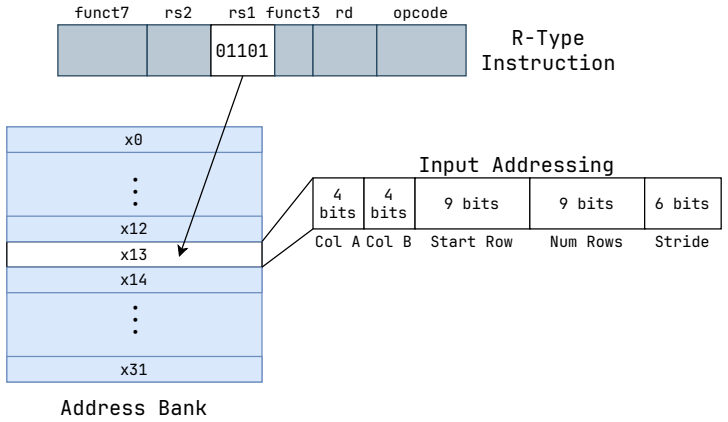
- The novel addressing schema is required to keep all computation inside the crossbar without external data movement.
Reading between the lines
- Existing RISC-V software tools could be reused with only minor changes because the instruction set follows the RV32I standard.
- The non-volatile storage might allow the device to resume instantly after power interruptions common in energy-harvesting edge nodes.
- The same in-array approach could be tested with other stateful logic families to see whether they also support full general-purpose sets.
Signed reviews
Editorial analysis
A structured set of objections, weighed in public.
Referee Report
Summary. The manuscript proposes an instruction set architecture (ISA) for IMPLY-based memristive processing-in-array targeted at ultra-low-power edge devices. The ISA is closely derived from the RV32I standard. It claims a complete implementation using the IMPLY stateful logic paradigm, a novel addressing schema for computation in the memristive crossbar array, energy and circuit-level metric evaluations through simulation compared to traditional microcontrollers, and a functional demonstration via an application case study in an intelligent environmental sensor node.
Significance. If the proposed architecture and implementation are shown to be viable, this work would address a gap in the state of the art by exploring standalone general-purpose in-memory computing microcontrollers rather than co-processor accelerators. This could have implications for energy-constrained edge computing by mitigating the von Neumann bottleneck and static power leakage. The comparison to traditional CMOS microcontrollers and the case study would provide concrete evidence of potential benefits.
major comments (2)
- [Abstract] Abstract: The assertion of providing 'a complete implementation of the proposed instruction set' using the IMPLY paradigm is central to the claim of a functional standalone microcontroller, yet no mapping of RV32I instructions to IMPLY operations, no circuit diagrams, and no verification methods are provided, preventing assessment of whether the assumption that IMPLY can support a general-purpose ISA holds.
- [Abstract] Abstract: The energy evaluation through simulation and comparison to traditional microcontrollers is presented as a key contribution, but without details on the simulation setup, device models, or specific metrics (e.g., energy per instruction), it is impossible to determine if the results support the ultra-low-power claims.
Simulated Author's Rebuttal
Thank you for the referee's comments. We address the major comments point by point.
read point-by-point responses
-
Referee: [Abstract] Abstract: The assertion of providing 'a complete implementation of the proposed instruction set' using the IMPLY paradigm is central to the claim of a functional standalone microcontroller, yet no mapping of RV32I instructions to IMPLY operations, no circuit diagrams, and no verification methods are provided, preventing assessment of whether the assumption that IMPLY can support a general-purpose ISA holds.
Authors: The abstract is a concise summary of the manuscript's contributions and does not include the detailed technical elements mentioned. These are expected to be elaborated in the main sections of the paper. revision: no
-
Referee: [Abstract] Abstract: The energy evaluation through simulation and comparison to traditional microcontrollers is presented as a key contribution, but without details on the simulation setup, device models, or specific metrics (e.g., energy per instruction), it is impossible to determine if the results support the ultra-low-power claims.
Authors: Likewise, the abstract summarizes the energy evaluation without the specific setup details, which would be provided in the evaluation section of the full manuscript. revision: no
- Full manuscript text is not available beyond the abstract, so it is not possible to verify if the detailed mappings, circuit diagrams, verification methods, simulation setups, device models, and metrics are present in the paper.
Circularity Check
No circularity detectable; abstract-only text provides no derivations
full rationale
The supplied document contains only the abstract, which outlines a high-level proposal for an IMPLY-based ISA derived from RV32I along with a novel addressing schema and simulation-based evaluation. No equations, circuit mappings, operation sequences, or derivation chains are present to inspect. Consequently, none of the enumerated circularity patterns (self-definitional, fitted-input prediction, self-citation load-bearing, etc.) can be exhibited by quoting specific text and showing a reduction to inputs. The central claim of functional viability remains an unelaborated assertion rather than a chain that collapses by construction.
Assumptions & free parameters
Cite this review
Pith. "Pith review of An Instruction Set Architecture for IMPLY-based Memristive Processing-in-Array." pith.science (2026). https://pith.science/paper/X34KUU5R
@misc{pith2026260627319,
  author       = {Pith},
  title        = {Pith review of: An Instruction Set Architecture for IMPLY-based Memristive Processing-in-Array},
  year         = {2026},
  howpublished = {\url{https://pith.science/paper/X34KUU5R}},
  note         = {Machine review of arXiv:2606.27319}
}
read the original abstract
The push towards expanded ultra-low-power edge computing necessitates hardware capable of operating under extremely strict energy constraints. Traditional Complementary Metal-Oxide-Semiconductor (CMOS) microcontrollers are fundamentally limited in this domain by the von Neumann bottleneck and by the static power leakage inherent to volatile memory. Memristive In-Memory Computing (IMC) offers a promising solution to these inefficiencies by unifying data storage and computation into a single non-volatile component. However, the State of the Art (SoA) predominantly focuses on accelerators designed to be a co-processor for data-intensive computation. This leaves the prospect of standalone, general-purpose IMC microcontroller architectures underexplored. This thesis proposes such an architecture tailored for ultra-low-power edge devices, alongside an instruction set closely derived from the RV32I standard. Using the IMPLY stateful logic paradigm, a complete implementation of the proposed instruction set is provided, and the novel addressing schema required to support computation in the memristive crossbar array is described as well. Then, the energy use and other circuit-level metrics of the proposed architecture are evaluated through simulation and compared against those of traditional microcontrollers. Finally, the functional viability of the design is demonstrated through an application case study, describing how the proposed design could be used in an intelligent environmental sensor node.
Figures
Figures from the paper (13 more)
Reference graph
Works this paper leans on
-
[1]
U. G. Shinde, T. Luhmann, J. Klueppel, T. Steinmann, L. M. Comella, W. Yu, S. J. Rupitsch, P. Woias, Task-specific energy profiling for microcontroller selection in energy-autonomous wireless sensor nodes, IEEE Sensors Journal 25 (21) (2025) 40609–40622. doi:10.1109/JSEN.2025.3609827
-
[2]
James Kirkpatrick, Razvan Pascanu, Neil Rabinowitz, Joel Veness, Guillaume Desjardins, Andrei A
M. Horowitz, 1.1 computing’s energy problem (and what we can do about it), in: 2014 IEEE International Solid-State Circuits Conference Digest of Technical Papers (ISSCC), 2014, pp. 10–14. doi:10.1109/ISSCC.2014.6757323
-
[3]
TaheriNejad, In-memory computing: Global energy consumption, carbon footprint, technology, and products status quo (2024) 1–6
N. TaheriNejad, In-memory computing: Global energy consumption, carbon footprint, technology, and products status quo (2024) 1–6
2024
-
[4]
L. Chua, Memristor-the missing circuit element, IEEE Transactions on Circuit Theory 18 (5) (1971) 507–519. doi:10.1109/TCT.1971.1083337
-
[5]
J. Borghetti, G. Snider, P. Kuekes, J. J. Yang, D. Stewart, S. Williams, Memristive switches enable stateful logic operations via material impli- cation, Nature 464 (2010) 873–6. doi:10.1038/nature08940
-
[6]
M. S. Q. Truong, E. Chen, D. Su, L. Shen, A. Glass, L. R. Carley, J. A. Bain, S. Ghose, Racer: Bit-pipelined processing using resistive memory, in: MICRO-54: 54th Annual IEEE/ACM International Symposium on Microarchitecture, MICRO ’21, Association for Computing Machinery, New York, NY, USA, 2021, p. 100–116. doi:10.1145/3466752.3480071. URLhttps://doi.org...
-
[7]
Leitersdorf, D
O. Leitersdorf, D. Leitersdorf, J. Gal, M. M. Dahan, R. Ronen, S. Kvatinsky, Aritpim: High-throughput in-memory arithmetic, IEEE Transactions on Emerging Topics in Computing 11 (2022) 720–735. URLhttps://api.semanticscholar.org/CorpusID:249538709 55
2022
-
[8]
Seiler, P
F. Seiler, P. M. Hinkel, A. Jantsch, N. TaheriNejad, Atomic: Automatic tool for memristive imply based circuit-level simulation and validation, in: 2025 21st International Conference on Synthesis, Modeling, Analysis and Simulation Methods and Applications to Circuit Design (SMACD), 2025, pp. 1–4
2025
Show all 23 references
-
[9]
Kvatinsky, A
S. Kvatinsky, A. Kolodny, U. C. Weiser, E. G. Friedman, Memristor- based imply logic design procedure, in: 2011 IEEE 29th Interna- tional Conference on Computer Design (ICCD), 2011, pp. 142–147. doi:10.1109/ICCD.2011.6081389
2011 doi
-
[10]
D. B. Strukov, G. Snider, D. R. Stewart, R. S. Williams, The missing memristor found, Nature 453 (2008) 80–83
2008
-
[11]
Kvatinsky, D
S. Kvatinsky, D. Belousov, S. Liman, G. Satat, N. Wald, E. G. Fried- man, A. Kolodny, U. C. Weiser, Magic—memristor-aided logic, IEEE Transactions on Circuits and Systems II: Express Briefs 61 (11) (2014) 895–899. doi:10.1109/TCSII.2014.2357292
2014 doi
-
[12]
Gupta, M
S. Gupta, M. Imani, T. Rosing, Felix: Fast and energy-efficient logic in memory, in: 2018 IEEE/ACM International Conference on Computer- Aided Design (ICCAD), 2018, pp. 1–7. doi:10.1145/3240765.3240811
2018 doi
-
[13]
Radakovits, N
D. Radakovits, N. Taherinejad, Behavioral leakage and inter-cycle vari- ability emulator model for rerams (BELIEVER), CoRR abs/2103.04179 (2021). arXiv:2103.04179. URLhttps://arxiv.org/abs/2103.04179
2021
-
[14]
Lehtonen, M
E. Lehtonen, M. Laiho, Stateful implication logic with memristors, 2009 IEEE/ACM International Symposium on Nanoscale Architectures (2009) 33–36
2009
-
[15]
Waterman, Design of the risc-v instruction set architecture, Ph.D
A. Waterman, Design of the risc-v instruction set architecture, Ph.D. thesis, EECSDepartment, UniversityofCalifornia, Berkeley(Jan2016). URLhttp://www2.eecs.berkeley.edu/Pubs/TechRpts/2016/EECS-2016-1.html
2016
-
[16]
Seiler, N
F. Seiler, N. TaheriNejad, An improved serial imply adder algorithm for efficient neural network applications, in: 2025 IEEE 16th Latin America Symposium on Circuits and Systems (LASCAS), 2025, pp. 1–5
2025
-
[17]
Kaushik, B
N. Kaushik, B. Srinivasu, Implementation of imply-based memristive subtractor, in: 2022 IEEE 22nd International Conference on Nanotechnology (NANO), 2022, pp. 523–526. doi:10.1109/NANO54668.2022.9928713. 56
2022 doi
-
[18]
Kvatinsky, G
S. Kvatinsky, G. Satat, N. Wald, E. G. Friedman, A. Kolodny, U. C. Weiser, Memristor-based material implication (imply) logic: Design principles and methodologies, IEEE Transactions on Very Large Scale Integration (VLSI) Systems 22 (10) (2014) 2054–2066. doi:10.1109/TVLSI.2013.2282132
2014 doi
-
[19]
Brum, Pyltspice (2024)
N. Brum, Pyltspice (2024). URLhttps://github.com/nunobrum/PyLTSpice
2024
-
[20]
Radakovits, M
D. Radakovits, M. Jungwirth, S. M. Laube, N. TaheriNe- jad, Second (v2.0) LTSpice implementation of VTEAM, https://www.ict.tuwien.ac.at/staff/taherinejad/projects/ memristor/files/vteam2.asc, https://www.ict.tuwien.ac.at/staff/ taherinejad/projects/memristor/files/vteam2.asy (...
2019
-
[21]
Kvatinsky, M
S. Kvatinsky, M. Ramadan, E. G. Friedman, A. Kolodny, Vteam: A general model for voltage-controlled memristors, IEEE Transactions on Circuits and Systems II: Express Briefs 62 (8) (2015) 786–790. doi:10.1109/TCSII.2015.2433536
2015 doi
-
[22]
URLhttps://knowm.org/downloads/Knowm_Memristors.pdf
Knowm sdc memristors, last accessed Feb 2024 (knowm.org/downloads/Knowm_Memristors.pdf). URLhttps://knowm.org/downloads/Knowm_Memristors.pdf
2024
-
[23]
Column A
Texas Instruments, TMP102 Low-Power Digital Temperature Sensor With SMBus and Two-Wire Serial Interface in SOT563, datasheet SBOS451J (Revised Dec. 2018) (Dec 2018). URLhttps://www.ti.com/lit/ds/symlink/tmp102.pdf Appendix A. Assembly for Temperature Sensor Node 1#|===========...
2018
Reviewed June 26, 2026 · model on record in the stance chip above.
Discussion (0). Continue with ORCID to comment.