REVIEW 3 major objections 7 minor 21 references
ITERA-LLM: Boosting Sub-8-Bit Large Language Model Inference via Iterative Tensor Decomposition
T0 review · 3 major / 7 minor · reviewed 2026-08-15 · deepseek-v4-flash
Pith's one-line read ITERA-LLM claims that putting quantization inside an iterative SVD residual loop, instead of after it, recovers up to 4.9% BLEU over quantization-only W4A8 compression and reduces FPGA linear-layer latency by up to 41.1% at comparable…
desk verdict A real algorithmic contribution in iterative SVD plus sensitivity-based rank allocation, but the headline 41.1% hardware speedup is model-only and not yet measured. read the letter →
The pith
A machine-rendered reading of the paper's core claim, the machinery that carries it, and where it could break.
The reading
What carries the argument
The central mechanism is the SVD-based iterative tensor decomposition loop: starting from a weight matrix $W$, each iteration takes the rank-1 singular value decomposition of the current residual, quantizes the two singular-vector factors to the target word length, subtracts their product from the residual, and accumulates the quantized factors into two low-rank matrices $W'_1$ and $W'_2$. Placing quantization inside the residual loop lets the approximation explicitly account for quantization error at every rank. The supporting mechanism is sensitivity-based rank allocation, which uses finite-difference estimates of model accuracy with respect to each layer's rank to shift rank budget from insensitive to sensitive layers. On the hardware side, the Single and Cascade SVD MatMul engines reuse or cascade the same systolic MatMul tile and keep the intermediate $XW'_1$ tile on-chip, supported by analytical latency, DSP, BRAM, and bandwidth models for design-space exploration.
What would settle it
Synthesize the best W6A8 SVD-iterative design point and the quantization-only baseline on a ZCU111 with Vitis HLS 2023.2 at 200 MHz, run the EN-DE and FR-EN OPUS-MT linear layers at batch size 512, and compare measured latency and BLEU against the predicted 41.1% reduction and 4.9% improvement.
Extended reading notes
Core claim
The central claim is that quantization error and low-rank truncation error can be compensated together by running SVD as a quantized rank-one residual refinement loop, rather than decomposing first and quantizing afterward. This iterative decomposition produces compression Pareto fronts that dominate both quantization-only and one-shot SVD baselines across compression ratios. With sensitivity-based rank allocation, W4A8 improves BLEU by up to 4.9% over quantization-only at the same compression ratio, and W6A8 reduces the number of fixed-point operations by 12.5% at similar model accuracy. Under the resource constraints of the ZCU111 FPGA, the framework reports linear-layer latency reductions between 12.1% and 41.1% compared to a quantization-only MatMul baseline at comparable accuracy.
Load-bearing premise
The reported latency reductions and Pareto fronts rest on analytical performance and resource models in Section VI that the paper does not validate with measured bitstreams on the ZCU111 board; if those rate and workload estimates are inaccurate, the 41.1% latency reduction may not materialize in real hardware.
Editorial extensions
If this is right
- Sub-8-bit post-training LLM compression can avoid the accuracy drop of quantization-only W4A8 by using iterative SVD with sensitivity-based rank allocation, producing Pareto fronts that dominate quantization-only baseline.
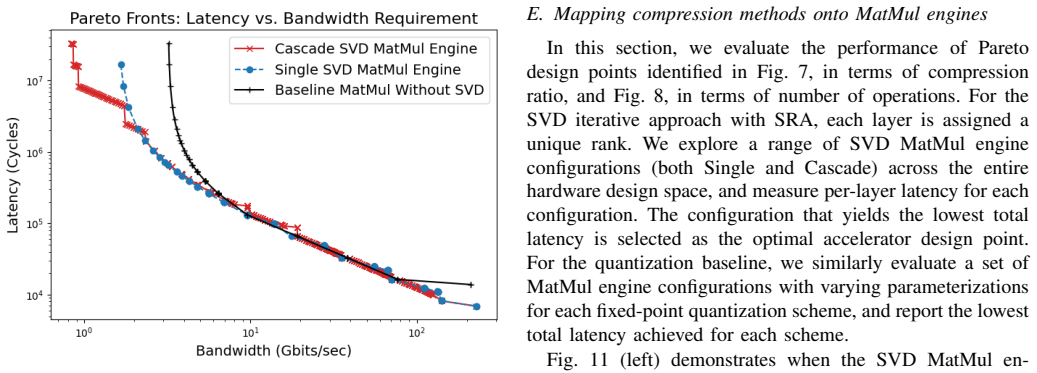
- Under compute-bound resources, W6A8 iterative SVD with SRA gives better BLEU and lower latency than both W4A8 and the quantization baseline, while under bandwidth-limited resources W4A8 with SRA gives the best Pareto front.
- At similar model accuracy, the method reduces fixed-point operations by 12.5% at W6A8 compared to quantization-only compression.
- SVD MatMul engines can match baseline MatMul latency in the bandwidth-limited region while requiring less off-chip bandwidth, and beat it in the compute-bound region due to reduced operations.
- For selected design points, per-layer occupancy variation remains below 5%, indicating padding overhead is small with the chosen tiling configurations.
Reading between the lines
- If the analytical hardware models prove accurate on real hardware, the same co-design search should transfer to other transformer workloads, but the paper only demonstrates OPUS-MT translation models, so generality to other LLM families remains untested.
- The accuracy gains concentrate at low compression ratios where more residual refinement iterations are available, suggesting a direct test: sweep the rank budget on a single model and check whether per-iteration BLEU recovery stays roughly constant or decays.
- The 41.1% figure is specifically linear-layer latency, not end-to-end inference; extending it to whole-model speedup requires assuming non-linear layers, embeddings, and decoding overheads are not the dominant bottleneck.
- A natural extension would be to apply the same iterative residual idea to other decompositions, such as Tucker or CP, provided each iteration can produce a quantized low-rank factor update, though the paper does not investigate this.
Signed reviews
Editorial analysis
A structured set of objections, weighed in public.
Referee Report
Summary. ITERA-LLM proposes a software-hardware co-design framework for sub-8-bit LLM inference on FPGAs. The algorithmic contribution is an iterative SVD-based tensor decomposition in which each rank-1 factor is quantized and subtracted from the residual, followed by a Sensitivity-based Rank Allocation (SRA) heuristic that adjusts per-layer ranks via finite-difference estimates of BLEU sensitivity under a total rank budget. The hardware contribution is a set of analytical performance and resource models for two SVD MatMul engine variants (single-engine and cascade), used to prune and explore the design space under ZCU111 constraints. The paper reports up to 41.1% linear-layer latency reduction relative to a quantization-only MatMul baseline at comparable BLEU, and up to 4.9% BLEU improvement at W4A8.
Significance. If the latency and accuracy claims were independently validated, the paper would make a useful contribution to low-bitwidth LLM acceleration on FPGAs: the iterative residual compensation is a plausible mechanism for recovering quantization loss at sub-8-bit precision, SRA is a principled way to allocate a rank budget, and the DSE coupling of compression Pareto fronts with hardware configurations addresses a real gap. The paper is also careful to compare against a quantization-only baseline and to separate compute-bound from bandwidth-limited regimes. However, the headline hardware speedup is produced entirely by an unvalidated analytical model, and the accuracy improvements are partly fitted on the evaluation metric, so the significance is conditional on additional evidence. No code, bitstream, or synthesis report is provided, which further limits reproducibility.
major comments (3)
- [Section VI.A, Eq. (15), Fig. 11] The central latency claim is not supported by any implementation evidence. Eq. (15) computes latency as the maximum of three workload/rate ratios, which assumes that input, output, and computation are perfectly overlapped and ignores pipeline fill and drain, port contention, DRAM efficiency, and the cost of buffering and re-reading the intermediate Mt×R tile described in Section V. The paper reports no RTL simulation, synthesis timing, resource utilization report, or on-board ZCU111 measurement, so the 0.589× (41.1% reduction) latency ratio and the Pareto fronts in Fig. 11 are model-predicted values only. Adding at least a synthesis-based validation of the cycle and resource models, and ideally on-board measurements, is required to support the headline result.
- [Section IV.B, Eq. (8), Section VIII] The SRA procedure optimizes ranks by evaluating BLEU on a calibration set (Eqs. 6-8) and the same BLEU metric on the same WMT2019 benchmark family is used for the final evaluation, with no held-out split or multiple-seed/error-bar reporting. The accuracy improvement over the quantization-only baseline is therefore partly an optimized quantity rather than an independent prediction. Please report results on a separate validation or test set, provide variance over at least several runs, and state the calibration set size and sampling procedure.
- [Section VI.B, Eqs. (17)-(18)] The BRAM model assigns one BRAM18K per DSP at depth K/Kf, which does not account for dual-port conflicts, padding to the DSP/Kf granularity, or the actual FIFO implementation after synthesis. Since the resource model is used to prune the design space and to define the ZCU111 constraints in Figs. 10-11, an error in this model could change which configurations are feasible and thus alter the reported Pareto fronts. Please validate the resource estimates against synthesis reports for representative configurations.
minor comments (7)
- [Algorithm 1] The residual update line has a typo: it reads "˜R = ˜R− W′k_1 , W′k_2" but should subtract the product W′k_1 W′k_2, not two separate terms.
- [Eq. (4)] Equation (4) writes the rank-1 factors as W′k_1 and W′k_2 without explicitly stating their dimensions; please clarify that they are rank-1 outer products to avoid ambiguity with the augmented rank-r matrices W′1 and W′2.
- [Section VIII.B] The experimental setup labels [8] as a post-training quantization scheme, but [8] (Q8BERT) is a quantization-aware training method; please correct the citation or the description of the baseline.
- [Section IV.B] The SRA evaluation uses a "randomly sampled calibration set" without reporting its size, sampling distribution, or number of sentences; this information is needed for reproducibility and for judging the stability of the finite-difference sensitivities.
- [Section V] The paper describes weight word lengths in detail but does not explicitly state how activations X are quantized in the hardware path (beyond the A8 notation); please make the activation quantization scheme and its implementation in the PE explicit.
- [Fig. 10 caption] The caption says "corresponding bandwidth requirement to run at full throughput" without noting that these values come from the analytical model of Eq. (19); please state that these are modeled estimates, not measurements.
- [Abstract and Section IV] The paper uses "model accuracy" and "BLEU Score" interchangeably; please use consistent terminology, since BLEU is a translation quality metric rather than accuracy in the classification sense.
Circularity Check
No significant circularity: ITERA-LLM's compression, rank search, and analytical latency estimates are explicit optimizations/models rather than re-labeled inputs, though hardware claims remain model-only.
full rationale
The paper's central claims do not reduce to their inputs by construction. Algorithm 1 defines an explicit iterative SVD-with-quantization residual refinement loop; the output is not assumed to equal the target accuracy or latency. The SRA procedure (Section IV) solves the stated optimization problem in Eq. 5 by finite-difference BLEU sensitivity estimates and greedy rank adjustment; the reported BLEU improvements are empirical outcomes of that search, and the paper does not state that the calibration set used for rank allocation is the same as the WMT2019 evaluation set, so the result is not a fitted parameter renamed as a prediction. The latency and resource models (Section VI, Eqs. 12-19) are analytical estimates used for design-space exploration; they are not fitted to the claimed 41.1% speedup, so the latency comparison is model-based rather than circular. The self-citations ([15], [17]) appear only as related-work context and are not load-bearing for the paper's unique claims; no uniqueness theorem or ansatz is imported from the authors' prior work. The main weakness is that the hardware latency claims are not validated against synthesis or on-board measurement, but that is a correctness or validation gap, not circularity.
Assumptions & free parameters
free parameters (3)
- per-layer decomposition ranks r_i =
variable, set by SRA
- weight bit-width wl (W4A8, W6A8) =
4 and 6 bits in the reported Pareto points
- SRA hyperparameters delta0 and alpha =
not specified
assumptions (4)
- domain assumption SVD-based low-rank approximation combined with quantization can recover accuracy lost by sub-8-bit weight quantization in LLMs.
- domain assumption Finite-difference sensitivity of BLEU with respect to rank is a valid guide for rank allocation across layers.
- domain assumption The analytical rate and resource models (Eq. 12-19) predict actual FPGA latency and utilization accurately enough for design ranking.
- domain assumption The randomly sampled calibration set used for SRA represents the WMT2019 test distribution.
Cite this review
Pith. "Pith review of ITERA-LLM: Boosting Sub-8-Bit Large Language Model Inference via Iterative Tensor Decomposition." pith.science (2026). https://pith.science/paper/X3AIZBQK
@misc{pith2026250508981,
  author       = {Pith},
  title        = {Pith review of: ITERA-LLM: Boosting Sub-8-Bit Large Language Model Inference via Iterative Tensor Decomposition},
  year         = {2026},
  howpublished = {\url{https://pith.science/paper/X3AIZBQK}},
  note         = {Machine review of arXiv:2505.08981}
}
read the original abstract
Recent advancements in Large Language Models (LLMs) have demonstrated impressive capabilities as their scale expands to billions of parameters. Deploying these large-scale models on resource-constrained platforms presents significant challenges, with post-training fixed-point quantization often used as a model compression technique. However, quantization-only methods typically lead to significant accuracy degradation in LLMs when precision falls below 8 bits. This paper addresses this challenge through a software-hardware co-design framework, ITERA-LLM, which integrates sub-8-bit quantization with SVD-based iterative low-rank tensor decomposition for error compensation, leading to higher compression ratios and reduced computational complexity. The proposed approach is complemented by a hardware-aware Design Space Exploration (DSE) process that optimizes accuracy, latency, and resource utilization, tailoring the configuration to the specific requirements of the targeted LLM. Our results show that ITERA-LLM achieves linear layer latency reduction of up to 41.1%, compared to quantization-only baseline approach while maintaining similar model accuracy.
Figures


Figures from the paper (8 more)




Reference graph
Works this paper leans on
-
[1]
Rae, Oriol Vinyals, and Laurent Sifre
Jordan Hoffmann, Sebastian Borgeaud, Arthur Mensch, Elena Buchatskaya, Trevor Cai, Eliza Rutherford, Diego de Las Casas, Lisa Anne Hendricks, Johannes Welbl, Aidan Clark, Tom Hennigan, Eric Noland, Katie Millican, George van den Driessche, Bogdan Damoc, Aurelia Guy, Simon Osindero, Karen Simonyan, Erich Elsen, Jack W. Rae, Oriol Vinyals, and Laurent Sifre...
2022
-
[2]
M4bram: Mixed-precision matrix-matrix multiplication in fpga block rams
Yuzong Chen, Jordan Dotzel, and Mohamed S Abdelfattah. M4bram: Mixed-precision matrix-matrix multiplication in fpga block rams. In 2023 International Conference on Field Programmable Technology (ICFPT), pages 69–78. IEEE, 2023
work page 2023
-
[3]
Jiajun Wu, Jiajun Zhou, Yizhao Gao, Yuhao Ding, Ngai Wong, and Hayden Kwok-Hay So. Msd: Mixing signed digit representations for hardware-efficient dnn acceleration on fpga with heterogeneous resources. In 2023 IEEE 31st Annual International Symposium on Field- Programmable Custom Computing Machines (FCCM) , pages 94–104. IEEE, 2023
work page 2023
-
[4]
Democratizing neural ma- chine translation with OPUS-MT
J ¨org Tiedemann, Mikko Aulamo, Daria Bakshandaeva, Michele Boggia, Stig-Arne Gr ¨onroos, Tommi Nieminen, Alessandro Raganato Yves Scherrer, Raul Vazquez, and Sami Virpioja. Democratizing neural ma- chine translation with OPUS-MT. Language Resources and Evaluation, (58):713–755, 2023
work page 2023
-
[5]
Omniquant: Omnidirectionally calibrated quantization for large language models, 2024
Wenqi Shao, Mengzhao Chen, Zhaoyang Zhang, Peng Xu, Lirui Zhao, Zhiqian Li, Kaipeng Zhang, Peng Gao, Yu Qiao, and Ping Luo. Omniquant: Omnidirectionally calibrated quantization for large language models, 2024
2024
-
[6]
Qllm: Accurate and efficient low-bitwidth quantization for large language models, 2024
Jing Liu, Ruihao Gong, Xiuying Wei, Zhiwei Dong, Jianfei Cai, and Bohan Zhuang. Qllm: Accurate and efficient low-bitwidth quantization for large language models, 2024
work page 2024
-
[7]
Efficient arbitrary precision acceleration for large language models on gpu tensor cores, 2024
Shaobo Ma, Chao Fang, Haikuo Shao, and Zhongfeng Wang. Efficient arbitrary precision acceleration for large language models on gpu tensor cores, 2024
work page 2024
-
[8]
Ofir Zafrir, Guy Boudoukh, Peter Izsak, and Moshe Wasserblat. Q8bert: Quantized 8bit bert. In 2019 Fifth Workshop on Energy Efficient Machine Learning and Cognitive Computing - NeurIPS Edition (EMC2-NIPS) , pages 36–39. IEEE, December 2019
work page 2019
Show all 21 references
-
[9]
Q-bert: Hessian based ultra low precision quantization of bert
Sheng Shen, Zhen Dong, Jiayu Ye, Linjian Ma, Zhewei Yao, Amir Gholami, Michael W Mahoney, and Kurt Keutzer. Q-bert: Hessian based ultra low precision quantization of bert. In Proceedings of the AAAI Conference on Artificial Intelligence , volume 34, pages 8815– 8821, 2020
2020
-
[10]
Owq: Outlier-aware weight quantization for efficient fine-tuning and inference of large language models
Changhun Lee, Jungyu Jin, Taesu Kim, Hyungjun Kim, and Eunhyeok Park. Owq: Outlier-aware weight quantization for efficient fine-tuning and inference of large language models. In Proceedings of the AAAI Conference on Artificial Intelligence , volume 38, pages 13355–13364, 2024
2024
-
[11]
Hawq: Hessian aware quantization of neural networks with mixed-precision
Zhen Dong, Zhewei Yao, Amir Gholami, Michael W Mahoney, and Kurt Keutzer. Hawq: Hessian aware quantization of neural networks with mixed-precision. In Proceedings of the IEEE/CVF international conference on computer vision , pages 293–302, 2019
2019
-
[12]
Bitmod: Bit-serial mixture-of-datatype llm acceleration
Yuzong Chen, Ahmed F AbouElhamayed, Xilai Dai, Yang Wang, Marta Andronic, George A Constantinides, and Mohamed S Abdelfattah. Bitmod: Bit-serial mixture-of-datatype llm acceleration. arXiv preprint arXiv:2411.11745, 2024
2024 arXiv
-
[13]
Optimizing bit-serial matrix multiplica- tion for reconfigurable computing
Yaman Umuroglu, Davide Conficconi, Lahiru Rasnayake, Thomas B Preusser, and Magnus Sj¨alander. Optimizing bit-serial matrix multiplica- tion for reconfigurable computing. ACM Transactions on Reconfigurable Technology and Systems (TRETS) , 12(3):1–24, 2019
2019
-
[14]
Hihispmv: Sparse matrix vector multiplication with hierarchical row reductions on fpgas with high bandwidth memory
Abdul Rehman Tareen, Marius Meyer, Christian Plessl, and Tobias Kenter. Hihispmv: Sparse matrix vector multiplication with hierarchical row reductions on fpgas with high bandwidth memory. In 2024 IEEE 32nd Annual International Symposium on Field-Programmable Custom Computing M...
2024
-
[15]
Hass: Hardware-aware sparsity search for dataflow dnn accelerator
Zhewen Yu, Sudarshan Sreeram, Krish Agrawal, Junyi Wu, Alexander Montgomerie-Corcoran, Cheng Zhang, Jianyi Cheng, Christos-Savvas Bouganis, and Yiren Zhao. Hass: Hardware-aware sparsity search for dataflow dnn accelerator. arXiv preprint arXiv:2406.03088 , 2024
2024 arXiv
-
[16]
Adaptable butterfly accelerator for attention-based nns via hardware and algorithm co-design
Hongxiang Fan, Thomas Chau, Stylianos I Venieris, Royson Lee, Alexandros Kouris, Wayne Luk, Nicholas D Lane, and Mohamed S Abdelfattah. Adaptable butterfly accelerator for attention-based nns via hardware and algorithm co-design. In 2022 55th IEEE/ACM International Symposium o...
2022
-
[17]
Streamsvd: Low-rank ap- proximation and streaming accelerator co-design
Zhewen Yu and Christos-Savvas Bouganis. Streamsvd: Low-rank ap- proximation and streaming accelerator co-design. In 2021 International Conference on Field-Programmable Technology (ICFPT) , pages 1–9. IEEE, 2021
2021
-
[18]
Charm: Composing heterogeneous accelerators for matrix multiply on versal acap architec- ture, 2023
Jinming Zhuang, Jason Lau, Hanchen Ye, Zhuoping Yang, Yubo Du, Jack Lo, Kristof Denolf, Stephen Neuendorffer, Alex Jones, Jingtong Hu, Deming Chen, Jason Cong, and Peipei Zhou. Charm: Composing heterogeneous accelerators for matrix multiply on versal acap architec- ture, 2023
2023
-
[19]
Film-qnn: Efficient fpga acceleration of deep neural networks with intra-layer, mixed-precision quantization
Mengshu Sun, Zhengang Li, Alec Lu, Yanyu Li, Sung-En Chang, Xiaolong Ma, Xue Lin, and Zhenman Fang. Film-qnn: Efficient fpga acceleration of deep neural networks with intra-layer, mixed-precision quantization. In Proceedings of the 2022 ACM/SIGDA International Symposium on Fie...
2022
-
[20]
Understanding the potential of fpga-based spatial acceleration for large language model inference
Hongzheng Chen, Jiahao Zhang, Yixiao Du, Shaojie Xiang, Zichao Yue, Niansong Zhang, Yaohui Cai, and Zhiru Zhang. Understanding the potential of fpga-based spatial acceleration for large language model inference. ACM Transactions on Reconfigurable Technology and Systems, 18(1):...
2024
-
[21]
James W. Demmel. Applied numerical linear algebra . Society for Industrial and Applied Mathematics, USA, 1997
1997
Reviewed August 15, 2026 · model on record in the stance chip above.
Discussion (0). Continue with ORCID to comment.