Beyond Data-Driven: How Physics-Informed Neural Networks are Reshaping Multi-Physics Design and Discovery
Pith reviewed 2026-06-26 11:53 UTC · model grok-4.3
The pith
Embedding governing equations as soft constraints in neural network training confines solutions to the physics manifold and enables modeling with sparse data.
A machine-rendered reading of the paper's core claim, the machinery that carries it, and where it could break.
Core claim
Physics-informed neural networks reformulate the learning task as a constrained optimization problem in which admissible solutions are confined to the manifold defined by the underlying physics, enabling the construction of models that are simultaneously data-efficient, physically consistent, and capable of operating in regimes where measurements are sparse or indirect.
What carries the argument
Embedding partial differential equations, conservation laws, and constitutive relationships as soft constraints in the training objective.
Load-bearing premise
Embedding governing equations as soft constraints in the training objective confines solutions to the physics-defined manifold without introducing significant accuracy or convergence trade-offs.
What would settle it
Training a PINN on a problem with known exact solution and observing that the network output violates a conservation law by more than numerical tolerance would falsify the claim of confinement to the physics manifold.
Figures
read the original abstract
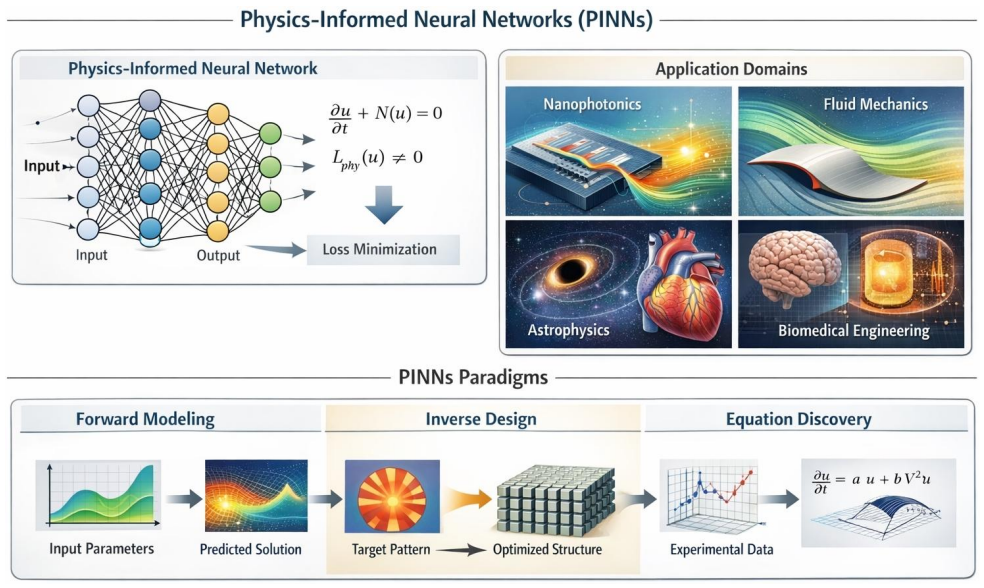
Physics-informed neural networks (PINNs) constitute a rapidly maturing class of scientific machine learning models in which the governing equations of a physical system are embedded directly into the training objective as soft constraints. By enforcing partial differential equations (PDEs), conservation laws, and constitutive relationships during optimization, PINNs enable the construction of models that are simultaneously data-efficient, physically consistent, and capable of operating in regimes where measurements are sparse or indirect. In contrast to conventional deep learning, where the loss is typically defined solely in terms of data misfit, the learning task in PINNs is reformulated as a constrained optimization problem in which admissible solutions are confined to the manifold defined by the underlying physics. This review provides a comprehensive assessment of recent developments in physics-informed machine learning with an emphasis on PINN-based formulations for forward modelling, inverse design, and equation discovery across nanophotonics, fluid mechanics, astronomy, and biomedical engineering. Particular attention is devoted to how physical knowledge is injected at different stages of the modelling pipeline, including synthetic data generation, non-dimensionalization and scaling, architecture selection, loss design, and post-training regularization. We highlight emerging strategies for multi-physics coupling, transfer learning across parameter and geometry spaces, and rigorous benchmarking against established numerical solvers. Finally, the review discusses interpretability, uncertainty quantification, and hardware acceleration, and articulates how physics-informed learning is reshaping engineering practice by enabling digital twins and design workflows that combine simulation and data in a unified differentiable framework.
Editorial analysis
A structured set of objections, weighed in public.
Referee Report
Summary. The manuscript is a review of physics-informed neural networks (PINNs) that claims embedding PDEs, conservation laws, and constitutive relations as soft constraints in the training loss reformulates the problem as constrained optimization, confining solutions to the physics-defined manifold. This is said to yield data-efficient, physically consistent models suitable for sparse-data regimes in forward modeling, inverse design, and equation discovery across nanophotonics, fluid mechanics, astronomy, and biomedical engineering. The review surveys injection of physics at stages including data generation, architecture choice, loss design, multi-physics coupling, transfer learning, benchmarking, interpretability, and hardware acceleration.
Significance. A balanced review that rigorously benchmarks PINN formulations against established solvers and discusses multi-physics coupling strategies could be useful for practitioners. The abstract's emphasis on non-dimensionalization, scaling, and post-training regularization identifies practical implementation points that are often under-discussed.
major comments (1)
- [Abstract] Abstract: The central claim that soft-constraint embedding 'confines admissible solutions to the manifold defined by the underlying physics' is load-bearing for the review's thesis on data-efficiency and consistency with sparse measurements. The weighted sum of data-misfit and residual losses does not guarantee manifold membership; in multi-physics settings with disparate length scales or stiffness, this formulation frequently produces solutions satisfying neither term to high accuracy. The review must explicitly address convergence trade-offs and contrast with hard-constraint or augmented-Lagrangian alternatives.
minor comments (2)
- [Abstract] The abstract paragraph on reformulation as constrained optimization is repeated in substance later in the text; consolidate to avoid redundancy.
- When citing external benchmarks, ensure each comparison specifies the exact PDE residual norm and data density used, rather than qualitative statements.
Simulated Author's Rebuttal
We thank the referee for their constructive feedback on our review manuscript. We address the single major comment below.
read point-by-point responses
-
Referee: [Abstract] Abstract: The central claim that soft-constraint embedding 'confines admissible solutions to the manifold defined by the underlying physics' is load-bearing for the review's thesis on data-efficiency and consistency with sparse measurements. The weighted sum of data-misfit and residual losses does not guarantee manifold membership; in multi-physics settings with disparate length scales or stiffness, this formulation frequently produces solutions satisfying neither term to high accuracy. The review must explicitly address convergence trade-offs and contrast with hard-constraint or augmented-Lagrangian alternatives.
Authors: We agree that the abstract phrasing presents the soft-constraint formulation in terms that could be read as implying strict manifold confinement, whereas the weighted loss provides only an approximation whose quality depends on weighting, optimization, and problem conditioning. This point is valid and the manuscript does not currently contain an explicit discussion of these trade-offs in the abstract or a dedicated contrast with hard-constraint or augmented-Lagrangian formulations. In the revised manuscript we will (i) rephrase the abstract to state that admissible solutions are encouraged to lie near the physics manifold and (ii) insert a new subsection that reviews known convergence limitations of soft-constraint PINNs in multi-physics problems with disparate scales or stiffness and that briefly contrasts these with hard-constraint and augmented-Lagrangian alternatives. These changes will be made without altering the overall scope or conclusions of the review. revision: yes
Circularity Check
No circularity: review surveys external literature without internal derivations or self-referential claims
full rationale
This is a survey paper assessing PINN developments in multiple fields. The abstract and provided text describe existing techniques (embedding PDEs as soft constraints, reformulating learning as constrained optimization) by reference to prior work, without presenting new equations, fitted parameters, predictions, or derivations that could reduce to the paper's own inputs. No self-citations are invoked as load-bearing uniqueness theorems, and no ansatzes or renamings are introduced. The central claims rest on external benchmarking and literature, making the text self-contained against external sources with no reduction by construction.
Axiom & Free-Parameter Ledger
axioms (1)
- domain assumption Embedding governing equations as soft constraints in the loss confines admissible solutions to the physics manifold
Forward citations
Cited by 1 Pith paper
-
Giant Second-Harmonic Generation in 3R-MoS2/MLM Hybrid Metasurfaces Cavities
Physics-informed AI designs dual-resonant metasurfaces claimed to deliver over 1000x SHG intensity enhancement in 3R-MoS2 hybrids versus bare flakes.
Reference graph
Works this paper leans on
-
[1]
Quartapelle, Numerical solution of the incompressible Navier-Stokes equations
L. Quartapelle, Numerical solution of the incompressible Navier-Stokes equations. Birkhäuser, 2013
2013
-
[2]
Fitzpatrick, Maxwell's Equations and the Principles of Electromagnetism
R. Fitzpatrick, Maxwell's Equations and the Principles of Electromagnetism. Jones & Bartlett Publishers, 2008
2008
-
[3]
Numerical solution for optimal control of the reaction-diffusion equations in cardiac electrophysiology,
C. Nagaiah, K. Kunisch, and G. Plank, "Numerical solution for optimal control of the reaction-diffusion equations in cardiac electrophysiology," Computational Optimization and Applications, vol. 49, no. 1, pp. 149-178, 2011
2011
-
[4]
Practical aspects of formulation and solution of moving mesh partial differential equations,
W. Huang, "Practical aspects of formulation and solution of moving mesh partial differential equations," Journal of Computational Physics, vol. 171, no. 2, pp. 753-775, 2001
2001
-
[5]
Scaling limits for PDE-based simulation,
P. F. Fischer, "Scaling limits for PDE-based simulation," in 22nd AIAA Computational Fluid Dynamics Conference, 2015, p. 3049
2015
-
[6]
D. B. Davidson, Computational electromagnetics for RF and microwave engineering. Cambridge University Press, 2010
2010
-
[7]
Learning deep neural networks for high dimensional output problems,
B. Labbé, R. Hérault, and C. Chatelain, "Learning deep neural networks for high dimensional output problems," in 2009 International Conference on Machine Learning and Applications, 2009: IEEE, pp. 63-68
2009
-
[8]
Data-driven modelling: some past experiences and new approaches,
D. P. Solomatine and A. Ostfeld, "Data-driven modelling: some past experiences and new approaches," Journal of hydroinformatics, vol. 10, no. 1, pp. 3-22, 2008
2008
-
[9]
Physics- informed machine learning,
G. E. Karniadakis, I. G. Kevrekidis, L. Lu, P. Perdikaris, S. Wang, and L. Yang, "Physics- informed machine learning," Nature Reviews Physics, vol. 3, no. 6, pp. 422-440, 2021
2021
-
[10]
Differentiable optimization-based modeling for machine learning,
B. Amos, "Differentiable optimization-based modeling for machine learning," 2019
2019
-
[11]
A new era of clinical research methods in a data-rich environment,
W. T. Riley, "A new era of clinical research methods in a data-rich environment," in Oncology informatics: Elsevier, 2016, pp. 343-355
2016
-
[12]
Is dark matter in spiral galaxies cold gas? I. Observational constraints and dynamical clues about galaxy evolution,
D. Pfenniger, F. Combes, and L. Martinet, "Is dark matter in spiral galaxies cold gas? I. Observational constraints and dynamical clues about galaxy evolution," Astronomy and Astrophysics, Vol. 285, p. 79-93 (1994), vol. 285, pp. 79-93, 1994
1994
-
[13]
Machine learning through physics– informed neural networks: Progress and challenges,
X. W. Klapa Antonion, M. Raissi, and L. Joshie, "Machine learning through physics– informed neural networks: Progress and challenges," Academic Journal of Science and Technology, vol. 9, no. 1, p. 2024, 2024
2024
-
[14]
O. A. M. Abdelraouf, A. M. A. Ahmed, E. Eldele, and A. A. Omar, "From maxwell’s equations to artificial intelligence: The evolution of physics-guided AI in nanophotonics and electromagnetics," Optics & Laser Technology, vol. 192, p. 113828, 2025/12/01/ 2025, doi: https://doi.org/10.1016/j.optlastec.2025.113828
-
[15]
Application of conservation laws to the learning of physics-informed neural networks,
J. Gurieva, E. Vasiliev, and L. Smirnov, "Application of conservation laws to the learning of physics-informed neural networks," Procedia Computer Science, vol. 212, pp. 464-473, 2022
2022
-
[16]
Learning by neural networks under physical constraints for simulation in fluid mechanics,
Y . Yang and Y . Mesri, "Learning by neural networks under physical constraints for simulation in fluid mechanics," Computers & Fluids, vol. 248, p. 105632, 2022
2022
-
[17]
I. I. Abdulaal, A. W. Elsayed, and O. A. Abdelraouf, "Terahertz Quasi-BIC Metasurfaces for Ultra-Sensitive Biosensing and High-Speed Wireless Communications," arXiv preprint arXiv:2510.00357, 2025
arXiv 2025
-
[18]
Recent Progress in Nanophotonics for Green Energy, Medicine, Healthcare, and Optical Computing Applications,
O. M. Halawa, E. Ahmed, M. M. Abdelrazek, Y . M. Nagy, and O. A. M. Abdelraouf, "Recent Progress in Nanophotonics for Green Energy, Medicine, Healthcare, and Optical Computing Applications," Materials, vol. 19, no. 8, p. 1660, 2026. [Online]. Available: https://www.mdpi.com/1996-1944/19/8/1660
2026
-
[19]
High-order photonic cavity modes enabled 3D structural colors,
H. Liu et al., "High-order photonic cavity modes enabled 3D structural colors," ACS nano, vol. 16, no. 5, pp. 8244-8252, 2022
2022
-
[20]
Recent advances in tunable metasurfaces: materials, design, and applications,
O. A. Abdelraouf et al., "Recent advances in tunable metasurfaces: materials, design, and applications," ACS nano, vol. 16, no. 9, pp. 13339-13369, 2022
2022
-
[21]
All‐Optical Switching of Structural Color with a Fabry–Pérot Cavity,
O. A. Abdelraouf et al., "All‐Optical Switching of Structural Color with a Fabry–Pérot Cavity," Advanced Photonics Research, vol. 4, no. 11, p. 2300209, 2023. 72
2023
-
[22]
Aperiodic Bragg reflectors for tunable high-purity structural color based on phase change material,
S. Jana et al., "Aperiodic Bragg reflectors for tunable high-purity structural color based on phase change material," Nano Letters, vol. 24, no. 13, pp. 3922-3929, 2024
2024
-
[23]
Nanophotonic Engineering of CZTSSe Thin-Film Solar Cells for Near-Unity Absorption and Enhanced Efficiency,
T. S. Almurayziq, O. A. Abdelraouf, A. Shaker, M. Salem, M. T. Alshammari, and M. T. Qureshi, "Nanophotonic Engineering of CZTSSe Thin-Film Solar Cells for Near-Unity Absorption and Enhanced Efficiency," Photonics and Nanostructures-Fundamentals and Applications, p. 101528, 2026
2026
-
[24]
A review on tandem solar cells based on Perovskite/Si: 2-T versus 4-T configurations,
D. Khodair, A. Saeed, A. Shaker, M. Abouelatta, O. A. Abdelraouf, and S. EL-Rabaie, "A review on tandem solar cells based on Perovskite/Si: 2-T versus 4-T configurations," Solar Energy, vol. 300, p. 113815, 2025
2025
-
[25]
Well‐ dispersed Au nanoparticles prepared via magnetron sputtering on TiO2 nanotubes with unprecedentedly high activity for water splitting,
N. Atef, S. S. Emara, D. S. Eissa, A. El‐Sayed, O. A. Abdelraouf, and N. K. Allam, "Well‐ dispersed Au nanoparticles prepared via magnetron sputtering on TiO2 nanotubes with unprecedentedly high activity for water splitting," Electrochemical Science Advances, vol. 1, no. 1, p. e2000004, 2021
2021
-
[26]
Nanostructuring for enhanced absorption and carrier collection in CZTS-based solar cells: coupled optical and electrical modeling,
O. A. Abdelraouf and N. K. Allam, "Nanostructuring for enhanced absorption and carrier collection in CZTS-based solar cells: coupled optical and electrical modeling," Optical Materials, vol. 54, pp. 84-88, 2016
2016
-
[27]
Towards nanostructured perovskite solar cells with enhanced efficiency: Coupled optical and electrical modeling,
O. A. Abdelraouf and N. K. Allam, "Towards nanostructured perovskite solar cells with enhanced efficiency: Coupled optical and electrical modeling," Solar Energy, vol. 137, pp. 364-370, 2016
2016
-
[28]
Plasmonic scattering nanostructures for efficient light trapping in flat czts solar cells,
O. A. Abdelraouf, M. I. Abdelrahaman, and N. K. Allam, "Plasmonic scattering nanostructures for efficient light trapping in flat czts solar cells," in Metamaterials XI, 2017, vol. 10227: SPIE, pp. 90-98
2017
-
[29]
Optimizing absorption and scattering cross section of metal nanostructures for enhancing light coupling inside perovskite solar cells,
O. A. Abdelraouf, H. A. Ali, and N. K. Allam, "Optimizing absorption and scattering cross section of metal nanostructures for enhancing light coupling inside perovskite solar cells," in 2017 Conference on Lasers and Electro-Optics Europe & European Quantum Electronics Conference (CLEO/Europe-EQEC), 2017: IEEE, pp. 1-1
2017
-
[30]
Using all dielectric and plasmonic cross grating metasurface for enhancing efficiency of CZTS solar cells,
O. A. Abdelraouf, A. Shaker, and N. K. Allam, "Using all dielectric and plasmonic cross grating metasurface for enhancing efficiency of CZTS solar cells," in Nanophotonics VII, 2018, vol. 10672: SPIE, pp. 246-255
2018
-
[31]
All dielectric and plasmonic cross-grating metasurface for efficient perovskite solar cells,
O. A. Abdelraouf, A. Shaker, and N. K. Allam, "All dielectric and plasmonic cross-grating metasurface for efficient perovskite solar cells," in Metamaterials Xi, 2018, vol. 10671: SPIE, pp. 104-112
2018
-
[32]
Enhancing light absorption inside CZTS solar cells using plasmonic and dielectric wire grating metasurface,
O. A. Abdelraouf, A. Shaker, and N. K. Allam, "Enhancing light absorption inside CZTS solar cells using plasmonic and dielectric wire grating metasurface," in Metamaterials XI, 2018, vol. 10671: SPIE, pp. 165-174
2018
-
[33]
Design methodology for selecting optimum plasmonic scattering nanostructures inside CZTS solar cells,
O. A. Abdelraouf, A. Shaker, and N. K. Allam, "Design methodology for selecting optimum plasmonic scattering nanostructures inside CZTS solar cells," in Photonics for Solar Energy Systems VII, 2018, vol. 10688: SPIE, pp. 24-32
2018
-
[34]
Design of optimum back contact plasmonic nanostructures for enhancing light coupling in CZTS solar cells,
O. A. Abdelraouf, A. Shaker, and N. K. Allam, "Design of optimum back contact plasmonic nanostructures for enhancing light coupling in CZTS solar cells," in Photonics for Solar Energy Systems VII, 2018, vol. 10688: SPIE, pp. 33-41
2018
-
[35]
Plasmonic nanoscatter antireflective coating for efficient CZTS solar cells,
O. A. Abdelraouf, A. Shaker, and N. K. Allam, "Plasmonic nanoscatter antireflective coating for efficient CZTS solar cells," in Photonics for Solar Energy Systems VII, 2018, vol. 10688: SPIE, pp. 15-23
2018
-
[36]
Novel design of plasmonic and dielectric antireflection coatings to enhance the efficiency of perovskite solar cells,
O. A. Abdelraouf, A. Shaker, and N. K. Allam, "Novel design of plasmonic and dielectric antireflection coatings to enhance the efficiency of perovskite solar cells," Solar Energy, vol. 174, pp. 803-814, 2018
2018
-
[37]
Front dielectric and back plasmonic wire grating for efficient light trapping in perovskite solar cells,
O. A. Abdelraouf, A. Shaker, and N. K. Allam, "Front dielectric and back plasmonic wire grating for efficient light trapping in perovskite solar cells," Optical materials, vol. 86, pp. 311-317, 2018
2018
-
[38]
Deep learning in nano-photonics: inverse design and beyond,
P. R. Wiecha, A. Arbouet, C. Girard, and O. L. Muskens, "Deep learning in nano-photonics: inverse design and beyond," Photon. Res., vol. 9, no. 5, pp. B182-B200, 2021. 73
2021
-
[39]
Recent advancements and applications of physics-informed machine learning in biomedical research,
V . Roquemen-Echeverri and C. Mosquera-Lopez, "Recent advancements and applications of physics-informed machine learning in biomedical research," Current Opinion in Biomedical Engineering, vol. 35, p. 100612, 2025
2025
-
[40]
Extended physics-informed neural networks (XPINNs): A generalized space-time domain decomposition based deep learning framework for nonlinear partial differential equations,
A. D. Jagtap and G. E. Karniadakis, "Extended physics-informed neural networks (XPINNs): A generalized space-time domain decomposition based deep learning framework for nonlinear partial differential equations," Communications in Computational Physics, vol. 28, no. 5, 2020
2020
-
[41]
Bayesian physics-informed neural networks for inverse uncertainty quantification problems in cardiac electrophysiology,
D. Ceccarelli, "Bayesian physics-informed neural networks for inverse uncertainty quantification problems in cardiac electrophysiology," 2019
2019
-
[42]
Learning specialized activation functions for physics-informed neural networks,
H. Wang, L. Lu, S. Song, and G. Huang, "Learning specialized activation functions for physics-informed neural networks," arXiv preprint arXiv:2308.04073, 2023
arXiv 2023
-
[43]
Effect of Activation Functions on Performance of Physics Informed Neural Networks: Beam Deflection Case Study,
G. M. Gunay, "Effect of Activation Functions on Performance of Physics Informed Neural Networks: Beam Deflection Case Study," Available at SSRN 5642997, 2025
2025
-
[44]
Implicit neural representations with periodic activation functions,
V . Sitzmann, J. Martel, A. Bergman, D. Lindell, and G. Wetzstein, "Implicit neural representations with periodic activation functions," Advances in neural information processing systems, vol. 33, pp. 7462-7473, 2020
2020
-
[45]
Physics-informed neural networks for PDE problems: A comprehensive review,
K. Luo et al., "Physics-informed neural networks for PDE problems: A comprehensive review," Artificial Intelligence Review, vol. 58, no. 10, p. 323, 2025
2025
-
[46]
Sparse identification of nonlinear dynamics with control (SINDYc),
S. L. Brunton, J. L. Proctor, and J. N. Kutz, "Sparse identification of nonlinear dynamics with control (SINDYc)," IF AC-PapersOnLine, vol. 49, no. 18, pp. 710-715, 2016
2016
-
[47]
Gradnorm: Gradient normalization for adaptive loss balancing in deep multitask networks,
Z. Chen, V . Badrinarayanan, C.-Y . Lee, and A. Rabinovich, "Gradnorm: Gradient normalization for adaptive loss balancing in deep multitask networks," in International conference on machine learning, 2018: PMLR, pp. 794-803
2018
-
[48]
Softadapt: Techniques for adaptive loss weighting of neural networks with multi-part loss functions,
A. A. Heydari, C. A. Thompson, and A. Mehmood, "Softadapt: Techniques for adaptive loss weighting of neural networks with multi-part loss functions," arXiv preprint arXiv:1912.12355, 2019
arXiv 1912
-
[49]
Neural tangent kernel: Convergence and generalization in neural networks,
A. Jacot, F. Gabriel, and C. Hongler, "Neural tangent kernel: Convergence and generalization in neural networks," Advances in neural information processing systems, vol. 31, 2018
2018
-
[50]
When do extended physics- informed neural networks (XPINNs) improve generalization?,
Z. Hu, A. D. Jagtap, G. E. Karniadakis, and K. Kawaguchi, "When do extended physics- informed neural networks (XPINNs) improve generalization?," arXiv preprint arXiv:2109.09444, 2021
arXiv 2021
-
[51]
Learning physical models that can respect conservation laws,
D. Hansen, D. C. Maddix, S. Alizadeh, G. Gupta, and M. W. Mahoney, "Learning physical models that can respect conservation laws," in International Conference on Machine Learning, 2023: PMLR, pp. 12469-12510
2023
-
[52]
O. A. M. Abdelraouf, "NanoPhotoNet-Inverse: AI-driven inverse design of dual-resonance multi-layer metasurface for enhanced single photon emission," Optics Communications, vol. 610, p. 133152, 2026/08/01/ 2026, doi: https://doi.org/10.1016/j.optcom.2026.133152
-
[53]
O. A. M. Abdelraouf, "NanoPhotoNet-NL: AI-Assisted Design of Nonlinear Multilayer Metasurfaces for Broadband Tunable Deep Ultraviolet Emission," Optics Communications, p. 132526, 2025/10/03/ 2025, doi: https://doi.org/10.1016/j.optcom.2025.132526
-
[54]
NanoPhotoNet: AI-Enhanced Design Tool for Reconfigurable and High-Performance Multi-Layer Metasurfaces,
O. A. Abdelraouf, A. Mousa, and M. Ragab, "NanoPhotoNet: AI-Enhanced Design Tool for Reconfigurable and High-Performance Multi-Layer Metasurfaces," Photonics and Nanostructures-Fundamentals and Applications, p. 101379, 2025
2025
-
[55]
A Maxwell's Equations Based Deep Learning Method for Time Domain Electromagnetic Simulations,
P. Zhang, Y . Hu, Y . Jin, S. Deng, X. Wu, and J. Chen, "A Maxwell's Equations Based Deep Learning Method for Time Domain Electromagnetic Simulations," IEEE Journal on Multiscale and Multiphysics Computational Techniques, vol. 6, pp. 35-40, 2021, doi: 10.1109/JMMCT.2021.3057793
-
[56]
Physics-Informed Neural Network for Solving Three-Dimensional Maxwell's Equations,
H. Qin, T. Zhang, H. Bao, Z. Yu, and D. Ding, "Physics-Informed Neural Network for Solving Three-Dimensional Maxwell's Equations," in 2025 International Conference on Microwave and Millimeter Wave Technology (ICMMT), 19-22 May 2025 2025, pp. 1-3, doi: 10.1109/ICMMT65948.2025.11188574. 74
-
[57]
G. G. Shaviner, H. Chandravamsi, S. Pisnoy, Z. Chen, and S. H. Frankel, "PINNs for solving unsteady Maxwell’s equations: convergence issues and comparative assessment with compact schemes," Neural Computing and Applications, vol. 37, no. 29, pp. 24103-24122, 2025/10/01 2025, doi: 10.1007/s00521-025-11554-2
-
[58]
Physics-Informed Neural Modeling of 2D Transient Electromagnetic Fields,
S. Oh and S. K. Hong, "Physics-Informed Neural Modeling of 2D Transient Electromagnetic Fields," Applied Sciences, vol. 15, no. 23, p. 12612, 2025. [Online]. Available: https://www.mdpi.com/2076-3417/15/23/12612
2025
-
[59]
M. Nohra and S. Dufour, "Physics-Informed Neural Networks for the Numerical Modeling of Steady-State and Transient Electromagnetic Problems with Discontinuous Media," arXiv, arXiv:2406.04380 [physics.comp-ph], 2024/06/06 2024. [Online]. Available: https://arxiv.org/abs/2406.04380
arXiv 2024
-
[60]
H. Zhang et al., "FE-PIRBN: Feature-enhanced physics-informed radial basis neural networks for solving high-frequency electromagnetic scattering problems," Journal of Computational Physics, vol. 527, p. 113798, 2025/04/15/ 2025, doi: https://doi.org/10.1016/j.jcp.2025.113798
-
[61]
Physics Informed Neural Networks for Electromagnetic Analysis,
A. Khan and D. A. Lowther, "Physics Informed Neural Networks for Electromagnetic Analysis," IEEE Transactions on Magnetics, vol. 58, no. 9, pp. 1-4, 2022, doi: 10.1109/TMAG.2022.3161814
-
[62]
Physics-Informed Neural Networks for Solving 2-D Magnetostatic Fields,
Z. Gong, Y . Chu, and S. Yang, "Physics-Informed Neural Networks for Solving 2-D Magnetostatic Fields," IEEE Transactions on Magnetics, vol. 59, no. 11, pp. 1-5, 2023, doi: 10.1109/TMAG.2023.3281863
-
[63]
Physics-Informed Neural Networks for Solving Parametric Magnetostatic Problems,
A. Beltrán-Pulido, I. Bilionis, and D. Aliprantis, "Physics-Informed Neural Networks for Solving Parametric Magnetostatic Problems," IEEE Transactions on Energy Conversion, vol. 37, no. 4, pp. 2678-2689, 2022, doi: 10.1109/TEC.2022.3180295
-
[64]
Physics-Informed Graph Neural Network for Electromagnetic Simulations,
Y . Su, S. Zeng, X. Wu, Y . Huang, and J. Chen, "Physics-Informed Graph Neural Network for Electromagnetic Simulations," in 2023 XXXVth General Assembly and Scientific Symposium of the International Union of Radio Science (URSI GASS), 19-26 Aug. 2023 2023, pp. 1-3, doi: 10.23919/URSIGASS57860.2023.10265621
-
[65]
MaxwellNet: Physics-driven deep neural network training based on Maxwell’s equations,
J. Lim and D. Psaltis, "MaxwellNet: Physics-driven deep neural network training based on Maxwell’s equations," APL Photonics, vol. 7, no. 1, 2022, doi: 10.1063/5.0071616
-
[66]
Predicting nonlinear optical scattering with physics-driven neural networks,
C. Gigli, A. Saba, A. B. Ayoub, and D. Psaltis, "Predicting nonlinear optical scattering with physics-driven neural networks," APL Photonics, vol. 8, no. 2, 2023, doi: 10.1063/5.0119186
-
[67]
Physics-Informed Deep Model for Fast Time-Domain Electromagnetic Simulation and Inversion,
H. Liu et al., "Physics-Informed Deep Model for Fast Time-Domain Electromagnetic Simulation and Inversion," IEEE Transactions on Antennas and Propagation, vol. 72, no. 10, pp. 7807-7820, 2024, doi: 10.1109/TAP.2024.3433389
-
[68]
Physics-informed deep learning for 3D modeling of light diffraction from optical metasurfaces,
V . Medvedev, A. Erdmann, and A. Rosskopf, "Physics-informed deep learning for 3D modeling of light diffraction from optical metasurfaces," Optics Express, vol. 33, no. 1, pp. 1371-1384, 2025
2025
-
[69]
W. Xu, Q. Zhong, M. Wang, Z. Wei, Z. Wang, and X. Cheng, "High precision, full-vector optical mode solving in waveguides via fourth-order derivative physics-informed neural networks," Optics Express, vol. 33, no. 18, pp. 38317-38328, 2025/09/08 2025, doi: 10.1364/OE.571156
-
[70]
Virtual draw of microstructured optical fiber based on physics-informed neural networks,
J. Ding et al., "Virtual draw of microstructured optical fiber based on physics-informed neural networks," Optics Express, vol. 32, no. 6, pp. 9316-9331, 2024/03/11 2024, doi: 10.1364/OE.518238
-
[71]
O. A. Abdelraouf, "Amplified Directional Photoluminescence from CIS Quantum Dots and hBN Quantum Emitters using Tunable BIC Metasurfaces," arXiv preprint arXiv:2510.10470, 2025
arXiv 2025
-
[72]
Electrically tunable photon-pair generation in nanostructured NbOCl2 for quantum communications,
O. A. M. Abdelraouf, "Electrically tunable photon-pair generation in nanostructured NbOCl2 for quantum communications," Optics & Laser Technology, vol. 192, p. 113517, 2025/12/01/ 2025, doi: https://doi.org/10.1016/j.optlastec.2025.113517. 75
-
[73]
Phase-matched Deep Ultraviolet Chiral Bound States in the Continuum Metalens,
O. A. Abdelraouf, "Phase-matched Deep Ultraviolet Chiral Bound States in the Continuum Metalens," arXiv preprint arXiv:2509.15904, 2025
arXiv 2025
-
[74]
Tunable transmissive THG in silicon metasurface enabled by phase change material,
O. A. Abdelraouf et al., "Tunable transmissive THG in silicon metasurface enabled by phase change material," in CLEO: QELS_Fundamental Science, 2021: Optica Publishing Group, p. FTh4K. 3
2021
-
[75]
Multistate tuning of third harmonic generation in fano‐resonant hybrid dielectric metasurfaces,
O. A. Abdelraouf et al., "Multistate tuning of third harmonic generation in fano‐resonant hybrid dielectric metasurfaces," Advanced Functional Materials, vol. 31, no. 48, p. 2104627, 2021
2021
-
[76]
Modal phase-matched bound states in the continuum for enhancing third harmonic generation of deep ultraviolet emission,
O. A. Abdelraouf, A. P. Anthur, X. R. Wang, Q. J. Wang, and H. Liu, "Modal phase-matched bound states in the continuum for enhancing third harmonic generation of deep ultraviolet emission," ACS nano, vol. 18, no. 5, pp. 4388-4397, 2024
2024
-
[77]
Hybrid Metasurfaces Enabling Focused Tunable Amplified Photoluminescence Through Dual Bound States in the Continuum,
O. A. Abdelraouf, M. Wu, and H. Liu, "Hybrid Metasurfaces Enabling Focused Tunable Amplified Photoluminescence Through Dual Bound States in the Continuum," Advanced Functional Materials, p. 2505165, 2025
2025
-
[78]
Recent Developments in Deep-Ultraviolet Flat Optics,
O. A. M. Abdelraouf, T. Wang, and Z. Wang, "Recent Developments in Deep-Ultraviolet Flat Optics," Nanophotonics, vol. 15, no. 10, p. e70136, 2026, doi: https://doi.org/10.1002/nap2.70136
-
[79]
Physics- Informed Machine Learning for Optical Modes in Composites,
A. Ghosh, M. Elhamod, J. Bu, W.-C. Lee, A. Karpatne, and V . A. Podolskiy, "Physics- Informed Machine Learning for Optical Modes in Composites," Advanced Photonics Research, vol. 3, no. 11, p. 2200073, 2022, doi: https://doi.org/10.1002/adpr.202200073
-
[80]
F. Davoodi, "Active Physics-Informed Deep Learning: Surrogate Modeling for Nonplanar Wavefront Excitation of Topological Nanophotonic Devices," Nano Letters, vol. 25, no. 2, pp. 768-775, 2025/01/15 2025, doi: 10.1021/acs.nanolett.4c05120
discussion (0)
Sign in with ORCID, Apple, or X to comment. Anyone can read and Pith papers without signing in.