REVIEW 3 major objections 5 minor 38 references
Robust bipedal locomotion on flowable slopes via foot-driven terrain manipulation
T0 review · 3 major / 5 minor · reviewed 2026-07-14 · grok-4.5
Pith's one-line read Intermediate-spaced cleats keep granular slopes near the yield threshold so bipeds can walk up 30° by shaping the terrain underfoot, not only by controlling body motion.
desk verdict Solid robophysical map of biped cleat spacing on granular slopes, with real force/PIV mechanism and a clean transfer to a free 15 kg biped; substrate generality is the only real open question. read the letter →
The pith
A machine-rendered reading of the paper's core claim, the machinery that carries it, and where it could break.
The reading
What carries the argument
Intermediate cleat spacing as a terradynamic design rule—thin sole plates whose spacing is chosen so intrusion zones do not over-couple, insertion resistance stays within the robot’s force budget, and the foot solidifies rather than fluidizes the granular volume beneath it.
What would settle it
Repeat the full cleat-spacing heatmap (no/sparse/effective/dense × depth × slope) on a different granular medium such as coarse sand or glass beads of different diameter; if intermediate spacing no longer minimizes slip and solidifies the substrate on 20–30° slopes while sparse and dense still fail in the reported modes, the claimed design rule is false.
Extended reading notes
Core claim
Systematic robophysical trials show that cleat spacing is the decisive design parameter for bipedal walking on granular slopes: intermediate spacing (~4 cm) distributes interaction forces and holds substrate stresses near or below the yield threshold, producing a solid-like response under the foot and enabling walking up to 30°, whereas sparse and dense spacings produce excessive yielding or insertion resistance and lead to failure. The same intermediate-spacing principle transfers to an actively depth-adjusting foot and to a larger autonomous biped.
Load-bearing premise
The intermediate spacing found for 1 mm poppy seeds and the two robots tested will still keep stresses near the yield threshold for other particle sizes, shapes, densities, and much heavier or more dynamic bipeds.
Editorial extensions
If this is right
- Biped feet for sand and soil can be designed around intermediate cleat geometry rather than pure traction maximization.
- Active depth-adjusting cleats can switch between rigid and flowable terrain without rewriting body-level gaits.
- Limb-centric terrain regulation can complement or reduce reliance on body-centric force or MPC controllers on deformable slopes.
- Scaling cleat area and depth with robot mass becomes an explicit design target for larger bipeds.
- Penetrability sensing (for example motor current) can close a loop on terrain state at the foot.
Reading between the lines
- Optimal spacing is likely a function of grain diameter and friction angle; DEM or multi-substrate trials could yield a spacing-to-grain-size ratio usable across media.
- The same solidification-by-spacing idea may transfer to multi-legged robots and to wheeled or tracked vehicles with grousers on granular inclines.
- If intermediate cleats keep the substrate solid-like, rigid-contact controllers and learning policies may transfer with less domain randomization on slopes.
- Combining intermediate cleats with gait optimization or reinforcement learning could push beyond 30° or into wet and cohesive soils the paper does not test.
Editorial analysis
A structured set of objections, weighed in public.
Referee Report
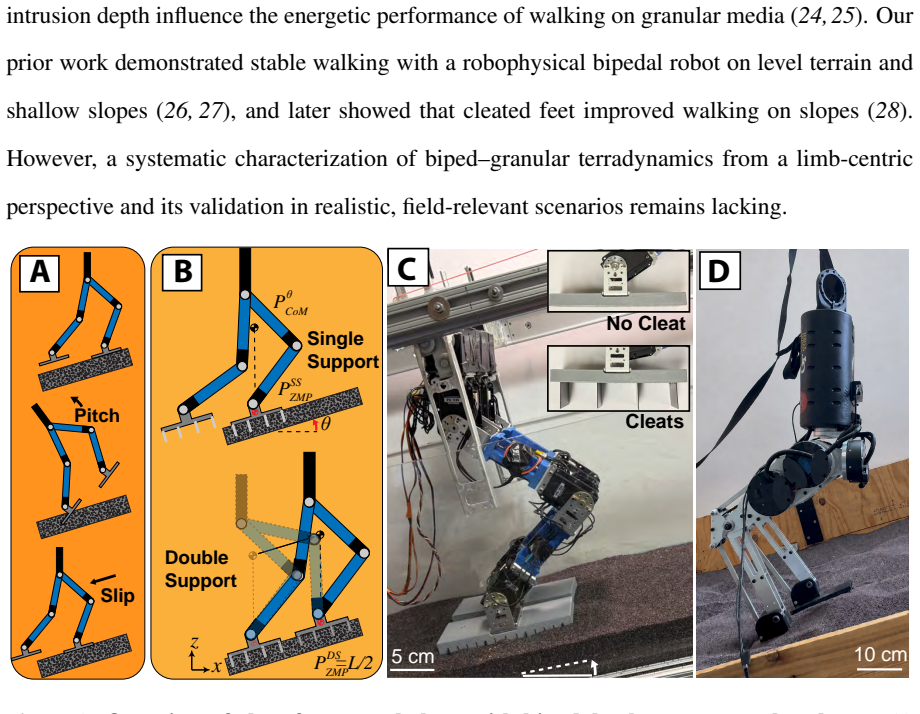
Summary. The manuscript argues that bipedal locomotion on flowable granular slopes can be made robust by a limb-centric strategy that shapes terrain response through cleated feet, rather than by body-centric regulation of robot states alone. Using the planarized 1.4 kg robophysical biped BLUEY, the authors systematically vary cleat spacing (sparse 12 cm, intermediate/effective 4 cm, dense 1 cm), depth (1–3 cm), and slope (0–30°). Slip heatmaps, sidewall PIV, and dual-plate intrusion/drag force measurements show that sparse cleats produce trailing-edge fluidization and pitching failure, dense cleats produce excessive insertion resistance (or incomplete penetration on level ground), while intermediate spacing keeps substrate stresses near or below yield, solidifies the volume under the foot, and enables sustained walking up to 30°. These principles are embodied in a current-sensing retractable-cleat foot that transitions between rigid and granular surfaces, and are transferred to the 15 kg unconstrained biped HECTOR under closed-loop MPC on a 15° slope, where the same intermediate spacing again outperforms sparse, dense, and no-cleat feet.
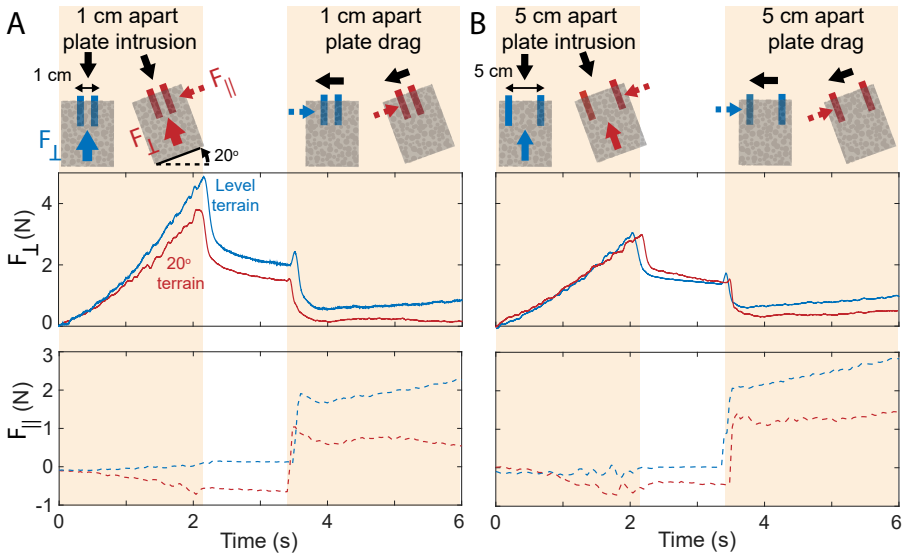
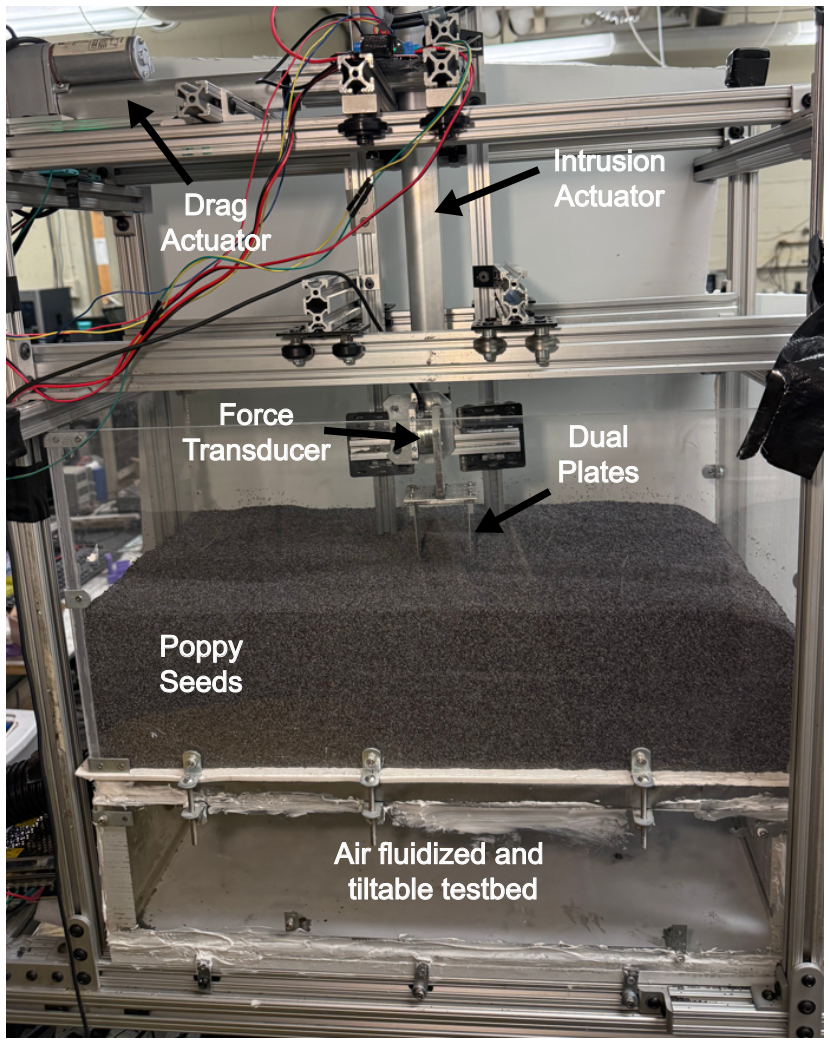
Significance. If the result holds, the work supplies a concrete, experimentally grounded alternative to purely body-centric bipedal control on yielding media: design the foot so that contact forces remain near the substrate yield threshold. The combination of controlled robophysical performance maps (Fig. 3), particle-flow visualization (Fig. 4), dual-plate force curves that mechanistically explain the observed failure modes (Figs. 5, 8), an adaptive-depth foot demonstration (Fig. 6), and successful transfer to a larger closed-loop platform (Fig. 7) is a substantial contribution to terradynamics-informed legged robotics. The authors correctly flag the substrate- and scale-dependence of the optimal spacing; within the tested regime the evidence is strong and the design principles are immediately usable.
major comments (3)
- The central claim that intermediate spacing “maintains substrate stresses near (or below) the yield threshold” is supported only by qualitative PIV solidification patterns (Fig. 4 B,D) and by the dual-plate force trends (Figs. 5, 8). No local stress or yield-stress measurement under the multi-cleat foot is reported. A quantitative estimate (e.g., force per unit area under the foot versus an independent yield-stress measurement of the poppy-seed bed, or DEM force-chain statistics) would make the mechanistic claim load-bearing rather than interpretive. Without it the claim remains plausible but not fully demonstrated.
- HECTOR transfer (Fig. 7) is performed only on a 15° slope with a single commanded speed and a single cleat depth (4 cm). BLUEY succeeds up to 30°. The manuscript asserts that “the principles … translate,” yet the steeper-slope regime that is the paper’s strongest BLUEY result is not tested on the larger platform. Either additional HECTOR trials at higher angles (or an explicit statement that 15° is the current hardware limit) or a scaling argument that predicts the expected performance drop would strengthen the transfer claim.
- All locomotion and force data are obtained with 1 mm poppy seeds at two packing fractions (~58 % and ~61 %). The Discussion correctly notes that particle size, shape and density may alter optimal spacing, but the manuscript still presents 4 cm as “effective” without a dimensionless characterization (e.g., spacing relative to particle diameter or to the size of the plastic zone under a single plate). A short scaling analysis or a second substrate would convert the empirical optimum into a transferable design rule.
minor comments (5)
- Fig. 3 caption states “mean slip value of three trials” but no error bars or standard deviations are shown on the heatmap; adding them (or a supplementary table) would let the reader judge trial-to-trial variability.
- The term “effective cleat spacing” is introduced as an invented label for the 4 cm case. Consider defining it once as “intermediate (4 cm) spacing, hereafter called effective” to avoid implying a priori optimality.
- Eqs. (1)–(3) for the slope-adept ZMP gait are clear, but the rotation matrix R_x(θ) is written as acting on a 2-D vector while being declared ∈ R^{3 imes3}; a brief clarification of the embedding would help.
- Several self-citations supply the BLUEY and HECTOR platforms; a short sentence distinguishing what is new (performance maps, force data, adaptive foot, HECTOR cleat transfer) from prior platform descriptions would improve novelty disclosure.
- Typographical: “solid– and fluid–like” (abstract/intro) should be “solid- and fluid-like”; “poppy seed” vs “poppy seeds” is inconsistent; arXiv identifier in the header is 2607.11855 (future-dated).
Circularity Check
No circularity: purely experimental terradynamics study whose intermediate-spacing claim is measured, not derived from fitted or self-defined inputs.
full rationale
The paper's load-bearing claims (intermediate ~4 cm cleat spacing keeps substrate stresses near/below yield, enabling BLUEY walking to 30° and transfer to an adaptive foot plus HECTOR) rest on new empirical measurements: slip heatmaps (Fig. 3), sidewall PIV solidification patterns (Fig. 4), dual-plate intrusion/drag forces (Figs. 5, 8), adaptive-cleat transitions (Fig. 6), and HECTOR displacement curves (Fig. 7). Cleat spacing and depth are free design parameters systematically varied; none is fitted to a subset of the same data and then re-presented as a prediction. The slope-adept ZMP gait (Eqs. 1–3) is an open-loop kinematic constraint taken from prior literature and used only to stabilize the platform so that cleat–terrain effects can be isolated; it does not encode or force the intermediate-spacing result. Self-citations supply the BLUEY/HECTOR platforms and earlier level-terrain baselines but are not invoked as uniqueness theorems or as the sole support for the yield-threshold interpretation. No equation reduces a claimed first-principles prediction to a quantity defined by the same fit, and the Discussion explicitly flags the substrate- and scale-dependence of the observed optimum. The derivation chain is therefore self-contained experimental evidence, not circular.
Assumptions & free parameters
free parameters (4)
- cleat spacings tested =
1 / 4 / 12 cm (BLUEY); 1 / 4 / 16 cm (HECTOR)
- cleat depths =
1–3 cm / 4 cm
- gait parameters (step length, period, CoM height) =
e.g. 10 cm stride, 1–4 s period, 18 cm CoM
- current threshold for adaptive cleat deployment =
ε (unspecified numerical value)
assumptions (4)
- domain assumption Granular media possess a yield stress; stresses above it produce fluid-like flow and loss of load-bearing capacity.
- domain assumption Intrusion and drag forces on thin plates scale with depth and exhibit cooperative (non-additive) effects at small spacing.
- ad hoc to paper A quasi-static ZMP-constrained gait that keeps ankle moment near zero isolates foot–terrain interaction from body dynamics sufficiently for the comparison of cleat designs.
- domain assumption Poppy seeds (1 mm, volume fraction ~58–61 %) are a representative model of flowable natural slopes.
invented entities (1)
-
effective cleat spacing
Cite this review
Pith. "Pith review of Robust bipedal locomotion on flowable slopes via foot-driven terrain manipulation." pith.science (2026). https://pith.science/paper/X45SVKR7
@misc{pith2026260711855,
  author       = {Pith},
  title        = {Pith review of: Robust bipedal locomotion on flowable slopes via foot-driven terrain manipulation},
  year         = {2026},
  howpublished = {\url{https://pith.science/paper/X45SVKR7}},
  note         = {Machine review of arXiv:2607.11855}
}
read the original abstract
Bipedal robots are challenging to control because they operate close to instability, where small variations in foot-terrain contact can rapidly destabilize locomotion. On rigid terrain, bipedal robots mitigate this fragility by using well-established contact mechanics and control strategies. On flowable surfaces such as granular slopes, foot contact can induce large surface deformations and solid-fluid-like transitions, coupling terrain effects with robot dynamics, leading to underperformance or failure. This is partly due to the lack of reliable methods to represent the dynamics of flowable terrain, making it difficult to account for terrain effects in locomotion design. Here, we investigate how controlling terrain response can improve bipedal locomotion on granular slopes by studying the terradynamics of cleated feet, thin plates emanating from the foot soles. Systematic studies of a small-scale (1.4 kg) robophysical biped reveal that cleats with sparse and dense spacing lead to excessive terrain yielding and resistance, respectively, degrading performance and leading to failure. An intermediate cleat spacing distributes interaction forces to maintain substrate stresses near (or below) the yield threshold, enabling walking on granular slopes up to 30 degrees. Guided by these principles, we design a foot that actively adjusts cleat depth and accommodates both rigid and granular terrain. We also demonstrate that the principles of effective foot-terrain interaction translate to a larger (15 kg) autonomous biped. Our study presents an alternative to conventional body-centric robot control approaches, which regulate terrain-induced effects through body motion, by instead regulating terrain interactions through limb-centric approach.
Figures


Figures from the paper (10 more)



Reference graph
Works this paper leans on
-
[1]
C. G. Atkeson,et al.,The DARPA Robotics Challenge Finals: Humanoid Robots to the Rescue(Springer, 2018), pp. 667–684
2018
-
[2]
Holmes, R
P. Holmes, R. J. Full, D. E. Koditschek, J. Guckenheimer,SIAM Review48, 207 (2006)
2006
-
[3]
Gu,et al.,IEEE Transactions on Robotics41, 4300 (2025)
Z. Gu,et al.,IEEE Transactions on Robotics41, 4300 (2025)
2025
-
[4]
Reher, A
J. Reher, A. D. Ames,Annual Review of Control, Robotics, and Autonomous Systems4, 535 (2021)
2021
-
[5]
S. F. Roberts, D. E. Koditschek, RHex slips on granular media,Technical report, University of Pennsylvania (2016). ScholarlyCommons Technical Reports, Department of Electrical and Systems Engineering
2016
-
[6]
C. Li, T. Zhang, D. I. Goldman,Science339, 1408 (2013)
2013
-
[7]
Kamrin, K
K. Kamrin, K. M. Hill, D. I. Goldman, J. E. Andrade,Annual Review of Fluid Mechanics 56, 215 (2024)
2024
-
[8]
Radosavovic,et al.,Science Robotics9, eadi9579 (2024)
I. Radosavovic,et al.,Science Robotics9, eadi9579 (2024)
2024
Show all 38 references
-
[9]
Li,et al.,Proceedings of the 2021 IEEE International Conference on Robotics and Automation (ICRA)(IEEE, 2021), pp
Z. Li,et al.,Proceedings of the 2021 IEEE International Conference on Robotics and Automation (ICRA)(IEEE, 2021), pp. 2811–2817
2021
-
[10]
Choi,et al.,Science Robotics8, eade2256 (2023)
S. Choi,et al.,Science Robotics8, eade2256 (2023)
2023
-
[11]
E. R. Westervelt, J. W. Grizzle, D. E. Koditschek,IEEE Transactions on Automatic Control 48, 42 (2003)
2003
-
[12]
A. D. Ames,IEEE Transactions on Automatic Control59, 1115 (2014). 36
2014
-
[13]
Hereid,et al.,Proceedings of the 17th International Conference on Hybrid Systems: Computation and Control(2014), pp
A. Hereid,et al.,Proceedings of the 17th International Conference on Hybrid Systems: Computation and Control(2014), pp. 263–272
2014
-
[14]
Mazouchova, N
N. Mazouchova, N. Gravish, A. Savu, D. I. Goldman,Biology Letters6, 398 (2010)
2010
-
[15]
Marvi,et al.,Science346, 224 (2014)
H. Marvi,et al.,Science346, 224 (2014)
2014
-
[16]
X. Liao, F. Qian,arXiv preprint arXiv:2603.06928(2026)
2026 arXiv
-
[17]
Kolvenbach,et al.,Field Robotics2, 910 (2022)
H. Kolvenbach,et al.,Field Robotics2, 910 (2022)
2022
-
[18]
Yao,et al.,IEEE/ASME Transactions on Mechatronics29, 4039 (2024)
C. Yao,et al.,IEEE/ASME Transactions on Mechatronics29, 4039 (2024)
2024
-
[19]
Shi,et al.,IEEE Robotics and Automation Letters9, 6720 (2024)
G. Shi,et al.,IEEE Robotics and Automation Letters9, 6720 (2024)
2024
-
[20]
Godon, A
S. Godon, A. Ristolainen, M. Kruusmaa,Bioinspiration & Biomimetics19, 066009 (2024)
2024
-
[21]
Piazza, C
C. Piazza, C. Della Santina, G. Grioli, A. Bicchi, M. G. Catalano,IEEE Transactions on Robotics40, 3290 (2024)
2024
-
[22]
Guo,et al.,Proceedings of the 2020 3rd IEEE International Conference on Soft Robotics (RoboSoft)(IEEE, 2020), pp
X. Guo,et al.,Proceedings of the 2020 3rd IEEE International Conference on Soft Robotics (RoboSoft)(IEEE, 2020), pp. 550–557
2020
-
[23]
Tyler,et al.,IF AC-PapersOnLine56, 523 (2023)
T. Tyler,et al.,IF AC-PapersOnLine56, 523 (2023)
2023
-
[24]
X. Chen, X. Huang, J. Yi, J. W. Shan, T. Liu,IEEE/ASME Transactions on Mechatronics (2025). Accepted/In press
2025
-
[25]
X. Chen, A. Anikode, J. Yi, T. Liu,Proceedings of the 2024 IEEE International Conference on Robotics and Automation (ICRA)(IEEE, 2024), pp. 13093–13099
2024
-
[26]
Xiong, A
X. Xiong, A. D. Ames, D. I. Goldman,Proceedings of the 2017 IEEE/RSJ International Conference on Intelligent Robots and Systems (IROS)(IEEE, 2017), pp. 4552–4559. 37
2017
-
[27]
J. R. Gosyne, C. M. Hubicki, X. Xiong, A. D. Ames, D. I. Goldman,Proceedings of the 2018 IEEE-RAS 18th International Conference on Humanoid Robots (Humanoids)(IEEE, 2018), pp. 994–1001
2018
-
[28]
Karsai,et al.,Advanced Intelligent Systems4, 2200119 (2022)
A. Karsai,et al.,Advanced Intelligent Systems4, 2200119 (2022)
2022
-
[29]
Mikolajczyk,et al.,Sensors22, 4440 (2022)
T. Mikolajczyk,et al.,Sensors22, 4440 (2022)
2022
-
[30]
J. Li, J. Ma, O. Kolt, M. Shah, Q. Nguyen,arXiv preprint arXiv:2312.11868(2023)
2023 arXiv
-
[31]
Kamohara, F
J. Kamohara, F. Wu, C. Wamorkar, S. Hutchinson, Y . Zhao,Proceedings of the 2026 IEEE International Conference on Robotics and Automation (ICRA)(2026). Accepted; arXiv:2509.18466
2026
-
[32]
Pravin,et al.,Physical Review E104, 024902 (2021)
S. Pravin,et al.,Physical Review E104, 024902 (2021)
2021
-
[33]
Agarwal, A
S. Agarwal, A. Karsai, D. I. Goldman, K. Kamrin,Soft Matter17, 7196 (2021)
2021
-
[34]
Gravish, P
N. Gravish, P. B. Umbanhowar, D. I. Goldman,Physical Review E89, 042202 (2014)
2014
-
[35]
Mazouchova, P
N. Mazouchova, P. B. Umbanhowar, D. I. Goldman,Bioinspiration & Biomimetics8, 026007 (2013)
2013
-
[36]
X. He, Q. Guo, Y . Xu, L. Feng, J. Wang,Journal of Fluid Mechanics954, A34 (2023)
2023
-
[37]
Kajita,et al.,Proceedings of the 2003 IEEE International Conference on Robotics and Automation (ICRA)(IEEE, 2003), vol
S. Kajita,et al.,Proceedings of the 2003 IEEE International Conference on Robotics and Automation (ICRA)(IEEE, 2003), vol. 2, pp. 1620–1626
2003
-
[38]
Askari, K
H. Askari, K. Kamrin,Nature Materials15, 1274 (2016). 38
2016
Reviewed July 14, 2026 · model on record in the stance chip above.
Discussion (0). Sign in to comment.