REVIEW 4 major objections 6 minor 1 cited by
InverTwin: Solving Inverse Problems via Differentiable Radio Frequency Digital Twin
T0 review · 4 major / 6 minor · reviewed 2026-08-05 · deepseek-v4-flash
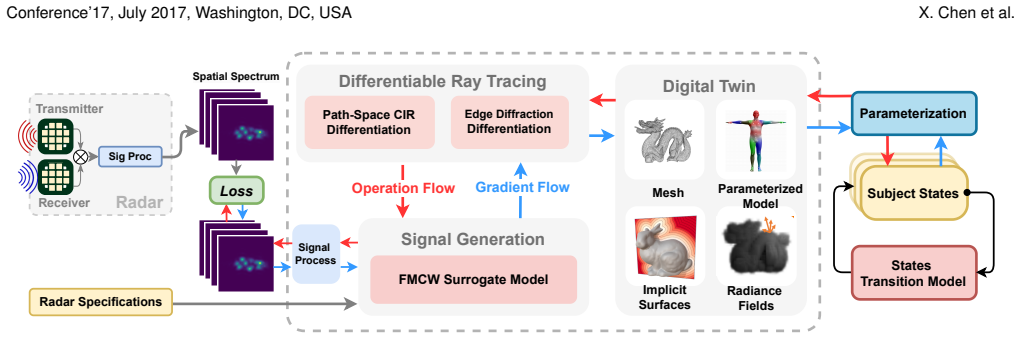
Pith's one-line read The paper claims that making the entire RF simulation chain differentiable end to end — via path-space differentiation and a radar surrogate model — lets an optimizer recover scene geometry, pose, and material directly from radar signals.
desk verdict Genuine new idea in differentiable RF simulation, but the evidence is a self-consistency check; send to review for major revision, not desk reject. read the letter →
The pith
A machine-rendered reading of the paper's core claim, the machinery that carries it, and where it could break.
The reading
What carries the argument
The chain-rule decomposition of the gradient of the spatial spectrum with respect to scene parameters, supported by two mechanisms. Path-space CIR differentiation reformulates the channel impulse response as an integral over propagation paths in a reparameterized reference domain, so geometric edges become interior points; silhouette-edge boundary terms are handled by boundary path segmentation and a Monte Carlo estimator, giving gradients of delay, amplitude, and phase with respect to scene parameters. The radar surrogate model substitutes the discrete-Fourier range profile with a sum of Gaussian pulses centered on path delays, with analytic derivatives, and replaces beamforming or MUSIC ou
What would settle it
Set up a real FMCW radar with one object at a known position, build a digital twin of the room, and run InverTwin from a perturbed object position. If the optimizer drives the object toward ground truth on the surrogate-generated signal but the same loss computed on the measured signal does not decrease (or decreases while the position moves away), the surrogate-fidelity premise fails.
Extended reading notes
Core claim
The central claim is that inverse RF problems can be solved as optimization once the simulation is differentiable end to end. InverTwin decomposes the gradient of the radar spatial spectrum with respect to scene parameters through three stages — spatial spectrum to range profile, range profile to channel impulse response (delay, amplitude, phase), and impulse response to scene parameters — and computes each piece with automatic differentiation. The two innovations that make this tractable are path-space CIR differentiation, which reparameterizes the propagation domain so sharp and silhouette edges no longer create non-differentiable integrands and estimates the boundary terms by Monte Carlo,
Load-bearing premise
The load-bearing premise is that the smoothed Gaussian-pulse surrogate model preserves enough of the real FMCW radar signal's physical information that optimizing against it recovers true scene parameters — a premise the paper supports with simulator-based tests but not with measured radar comparison, even though it concedes ray tracing cannot model absolute phase accurately.
Editorial extensions
If this is right
- Scene geometry, pose, and material can be recovered from radar measurements by optimization alone, without collecting task-specific training data or fine-tuning a model.
- Data-driven RF sensing systems gain a test-time adaptation mechanism: a pretrained perception model can be improved in the loop as the digital twin is fitted to a new scene.
- Hybrid model/data-driven constraints, such as pre-trained shape priors, can be plugged into the optimizer to restrict the search space and improve convergence on structured objects.
- The differentiable simulator can be embedded in robotic training loops, letting gradients flow from radar observations through simulation into a control policy.
Reading between the lines
- The paper does not test the surrogate against measured radar range profiles or full-wave simulation; an ablation varying the random phase assignment in the spatial-spectrum surrogate would reveal how much of the reported convergence depends on that heuristic.
- The path-space differentiation machinery is not FMCW-specific and likely carries over to OFDM, ultra-wideband, or Wi-Fi sensing, where the same phase periodicity and edge discontinuities appear.
- If surrogate fidelity holds, the same bidirectional gradient chain could extend to inverse design problems — placing antennas, scatterers, or meta-material tags to produce a desired radar response.
- The case studies are demonstrative rather than quantitative reconstruction benchmarks; a head-to-head with measured radar data would be the natural next test of the central premise.
Editorial analysis
A structured set of objections, weighed in public.
Referee Report
Summary. The paper proposes InverTwin, a differentiable RF simulation framework for solving inverse problems, i.e., recovering scene parameters (geometry, pose, material) from observed radar measurements by gradient-based optimization. The method decomposes the derivative of the spatial spectrum w.r.t. scene parameters through the CIR and range-profile stages (Eq. 1), using path-space differentiation and reparameterization to handle discontinuities (Sec. 3.3) and surrogate models—a Gaussian range-profile surrogate (Eq. 17) and an Airy-disc spatial-spectrum surrogate with random phase (Eq. 20)—to mitigate local non-convexity. The authors implement the system in C++/CUDA/PyTorch and report a gradient microbenchmark on a synthetic letter-A scene. They claim three case studies (test-time adaptation, hybrid RF-visual sensing, physically constrained optimization) but do not present their results.
Significance. If substantiated, InverTwin would be a meaningful advance toward physics-based inverse RF sensing and simulation-in-the-loop optimization, with applications in digital twin construction, robotics, and data augmentation. The paper adapts ideas from differentiable rendering to RF and explicitly implements a custom hardware-accelerated pipeline, which is a nontrivial engineering contribution. It also candidly identifies the limitation of ray tracing regarding absolute phase. However, the current manuscript does not establish the central claim: there is no end-to-end inverse reconstruction result, no validation against measured or full-wave radar data, and the surrogate model's fidelity is unexamined. Consequently, the significance of the proposed framework cannot be assessed beyond the conceptual proposal.
major comments (4)
- [Section 5, Section 7] The central claim—that InverTwin solves inverse problems and 'uniquely deduces simulation inputs from outputs'—is not evaluated. The only experimental section, 5.1, reports a gradient microbenchmark on a synthetic letter-A scene, not an end-to-end recovery of scene parameters. The three case studies promised in Section 1 are never presented with any results. No quantitative reconstruction of θ* from simulated or measured radar data appears anywhere. This missing evidence directly undermines the paper's title and conclusion.
- [Sec. 3.4, Eqs. (17), (20)] The optimization in Eq. (21) uses the surrogate forward model, not the actual FMCW processing of Eqs. (15)–(16). The surrogate has free parameters σ and a randomly assigned phase. No comparison with measured radar range profiles or full-wave simulation is provided, so there is no support that optimizing against the surrogate yields physically correct scene parameters. In particular, Eq. (20) assigns each path a random phase, contradicting the paper's own statement in Sec. 2.1 that ray tracing can represent relative phase between paths; random phase destroys relative phase information and makes the interference pattern non-physical.
- [Sec. 5.1] The finite-difference ground truth is computed from the same surrogate model (Eq. 17) that InverTwin differentiates. Because the surrogate is designed to be smooth, this self-consistency check cannot validate gradient accuracy with respect to true radar signals. The reported MAE comparisons (0.59 vs. 0.63/0.69) are relative only under the same synthetic surrogate and lack error bars. This does not support the claim that InverTwin estimates gradients of simulated signals accurately in any physically meaningful sense.
- [Sec. 3.4.2] The spatial-spectrum surrogate's differentiability is stated to be 'detailed in the anonymous supplementary material due to space constraints.' That material is not part of the manuscript. Since this component provides the first factor in the chain rule (Eq. 1), omitting its derivation prevents verification of a key technical claim. The manuscript should either include the derivation or clearly state the surrogate as an assumption.
minor comments (6)
- [Eq. (3)] The Fourier transform expression uses 'e^{-j2θ f t}'; θ is likely a typo for π. Please correct to e^{-j2π f t}.
- [Eq. (17)] The definition of G_i is ambiguous: the denominator index j is not defined, and the text refers to a 'modified Gaussian kernel P_i' although the symbol used is G_i. Please clarify the indexing and notation.
- [Sec. 4.2] The loss function and the Laplacian matrix are both denoted L, which is confusing. Use separate symbols, e.g., L_loss and L_laplacian.
- [Sec. 5.1] The MAE values are reported without standard deviations or significance tests. Given the small differences (0.59 vs. 0.63/0.69), this is a presentation concern.
- [Figs. 6, 7, 9] These figures are illustrative but have no captioned results, axes, or associated experiments. If they are meant as evidence, they need proper captions and quantitative support; otherwise they should be moved to a concept figure.
- [Sec. 3.3.5] The derivation of Eq. (13) swaps a sum over path lengths N with an integral over path space and applies the divergence theorem to non-smooth integrands. A brief justification of this interchange and the existence conditions would be helpful.
Circularity Check
Gradient validation is a self-consistency check against the same surrogate forward model; inverse-problem claims rest on unvalidated surrogate fidelity.
-
self definitional
[Section 5.1 (Gradient Estimation Evaluation), with Eqs. (17), (19), (21)]
"We use the FD method as the ground truth. Even with the surrogate model to overcome nonconvexity, Metawave and Sionna (Fig. 8g,h) fail to accurately capture gradients, particularly around edges, achieving an MAE of 0.63 and 0.69, respectively. Our path space differentiation approach (Sec. 3.3) explicitly handles the edge discontinuities, allowing InverTwin to preserve critical details of the scene, decreasing the MAE to 0.59."
The finite-difference (FD) ground truth is computed on the same forward function that InverTwin differentiates—the radar surrogate model of Eq. (17), with derivatives in Eq. (19). Thus the comparison measures whether InverTwin's analytic derivatives match numerical derivatives of the identical simulated function. This is a self-consistency/implementation check, not a test against measured or full-wave radar data. Since the inverse problem in Eq. (21) optimizes a loss between S(θ) and observations y, the reported gradient accuracy is guaranteed (up to numerical error) to hold for the surrogate itself; it does not establish that optimizing through the surrogate recovers physically correct scene parameters. The paper's conclusion that InverTwin 'uniquely deduces simulation inputs from outputs
full rationale
The path-space CIR differentiation (Sec. 3.3) is adapted from external differentiable-rendering methods [19, 40] and is not circular. The radar surrogate model (Eq. 17) is an explicit design choice to smooth the loss landscape; its Gaussian form guarantees smoothness, so that part is definitional by design. The central circularity is in evaluation: Section 5.1 validates gradients against FD of the same surrogate, so the 'accurate gradients' result is a tautology w.r.t. the forward model. No end-to-end inverse reconstruction, object shape estimation, or 3D reconstruction experiment is actually reported in this version, despite claims in the introduction. The paper also concedes in Sec. 2.1 that ray tracing cannot accurately simulate absolute phase, yet Eq. (20) assigns random phases in the spatial-spectrum surrogate; this disconnects the surrogate's interference pattern from physical phase relationships. That is a fidelity/validity risk rather than a formal circularity, but it compounds the issue: recovering θ* by minimizing L(S(θ), y) is only meaningful if S faithfully models y, and no evidence (measured radar data or full-wave comparison) is provided. Self-citations [3, 4] appear only in related work and are not load-bearing. Overall, the derivation chain itself is not circular, but the only reported experimental support for the central claim is a self-referential gradient check, giving partial circularity (score 5).
Assumptions & free parameters
free parameters (3)
- sigma (Gaussian pulse width) =
not specified
- random phase in spatial spectrum surrogate =
uniform [0, 2*pi]
- optimizer hyperparameters learning rate and regularization weight =
not specified
assumptions (6)
- standard math Reynolds transport theorem and divergence theorem justify the path-space boundary integrals in Eqs. (5), (8), and (13).
- domain assumption Geometric ray tracing with UTD diffraction is an adequate forward model for RF sensing, including relative phase accuracy.
- domain assumption Sharp and silhouette edges are the dominant sources of non-differentiability and can be removed by reparameterizing surfaces from a reference manifold.
- ad hoc to paper The Gaussian surrogate range profile (Eq. 17) with width sigma accurately approximates the true radar range profile and its gradients.
- ad hoc to paper The Airy-disc spatial spectrum surrogate with random phase (Eq. 20) preserves the physical interference behavior needed for inverse reconstruction.
- domain assumption MUSIC and beamforming spatial spectrum algorithms are differentiable with respect to the range profile.
Cite this review
Pith. "Pith review of InverTwin: Solving Inverse Problems via Differentiable Radio Frequency Digital Twin." pith.science (2026). https://pith.science/paper/X6DL4BKH
@misc{pith2026250814204,
  author       = {Pith},
  title        = {Pith review of: InverTwin: Solving Inverse Problems via Differentiable Radio Frequency Digital Twin},
  year         = {2026},
  howpublished = {\url{https://pith.science/paper/X6DL4BKH}},
  note         = {Machine review of arXiv:2508.14204}
}
read the original abstract
Digital twins (DTs), virtual simulated replicas of physical scenes, are transforming various industries. However, their potential in radio frequency (RF) sensing applications has been limited by the unidirectional nature of conventional RF simulators. In this paper, we present InverTwin, an optimization-driven framework that creates RF digital twins by enabling bidirectional interaction between virtual and physical realms. InverTwin overcomes the fundamental differentiability challenges of RF optimization problems through novel design components, including path-space differentiation to address discontinuity in complex simulation functions, and a radar surrogate model to mitigate local non-convexity caused by RF signal periodicity. These techniques enable smooth gradient propagation and robust optimization of the DT model. Our implementation and experiments demonstrate InverTwin's versatility and effectiveness in augmenting both data-driven and model-driven RF sensing systems for DT reconstruction.
Figures


Figures from the paper (5 more)


Forward citations
Cited by 1 Pith paper
-
HybridSim: A Physics-Learning Hybrid Digital Twin for mmWave Human Sensing
A decoupled direct-path (BRDF) plus indirect-path (3D Gaussian Splatting) simulator synthesizes mmWave radar heatmaps from human meshes and boosts downstream activity recognition accuracy.
Reference graph
Works this paper leans on
-
[1]
Sai Praveen Bangaru, Lifan Wu, Tzu-Mao Li, Jacob Munkberg, Gilbert Bernstein, Jonathan Ragan-Kelley, Frédo Durand, Aaron Lefohn, and Yong He. Slang. d: Fast, modular and differentiable shader program- ming.ACM Transactions on Graphics (TOG), 42(6):1–28, 2023
work page 2023
-
[2]
Angel X. Chang, Thomas Funkhouser, Leonidas Guibas, Pat Hanra- han, Qixing Huang, Zimo Li, Silvio Savarese, Manolis Savva, Shu- ran Song, Hao Su, Jianxiong Xiao, Li Yi, and Fisher Yu. ShapeNet: An Information-Rich 3D Model Repository. Technical Report arXiv:1512.03012 [cs.GR], Stanford University — Princeton University — Toyota Technological Institute at ...
arXiv 2015
-
[3]
Metawave: Attacking mmwave sensing with meta-material- enhanced tags
Xingyu Chen, Zhengxiong Li, Baicheng Chen, Yi Zhu, Chris Xiaoxuan Lu, Zhengyu Peng, Feng Lin, Wenyao Xu, Kui Ren, and Chunming Qiao. Metawave: Attacking mmwave sensing with meta-material- enhanced tags. InThe 30th Network and Distributed System Security (NDSS) Symposium, volume 2023, 2023
work page 2023
-
[4]
Xingyu Chen and Xinyu Zhang. Rf genesis: Zero-shot generaliza- tion of mmwave sensing through simulation-based data synthesis and generative diffusion models. InACM Conference on Embedded Net- worked Sensor Systems (SenSys ’23), pages 1–14, Istanbul, Turkiye,
-
[5]
Invertible neural brdf for object inverse rendering
Zhe Chen, Shohei Nobuhara, and Ko Nishino. Invertible neural brdf for object inverse rendering. InEuropean Conference on Computer Vision, pages 767–783. Springer, 2020
work page 2020
-
[6]
Through fog high-resolution imaging using millimeter wave radar
Junfeng Guan, Sohrab Madani, Suraj Jog, Saurabh Gupta, and Haitham Hassanieh. Through fog high-resolution imaging using millimeter wave radar. InProceedings of the IEEE/CVF Conference on Computer Vision and Pattern Recognition, 2020
work page 2020
-
[7]
High Resolution Millimeter Wave Imaging For Self-Driving Cars
Junfeng Guan, Sohrab Madani, Suraj Jog, and Haitham Hassanieh. High resolution millimeter wave imaging for self-driving cars.arXiv preprint arXiv:1912.09579, 2019
work page Pith review arXiv 1912
-
[8]
Sionna: An open-source library for next-generation physical layer research.arXiv preprint, Mar
Jakob Hoydis, Sebastian Cammerer, Fayçal Ait Aoudia, Avinash Vem, Nikolaus Binder, Guillermo Marcus, and Alexander Keller. Sionna: An open-source library for next-generation physical layer research.arXiv preprint, Mar. 2022
work page 2022
Show all 44 references
-
[9]
Wenzel Jakob, Sébastien Speierer, Nicolas Roussel, and Delio Vicini. Dr. jit: A just-in-time compiler for differentiable rendering.ACM Transactions on Graphics (TOG), 41(4):1–19, 2022
2022
-
[10]
Towards 3d human pose construction using wifi
Wenjun Jiang, Hongfei Xue, Chenglin Miao, Shiyang Wang, Sen Lin, Chong Tian, Srinivasan Murali, Haochen Hu, Zhi Sun, and Lu Su. Towards 3d human pose construction using wifi. InProceedings of the 26th Annual International Conference on Mobile Computing and Networking, pages 1–14, 2020
2020
-
[11]
Differentiable rendering: A survey.arXiv preprint arXiv:2006.12057, 2020
Hiroharu Kato, Deniz Beker, Mihai Morariu, Takahiro Ando, Toru Matsuoka, Wadim Kehl, and Adrien Gaidon. Differentiable rendering: A survey.arXiv preprint arXiv:2006.12057, 2020
2006 arXiv
-
[12]
m3track: mmwave-based multi-user 3d posture tracking
Hao Kong, Xiangyu Xu, Jiadi Yu, Qilin Chen, Chenguang Ma, Yingying Chen, Yi-Chao Chen, and Linghe Kong. m3track: mmwave-based multi-user 3d posture tracking. InProceedings of the 20th Annual International Conference on Mobile Systems, Applications and Services, pages 491–503, 2022
2022
-
[13]
Finite difference methods for differential equations
Randall J LeVeque. Finite difference methods for differential equations. Draft version for use in AMath, 585(6):112, 1998
1998
-
[14]
Dif- ferentiable monte carlo ray tracing through edge sampling.ACM Trans- actions on Graphics (TOG), 37(6):1–11, 2018
Tzu-Mao Li, Miika Aittala, Frédo Durand, and Jaakko Lehtinen. Dif- ferentiable monte carlo ray tracing through edge sampling.ACM Trans- actions on Graphics (TOG), 37(6):1–11, 2018
2018
-
[15]
Towards domain-independent and real-time gesture recognition using mmwave signal.IEEE Transactions on Mobile Computing, 2022
Yadong Li, Dongheng Zhang, Jinbo Chen, Jinwei Wan, Dong Zhang, Yang Hu, Qibin Sun, and Yan Chen. Towards domain-independent and real-time gesture recognition using mmwave signal.IEEE Transactions on Mobile Computing, 2022
2022
-
[16]
Soli: Ubiquitous gesture sensing with millimeter wave radar.ACM Transac- tions on Graphics (TOG), 35(4):1–19, 2016
Jaime Lien, Nicholas Gillian, M Emre Karagozler, Patrick Amihood, Carsten Schwesig, Erik Olson, Hakim Raja, and Ivan Poupyrev. Soli: Ubiquitous gesture sensing with millimeter wave radar.ACM Transac- tions on Graphics (TOG), 35(4):1–19, 2016
2016
-
[17]
Cardiac scan: A non-contact and continuous heart-based user authentication system
Feng Lin, Chen Song, Yan Zhuang, Wenyao Xu, Changzhi Li, and Kui Ren. Cardiac scan: A non-contact and continuous heart-based user authentication system. InProceedings of the 23rd Annual International Conference on Mobile Computing and Networking, MobiCom ’17, pages 315–328, Ne...
2017
-
[18]
Smpl: A skinned multi-person linear model
Matthew Loper, Naureen Mahmood, Javier Romero, Gerard Pons-Moll, and Michael J Black. Smpl: A skinned multi-person linear model. In Seminal Graphics Papers: Pushing the Boundaries, V olume 2, pages 851–866. 2023
2023
-
[19]
Reparam- eterizing discontinuous integrands for differentiable rendering.ACM Transactions on Graphics (TOG), 38(6):1–14, 2019
Guillaume Loubet, Nicolas Holzschuch, and Wenzel Jakob. Reparam- eterizing discontinuous integrands for differentiable rendering.ACM Transactions on Graphics (TOG), 38(6):1–14, 2019
2019
-
[20]
Inverse lighting for photography
Stephen R Marschner and Donald P Greenberg. Inverse lighting for photography. InColor and Imaging Conference, volume 1997, pages 262–265. Society for Imaging Science and Technology, 1997
1997
-
[21]
Cornell University, 1998
Stephen Robert Marschner.Inverse rendering for computer graphics. Cornell University, 1998
1998
-
[22]
Nerf: Representing scenes as neural radiance fields for view synthesis
Ben Mildenhall, Pratul P Srinivasan, Matthew Tancik, Jonathan T Bar- ron, Ravi Ramamoorthi, and Ren Ng. Nerf: Representing scenes as neural radiance fields for view synthesis. InEuropean conference on computer vision, pages 405–421. Springer, 2020
2020
-
[23]
Nerf: Representing scenes as neural radiance fields for view synthesis.Communications of the ACM, 65(1):99–106, 2021
Ben Mildenhall, Pratul P Srinivasan, Matthew Tancik, Jonathan T Bar- ron, Ravi Ramamoorthi, and Ren Ng. Nerf: Representing scenes as neural radiance fields for view synthesis.Communications of the ACM, 65(1):99–106, 2021
2021
-
[24]
Rtx ray tracing, 2024
NVIDIA Corporation. Rtx ray tracing, 2024. Accessed: 2024-09-05
2024
-
[25]
Prentice-Hall Inc., 1998
Alan V Oppenheim and Ronald T Schafer.Digital signal processing, 2nd Edition. Prentice-Hall Inc., 1998
1998
-
[26]
Deepsdf: Learning continuous signed distance functions for shape representation
Jeong Joon Park, Peter Florence, Julian Straub, Richard Newcombe, and Steven Lovegrove. Deepsdf: Learning continuous signed distance functions for shape representation. InProceedings of the IEEE/CVF conference on computer vision and pattern recognition, pages 165–174, 2019
2019
-
[27]
Optix: a general purpose ray tracing engine.Acm transactions on graphics (tog), 29(4):1–13, 2010
Steven G Parker, James Bigler, Andreas Dietrich, Heiko Friedrich, Jared Hoberock, David Luebke, David McAllister, Morgan McGuire, Keith Morley, Austin Robison, et al. Optix: a general purpose ray tracing engine.Acm transactions on graphics (tog), 29(4):1–13, 2010
2010
-
[28]
Gendr: A generalized differentiable renderer
Felix Petersen, Bastian Goldluecke, Christian Borgelt, and Oliver Deussen. Gendr: A generalized differentiable renderer. InProceed- ings of the IEEE/CVF Conference on Computer Vision and Pattern Recognition, pages 4002–4011, 2022
2022
-
[29]
Radarhd: Demonstrating lidar-like point clouds from mmwave radar
Akarsh Prabhakara, Tao Jin, Arnav Das, Gantavya Bhatt, Lilly Kumari, Elahe Soltanaghai, Jeff Bilmes, Swarun Kumar, and Anthony Rowe. Radarhd: Demonstrating lidar-like point clouds from mmwave radar. InProceedings of the 29th Annual International Conference on Mobile Computing ...
2023
-
[30]
3d point cloud generation with millimeter-wave radar.Proceedings of the ACM on Interactive, Mobile, Wearable and Ubiquitous Technologies, 4(4):1–23, 2020
Kun Qian, Zhaoyuan He, and Xinyu Zhang. 3d point cloud generation with millimeter-wave radar.Proceedings of the ACM on Interactive, Mobile, Wearable and Ubiquitous Technologies, 4(4):1–23, 2020
2020
-
[31]
3d human pose estimation using wifi signals
Yili Ren, Zi Wang, Yichao Wang, Sheng Tan, Yingying Chen, and Jie Yang. 3d human pose estimation using wifi signals. InProceedings of the 19th ACM Conference on Embedded Networked Sensor Systems, pages 363–364, 2021
2021
-
[32]
Osborne Reynolds. Iv. on the dynamical theory of incompressible viscous fluids and the determination of the criterion.Philosophical transactions of the royal society of london.(a.), (186):123–164, 1895
-
[33]
Multiple emitter location and signal parameter estima- tion.IEEE transactions on antennas and propagation, 34(3):276–280, 11 Conference’17, July 2017, Washington, DC, USA X
Ralph Schmidt. Multiple emitter location and signal parameter estima- tion.IEEE transactions on antennas and propagation, 34(3):276–280, 11 Conference’17, July 2017, Washington, DC, USA X. Chen et al. 1986
2017
-
[34]
The ofdm joint radar-communication system: An overview
Yoke Leen Sit, Christian Sturm, Lars Reichardt, Thomas Zwick, and Werner Wiesbeck. The ofdm joint radar-communication system: An overview. InProc. Int. Conf. Advances in Satellite and Space Commu- nications (SPACOMM 2011), pages 69–74, 2011
2011
-
[35]
Laplace-beltrami: The swiss army knife of geometry processing
Justin Solomon, Keegan Crane, and Etienne V ouga. Laplace-beltrami: The swiss army knife of geometry processing. InSymposium on Geom- etry Processing graduate school, volume 2, Cardiff, UK, 2014
2014
-
[36]
Wi-mesh: A wifi vision-based approach for 3d human mesh construction
Yichao Wang, Yili Chen, Yingying Chen, and Jie Yang. Wi-mesh: A wifi vision-based approach for 3d human mesh construction. In Proceedings of the 18th Conference on Embedded Networked Sensor Systems (SenSys), 2022
2022
-
[37]
Inverse texture synthesis
Li-Yi Wei, Jianwei Han, Kun Zhou, Hujun Bao, Baining Guo, and Heung-Yeung Shum. Inverse texture synthesis. InACM SIGGRAPH 2008 papers, pages 1–9. 2008
2008
-
[38]
M4esh: mmwave-based 3d human mesh construc- tion for multiple subjects
Hongfei Xue, Qiming Cao, Yan Ju, Haochen Hu, Haoyu Wang, Aidong Zhang, and Lu Su. M4esh: mmwave-based 3d human mesh construc- tion for multiple subjects. InProceedings of the 18th Conference on Embedded Networked Sensor Systems (SenSys), 2022
2022
-
[39]
mmmesh: towards 3d real-time dynamic human mesh construction using millimeter-wave
Hongfei Xue, Yan Ju, Chenglin Miao, Yijiang Wang, Shiyang Wang, Aidong Zhang, and Lu Su. mmmesh: towards 3d real-time dynamic human mesh construction using millimeter-wave. InProceedings of the 19th Annual International Conference on Mobile Systems, Applications, and Services,...
2021
-
[40]
Path-space differentiable rendering.ACM Trans
Cheng Zhang, Bailey Miller, Kai Yan, Ioannis Gkioulekas, and Shuang Zhao. Path-space differentiable rendering.ACM Trans. Graph., 39(4):143:1–143:19, 2020
2020
-
[41]
Through-wall human mesh recovery using radio signals
Mingmin Zhao, Yingcheng Liu, Aniruddh Raghu, Tianhong Li, Hang Zhao, Antonio Torralba, and Dina Katabi. Through-wall human mesh recovery using radio signals. InProceedings of the IEEE/CVF Interna- tional Conference on Computer Vision, pages 10113–10122, 2019
2019
-
[42]
Rf-based 3d skeletons
Mingmin Zhao, Yonglong Tian, Hang Zhao, Mohammad Abu Alsheikh, Tianhong Li, Rumen Hristov, Zachary Kabelac, Dina Katabi, and An- tonio Torralba. Rf-based 3d skeletons. InProceedings of the 2018 Conference of the ACM Special Interest Group on Data Communication, pages 267–281, 2018
2018
-
[43]
Zero-effort cross-domain gesture recognition with wi-fi
Yue Zheng, Yi Zhang, Kun Qian, Guidong Zhang, Yunhao Liu, Chenshu Wu, and Zheng Yang. Zero-effort cross-domain gesture recognition with wi-fi. InProceedings of the 17th Annual International Conference on Mobile Systems, Applications, and Services, pages 313–325, 2019. 12
2019
-
[2023]
ACM, New York, NY , USA
Reviewed August 5, 2026 · model on record in the stance chip above.
Discussion (0). Sign in to comment.