REVIEW 1 major objections 4 minor 24 references
Ornamentation lattices and intreeval hypergraphic lattices
T0 review · 1 major / 4 minor · reviewed 2026-08-06 · deepseek-v4-flash
Pith's one-line read For unstarred increasing trees, the acyclic reorientation, sourcing, and ornamentation posets converge into a single lattice, and the ornamentation lattice is realized by the path hypergraphic polytope.
desk verdict Solid lattice-theoretic paper with a polytopal realization claim that depends on an unpublished coauthor preprint. read the letter →
The pith
A machine-rendered reading of the paper's core claim, the machinery that carries it, and where it could break.
The reading
What carries the argument
The machinery is a chain of order-preserving surjections between the acyclic reorientation poset of $\operatorname{tc}(D)$, the acyclic sourcing poset of the path hypergraph $\mathbb{P}(D)$, and the acyclic ornamentation poset $\operatorname{AO}(D)$ for a directed graph $D$. For unstarred trees these maps become isomorphisms and lattice quotients. The key geometric device is the hypergraphic polytope $\Delta_{\mathbb{H}} = \sum_{H \in \mathbb{H}} \Delta_H$, a Minkowski sum of standard simplices; its graph, oriented in the direction $\omega = (n-1, n-3, \dots, 3-n, 1-n)$, is identified with the acyclic sourcing poset via the source characterization of [Gél25]. The lattice-theoretic engine is semidistributivity: join- and meet-irreducible ornamentations of a directed tree are exactly the path ornaments $J_P$ and $M_P$, and all of these are acyclic, which drives the MacNeille completion statement.
What would settle it
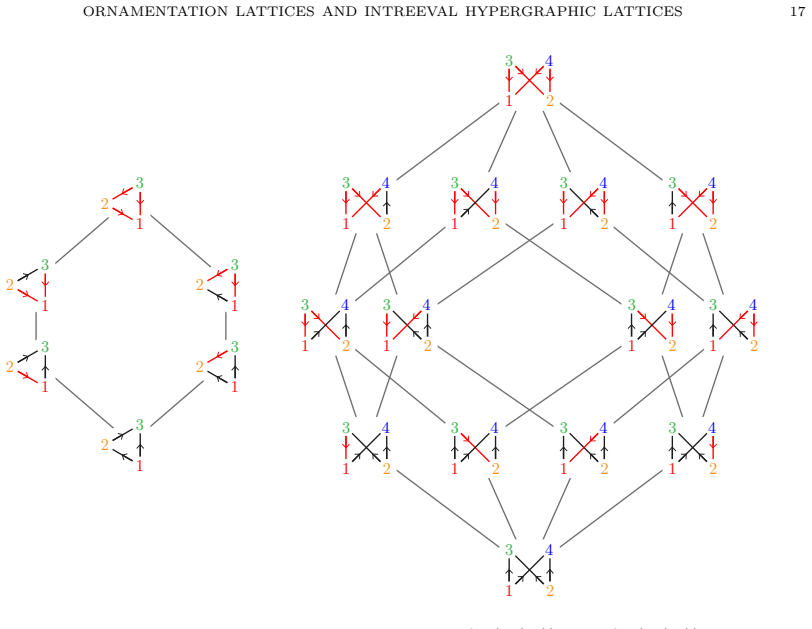
Enumerate all ornamentations of the $(2,3)$-broom (a rooted tree) and compare the resulting Hasse diagram with the graph of $\Delta_{\mathbb{P}(T)}$ oriented in direction $\omega$; any mismatch in order or in cardinality would falsify the claimed polytopal realization.
Extended reading notes
Core claim
The central result is Theorem 1.4. For an unstarred increasing tree $T$ (rooted trees with edges oriented toward the root are the main example), the acyclic reorientation poset $\operatorname{AR}(\operatorname{tc}(T))$, the acyclic sourcing poset $\operatorname{AS}(\mathbb{P}(T))$, and the acyclic ornamentation poset $\operatorname{AO}(T)$ are all lattices; every ornamentation of $T$ is acyclic, so $\operatorname{AS}(\mathbb{P}(T)) \simeq \operatorname{AO}(T) = O(T)$; the map sending a reorientation to its induced ornamentation is a surjective lattice map, making $O(T)$ a lattice quotient of $\operatorname{AR}(\operatorname{tc}(T))$; and $O(T)$ is isomorphic to the transitive closure of the graph of the path hypergraphic polytope $\Delta_{\mathbb{P}(T)}$ oriented in direction $\omega$. The polytopal part settles the open question of finding geometric realizations for ornamentation lattices of rooted trees. A second theorem characterizes, for an increasing tree $T$, which subhypergraphs $I$ of $\mathbb{P}(T)$ have $\operatorname{AS}(I)$ a lattice: exactly the path-intersection-closed and star-sparse ones.
Load-bearing premise
The geometric statement of Theorem 1.4(4) depends on a source characterization from [Gél25]—that the acyclic sourcing poset of any hypergraph is the transitive closure of the graph of its hypergraphic polytope oriented in direction $\omega$—which is not proved in this paper, so the polytopal realization is established only conditional on that external result.
Editorial extensions
If this is right
- For rooted and unstarred increasing trees, ornamentation lattices now come with explicit polytopal models, so questions about their order, congruences, and enumeration can be attacked geometrically.
- The ornamentation lattice being a quotient of the acyclic reorientation lattice of the transitive closure transfers the theory of lattice congruences and quotient lattices to ornamentations.
- All ornamentations of an unstarred tree are acyclic; cyclic ornamentations exist only beyond this class, so the acyclic ornamentation poset equals the full ornamentation lattice exactly in the unstarred case.
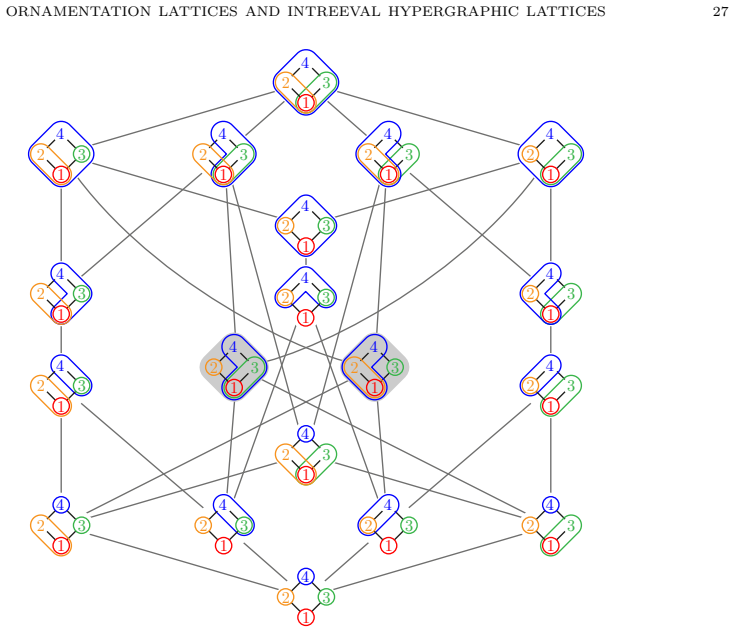
- For any increasing tree, the ornamentation lattice is the MacNeille completion of the acyclic sourcing poset, making the two objects equivalent at the level of lattice completions.
- Subhypergraphs of a path hypergraph whose acyclic sourcing poset is a lattice are fully characterized by path-intersection-closedness and star-sparsity, extending the interval hypergraph classification.
Reading between the lines
- I would test Conjecture 1.5 (a polytopal realization for every directed graph) on small starred trees, where cyclic ornamentations exist and the MacNeille completion is strictly larger than the acyclic poset; a counterexample there would delimit the conjecture.
- The quasi-lattice map from the ornamentation lattice to the acyclic sourcing poset of Section 6 gives a general sufficient condition for acyclic sourcing posets to be lattices; the same template may apply to hypergraphs beyond path hypergraphs, such as those from graph associahedra.
- The bijection between comb ornamentations and labeled Dyck paths suggests that ornamentation lattices of other rooted families might be indexed by variations of Dyck paths, hinting at an unlabeled statistic that could appear in other lattice quotients.
- Because path-intersection-closedness and star-sparsity are decidable conditions, Theorem 1.6 yields an efficient recognition algorithm for intreeval hypergraphs with lattice acyclic sourcing posets, not just a structural characterization.
Editorial analysis
A structured set of objections, weighed in public.
Referee Report
Summary. The paper studies three families of posets attached to a directed graph D: the acyclic reorientation poset of its transitive closure tc(D), the acyclic sourcing poset of its path hypergraph P(D), and the (acyclic) ornamentation poset of D. The authors establish order-preserving surjections among these posets and then specialize to increasing trees. For an increasing tree T they prove that the ornamentation lattice O(T) is semidistributive, describe its join and meet irreducibles, and show that O(T) is the MacNeille completion of AS(P(T)) and that the transitively biclosed reorientation lattice is the MacNeille completion of AR(tc(T)). For unstarred trees (which include rooted trees) they prove that all ornamentations are acyclic, that AS(P(T)) is isomorphic to O(T) and is a lattice quotient of AR(tc(T)), and that O(T) is isomorphic to the transitive closure of the graph of the path hypergraphic polytope P(P(T)) oriented in a linear direction, thereby answering a question of Defant and Sack for that family. The final section characterizes the subhypergraphs of P(T) whose acyclic sourcing poset is a lattice in terms of path intersection closedness and star sparsity, generalizing the interval hypergraph results of Bergeron–Pilaud.
Significance. If the results hold, the paper gives a clean conceptual unification of three Tamari-like hierarchies and answers the Defant–Sack polytopal realization question for rooted and unstarred trees. The combinatorial parts are detailed and self-contained: the semidistributivity proof, the MacNeille completion arguments, the lattice-quotient statement, and the Section 6 characterization are all argued from explicit definitions with full proofs. The paper also provides concrete enumerative results for brooms and combs, with generating functions and bijections. The main weakness is that the geometric bridge used for the headline polytopal realization is not established in this manuscript but is cited to an in-preparation coauthor preprint [Gél25]; the stress-test concern on this point is valid and is the only load-bearing gap I found. For the non-geometric results, the paper is convincing and well within the standards of the field.
major comments (1)
- [§3.2 (Remark 3.8), §5.2 (Theorem 1.4(4), Corollary 5.9)] The polytopal realization of O(T) is not established by the present paper alone. The identification of AS(H) with the transitive closure of the graph of the hypergraphic polytope oriented in direction ω is attributed to [Gél25], an in-preparation preprint by a coauthor, and no proof appears in the manuscript. Since this identification is exactly the step that converts the combinatorial isomorphism AS(P(T)) ≅ O(T) into the claimed isomorphism between O(T) and the oriented graph of △P(T), the answer to the Defant–Sack question is conditional on an unpublished external result. Please either include a proof of the needed source characterization (at least for path hypergraphs of unstarred trees, which is all that Theorem 1.4(4) requires) or cite a publicly available complete source. Without this, Theorem 1.4(4) and Corollary 5.9 should be rephrased as conditional on [Gél25].
minor comments (4)
- [§5.2, Proposition 5.5] The acyclicity of SO is only asserted with "the proof is similar", but prop. 5.5 is load-bearing for Theorem 1.4(2). A short argument would be useful: since RO = RSO by Lemma 2.42 and RO is acyclic, a directed cycle in SO would yield a directed cycle in rev(RSO), contradicting the acyclicity already established.
- [§3.3, Definition 3.30] The notation AOS and AOR is easy to confuse with OS and OR, especially because the subscript can be a reorientation or a sourcing. Consider a typographic distinction or a clearer naming convention, for instance using a bar or a superscript.
- [§6.4, Lemma 6.26] The proof jumps from S1(J) ≤ S2(J) < S1(I) ≤ S2(I) to the assertion that min(J) ≤ S1(J) < min(I ∩ J) and max(I) ≥ S2(I) > max(I ∩ J). This is correct when S1 and S2 are acyclic, but a one-sentence justification would help the reader.
- [References] The dependence on [Gél25] and [Sac25], both in-preparation and both by coauthors, should be resolved before publication. If they remain unavailable, the statements that rely on them should be restricted to results proved in this paper.
Circularity Check
Theorem 1.4(4) leans on a coauthor's in-preparation hypergraphic poset theorem; the lattice-theoretic core is self-contained.
-
self citation load bearing
[Remark 3.8 and Corollary 5.9 (used in Theorem 1.4(4))]
"In particular, it is proved in [G´el25] that the transitive closure of the graph of △H, oriented in the direction ω, is isomorphic to the acyclic sourcing poset AS(H)."
The geometric realization of O(T) in Theorem 1.4(4) is obtained by combining Proposition 5.5 (AS(P(T)) ≅ O(T), proved in the paper) with the quoted source characterization from [G´el25], an in-preparation preprint by co-author F. G´elinas. The paper gives no proof of this characterization, so the central geometric claim rests on an overlapping-author citation that is not independently verified in the present work. This is not a reduction of the theorem to its own statement, because the poset and lattice isomorphisms are derived from definitions; it is a load-bearing self-citation for the polytopal part, making that part not self-contained.
full rationale
The main lattice-theoretic results, including Theorem 1.4(1)-(3) and Theorem 1.6, are derived self-contained from definitions, elementary lemmas, and published external references such as [Pil24] and [BP24]. No fitted parameter is renamed as a prediction, and no target statement is used as its own input by construction. The only circularity concern is the geometric bridge: Corollary 5.9 and Theorem 1.4(4) invoke the in-preparation coauthor preprint [G´el25] for the statement that the acyclic sourcing poset AS(H) is the transitive closure of the ω-oriented graph of the hypergraphic polytope △H. That cited result is load-bearing for the polytopal realization and is not proved in this paper; it is also not independently available (listed as 'In preparation, 2025'). Nevertheless, this is a dependency on unpublished work by a coauthor rather than a constructional equivalence: the paper's own contribution is the poset/lattice isomorphism AS(P(T)) ≅ O(T), which is proved directly. Thus the paper is mostly self-contained, with one significant but partial self-citation dependency, giving a score of 2 rather than a higher circularity score.
Assumptions & free parameters
assumptions (4)
- standard math Any finite lattice is the MacNeille completion of the subposet induced by its join and meet irreducible elements (Proposition 4.20, citing [DP02, Thm. 7.42]).
- domain assumption The acyclic sourcing poset AS(H) is isomorphic to the transitive closure of the graph of the hypergraphic polytope △H oriented in the standard direction ω ([Gél25]).
- standard math The acyclic reorientation poset AR(E) is isomorphic to the transitive closure of the graph of the graphical zonotope of E oriented in direction ω, and AR(E) is a lattice iff the transitive reduction of any induced subgraph of E is a forest ([Pil24, Thm. 1]).
- standard math For interval hypergraphs, AS(I) is a lattice iff I is closed under intersection ([BP24, Thm. A]).
Cite this review
Pith. "Pith review of Ornamentation lattices and intreeval hypergraphic lattices." pith.science (2026). https://pith.science/paper/X6LPZ7WA
@misc{pith2026250801606,
  author       = {Pith},
  title        = {Pith review of: Ornamentation lattices and intreeval hypergraphic lattices},
  year         = {2026},
  howpublished = {\url{https://pith.science/paper/X6LPZ7WA}},
  note         = {Machine review of arXiv:2508.01606}
}
abstract
Given a directed graph $D$ with transitive closure $\operatorname{tc}(D)$ and path hypergraph $\mathbb{P}(D)$, we study the connections between the (acyclic) reorientation poset of $\operatorname{tc}(D)$, the (acyclic) sourcing poset of $\mathbb{P}(D)$, and the (acyclic) ornamentation poset of $D$. Geometrically, the acyclic reorientation poset of $\operatorname{tc}(D)$ (resp. the acyclic sourcing poset of $\mathbb{P}(D)$) is the transitive closure of the skeleton of the graphical zonotope of $\operatorname{tc}(D)$ (resp. of the hypergraphic polytope of $\mathbb{P}(D)$) oriented in a linear direction. When $D$ is a rooted (or even unstarred) increasing tree, we show that the acyclic sourcing poset of $\mathbb{P}(D)$ is isomorphic to the ornamentation lattice of $D$, and that they form a lattice quotient of the acyclic reorientation lattice of $\operatorname{tc}(D)$. As a consequence, we obtain polytopal realizations of the ornamentation lattices of rooted (or even unstarred) increasing trees, answering an open question of C. Defant and A. Sack. When $D$ is an increasing tree, we show that the ornamentation lattice of $D$ is the MacNeille completion of the acyclic sourcing poset of $\mathbb{P}(D)$. Finally, still when $D$ is an increasing tree, we use the ornamentation lattice of $D$ to characterize the subhypergraphs of the path hypergraph $\mathbb{P}(D)$ whose acyclic sourcing poset is a lattice.
Figures


Figures from the paper (15 more)





Reference graph
Works this paper leans on
-
[1]
The Pop-Stack Operator on Ornamentation Lattices
Khalid Ajran and Colin Defant. The pop-stack operator on ornamentation lattices. Preprint, http://arxiv.org/abs/2501.10311 arXiv:2501.10311 , 2025
work page Pith review arXiv 2025
-
[2]
Hypergraphic polytopes: combinatorial properties and antipode
Carolina Benedetti, Nantel Bergeron, and John Machacek. Hypergraphic polytopes: combinatorial properties and antipode. J. Comb. , 10(3):515--544, 2019. https://doi.org/10.4310/JOC.2019.v10.n3.a4 Doi
-
[3]
Lattices from graph associahedra and subalgebras of the M alvenuto- R eutenauer algebra
Emily Barnard and Thomas McConville. Lattices from graph associahedra and subalgebras of the M alvenuto- R eutenauer algebra. Algebra Universalis , 82(1):Paper No. 2, 53, 2021. https://doi.org/10.1007/s00012-020-00689-z Doi
-
[4]
Interval hypergraphic lattices
Nantel Bergeron and Vincent Pilaud. Interval hypergraphic lattices. Preprint, http://arxiv.org/abs/2411.09832 arXiv:2411.09832 , 2024
-
[5]
Cesar Ceballos, Francisco Santos, and G\"unter M. Ziegler. Many non-equivalent realizations of the associahedron. Combinatorica , 35(5):513--551, 2015. https://doi.org/10.1007/s00493-014-2959-9 Doi
-
[6]
B. A. Davey and H. A. Priestley. Introduction to lattices and order . Cambridge University Press, New York, second edition, 2002. https://doi.org/10.1017/cbo9780511809088 Doi
-
[7]
Colin Defant and Andrew Sack. Operahedron lattices. Preprint, http://arxiv.org/abs/2402.12717 arXiv:2402.12717 , 2024
arXiv 2024
-
[8]
Ralph Freese and J. B. Nation. Free lattices. Mathematical Surveys and Monographs , 75:93--106, 1995. https://doi.org/10.1090/surv/042 Doi
doi:10.1090/surv/042 1995
Show all 24 references
-
[9]
Analytic combinatorics
Philippe Flajolet and Robert Sedgewick. Analytic combinatorics . Cambridge University Press, Cambridge, 2009. https://doi.org/10.1017/cbo9780511801655 Doi
2009 doi
-
[10]
Source characterization of the hypegraphic posets
F \'e lix G \'e linas. Source characterization of the hypegraphic posets. In preparation, 2025
2025
-
[11]
Acyclic orientations
Curtis Greene. Acyclic orientations. In Proceedings of the NATO Advanced Study Institute held in Berlin (West Germany) , volume 31 of Nato Science Series C: , pages 65--68. Springer Netherlands, 1977. https://doi.org/10.1007/978-94-010-1220-1_4 Doi
1977 doi
-
[12]
On the interpretation of W hitney numbers through arrangements of hyperplanes, zonotopes, non- R adon partitions, and orientations of graphs
Curtis Greene and Thomas Zaslavsky. On the interpretation of W hitney numbers through arrangements of hyperplanes, zonotopes, non- R adon partitions, and orientations of graphs. Trans. Amer. Math. Soc. , 280(1):97--126, 1983. https://doi.org/10.1090/S0002-9947-1983-0712251-1 Doi
1983 doi
-
[13]
Problems of associativity: A simple proof for the lattice property of systems ordered by a semi-associative law
Samuel Huang and Dov Tamari. Problems of associativity: A simple proof for the lattice property of systems ordered by a semi-associative law. J. Combinatorial Theory Ser. A , 13:7--13, 1972. https://doi.org/10.1016/0097-3165(72)90003-9 Doi
1972 doi
-
[14]
Realization of the S tasheff polytope
Jean-Louis Loday. Realization of the S tasheff polytope. Arch. Math. (Basel) , 83(3):267--278, 2004. https://doi.org/10.1007/s00013-004-1026-y Doi
2004 doi
-
[15]
Associahedra, T amari Lattices and Related Structures
Folkert M \"u ller-Hoissen, Jean Marcel Pallo, and Jim Stasheff, editors. Associahedra, T amari Lattices and Related Structures. T amari Memorial Festschrift , volume 299 of Progress in Mathematics . Springer, New York, 2012. https://doi.org/10.1007/978-3-0348-0405-9 Doi
2012 doi
-
[16]
Published electronically at http://oeis.org, 2010
The O n- L ine E ncyclopedia of I nteger S equences. Published electronically at http://oeis.org, 2010
2010
-
[17]
Acyclic reorientation lattices and their lattice quotients
Vincent Pilaud. Acyclic reorientation lattices and their lattice quotients. Ann. Comb. , 28(4):1035--1092, 2024. https://doi.org/10.1007/s00026-024-00697-z Doi
2024 doi
-
[18]
Permutohedra, associahedra, and beyond
Alexander Postnikov. Permutohedra, associahedra, and beyond. Int. Math. Res. Not. IMRN , (6):1026--1106, 2009. https://doi.org/10.1093/imrn/rnn153 Doi
2009 doi
-
[19]
Vincent Pilaud, Francisco Santos, and G\" u nter M. Ziegler. Celebrating L oday's associahedron. Arch. Math. (Basel) , 121(5-6):559--601, 2023. https://doi.org/10.1007/s00013-023-01895-6 Doi
2023 doi
-
[20]
Lattice congruences of the weak order
Nathan Reading. Lattice congruences of the weak order. Order , 21(4):315--344, 2004. https://doi.org/10.1007/s11083-005-4803-8 Doi
2004 doi
-
[21]
Lattices from pointed building sets: Generalized ornamentation lattices
Andrew Sack. Lattices from pointed building sets: Generalized ornamentation lattices. In preparation, 2025
2025
-
[22]
Quantum groups: From coalgebras to D rinfeld algebras
Steve Shnider and Shlomo Sternberg. Quantum groups: From coalgebras to D rinfeld algebras . Series in Mathematical Physics. International Press, Cambridge, MA, 1993
1993
-
[23]
Monoides pr\'eordonn\'es et cha\^ines de Malcev
Dov Tamari. Monoides pr\'eordonn\'es et cha\^ines de Malcev . PhD thesis, Universit\'e Paris Sorbonne, 1951. https://doi.org/10.24033/bsmf.1446 Doi
1951 doi
-
[24]
Relating the associahedron and the permutohedron
Andy Tonks. Relating the associahedron and the permutohedron. In Operads: P roceedings of R enaissance C onferences ( H artford, CT / L uminy, 1995) , volume 202 of Contemp. Math. , pages 33--36. Amer. Math. Soc., Providence, RI, 1997. https://doi.org/10.1090/conm/202/02598 Doi
1995 doi
Reviewed August 6, 2026 · model on record in the stance chip above.
Discussion (0). Continue with ORCID to comment.