REVIEW 4 major objections 6 minor 27 references
Testing the Limits of Particle Acceleration in Cygnus OB2 with HAWC
T0 review · 4 major / 6 minor · reviewed 2026-08-14 · deepseek-v4-flash
Pith's one-line read Cygnus OB2 accelerates cosmic rays to hundreds of TeV, with a TeV source matching the GeV cocoon.
desk verdict Credible HAWC report of a 2.18° TeV source matching the Fermi cocoon, with a template-degeneracy caveat that the full paper must address. read the letter →
The pith
A machine-rendered reading of the paper's core claim, the machinery that carries it, and where it could break.
The reading
What carries the argument
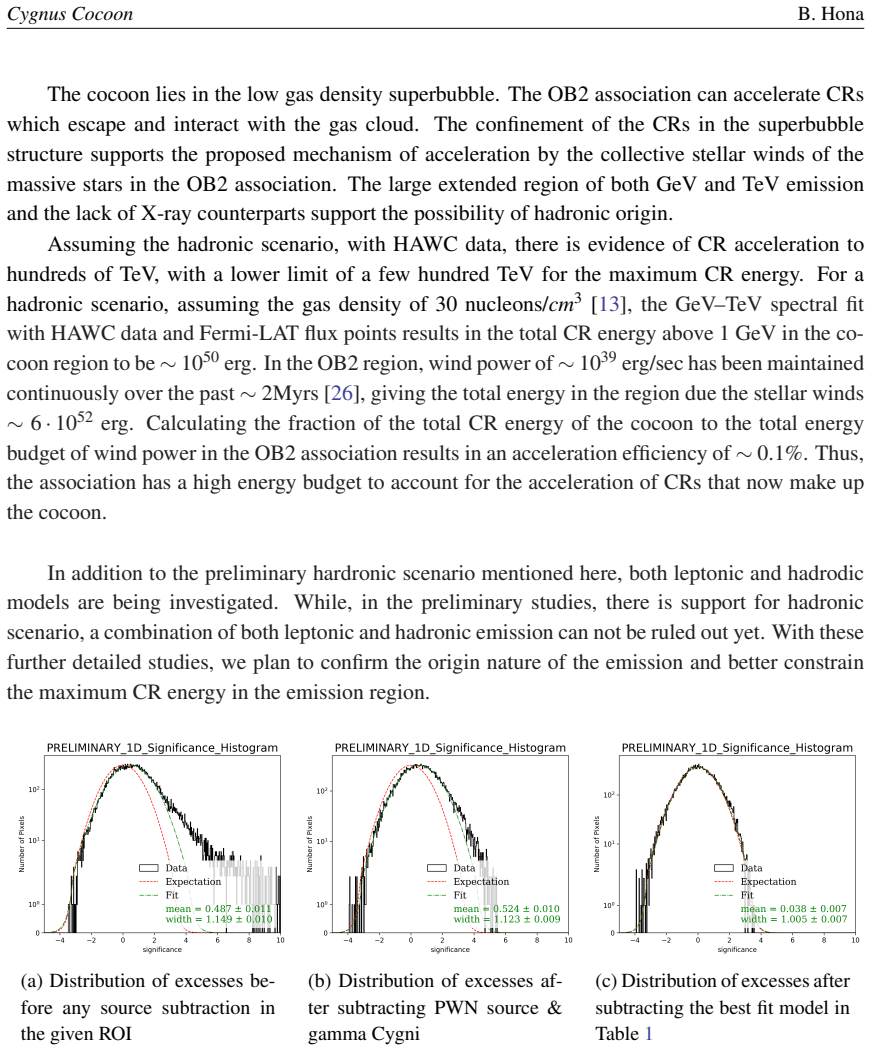
The argument is carried by a multi-source maximum-likelihood fit of HAWC event maps in 108 size-and-energy bins. Each overlapping source is assigned a simple spatial and spectral model: the pulsar-wind nebula 2HWC J2031+415/VER J2031+415 is a $0.27^\circ$ Gaussian with a power law and exponential cutoff; the gamma Cygni supernova remnant is a $0.63^\circ$ disk with a power law; the cocoon candidate is a Gaussian. The crucial move is subtraction: after fitting and removing the two known sources, the remaining significant excess is interpreted as a single new TeV source. HAWC's energy-reconstruction methods (a ground-parameter estimator, cross-checked with a neural network) provide the energy binning that reveals the GeV-TeV spectral curvature.
What would settle it
Re-fit the same HAWC maps with the pulsar-wind nebula represented by VERITAS's asymmetric Gaussian morphology and with gamma Cygni modeled from radio or molecular templates; if the remaining excess is no longer a significant $2.18^\circ$ Gaussian at the cocoon position, the claimed TeV counterpart is an artifact of the assumed source models. An independent TeV observation with sub-$0.1^\circ$ resolution should recover the same extended source if it is real.
Extended reading notes
Core claim
The paper claims that the TeV source HAWC J2030+406 is the TeV counterpart of the Fermi-LAT Cygnus cocoon. After fitting a multi-source model with a maximum-likelihood procedure, subtracting the pulsar-wind nebula VER J2031+415 (a $0.27^\circ$ Gaussian with an exponential cutoff) and the gamma Cygni supernova remnant (a $0.63^\circ$ power-law disk), an extended excess remains at (RA, Dec) = ($307.65^\circ \pm 0.30^\circ$, $40.93^\circ \pm 0.26^\circ$) with Gaussian width $2.18^\circ \pm 0.19^\circ$, contributing about 90% of the flux at 2HWC J2031+415. Its power-law spectrum has index $-2.65 \pm 0.06$, softer than the GeV index of about $-2.1$. Interpreting the emission as hadronic, the authors derive a lower limit of a few hundred TeV on the maximum accelerated cosmic-ray energy, a total cosmic-ray energy above 1 GeV of about $10^{50}$ erg, and an acceleration efficiency of about 0.1% relative to the wind energy budget of Cygnus OB2.
Load-bearing premise
The conclusion depends on the multi-source model being accurate: the pulsar-wind nebula is assumed to be a $0.27^\circ$ Gaussian with an exponential cutoff, gamma Cygni is assumed to be a $0.63^\circ$ power-law disk, and the residual after subtracting them is assumed to be one new source; if either model is wrong, the leftover emission attributed to the cocoon could be a subtraction artifact.
Editorial extensions
If this is right
- The GeV and TeV cocoon are the same object, so the spectral break from index about $-2.1$ at GeV to $-2.65$ at TeV constrains how freshly accelerated cosmic rays escape the superbubble.
- Cygnus OB2 joins supernova remnants as a demonstrated Galactic source class able to accelerate cosmic rays to hundreds of TeV, not just to tens of TeV.
- The 0.1% efficiency relative to the wind energy budget leaves ample room for the OB2 association to power the observed cocoon, keeping the stellar-wind acceleration channel viable.
- If hadronic, the total cosmic-ray energy above 1 GeV of about $10^{50}$ erg becomes a benchmark for models of collective wind acceleration in other massive star-forming regions.
- The non-detection of a separate diffuse component in the HAWC fit means the TeV emission is dominated by the three discrete sources, narrowing the interpretation of the region.
Reading between the lines
- A direct test would be to search for analogous GeV-cocoon/TeV-excess pairs around other massive OB associations in HAWC data; if several show the same curved spectrum, superbubbles could be a common Galactic cosmic-ray accelerator class.
- Since the inferred cosmic-ray energy scales inversely with the assumed gas density, an independent density measurement (for example from molecular-line surveys) would tighten the efficiency figure; a lower-density cavity would raise the required energy.
- If a future instrument resolves the $2.18^\circ$ extension with a different width, or finds that the residual vanishes when the pulsar-wind nebula is modeled as an asymmetric Gaussian, the cocoon attribution would need revision.
- The lack of a detected X-ray counterpart and the curved GeV-TeV spectrum favor a hadronic origin, but a leptonic component could still contribute; multi-wavelength radio and X-ray limits could separate the two channels.
Signed reviews
Editorial analysis
A structured set of objections, weighed in public.
Referee Report
Summary. Using 1128 days of HAWC data, the authors fit a multi-source model to the Cygnus region around 2HWC J2031+415, which includes a PWN template, the gamma Cygni SNR, and an extended Gaussian source. They report an extended TeV source, HAWC J2030+406, with Gaussian width 2.18 degrees ± 0.19 degrees, position (307.65 degrees ± 0.30 degrees, 40.93 degrees ± 0.26 degrees), and a power-law spectrum with index -2.65 ± 0.06, contributing roughly 90% of the total flux at the 2HWC J2031+415 position. The authors identify this source as the TeV counterpart of the Fermi-LAT Cygnus cocoon, argue for a hadronic origin of the emission, and derive a lower limit on the maximum cosmic-ray energy of a few hundred TeV and a wind-acceleration efficiency of about 0.1%.
Significance. If the identification is correct, this would be an important step in establishing that massive star-forming regions can accelerate cosmic rays to hundreds of TeV, complementing the GeV detection of the Cygnus cocoon. The morphological agreement between the HAWC source and the Fermi-LAT cocoon, and the observed spectral softening from GeV to TeV, are suggestive and worth reporting. The authors are transparent about several limitations, including the HAWC PWN extent being 2-3 times larger than the VERITAS morphology and the preliminary nature of the hadronic interpretation. However, the central claims rest on a residual analysis whose degeneracy and systematic uncertainties are not yet quantified, so the significance is conditional on further robustness checks.
major comments (4)
- [4.1, Eq. (4.1)] The separation of the emission at 2HWC J2031+415 into a compact PWN and a 2.18-degree extended source is degenerate because the PWN template is not independently fixed. The paper notes that HAWC's PWN width (0.27 degrees ± 0.03 degrees) is 2-3 times larger than the VERITAS asymmetric morphology (0.19 degrees by 0.08 degrees), and the PWN lies inside the fitted cocoon. A different but equally plausible PWN shape, or an unmodeled gamma Cygni halo, could redistribute counts between the components and either reduce or inflate the extended excess. Please present a robustness test that varies the PWN morphology, for example by fixing it to the VERITAS shape or allowing a free asymmetry, and show how the cocoon spectrum and width change.
- [4.1] The detection significance of the new extended source HAWC J2030+406 is not quoted anywhere. The text states only that an extended emission is 'significantly detected' in the Fig. 1 caption and that the final model accounts for the total TeV emission in Fig. 2c. Since HAWC J2030+406 is defined as a residual above the other sources, the reader needs a test statistic or significance value, for example from the 3ML fit, to assess the detection claim. Without this number, the source assertion cannot be evaluated.
- [5] The statement that there is 'evidence of CR acceleration to hundreds of TeV, with a lower limit of a few hundred TeV for the maximum CR energy' is not supported by the analysis as presented. The measured spectrum is a power law over the HAWC energy range (Eq. 4.2), and the authors themselves summarize the spectral energy distribution as extending to 'at least tens of TeV.' No maximum-energy fit, cutoff parameter, or energy-dependent efficiency calculation is given. Please provide the derivation of the lower limit, including the assumed source spectrum, the gas density, and the HAWC response above 10 TeV, or rephrase the conclusion to match the direct spectral evidence.
- [4.1 and 5] Systematic uncertainties are not propagated into any of the reported results. The text mentions a diffuse-emission test that decreases the cocoon flux by 10-15% and a cross-check with the neural-network energy estimator that agrees 'within statistical uncertainties,' but the final spectral index, width, flux, efficiency, and maximum-energy limit are quoted without systematic errors. Given that the detection is a residual, the 10-15% flux variation should be reported as a systematic uncertainty and propagated into the derived quantities, namely the 0.1% efficiency and the few-hundred-TeV limit.
minor comments (6)
- [Table 1] Table 1 lists the cocoon width as '2 degrees' while the text and abstract quote 2.18 degrees ± 0.19 degrees; please make the values consistent.
- [Section 1 and elsewhere] The manuscript contains several typos, including 'hundress', 'recontructed', 'anaylysis', 'descibed', 'hardronic', and 'hadrodic'; a careful copyedit is needed.
- [4.1] The diffuse-emission test is described only qualitatively; please give the fitted parameters and significance for the uniform and Gaussian background components, or state where the full details can be found.
- [4.1 and Table 1] Table 1 refers to the gamma Cygni source as a '0.63 degrees radius disk' while the text says 'extended disk of about 0.63 degrees'; clarify whether the quoted size is a radius or a Gaussian width.
- [5] The reference [13] for the assumed gas density of 30 nucleons per cubic centimeter appears to be a general Cygnus X paper; please cite a specific measurement of the cocoon or superbubble gas density.
- [Figure 2] The caption for Figure 2 does not give the binning or the exact source-subtraction procedure used for the significance distributions; a sentence describing these details would improve reproducibility.
Circularity Check
No circularity: the analysis is an observational multi-source fit with external cross-checks; inferred quantities are physical interpretations, not relabeled inputs.
full rationale
This paper reports an observational analysis of HAWC data toward the Cygnus OB2 region. The central result, a TeV extended source HAWC J2030+406 with Gaussian width 2.18 deg and power-law index -2.65, is obtained by fitting a multi-source model (PWN, gamma Cygni, and the extended source) to HAWC maps. This fitted component is a measurement, not a prediction derived from a premise that already contains the answer. The paper does not claim to derive the cocoon from first principles; it claims to detect and characterize a TeV counterpart to the Fermi-LAT cocoon. The derived quantities in the conclusion depend on physical assumptions: the hadronic scenario, a gas density of 30 nucleons/cm^3, and the wind power of the OB2 association. These are inputs to an interpretive energy-budget estimate, not parameters secretly reintroduced as predictions. The lower limit of a few hundred TeV on the maximum CR energy follows from the observed spectral extension into tens of TeV under the hadronic assumption; this is a standard physical inference, not a tautology. The potentially weak step is the model dependence of the residual: if the PWN or gamma Cygni template shapes are inaccurate, the 2.18 deg component could change. That is a legitimate systematic concern, but it is not circular. The templates are not defined in terms of the cocoon result; the fit is an ordinary decomposition of overlapping sources. Comparisons to Fermi-LAT morphology, ARGO spectrum, and VERITAS PWN measurements provide external anchors, and the paper explicitly notes the HAWC PWN morphology is 2-3 times larger than VERITAS's, indicating known model uncertainty rather than a construction that forces the conclusion. Citations to HAWC instrument and method papers are self-citations to the collaboration's established analysis infrastructure, but they are not load-bearing for the scientific claim in a circular way; they describe standard detector response, event reconstruction, and background estimation tools applied to the data. No uniqueness theorem or prior derivation by the same authors is invoked to forbid alternative interpretations. The paper is honest that leptonic and hadronic mixtures cannot yet be ruled out, further showing that the conclusion is not forced by definition. Overall, no step in the derivation chain reduces by construction to its inputs.
Assumptions & free parameters
free parameters (5)
- Spectral index of the extended cocoon source =
-2.65 +/- 0.06
- Gaussian width of the cocoon source =
2.18 deg +/- 0.19 deg
- PWN spectral parameters for 2HWC J2031+415 =
Power law with exponential cutoff, cutoff at a few tens of TeV
- Gamma Cygni SNR model parameters =
Disk radius ~0.63 deg, power law (values in [16])
- Gas density for hadronic energy estimate =
30 nucleons/cm^3
assumptions (5)
- standard math Maximum likelihood estimation as implemented in 3ML is valid for the binned HAWC data.
- domain assumption HAWC energy estimation via the ground-parameter method is accurate enough for spectral analysis; neural-network results agree within statistical uncertainties.
- domain assumption The PWN nature of VER J2031+415 and the gamma Cygni SNR model are correct.
- domain assumption The gamma-ray emission from the cocoon is hadronic in origin.
- domain assumption The gas density in the cocoon is 30 nucleons/cm^3.
Cite this review
Pith. "Pith review of Testing the Limits of Particle Acceleration in Cygnus OB2 with HAWC." pith.science (2026). https://pith.science/paper/X7LMPRFC
@misc{pith2026190809025,
  author       = {Pith},
  title        = {Pith review of: Testing the Limits of Particle Acceleration in Cygnus OB2 with HAWC},
  year         = {2026},
  howpublished = {\url{https://pith.science/paper/X7LMPRFC}},
  note         = {Machine review of arXiv:1908.09025}
}
read the original abstract
Star forming regions (SFRs) have been postulated as possible sources of cosmic rays (CRs) in our galaxy. One example of a gamma-ray source associated with an SFR is the Fermi-LAT cocoon, an extended region of gamma-ray emission in the Cygnus X region and attributed to a possible superbubble with freshly accelerated CRs. Because the emission region is surrounded by ionization fronts, it has been named the "Cygnus cocoon". CRs in the cocoon could have originated in the OB2 association and been accelerated at the interaction sites of stellar winds of massive O type stars. So far, there is no clear association at TeV energies. Spectral and morphological studies of TeV gamma-ray emission detected by the High Altitude Water Cherenkov (HAWC) observatory at the 2HWC J2031+415 region reveal that the spectral energy distribution of the cocoon extends from GeV to at least tens of TeV. Using HAWC data, we are able to study the acceleration of particles to highest energies in the Cygnus OB2 SFR.
Figures

Reference graph
Works this paper leans on
- [1]
-
[2]
Abeysekara, A. U. et al. 2013a, APh, 50, 26
- [3]
-
[4]
2017, ApJ, 843, 39 6 Cygnus Cocoon B
Abeysekara, A.U., et al. 2017, ApJ, 843, 39 6 Cygnus Cocoon B. Hona
work page 2017
-
[5]
2019, arXiv:1905.12518, accepted in ApJ
Abeysekara, A.U., et al. 2019, arXiv:1905.12518, accepted in ApJ
arXiv 2019
-
[6]
Abramowski, A. et al. 2016, 531, 476
work page 2016
- [7]
- [8]
Show all 27 references
-
[9]
2002, AandA, 393, L37-L40
Aharonian, F., et al. 2002, AandA, 393, L37-L40
2002
-
[10]
2014, ApJ, 783, 16
Aliu, E., et al. 2014, ApJ, 783, 16
2014
-
[11]
2014, ApJ, 790, 152
Bartoli, B., et al. 2014, ApJ, 790, 152
2014
-
[12]
2018, ApJ, 861, 134
Bird, R., et al. 2018, ApJ, 861, 134
2018
-
[13]
2009, Nature, 460, 701
Butt, Y ., et al. 2009, Nature, 460, 701
2009
-
[14]
Bykove. A. M., 2001, Space Sci. ReV , 99, 317
2001
-
[15]
Cerarsky, C. J. and Montmerle, T. 1983, Space Sci. Rev., 237, 236
1983
-
[16]
for the HAWC collaboration
Fleischhack, H. for the HAWC collaboration. these proceedings, PoS(ICRC2019)675
-
[17]
for the HAWC collaboration
Malone, K. for the HAWC collaboration. these proceedings, PoS(ICRC2019)734
-
[18]
for the HAWC collaboration
Linnemann, J. for the HAWC collaboration. these proceedings, PoS(ICRC2019)723
-
[19]
J., et al
Marti. J., et al. 2010, In ASP Conference Series, volume 422
2010
-
[20]
2015, ApJ, 803, 2
Mizuno, T., et al. 2015, ApJ, 803, 2
2015
-
[21]
Romero. G. E., 2008, In AIP Conference Proceedings, volume 1085
2008
-
[22]
B., et al
Tjus, J. B., et al. 2016, ApJ, 81, 1
2016
-
[23]
2015, 34th ICRC, PoS, 1042
Vianello, G., et al. 2015, 34th ICRC, PoS, 1042
2015
-
[24]
Wright., N. J. et al. 2009, ApJS, 184, 84
2009
-
[25]
Knödlseder, J., 2000, AandA, 360, 539
2000
-
[26]
A., et al
Lozinskaya, T. A., et al. 2002, AstL, 28, 223
2002
-
[27]
2015, 34th ICRC, PoS, 948 7
Younk, P., et al. 2015, 34th ICRC, PoS, 948 7
2015
Reviewed August 14, 2026 · model on record in the stance chip above.
Discussion (0). Continue with ORCID to comment.