REVIEW 3 major objections 8 minor 33 references
Multiple Vehicles and Traction Network Interaction System Stability Analysis and Oscillation Responsibility Identification
T0 review · 3 major / 8 minor · reviewed 2026-07-14 · grok-4.5
Pith's one-line read Measured vehicle impedances alone can predict railway oscillations and name the vehicles and parameters that cause them.
desk verdict Solid black-box workflow for multi-vehicle AT railway HIS/LFO that actually matches HIL on real schedules; useful for operators, not a theory paper. read the letter →
The pith
A machine-rendered reading of the paper's core claim, the machinery that carries it, and where it could break.
The reading
What carries the argument
The multilevel frequency-domain sensitivity of the return-ratio eigenloci: port participation factors derived from left and right eigenvectors, chained to admittance-level and (normalized) parameter-level derivatives, all evaluated where |Λk| > 0 dB.
What would settle it
Run the same real train schedule on the HIL platform with mutual inductances restored in the network model, or with deliberately corrupted vehicle impedance data; if the predicted unstable eigenloci and the ranked responsible vehicles no longer match the observed oscillation frequencies and the vehicles whose disconnection restores stability, the claim fails.
Extended reading notes
Core claim
A black-box component-connection impedance model of a multi-vehicle all-parallel double-way AT railway system, built solely from measured vehicle admittances aligned to a global dq frame, correctly predicts both low-frequency and high-frequency harmonic instability; multilevel frequency-domain sensitivity of the return-ratio eigenvalues then quantitatively identifies the responsible vehicles, their critical admittance elements, and the internal parameters that most affect stability.
Load-bearing premise
Mutual inductance among contact, rail and feeder wires can be ignored so the traction network collapses to a simple mesh of series impedances that Kron reduction can handle, and the manufacturer impedance measurements remain accurate at every operating point used in the analysis.
Editorial analysis
A structured set of objections, weighed in public.
Referee Report
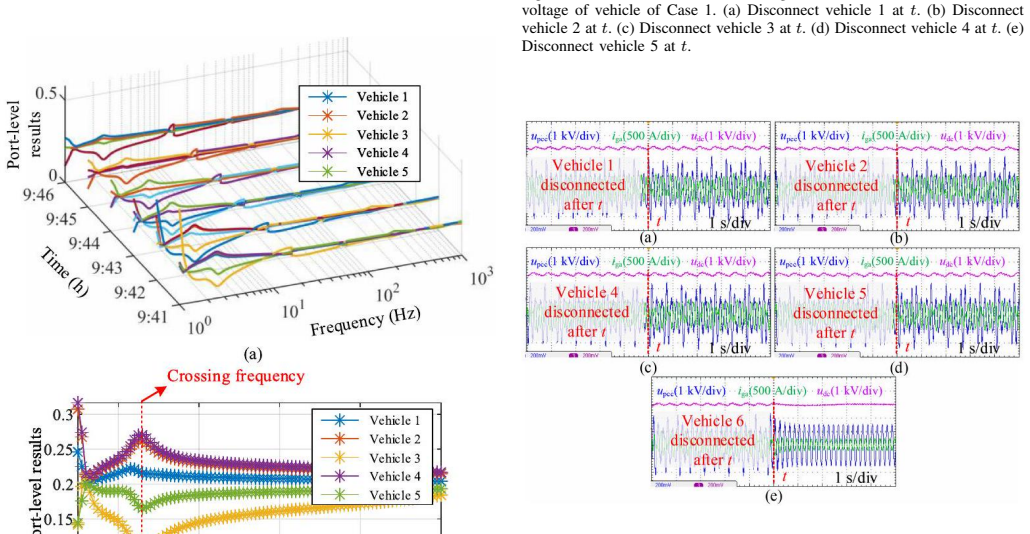
Summary. The paper develops a component-connection (CCM) impedance model for multi-vehicle railway vehicle–grid systems under all-parallel double-way AT feeding that uses only measured vehicle DQ admittances (no internal vehicle parameters), forms the return-ratio matrix L_rt = Z_ps Y_as after Kron reduction and global-dq alignment, and assesses stability via the generalized Nyquist criterion. It further derives multilevel frequency-domain sensitivity of the critical eigenloci of L_rt at port, admittance, and parameter levels to rank responsible vehicles and internal parameters, and embeds both tools in a system-level compatibility-test workflow aligned with EN 50388. Two real-schedule snapshots (LFO ~2.5 Hz; high-frequency HIS ~83/562 Hz) and parameter-perturbation cases are verified on an HIL platform, with sequential vehicle disconnection and parameter changes confirming the predicted rankings.
Significance. If the modeling and sensitivity pipeline hold under the stated assumptions, the work is a practically useful contribution to railway electrical-compatibility assessment: it addresses black-box vehicles under IP constraints, multi-PoC AT networks with vehicle motion, and responsibility identification beyond binary stability tests. Strengths include an explicit multilevel eigenlocus sensitivity derivation (port → admittance → parameter), a standards-oriented test flowchart, and HIL evidence on real train-schedule configurations that reproduces both predicted unstable frequencies and ranked vehicles/parameters. The focus on all-parallel double-way AT feeding is also of engineering interest for mountainous corridors. The computational-complexity advantage over state-space/residue methods is argued but not quantified; the mutual-inductance simplification is standard but unquantified. Overall the central claim is defensible and the validation is stronger than typical pure-simulation impedance papers in this niche.
major comments (3)
- Abstract and §III.C claim that the multilevel sensitivity method “outperforms traditional sensitivity analysis methods in computational complexity.” The comparison is only qualitative (lower port-order model vs full state dimension; no system identification or pole/residue extraction). No operation counts, wall-clock timings, or scaling curves versus the residue-based or state-based baselines cited ([10], [25], [26]) are given for the same multi-vehicle cases. Either add quantitative complexity/timing evidence on the reported cases or moderate the abstract/contribution language to “lower model order / simpler workflow.”
- §II.B, Eqs. (1)–(2) and the subsequent mesh/Kron construction of Y_ps rest on neglecting mutual inductances among CW/RW/FW conductors so that AT segments reduce to series branch impedances. This is foundational for both LFO and high-frequency HIS predictions (Case 2, tens–hundreds of Hz). The manuscript does not quantify the approximation error or cite bounds for the AT topology used. A short error discussion, literature bound, or comparison against a multiconductor line model at the critical frequencies would strengthen the claim that the CCM model “accurately address[es] both LFO and high-frequency HIS.”
- §IV.A Case 2 induces high-frequency HIS by deliberately setting the onboard transformer inductance of vehicle 6 to 0.54 mH (one-tenth of the nominal 5.4 mH in Table I). The port-level ranking correctly flags vehicle 6, but the scenario is artificial. The paper should state more clearly that this case is a controlled stress test of the sensitivity pipeline, and either (i) add a natural-parameter multi-vehicle HIS snapshot from the same schedule or (ii) discuss how ranking reliability is expected to transfer when HIS arises without such detuning.
minor comments (8)
- §II.D stability wording: “phases of all eigenvalues of L_rt intersect with −180×(2k+1) and have magnitudes less than 0 dB” is informal GNSC language; a one-sentence statement of the open-loop stability assumption and the −1-point encirclement form would avoid ambiguity.
- Fig. 9 vs Fig. 10(b): the 50 Hz dq/αβ offset for Case 2 is explained in text but could be annotated on the figure (e.g., mark 83 Hz ↔ 133 Hz) to make the match immediate for readers.
- Parameter-level pie chart is referred to as “Fig. 14” in the text of §IV.E while Fig. 14 is the admittance-level bar plot and the pie chart is Fig. 15; fix the cross-reference.
- Eqs. (15)–(18) subscript text says “dd, dq, dd, and dd” (duplicated dd); should be dd, dq, qd, qq.
- Table I “Short-circuit impedance 10.34” lacks units (%); OCL type “CTMH150” is listed without impedance parameters used in (1)–(2).
- §III.A.3 min–max normalization of parameters before ∂Λ/∂p is reasonable, but the ranges (k_pmin, k_pmax) used for the pie chart are not stated; a short note or appendix table would aid reproducibility.
- Several minor typos: “vehiclegrid,” “frequencyscan,” “admittancelevel,” “montanic,” and inconsistent hyphenation of “vehicle-grid” / “vehicle–grid.”
- Appendix Tables II–III give node voltages/phases for Cases 1–2; a one-line pointer in §IV.B to these tables would help readers reconstruct the global-dq alignment angles θ_i.
Circularity Check
No circularity: CCM/GNSC stability and multilevel eigenlocus sensitivity are derived from measured impedances and network topology, then independently confirmed by HIL time-domain waveforms and disconnection/perturbation experiments.
full rationale
The paper's load-bearing chain is: (i) construct passive Z_ps via mesh equivalent + Kron reduction of the all-parallel AT network (Eqs. 1-5, ignoring mutual inductance as stated), (ii) assemble active Y_as from manufacturer-supplied measured DQ admittances after global-frame alignment (Eqs. 6-8), (iii) form return-ratio L_rt = Z_ps Y_as and apply GNSC to its eigenloci (Eq. 9), and (iv) obtain multilevel participation/sensitivity functions directly from the left/right eigenvectors of that same L_rt (Eqs. 10-20). None of these steps defines the output in terms of the claimed prediction; the impedances are external inputs, the network topology is independent, and the sensitivity rankings are algebraic consequences of the eigen-decomposition. Validation uses separate HIL time-domain runs (Cases 1-2 and 1.1-1.6) whose oscillation frequencies and vehicle/parameter rankings match the frequency-domain forecasts; the HIL does not re-use or re-fit the same L_rt data. Self-citations supply background parameters (CRH5 values) or prior measurement techniques but are not uniqueness theorems or ansätze that force the stability conclusions. The modeling assumptions (mutual-inductance neglect, measurement fidelity) are explicit and do not create definitional circularity. Hence the derivation is self-contained against external benchmarks.
Assumptions & free parameters
assumptions (4)
- domain assumption Mutual inductance among contact, rail and feeder wires may be neglected, allowing the AT network to be reduced to a mesh of series impedances Z_n,k and Z_k,m (Eqs. 1–2).
- domain assumption Vehicle DQ admittances do not satisfy mirror-frequency decoupling, so each must be rotated into a common global reference frame via the steady-state angle θ_i obtained from power-flow (Eqs. 6–7).
- standard math Generalized Nyquist criterion applied to the eigenvalues of the return-ratio matrix L_rt = Z_ps Y_as is necessary and sufficient for small-signal stability of the multi-port interconnection.
- domain assumption Manufacturer-supplied impedance measurements at the relevant power and mode points are accurate enough that the constructed Y_as yields correct eigenloci.
Cite this review
Pith. "Pith review of Multiple Vehicles and Traction Network Interaction System Stability Analysis and Oscillation Responsibility Identification." pith.science (2026). https://pith.science/paper/XBFE2VII
@misc{pith2026260711243,
  author       = {Pith},
  title        = {Pith review of: Multiple Vehicles and Traction Network Interaction System Stability Analysis and Oscillation Responsibility Identification},
  year         = {2026},
  howpublished = {\url{https://pith.science/paper/XBFE2VII}},
  note         = {Machine review of arXiv:2607.11243}
}
read the original abstract
The electrical incompatibility between vehicles and traction network in railway system can result in system instability and oscillation overvoltage issues. To analyze the system stability, impedance-based frequency-domain methods are commonly used. However, the current impedance-based modeling methods face challenges in practical implementation due to the requirement of precise analytical models and detailed internal parameters for all vehicles. Moreover, multiple vehicles operate simultaneously in railway systems, each with different operating conditions and internal parameters, thereby influencing system stability to different extents. Therefore, it is crucial to accurately identify the critical vehicles to prevent resonance accidents. To address these challenges, a component connection-based modeling approach for the railway vehicle-grid system is proposed, which only requires the measured impedance results without the internal information of vehicles. In addition, a multilevel sensitivity analysis method is introduced to quantitatively identify the critical vehicles and internal parameters that influence system stability, which outperforms traditional sensitivity analysis methods in computational complexity. Furthermore, a system-level electrical compatibility test process for the railway vehicle-grid system is provided, incorporating the proposed stability and sensitivity analysis methods. Finally, case studies based on the real-world train schedule of a multivehicle-accessed railway vehicle-grid system are designed to verify the correctness of the proposed method.
Figures


Figures from the paper (13 more)




Reference graph
Works this paper leans on
-
[10]
Participation analysis in impedance models: The grey-box approach for power system stability,
Y . Zhu, Y . Gu, Y . Li, and T. Green, "Participation analysis in impedance models: The grey-box approach for power system stability," IEEE Trans. Power Syst., vol. 37, no. 1, pp. 343-353, Jan. 2022
2022
-
[25]
Black-box impedancebased stability assessment of dynamic interactions between converters and grid,
N. Cifuentes, M. Sun, R. Gupta, and B. C. Pal, "Black-box impedancebased stability assessment of dynamic interactions between converters and grid," IEEE Trans. Power Syst., vol. 37, no. 4, pp. 2976-2987, Jul. 2022
2022
-
[26]
A gray-box hierarchical oscillatory instability source identification method of multiple-inverter-fed power systems,
W. Zhou, R. E. Torres-Olguin, Y . Wang, and Z. Chen, "A gray-box hierarchical oscillatory instability source identification method of multiple-inverter-fed power systems," IEEE Trans. Emerg. Sel. Topics Power Electron., vol. 9, no. 3, pp. 3095-3113, Jun. 2021
2021
-
[1]
National railway administration of the people’s Republic of China
"National railway administration of the people’s Republic of China." Accessed: Jan. 26, 2024. [Online]. Available: http://www.nra.gov.cn/
2024
-
[2]
Train and stability evaluation in high-speed railways: Phenomena and modeling,
H. Hu, H. Tao, F. Blaabjerg, X. Wang, Z. He, and S. Gao, "Train and stability evaluation in high-speed railways: Phenomena and modeling," IEEE Trans. Power Electron., vol. 33, no. 6, pp. 4627-4642, Jun. 2018
2018
-
[3]
Railway Applications-Fixed Installations and Rolling Stock-Technical Criteria for the Coordination Between Electric Traction Power Supply Systems and Rolling Stock to Achieve Interoperability, CENELEC Standard EN 50388-1, 2022
2022
-
[4]
Input impedance modeling and verification of single-phase voltage source converters based on harmonic linearization,
H. Zhang, Z. Liu, S. Wu, and Z. Li, "Input impedance modeling and verification of single-phase voltage source converters based on harmonic linearization," IEEE Trans. Power Electron., vol. 34, no. 9, pp. 8544-8554, Sep. 2019
2019
-
[5]
Impacts of quadrature signal generation-based PLLS on low-frequency oscillation in an electric railway system,
Y . Zhou, H. Hu, X. Yang, Z. Meng, and Z. He, "Impacts of quadrature signal generation-based PLLS on low-frequency oscillation in an electric railway system," IEEE Trans. Transp. Electrific., vol. 7, no. 4, pp. 3124-3136, Dec. 2021
2021
Show all 33 references
-
[6]
Vehicle-grid system modeling and stability analysis with forbidden region- based criterion,
Y . Liao, Z. Liu, G. Zhang, and C. Xiang, "Vehicle-grid system modeling and stability analysis with forbidden region- based criterion," IEEE Trans. Power Electron., vol. 32, no. 5, pp. 3499-3512, May 2017
2017
-
[7]
Eigenvalue-based harmonic instability analysis of electrical railway vehicle- network system,
X. Lv, X. Wang, Y . Che, and R. Fu, "Eigenvalue-based harmonic instability analysis of electrical railway vehicle- network system," IEEE Trans. Transp. Electrific., vol. 5, no. 3, pp. 727-744, Sep. 2019
2019
-
[8]
Impedance-based harmonic instability assessment in a multiple electric trains and traction network interaction system,
H. Tao, H. Hu, X. Wang, F. Blaabjerg, and Z. He, "Impedance-based harmonic instability assessment in a multiple electric trains and traction network interaction system," IEEE Trans. Ind. Appl., vol. 54, no. 5, pp. 5083- 5096, Sep./Oct. 2018
2018
-
[9]
Rogers, Power System Oscillations
G. Rogers, Power System Oscillations. Boston, MA, USA: Springer, 2000
2000
-
[11]
Frequency-domain participation analysis for electronic power systems,
Y . Liao, X. Wang, and X. Wang, "Frequency-domain participation analysis for electronic power systems," IEEE Trans. Power Electron., vol. 37, no. 3, pp. 2531-2537, Mar. 2022
2022
-
[12]
SISO impedance-based stability analysis for systemlevel small-signal stability assessment of large-scale power electronicsdominated power systems,
D. Yang and Y . Sun, "SISO impedance-based stability analysis for systemlevel small-signal stability assessment of large-scale power electronicsdominated power systems," IEEE Trans. Sustain. Energy, vol. 13, no. 1, pp. 537-550, Jan. 2022
2022
-
[13]
Challenges and countermeasures facing the electrification project of Sichuan-Tibet railway,
Y . Deng and Z. Lin, "Challenges and countermeasures facing the electrification project of Sichuan-Tibet railway," Electric Railway, vol. 30, no. 1, pp. 5-11, Mar. 2019
2019
-
[14]
Study on application of allparallel DN power supply mode on montanic electrified railway,
Y . Deng, Z. Liu, Y . Wang, and K. Huang, "Study on application of allparallel DN power supply mode on montanic electrified railway," in Proc. Int. Conf. Electr. Inf. Technol. Rail Transp., 2016, pp. 153-162
2016
-
[15]
Stability research of high-speed railway emus and traction network cascade system considering impedance matching,
Z. Liu, G. Zhang, and Y . Liao, "Stability research of high-speed railway emus and traction network cascade system considering impedance matching," IEEE Trans. Ind. Appl., vol. 52, no. 5, pp. 4315-4326, Sep./Oct. 2016
2016
-
[16]
Contact wire irregularity stochastics and effect on high- speed railway pantograph-catenary interactions,
Y . Song, Z. Liu, A. Rønnquist, P. Nåvik, and Z. Liu, "Contact wire irregularity stochastics and effect on high- speed railway pantograph-catenary interactions," IEEE Trans. Instrum. Meas., vol. 69, no. 10, pp. 8196-8206, Oct. 2020
2020
-
[17]
Optimal operation of electric railways with renewable energy and electric storage systems,
J. A. Aguado, A. J. S. Racero, and S. de la Torre, "Optimal operation of electric railways with renewable energy and electric storage systems," IEEE Trans. Smart Grid, vol. 9, no. 2, pp. 993-1001, Mar. 2018
2018
-
[18]
Spatiotemporal model reduction of inverterbased islanded microgrids,
L. Luo and S. V . Dhople, "Spatiotemporal model reduction of inverterbased islanded microgrids," IEEE Trans. Energy Convers., vol. 29, no. 4, pp. 823-832, Dec. 2014
2014
-
[19]
Apparent impedance analysis: A small-signal method for stability analysis of power electronic-based systems,
A. Rygg and M. Molinas, "Apparent impedance analysis: A small-signal method for stability analysis of power electronic-based systems," IEEE Trans. Emerg. Sel. Topics Power Electron., vol. 5, no. 4, pp. 1474-1486, Dec. 2017
2017
-
[20]
A DQ-frame impedance measurement method based on Hilbert transform for single-phase vehicle-grid system,
Y . Liao, Z. Liu, X. Hu, and B. Wen, "A DQ-frame impedance measurement method based on Hilbert transform for single-phase vehicle-grid system," in Proc. IEEE Transp. Electrif. Conf. Expo, 2017, pp. 1-6
2017
-
[21]
Current- based NewtonRaphson power flow calculation for AT-fed railway power supply systems,
K. Mongkoldee and T. Kulworawanichpong, "Current- based NewtonRaphson power flow calculation for AT-fed railway power supply systems," Int. J. Elect. Power Energy Syst, vol. 98, pp. 11-22, Jun. 2018
2018
-
[22]
D-Q impedance based stability analysis and parameter design of three-phase inverter-based ac power systems,
W. Cao, Y . Ma, L. Yang, F. Wang, and L. M. Tolbert, 16 "D-Q impedance based stability analysis and parameter design of three-phase inverter-based ac power systems," IEEE Trans. Ind. Electron., vol. 64, no. 7, pp. 6017-6028, Jul. 2017
2017
-
[23]
DQ impedance reshaping of three-phase power- controlled grid-connected inverter for low-frequency stability improvement under weak grid condition,
W. Zhou, Y . Wang, R. E. Torres-Olguin, and Z. Chen, "DQ impedance reshaping of three-phase power- controlled grid-connected inverter for low-frequency stability improvement under weak grid condition," in Proc. IEEE Energy Convers. Congr. Expo., 2020, pp. 1678-1685
2020
-
[24]
Analysis and control of cascaded energy storage system for energy efficiency and power quality improvement in electrified railways,
J. Chen et al., "Analysis and control of cascaded energy storage system for energy efficiency and power quality improvement in electrified railways," IEEE Trans. Transp. Electrific., early access, Jun. 21, 2023, doi: 10.1109/TTE.2023.3287891
2023 doi
-
[27]
Harmonic transfer-function-based impedance modeling of a three-phase VSC for asymmetric AC grid stability analysis,
C. Zhang, M. Molinas, A. Rygg, J. Lyu, and X. Cai, "Harmonic transfer-function-based impedance modeling of a three-phase VSC for asymmetric AC grid stability analysis," IEEE Trans. Power Electron., vol. 34, no. 12, pp. 12552-12566, Dec. 2019
2019
-
[28]
Impedance modelling mechanisms and stability issues of single phase inverter with SISO structure and frequency coupling effect,
Z. Li, M. Zhu, C. Hou, H. Wang, Y . Li, and X. Cai, "Impedance modelling mechanisms and stability issues of single phase inverter with SISO structure and frequency coupling effect," IEEE Trans. Energy Convers., vol. 37, no. 1, pp. 573-584, Mar. 2022
2022
-
[29]
Conversion and SISO equivalence of impedance model of single-phase converter in electric multiple units,
X. Meng et al., "Conversion and SISO equivalence of impedance model of single-phase converter in electric multiple units," IEEE Trans. Transp. Electrific., vol. 9, no. 1, pp. 1363-1378, Mar. 2023
2023
-
[30]
Analysis of low- frequency oscillation in electric railways based on small-signal modeling of vehicle-grid system in DQ frame,
H. Wang, W. Mingli, and J. Sun, "Analysis of low- frequency oscillation in electric railways based on small-signal modeling of vehicle-grid system in DQ frame," IEEE Trans. Power Electron., vol. 30, no. 9, pp. 5318-5330, Sep. 2015
2015
-
[31]
A simplified virtual-vectorbased model predictive control technique with a control factor for threephase SPMSM drives,
H. Lin, S. Niu, Z. Xue, and S. Wang, "A simplified virtual-vectorbased model predictive control technique with a control factor for threephase SPMSM drives," IEEE Trans. Power Electron., vol. 38, no. 6, pp. 7546-7557, Jun. 2023
2023
-
[32]
Stability improvement for three-phase grid-connected converters through impedance reshaping in quadratureaxis,
J. Fang, X. Li, H. Li, and Y . Tang, "Stability improvement for three-phase grid-connected converters through impedance reshaping in quadratureaxis," IEEE Trans. Power Electron., vol. 33, no. 10, pp. 8365-8375, Oct. 2018
2018
-
[33]
Low-frequency stability analysis of single-phase system with DQ-frame impedance approach: Impedance modeling and verification,
Y . Liao, Z. Liu, H. Zhang, and B. Wen, "Low-frequency stability analysis of single-phase system with DQ-frame impedance approach: Impedance modeling and verification," IEEE Trans. Ind. Appl., vol. 54, no. 5, pp. 4999-5011, Sep./Oct. 2018
2018
Reviewed July 14, 2026 · model on record in the stance chip above.
Discussion (0). Sign in to comment.