Collision and coalescence dynamics of bosonic quantum Hall droplets
Pith reviewed 2026-06-29 02:38 UTC · model grok-4.3
The pith
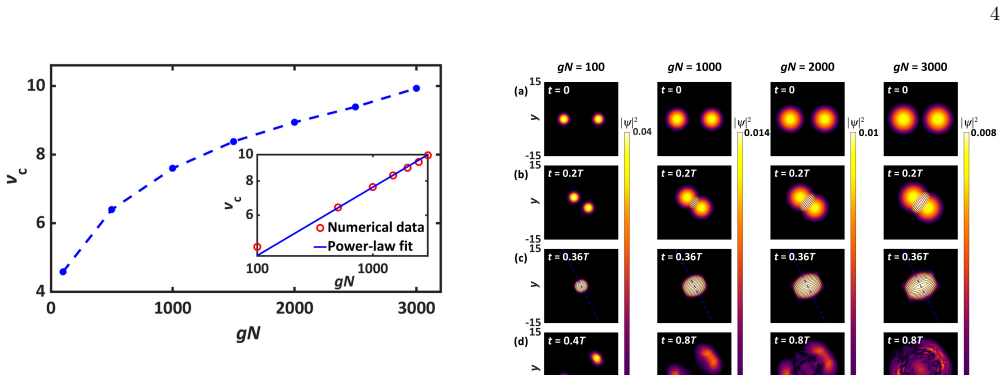
Bosonic quantum Hall droplets merge or separate at a critical velocity that scales as (gN) to the power 1/4.
A machine-rendered reading of the paper's core claim, the machinery that carries it, and where it could break.
Core claim
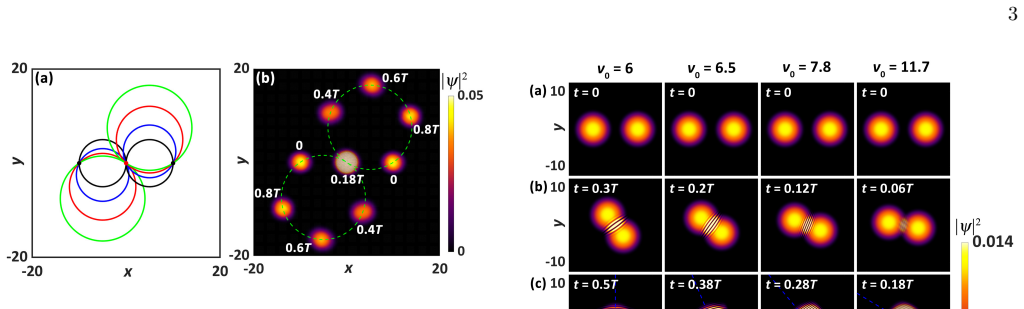
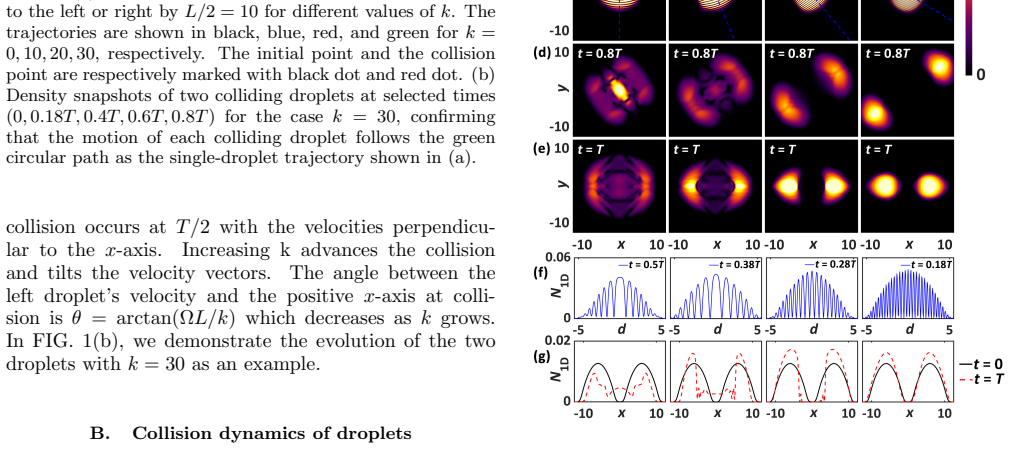
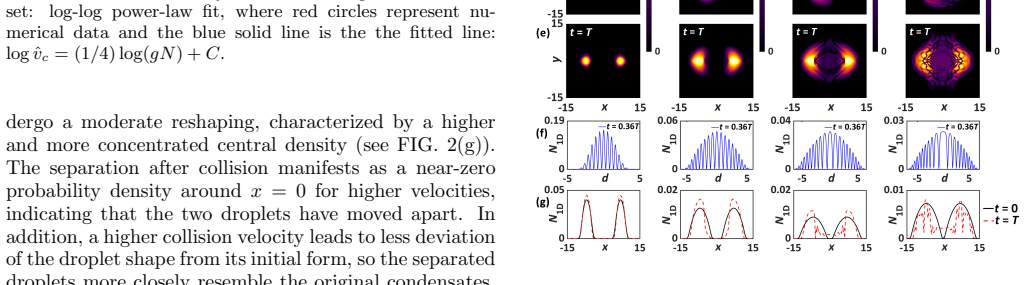
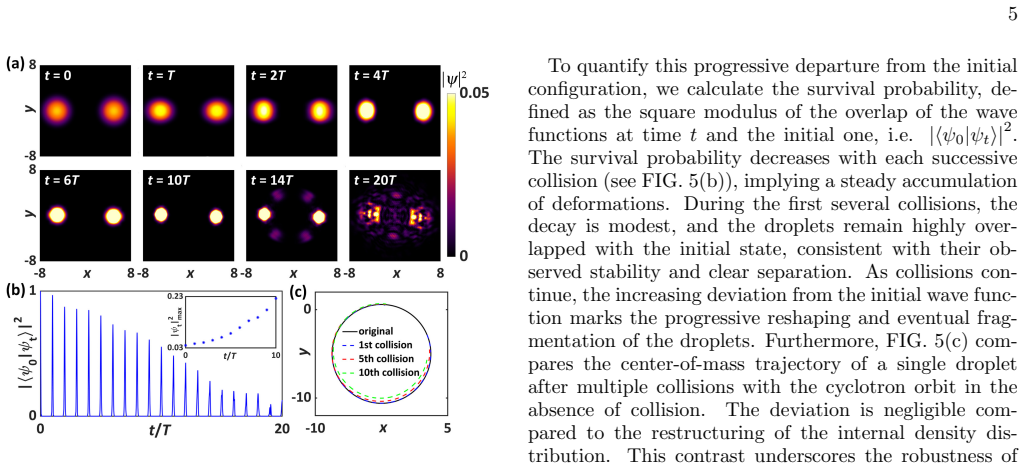
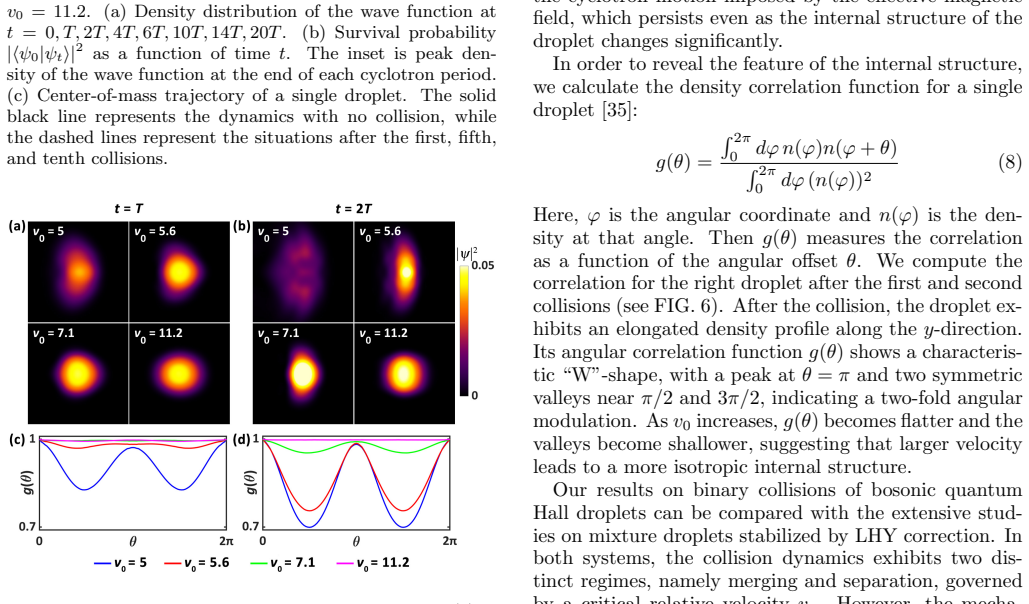
Within the Gross-Pitaevskii framework, two-droplet collisions exhibit merging or separation controlled by initial relative velocity, with the critical velocity vc scaling as (gN)^{1/4} due to the essential role of collision time in a simplified analytical model. This differs from the mechanism in Lee-Huang-Yang stabilized quantum droplets. The center of mass trajectory remains nearly unaffected by collisions due to angular momentum conservation. Overlapping stationary droplets develop vortex arrays via Kelvin-Helmholtz instability from phase-induced shear flow, but multiple droplets reorganize into isolated ones rather than forming extended states, demonstrating the localized property in the
What carries the argument
The universal scaling law vc ∝ (gN)^{1/4} for the critical collision velocity, derived from a simplified analytical model emphasizing the collision time.
If this is right
- Collision changes droplet shape significantly but center of mass trajectory is nearly unaffected due to angular momentum conservation.
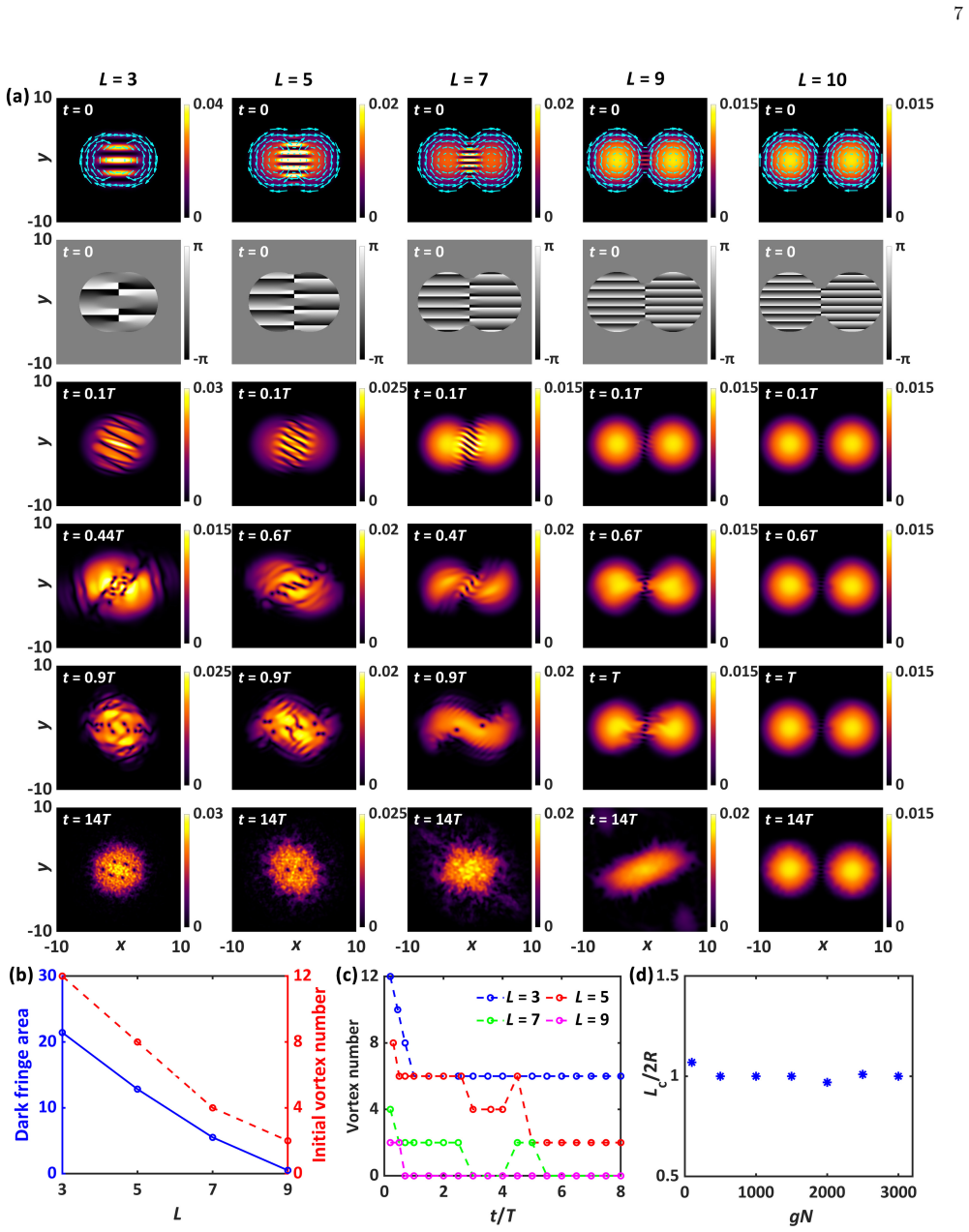
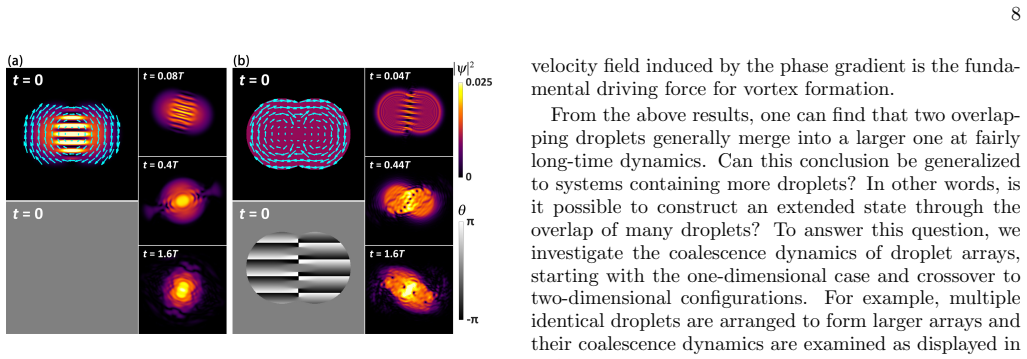
- Overlapping stationary droplets lead to vortex arrays through Kelvin-Helmholtz instability driven by phase-induced shear flow.
- Multiple overlapping droplets reorganize into new isolated droplets instead of extended states, revealing the localized property in the bulk region.
- The collision outcomes differ fundamentally from the mechanism governing conventional Lee-Huang-Yang stabilized quantum droplets.
Where Pith is reading between the lines
- The scaling may allow prediction of collision outcomes in other rotating bosonic systems from interaction and particle number alone.
- Tuning relative velocity, g, or N could offer a route to control coalescence in experiments without full numerical simulation.
- The tendency to reorganize into isolated droplets may limit the creation of larger quantum Hall states by simple merging.
Load-bearing premise
The Gross-Pitaevskii mean-field framework remains quantitatively accurate for the collision and coalescence dynamics of these bosonic quantum Hall droplets without requiring beyond-mean-field corrections or trap-specific details.
What would settle it
An experiment measuring the critical velocity for droplet merging across different interaction strengths g and particle numbers N, checking whether it follows the predicted scaling vc proportional to (gN) to the power 1/4.
Figures
read the original abstract
Recently bosonic quantum Hall droplets have been observed in rapidly rotating two-dimensional Bose-Einstein condensates (BECs), which exhibit robust dynamical stability. Inspired by this, we systematically investigate the collision and coalescence dynamics of these droplets within the Gross-Pitaevskii framework. For two-droplet collisions, we find two distinct collision outcomes, namely merging and separation, that are controlled by the initial relative velocity. The critical velocity exhibits a universal scaling law with the interaction and the particle number as $v_c \propto (gN)^{1/4}$, which can be interpreted from a simplified analytical model, revealing the essential role of the collision time. It differs fundamentally from the mechanism governing the conventional Lee-Huang-Yang stabilized quantum droplets. Furthermore, while the collision can change the shape of the droplet significantly, the center of mass trajectory remains nearly unaffected, owing to the conservation of angular momentum. For overlapping stationary droplets, vortex arrays can emerge through Kelvin-Helmholtz instability driven by phase-induced shear flow. Although two droplets may merge into a larger one, extended states cannot be constructed from multiple overlapping droplets. Instead, the system dynamically reorganizes into new isolated droplets, revealing the localized property in the bulk region. Our results reveal the unique nonequilibrium dynamics of quantum Hall droplets and suggest new pathways for manipulating strongly correlated rotating quantum fluids.
Editorial analysis
A structured set of objections, weighed in public.
Referee Report
Summary. The manuscript investigates collision and coalescence dynamics of bosonic quantum Hall droplets in rapidly rotating 2D BECs within the Gross-Pitaevskii framework. It reports two outcomes (merging vs. separation) for two-droplet collisions controlled by initial relative velocity, with critical velocity exhibiting the scaling vc ∝ (gN)^{1/4} supported by simulations and interpreted via a simplified analytical model that highlights collision time. Center-of-mass trajectories remain nearly unaffected due to angular-momentum conservation; overlapping stationary droplets develop vortex arrays via Kelvin-Helmholtz instability from phase-induced shear; and multiple droplets reorganize into isolated droplets rather than forming extended states, underscoring localized bulk behavior.
Significance. If the reported scaling and its mechanistic interpretation hold after validation, the work would distinguish the nonequilibrium dynamics of quantum Hall droplets from those of Lee-Huang-Yang-stabilized droplets and identify collision time as a controlling factor. The numerical results on shape deformation, vortex emergence, and reorganization into localized states could suggest experimental routes for controlling strongly correlated rotating fluids.
major comments (1)
- [Simplified analytical model (near abstract and results on two-droplet collisions)] The simplified analytical model for the vc ∝ (gN)^{1/4} scaling is presented as interpretive (based on collision time) rather than derived from the rotating-frame Gross-Pitaevskii equations or LLL-projected dynamics. No quantitative comparison to the simulation data is shown, nor is it demonstrated that the model incorporates angular-momentum conservation or possible shear effects; this validation step is load-bearing for the central claim that the scaling is mechanistically explained rather than coincidental.
minor comments (2)
- [Abstract] The abstract states that simulations and the model support the scaling but supplies no parameter ranges for gN, number of runs, or error estimates on vc; a brief statement of the explored regime would aid assessment of universality.
- [Figures and results sections] Figure captions and text should explicitly note whether the reported droplet radii or densities are fixed or vary with gN when discussing the scaling.
Simulated Author's Rebuttal
We thank the referee for their thorough review and valuable feedback on our manuscript. We address the major comment point by point below.
read point-by-point responses
-
Referee: [Simplified analytical model (near abstract and results on two-droplet collisions)] The simplified analytical model for the vc ∝ (gN)^{1/4} scaling is presented as interpretive (based on collision time) rather than derived from the rotating-frame Gross-Pitaevskii equations or LLL-projected dynamics. No quantitative comparison to the simulation data is shown, nor is it demonstrated that the model incorporates angular-momentum conservation or possible shear effects; this validation step is load-bearing for the central claim that the scaling is mechanistically explained rather than coincidental.
Authors: We agree that our analytical model is simplified and serves as an interpretive tool rather than a rigorous derivation from the rotating-frame Gross-Pitaevskii equations. In the revised version, we will provide a quantitative comparison by plotting the model's predicted critical velocity against the numerical simulation data to demonstrate agreement. We will also add a discussion explaining how the model is consistent with angular momentum conservation, noting that the center-of-mass motion remains largely unaffected as observed in simulations, and that shear effects primarily manifest in the overlapping stationary case rather than during the brief collision. However, a complete derivation from LLL-projected dynamics is not feasible within the current framework and would require advanced many-body methods beyond the scope of this study. revision: partial
- Derivation of the scaling law from the rotating-frame Gross-Pitaevskii equations or LLL-projected dynamics
Circularity Check
No circularity: scaling derived from independent analytical model
full rationale
The paper states the vc ∝ (gN)^{1/4} scaling 'can be interpreted from a simplified analytical model, revealing the essential role of the collision time' and contrasts it with GP numerics and other mechanisms. No quoted step reduces the claimed result to a fit, self-definition, or self-citation chain; the model is presented as interpretive and distinct from the simulation data. The central claim therefore retains independent content from the analytical construction.
Axiom & Free-Parameter Ledger
axioms (1)
- domain assumption The Gross-Pitaevskii equation provides an accurate description of the dynamics of bosonic quantum Hall droplets.
Reference graph
Works this paper leans on
-
[1]
M. H. Anderson, J. R. Ensher, M. R. Matthews,et al., Science269, 198 (1995)
1995
-
[2]
K. B. Davis, M. O. Mewes, M. R. Andrews,et al., Phys. Rev. Lett.75, 3969 (1995)
1995
-
[3]
Bloch, J
I. Bloch, J. Dalibard, and W. Zwerger, Rev. Mod. Phys. 80, 885 (2008)
2008
-
[4]
N. K. Wilkin and J. M. F. Gunn, Phys. Rev. Lett.84, 6 (2000)
2000
-
[5]
A. L. Fetter, Rev. Mod. Phys.81, 647 (2009)
2009
-
[6]
Z. Li, H. Cao, Z. Cao, S. Li, X. Liu, Y. Lan, and M. Sun, Chaos Solitons Fract.209, 118344 (2026)
2026
-
[7]
J. R. Abo-Shaeer, C. Raman, J. M. Vogels,et al., Science 292, 476 (2001)
2001
-
[8]
Cozzini, S
M. Cozzini, S. Stringari, and C. Tozzo, Phys. Rev. A73, 023615 (2006)
2006
-
[9]
R. A. Williams, S. Al-Assam, and C. J. Foot, Phys. Rev. Lett.104, 050404 (2010)
2010
-
[10]
L. J. O’Riordan and T. Busch, Phys. Rev. A94, 053603 (2016)
2016
-
[11]
Klaus, T
L. Klaus, T. Bland, E. Poli,et al., Nat. Phys.18, 1453 (2022)
2022
-
[12]
H. L. Stormer, D. C. Tsui, and A. C. Gossard, Rev. Mod. Phys.71, S298 (1999)
1999
-
[13]
N. R. Cooper, Adv. Phys.57, 539 (2008)
2008
-
[14]
L´ eonard, S
J. L´ eonard, S. Kim, J. Kwan,et al., Nature619, 495 (2023)
2023
-
[15]
Mukherjee, A
B. Mukherjee, A. Shaffer, P. B. Patel,et al., Nature601, 58 (2022)
2022
-
[16]
Z. Cao, S. Li, Z. Li,et al., Phys. Rev. A113, L011301 (2026)
2026
-
[17]
Zhang, Z
Z. Zhang, Z. He, P. Miao,et al., Int. J. Mod. Phys. B33, 1950261 (2019)
2019
-
[18]
J. Li, Z. Yang, and S. Zhang, Appl. Math. Lett.140, 108588 (2023)
2023
-
[19]
Q. Zhou, Z. Huang, Y. Sun,et al., Nonlinear Dyn.111, 5757 (2023)
2023
-
[20]
K. Geng, B. Zhu, Q. Cao,et al., Nonlinear Dyn.111, 16483 (2023)
2023
-
[21]
Z. Zhou, X. Yu, Y. Zou,et al., Commun. Nonlinear Sci. Numer. Simul.78, 104881 (2019)
2019
-
[22]
Z. Zhou, Y. Shi, S. Tang,et al., Chaos Solitons Fract. 150, 111193 (2021)
2021
-
[23]
Ferioli, G
G. Ferioli, G. Semeghin, L. Masi,et al., Phys. Rev. Lett. 122, 090401 (2019)
2019
-
[24]
J. E. Alba-Arroyo, S. F. Caballero-Benitez, and R. J´ auregui, Sci. Rep.12, 18467 (2022)
2022
-
[25]
Y. Hu, Y. Fei, X. Chen,et al., Front. Phys.17, 61505 (2022)
2022
-
[26]
S. K. Adhikari, Laser Phys. Lett.14, 025501 (2017)
2017
-
[27]
A. Yang, G. Li, X. Jiang, Z. Fan, Z. Chen, B. Liu, and Y. Li, Photonics10, 405 (2023)
2023
-
[28]
G. Li, X. Jiang, B. Liu,et al., Front. Phys.19, 22202 (2024)
2024
-
[29]
S. R. Otajonov, B. A. Umarov, and F. K. Abdullaev, Chaos Solitons Fract.186, 115212 (2024)
2024
-
[30]
J. Hu, H. Wang, G. Chen,et al., Chaos Solitons Fract. 191, 115837 (2025)
2025
-
[31]
E. P. Gross, Nuovo Cim.20, 454 (1961)
1961
-
[32]
L. P. Pitaevskii, J. Exp. Theor. Phys.13, 451 (1961)
1961
-
[33]
E. P. Gross, J. Math. Phys.4, 195 (1963)
1963
-
[34]
Bao and H
W. Bao and H. Wang, J. Comput. Phys.217, 612 (2006)
2006
-
[35]
Zhang, K
Z. Zhang, K. Yao, L. Feng,et al., Nat. Phys.16, 652 (2020)
2020
-
[36]
Hernandez-Rajkov, N
D. Hernandez-Rajkov, N. Grani, F. Scazza,et al., Nat. Phys.20, 939 (2024)
2024
-
[37]
S. Ryu, H. Zhang, and U. J. Anuta, Micromachines14, 2046 (2023)
2046
-
[38]
Beaty and J
E. Beaty and J. R. Lister, J. Fluid Mech.957, A25 (2023)
2023
-
[39]
Eggers, J
J. Eggers, J. E. Sprittles, and J. H. Snoeijer, Annu. Rev. Fluid Mech.57, 61 (2025)
2025
-
[40]
J. M. Escart´ ın, F. Ancilotto, M. Barranco, and M. Pi, Phys. Rev. B99, 140505(R) (2019)
2019
-
[41]
J. M. Escart´ ın, F. Ancilotto, M. Barranco, and M. Pi, Phys. Rev. B105, 024511 (2022)
2022
-
[42]
Takeuchi, N
H. Takeuchi, N. Suzuki, K. Kasamatsu, H. Saito, and M. Tsubota, Phys. Rev. B81, 094517 (2010)
2010
-
[43]
Kokubo, K
H. Kokubo, K. Kasamatsu, and H. Takeuchi, Phys. Rev. A104, 023312 (2021)
2021
discussion (0)
Sign in with ORCID, Apple, or X to comment. Anyone can read and Pith papers without signing in.