REVIEW 3 major objections 4 minor 1 cited by
Systematic search for blue hyper-velocity stars from LAMOST survey
T0 review · 3 major / 4 minor · reviewed 2026-08-16 · deepseek-v4-flash
Pith's one-line read A systematic search of LAMOST survey data finds ten new unbound B- and A-type hypervelocity star candidates, tripling the number previously identified by LAMOST.
desk verdict A careful, transparent HVS search whose 'ten unbound' headline rests on a distance calibration and escape model that together leave at least four candidates within ~1σ of bound. read the letter →
The pith
A machine-rendered reading of the paper's core claim, the machinery that carries it, and where it could break.
The reading
What carries the argument
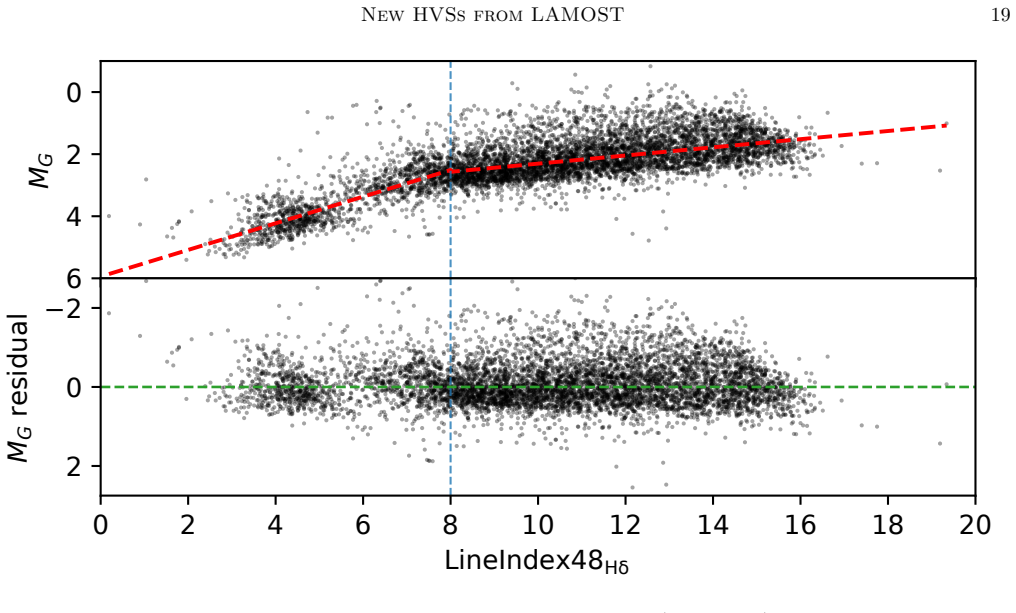
The load-bearing device is a two-segment linear relation between the Hδ line index (measured across a 48 Å band) and the Gaia $G$-band absolute magnitude $M_G$ for A-type stars, calibrated on thousands of low-extinction LAMOST spectra and expressed as $M_G = -0.429\,\mathrm{LineIndex48}_{Hδ}+5.943$ for small indices and $M_G = -0.131\,\mathrm{LineIndex48}_{Hδ}+3.620$ for larger ones, with a 0.60 mag scatter that translates to roughly 30 percent distance uncertainty. This relation supplies photometric distances when Gaia parallaxes are unreliable, and those distances feed the calculation of total Galactocentric velocities and backward orbit integrations against the MWPotential2014 escape-velocity curve.
What would settle it
Measure accurate parallaxes and multi-epoch high-resolution radial velocities for LAMOST-HVS11 and LAMOST-HVS14. If their distances or systemic velocities place their total velocities below the local escape curve, they are not unbound; likewise, showing that LAMOST-HVS14's ~60 km/s velocity difference comes from binary orbital motion would weaken its single-spectrum classification.
Extended reading notes
Core claim
The central claim is that ten new unbound B- and A-type hypervelocity star candidates, designated LAMOST-HVS5 through LAMOST-HVS14, have been identified, tripling the number of unbound HVSs previously found by LAMOST. For each candidate, the authors combine LAMOST radial velocities, space-astrometry positions and proper motions, and photometric distances (from MK spectral classification or from a newly calibrated hydrogen-line distance relation) to compute Galactocentric total velocities that exceed the escape-velocity curve of the adopted Galactic potential. The kinematics split the sample: six candidates have backward-integrated orbits whose disk crossings lie near the Galactic Center or known young massive clusters, pointing to ejection by the central black hole or few-body encounters, while four candidates move on inward or off-center orbits that make those origins less likely. The paper presents these objects as candidates pending further observation, not as confirmed hypervelocity stars.
Load-bearing premise
The claim that these stars are truly unbound rests on photometric distances estimated from the strength of a single hydrogen absorption line (about 30 percent uncertainty) and on the adopted model of the Milky Way's escape speed; the slowest candidates, LAMOST-HVS11 and LAMOST-HVS14, would become bound under a small systematic shift in either.
Editorial extensions
If this is right
- The number of unbound hypervelocity stars known from LAMOST rises from four to fourteen, giving a much larger sample for statistical tests of ejection mechanisms.
- Six of the ten candidates trace back toward the Galactic Center or young massive clusters, favoring Hills-type ejection or dynamical encounters over supernova runaways for those objects.
- The hydrogen-line distance method lets A-type stars without reliable parallaxes be included in HVS searches, moving the sample beyond the B-type stars found in earlier LAMOST work.
- Because most new candidates are A-type, follow-up abundance, pulsation, and binarity studies can separate genuine hypervelocity stars from contaminating variables and binaries.
- Marginal candidates such as LAMOST-HVS11 and LAMOST-HVS14 sit close to the escape curve, so improved distances will directly sharpen the census of truly unbound stars.
Reading between the lines
- Beyond the paper, the same two-step selection (radial-velocity cut followed by total-velocity check with photometric distances) could be applied to other large spectroscopic surveys, potentially turning up more A-type hypervelocity candidates at distances where Gaia parallaxes are poor.
- LAMOST-HVS14's roughly 60 km/s velocity difference between two epochs is a natural test case: a few high-resolution spectra would show whether the shift is binary motion or noise, and that measurement alone could change its unbound classification.
- The search intentionally excludes stars with total velocities between 300 and 500 km/s when their radial velocities are low, so a proper-motion-driven search would sample a complementary ejection population and may find stars that this method misses.
- If even a fraction of these candidates are confirmed, their implied ejection rate of A-type stars could be compared with theoretical predictions of the Galactic-Center Hills mechanism, a quantitative step this paper does not attempt.
Signed reviews
Editorial analysis
A structured set of objections, weighed in public.
Referee Report
Summary. This paper presents a systematic search for blue hyper-velocity star (HVS) candidates in the LAMOST DR10 low-resolution spectroscopic survey. From about 420,000 blue objects, the authors select 125 high-velocity candidates using either rest-frame radial velocities relative to the Galactic center exceeding 300 km/s or total velocities exceeding 500 km/s. After visual inspection, MKCLASS spectral typing, and photometric distance estimates from a newly calibrated Hδ line-index–absolute-magnitude relation for A-type stars, the paper reports ten new unbound HVS candidates (LAMOST-HVS5 through LAMOST-HVS14), which would triple the number of unbound HVSs previously identified by LAMOST. The candidates are characterized with Gaia DR3 astrometry, LAMOST radial velocities, photometric distances, and backward orbital integrations in the MWPotential2014 model. The paper discusses possible origins (Galactic center, young massive clusters, supernova ejection) and caveats including distance uncertainties and possible binarity.
Significance. If the ten candidates are indeed unbound, this is a substantial increase in the known LAMOST HVS sample and would provide new kinematic probes of ejection mechanisms and the Galactic potential. The paper's strengths include a well-documented selection pipeline, Monte Carlo propagation of statistical uncertainties, explicit variability and binary checks, and a newly derived Hδ–MG calibration that is fitted to an independent LAMOST/Gaia sample rather than to the candidates themselves, so there is no circularity in the distance calibration. The candidate list and spectra will be useful for follow-up regardless of whether every candidate is confirmed unbound. However, the headline claim of ten unbound HVSs rests on photometric distances with 0.60 mag scatter and on a single assumed escape-velocity model, and several candidates lie within about 1 sigma of the escape threshold. The significance of the result would be much stronger if the impact of systematic distance errors and potential-model choices were quantified and the marginal candidates were treated conservatively.
major comments (3)
- [§3.1.1, LAMOST-HVS14, Table 5] The unbound classification of LAMOST-HVS5 through HVS9 and HVS13 depends on photometric distances from the Hδ line-index–MG relation (Eqs. 3–4), which has a 0.60 mag scatter. The calibration sample is restricted to rgeo < 3.5 kpc, |b| > 15°, and E(B−V) < 0.7, i.e., nearby, low-reddening, mostly disk A-type stars. Applying this relation to distant halo A-type stars (e.g., A0III/A1IV classifications) may introduce a systematic offset because Hδ strength depends on luminosity class and halo metallicity differs from the calibration sample. A 0.3 mag offset—half the stated scatter—changes distances by about 15% and directly shifts vtot and the escape comparison. Since HVS7 (511 ± 59 km/s at 12.5 kpc), HVS8 (501.6 ± 124.2 km/s at 15.3 kpc), HVS11 (437.0 ± 4.2 km/s at 32.5 kpc), and HVS14 (438.0 ± 16.1 km/s at 22.5 kpc) are within roughly 1σ of the MWPotential2014 escape velocity, the claim of ten unbound candidates is not robust without a systematic-error analysis. The paper should estimate the MG offset required to make each candidate bound and present a conservative list of secure versus marginal unbound candidates.
- [§3.1.1, Figure 2] LAMOST-HVS14's unbound status hinges on the higher-SNR spectrum with vlos = 254.7 ± 16.6 km/s, while the lower-SNR spectrum gives 299.7 ± 45.2 km/s, a ~60 km/s discrepancy that the authors acknowledge but do not propagate into the final classification. Using the higher-SNR value yields vtot = 438.0 ± 16.1 km/s versus a local escape velocity of about 440 km/s, so the candidate is marginal even with this choice; using the lower-SNR value would push vtot to 480.6 ± 43.9 km/s but with much larger uncertainty. The paper should treat the radial-velocity discrepancy as a systematic uncertainty, present both classifications, and justify why one epoch is preferred over the other beyond the SNR difference.
- [§3.1.1, Figure 2] The unbound classification is made by comparing vtot to the MWPotential2014 escape velocity curve, but the paper provides no test of how the classification changes with a reasonable alternative Galactic potential (e.g., McMillan 2017 or a ±10% mass normalization of MWPotential2014). The escape velocity is model-dependent at the few-percent level, which is decisive for candidates such as HVS11 and HVS14 that lie within ~1σ of the boundary. Adding a robustness test that recomputes the number of unbound candidates under alternative potentials, or at least quotes the sensitivity of each candidate to the assumed mass profile, would make the headline claim much more solid.
minor comments (4)
- [§2.3, Eqs. (1)–(2)] Equation (1) uses Vφ,⊙ = 252.23 km/s for the solar circular motion, while Equation (2) adopts Vc(R0) = 230 km/s; the relationship between these two constants should be stated explicitly, and the paper should quantify how the candidate list changes when either convention is used rather than only stating that the results hold well.
- [Table 1] The table contains the typo 'Exmained' instead of 'Examined'.
- [§2.4] The code name 'MKCALSS' appears to be a typo for 'MKCLASS' in the text, and the same misspelling is used in 'The MKCALSS code' sentence.
- [Figure 5] The caption writes 'pannel' instead of 'panel' in the description of the LAMOST-HVS14 spectra.
Circularity Check
No significant circularity: candidates are tested against an external escape-velocity model using distances from a separately calibrated relation.
full rationale
The paper's main claim—ten new unbound HVS candidates—rests on a chain that is not circular. Candidate selection uses either LAMOST radial velocities via |vrf| > 300 km/s or total velocities vtot > 500 km/s computed from Gaia astrometry and parallax distances. For objects without reliable parallaxes, distances are re-derived from a photometric calibration: the Hδ line index–absolute magnitude relation (Eqs. 3–4) fitted to 6,453 spectra from a separate LAMOST/Gaia sample of low-extinction, nearby A-type stars. This calibration is independent of the candidate list and of the unbound classification; applying it to individual candidates does not force any particular vtot or any particular result in the escape-velocity comparison. The unbound status is then judged by comparing each candidate's vtot to the MWPotential2014 escape velocity curve from Bovy (2015), an external model not fitted to the candidates. There is no step in which a 'prediction' is equivalent to an input by construction: the photometric relation is fitted to other stars, the velocities are direct observables, and the escape curve is external. The paper's self-citations (e.g., Huang et al. 2017, 2019; Li et al. 2018, 2023b; Wang et al. 2021; Zhou et al. 2023) supply prior discoveries, method versions, and standard solar-motion parameters, but none is load-bearing in a way that reduces the central claim to a self-citation. The acknowledged dependence of marginal candidates (e.g., LAMOST-HVS7, HVS8, HVS11, HVS14) on the 0.60 mag scatter of the Hδ-MG calibration and on the assumed Galactic potential is a systematic/correctness risk, not a circularity.
Assumptions & free parameters
free parameters (5)
- Hδ line index-MG slope (segment 1) =
-0.429
- Hδ line index-MG intercept (segment 1) =
5.943
- Hδ line index-MG slope (segment 2) =
-0.131
- Hδ line index-MG intercept (segment 2) =
3.620
- MG calibration scatter =
0.60 mag
assumptions (4)
- domain assumption Gaia DR3 astrometry and LAMOST radial velocities are accurate after quality cuts
- domain assumption MWPotential2014 (Bovy 2015) describes the Milky Way potential well enough for escape-velocity comparison and orbit integration
- domain assumption The photometric distance calibration for A-type stars applies to the HVS candidates
- domain assumption Adopted solar parameters (R0=8.34 kpc, Vc=230 km/s, solar peculiar motion) are correct
Cite this review
Pith. "Pith review of Systematic search for blue hyper-velocity stars from LAMOST survey." pith.science (2026). https://pith.science/paper/XCVJ6Y43
@misc{pith2026250414836,
  author       = {Pith},
  title        = {Pith review of: Systematic search for blue hyper-velocity stars from LAMOST survey},
  year         = {2026},
  howpublished = {\url{https://pith.science/paper/XCVJ6Y43}},
  note         = {Machine review of arXiv:2504.14836}
}
abstract
Hypervelocity stars (HVSs) represent a unique class of objects capable of escaping the gravitational pull of the Milky Way due to extreme acceleration events, such as close encounters with the supermassive black hole at the Galactic center (GC), supernova explosions in binary systems, or multi-body dynamical interactions. Finding and studying HVSs are crucial to exploring these ejection mechanisms, characterizing central black holes, probing the GC environment, and revealing the distribution of dark matter in our galaxy. The Large Sky Area Multi-Object Fiber Spectroscopic Telescope (LAMOST) spectroscopic surveys have so far identified four B-type unbound HVSs. To expand this sample with the second-phase LAMOST survey that started in 2018, we conducted a systematic search for early-type HVSs using the LAMOST Data Release 10. We identified 125 early-type high-velocity candidates with total velocities exceeding 300 km\,s$^{-1}$. Among them, we report ten new unbound B- and A-type hypervelocity star (HVS) candidates (designated LAMOST-HVS5 through LAMOST-HVS14), tripling the number of unbound HVSs previously identified by LAMOST. Kinematic analyses suggest that these newly discovered HVS candidates likely originated either from the Galactic Center or via dynamical interactions. Future high-resolution follow-up observations promise to refine the stellar parameters, distances, and elemental abundances of these candidates, thereby providing deeper insights into their origins and broadening their potential applications across astrophysics.
Figures


Figures from the paper (8 more)


Forward citations
Cited by 1 Pith paper
-
The ejection and detectability of high- and hyper-velocity stars by compact object binaries in globular clusters
Star plus compact-object binary encounters in globular clusters likely ejected about 6,300 Milky Way stars in the last 500 Myr, including roughly 840 stars faster than 500 km/s, almost none of which are detectable in ...
Reference graph
Works this paper leans on
-
[1]
2021, AJ, 161, 147, doi: 10.3847/1538-3881/abd806
Demleitner, M., & Andrae, R. 2021, AJ, 161, 147, doi: 10.3847/1538-3881/abd806
-
[2]
Bellm, E. C., Kulkarni, S. R., Graham, M. J., et al. 2019, PASP, 131, 018002, doi: 10.1088/1538-3873/aaecbe
-
[3]
Boubert, D., Erkal, D., Evans, N. W., & Izzard, R. G. 2017, MNRAS, 469, 2151, doi: 10.1093/mnras/stx848
-
[4]
Boubert, D., & Evans, N. W. 2016, ApJL, 825, L6, doi: 10.3847/2041-8205/825/1/L6
-
[5]
2015, ApJS, 216, 29, doi: 10.1088/0067-0049/216/2/29
Bovy, J. 2015, ApJS, 216, 29, doi: 10.1088/0067-0049/216/2/29
-
[6]
F., Crestani, J., Fabrizio, M., et al
Braga, V. F., Crestani, J., Fabrizio, M., et al. 2021, ApJ, 919, 85, doi: 10.3847/1538-4357/ac1074
-
[7]
1979, PASP, 91, 5, doi: 10.1086/130433
Breger, M. 1979, PASP, 91, 5, doi: 10.1086/130433
doi:10.1086/130433 1979
-
[8]
Breger, M., Hutchins, J., & Kuhi, L. V. 1976, ApJ, 210, 163, doi: 10.1086/154814
doi:10.1086/154814 1976
Show all 75 references
-
[9]
C., Kenyon, S
Bromley, B. C., Kenyon, S. J., Geller, M. J., et al. 2006, ApJ, 653, 1194, doi: 10.1086/508419
2006 doi
-
[10]
Brown, W. R. 2015, ARA&A, 53, 15, doi: 10.1146/annurev-astro-082214-122230
2015 doi
-
[11]
R., Geller, M
Brown, W. R., Geller, M. J., & Kenyon, S. J. 2009a, The Astrophysical Journal, 690, 1639–1647, doi: 10.1088/0004-637X/690/2/1639
-
[12]
R., Geller, M
Brown, W. R., Geller, M. J., & Kenyon, S. J. 2012, ApJ, 751, 55, doi: 10.1088/0004-637X/751/1/55 —. 2014, ApJ, 787, 89, doi: 10.1088/0004-637X/787/1/89
2012 doi
-
[13]
R., Geller, M
Brown, W. R., Geller, M. J., Kenyon, S. J., & Bromley, B. C. 2009b, The Astrophysical Journal, 690, L69–L71, doi: 10.1088/0004-637X/690/1/L69
-
[14]
R., Geller, M
Brown, W. R., Geller, M. J., Kenyon, S. J., & Kurtz, M. J. 2005, ApJL, 622, L33, doi: 10.1086/429378 —. 2006a, ApJL, 640, L35, doi: 10.1086/503279 —. 2006b, ApJ, 647, 303, doi: 10.1086/505165
2005 doi
-
[15]
Bromley, B. C. 2007a, ApJ, 660, 311, doi: 10.1086/513595 —. 2007b, ApJ, 671, 1708, doi: 10.1086/523642
-
[16]
2020, ApJS, 249, 18, doi: 10.3847/1538-4365/ab9cae
Chen, X., Wang, S., Deng, L., et al. 2020, ApJS, 249, 18, doi: 10.3847/1538-4365/ab9cae
2020 doi
-
[17]
D., & M´ enard, B
Cheng, S., Cummings, J. D., & M´ enard, B. 2019, ApJ, 886, 100, doi: 10.3847/1538-4357/ab4989 20 Sun et al
2019 doi
-
[18]
2012, Research in Astronomy and Astrophysics, 12, 1197, doi: 10.1088/1674-4527/12/9/003
Cui, X.-Q., Zhao, Y.-H., Chu, Y.-Q., et al. 2012, Research in Astronomy and Astrophysics, 12, 1197, doi: 10.1088/1674-4527/12/9/003
2012 doi
-
[19]
P., et al
Czesla, S., Schr¨ oter, S., Schneider, C. P., et al. 2019, PyA: Python astronomy-related packages. http://ascl.net/1906.010
2019
-
[20]
2019, ApJS, 244, 4, doi: 10.3847/1538-4365/ab328c
Du, C., Li, H., Yan, Y., et al. 2019, ApJS, 244, 4, doi: 10.3847/1538-4365/ab328c
2019 doi
-
[21]
2005, ApJL, 634, L181, doi: 10.1086/498940
Reimers, D. 2005, ApJL, 634, L181, doi: 10.1086/498940
2005 doi
-
[22]
J., Chandra, V., et al
El-Badry, K., Shen, K. J., Chandra, V., et al. 2023, The Open Journal of Astrophysics, 6, 28, doi: 10.21105/astro.2306.03914
2023 arXiv
-
[23]
2019, MNRAS, 483, 2007, doi: 10.1093/mnras/sty2674 Gaia Collaboration, Prusti, T., de Bruijne, J
Antonini, F. 2019, MNRAS, 483, 2007, doi: 10.1093/mnras/sty2674 Gaia Collaboration, Prusti, T., de Bruijne, J. H. J., et al. 2016, A&A, 595, A1, doi: 10.1051/0004-6361/201629272 Gaia Collaboration, Vallenari, A., Brown, A. G. A., et al. 2023, A&A, 674, A1, doi: 10.1051/0004-63...
2019 doi
-
[24]
2015, Science, 347, 1126, doi: 10.1126/science.1259063
Geier, S., F¨ urst, F., Ziegerer, E., et al. 2015, Science, 347, 1126, doi: 10.1126/science.1259063
2015 doi
-
[26]
Y., Gould, A., Miralda-Escud´ e, J., & Zentner, A
Gnedin, O. Y., Gould, A., Miralda-Escud´ e, J., & Zentner, A. R. 2005, ApJ, 634, 344, doi: 10.1086/496958
2005 doi
-
[27]
O., & Corbally, C
Gray, R. O., & Corbally, C. J. 2014, AJ, 147, 80, doi: 10.1088/0004-6256/147/4/80
2014 doi
-
[28]
2019, ApJ, 887, 93, doi: 10.3847/1538-4357/ab5362
Finkbeiner, D. 2019, ApJ, 887, 93, doi: 10.3847/1538-4357/ab5362
2019 doi
-
[29]
V., Gualandris, A., & Portegies Zwart, S
Gvaramadze, V. V., Gualandris, A., & Portegies Zwart, S. 2009, MNRAS, 396, 570, doi: 10.1111/j.1365-2966.2009.14809.x
2009
-
[30]
2019, ApJ, 873, 116, doi: 10.3847/1538-4357/ab05c8
Hattori, K., Valluri, M., Castro, N., et al. 2019, ApJ, 873, 116, doi: 10.3847/1538-4357/ab05c8
2019 doi
- [31]
-
[32]
Hills, J. G. 1988, Nature, 331, 687, doi: 10.1038/331687a0
1988 doi
-
[33]
A., Heber, U., O’Toole, S
Hirsch, H. A., Heber, U., O’Toole, S. J., & Bresolin, F. 2005, A&A, 444, L61, doi: 10.1051/0004-6361:200500212
2005 doi
-
[34]
2024, National Science Review, nwae347, doi: 10.1093/nsr/nwae347
Huang, Y., Li, Q., Liu, J., et al. 2024, National Science Review, nwae347, doi: 10.1093/nsr/nwae347
2024 doi
-
[35]
2021, ApJL, 907, L42, doi: 10.3847/2041-8213/abd413
Huang, Y., Li, Q., Zhang, H., et al. 2021, ApJL, 907, L42, doi: 10.3847/2041-8213/abd413
2021 doi
-
[36]
W., Yuan, H
Huang, Y., Liu, X. W., Yuan, H. B., et al. 2015, MNRAS, 449, 162, doi: 10.1093/mnras/stv204 —. 2016, MNRAS, 463, 2623, doi: 10.1093/mnras/stw2096
2015 doi
-
[37]
W., Zhang, H
Huang, Y., Liu, X. W., Zhang, H. W., et al. 2017, ApJL, 847, L9, doi: 10.3847/2041-8213/aa894b
2017 doi
-
[38]
W., Wang, C., et al
Huang, Y., Zhang, H. W., Wang, C., et al. 2019, ApJL, 884, L7, doi: 10.3847/2041-8213/ab430b
2019 doi
-
[39]
P., Perets, H., & Hallakoun, N
Igoshev, A. P., Perets, H., & Hallakoun, N. 2023, MNRAS, 518, 6223, doi: 10.1093/mnras/stac3488
2023 doi
-
[40]
2010, ApJ, 711, 138, doi: 10.1088/0004-637X/711/1/138
Schuh, S. 2010, ApJ, 711, 138, doi: 10.1088/0004-637X/711/1/138
2010 doi
-
[41]
Rossum, D. R. 2012, ApJL, 761, L23, doi: 10.1088/2041-8205/761/2/L23
2012 doi
-
[42]
E., Boubert, D., Li, T
Koposov, S. E., Boubert, D., Li, T. S., et al. 2020, MNRAS, 491, 2465, doi: 10.1093/mnras/stz3081
2020 doi
-
[43]
Leonard, P. J. T. 1991, AJ, 101, 562, doi: 10.1086/115704
1991 doi
-
[44]
2022, The Astrophysical Journal Letters, 933, L13, doi: 10.3847/2041-8213/ac786d
Li, H., Du, C., Ma, J., et al. 2022, The Astrophysical Journal Letters, 933, L13, doi: 10.3847/2041-8213/ac786d
2022 doi
-
[45]
Li, Q.-Z., Huang, Y., Dong, X.-B., Chen, J.-J., & Luo, A. L. 2023a, Research in Astronomy and Astrophysics, 23, 115026, doi: 10.1088/1674-4527/acf1e5
-
[46]
2023b, AJ, 166, 12, doi: 10.3847/1538-3881/acd1dc
Li, Q.-Z., Huang, Y., Dong, X.-B., et al. 2023b, AJ, 166, 12, doi: 10.3847/1538-3881/acd1dc
-
[47]
2012, ApJL, 744, L24, doi: 10.1088/2041-8205/744/2/L24
Li, Y., Luo, A., Zhao, G., et al. 2012, ApJL, 744, L24, doi: 10.1088/2041-8205/744/2/L24
2012 doi
-
[48]
L., Zhao, G., et al
Li, Y.-B., Luo, A. L., Zhao, G., et al. 2015, Research in Astronomy and Astrophysics, 15, 1364, doi: 10.1088/1674-4527/15/8/018 —. 2018, AJ, 156, 87, doi: 10.3847/1538-3881/aad09a
2015 doi
-
[49]
L., Lu, Y.-J., et al
Li, Y.-B., Luo, A. L., Lu, Y.-J., et al. 2021, ApJS, 252, 3, doi: 10.3847/1538-4365/abc16e
2021 doi
-
[50]
2019, ApJS, 241, 32, doi: 10.3847/1538-4365/ab0a0d
Liu, Z., Cui, W., Liu, C., et al. 2019, ApJS, 241, 32, doi: 10.3847/1538-4365/ab0a0d
2019 doi
-
[51]
M., Paunzen, E., Pressberger, R., Slettebak, A., & Wagner, R
Maitzen, H. M., Paunzen, E., Pressberger, R., Slettebak, A., & Wagner, R. M. 1998, A&A, 339, 782
1998
-
[52]
W., Keenan, P
Morgan, W. W., Keenan, P. C., & Kellman, E. 1943, An atlas of stellar spectra, with an outline of spectral classification
1943
-
[53]
B., & ˇSubr, L
Perets, H. B., & ˇSubr, L. 2012, ApJ, 751, 133, doi: 10.1088/0004-637X/751/2/133
2012 doi
-
[54]
B., Wu, X., Zhao, H
Perets, H. B., Wu, X., Zhao, H. S., et al. 2009, ApJ, 697, 2096, doi: 10.1088/0004-637X/697/2/2096
2009 doi
-
[55]
M., & Maunsell, C
Petrie, R. M., & Maunsell, C. D. 1949, AJ, 54, 193, doi: 10.1086/106259 Portegies Zwart, S. F. 2000, ApJ, 544, 437, doi: 10.1086/317190 Portegies Zwart, S. F., McMillan, S. L. W., & Gieles, M. 2010, ARA&A, 48, 431, doi: 10.1146/annurev-astro-081309-130834
1949 doi
-
[56]
2008, ApJL, 684, L103, doi: 10.1086/592245
Przybilla, N., Fernanda Nieva, M., Heber, U., & Butler, K. 2008, ApJL, 684, L103, doi: 10.1086/592245
2008 doi
-
[57]
B., Li, L
Qian, S. B., Li, L. J., He, J. J., et al. 2018, MNRAS, 475, 478, doi: 10.1093/mnras/stx3185 New HVSs from LAMOST 21
2018 doi
-
[58]
A., G¨ ansicke, B
Raddi, R., Hollands, M. A., G¨ ansicke, B. T., et al. 2018, MNRAS, 479, L96, doi: 10.1093/mnrasl/sly103
2018 doi
-
[59]
A., Koester, D., et al
Raddi, R., Hollands, M. A., Koester, D., et al. 2019, MNRAS, 489, 1489, doi: 10.1093/mnras/stz1618
2019 doi
-
[60]
2022, A&A, 658, A22, doi: 10.1051/0004-6361/202141837
Raddi, R., Torres, S., Rebassa-Mansergas, A., et al. 2022, A&A, 658, A22, doi: 10.1051/0004-6361/202141837
2022 doi
- [61]
-
[62]
J., Menten, K
Reid, M. J., Menten, K. M., Brunthaler, A., et al. 2014, ApJ, 783, 130, doi: 10.1088/0004-637X/783/2/130 Sch¨ onrich, R., Binney, J., & Dehnen, W. 2010, MNRAS, 403, 1829, doi: 10.1111/j.1365-2966.2010.16253.x
2014
-
[63]
S., et al
Sesar, B., Ivezi´ c,ˇZ., Stuart, J. S., et al. 2013, AJ, 146, 21, doi: 10.1088/0004-6256/146/2/21
2013 doi
-
[64]
J., Kasen, D., Miles, B
Shen, K. J., Kasen, D., Miles, B. J., & Townsley, D. M. 2018a, ApJ, 854, 52, doi: 10.3847/1538-4357/aaa8de
-
[65]
J., Boubert, D., G¨ ansicke, B
Shen, K. J., Boubert, D., G¨ ansicke, B. T., et al. 2018b, ApJ, 865, 15, doi: 10.3847/1538-4357/aad55b
-
[66]
D., & Heber, U
Tillich, A., Przybilla, N., Scholz, R. D., & Heber, U. 2009, A&A, 507, L37, doi: 10.1051/0004-6361/200913173
2009 doi
-
[67]
2017, Science, 357, 680, doi: 10.1126/science.aam8378
Vennes, S., Nemeth, P., Kawka, A., et al. 2017, Science, 357, 680, doi: 10.1126/science.aam8378
2017 doi
-
[68]
2009, A&A, 508, L27, doi: 10.1051/0004-6361/200913326
Wang, B., & Han, Z. 2009, A&A, 508, L27, doi: 10.1051/0004-6361/200913326
2009 doi
-
[69]
2013, A&A, 559, A94, doi: 10.1051/0004-6361/201322298
Wang, B., Justham, S., & Han, Z. 2013, A&A, 559, A94, doi: 10.1051/0004-6361/201322298
2013 doi
-
[70]
W., Huang, Y., et al
Wang, F., Zhang, H. W., Huang, Y., et al. 2021, MNRAS, 504, 199, doi: 10.1093/mnras/stab848
2021 doi
-
[71]
2007, MNRAS, 379, 1293, doi: 10.1111/j.1365-2966.2007.12034.x
Yu, Q., & Madau, P. 2007, MNRAS, 379, 1293, doi: 10.1111/j.1365-2966.2007.12034.x
2007
-
[72]
2003, ApJ, 599, 1129, doi: 10.1086/379546
Yu, Q., & Tremaine, S. 2003, ApJ, 599, 1129, doi: 10.1086/379546
2003 doi
-
[73]
2023, ApJS, 264, 14, doi: 10.3847/1538-4365/ac9dfa
Zhang, R., & Yuan, H. 2023, ApJS, 264, 14, doi: 10.3847/1538-4365/ac9dfa
2023 doi
-
[74]
2012, Research in Astronomy and Astrophysics, 12, 723, doi: 10.1088/1674-4527/12/7/002
Zhao, G., Zhao, Y.-H., Chu, Y.-Q., Jing, Y.-P., & Deng, L.-C. 2012, Research in Astronomy and Astrophysics, 12, 723, doi: 10.1088/1674-4527/12/7/002
2012 doi
-
[75]
L., Beers, T
Zheng, Z., Carlin, J. L., Beers, T. C., et al. 2014, ApJL, 785, L23, doi: 10.1088/2041-8205/785/2/L23
2014 doi
-
[76]
2023, ApJ, 946, 73, doi: 10.3847/1538-4357/acadd9
Zhou, Y., Li, X., Huang, Y., & Zhang, H. 2023, ApJ, 946, 73, doi: 10.3847/1538-4357/acadd9
2023 doi
Reviewed August 16, 2026 · model on record in the stance chip above.
Discussion (0). Continue with ORCID to comment.