REVIEW 2 major objections 4 minor 58 references
T-IFISS: a toolbox for adaptive FEM computation
T0 review · 2 major / 4 minor · reviewed 2026-08-14 · deepseek-v4-flash
Pith's one-line read T-IFISS implements self-adaptive finite element workflows with rigorous a posteriori error control for deterministic and parametric elliptic PDEs.
desk verdict A genuinely useful, well-documented adaptive FEM toolbox; algorithms are prior work but the integration is new, and the only real weakness is the unquantified approximate reference solutions in the effectivity plots. read the letter →
The pith
A machine-rendered reading of the paper's core claim, the machinery that carries it, and where it could break.
The reading
What carries the argument
The machinery that carries the paper is the adaptive loop SOLVE → ESTIMATE → MARK → REFINE, instantiated with hierarchical error estimators (EES1–EES3), edge- or element-based bulk-chasing marking, and newest-vertex bisection with nested finite element spaces. For goal functionals, the dual problem supplies a second Galerkin solution, and the reliable estimate $\mu\zeta$ for $|G(u)-G(u_h)|$ is formed from the product of the primal and dual energy-error estimates; four marking strategies (GO-MARK1–4) combine the primal and dual indicators. For parametric problems, the stochastic Galerkin space is the tensor product $X\otimes P$, the system matrix is a Kronecker sum $A=G_0\otimes K_0+\sum_m G_m\otimes K_m$, and a preconditioned minimum-residual solver works on the component matrices without assembling $A$. The parametric error estimator $\eta$ splits into spatial and parametric contributions, and the adaptive SGFEM algorithm chooses which component to refine based on the dominant contribution or the larger predicted error reduction.
What would settle it
Compute the same four case studies with reference solutions obtained from one additional uniform refinement of the final adaptive mesh (or from a P3/high-order enriched space), and check whether the effectivity indices in Figures 5(b), 9(b), and 12(b) change by more than a few percent. If they shift substantially, the estimators are tracking the reference surrogate rather than the true error.
Extended reading notes
Core claim
The central discovery is that a single modular software architecture can host the entire adaptive finite element workflow—Galerkin solve, local or global hierarchical error estimation, bulk-chasing marking, and newest-vertex-bisection refinement—and extend it to parametric PDEs through stochastic Galerkin discretization. In the deterministic setting, the paper's key identity is the goal-oriented error estimate $|G(u)-G(u_h)|\le \|u-u_h\|\,\|z-z_h\|$, obtained by Galerkin orthogonality and the dual problem, so that the product of two energy-error estimates gives a rigorous and computable bound on a functional error. In the stochastic setting, the error estimator splits into a spatial part $\|e_X\|_0$ and a parametric part $\|e_P\|_0$, combined as $\eta=(\|e_X\|_0^2+\|e_P\|_0^2)^{1/2}$, and the adaptive algorithm chooses between spatial refinement and enrichment of the polynomial index set by comparing predicted error reductions. The four case studies are presented as evidence that these mechanisms deliver optimal convergence rates and stable effectivity indices in practice.
Load-bearing premise
The reported effectivity indices—the ratios that validate the error estimators—are computed against approximate reference solutions whose own errors are not quantified, so the demonstration of rigorous error control assumes those reference surrogates are accurate enough.
Editorial extensions
If this is right
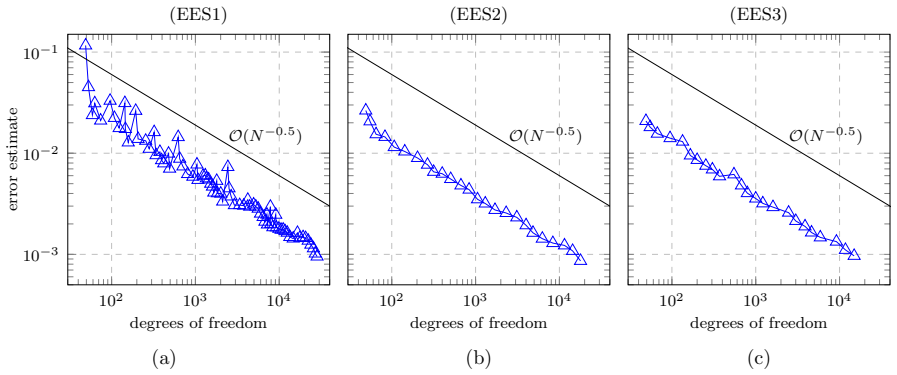
- For the anisotropic diffusion problem, the edge-based two-level estimator EES3 with bulk-chasing marking gives an optimal $O(N^{-1/2})$ error-decay rate and essentially monotonic reductions, while the elementwise estimator EES1 stalls because interior residuals vanish for constant coefficients.
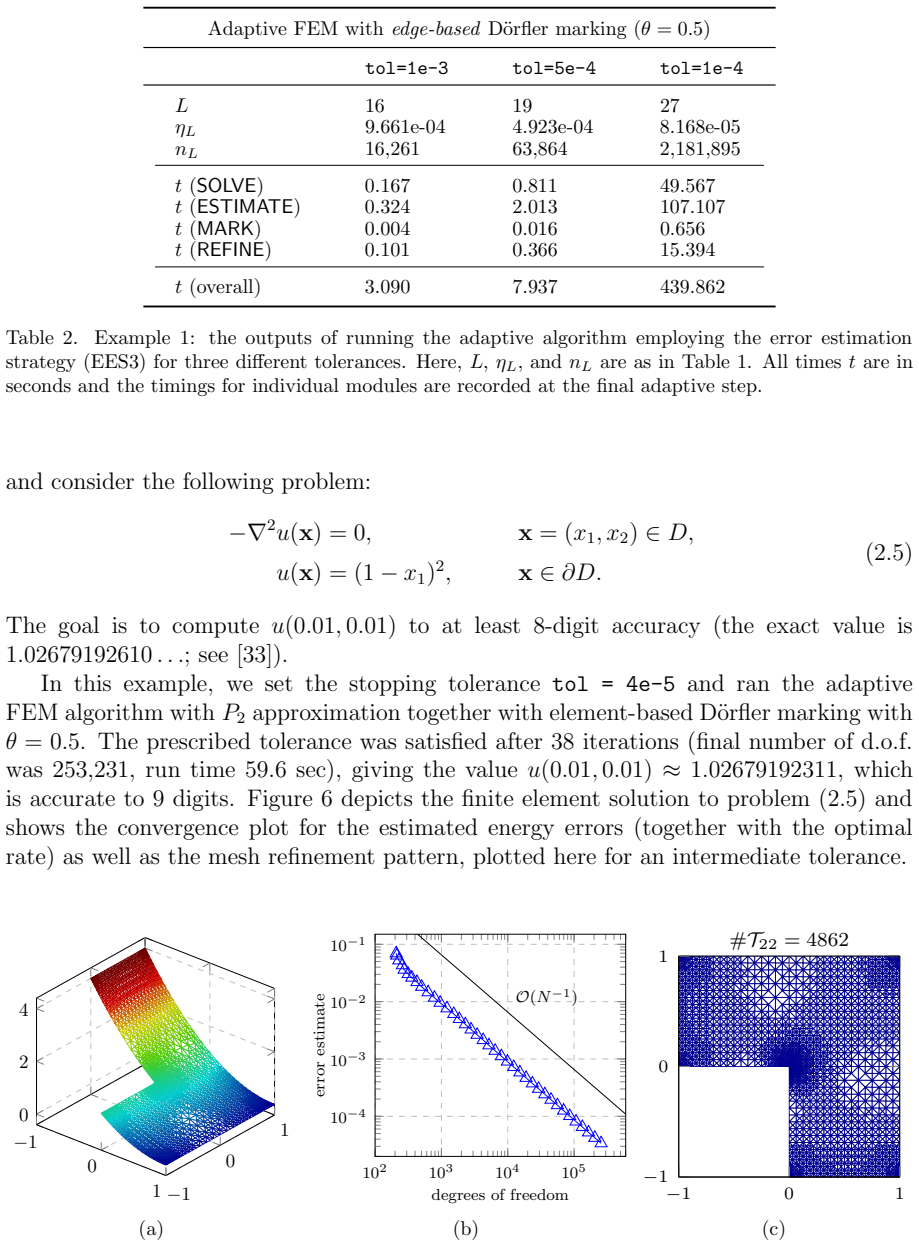
- Goal-oriented adaptivity with the GO-MARK4 combination rule computes the point value $u(0.01,0.01)\approx 1.02679192311$, accurate to nine digits, and keeps the goal-error effectivity index near 2.8.
- In stochastic Galerkin FEM, refining both the spatial mesh and the parametric index set yields faster convergence than refining only one component; the representative run reached a $3\times 10^{-3}$ tolerance in 19 iterations with 23 polynomials and 6 active parameters.
- The matrix-free preconditioned solver keeps iteration counts below 20 regardless of mesh resolution and active parameter count, making stochastic Galerkin systems with millions of unknowns practical on a laptop.
- Because all components are modular and exchangeable, the toolbox supports reproducible research: a user can replace an estimator or marking strategy and immediately compare convergence behavior.
Reading between the lines
- The paper leaves implicit that its effectivity validation rests on unquantified reference surrogates; a direct extension is to recompute Figures 5, 9, and 12 with one additional uniform refinement as the reference and require the effectivity indices to remain stable.
- The version-2 refinement-selection rule (choose the larger predicted error reduction) could be applied in the goal-oriented stochastic setting, steering the estimator toward a functional by comparing $\mu\zeta$ before and after candidate spatial and parametric refinements.
- The same Kronecker-preconditioned machinery and hierarchical parametric estimators should carry over to non-affine coefficient representations, giving a path from this toolbox to more general random-field models such as lognormal coefficients.
- The observed failure of elementwise EES1 on constant-coefficient problems suggests an automatic estimator-selection heuristic: monitor whether interior residuals are structurally zero and switch to an edge-based estimator mid-loop.
Signed reviews
Editorial analysis
A structured set of objections, weighed in public.
Referee Report
Summary. The paper introduces T-IFISS, an open-source MATLAB/Octave toolbox for adaptive finite element computation for deterministic and parametric elliptic PDEs. It describes the modular implementation of the adaptive loop SOLVE–ESTIMATE–MARK–REFINE, three a posteriori error estimation strategies, goal-oriented error estimation with four marking strategies, and stochastic Galerkin FEM with spatial and parametric adaptivity. Four numerical case studies are presented: an anisotropic diffusion problem, a harmonic function in the L-shaped domain, a goal-functional problem on a slit domain, and a parametric diffusion problem with random coefficients. The paper emphasizes that the toolbox is designed both as a research platform for reproducible experiments and as a teaching tool, and it documents the software's directory structure and relationship to the earlier IFISS package.
Significance. The toolbox fills a useful niche by making a range of state-of-the-art adaptive FEM and stochastic Galerkin techniques available in a high-level, readable MATLAB/Octave environment, complementing IFISS and similar packages. The open-source release, modular design, and built-in test problems support reproducibility and classroom use. The numerical case studies provide evidence that the implemented estimators and adaptive strategies achieve optimal or near-optimal convergence rates in the tested examples, and the stochastic Galerkin module demonstrates a genuinely distinctive capability within the IFISS framework. The paper is honest about the distinction between implemented algorithms and their theoretical foundations, which are cited to prior peer-reviewed work.
major comments (2)
- [Sections 2.2, 3.3, 4.5; Figures 5(b), 9(b), 12(b)] The effectivity indices are computed against approximate reference solutions rather than exact errors: in Example 1 a P2 adaptive solution with tol=2e-5, in Example 3 a solution on two uniformly refined final meshes, and in Example 4 a P2 solution on the final mesh with the enriched polynomial space PP∪QP (37,020,322 dof). The paper does not quantify the accuracy of these surrogate references. If any of the surrogates is not sufficiently accurate, the reported effectivity indices could be biased, and the empirical support for the phrase 'rigorous error control' would be weakened. Please add a quantitative estimate or bound for the reference error in each case, or explicitly state that the indices are indicative rather than validated surrogates for the exact error.
- [Figure 5(b), Figure 12(b)] The effectivity indices for the EES3 estimator in Example 1 are consistently below 1 (roughly 0.5-0.7), and several indices in Example 4 also fall below 1. Since the reference solutions are presumably more accurate than the approximations being tested, these values suggest that the estimator is not a guaranteed upper bound in these examples. The text should clarify whether 'rigorous error control' means a provable upper bound up to a generic constant or merely asymptotic reliability of the estimator, and should state explicitly that the case studies demonstrate the latter if that is the intended interpretation.
minor comments (4)
- [Section 4.1, footnote 10] Footnote 10 states that the error estimation module and the adaptive algorithm are 'only implemented for P1 approximation,' but Section 2.2 clearly describes adaptive P2 computation with EES1 using quartic bubble functions in a deterministic setting. Please clarify that this footnote refers to the stochastic Galerkin module, not to the deterministic part of the toolbox.
- [Table 3] The multi-indices in Table 3 are displayed as finite tuples without an explicit note that omitted entries are zero. Adding a sentence such as 'for clarity, trailing zero entries are omitted' would make the table easier to read.
- [Figure 11 and Section 4.5] The convergence plot in Figure 11 includes a reference line O(N^{-1/3}) for the total degrees of freedom, but the text does not explain the expected rate for the full stochastic Galerkin approximation when both spatial and parametric dimensions contribute to N. A brief comment on how N mixes the two types of degrees of freedom would help interpret the plot.
- [General terminology] The paper uses 'effectivity index' for the ratio of the error estimate to an error measured against an approximate reference solution. Since this is not the exact error, consider defining this as a 'surrogate effectivity index' at first use to avoid ambiguity.
Circularity Check
No significant circularity: the paper is a software description whose case studies are independent numerical tests, including an external benchmark; approximate reference solutions create a validation gap, not a circular reduction.
full rationale
The paper does not derive a new result from an input that contains the result. T-IFISS is presented as a toolbox implementing previously published adaptive FEM and stochastic Galerkin algorithms, and its claims are supported by computational case studies rather than by a formal derivation chain. Example 2 is checked against a known exact value from an external NA Digest challenge, which is an independent benchmark. The effectivity studies in Examples 1, 3, and 4 compare the implemented error estimators against higher-fidelity reference solutions (P2 with a tighter tolerance, two uniform refinements, or P2 with an enriched polynomial space); these references are independent of the estimators themselves, so the comparisons are validation experiments rather than self-verification. The authors cite their own prior theoretical work (e.g., [10], [11], [12], [13], [15]) for reliability and convergence properties, but those are published mathematical results with stated assumptions, and the present paper does not rely on them as the conclusion of its own argument. No fitted parameter is renamed as a prediction, and no equation is defined so that the claimed demonstration is forced by construction. The only substantive weakness is that the accuracy of the reference surrogates is not quantified, which could bias reported effectivity indices; however, this is a validation gap and not evidence of circularity.
Assumptions & free parameters
assumptions (4)
- domain assumption The implemented a posteriori error estimators (EES1-EES3) are reliable and efficient for the tested problems.
- domain assumption Goal-oriented marking strategies (GO-MARK2 to GO-MARK4) achieve optimal convergence rates.
- domain assumption Spatial and parametric error estimators in stochastic Galerkin FEM are reliable and provide effectivity.
- ad hoc to paper The reference solutions used for effectivity indices are accurate surrogates for the true error.
Cite this review
Pith. "Pith review of T-IFISS: a toolbox for adaptive FEM computation." pith.science (2026). https://pith.science/paper/XDCNAPZD
@misc{pith2026190805618,
  author       = {Pith},
  title        = {Pith review of: T-IFISS: a toolbox for adaptive FEM computation},
  year         = {2026},
  howpublished = {\url{https://pith.science/paper/XDCNAPZD}},
  note         = {Machine review of arXiv:1908.05618}
}
read the original abstract
T-IFISS is a finite element software package for studying finite element solution algorithms for deterministic and parametric elliptic partial differential equations. The emphasis is on self-adaptive algorithms with rigorous error control using a variety of a posteriori error estimation techniques. The open-source MATLAB framework provides a computational laboratory for experimentation and exploration, enabling users to quickly develop new discretizations and test alternative algorithms. The package is also valuable as a teaching tool for students who want to learn about state-of-the-art finite element methodology.
Figures


Figures from the paper (9 more)



Reference graph
Works this paper leans on
-
[1]
M. Ainsworth and J. T. Oden , A posteriori error estimation in finite element analysis, Pure and Applied Mathematics (New York), Wiley, 2000
work page 2000
-
[2]
I. Babuˇska, R. Tempone, and E. Zouraris, Galerkin finite element approxima- tions of stochastic elliptic partial differential equations , SIAM J. Numer. Anal., 42 (2004), pp. 800–825
work page 2004
-
[3]
I. Babuˇska and M. Vogelius , Feedback and adaptive finite element solution of one-dimensional boundary value problems. , Numer. Math., 44 (1984), pp. 75–102
work page 1984
-
[4]
W. Bangerth, R. Hartmann, and G. Kanschat, deal.II – a general purpose ob- ject oriented finite element library, ACM Trans. Math. Software, 33 (2007), pp. 24/1– 24/27. https://www.dealii.org
work page 2007
-
[5]
R. E. Bank , PLTMG: a software package for solving elliptic partial differential equations. Users’ guide 8.0 , vol. 5 of Software, Environments, and Tools, Society for Industrial and Applied Mathematics (SIAM), Philadelphia, PA, 1998. http: //www.scicomp.ucsd.edu/~reb/software.html
work page 1998
-
[6]
R. E. Bank and A. Weiser, Some a posteriori error estimators for elliptic partial differential equations, Math. Comp., 44 (1985)
work page 1985
-
[7]
B¨ansch, Local mesh refinement in 2 and 3 dimensions , IMPACT Comput
E. B¨ansch, Local mesh refinement in 2 and 3 dimensions , IMPACT Comput. Sci. Engrg., 3 (1991), pp. 181–191
work page 1991
- [8]
Show all 58 references
-
[9]
Becker and R
R. Becker and R. Rannacher, An optimal control approach to a posteriori error estimation in finite element methods , Acta Numer., 10 (2001), pp. 1–102
2001
-
[10]
Bespalov, C
A. Bespalov, C. E. Powell, and D. Silvester , Energy norm a posteriori error estimation for parametric operator equations, SIAM J. Sci. Comput., 36 (2014), pp. A339–A363
2014
-
[11]
Bespalov, D
A. Bespalov, D. Praetorius, L. Rocchi, and M. Ruggeri , Convergence of adaptive stochastic Galerkin FEM, SIAM J. Numer. Anal., 57 (2019), pp. 2359–2382
2019
-
[12]
Bespalov, D
A. Bespalov, D. Praetorius, L. Rocchi, and M. Ruggeri , Goal-oriented error estimation and adaptivity for elliptic PDEs with parametric or uncertain inputs, Comput. Methods Appl. Mech. Engrg., 345 (2019), pp. 951–982
2019
-
[13]
Bespalov and L
A. Bespalov and L. Rocchi, Efficient adaptive algorithms for elliptic PDEs with random data, SIAM/ASA J. Uncertain. Quantif., 6 (2018), pp. 243–272
2018
-
[14]
Available online athttp://web.mat.bham
, Stochastic T-IFISS, February 2019. Available online athttp://web.mat.bham. ac.uk/A.Bespalov/software/index.html#stoch_tifiss
2019
-
[15]
Bespalov and D
A. Bespalov and D. Silvester, Efficient adaptive stochastic Galerkin methods for parametric operator equations, SIAM J. Sci. Comput., 38 (2016), pp. A2118–A2140. 23
2016
-
[16]
Bespalov and F
A. Bespalov and F. Xu , A posteriori error estimation and adaptivity in stochas- tic Galerkin FEM for parametric elliptic PDEs: beyond the affine case . Preprint, arXiv:1903.06520 [math.NA], 2019
1903 arXiv
-
[17]
Blatt, A
M. Blatt, A. Burchardt, A. Dedner, C. Engwer, J. Fahlke, B. Fle- misch, C. Gersbacher, C. Gr ¨aser, F. Gruber, C. Gr ¨uninger, D. Kempf, R. Kl¨ofkorn, T. Malkmus, S. M ¨uthing, M. Nolte, M. Piatkowski, and O. Sander, The distributed and unified numerics environment, version 2.4...
2016
-
[18]
A. J. Crowder, C. E. Powell, and A. Bespalov, Efficient adaptive multilevel stochastic Galerkin approximation using implicit a posteriori error estimation , SIAM J. Sci. Comput., 41 (2019), pp. A1681–A1705
2019
-
[19]
M. K. Deb, I. Babu ˇska, and J. T. Oden , Solution of stochastic partial differ- ential equations using Galerkin finite element techniques , Comput. Methods Appl. Mech. Engrg., 190 (2001), pp. 6359–6372
2001
-
[20]
D ¨orfler, A convergent adaptive algorithm for Poisson’s equation , SIAM J
W. D ¨orfler, A convergent adaptive algorithm for Poisson’s equation , SIAM J. Numer. Anal., 33 (1996), pp. 1106–1124
1996
-
[21]
Eigel, C
M. Eigel, C. J. Gittelson, C. Schwab, and E. Zander , Adaptive stochastic Galerkin FEM, Comput. Methods Appl. Mech. Engrg., 270 (2014), pp. 247–269
2014
-
[22]
, A convergent adaptive stochastic Galerkin finite element method with quasi- optimal spatial meshes , ESAIM Math. Model. Numer. Anal., 49 (2015), pp. 1367– 1398
2015
-
[23]
Eigel and E
M. Eigel and E. Zander , ALEA – A python framework for spectral methods and low-rank approximations in uncertainty quantification . https://bitbucket.org/ aleadev/alea/src
-
[24]
Elman, A
H. Elman, A. Ramage, and D. Silvester, IFISS: a computational laboratory for investigating incompressible flow problems , SIAM Review, 56 (2014), pp. 261–273
2014
-
[25]
Elman, D
H. Elman, D. Silvester, and A. Wathen , Finite Elements and Fast Itera- tive Solvers: with Applications in Incompressible Fluid Dynamics , Oxford University Press, Oxford, UK, 2014. Second Edition, xiv+400 pp. ISBN: 978-0-19-967880-8
2014
-
[26]
H. C. Elman, A. Ramage, and D. J. Silvester , Algorithm 886: IFISS, a Matlab toolbox for modelling incompressible flow , ACM Trans. Math. Software, 33 (2007), article 14
2007
-
[27]
Eriksson, D
K. Eriksson, D. Estep, P. Hansbo, and C. Johnson , Introduction to adaptive methods for differential equations , Acta Numer., 4 (1995), pp. 105–158
1995
-
[28]
Feischl, D
M. Feischl, D. Praetorius, and K. G. van der Zee , An abstract analysis of optimal goal-oriented adaptivity, SIAM J. Numer. Anal., 54 (2016), pp. 1423–1448
2016
-
[29]
Funken, D
S. Funken, D. Praetorius, and P. Wissgott , Efficient implementation of adaptive P1-FEM in Matlab , Comput. Methods Appl. Math., 11 (2011), pp. 460–
2011
-
[30]
Gautschi, Orthogonal polynomials: computation and approximation, Numerical Mathematics and Scientific Computation, Oxford University Press, New York, 2004
W. Gautschi, Orthogonal polynomials: computation and approximation, Numerical Mathematics and Scientific Computation, Oxford University Press, New York, 2004
2004
-
[31]
R. G. Ghanem and P. D. Spanos, Stochastic finite elements: a spectral approach, Springer-Verlag, New York, 1991
1991
-
[32]
M. B. Giles and E. S ¨uli, Adjoint methods for PDEs: a posteriori error analysis and postprocessing by duality, Acta Numer., 11 (2002), pp. 145–236
2002
-
[33]
Gopal and L
A. Gopal and L. N. Trefethen, New Laplace and Helmholtz solvers , Proc. Nat. Acad. Sci., 116 (2019), pp. 10223–10225
2019
-
[34]
Hecht, New development in FreeFem++, J
F. Hecht, New development in FreeFem++, J. Numer. Math., 20 (2012), pp. 251–
2012
-
[35]
Holst and S
M. Holst and S. Pollock , Convergence of goal-oriented adaptive finite element methods for nonsymmetric problems, Numer. Methods Partial Differential Equations, 32 (2016), pp. 479–509
2016
-
[36]
A. Khan, A. Bespalov, C. E. Powell, and D. J. Silvester , Robust a pos- teriori error estimation for stochastic Galerkin formulations of parameter-dependent linear elasticity equations. Preprint, arXiv:1810.07440 [math.NA], 2018
-
[37]
A. Khan, C. E. Powell, and D. J. Silvester , Robust preconditioning for stochastic Galerkin formulations of parameter-dependent nearly incompressible elas- ticity equations, SIAM J. Sci. Comput., 41 (2019), pp. A402–A421
2019
-
[38]
Kossaczky, A recursive approach to local mesh refinement in two and three di- mensions, J
I. Kossaczky, A recursive approach to local mesh refinement in two and three di- mensions, J. Comput. Appl. Math., 55 (1995), pp. 275–288
1995
-
[39]
Logg, K.-A
A. Logg, K.-A. Mardal, G. N. Wells, et al. , Automated Solution of Differential Equations by the Finite Element Method , Springer, 2012. https: //fenicsproject.org/
2012
-
[40]
G. J. Lord, C. E. Powell, and T. Shardlow, An introduction to computational stochastic PDEs, Cambridge Texts in Applied Mathematics, Cambridge University Press, New York, 2014
2014
-
[41]
W. F. Mitchell, A comparison of adaptive refinement techniques for elliptic prob- lems, ACM Trans. Math. Software, 15 (1989), pp. 326–347
1989
-
[42]
M. S. Mommer and R. Stevenson , A goal-oriented adaptive finite element method with convergence rates, SIAM J. Numer. Anal., 47 (2009), pp. 861–886
2009
-
[43]
Mund and E
P. Mund and E. P. Stephan , An adaptive two-level method for the coupling of nonlinear FEM-BEM equations, SIAM J. Numer. Anal., 36 (1999), pp. 1001–1021
1999
-
[44]
P. Mund, E. P. Stephan, and J. Weiße, Two-level methods for the single layer potential in R3, Computing, 60 (1998), pp. 243–266
1998
-
[45]
R. H. Nochetto and A. Veeser , Primer of adaptive finite element methods , in Multiscale and Adaptivity: Modeling, Numerics and Applications, vol. 2040, Springer-Verlag Berlin Heidelberg, 2012, pp. 125–225. 25
2012
-
[46]
Persson and G
P.-O. Persson and G. Strang, A simple mesh generator in Matlab , SIAM Rev., 46 (2004), pp. 329–345. http://persson.berkeley.edu/distmesh/
2004
-
[47]
C. E. Powell and H. C. Elman , Block-diagonal preconditioning for spectral stochastic finite-element systems , IMA Journal of Numerical Analysis, 29 (2009), pp. 350–375
2009
-
[48]
Prudhomme and J
S. Prudhomme and J. T. Oden , On goal-oriented error estimation for elliptic problems: application to the control of pointwise errors , Comput. Methods Appl. Mech. Engrg., 176 (1999), pp. 313–331. New advances in computational methods (Cachan, 1997)
1999
-
[49]
M. C. Rivara, Mesh refinement processes based on the generalized bisection of sim- plices, SIAM J. Numer. Anal., 21 (1984), pp. 604–613
1984
-
[50]
Rocchi , Adaptive algorithms for partial differential equations with parametric uncertainty, PhD thesis, University of Birmingham, 2019
L. Rocchi , Adaptive algorithms for partial differential equations with parametric uncertainty, PhD thesis, University of Birmingham, 2019. Electronically published at https://etheses.bham.ac.uk/id/eprint/9157/
2019
-
[51]
Schmidt and K
A. Schmidt and K. G. Siebert , Design of adaptive finite element software. The finite element toolbox ALBERTA, vol. 42 of Lecture Notes in Computational Science and Engineering, Springer-Verlag, Berlin, 2005. http://www.alberta-fem.de
2005
-
[52]
E. G. Sewell, Automatic generation of triangulations for piecewise polynomial ap- proximation, PhD thesis, Purdue University, 1972
1972
-
[53]
D. J. Silvester and V. Simoncini , An optimal iterative solver for symmetric indefinite systems stemming from mixed approximation, ACM Trans. Math. Software, 37 (2011), pp. 42/1–42/22
2011
-
[54]
Stevenson , The completion of locally refined simplicial partitions created by bisection, Math
R. Stevenson , The completion of locally refined simplicial partitions created by bisection, Math. Comp., 77 (2008), pp. 227–241
2008
-
[55]
L. N. Trefethen, 8-digit Laplace solutions on polygons? Posting on NA Digest at http://www.netlib.org/na-digest-html (29 November 2018)
2018
-
[56]
Zander, SGLib v0.9
E. Zander, SGLib v0.9. https://github.com/ezander/sglib. 26
-
[265]
https://freefem.org/
-
[490]
https://www.asc.tuwien.ac.at/~praetorius/matlab/p1afem.zip. 24
Reviewed August 14, 2026 · model on record in the stance chip above.
Discussion (0). Continue with ORCID to comment.