REVIEW 5 major objections 6 minor 1 cited by
Make yourself comfortable: Nudging urban heat and noise mitigation with smartwatch-based Just-in-time Adaptive Interventions (JITAI)
T0 review · 5 major / 6 minor · reviewed 2026-08-10 · deepseek-v4-flash
Pith's one-line read Context-triggered smartwatch messages can nudge people to change location, use earphones, and adjust their environment for heat and noise comfort.
desk verdict Useful feasibility study with open data, but the abstract's effect-size ranges do not survive a close read of Section 3.1 and one range contradicts the body text. read the letter →
The pith
A machine-rendered reading of the paper's core claim, the machinery that carries it, and where it could break.
The reading
What carries the argument
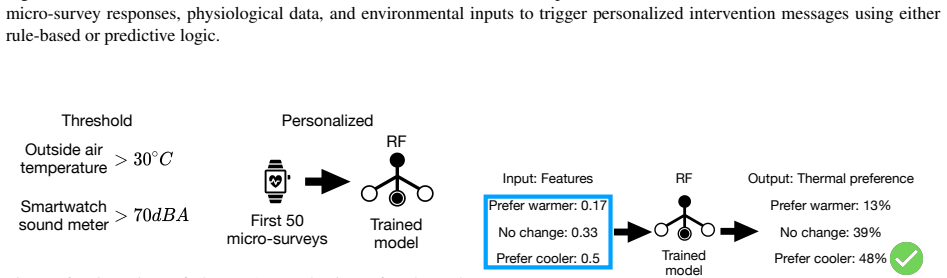
The carrying mechanism is a JITAI delivery loop built on the open-source Cozie Apple smartwatch platform. Participants answer micro-surveys on the watch; the platform fuses those self-reports with physiological and activity streams (sound level, heart rate, step count, GPS) and with public weather data; a cloud function then decides whether to push an intervention message. Two trigger logics are tested: threshold-based triggers (outdoor air temperature above 30°C for thermal messages, smartwatch sound meter above 70 dBA for noise messages, capped at four per weekday) and personalized triggers, where a Random Forest classifier — a decision-tree ensemble — trained on each participant's first 50 micro-survey responses predicts the probability of thermal or noise preference by hour of day and sends messages when the predicted non-neutral preference is highest. A weekly in-app survey supplies the outcome measures: perceived helpfulness, annoyance, and self-reported behavioral responses.
What would settle it
A controlled trial in which a randomly chosen half of participants either receive no intervention messages or have messages withheld on randomly assigned days, with identical weekly surveys and objective sensors (e.g., GPS-derived location changes and smartwatch sound exposure); if the no-message group shows the same upward trends, the paper's central claim is falsified.
Extended reading notes
Core claim
On the paper's own terms, the central finding is that a just-in-time adaptive intervention loop built on smartwatch micro-surveys can shift self-reported occupant behavior in the field. Over the first three weeks of message delivery in two deployment phases, weekly-survey responses moved upward: perceived message helpfulness rose by 8–19 percentage points, reported location changes after noise messages by 4–11 points, earphone use by 2–17 points, and adjustments of location or thermostat for thermal comfort by 3–13 points. The paper also reports that the personalized prediction mechanism, trained on each participant's first 50 micro-surveys, triggered messages for only 19 of 55 phase-2 participants, that annoyance grew in the personalized phase, and that conscientiousness, gender, and outdoor preference were associated with how helpful and actionable participants found the messages. The authors present this as one of the first demonstrations that JITAI is tolerable and potentially behavior-changing in built-environment thermal and aural comfort contexts.
Load-bearing premise
The load-bearing premise is that the rises in self-reported behavior came from the alert messages themselves, not from normal week-to-week changes in weather, noise, or people's growing familiarity with the app; the study did not include a comparison group of participants who received no alerts.
Editorial extensions
If this is right
- If the reported trends reflect real behavior change, timely messages could reduce reliance on energy-intensive heating and cooling by helping occupants choose where to sit, what to wear, or whether to use earphones.
- Personalized delivery reached only 19 of 55 phase-2 participants and produced more messages, so personalization based on 50 micro-surveys concentrates effectiveness on a subset and risks notification fatigue.
- Personality, gender, and outdoor preference correlate with perceived helpfulness, which implies that one-size-fits-all nudging will under-serve some occupants and that tailoring by individual traits is a natural next step.
- The spatial concentration of messages around particular campus paths and urban areas suggests the same framework could be extended with geofencing to warn people about heat- or noise-prone zones.
- Because the study measured proximal behavior rather than distal outcomes, the authors' framework implies that future work must test whether nudged actions actually improve comfort, productivity, or well-being.
Reading between the lines
- Our inference: because the study has no no-message control group and outcomes are self-reported, the observed upward trends could partly reflect growing familiarity with the app or social desirability; a within-subject design that randomly withholds messages on some days would separate the nudge effect from ambient trends.
- Our inference: the 70 dBA and 30°C thresholds are tuned to Singapore's climate and street noise; applying the same framework elsewhere would require recalibrating both thresholds and message frequency, so the reported effect sizes are place-specific.
- Our inference: the rise in earphone use suggests acoustic JITAI messages may function as a wearable form of personal environmental control, shifting some acoustic comfort management from building design to time- and place-specific behavior; this could be tested by pairing message logs with objective noise-exposure measurements.
- Our inference: the personalized model's cold start from the first 50 micro-surveys means participants who respond sparsely get few or no personalized messages; testing models trained on smaller or adaptive sample sizes could broaden who benefits.
Signed reviews
Editorial analysis
A structured set of objections, weighed in public.
Referee Report
Summary. This paper presents a Just-in-Time Adaptive Intervention (JITAI) framework built on the Cozie Apple smartwatch platform, deployed for eight months in Singapore with 103 participants. The system collects micro-survey responses, physiological data, and weather data, and delivers threshold-based (temperature >30 °C, noise >70 dBA) or personalized Random-Forest-triggered intervention messages. The paper reports weekly-survey results over the first three weeks of two deployment phases, claiming increases in perceived usefulness and in self-reported noise- and thermal-related adaptive behaviors (location changes, earphone use, thermal adjustments), plus associations with personality, gender, and outdoor preference, and a spatial analysis of message delivery. The authors provide open data and code for reproducibility.
Significance. If the behavioral trends were valid, this would be one of the first field demonstrations of JITAI in the built environment, with practical implications for personalized environmental nudging and occupant-centric building controls. The study's strengths are the large longitudinal deployment (103 participants, >12,000 micro-surveys, >3,600 messages), the open-source platform, and the explicit reproducibility statement. However, the headline behavioral effect sizes are not supported by the reported analysis because response-category definitions and denominators change across weeks, the ranges in the abstract are not derivable from the text, and the design (no control group, self-report only) cannot support causal claims, as the authors themselves acknowledge in Sections 4.7 and 4.8.
major comments (5)
- [Section 3.1, Figure 9] The weekly behavioral percentages are computed with different Likert-category combinations across weeks, making the time trends invalid. For example, Phase 2 location changes are 'Sometimes' alone in Week 1 (18%), 'Often and Sometimes' in Week 2 (22%), and 'Always, Often and Sometimes' in Week 3 (26%); Phase 1 earphone use is 'Always and Sometimes' in Week 1 (10%), 'Often and Sometimes' in Week 2 (14%), and three categories in Week 3 (31%). Adding response categories mechanically inflates the combined percentage even when no participant changes behavior. The abstract's and conclusion's ranges (4-11%, 2-17%, 3-13%) therefore do not measure a consistent behavioral outcome. Please recompute all trends with a fixed category definition (e.g., 'Often or more') and report those values, or remove the ranges.
- [Abstract and Section 5] The effect-size ranges in the abstract and conclusion are not consistent with the week-by-week numbers in Section 3.1. For instance, Phase 1 location changes go from 10% (Week 1) to 26% (Week 3) and Phase 2 from 18% to 26%; Phase 1 earphone use goes from 10% to 31% and Phase 2 from 17% to 33%; Phase 1 thermal adjustments go from 10% to 26% while Phase 2 goes from 31% to 29%. None of these differences matches the claimed '4-11%', '2-17%', or '3-13%' ranges, and no computation is shown. Please state explicitly how each range was derived, or correct the abstract and conclusion to match the reported data.
- [Section 3.1, Figure 9] The percentages are also computed on different denominators across weeks: the weekly N changes (e.g., Phase 1 Week 1 N=39 vs. Week 2 N=48; Phase 2 Week 1 N=45 vs. Week 2 N=55), and the stacked bars in Figure 9 include 'No response' and 'No intervention messages received' categories. Thus a rising percentage of a given response category may reflect changes in response rate or message receipt rather than behavior change. The text should report the denominators and either exclude non-respondents consistently or analyze response rates separately.
- [Sections 4.7, 4.8, and 5] The causal framing is not supported by the design. The authors acknowledge in Section 4.7 that 'we cannot definitively determine whether the increased behavioral responses over time were driven by exposure to the intervention alone or by changes in ambient discomfort,' and Section 4.8 states that the framework 'lacked measurable observation that would provide objective evidence of a behavior change' and recommends a no-intervention control. Given these limitations, statements in Section 3.1 such as 'the intervention messages were effective in encouraging participants to adopt earphone use' and the title's 'Nudging' overstate what the data can establish. Please revise the abstract, Section 3.1, and Section 5 to present the results as descriptive trends and to consistently qualify any effectiveness language with the acknowledged design limitations.
- [Section 4.1, Figure 13] The Phase 1 versus Phase 2 comparison is confounded by the different message-delivery schedules. According to Figure 13, Phase 1 threshold-based JITAIs were sent only after 50 micro-surveys, whereas Phase 2 threshold messages were sent until 50 micro-surveys and personalized messages thereafter; moreover, only 19 of 55 Phase 2 participants received any personalized message. The weekly behavior percentages in Section 3.1 are phase-level aggregates that do not condition on whether, when, or how many intervention messages each participant received, so differences between phases cannot be attributed to the threshold versus personalized mechanism. Please report the trends separately for message-recipient subgroups or otherwise account for exposure.
minor comments (6)
- [Figure 13 caption] The caption of Figure 13a states that threshold-based JITAIs were 'only sent after the participant submitted 50 micro-surveys' in Phase 1, which contradicts Section 2.3 and Figure 4, where Phase 1 sends threshold-based JITAI messages from the beginning of data collection. Please correct the caption.
- [Section 3.2] The ordinal logistic regression and chi-square analyses are mentioned but no coefficients, confidence intervals, or p-values are reported in the text or figures; without these, the reader cannot evaluate the strength of the personality, gender, and preference associations.
- [Section 3.1] The word 'significantly' is used in a descriptive context ('the percentage increased significantly to 22%') without any statistical test; please rephrase to report the observed percentage.
- [Figure 11 caption] The caption says participants who enjoy being outdoors 'were less likely to make environmental adjustments,' while the text (Section 3.2) says they 'appeared to be more likely to adjust their location or thermostat for thermal comfort.' One of these statements is inverted; please correct the inconsistency.
- [Section 2.5] The personalized Random Forest model description lacks hyperparameter details and any validation accuracy; since Phase 2's personalized mechanism is central to the paper, a brief report of model performance (e.g., cross-validated accuracy) would support reproducibility.
- [Section 4.1] The sentence 'All participants in this study received the same interventions' is imprecise because Phase 2 participants received personalized messages after 50 micro-surveys while Phase 1 participants did not; clarify that the message content was the same but the trigger mechanism differed.
Circularity Check
No circular derivation: weekly-survey outcomes are measured independently of the ML trigger; self-citations are platform or context, not load-bearing evidence.
full rationale
The paper's claimed derivation chain is empirical rather than formal. The personalized component is a Random Forest that predicts hourly thermal or noise preference from the first 50 micro-surveys, and it only determines when an intervention message is sent; the outcome claims (perceived usefulness, location changes, earphone use, thermal adjustments) come from separate weekly survey questions, so the reported trends are not computed from the fitted model or from the intervention trigger. No fitted parameter is renamed as a prediction, no uniqueness theorem from prior work is invoked to force a choice, and no known empirical pattern is re-expressed as a new result. Self-citations to Cozie and to earlier framework papers (Miller et al. 2022, 2023; Tartarini et al. 2023; Quintana et al. 2021, 2022) describe the platform and model choice but are not load-bearing evidence for the behavioral outcomes. The paper itself flags the real threats to its conclusions in Sections 4.7 and 4.8: it cannot determine whether increases were caused by the intervention or by ambient changes, and it lacked objective behavior measurement and a no-message control group. Those are causal-inference and measurement-validity limitations, not circular reasoning. A separate validity concern is that some weekly percentages use different response-category unions across weeks (e.g., Phase 2 location-change Week 1 counts only 'Sometimes' while Week 2 counts 'Often and Sometimes'), and the abstract's 3-13% thermal increase is hard to reconcile with the Section 3.1 numbers; this affects the reliability of the effect-size ranges but is not a circular derivation.
Assumptions & free parameters
free parameters (6)
- Thermal trigger threshold =
30 °C outdoor air temperature
- Noise trigger threshold =
70 dBA smartwatch sound level
- Daily message cap =
4 messages per day, 9 AM to 7 PM weekdays
- Personalization training set size =
50 micro-surveys per participant
- Random Forest hyperparameters =
not reported
- Analysis window =
first three weeks of each phase
assumptions (6)
- domain assumption Apple Watch environmental audio exposure readings reflect the acoustic conditions participants actually experience.
- domain assumption The nearest-station outdoor air temperature from the weather API approximates the thermal conditions at each participant's location.
- domain assumption Weekly survey self-reports truthfully describe actual behavior changes (location changes, earphone use, thermostat adjustments).
- domain assumption Participants who completed Week 3 surveys are comparable to those who dropped out earlier.
- domain assumption The recruited sample, mostly NUS students aged 18 to 30 who use iPhones, represents the broader urban population targeted by the claims.
- domain assumption The Random Forest model trained on 50 micro-surveys generalizes to future hours without overfitting.
Cite this review
Pith. "Pith review of Make yourself comfortable: Nudging urban heat and noise mitigation with smartwatch-based Just-in-time Adaptive Interventions (JITAI)." pith.science (2026). https://pith.science/paper/XFLCUU4Q
@misc{pith2026250109530,
  author       = {Pith},
  title        = {Pith review of: Make yourself comfortable: Nudging urban heat and noise mitigation with smartwatch-based Just-in-time Adaptive Interventions (JITAI)},
  year         = {2026},
  howpublished = {\url{https://pith.science/paper/XFLCUU4Q}},
  note         = {Machine review of arXiv:2501.09530}
}
read the original abstract
Humans can play a more active role in improving their comfort in the built environment if given the right information at the right place and time. This paper outlines the use of Just-in-Time Adaptive Interventions (JITAI) implemented in the context of the built environment to provide information that helps humans minimize the impact of heat and noise on their daily lives. This framework is based on the open-source Cozie iOS smartwatch platform. It includes data collection through micro-surveys and intervention messages triggered by environmental, contextual, and personal history conditions. An eight-month deployment of the method was completed in Singapore with 103 participants who submitted more than 12,000 micro-surveys and had more than 3,600 JITAI intervention messages delivered to them. A weekly survey conducted during two deployment phases revealed an overall increase in perceived usefulness ranging from 8-19% over the first three weeks of data collection. For noise-related interventions, participants showed an overall increase in location changes ranging from 4-11% and a 2-17% increase in earphone use to mitigate noise distractions. For thermal comfort-related interventions, participants demonstrated a 3-13\% increase in adjustments to their location or thermostat to feel more comfortable. The analysis found evidence that personality traits (such as conscientiousness), gender, and environmental preferences could be factors in determining the perceived helpfulness of JITAIs and influencing behavior change. These findings underscore the importance of tailoring intervention strategies to individual traits and environmental conditions, setting the stage for future research to refine the delivery, timing, and content of intervention messages.
Figures


Figures from the paper (9 more)




Forward citations
Cited by 1 Pith paper
-
Urban Comfort Assessment in the Era of Digital Planning: A Multidimensional, Data-driven, and AI-assisted Framework
Urban comfort assessment is unified into a multidimensional, data-driven, AI-assisted framework for digital planning, integrating factors such as greenery coverage, thermal comfort, and walkability.
Reference graph
Works this paper leans on
-
[1]
write newline
" write newline "" before.all 'output.state := FUNCTION n.dashify 't := "" t empty not t #1 #1 substring "-" = t #1 #2 substring "--" = not "--" * t #2 global.max substring 't := t #1 #1 substring "-" = "-" * t #2 global.max substring 't := while if t #1 #1 substring * t #2 global.max substring 't := if while FUNCTION word.in bbl.in ":" * " " * FUNCTION f...
-
[2]
author Abboushi, B. , author Safranek, S. , author Rodriguez-Feo Bermudez, E. , author Pratoomratana, S. , author Chen, Y. , author Poplawski, M. , author Davis, R. , year 2022 . title A review of the use of wearables in indoor environmental quality studies and an evaluation of data accessibility from a wearable device . journal Frontiers in Built Environ...
work page 2022
-
[3]
, author Alsina-Pag \`e s, R.M
author Al \' as, F. , author Alsina-Pag \`e s, R.M. , year 2019 . title Review of wireless acoustic sensor networks for environmental noise monitoring in smart cities . journal Journal of Sensors volume 2019
work page 2019
-
[4]
author Angelici, M. , author Profeta, P. , year 2023 . title Smart working: Work flexibility without constraints . journal Manage. Sci
work page 2023
-
[5]
author Appel-Meulenbroek, R. , author Steps, S. , author Wenmaekers, R. , author Arentze, T. , year 2020 . title Coping strategies and perceived productivity in open-plan offices with noise problems . journal Journal of Managerial Psychology volume 36 , pages 400--414
work page 2020
-
[6]
author Arakawa Martins, L. , author Soebarto, V. , author Williamson, T. , year 2022 . title A systematic review of personal thermal comfort models . journal Build. Environ. volume 207 , pages 108502
work page 2022
-
[7]
author Becerik-Gerber, B. , author Lucas, G. , author Aryal, A. , author Awada, M. , author Berg \'e s, M. , author Billington, S. , author Boric-Lubecke, O. , author Ghahramani, A. , author Heydarian, A. , author H \"o elscher, C. , author Jazizadeh, F. , author Khan, A. , author Langevin, J. , author Liu, R. , author Marks, F. , author Mauriello, M.L. ,...
work page 2022
-
[8]
author Bergefurt, L. , author Appel-Meulenbroek, R. , author Maris, C. , author Arentze, T. , author Weijs-Perr \'e e, M. , author de Kort, Y. , year 2023 . title The influence of distractions of the home-work environment on mental health during the COVID-19 pandemic . journal Ergonomics volume 66 , pages 16--33
work page 2023
Show all 58 references
-
[9]
, author Pigliautile, I
author Castaldo, V.L. , author Pigliautile, I. , author Rosso, F. , author Cotana, F. , author De Giorgio, F. , author Pisello, A.L. , year 2018 . title How subjective and non-physical parameters affect occupants' environmental comfort perception . journal Energy Build. volume...
2018
-
[10]
, author Schiavon, S
author Cheung, T. , author Schiavon, S. , author Parkinson, T. , author Li, P. , author Brager, G. , year 2019 . title Analysis of the accuracy on PMV -- PPD model using the ASHRAE global thermal comfort database II . journal Build. Environ. volume 153 , pages 205--217
2019
-
[11]
, author McIlvennie, C
author Day, J.K. , author McIlvennie, C. , author Brackley, C. , author Tarantini, M. , author Piselli, C. , author Hahn, J. , author O'Brien, W. , author Rajus, V.S. , author De Simone, M. , author Kj rgaard, M.B. , author Pritoni, M. , author Schl \"u ter, A. , author Peng, ...
2020
-
[12]
, author Schraivogel, S
author Fischer, T. , author Schraivogel, S. , author Caversaccio, M. , author Wimmer, W. , year 2022 . title Are smartwatches a suitable tool to monitor noise exposure for public health awareness and otoprotection? journal Front. Neurol. volume 13 , pages 856219
2022
-
[13]
, author Parkinson, T
author Graham, L.t. , author Parkinson, T. , author Schiavon, S. , year 2021 . title Lessons learned from 20 years of CBE's occupant surveys . journal Buildings and Cities volume 2 , pages 166--184
2021
-
[14]
, author Harit, V
author Gupta, A. , author Harit, V. , year 2016 . title Child safety & tracking management system by using gps, geo-fencing & android application: An analysis , in: booktitle 2016 Second International Conference on Computational Intelligence & Communication Technology (CICT) ,...
2016
-
[15]
, author Houghton, J
author Hardeman, W. , author Houghton, J. , author Lane, K. , author Jones, A. , author Naughton, F. , year 2019 . title A systematic review of just-in-time adaptive interventions ( JITAIs ) to promote physical activity . journal Int. J. Behav. Nutr. Phys. Act. volume 16 , pages 31
2019
-
[16]
, author McIlvennie, C
author Heydarian, A. , author McIlvennie, C. , author Arpan, L. , author Yousefi, S. , author Syndicus, M. , author Schweiker, M. , author Jazizadeh, F. , author Rissetto, R. , author Pisello, A.L. , author Piselli, C. , author Berger, C. , author Yan, Z. , author Mahdavi, A. ...
2020
-
[17]
, author Quintana, M
author Jayathissa, P. , author Quintana, M. , author Sood, T. , author Nazarian, N. , author Miller, C. , year 2019 . title Is your clock-face cozie? a smartwatch methodology for the in-situ collection of occupant comfort data . journal J. Phys. Conf. Ser. volume 1343 , pages 012145
2019
-
[18]
, author Hartmann, S
author Keller, R. , author Hartmann, S. , author Teepe, G.W. , author Lohse, K.M. , author Alattas, A. , author Tudor Car, L. , author M \"u ller-Riemenschneider, F. , author von Wangenheim, F. , author Mair, J.L. , author Kowatsch, T. , year 2022 . title Digital behavior chan...
2022
-
[19]
, author de Dear, R
author Kim, J. , author de Dear, R. , year 2013 . title Workspace satisfaction: The privacy-communication trade-off in open-plan offices . journal J. Environ. Psychol. volume 36 , pages 18--26
2013
-
[20]
, author Sarkar, S
author Kumar, S. , author Sarkar, S. , author Chahar, B. , year 2021 . title A systematic review of work-life integration and role of flexible work arrangements . journal Int. J. Organ. Anal. volume ahead-of-print
2021
-
[21]
, author Koeva, M
author Lehtola, V.V. , author Koeva, M. , author Elberink, S.O. , author Raposo, P. , author Virtanen, J.P. , author Vahdatikhaki, F. , author Borsci, S. , year 2022 . title Digital twin of a city: Review of technology serving city needs . journal International Journal of Appl...
2022
-
[22]
, author Janssen, P
author Lei, B. , author Janssen, P. , author Stoter, J. , author Biljecki, F. , year 2023 . title Challenges of urban digital twins: A systematic review and a delphi expert survey . journal Automation in Construction volume 147 , pages 104716 . :10.1016/j.autcon.2022.104716
2023
-
[23]
, author Loveday, D
author Li, Z. , author Loveday, D. , author Demian, P. , year 2021 . title Nudging and usage of thermal comfort-related systems . journal Energy Build. volume 252 , pages 111480
2021
-
[24]
, author Simons, M
author Ligtenberg, A. , author Simons, M. , author Barhorst, M. , author Winkens, L. , year 2022 . title Making space a better place: Just in time adaptive interventions for healthy lifestyles . journal AGILE: GIScience Series volume 3 , pages 45
2022
-
[25]
, author Zhao, T
author Liu, P. , author Zhao, T. , author Luo, J. , author Lei, B. , author Frei, M. , author Miller, C. , author Biljecki, F. , year 2023 . title Towards human-centric digital twins: Leveraging computer vision and graph models to predict outdoor comfort . journal Sustainable ...
2023
-
[26]
, author Andr \'e , M
author Lorenz, C.L. , author Andr \'e , M. , author Abele, O. , author Gunay, B. , author Hahn, J. , author Hensen, P. , author Nagy, Z. , author Ouf, M.M. , author Park, J.Y. , author Yaduvanshi, N.S. , author Miller, C. , year 2023 . title A repository of occupant-centric co...
2023
-
[27]
, author Frei, M
author Maisha, K. , author Frei, M. , author Quintana, M. , author Chua, Y.X. , author Jain, R. , author Miller, C. , year 2023 . title Utilizing wearable technology to characterize and facilitate occupant collaborations in flexible workspaces . journal J. Phys. Conf. Ser. vol...
2023
-
[28]
, author Zhao, P
author Mangold, M. , author Zhao, P. , author Haitao, H. , author Mansourian, A. , year 2022 . title Geo-fence planning for dockless bike-sharing systems: A gis-based multi-criteria decision analysis framework . journal Urban Informatics volume 1 , pages 17
2022
-
[29]
, author Abdelrahman, M
author Miller, C. , author Abdelrahman, M. , author Chong, A. , author Biljecki, F. , author Quintana, M. , author Frei, M. , author Chew, M. , author Wong, D. , year 2021 . title The Internet-of-Buildings ( IoB ) --- digital twin convergence of wearable and IoT data with GIS/...
2021
-
[30]
, author Chua, Y.X
author Miller, C. , author Chua, Y.X. , author Frei, M. , author Quintana, M. , year 2022 . title Towards smartwatch-driven just-in-time adaptive interventions ( JITAI ) for building occupants , in: booktitle The 9th ACM International Conference on Systems for Energy-Efficient...
2022
-
[31]
, author Quintana, M
author Miller, C. , author Quintana, M. , author Frei, M. , author Chua, Y.X. , author Fu, C. , author Picchetti, B. , author Yap, W. , author Chong, A. , author Biljecki, F. , year 2023 . title Introducing the cool, quiet city competition: Predicting smartwatch-reported heat ...
2023
-
[32]
, author Park, Y
author Mosteiro-Romero, M. , author Park, Y. , author Miller, C. , year 2024 . title Converging smartwatch and urban datasets for sustainable city planning: A case study in seoul, south korea . journal E3S Web Conf
2024
-
[33]
, author Quintana, M
author Mosteiro-Romero, M. , author Quintana, M. , author Miller, C. , author Stouffs, R. , year 2023 . title From personal comfort to district performance: Using smartwatch and WiFi data for occupant-driven operation , in: booktitle Proceedings of the 10th ACM International C...
2023
-
[34]
, author Blandford, A
author M \"u ller, A.M. , author Blandford, A. , author Yardley, L. , year 2017 . title The conceptualization of a Just-In-Time adaptive intervention ( JITAI ) for the reduction of sedentary behavior in older adults . journal Mhealth volume 3 , pages 37
2017
-
[35]
, author Smith, S.N
author Nahum-Shani, I. , author Smith, S.N. , author Spring, B.J. , author Collins, L.M. , author Witkiewitz, K. , author Tewari, A. , author Murphy, S.A. , year 2018 . title Just-in-Time adaptive interventions ( JITAIs ) in mobile health: Key components and design principles ...
2018
-
[36]
, author Schiavon, S
author Parkinson, T. , author Schiavon, S. , author Kim, J. , author Betti, G. , year 2023 . title Common sources of occupant dissatisfaction with workspace environments in 600 office buildings . journal Build. Cities volume 4 , pages 17--35
2023
-
[37]
, author Engelen, L
author Pollard, B. , author Engelen, L. , author Held, F. , author Van Buskirk, J. , author Spinney, R. , author de Dear, R. , year 2022 . title Associations between spatial attributes, IEQ exposures and occupant movement behaviour in an open-plan office . journal Build. Envir...
2022
-
[38]
, author Abdelrahman, M
author Quintana, M. , author Abdelrahman, M. , author Frei, M. , author Tartarini, F. , author Miller, C. , year 2021 . title Longitudinal personal thermal comfort preference data in the wild , in: booktitle Proceedings of the 19th ACM Conference on Embedded Networked Sensor S...
2021
-
[39]
, author Schiavon, S
author Quintana, M. , author Schiavon, S. , author Tartarini, F. , author Kim, J. , author Miller, C. , year 2022 . title Cohort comfort models — Using occupant’s similarity to predict personal thermal preference with less data . journal Building and Environment volume 227 , p...
2022
-
[40]
, author Braun, U
author Reichert, M. , author Braun, U. , author Lautenbach, S. , author Zipf, A. , author Ebner-Priemer, U. , author Tost, H. , author Meyer-Lindenberg, A. , year 2020 . title Studying the impact of built environments on human mental health in everyday life: methodological dev...
2020
-
[41]
, author Parkinson, T
author Rupp, R.F. , author Parkinson, T. , author Kim, J. , author Toftum, J. , author de Dear, R. , year 2022 . title The impact of occupant's thermal sensitivity on adaptive thermal comfort model . journal Build. Environ. volume 207 , pages 108517
2022
-
[42]
, author Dong, B
author Salim, F.D. , author Dong, B. , author Ouf, M. , author Wang, Q. , author Pigliautile, I. , author Kang, X. , author Hong, T. , author Wu, W. , author Liu, Y. , author Rumi, S.K. , author Rahaman, M.S. , author An, J. , author Deng, H. , author Shao, W. , author Dziedzi...
2020
-
[43]
, author Vemuri, A
author Saponaro, M. , author Vemuri, A. , author Dominick, G. , author Decker, K. , year 2021 . title Contextualization and individualization for just-in-time adaptive interventions to reduce sedentary behavior , in: booktitle Proceedings of the Conference on Health, Inference...
2021
-
[44]
, author Rissetto, R
author Schweiker, M. , author Rissetto, R. , author Wagner, A. , year 2020 . title Thermal expectation: Influencing factors and its effect on thermal perception . journal Energy Build. volume 210 , pages 109729
2020
-
[45]
, author Jain, R.K
author Sonta, A. , author Jain, R.K. , year 2020 . title Learning socio-organizational network structure in buildings with ambient sensing data . journal Data-Centric Engineering volume 1 , pages e9
2020
-
[46]
, author Janssen, P
author Sood, T. , author Janssen, P. , author Miller, C. , year 2020 . title Spacematch: Using environmental preferences to match occupants to suitable activity-based workspaces . journal Frontiers in Built Environment volume 6 , pages 113
2020
-
[47]
, author Bharathy, G
author Soomro, A.M. , author Bharathy, G. , author Biloria, N. , author Prasad, M. , year 2021 . title A review on motivational nudges for enhancing building energy conservation behavior . journal Journal of Smart Environments and Green Computing volume 1 , pages 3--20
2021
-
[48]
, year 2014
author Szczytowski, P. , year 2014 . title Geo-fencing based disaster management service , in: booktitle Workshop on Agents, Virtual Societies and Analytics , organization Springer . pp. pages 11--21
2014
-
[49]
, author Frei, M
author Tartarini, F. , author Frei, M. , author Schiavon, S. , author Chua, Y.X. , author Miller, C. , year 2023 . title Cozie apple: An iOS mobile and smartwatch application for environmental quality satisfaction and physiological data collection . journal J. Phys. Conf. Ser....
2023
-
[50]
, author Lei, Y
author Tekler, Z.D. , author Lei, Y. , author Peng, Y. , author Miller, C. , author Chong, A. , year 2023 . title A hybrid active learning framework for personal thermal comfort models . journal Build. Environ. volume 234 , pages 110148
2023
-
[51]
, author Heidari, O
author Tobin, K. , author Heidari, O. , author Volpi, C. , author Sodder, S. , author Duncan, D. , year 2023 . title Use of geofencing interventions in population health research: a scoping review . journal BMJ open volume 13 , pages e069374
2023
-
[52]
, author Al-Assaad, D
author Torresin, S. , author Al-Assaad, D. , author Aletta, F. , author Balderrama, A. , author Bivolarova, M.P. , author de Souza, L.P. , author Dicle, S.Y. , author Lee, P.J. , author Llorca-Bofí, J. , author Maula, H. , author Pigliautile, I. , author Pisello, A.L. , author...
2024
-
[53]
, author Kroese, F.M
author Venema, T.A.G. , author Kroese, F.M. , author De Ridder, D.T.D. , year 2018 . title I'm still standing: A longitudinal study on the effect of a default nudge . journal Psychology and Health volume 33 , pages 669--681
2018
-
[54]
, author He, Z
author Wang, Y. , author He, Z. , author Zhai, W. , author Wang, S. , author Zhao, C. , year 2024 . title How do the 3d urban morphological characteristics spatiotemporally affect the urban thermal environment? a case study of san antonio . journal Building and Environment vol...
2024
-
[55]
, author Yu, H
author Xu, X. , author Yu, H. , author Sun, Q. , author Tam, V.W.Y. , year 2023 . title A critical review of occupant energy consumption behavior in buildings: How we got here, where we are, and where we are headed . journal Renewable Sustainable Energy Rev. volume 182 , pages 113396
2023
-
[56]
, author Yang, Y
author Yang, J. , author Yang, Y. , author Sun, D. , author Jin, C. , author Xiao, X. , year 2021 . title Influence of urban morphological characteristics on thermal environment . journal Sustainable Cities and Society volume 72 , pages 103045
2021
-
[57]
, author Stouffs, R
author Yap, W. , author Stouffs, R. , author Biljecki, F. , year 2023 . title Urbanity: automated modelling and analysis of multidimensional networks in cities . journal npj Urban Sustainability volume 3 . :10.1038/s42949-023-00125-w
2023 doi
-
[58]
, author Primack, R.B
author Zipf, L. , author Primack, R.B. , author Rothendler, M. , year 2020 . title Citizen scientists and university students monitor noise pollution in cities and protected areas with smartphones . journal PLoS One volume 15 , pages e0236785
2020
Reviewed August 10, 2026 · model on record in the stance chip above.
Discussion (0). Continue with ORCID to comment.