REVIEW 3 major objections 5 minor 99 references
The s process in rotating low-mass AGB stars. Nucleosynthesis calculations in models matching asteroseismic constraints
T0 review · 3 major / 5 minor · reviewed 2026-08-14 · deepseek-v4-flash
Pith's one-line read Rotation matching asteroseismic observations leaves s-process yields unchanged.
desk verdict First rotating AGB s-process models forced to match asteroseismic core rates; yields match non-rotating models, but the artificial viscosity's unknown mixing efficiency is the load-bearing caveat. read the letter →
The pith
A machine-rendered reading of the paper's core claim, the machinery that carries it, and where it could break.
The reading
What carries the argument
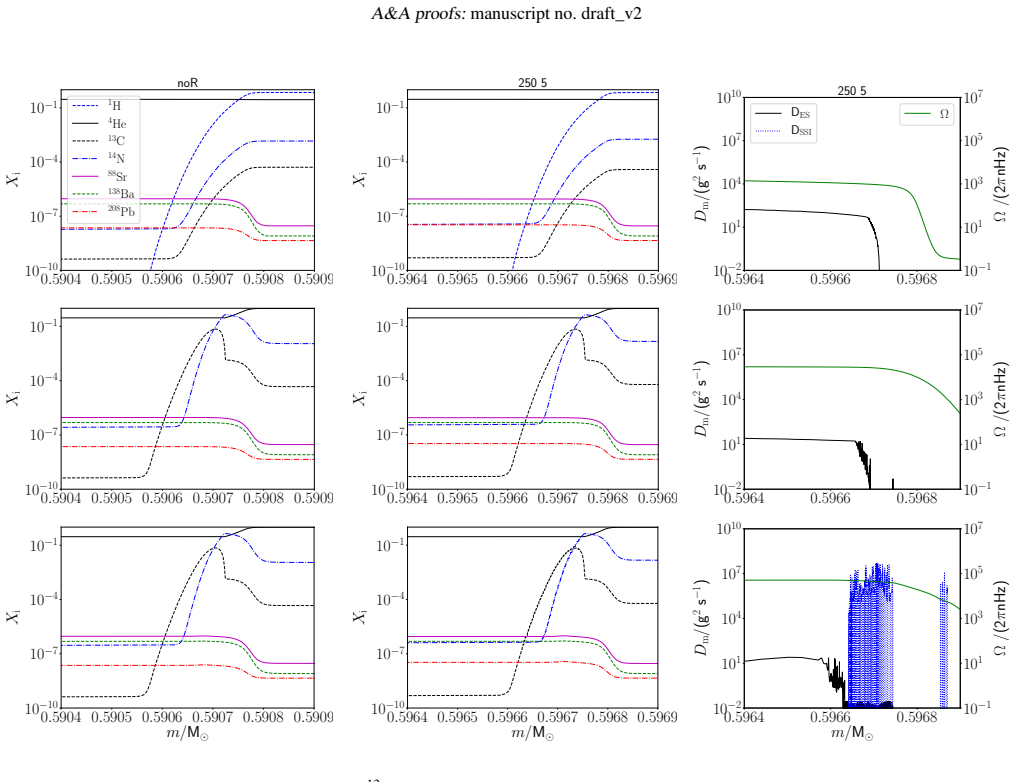
The key device is the split between angular momentum transport and chemical mixing. The artificial viscosity $\nu_{\mathrm{add}}$, a constant calibrated to asteroseismic core rotation rates, is added to the angular momentum diffusion coefficient $D_{\mathrm{am}}$ but not to the chemical mixing coefficient $D_{\mathrm{mix}}$, so the core is slowed while composition is untouched. The diagnostic object is the $^{13}\mathrm{C}$ pocket, a thin layer of carbon-13 formed at the top of the helium intershell after each third dredge-up; during the interpulse period it releases neutrons via $^{13}\mathrm{C}(\alpha,n)^{16}\mathrm{O}$ and drives the s process. The paper shows that in the slowly rotating cores the residual instabilities—mainly the Eddington-Sweet circulation, which scales as $\Omega^2$ and is inhibited by the molecular weight gradient—are too weak to change the pocket, while the secular shear is discontinuous and therefore does not mix composition smoothly. This explains why the s-process yields match the non-rotating case.
What would settle it
The claim fails if a physically motivated angular momentum transport mechanism that also mixes chemical elements is implemented in the same stellar evolution code and produces s-process yields different from non-rotating models; the authors themselves show that adding $\nu_{\mathrm{add}}$ to the chemical mixing coefficient erases the $^{13}\mathrm{C}$ pocket entirely, so the threshold chemical mixing efficiency could be bracketed with a parameter study.
Extended reading notes
Core claim
The central discovery, stated on the paper's own terms, is that the missing angular momentum transport process required to match asteroseismic observations also suppresses rotationally induced mixing to the point of irrelevance for s-process nucleosynthesis. Using a constant artificial viscosity $\nu_{\mathrm{add}}$ added only to the angular momentum diffusion equation, and calibrated to observed core rotation rates, the authors construct $2\,M_\odot$, $Z=0.01$ AGB models whose cores spin at the observed rates during the main sequence, core helium burning, and the white dwarf phase. In these models the Eddington-Sweet circulation, the only continuously acting rotational mixing process, has a diffusion coefficient in the $^{13}\mathrm{C}$ pocket region that is too small to alter the abundance profiles, and the secular shear instability produces only discontinuous mixing with little effect. The resulting surface enrichment of s-process elements is comparable to the non-rotating model, including in a model rotating an order of magnitude faster than the asteroseismic upper limit. The authors conclude that rotation consistent with asteroseismology has no effect on s-process production, independent of the initial rotation rate.
Load-bearing premise
The conclusion rests on the assumption that the real, still unidentified process that removes angular momentum from stellar cores, here represented by the artificial viscosity, does not also mix chemical elements; if it mixed chemicals at even a fraction of its angular momentum efficiency, the $^{13}\mathrm{C}$ pocket and the s-process yields would change.
Editorial extensions
If this is right
- Observed run-to-run spreads in s-process abundances among AGB stars of similar metallicity should not be attributed to rotation; other processes such as convective boundary mixing must be responsible.
- Non-rotating AGB models can be used for heavy-element yield grids in galactic chemical evolution without losing accuracy due to rotation.
- The initial rotation rate of a star, at least up to 250 km/s, does not determine its s-process outcome once the core spin is slowed to observed values.
- Even a core rotating one order of magnitude faster than the asteroseismic upper limit still yields s-process enrichments matching non-rotating models, giving a wide safety margin.
- The missing angular momentum transport mechanism is constrained: it must not mix chemical elements at the same rate as it transports angular momentum, otherwise chemically homogeneous stars would result.
Reading between the lines
- If the result extends to other masses and metallicities, rotating AGB models may be dropped from yield grids entirely, freeing computational resources for multi-dimensional mixing studies.
- Asteroseismic core rotation rates could be used as a boundary condition to calibrate the chemical mixing side of rotational instabilities: any candidate transport mechanism must reproduce both the observed spins and the observed s-process patterns.
- The paper's exclusion of the GSF instability rests on arguments from other stellar contexts; if GSF operates in the AGB intershell, the $^{13}\mathrm{C}$ pocket could be affected, although the appendix suggests even including it does not change the yields.
- A direct observational test would be to compare s-process abundances of asteroseismically characterized post-AGB stars with their core rotation rates; the paper predicts no correlation.
Signed reviews
Editorial analysis
A structured set of objections, weighed in public.
Referee Report
Summary. The paper investigates whether rotational mixing affects s-process nucleosynthesis in low-mass AGB stars when the stellar models are forced to match asteroseismically measured core rotation rates. The authors construct 2 Msun, Z=0.01 MESA models with initial rotation rates of 0, 125, and 250 km/s, and add an artificial viscosity nu_add (calibrated in Paper I) to the angular momentum transport equation to slow the core. They compute s-process yields with the NuGrid post-processing tool MPPNP. For models with nu_add=10^6 cm^2/s, which match the upper limit of observed core rotation rates during core He burning and the white dwarf phase, the surface enrichment of s-process elements is comparable to that of the non-rotating model. A conservative model rotating an order of magnitude faster than observed ('250 5') also shows comparable s-process production. The authors conclude that once rotation rates are consistent with asteroseismic constraints, rotationally induced mixing has no effect on s-process nucleosynthesis, and that this result is independent of the initial rotation rate.
Significance. If the central claim holds, this is an important and timely result: it connects asteroseismic constraints on internal rotation to nucleosynthesis yields, suggesting that non-rotating AGB models may be adequate for galactic chemical evolution studies, at least for the masses and metallicities considered. The paper is computationally substantial, uses established codes (MESA, MPPNP), and compares against a broad set of observed rotation rates across several evolutionary phases. It also includes a conservative upper-limit model and an appendix exploring the role of additional rotational instabilities. These are genuine strengths. However, the headline conclusion rests on the assumption that the unidentified angular momentum transport process, here represented by nu_add, does not mix chemical elements at levels relevant to 13C-pocket formation. The paper's own tests only rule out equal efficiency for angular momentum and chemical mixing, not partial efficiencies, so the universal phrasing of the conclusion is stronger than the evidence currently supports.
major comments (3)
- [Sect. 2.2, Eqs. (5)-(6), and Sect. 4] The decision to add nu_add only to Dam and not to Dmix is the main load-bearing assumption of the paper. The test described in Sect. 4, in which nu_add is also added to Dmix at the same value and produces chemically homogeneous stars, rules out only the case where the missing process mixes chemicals with the same efficiency as it transports angular momentum. It does not constrain intermediate efficiencies. Since the physical nature of the missing process is unknown, a mechanism such as internal gravity waves or a magnetic instability could, in principle, mix chemicals at a fraction of the angular momentum transport rate. The 13C pocket is sensitive to weak diffusive mixing, and even a modest extra diffusion coefficient in the pocket region could change the 13C/14N ratio and the resulting neutron capture path. I therefore request either a parametric study varying the ratio of chemical to angular momentum diffusion (e.g., D_mix = fc * D_rot + epsilon * nu_add with 0 < epsilon < 1) or a clear restriction of the conclusion to models in which the missing process does not mix chemicals.
- [Abstract and Sect. 4, bullet list] The statement that the result is 'independent of the initial rotation rate' is not supported by the model grid. The main s-process comparison includes only two initial rotation rates, 125 and 250 km/s, both typical of young B stars. The additional 10 km/s model mentioned in Sect. 2.5 is used only to show that low initial rotation cannot reproduce observed core rotation rates; no s-process yields are shown for it. Two initial rates are insufficient to establish independence over the full relevant range. The claim should be weakened to 'for the initial rotation rates considered here' or supported with models spanning a wider range, including a low-rotation case for which yields are actually computed.
- [Sect. 3.1 and Fig. 3] The detailed comparison of 13C-pocket abundance and diffusion profiles is presented for the '250 5' model, which rotates an order of magnitude faster than the asteroseismic upper limit, rather than for the '250 6' model that actually matches the observed rotation rates. While Fig. 5 shows that the surface enrichment of '250 6' overlaps with the non-rotating model, the paper does not show the pocket structure for the asteroseismically matched model. Given that the 13C pocket is the primary neutron source and that the authors emphasize the importance of small differences in the pocket, I ask that the pocket profiles for the '250 6' model (or an explicit statement of why they are not shown) be included to directly support the central conclusion.
minor comments (5)
- [Sect. 2, paragraph on mass loss] The text reads 'ad discussed by Wood & Faulkner 1986'; this should be 'as discussed by'.
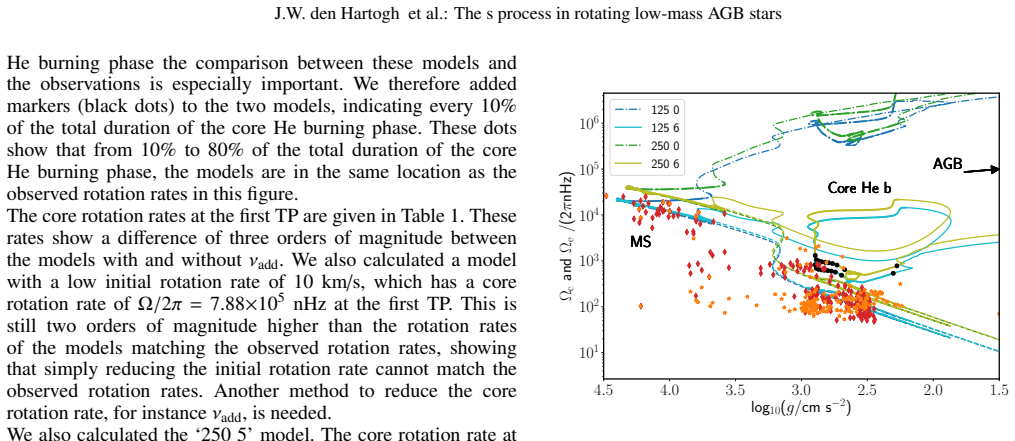
- [Fig. 2] The x-axis label appears as 'log10(g/cm s□2)', which looks like a corrupted rendering; it should presumably be a density or log g label. Please correct the typesetting.
- [Sect. 3.1, paragraph on ES circulation] The text states both that the Eddington-Sweet circulation is present with values between 10^1 and 10^2 g^2 s^-1 in the 13C-pocket region and that the molecular weight gradient prevents this mixing process from being active within the pocket. These statements appear contradictory and should be clarified.
- [Table 1 caption] The caption begins 'Names of the models are a combination...'; this should be 'Names of the models are combinations...' or 'The model names are a combination...'.
- [Sect. 4, paragraph on f parameters] The authors state that the conclusions remain the same when testing the Yoon et al. (2006) and Brott et al. (2011) values of fc and fmu, but no results or figures are shown for this test. A sentence with the resulting yields or a figure reference would make this verifiable.
Circularity Check
No significant circularity: the s-process yields are independent outputs of models calibrated only to asteroseismic rotation data.
full rationale
The paper's central claim is that rotating AGB models whose cores are forced (via an artificial viscosity nu_add) to match asteroseismically measured rotation rates produce s-process yields comparable to non-rotating models. The derivation chain is: (i) nu_add is calibrated to asteroseismic core and surface rotation-rate observations (Fig. 2), an external dataset; (ii) with this nu_add, MESA computes rotation profiles with slower, more solid-body cores; (iii) rotational mixing coefficients DES and DSSI are then computed from those profiles via the standard Heger et al. (2000) prescriptions, with fc and fmu taken from independent calibrations and not from any s-process data; (iv) MPPNP post-processing converts the resulting thermal and diffusion histories into s-process yields. The s-process yields are never used to adjust nu_add, fc, fmu, or any other parameter, so the headline result is an output rather than a fitted quantity. The main self-citation, Paper I, provides the nu_add method, but this paper independently re-anchors nu_add to asteroseismic rotation rates and directly compares to observations, so the self-citation is not load-bearing. The caveat that nu_add is added to Dam (Eq. 5) but not to Dmix (Eq. 6) is an explicit assumption about the physics of the missing angular-momentum process; the paper tests the equal-efficiency extreme and acknowledges that partial-efficiency mixing would remain a concern, but this is an uncertainty in model input, not a circular derivation of the conclusion. Thus no circular step is present.
Assumptions & free parameters
free parameters (5)
- nu_add (additional viscosity) =
10^6 cm^2 s^-1 for models 125 6 and 250 6; 10^5 for model 250 5
- fc (rotational mixing efficiency) =
1/30
- fmu (molecular weight gradient factor) =
0.05
- CBM parameters (D0, D2, f1HP0, f2HP0, z2) =
Values from Herwig et al. 1997 and Battino et al. 2016
- Initial rotation rates =
125 and 250 km/s at ZAMS
assumptions (5)
- domain assumption The 13C pocket created by convective boundary mixing is the dominant neutron source for the s-process in these models.
- domain assumption The missing angular momentum transport, modeled as nu_add, does not mix chemical elements.
- domain assumption The excluded rotational instabilities GSF, DSI, and SH are negligible in these stars.
- domain assumption Asteroseismic core rotation observations of MS, RGB, core He-burning, and WD stars are representative constraints for AGB progenitors and successors.
- standard math The standard MESA diffusion treatment of rotation and mixing (Eqs. 3-7) correctly captures the included physics.
Cite this review
Pith. "Pith review of The s process in rotating low-mass AGB stars. Nucleosynthesis calculations in models matching asteroseismic constraints." pith.science (2026). https://pith.science/paper/XFVU2ZFT
@misc{pith2026190809160,
  author       = {Pith},
  title        = {Pith review of: The s process in rotating low-mass AGB stars. Nucleosynthesis calculations in models matching asteroseismic constraints},
  year         = {2026},
  howpublished = {\url{https://pith.science/paper/XFVU2ZFT}},
  note         = {Machine review of arXiv:1908.09160}
}
abstract
Aims. We investigate the s-process during the AGB phase of stellar models whose cores are enforced to rotate at rates consistent with asteroseismology observations of their progenitors and successors. Methods. We calculated new 2M$_{\odot}$, Z=0.01 models, rotating at 0, 125, and 250 km/s at the start of main sequence. An artificial, additional viscosity was added to enhance the transport of angular momentum in order to reduce the core rotation rates to be in agreement with asteroseismology observations. We compared rotation rates of our models with observed rotation rates during the MS up to the end of core He burning, and the white dwarf phase. Results. We present nucleosynthesis calculations for these rotating AGB models that were enforced to match the asteroseismic constraints on rotation rates of MS, RGB, He-burning, and WD stars. In particular, we calculated one model that matches the upper limit of observed rotation rates of core He-burning stars and we also included a model that rotates one order of magnitude faster than the upper limit of the observations. The s-process production in both of these models is comparable to that of non-rotating models. Conclusions. Slowing down the core rotation rate in stars to match the above mentioned asteroseismic constraints reduces the rotationally induced mixing processes to the point that they have no effect on the s-process nucleosynthesis. This result is independent of the initial rotation rate of the stellar evolution model. However, there are uncertainties remaining in the treatment of rotation in stellar evolution, which need to be reduced in order to confirm our conclusions, including the physical nature of our approach to reduce the core rotation rates of our models, and magnetic processes.
Figures

Figures from the paper (2 more)


Reference graph
Works this paper leans on
-
[1]
, " * write output.state after.block = add.period write newline
ENTRY address archiveprefix author booktitle chapter edition editor howpublished institution eprint journal key month note number organization pages publisher school series title type volume year label extra.label sort.label short.list INTEGERS output.state before.all mid.sentence after.sentence after.block FUNCTION init.state.consts #0 'before.all := #1 ...
-
[2]
write newline
" write newline "" before.all 'output.state := FUNCTION n.dashify 't := "" t empty not t #1 #1 substring "-" = t #1 #2 substring "--" = not "--" * t #2 global.max substring 't := t #1 #1 substring "-" = "-" * t #2 global.max substring 't := while if t #1 #1 substring * t #2 global.max substring 't := if while FUNCTION word.in bbl.in " " * FUNCTION format....
-
[3]
1966, in Stellar Evolution, ed.\ R
Baker, N. 1966, in Stellar Evolution, ed.\ R. F. Stein,& A. G. W. Cameron (Plenum, New York) 333
1966
-
[4]
1988, A&A, 200, 58
Balluch, M. 1988, A&A, 200, 58
1988
-
[5]
Cox, J. P. 1980, Theory of Stellar Pulsation (Princeton University Press, Princeton) 165
1980
-
[6]
N.,& Stewart, J
Cox, A. N.,& Stewart, J. N. 1969, Academia Nauk, Scientific Information 15, 1
1969
-
[7]
1980, Prog
Mizuno H. 1980, Prog. Theor. Phys., 64, 544
1980
-
[8]
Tscharnuter W. M. 1987, A&A, 188, 55
1987
Show all 99 references
-
[9]
1992, in ASP Conf
Terlevich, R. 1992, in ASP Conf. Ser. 31, Relationships between Active Galactic Nuclei and Starburst Galaxies, ed. A. V. Filippenko, 13
1992
-
[10]
Yorke, H. W. 1980a, A&A, 86, 286
-
[11]
F., Tytler, D
Zheng, W., Davidsen, A. F., Tytler, D. & Kriss, G. A. 1997, preprint
1997
-
[12]
2002, , 579, 817
Abia , C., Dom \' nguez , I., Gallino , R., et al. 2002, , 579, 817
2002
-
[13]
Aerts, C., Mathis, S., & Rogers, T. M. 2019, , 57, null
2019
-
[14]
2018, , 237, 15
Aerts , C., Molenberghs , G., Michielsen , M., et al. 2018, , 237, 15
2018
-
[15]
V., & Tkachenko, A
Aerts, C., Reeth, T. V., & Tkachenko, A. 2017, , 847, L7
2017
-
[16]
2016, , 827, 30
Battino, U., Pignatari, M., Ritter, C., et al. 2016, , 827, 30
2016
-
[17]
2019, arXiv e-prints, arXiv:1906.01952
Battino , U., Tattersall , A., Lederer-Woods , C., et al. 2019, arXiv e-prints, arXiv:1906.01952
2019 arXiv
-
[18]
E., Hirschi , R., Pignatari , M., et al
Bennett , M. E., Hirschi , R., Pignatari , M., et al. 2012, , 420, 3047
2012
-
[19]
2017, , 835, 97
Bisterzo, S., Travaglio, C., Wiescher, M., Käppeler, F., & Gallino, R. 2017, , 835, 97
2017
-
[20]
1995, , 297, 727
Bloecker , T. 1995, , 297, 727
1995
-
[21]
J., Koch , D., Basri , G., et al
Borucki , W. J., Koch , D., Basri , G., et al. 2010, Science, 327, 977
2010
-
[22]
E., Cantiello , M., et al
Brott , I., de Mink , S. E., Cantiello , M., et al. 2011, , 530, A115
2011
-
[23]
F., Doherty , C
Buntain , J. F., Doherty , C. L., Lugaro , M., et al. 2017, , 471, 824
2017
-
[24]
M., Burbidge, G
Burbidge, E. M., Burbidge, G. R., Fowler, W. A., & Hoyle, F. 1957, Rev. Mod. Phys., 29, 547
1957
-
[25]
A., & Tognelli , E
Caleo , A., Balbus , S. A., & Tognelli , E. 2016, , 460, 338
2016
-
[26]
2014, , 788, 93
Cantiello , M., Mankovich , C., Bildsten , L., Christensen-Dalsgaard , J., & Paxton , B. 2014, , 788, 93
2014
-
[27]
2017, , 605, A111
Ceillier , T., Tayar , J., Mathur , S., et al. 2017, , 605, A111
2017
-
[28]
Chaboyer , B., Demarque , P., & Pinsonneault , M. H. 1995, , 441, 865
1995
-
[29]
& Zahn , J.-P
Chaboyer , B. & Zahn , J.-P. 1992, , 253, 173
1992
-
[30]
B., Pereira , C
de Castro , D. B., Pereira , C. B., Roig , F., et al. 2016, , 459, 4299
2016
-
[31]
2015, A&A, 580
Deheuvels, S., Ballot, J., Beck, P., & Mosser, B. 2015, A&A, 580
2015
-
[32]
J., et al
Deheuvels, S., Do g an, G., Goupil, M. J., et al. 2014, , 564, A27
2014
-
[33]
A., Chaplin, W
Deheuvels, S., Garc \' a, R. A., Chaplin, W. J., et al. 2012, , 756, 19
2012
-
[34]
W., Eggenberger , P., & Hirschi , R
den Hartogh , J. W., Eggenberger , P., & Hirschi , R. 2019, , 622, A187
2019
-
[35]
A., Pinsonneault, M., Terndrup, D
Denissenkov, P. A., Pinsonneault, M., Terndrup, D. M., & Newsham, G. 2010, ApJ, 716, 1269
2010
-
[36]
Denissenkov , P. A. & Tout , C. A. 2003, , 340, 722
2003
-
[37]
Eddington, A. S. 1925, The Observatory, 48, 73
1925
-
[38]
Eggenberger , P., Buldgen , G., & Salmon , S. J. A. J. 2019, , 626, L1
2019
-
[39]
2019, , 621, A66
Eggenberger, P., Deheuvels, S., Miglio, A., et al. 2019, , 621, A66
2019
-
[40]
2017, , 599, A18
Eggenberger, P., Lagarde, N., Miglio, A., et al. 2017, , 599, A18
2017
-
[41]
2005, , 440, L9
Eggenberger , P., Maeder , A., & Meynet , G. 2005, , 440, L9
2005
-
[42]
2012, , 544, L4
Eggenberger, P., Montalb \'a n, J., & Miglio, A. 2012, , 544, L4
2012
-
[43]
Endal , A. S. & Sofia , S. 1978, , 220, 279
1978
-
[44]
1968, , 68, 317
Fricke , K. 1968, , 68, 317
1968
-
[45]
L., & Jermyn , A
Fuller , J., Piro , A. L., & Jermyn , A. S. 2019, , 485, 3661
2019
-
[46]
1998, , 497, 388
Gallino , R., Arlandini , C., Busso , M., et al. 1998, , 497, 388
1998
-
[47]
& Schubert , G
Goldreich , P. & Schubert , G. 1967, , 150, 571
1967
-
[48]
& Siess, L
Goriely, S. & Siess, L. 2018, , 609, A29
2018
-
[49]
& Noels , A
Grevesse , N. & Noels , A. 1993, in Perfectionnement de l'Association Vaudoise des Chercheurs en Physique, ed. B. Hauck , S. Paltani , & D. Raboud , 205--257
1993
-
[50]
Heger , A., Langer , N., & Woosley , S. E. 2000, , 528, 368
2000
-
[51]
J., Gänsicke, B
Hermes, J. J., Gänsicke, B. T., Kawaler, S. D., et al. 2017, The Astrophysical Journal Supplement Series, 232, 23
2017
-
[52]
2000, , 360, 952
Herwig , F. 2000, , 360, 952
2000
-
[53]
2001, Astrophysics and Space Science, 275, 15
Herwig, F. 2001, Astrophysics and Space Science, 275, 15
2001
-
[54]
2005, , 43, 435
Herwig , F. 2005, , 43, 435
2005
-
[55]
1997, , 324, L81
Herwig , F., Bloecker , T., Schoenberner , D., & El Eid , M. 1997, , 324, L81
1997
-
[56]
2007, in Astronomical Society of the Pacific Conference Series, Vol
Herwig , F., Freytag , B., Fuchs , T., et al. 2007, in Astronomical Society of the Pacific Conference Series, Vol. 378, Why Galaxies Care About AGB Stars: Their Importance as Actors and Probes, ed. F. Kerschbaum , C. Charbonnel , & R. F. Wing , 43
2007
-
[57]
2003, , 593, 1056
Herwig , F., Langer , N., & Lugaro , M. 2003, , 593, 1056
2003
-
[58]
& Maeder , A
Hirschi , R. & Maeder , A. 2010, , 519, A16
2010
-
[59]
& Iben , Icko, J
Hollowell , D. & Iben , Icko, J. 1988, , 333, L25
1988
-
[60]
R., & McSwain , M
Huang , W., Gies , D. R., & McSwain , M. V. 2010, , 722, 605
2010
-
[61]
& Renzini , A
Iben , I., J. & Renzini , A. 1982, , 263, L23
1982
-
[62]
James , H. A. & Kahn , F. D. 1970, , 5, 232
1970
-
[63]
James , R. A. & Kahn , F. D. 1971, , 12, 332
1971
-
[64]
2011, Rev
K\"appeler, F., Gallino, R., Bisterzo, S., & Aoki, W. 2011, Rev. Mod. Phys., 83, 157
2011
-
[65]
Karakas , A. I. & Lattanzio , J. C. 2014, , 31, e030
2014
-
[66]
Kawaler , S. D. 2015, in Astronomical Society of the Pacific Conference Series, Vol. 493, 19th European Workshop on White Dwarfs, ed. P. Dufour , P. Bergeron , & G. Fontaine , 65
2015
-
[67]
1974, in IAU Symposium, Vol
Kippenhahn , R. 1974, in IAU Symposium, Vol. 66, Late Stages of Stellar Evolution, ed. R. J. Tayler & J. E. Hesser , 20
1974
-
[68]
1999, , 346, L37
Langer, N., Heger, A., Wellstein, S., & Herwig, F. 1999, , 346, L37
1999
-
[69]
Lau, H. H. B., Gil-Pons, P., Doherty, C., & Lattanzio, J. 2012, , 542, A1
2012
-
[70]
1987, , 178, 159
Maeder , A. 1987, , 178, 159
1987
-
[71]
& Meynet, G
Maeder, A. & Meynet, G. 2000, , 38, 143
2000
-
[72]
& Meynet, G
Maeder, A. & Meynet, G. 2012, Rev. Mod. Phys., 84, 25
2012
-
[73]
P., Goupil, M
Marques, J. P., Goupil, M. J., Lebreton, Y., et al. 2013, , 549, A74
2013
-
[74]
J., Belkacem , K., et al
Mosser , B., Goupil , M. J., Belkacem , K., et al. 2012, , 548, A10
2012
-
[75]
Nucci , M. C. & Busso , M. 2014, , 787, 141
2014
-
[76]
2011, , 192, 3
Paxton , B., Bildsten , L., Dotter , A., et al. 2011, , 192, 3
2011
-
[77]
2013, , 208, 4
Paxton , B., Cantiello , M., Arras , P., et al. 2013, , 208, 4
2013
-
[78]
2013, , 774, 98
Piersanti , L., Cristallo , S., & Straniero , O. 2013, , 774, 98
2013
-
[79]
2016, , 225, 24
Pignatari , M., Herwig , F., Hirschi , R., et al. 2016, , 225, 24
2016
-
[80]
H., Kawaler , S
Pinsonneault , M. H., Kawaler , S. D., Sofia , S., & Demarque , P. 1989, , 338, 424
1989
-
[81]
2018, , 476, 3432
Prantzos , N., Abia , C., Limongi , M., Chieffi , A., & Cristallo , S. 2018, , 476, 3432
2018
-
[82]
2004, , 415, 1089
Siess , L., Goriely , S., & Langer , N. 2004, , 415, 1089
2004
-
[83]
2016, , 589, A23
Spada , F., Gellert , M., Arlt , R., & Deheuvels , S. 2016, , 589, A23
2016
-
[84]
1995, , 440, L85
Straniero , O., Gallino , R., Busso , M., et al. 1995, , 440, L85
1995
-
[85]
2006, Nuclear Physics A, 777, 311
Straniero , O., Gallino , R., & Cristallo , S. 2006, Nuclear Physics A, 777, 311
2006
-
[86]
Suijs , M. P. L., Langer , N., Poelarends , A.-J., et al. 2008, , 481, L87
2008
-
[87]
Sweigart, A. V. 1999, in IAU Symposium, Vol. 190, New Views of the Magellanic Clouds, ed. Y.-H. Chu , N. Suntzeff , J. Hesser , & D. Bohlender , 370
1999
-
[88]
& Pinsonneault , M
Tayar , J. & Pinsonneault , M. H. 2013, , 775, L1
2013
-
[89]
& Pinsonneault , M
Tayar , J. & Pinsonneault , M. H. 2018, , 868, 150
2018
-
[90]
2004, , 601, 864
Travaglio , C., Gallino , R., Arnone , E., et al. 2004, , 601, 864
2004
-
[91]
1924, , 84, 665
von Zeipel, H. 1924, , 84, 665
1924
-
[92]
2016, , 93, 045803
Wallner , A., Bichler , M., Buczak , K., et al. 2016, , 93, 045803
2016
-
[93]
1946, Astrophysica Norvegica, 4, 1
Wasiutynski , J. 1946, Astrophysica Norvegica, 4, 1
1946
-
[94]
Wood, P. R. & Faulkner, D. J. 1986, , 307, 659
1986
-
[95]
C., Langer , N., & Norman , C
Yoon , S. C., Langer , N., & Norman , C. 2006, , 460, 199
2006
-
[96]
1974, in IAU Symposium, Vol
Zahn , J.-P. 1974, in IAU Symposium, Vol. 59, Stellar Instability and Evolution, ed. P. Ledoux , A. Noels , & A. W. Rodgers , 185--194
1974
-
[97]
@esa (Ref
\@ifclassloaded agu2001 natbib The agu2001 class already includes natbib coding, so you should not add it explicitly Type <Return> for now, but then later remove the command natbib from the document \@ifclassloaded aguplus natbib The aguplus class already includes natbib codin...
-
[98]
@stdbsttrue NAT@ctr \@lbibitem[ NAT@ctr ] \@lbibitem[#1]#2 \@extra@b@citeb \@ifundefined br@#2\@extra@b@citeb \@namedef br@#2 \@nameuse br@#2\@extra@b@citeb \@ifundefined b@#2\@extra@b@citeb @num @parse #2 [ @natanchorstart #2\@extra@b@citeb \@biblabel @num @natanchorend] @ifc...
-
[99]
n>5 X=pf, U x6P YEs > 88Y ZhL !|ӷ ! SE:udg:@:8 ( ); t iױE 't p,!W,@G@2 !Zx3^ FE Ջ #Ǒ) # dC)|AW# GU#d ն
@open @close @open @close and [1] URL: #1 \@ifundefined chapter * \@mkboth \@ifundefined NAT@sectionbib * \@mkboth * \@mkboth\@gobbletwo \@ifclassloaded amsart * \@ifclassloaded amsbook * \@ifundefined bib@heading @heading NAT@ctr thebibliography [1] @ \@biblabel NAT@ctr \@bib...
2001 arXiv
Reviewed August 14, 2026 · model on record in the stance chip above.
Discussion (0). Continue with ORCID to comment.