REVIEW 3 major objections 5 minor 19 references
Extending editing capabilities of subdivision schemes by refinement of point-normal pairs
T0 review · 3 major / 5 minor · reviewed 2026-08-14 · deepseek-v4-flash
Pith's one-line read Refining point-normal pairs with a 3D circle average turns a fixed control mesh into a family of limit surfaces that can be edited by rotating initial normals.
desk verdict A genuinely new 3D circle average and a nice editing idea, but the paper's own methodology makes the modified interpolatory schemes (MK4, MBY) undefined, because negative mask coefficients push binary weights outside [0,1]. read the letter →
The pith
A machine-rendered reading of the paper's core claim, the machinery that carries it, and where it could break.
The reading
What carries the argument
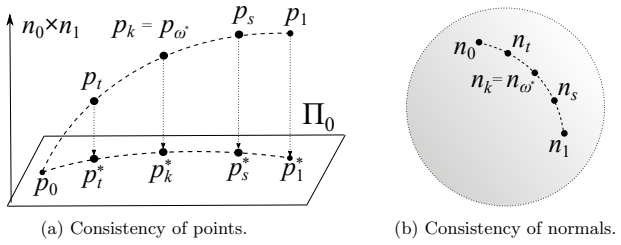
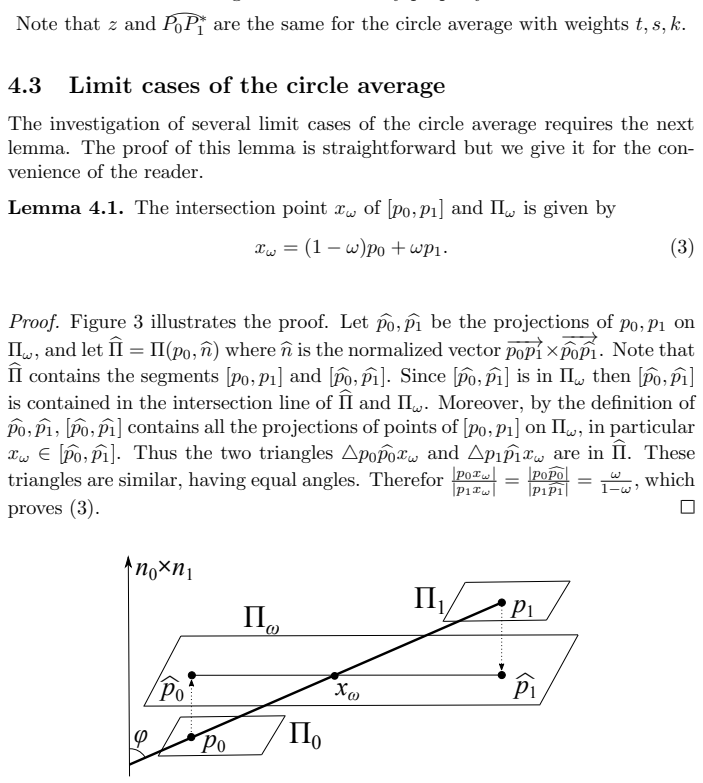
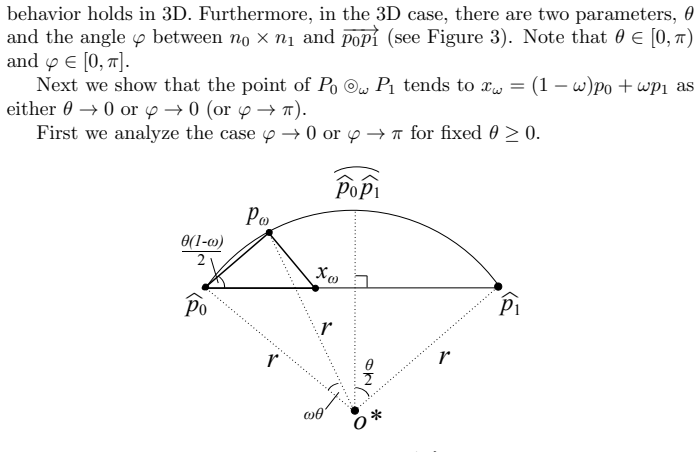
The load-bearing object is the 3D circle average $\circledast_\omega$ of two point-normal pairs, a weighted binary operation built by reducing the construction to a plane: with weight $\omega$, the point $p_1$ is projected onto the plane through $p_0$ with normal $n_0\times n_1$, the 2D circle average is evaluated there, and the resulting point is projected onto the parallel plane at distance $\omega\hbar$ from $\Pi_0$. This operation is the substitute for every weighted linear binary average in a rewritten subdivision rule, so the normal of each pair influences where the refined point lands. Its consistency property, $(P_0\circledast_t P_1)\circledast_k (P_0\circledast_s P_1) = P_0\circledast_{\omega^*}P_1$ with $\omega^*=ks+(1-k)t$, is what makes the nonlinear iteration behave like an average, and the limit-case analysis shows that when normals are parallel the average degenerates to the linear average, which is why the modified schemes are expected to match the smoothness of their linear counterparts.
What would settle it
Run one of the modified schemes on a mesh with naive normals for many refinement levels and check whether the maximal dihedral angle and the displacement between successive refined meshes decay to zero; if they oscillate or fail to decay, the modified scheme does not generate a limit surface and the editing claim loses its foundation.
Extended reading notes
Core claim
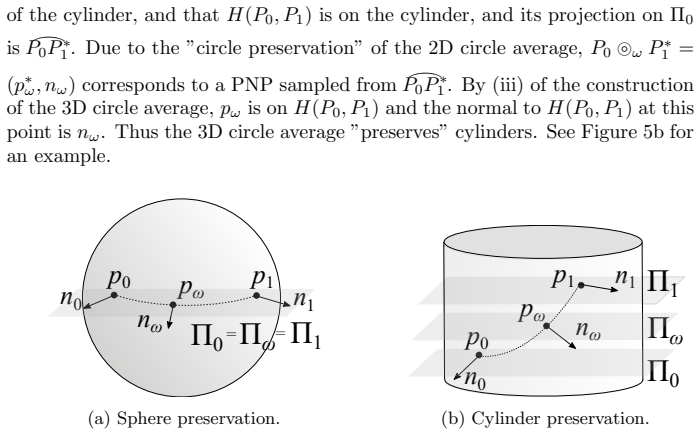
The paper's central claim is that the limit surface of a modified subdivision scheme depends on the initial normals as well as on the control mesh, so a single scheme with one mesh can generate a continuum of geometries by rotating those normals. The carrier of this claim is the 3D circle average $P_0 \circledast_\omega P_1$: project $p_1$ into the plane through $p_0$ normal to $n_0\times n_1$, apply the 2D circle average there, and lift the result to the parallel plane at fraction $\omega$ of the spacing. The paper establishes the consistency identity that makes the operation an average, shows that it reduces to the linear average as the normal angle or the chord angle tends to zero, and demonstrates sphere and cylinder preservation. Modified Catmull-Clark, Kobbelt 4-point, Butterfly, and Loop schemes are tested; with naive normals computed from the mesh they show smoother curvature estimates and faster decay of dihedral angles, and the modified interpolatory schemes avoid the self-intersections seen in their linear counterparts. The paper also states that the limit normals generated by the modified schemes are not the normals of the limit surface, and that convergence of the schemes is supported by tests but not yet proved.
Load-bearing premise
The load-bearing premise is that repeated application of a modified scheme settles down to a surface; the paper provides test evidence for this but no proof, and the normal component depends on a general geodesic-average convergence result.
Editorial extensions
If this is right
- A fixed control mesh yields a family of limit surfaces indexed by the initial normals, so shape editing gains a new degree of freedom alongside vertex positions.
- Every convergent linear scheme whose rules can be rewritten as repeated weighted binary averages admits a modified normal-editing version, so the construction extends beyond the four schemes tested.
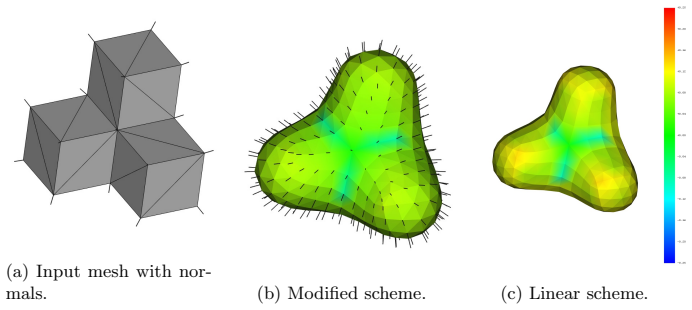
- With naive normals estimated from the mesh, the modified approximating schemes produce smoother discrete-curvature estimates and a faster decrease of maximal dihedral angles than the linear schemes on homogeneous meshes.
- The modified interpolatory schemes avoid the self-intersections that the linear Kobbelt 4-point and Butterfly schemes exhibit on meshes with uneven edge lengths.
- If a modified scheme converges, its limit surface is conjectured to have the same smoothness as the corresponding linear scheme, because the circle average tends to the linear average as the angle between normals goes to zero.
Reading between the lines
- Because the 3D construction is described for any 2D average of point-normal pairs, the lifting procedure could be applied to other binary averages to create additional editable subdivision schemes.
- The monotone decrease of the angle between generated normals and mesh normals as initial normals approach the naive normals suggests using the initial normals as optimization variables, fitting them to steer the limit surface toward a target curvature distribution.
- Since the limit normals are not the surface normals, applications that consume normals, such as rendering, shading, and offsetting, would need to recompute them from the refined mesh; designing a binary average whose limit normals coincide with the surface normals is the natural next step.
- The helix trace of the average indicates that editing normals twists the interpolated paths around the chords, which could be exploited as a fairing or shape-morphing tool in interactive design.
Signed reviews
Editorial analysis
A structured set of objections, weighed in public.
Referee Report
Summary. The paper proposes a 3D extension of the authors' earlier 2D 'circle average' for point-normal pairs, defines the 3D average by reducing it to a 2D average in a plane and then translating along the direction n0×n1, and proves several properties: consistency (Eq. (2)), a helix trace, limit behavior as θ→0 or φ→0, and preservation of spheres and of a helical curve on a cylinder. It then modifies four linear subdivision schemes — Catmull-Clark, Kobbelt 4-point, Butterfly, and Loop — by rewriting their refinement rules as repeated binary averages and replacing each binary average with the 3D circle average. A method for assigning 'naive' normals to vertices of a mesh without normals is given. The paper reports numerical comparisons of dihedral angles and discrete curvature, demonstrates editing of initial normals on a fox mesh, and provides code and videos. The authors explicitly state in Section 6.2 that they do not have a convergence proof for the modified point positions.
Significance. If the construction is well-defined and convergent, the editing capability is a real and useful contribution to subdivision surface design: fixing the control mesh and rotating initial normals yields a family of limit surfaces, as demonstrated in Section 6.3. The paper is also honest and concrete: it gives explicit formulas, includes a GitHub repository with code and mesh files, and provides videos. However, the central claim is currently conditional in two ways. First, the modification of schemes with negative mask coefficients is undefined as written, because the required binary weights leave the interval [0,1] on which the circle average is defined. Second, convergence of the point iterates is not proven and is explicitly disclaimed in Section 6.2. These issues do not destroy the value of the positive-mask schemes, but they do mean that the broad claims in Section 1.1 and in the empirical sections are not supported by the manuscript as it stands.
major comments (3)
- [§5.1, §3.1] The rewriting method in Section 5.1 does not keep binary weights in [0,1] when the original mask coefficients have mixed signs, but the 3D circle average is defined only for weights ω∈[0,1] in Section 3.1. For the K4 rule q=(9/16)(p0+p1)-(1/16)(p2+p3), the first binary average B=(p0+p1)/2 is valid, but the next required binary average combines B and p2 with weights 18/17 and -1/17, which are outside the allowed range. Reordering coefficients so that partial sums are positive avoids zero denominators but does not fix the out-of-range weights. Consequently MK4 and MBY are not defined by the manuscript, and the empirical results in Section 6.2.2, Table 1 for MK4, and the claim in Section 1.1 that the method can modify 'any convergent linear scheme' are unsupported.
- [§6.2] The paper states: 'Although we do not have a convergence proof for the modified schemes investigated in this paper, our tests indicate that the generated meshes converge to a surface.' Since the central contribution is that the modified schemes 'generate more geometries' and are 'surface-generating', this missing proof is load-bearing. The cited convergence of normals via manifold-valued geodesic averaging covers only the normal component and does not imply convergence of the point component. To place the main claim on a sound footing, the authors need either a convergence proof (for example by a proximity argument relative to the underlying linear scheme) or an explicit reframing of the convergence statement as a conjecture supported by experiments.
- [§6.3, Table 2] The monotonic decrease of the angles ξi is measured against the 'naive normal in the final mesh' at the last refinement level, not against the exact normal of the limit surface. This is an empirical proxy, and the conclusion that 'the closer are the initial normals to the naive normals, the closer are the limit normals to the normals of the limit surface' is therefore only as strong as the proxy. This should be stated explicitly, especially because no convergence proof is available for the point positions.
minor comments (5)
- [§6.2.2] The word 'Fugure' in 'as is demonstrated in Fugure 8' is a typo and should be corrected.
- [§4.4] The example 'x=cost, y=sint, z=t, 0≤t≤π' is a helix on a cylinder, not a cylinder surface; calling this 'preservation of cylinders' is misleading and the terminology should be clarified, e.g., 'preservation of circular helices on cylinders'.
- [§5.1] The manuscript notes that the performance of a modified scheme is 'almost independent of the order of the summands', but it does not state whether different admissible orders define the same modified scheme in general. Since the circle average is nonlinear, a canonical ordering should be specified in the definition of each modified scheme.
- [References] Reference [7] is listed as 'Mathematics of Computation, 1:1–2, 2016', which appears to be an incomplete or incorrect volume/pagination citation; please verify it.
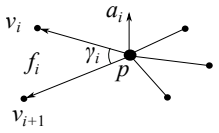
- [§5.3] The definition of naive normals uses a_i from cross products of edge vectors; the case where two consecutive edge vectors are collinear is not discussed, and a fallback should be mentioned for robustness.
Circularity Check
No significant circularity: the construction is self-contained and the cited prior results are independent published support.
full rationale
The paper's central derivation is a construction: the 3D circle average is defined explicitly in Section 3.2 by geometric projection and by reducing to the 2D circle average in a plane, and its consistency property (Eq. 2) is argued in Section 4.1 from the planar consistency of the 2D circle average plus linear interpolation in the perpendicular direction. This is a proof from definitions, not a restatement of the conclusion. The modified subdivision schemes are obtained by a stated rewriting algorithm (Section 5.1) applied to classical linear schemes, with no parameter fitted to the claimed output; the editing capability is simply the dependence of the scheme on the input normals, which is the intended behavior rather than a circular prediction. The author-overlap citations ([7], [11], [14]) are published results used as lemmas: [11] supplies the 2D circle-average consistency and preservation properties, [7] is an external manifold-valued convergence theorem, and [14] addresses 2D smoothness analysis; none of these is an unverified premise that already contains the 3D claims. Table 2 reports empirical angles for different initial normals and does not fit a model to those angles. The paper explicitly disclaims a convergence proof for the modified schemes in Section 6.2 ('we do not have a convergence proof for the modified schemes investigated in this paper'), which is an acknowledged gap in the argument but not a circularity. The negative-weight issue for K4/BY raised by a skeptical reading concerns well-definedness of the binary rewrite, not equivalence of inputs and outputs; it is a correctness risk, not a circularity. Overall, no step reduces by construction to its own inputs.
Assumptions & free parameters
assumptions (5)
- domain assumption The 2D circle average of [11] is consistent and preserves circles; used in the proofs of Sections 4.1 and 4.4.
- domain assumption The 3D circle average is undefined when the angle between normals is pi and is defined by continuity when the angle is zero.
- domain assumption General results on convergence of manifold-valued subdivision schemes based on geodesic averages apply to the normal component of the modified schemes.
- domain assumption A converging linear subdivision scheme's refinement rules can be rewritten as repeated weighted linear binary averages with positive partial sums.
- domain assumption The implementation is limited to meshes of exactly one face type, and the observed smoothing behavior assumes reasonably homogeneous edge lengths.
Cite this review
Pith. "Pith review of Extending editing capabilities of subdivision schemes by refinement of point-normal pairs." pith.science (2026). https://pith.science/paper/XHAW2MZ2
@misc{pith2026190806154,
  author       = {Pith},
  title        = {Pith review of: Extending editing capabilities of subdivision schemes by refinement of point-normal pairs},
  year         = {2026},
  howpublished = {\url{https://pith.science/paper/XHAW2MZ2}},
  note         = {Machine review of arXiv:1908.06154}
}
read the original abstract
In this paper we extend the 2D circle average of [11] to a 3D binary average of point-normal pairs, and study its properties. We modify classical surface-generating linear subdivision schemes with this average obtaining surface-generating schemes refining point-normal pairs. The modified schemes give the possibility to generate more geometries by editing the initial normals. For the case of input data consisting of a mesh only, we present a method for computing "naive" initial normals from the initial mesh. The performance of several modified schemes is compared to their linear variants, when operating on the same initial mesh, and examples of the editing capabilities of the modified schemes are given. In addition we provide a link to our repository, where we store the initial and refined mesh files, and the implementation code. Several videos, demonstrating the editing capabilities of the initial normals are provided in our Youtube channel.
Figures

Figures from the paper (7 more)


Reference graph
Works this paper leans on
-
[1]
Mao Aihua, Luo Jie, Chen Jun, and Li Guiqing. A new fast normal- based interpolating subdivision scheme by cubic B´ ezier curves.The Visual Computer, 32(9):1085–1095, 2016
work page 2016
-
[2]
Recursively generated b-spline surfaces on arbitrary topological meshes
Edwin Catmull and Jim Clark. Recursively generated b-spline surfaces on arbitrary topological meshes. Computer Aided Design , 10(6):355 – 355, 1978
work page 1978
-
[3]
A non–linear circle–preserving sub- division scheme
Pavel Chalmoviansk´ y and Bert J¨ uttler. A non–linear circle–preserving sub- division scheme. Advances in Computational Mathematics , 27:375–400, 2007
work page 2007
-
[4]
Analysis of subdivision schemes for nets of functions by proximity and controllability
Costanza Conti and Nira Dyn. Analysis of subdivision schemes for nets of functions by proximity and controllability. Journal of Computational and Applied Math, 236:461 – 475, 2011. 14
work page 2011
-
[5]
Nira Dyn, Michael S. Floater, and Kai Hormann. Four-point curve subdivi- sion based on iterated chordal and centripetal parametrizations. Computer Aided Geometric Design , 26:279–286, 2009
work page 2009
-
[6]
Nira Dyn, John A. Gregory, and David Levin. A butterfly subdivision scheme for surface interpolation with tension control. ACM Transactions on Graphics, 9:160 – 169, 1990
work page 1990
-
[7]
A global approach to the refinement of manifold data
Nira Dyn and Nir Sharon. A global approach to the refinement of manifold data. Mathematics of Computation , 1:1–2, 2016
work page 2016
-
[8]
Manifold-valued subdivision schemes based on geodesic inductive averaging
Nira Dyn and Nir Sharon. Manifold-valued subdivision schemes based on geodesic inductive averaging. Journal of Computational and Applied Math- ematics, 311:5467, February 2017
work page 2017
Show all 19 references
-
[9]
Subdivision schemes of sets and the approxima- tion of set-valued functions in the symmetric difference metric.Foundations of Computational Mathematics , 13(5):835–865, 2013
Shay Kels and Nira Dyn. Subdivision schemes of sets and the approxima- tion of set-valued functions in the symmetric difference metric.Foundations of Computational Mathematics , 13(5):835–865, 2013
2013
-
[10]
Interpolatory subdivision on open quadrilateral nets with arbitrary topology
Leif Kobbelt. Interpolatory subdivision on open quadrilateral nets with arbitrary topology. Computer Graphics Forum , 15:409 – 420, 1996
1996
-
[11]
A weighted binary average of point- normal pairs with application to subdivision schemes
Evgeny Lipovetsky and Nira Dyn. A weighted binary average of point- normal pairs with application to subdivision schemes. Computer Aided Geometric Design, 48:3648, November 2016
2016
-
[12]
Demo video
Evgeny Lipovetsky and Nira Dyn. Demo video. https://www.youtube. com/channel/UCq_EHFcGlCguUY20f14XAvA, 2018
2018
-
[13]
Supplementary source code
Evgeny Lipovetsky and Nira Dyn. Supplementary source code. https: //github.com/subdivision/CircAvg3D, 2018
2018
-
[14]
C 1 analysis of some 2 D subdivision schemes refining point-normal pairs with the circle average
Evgeny Lipovetsky and Nira Dyn. C 1 analysis of some 2 D subdivision schemes refining point-normal pairs with the circle average. Computer Aided Geometric Design , 69:45–54, 2019
2019
-
[15]
Charles T. Loop. Smooth subdivision surfaces based on triangles. Master’s thesis, Department of Mathematics, University of Utah, 1987
1987
-
[16]
From hermite to stationary subdi- vision schemes in one and several variables
Jean-Louis Merrien and Tomas Sauer. From hermite to stationary subdi- vision schemes in one and several variables. Advances in Computational Mathematics, 36 (4):547 – 579, 2012
2012
-
[17]
Mark Meyer, Mathieu Desbrun, Peter Schroder, and Alan H. Barr. Discrete differential-geometry operators for triangulated 2-manifolds. Visualization and mathematics , 3 (2):52 58, 2002
2002
-
[18]
Subdivision Surfaces , volume 3 of Geome- try and Computing
J¨ org Peters and Ulrich Reif. Subdivision Surfaces , volume 3 of Geome- try and Computing . Springer-Verlag Berlin Heidelberg, Berlin Heidelberg, 2008
2008
-
[19]
On convergent interpolatory subdivision schemes in riemannian geometry
Johannes Wallner. On convergent interpolatory subdivision schemes in riemannian geometry. Constructive Approximation, 40 (3):473 – 486, 2014. 15
2014
Reviewed August 14, 2026 · model on record in the stance chip above.
Discussion (0). Continue with ORCID to comment.