REVIEW 4 major objections 6 minor 83 references
Correlations between Event Rates of Short Gamma-Ray Bursts and Star Formation Rates with/without Time Delay
T0 review · 4 major / 6 minor · reviewed 2026-08-07 · deepseek-v4-flash
Pith's one-line read After subtracting star-formation components from observed short gamma-ray burst rates, this paper finds a leftover rate that declines steeply with redshift as a power law, and reads that residual as bursts from old stellar populations or…
desk verdict Useful multi-detector SGRB compilation, but the headline 'power-law residual' is an artifact of the fitting function and an unspecified SFR normalization, not an independent discovery. read the letter →
The pith
A machine-rendered reading of the paper's core claim, the machinery that carries it, and where it could break.
The reading
What carries the argument
The load-bearing object is the two-component rate model of Eq. (16), $$R_{\rm SGRB}(Z)=\frac{A_1}{C\sqrt{2\pi}}\exp\left[-\frac{(Z-B)^2}{$2C^{2}$}\right]+A_2 $Z^{{-D}}$,$$ with $Z=1+z$: the Gaussian part is the component that tracks the star-formation templates, and the power-law part is what remains after those templates are subtracted from the observed rate. The rate estimates themselves come from the parametric method of Eq. (11), which converts each detector's redshift-luminosity distribution into an event rate using the instrument's field of view, operation time, and sensitivity. The comparison curves are built by convolving two star-formation histories (Yüksel et al. 2008 and Madau & Dickinson 2014) with three merger delay-time distributions: Gaussian with $\tau_0=2$ Gyr, lognormal with $\tau_0=2.9$ Gyr, and power-law with $\alpha_\tau=0.81$.
What would settle it
Take a redshift-complete sample of SGRBs at $z<1$ and measure the stellar ages of their host galaxies: if those hosts are predominantly young and star-forming, the old-stellar-population explanation of the residual is falsified. A second check is to repeat the subtraction with the star-formation template normalized by an independent efficiency estimate rather than by the fit, and see whether the power-law residual persists or disappears.
Extended reading notes
Core claim
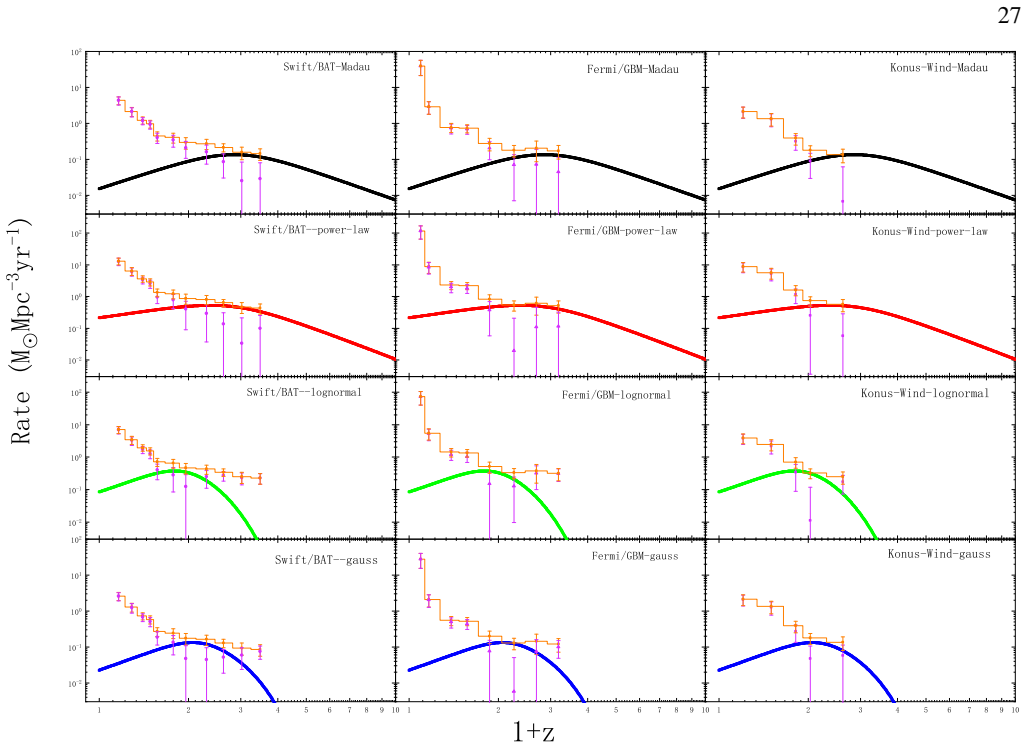
The paper's central claim is that the SGRB rate is two-component: one part follows the (possibly time-delayed) star formation rate, and a second part declines steeply with redshift in a power-law-like form (the rate falling roughly as $(1+z)^{-D}$). The two-component model of Eq. (16), a Gaussian added to a power law in $Z=1+z$, fits the observed rates of the Swift, Fermi, and Konus-Wind samples, and when the star-formation curves are subtracted from the data the leftover rate steeply declines toward higher redshift, as shown in Figures 5 and 6. The paper interprets that residual as evidence that a substantial fraction of low-redshift SGRBs come from old stellar populations or compact binary mergers rather than from young massive stars. Along the way it establishes that the detector samples differ systematically: Swift/BAT SGRBs have a median luminosity roughly an order of magnitude below that of Fermi/GBM or Konus-Wind SGRBs and a local rate roughly two orders of magnitude higher, while the Fermi and Konus-Wind samples have statistically identical redshift and luminosity distributions. The detector dependence is attributed to the instruments' energy bands and sensitivity limits, and the jet-corrected local rates, between roughly 0.30 and 66.47 Gpc$^{-3}$ yr$^{-1}$, overlap the inferred BH–NS merger rate of about 35 Gpc$^{-3}$ yr$^{-1}$.
Load-bearing premise
The analysis assumes the observed SGRB rate is exactly the sum of a Gaussian component tied to star formation and an independent power-law component (Eq. 16), and that the star-formation curves can be subtracted after a normalization the fit itself supplies; if the true rate is not this sum, the leftover power-law decline is an artifact of the decomposition rather than a new population.
Editorial extensions
If this is right
- A physical residual would mean the low-redshift excess of SGRBs is a genuine population rather than a selection effect: bursts whose progenitors formed long before the burst, consistent with compact binary mergers.
- Rate models for compact-object mergers would need two channels, one tracking star formation and one rising toward the present, rather than a single time-delayed convolution of the SFR.
- Because the three detector samples imply local rates differing by roughly two orders of magnitude, single-instrument rate estimates carry strong energy-band biases and should be compared only with like-instrument samples.
- The analogy the paper draws with non-repeating fast radio bursts gains force: both transient classes show low-redshift excesses that a delayed, old-population channel could explain uniformly.
- The jet-corrected local rate interval of 0.30–66.47 Gpc$^{-3}$ yr$^{-1}$ brackets the inferred BH–NS merger rate of about 35 Gpc$^{-3}$ yr$^{-1}$, linking the residual SGRB population to gravitational-wave sources.
Reading between the lines
- If the residual is real, the natural test is host-galaxy stellar ages at $z<1$: a two-population model predicts bimodal host ages, with the residual channel living in passive, old galaxies and the SFR-tracking channel in star-forming ones — a measurement the paper does not carry out.
- The subtraction is sensitive to how each star-formation template is normalized to the data; fixing that normalization with an independently estimated burst efficiency would settle whether the power-law tail survives or dissolves, and the paper leaves that normalization unspecified.
- The same Gaussian-plus-power-law decomposition could be applied to other transients with reported low-redshift excesses (long GRBs, FRBs, black holes, AGN) to test whether one delayed channel underlies the pattern across very different source sizes.
- Comparing the fitted power-law index $D$ across the three detectors and against gravitational-wave merger-rate evolution would tie the residual to a merger delay-time distribution — or expose it as detector-dependent.
Editorial analysis
A structured set of objections, weighed in public.
Referee Report
Summary. The paper compiles 103 short gamma-ray bursts (SGRBs) with measured redshifts from Swift/BAT, Fermi/GBM, and Konus-Wind, fits their luminosity distributions with a smoothly broken power law, derives redshift distribution functions for delayed and undelayed star-formation-rate (SFR) models, and computes event rates. It reports that Swift SGRBs have lower luminosities and redshifts than Fermi or Konus-Wind SGRBs, that the local rate of Swift SGRBs is about two orders of magnitude larger than the other two samples, and that the observed SGRB rates can be fitted with a Gaussian plus a power-law function. The central claim is that after subtracting the delayed/undelayed SFR components, the remaining SGRB rate declines steeply with redshift in a power-law-like form, which the authors interpret as evidence for an old-population or compact-binary merger component.
Significance. The paper provides a useful compilation of SGRB redshifts and luminosities across three detectors and a systematic comparison of two SFR models with three delay-time distributions, which is a valuable reference exercise. If the claimed power-law residual were established by a genuinely independent test, it would be an interesting indication of an SGRB population not tracking recent star formation. However, the central new claim is currently not independently supported: the residual is the power-law term imposed by the assumed fitting function in Eq. (16), and the normalization of the subtracted SFR curves is not specified. The cross-detector local-rate comparison is also weakened by the different Lmin values used in Table 5. These are load-bearing issues that can potentially be repaired with a revised analysis, but as presented the paper overstates what is demonstrated.
major comments (4)
- [Section 4.5, Eq. (16); Abstract] The headline claim is circular. Equation (16) fits the observed SGRB rate as a Gaussian plus a term A2 Z^{-D}; the 'remaining rate' shown as purple squares in Figures 5 and 6 is exactly this fitted power-law term, not an independently measured residual after SFR subtraction. To support the claim of a distinct old-population component, the authors need to demonstrate with a model-comparison statistic (for example, Δχ² or BIC) that the data require a power-law component in addition to the best-fitting delayed or undelayed SFR model, and they must report the uncertainties on A2 and D.
- [Figures 4-6 and Section 4.5] The manuscript never states how the dimensionless SFR curves of Figure 2, which are normalized to unity at z=0, are scaled to the absolute rates of Eq. (11) before being compared or subtracted. If the vertical scaling is chosen arbitrarily for each panel, then the shape and even the sign of the residual after subtraction are arbitrary. If the scaling instead uses the fitted local rates ρ0 of Table 5, that procedure must be described explicitly and its uncertainties propagated. Without this information, the 'deduction' of SFR components in Figures 5 and 6 is not a well-defined operation.
- [Table 5 and Section 4.4] The comparison leading to the claim that the Swift local rate is about two orders of magnitude larger than the Fermi or Konus-Wind rates is not meaningful as presented because the three rows of Table 5 use different minimum luminosities: 2.57×10^48 erg/s for Swift, 1.97×10^50 erg/s for Fermi, and 2.91×10^50 erg/s for Konus-Wind. Since Eq. (10) integrates the luminosity function from Lmin, the Swift sample's much lower Lmin will produce a larger local rate by construction. The authors should compare rates above a common luminosity threshold, using the cumulative ρ0,>L fits in Table 4, or present differential rates at a fixed luminosity.
- [Section 4.5, Eq. (16)] The fitted parameters A1, A2, B, C, and D of Eq. (16) are not reported anywhere in the text or tables; only reduced chi-square values appear in Figure 4. Consequently, the statement that the residual 'steeply declines with redshift in a power-law-like form' cannot be quantitatively evaluated: the reader does not know the slope D, its uncertainty, or the relative amplitude of the power-law term. These parameters should be tabulated for each detector and each SFR model considered.
minor comments (6)
- [Throughout] There are numerous typographical errors, including 'matche', 'redshit', 'Lognrmal', 'bianary', 'detetors', 'supporse', 'impirical', and 'Univeristy' in the references; a careful proofreading pass is needed.
- [Section 4.3] The sentence 'It needs to point out that we have only taken into account the luminosity errors and Poisson errors of the local event rate density, so the actual errors will be larger and the actual chi-squares will be smaller than the current ones' is confusing, because adding more sources of uncertainty should not decrease a chi-square statistic; this should be rewritten.
- [Section 4.4] The sentence 'the local event rates of Swift/BAT, Fermi/GBM and Konus-wind SGRBs are around two orders of magnitude larger than that of either Fermi or Konus-wind SGRBs' is grammatically ambiguous; the intended meaning is that the Swift rate is two orders of magnitude larger than the Fermi or Konus-Wind rates, and this should be stated clearly.
- [Section 4.1] The claim that the Fermi and Konus-Wind redshift and luminosity distributions are 'identical' is based on visual inspection of Figure 1; a two-sample statistical test such as Kolmogorov-Smirnov or Anderson-Darling should be reported to support this statement.
- [Table 1, note b] The number of SGRBs whose redshifts are estimated from the Ep-luminosity relation is not stated, and the systematic uncertainty from this calibration is not propagated into the redshift distributions or event-rate estimates; the authors should quantify this effect.
- [Section 5] Several in-text citations lack corresponding entries in the reference list, including Zhang et al. (2025), Pan et al. (2025), and Rong et al. (2025), and the speculative statement connecting SGRBs and FRBs should be clearly labeled as a speculation rather than a result of this analysis.
Circularity Check
The steep power-law residual after SFR subtraction is the A2 Z^-D term fitted in Eq. (16), not an independently measured excess; the SFR-subtraction normalization is unspecified.
-
fitted input called prediction
[Section 4.5, Eq. (16); Abstract]
"R_SGRB(Z)= A1/(C sqrt(2π)) exp[-(Z-B)^2/(2C^2)] + A2 Z^{-D} ... where A1,A2,B,C and D are the fitted parameters and Z=1+z. ... After deducting the diverse SFR components from the SGRB rates, we surprisingly notice that the remaining SGRB rates steeply decline with redshift in a power-law-like form"
The two-component fit in Eq. (16) contains a power-law term A2 Z^-D by construction, and the Gaussian term is the component that resembles the SFR-related rate. When the SFR curves are subtracted from the observed rates, the residual is essentially the fitted A2 Z^-D term; the claimed 'remaining SGRB rates steeply decline in a power-law-like form' is therefore a restatement of a fitted component, not a discovery from the residuals. The comparison also requires an arbitrary vertical normalization of the theoretical SFR curves (Figure 2 only normalizes to unity at z=0), so a power-law-like residual can be manufactured by the choice of scaling. The low-redshift excess over SFRs is data-driven, but the steep power-law decline and the old-population interpretation are imposed by the Eq.
full rationale
The paper's redshift and luminosity distribution work, the broken-power-law luminosity fits, and the local event rate estimates are largely self-contained and not circular. The delay-model parameters are taken from external literature, which is legitimate. However, the central new claim in the Abstract and Section 4.5 - that after subtracting SFR components the remaining SGRB rates decline steeply as a power law, indicating an old-population or compact-binary component - reduces to the A2 Z^-D term that the authors themselves introduce as one of the two fitted components in Eq. (16). Because the fitting function forces a power-law component to appear, and because the SFR curves used for subtraction are not given an independent absolute normalization, the 'power-law-like residual' is largely manufactured by the assumed functional form and scaling rather than being an independent measured quantity. This is a partial circularity centered on the paper's headline result, so the score is 7 rather than higher; the empirical low-redshift excess over SFRs is real and independently notable.
Assumptions & free parameters
free parameters (14)
- BPL alpha1 (Swift) =
-0.19 +/- 0.08
- BPL alpha2 (Swift) =
1.92 +/- 0.06
- BPL Lb (Swift) =
(2.14 +/- 0.21) x 10^50 erg/s
- BPL alpha1 (Fermi) =
0.49 +/- 0.05
- BPL alpha2 (Fermi) =
1.16 +/- 0.03
- BPL Lb (Fermi) =
(6.46 +/- 0.34) x 10^51 erg/s
- BPL alpha1 (Konus-Wind) =
0.96 +/- 0.04
- BPL alpha2 (Konus-Wind) =
1.11 +/- 0.07
- BPL Lb (Konus-Wind) =
(5.43 +/- 0.54) x 10^52 erg/s
- eta_Gauss for f_Gauss(z) =
-9.39 +/- 0.22
- eta_lognormal for f_log(z) =
-6.26 +/- 0.49
- eta_powerlaw for f_pl(z) =
-6.39 +/- 0.13
- Two-component rate fit parameters A1, A2, B, C, D (per detector) =
Not tabulated; reduced chi-square 1.54, 1.57, 1.75
- Triple power-law local rate parameters (k1, k2, k3, logLb1, logLb2) for Swift/Fermi/Konus and each of five SFR models =
Table 4 (many values, some with errors comparable to the estimates)
assumptions (6)
- standard math Flat Lambda-CDM cosmology with Omega_M=0.3, Omega_Lambda=0.7, H0=70 km/s/Mpc
- domain assumption Yuksel et al. (2008) SFR model with a=3.4, b=-0.3, c=-3.5, B=5000, C=9, eta=-10
- domain assumption Madau & Dickinson (2014) SFR model
- domain assumption Delay time distributions: Gaussian (tau0=2 Gyr, sigma=0.3), lognormal (tau0=2.9, sigma=0.2), power-law (alpha=0.81)
- ad hoc to paper Observed SGRB rate can be represented as a Gaussian plus a power-law (Eq. 16)
- domain assumption Luminosity function is a smoothly broken power-law (Eq. 8)
Cite this review
Pith. "Pith review of Correlations between Event Rates of Short Gamma-Ray Bursts and Star Formation Rates with/without Time Delay." pith.science (2026). https://pith.science/paper/XIED2UEX
@misc{pith2026250601013,
  author       = {Pith},
  title        = {Pith review of: Correlations between Event Rates of Short Gamma-Ray Bursts and Star Formation Rates with/without Time Delay},
  year         = {2026},
  howpublished = {\url{https://pith.science/paper/XIED2UEX}},
  note         = {Machine review of arXiv:2506.01013}
}
abstract
In this paper, we systematically investigate the redshift and luminosity distributions as well as the event rates of short Gamma-Ray Bursts (SGRBs) detected by Swift, Fermi, Konus-wind satellites. It is found that the distributions of redshift and luminosity of Fermi and Konus-wind SGRBs are identical and they obviously differ from those of Swift/BAT SGRBs. The luminosity distributions of SGRBs detected by diverse detectors can be uniformly fitted by a smoothly broken power-law function. The median luminosity of Swift SGRBs is about one order of magnitude smaller than that of Fermi/GBM or Konus-wind SGRBs. We also compare the local event rates of Swift/BAT, Fermi/GBM and Konus-wind SGRBs and find that the local rate of Swift SGRBs is around two orders of magnitude larger than that of either Fermi or Konus-wind SGRBs, while the latter two rates are comparable. The observed SGRB rates can be successfully fitted by a power-law plus Gauss function. The SGRB rates of three kinds of detectors matches the delayed/undelayed SFRs well except the delayed Lognormal and/or Gaussian SFRs at higher redshift and exceed all types of SFRs at lower redshift of $z<1$. After deducting the diverse SFR components from the SGRB rates, we surprisingly notice that the remaining SGRB rates steeply decline with redshift in a power-law-like form, indicating that these SGRBs could emerge from the old star populations or compact binary star mergers.
Figures


Figures from the paper (3 more)


Reference graph
Works this paper leans on
-
[1]
Yonetoku, D., Murakami, T., Nakamura, T., et al.\ 2004, , 609, 935. doi:10.1086/421285
doi:10.1086/421285 2004
-
[3]
Abbott, B. P., Abbott, R., Abbott, T. D., et al.\ 2017, , 119, 161101. doi:10.1103/PhysRevLett.119.161101
-
[4]
Abbott, B. P., Abbott, R., Abbott, T. D., et al.\ 2017, , 848, L13. doi:10.3847/2041-8213/aa920c
-
[5]
Abbott, B. P., Abbott, R., Abbott, T. D., et al.\ 2017, , 551, 85. doi:10.1038/nature24471
-
[6]
P., Anand, S., et al.\ 2021, Nature Astronomy, 5, 917
Ahumada, T., Singer, L. P., Anand, S., et al.\ 2021, Nature Astronomy, 5, 917. doi:10.1038/s41550-021-01428-7
-
[7]
Band, D., Matteson, J., Ford, L., et al.\ 1993, , 413, 281. doi:10.1086/172995
doi:10.1086/172995 1993
-
[8]
G., Petrosian, V., & Bowden, L.\ 2021, , 914, L40
Dainotti, M. G., Petrosian, V., & Bowden, L.\ 2021, , 914, L40. doi:10.3847/2041-8213/abf5e4
-
[9]
G., Narendra, A., Pollo, A., et al.\ 2024, , 967, L30
Dainotti, M. G., Narendra, A., Pollo, A., et al.\ 2024, , 967, L30. doi:10.3847/2041-8213/ad4970
Show all 83 references
-
[10]
doi:10.3847/2041-8213/acccec
Dall'Osso, S., Stratta, G., Perna, R., et al.\ 2023, , 949, L32. doi:10.3847/2041-8213/acccec
2023 doi
-
[11]
doi:10.1038/nature05374
Della Valle, M., Chincarini, G., Panagia, N., et al.\ 2006, , 444, 1050. doi:10.1038/nature05374
2006 doi
-
[12]
doi:10.3847/1538-4357/ac9590
Deng, Q., Zhang, Z.-B., Li, X.-J., et al.\ 2022, , 940, 5. doi:10.3847/1538-4357/ac9590
2022 doi
-
[13]
F., Li, X
Dong, X. F., Li, X. J., Zhang, Z. B., et al.\ 2022, , 513, 1078. doi:10.1093/mnras/stac949
2022 doi
-
[14]
F., Zhang, Z
Dong, X. F., Zhang, Z. B., Li, Q. M., et al.\ 2023, , 958, 37. doi:10.3847/1538-4357/acf852
2023 doi
-
[15]
doi:10.3847/1538-4357/ad8b43
Dong, X.-F., Huang, Y.-F., Zhang, Z.-B., et al.\ 2024, , 977, 29. doi:10.3847/1538-4357/ad8b43
2024 doi
-
[16]
& Petrosian, V.\ 1992, , 399, 345
Efron, B. & Petrosian, V.\ 1992, , 399, 345. doi:10.1086/171931
1992 doi
-
[17]
doi:10.1051/0004-6361/202347113
Ferro, M., Brivio, R., D'Avanzo, P., et al.\ 2023, , 678, A142. doi:10.1051/0004-6361/202347113
2023 doi
-
[18]
fai ., Nugent, A
Fong, W.-. fai ., Nugent, A. E., Dong, Y., et al.\ 2022, , 940, 56. doi:10.3847/1538-4357/ac91d0
2022 doi
-
[19]
B., Frail, D
Fox, D. B., Frail, D. A., Price, P. A., et al.\ 2005, , 437, 845. doi:10.1038/nature04189
2005 doi
-
[20]
L., De Colle, F., et al.\ 2023, , 951, 4
Garcia-Cifuentes, K., Becerra, R. L., De Colle, F., et al.\ 2023, , 951, 4. doi:10.3847/1538-4357/acd176
2023 doi
-
[21]
P., Barthelmy, S
Gehrels, N., Norris, J. P., Barthelmy, S. D., et al.\ 2006, , 444, 1044. doi:10.1038/nature05376
2006 doi
-
[22]
doi:10.3847/1538-4357/ab8f9d
Guo, Q., Wei, D.-M., Wang, Y.-Z., et al.\ 2020, , 896, 1, 83. doi:10.3847/1538-4357/ab8f9d
2020 doi
- [23]
-
[24]
J., Burns, E., & Goldstein, A.\ 2024, arXiv:2411.17244
Howell, E. J., Burns, E., & Goldstein, A.\ 2024, arXiv:2411.17244. doi:10.48550/arXiv.2411.17244
2024 doi
-
[25]
doi:10.3847/0004-637X/825/1/52
Kawaguchi, K., Kyutoku, K., Shibata, M., et al.\ 2016, , 825, 52. doi:10.3847/0004-637X/825/1/52
2016 doi
-
[26]
D., Y \"u ksel, H., Beacom, J
Kistler, M. D., Y \"u ksel, H., Beacom, J. F., et al.\ 2009, , 705, L104. doi:10.1088/0004-637X/705/2/L104
2009 doi
-
[27]
A., Fishman, G
Kouveliotou, C., Meegan, C. A., Fishman, G. J., et al.\ 1993, , 413, L101. doi:10.1086/186969
1993 doi
-
[28]
doi:10.3847/1538-4357/ac8fec
Lan, G.-X., Wei, J.-J., Li, Y., et al.\ 2022, , 938, 129. doi:10.3847/1538-4357/ac8fec
2022 doi
-
[29]
doi:10.1093/mnras/stz2011
Lan, G.-X., Zeng, H.-D., Wei, J.-J., et al.\ 2019, , 488, 4607. doi:10.1093/mnras/stz2011
2019 doi
- [30]
-
[31]
M., Sun, Q
Li, Q. M., Sun, Q. B., Zhang, Z. B., et al.\ 2024, , 527, 7111. doi:10.1093/mnras/stad3619
2024 doi
-
[32]
J., Zhang, Z
Li, X. J., Zhang, Z. B., & Zhang, K.\ 2022, , 657, A124. doi:10.1051/0004-6361/202140747
2022 doi
-
[33]
doi:10.3847/1538-4357/ad18a8
Li, X.-J., Zhang, Z.-B., Huang, Y.-F., et al.\ 2024, , 962, 117. doi:10.3847/1538-4357/ad18a8
2024 doi
-
[34]
doi:10.1088/1674-4527/21/10/254
Liu, Z.-Y., Zhang, F.-W., & Zhu, S.-Y.\ 2021, Research in Astronomy and Astrophysics, 21, 10, 254. doi:10.1088/1674-4527/21/10/254
2021 doi
-
[35]
M., Fryer, C
Lloyd-Ronning, N. M., Fryer, C. L., & Ramirez-Ruiz, E.\ 2002, , 574, 554. doi:10.1086/341059
2002 doi
-
[36]
doi:10.3847/2041-8213/ac6e3a
L \"u , H.-J., Yuan, H.-Y., Yi, T.-F., et al.\ 2022, , 931, L23. doi:10.3847/2041-8213/ac6e3a
2022 doi
- [37]
-
[38]
doi:10.1086/305523
Madau, P., Pozzetti, L., & Dickinson, M.\ 1998, , 498, 106. doi:10.1086/305523
1998 doi
-
[39]
& Dickinson, M.\ 2014, , 52, 415
Madau, P. & Dickinson, M.\ 2014, , 52, 415. doi:10.1146/annurev-astro-081811-125615
2014 doi
-
[40]
P., Tanvir, N
Mandhai, S., Lamb, G. P., Tanvir, N. R., et al.\ 2022, , 514, 2716. doi:10.1093/mnras/stac1473
2022 doi
-
[41]
& Chornock, R.\ 2021, , 59, 155
Margutti, R. & Chornock, R.\ 2021, , 59, 155. doi:10.1146/annurev-astro-112420-030742
2021 doi
-
[42]
Metzger, B. D. & Piro, A. L.\ 2014, , 439, 3916. doi:10.1093/mnras/stu247
2014 doi
-
[43]
P., Deller, A
Mooley, K. P., Deller, A. T., Gottlieb, O., et al.\ 2018, , 561, 355. doi:10.1038/s41586-018-0486-3
2018 doi
-
[44]
B.\ 2006, , 650, 281
Nakar, E., Gal-Yam, A., & Fox, D. B.\ 2006, , 650, 281. doi:10.1086/505855
2006 doi
-
[45]
doi:10.1093/mnras/stac1982
O'Connor, B., Troja, E., Dichiara, S., et al.\ 2022, , 515, 4890. doi:10.1093/mnras/stac1982
2022 doi
- [46]
- [47]
-
[48]
doi:10.1088/0004-637X/806/1/44
Petrosian, V., Kitanidis, E., & Kocevski, D.\ 2015, , 806, 44. doi:10.1088/0004-637X/806/1/44
2015 doi
-
[49]
& Dainotti, M
Petrosian, V. & Dainotti, M. G.\ 2024, , 963, L12. doi:10.3847/2041-8213/ad2763
2024 doi
-
[50]
doi:10.1103/RevModPhys.76.1143
Piran, T.\ 2004, Reviews of Modern Physics, 76, 1143. doi:10.1103/RevModPhys.76.1143
2004 doi
-
[51]
& Madau, P.\ 2001, , 548, 522
Porciani, C. & Madau, P.\ 2001, , 548, 522. doi:10.1086/319027
2001 doi
-
[52]
C., Gompertz, B
Rastinejad, J. C., Gompertz, B. P., Levan, A. J., et al.\ 2022, , 612, 223. doi:10.1038/s41586-022-05390-w
2022 doi
-
[53]
Rhodes, L., Fender, R., Williams, D. R. A., et al.\ 2021, , 503, 2966. doi:10.1093/mnras/stab640
2021 doi
-
[54]
doi:10.3847/1538-4357/ac60a2
Rossi, A., Rothberg, B., Palazzi, E., et al.\ 2022, , 932, 1. doi:10.3847/1538-4357/ac60a2
2022 doi
- [55]
-
[56]
M., Berger, E., Kasliwal, M., et al.\ 2006, , 650, 261
Soderberg, A. M., Berger, E., Kasliwal, M., et al.\ 2006, , 650, 261. doi:10.1086/506429
2006 doi
-
[57]
doi:10.1088/0004-637X/812/1/33
Sun, H., Zhang, B., & Li, Z.\ 2015, , 812, 33. doi:10.1088/0004-637X/812/1/33
2015 doi
-
[58]
Taylor, S. R. & Gair, J. R.\ 2012, , 86, 023502. doi:10.1103/PhysRevD.86.023502
2012 doi
-
[59]
I., Eisenstein, D., Fan, X., et al.\ 2006, , 647, 787
Thompson, R. I., Eisenstein, D., Fan, X., et al.\ 2006, , 647, 787. doi:10.1086/505568
2006 doi
- [60]
-
[61]
L., O'Connor, B., et al.\ 2022, , 612, 228
Troja, E., Fryer, C. L., O'Connor, B., et al.\ 2022, , 612, 228. doi:10.1038/s41586-022-05327-3
2022 doi
-
[62]
doi:10.3847/1538-4357/abd569
Tsvetkova, A., Frederiks, D., Svinkin, D., et al.\ 2021, , 908, 83. doi:10.3847/1538-4357/abd569
2021 doi
-
[63]
J., Zhang, B., O'Brien, P., et al.\ 2011, , 727, 109
Virgili, F. J., Zhang, B., O'Brien, P., et al.\ 2011, , 727, 109. doi:10.1088/0004-637X/727/2/109
2011 doi
-
[64]
& Piran, T.\ 2015, , 448, 3026
Wanderman, D. & Piran, T.\ 2015, , 448, 3026. doi:10.1093/mnras/stv123
2015 doi
-
[65]
P., Xu, D., et al.\ 2018, , 867, 147
Wang, J., Zhu, Z. P., Xu, D., et al.\ 2018, , 867, 147. doi:10.3847/1538-4357/aae6c3
2018 doi
-
[66]
Wijers, R. A. M. J., Bloom, J. S., Bagla, J. S., et al.\ 1998, , 294, L13. doi:10.1046/j.1365-8711.1998.01328.x10.1111/j.1365-8711.1998.01328.x
1998
-
[67]
doi:10.3847/1538-4357/ad4ee1
Xiao, S., Zhang, Y.-Q., Zhu, Z.-P., et al.\ 2024, , 970, 6. doi:10.3847/1538-4357/ad4ee1
2024 doi
-
[68]
doi:10.1038/ncomms8323
Yang, B., Jin, Z.-P., Li, X., et al.\ 2015, Nature Communications, 6, 7323. doi:10.1038/ncomms8323
2015 doi
-
[69]
doi:10.1038/s41586-022-05403-8
Yang, J., Ai, S., Zhang, B.-B., et al.\ 2022, , 612, 232. doi:10.1038/s41586-022-05403-8
2022 doi
-
[70]
Y., Dai, Z
Yu, H., Wang, F. Y., Dai, Z. G., et al.\ 2015, , 218, 13. doi:10.1088/0067-0049/218/1/13
2015 doi
-
[71]
doi:10.1088/1674-4527/ac712d
Yuan, H.-Y., L \"u , H.-J., Li, Y., et al.\ 2022, Research in Astronomy and Astrophysics, 22, 075011. doi:10.1088/1674-4527/ac712d
2022 doi
-
[72]
D., Beacom, J
Y \"u ksel, H., Kistler, M. D., Beacom, J. F., et al.\ 2008, , 683, L5. doi:10.1086/591449
2008 doi
-
[73]
doi:10.1038/s41550-021-01395-z
Zhang, B.-B., Liu, Z.-K., Peng, Z.-K., et al.\ 2021, Nature Astronomy, 5, 911. doi:10.1038/s41550-021-01395-z
2021 doi
-
[74]
ISBN: 978-1-139-22653-0
Zhang, B.\ 2018, The Physics of Gamma-Ray Bursts by Bing Zhang. ISBN: 978-1-139-22653-0. Cambridge Univeristy Press, 2018. doi:10.1017/9781139226530
2018 doi
-
[75]
& M \'e sz \'a ros, P.\ 2004, International Journal of Modern Physics A, 19, 2385
Zhang, B. & M \'e sz \'a ros, P.\ 2004, International Journal of Modern Physics A, 19, 2385. doi:10.1142/S0217751X0401746X
2004 doi
-
[76]
doi:10.1086/511781
Zhang, B., Zhang, B.-B., Liang, E.-W., et al.\ 2007, , 655, L25. doi:10.1086/511781
2007 doi
-
[77]
Zhang, G. Q. & Wang, F. Y.\ 2018, , 852, 1. doi:10.3847/1538-4357/aa9ce5
2018 doi
- [78]
-
[79]
C., Zhang, B., Li, Y., et al.\ 2021, , 501, 157
Zhang, R. C., Zhang, B., Li, Y., et al.\ 2021, , 501, 157. doi:10.1093/mnras/staa3537
2021 doi
-
[80]
B., Jiang, M., Zhang, Y., et al.\ 2020, , 902, 40
Zhang, Z. B., Jiang, M., Zhang, Y., et al.\ 2020, , 902, 40. doi:10.3847/1538-4357/abb400
2020 doi
-
[81]
& Choi, C.-S.\ 2008, , 484, 293
Zhang, Z.-B. & Choi, C.-S.\ 2008, , 484, 293. doi:10.1051/0004-6361:20079210
2008 doi
-
[82]
B., Zhang, C
Zhang, Z. B., Zhang, C. T., Zhao, Y. X., et al.\ 2018, , 130, 054202. doi:10.1088/1538-3873/aaa6af
2018 doi
-
[83]
doi:10.3847/1538-4357/abfe5e
Zhu, J.-P., Wu, S., Yang, Y.-P., et al.\ 2021, , 917, 24. doi:10.3847/1538-4357/abfe5e
2021 doi
-
[84]
qqP Z9 t 6ig .5 [CD(6Di5 a Xij5k.6f6 de[,1
Zhu, S.-Y., Liu, Z.-Y., Shi, Y.-R., et al.\ 2023, , 950, 30. doi:10.3847/1538-4357/acc83b fig1.pdf0000664000000000000000000017413115017030766011113 0ustar rootroot 8 0 obj <</Type/Font /Subtype /Type1 /BaseFont /Symbol >> endobj 9 0 obj <</Type/Font /Widths 10 0 R /FirstChar 1...
2023 doi
Reviewed August 7, 2026 · model on record in the stance chip above.
Discussion (0). Sign in to comment.