REVIEW 4 major objections 6 minor 2 cited by
Ill-Posedness in Limited Discrete Fourier Inversion and Regularization for Quasi Distributions in LaMET
T0 review · 4 major / 6 minor · reviewed 2026-08-15 · deepseek-v4-flash
Pith's one-line read This paper claims that the limited inverse discrete Fourier transform in the LaMET framework is a moderately ill-posed inverse problem—solutions exist and are unique, but stability fails—and that Tikhonov regularization with L-curve…
desk verdict Useful, workmanlike application of Tikhonov regularization to LaMET quasi-DA inversion, but the 'moderately tractable' spectral classification is asserted rather than shown. read the letter →
The pith
A machine-rendered reading of the paper's core claim, the machinery that carries it, and where it could break.
The reading
What carries the argument
The load-bearing object is the discrete Fourier matrix $K$ with entries $\exp(i x \lambda)$ on a finite grid, whose singular value decomposition $K = U \Sigma V^T$ exposes the instability: the formal solution $f = \sum_i (u_i^T g / \sigma_i) v_i$ divides by singular values as small as $10^{-18}$. Tikhonov regularization replaces that division with the normal equation $(K^\dagger K + \alpha I) f^\delta_\alpha = K^\dagger g^\delta$, adding $\alpha > 0$ to each singular value so that the noise-amplifying factors $\sigma_i^{-1}$ are controlled; the L-curve method fixes $\alpha$ by maximizing the curvature of the $\log\|K f - g^\delta\|^2$ versus $\log\|f\|^2$ tradeoff. Uniqueness of the limited Fourier transform is proved in the appendix by analytic continuation together with the Weierstrass approximation theorem.
What would settle it
Compute the singular values $\sigma_i$ of the real DFT matrix $K_{\mathrm{re}}$ for the paper's parameters ($x \in [-2,3]$, $\delta x = 0.01$; $\lambda \in [-20,20]$, $\delta \lambda = 0.5$) and plot $\log \sigma_i$ against the index $i$. A straight-line (linear) decay in this log-linear plot means geometric, i.e., exponential-in-index, decay—consistent with $\sigma_1/\sigma_{81} \approx 10^{17}$ giving a per-index ratio near $(10^{17})^{-1/80}\approx 0.61$—which directly contradicts the claim of slower-than-exponential decay. The classification of the problem as moderate rather than severe would then need to be revised.
Extended reading notes
Core claim
The central claim is that the limited inverse discrete Fourier transform underlying LaMET is an ill-posed inverse problem of moderate severity. It satisfies the first two Hadamard criteria: the Paley-Wiener theorem gives existence for compactly supported parton distributions, and an appendix proves uniqueness on $L^2$ of a finite interval. Stability fails because the singular values of the DFT matrix decay to about $10^{-18}$, giving a condition number of order $10^{17}$ that amplifies input errors massively. Tikhonov regularization, with the regularization parameter chosen by the L-curve criterion, is shown to turn this unstable inversion into a stable optimization problem; regularized solutions reproduce the true profile in toy models and produce a pion quasi distribution amplitude from real lattice data consistent with $\lambda$-extrapolation. The paper additionally claims the singular spectrum decays more slowly than exponentially, placing this problem in a moderately tractable class distinct from severely ill-posed problems such as spectral-function reconstruction from Euclidean correlators.
Load-bearing premise
The classification of the LaMET inversion as 'moderately tractable' rests on the unproven assertion in Sec. II.B that the DFT matrix singular values decay more slowly than exponentially; the paper's own quoted spectrum ($\sigma_1/\sigma_{81} \approx 10^{17}$) is consistent with exponential decay, so if the decay is actually exponential or faster, the problem would belong to the more severe class and the claimed distinction would collapse.
Editorial extensions
If this is right
- The LaMET Fourier inversion satisfies existence and uniqueness, so the only obstruction is stability, and Tikhonov regularization restores well-posedness.
- L-curve-selected Tikhonov regularization provides quantified uncertainties for the pion quasi distribution amplitude without any ansatz-based functional form.
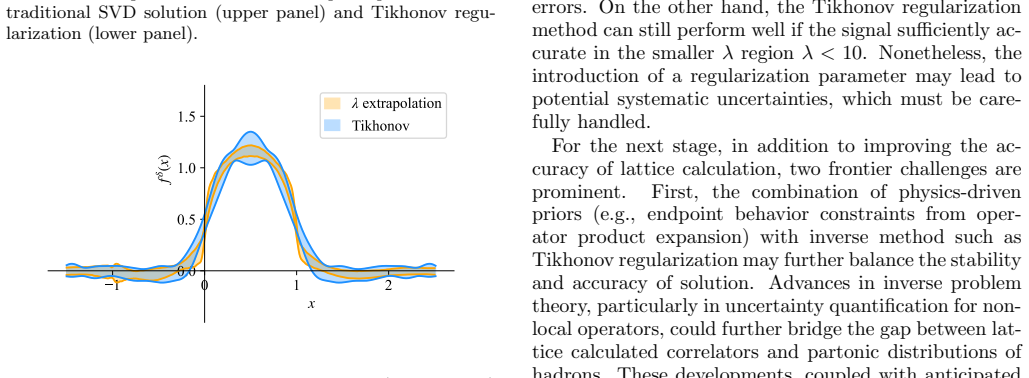
- The regularized reconstruction from real lattice data is statistically consistent with the $\lambda$-extrapolation result, cross-validating the two independent methods.
- Classifying the problem as moderately tractable separates it from severely ill-posed lattice QCD inversions (such as spectral-function reconstruction), indicating that standard regularization tools suffice here.
- As the input error approaches zero, the regularized solution converges to the true distribution, giving a formal guarantee behind the numerical reconstructions.
Reading between the lines
- The 'slower than exponential' singular-value decay that underpins the moderate-tractability classification is not demonstrated quantitatively; the quoted ratio $\sigma_1/\sigma_{81} \approx 10^{17}$ is compatible with geometric decay in the index, which would put the problem in the severe class even though Tikhonov regularization might still work.
- The same L-curve-regularized inversion could be applied as a cross-check to other LaMET observables (PDFs, GPDs, TMDs) that also provide only limited, noisy $g(\lambda)$ data.
- The agreement between Tikhonov and $\lambda$-extrapolation could be turned into a quantitative diagnostic: plotting the difference between the two reconstructions as a function of $\lambda_{\max}$ and data precision would reveal where regularization bias or extrapolation systematic errors dominate.
- Because the penalty term is $\|f\|^2_{\ell^2}$, the method favours smooth solutions and may smooth away genuine endpoint or kink structures; combining it with operator-product-expansion endpoint constraints is a natural next step.
Signed reviews
Editorial analysis
A structured set of objections, weighed in public.
Referee Report
Summary. The paper analyzes the limited discrete Fourier inversion problem that arises in the large-momentum effective theory (LaMET) when reconstructing momentum-space partonic distributions from finite-range, discrete coordinate-space lattice data. It shows that the continuous inverse Fourier transform on a bounded support is unique (with a proof in Appendix A), but that the discretized inversion is numerically unstable, as quantified by a singular value condition number of order 10^17. The authors propose Tikhonov regularization with the L-curve method for selecting the regularization parameter, demonstrate its effectiveness on toy models with uncorrelated and correlated noise, and apply it to lattice QCD data for the pion quasi distribution amplitude from the Lattice Parton Collaboration. The reconstructed quasi-DA is reported to be consistent with the previously used lambda-extrapolation method. The paper claims that the limited Fourier inversion in LaMET falls into a class of 'moderately tractable' ill-posed problems, distinguished by slow (slower than exponential) singular value decay.
Significance. If the claims are correct, the paper would provide a mathematically principled alternative to physics-driven extrapolation for partonic distributions in LaMET, with the potential to quantify uncertainties without model assumptions. The paper contains a self-contained uniqueness proof, a clean toy-model validation with a known ground truth, and a real-data application. However, the central classification of the problem as 'moderately tractable' is not substantiated: the reported singular value ratio is fully consistent with exponential (geometric) decay, which is typically associated with severely ill-posed problems. The uncertainty quantification is also less first-principles than claimed, since the L-curve is a heuristic and the bootstrap procedure does not propagate the regularization parameter choice. The core demonstration, that Tikhonov regularization stabilizes the inversion, is plausible and valuable, but the overreaching framing and the absence of a spectral analysis prevent acceptance in the current form.
major comments (4)
- [Sec. II.B (after Eq. (14))] The statement that the singular values of K_re 'decay more slowly than exponentially' is load-bearing for the paper's classification of the problem as 'moderately tractable,' but it is not substantiated. The paper gives sigma_1 = 0.3545 and sigma_n = 3.8e-18 for n = 81, yielding sigma_n/sigma_1 ~ 1e-17. Over the 80 index steps, this ratio is perfectly consistent with geometric decay sigma_i ~ r^i with r ~ 0.61, i.e., exponential decay in the index. Algebraic (slower-than-exponential) decay would give a far milder condition number. Please provide a quantitative spectral analysis (e.g., the full singular value spectrum on a log scale, or an asymptotic bound) or remove the classification claim from the abstract and Sec. II.B.
- [Sec. II.B and Appendix A] The uniqueness theorem is proved for data given on a continuum interval [lambda_min, lambda_max], whereas the practical inversion uses finitely many discrete values of lambda. For finite discrete data, the inverse problem is generally underdetermined and uniqueness does not hold as stated. The manuscript should explicitly state that the existence/uniqueness results apply to the continuous idealization, and should discuss the relation between this idealization and the finite-dimensional discrete problem actually solved by the regularization.
- [Sec. IV, Eq. (27) and Fig. 9] The claim of 'first-principles uncertainty quantification' is not supported by the described methodology. The regularization parameter alpha is selected per bootstrap sample via the L-curve criterion, and the reported alpha values span three orders of magnitude (10^-6 to 10^-4). The final uncertainty band shown in Fig. 12 does not appear to include the systematic component from the ambiguity in alpha selection. Please describe how the uncertainty band is constructed, and provide a sensitivity analysis of the final profile to the alpha selection rule (e.g., by comparing L-curve-selected alpha with other criteria such as the discrepancy principle).
- [Sec. IV, Fig. 12 and text] The agreement between the Tikhonov reconstruction and the lambda-extrapolation method is presented as confirmation of reliability and even of 'well-posedness under optimal conditions.' However, both methods use the same lattice data and share overlapping authorship/collaboration (LPC); the comparison is a consistency check rather than an independent validation. The text should be moderated and should state this limitation explicitly.
minor comments (6)
- [Abstract] The phrase 'The reconstructed solutions is consistent' should read 'The reconstructed solutions are consistent.'
- [Eqs. (7)-(8)] Please define X_nx and Lambda_nlambda explicitly as vectors and clarify the matrix construction; the current notation using sets and an outer product is ambiguous.
- [Eq. (18)] The approximation (sigma_1 + alpha)/(sigma_n + alpha) ~ sigma_1/alpha requires sigma_n << alpha << sigma_1; please state this condition or revise the heuristic.
- [Sec. III and Sec. V] There are several typos: 'maskes' should be 'masks', 'achiev' should be 'achieves', and 'the uncertainty in lattice data do not grow linearly' should read 'the uncertainties in lattice data do not grow linearly.'
- [Appendix A] The proof is correct but uses nonstandard notation (C[x_min,x_max]); consider referring to C([x_min,x_max]) and citing a standard result for the density of polynomials in L2.
- [Sec. I and Sec. II.B] The statement that the inverse problem satisfies 'existence' is not fully established; the Paley-Wiener argument applies to the true solution, not to arbitrary data. Please clarify the meaning of existence in the Hadamard sense.
Circularity Check
No circular derivation: the Tikhonov reconstruction is benchmarked on a known toy-model ground truth and the uniqueness proof is in-paper; the only concern is a minor non-load-bearing self-citation overlap in the real-data cross-check.
full rationale
The derivation chain is self-contained. Ill-posedness is established directly from the SVD spectrum (Eq. 14, kappa~10^17) and Picard-criterion divergence (Eq. 15); Tikhonov regularization is a standard external method whose convergence bound (Eqs. 19-21) is cited from the textbook literature, not from the authors' prior work. The toy-model validation uses a synthetic ground truth ft(x)=6x(1-x), generates g(lambda) via the DFT, adds controlled noise, and reconstructs; this is an external benchmark, not a fitted input renamed as a prediction. The uniqueness theorem (Appendix A) is proved in the paper, so no uniqueness result is imported from the authors' previous papers. The real-data comparison with the lambda-extrapolation method (Ref. [163]) is a cross-check rather than an input: the Tikhonov solution is not constructed from the lambda-extrapolation output. That said, Ref. [163] shares author Jun Hua and the input data come from the LPC collaboration (Ref. [112]); this reduces the independent weight of the real-data agreement, so a minor non-load-bearing self-citation concern applies (score 2). The Sec. II.B assertion that the singular values 'decay more slowly than exponentially' is unsupported and arguably inconsistent with sigma1/sigma_n~10^17, but an unproved premise is a correctness risk, not a circular reduction.
Assumptions & free parameters
free parameters (4)
- regularization parameter alpha =
7.31e-6 (pion quasi DA data)
- toy noise amplitude sigma =
0.05
- toy signal-decay exponent delta_M =
0.02
- discretization grid (x_min, x_max, delta_x, lambda_max, delta_lambda) =
(-2, 3, 0.01, 20, 0.5)
assumptions (5)
- standard math Paley-Wiener: compactly supported L2 functions have entire Fourier transforms of exponential type
- domain assumption Partonic distributions have compact support in x and coordinate-space correlators decay exponentially as g(lambda) proportional to e^{-m_eff |z|}
- domain assumption The discrete DFT matrix on the chosen grid faithfully represents the continuous limited Fourier inversion
- standard math Source condition f_true = K^dagger v with ||v||_l2 <= E, needed for the Tikhonov convergence bound
- domain assumption L-curve curvature maximum provides a near-optimal regularization parameter
Cite this review
Pith. "Pith review of Ill-Posedness in Limited Discrete Fourier Inversion and Regularization for Quasi Distributions in LaMET." pith.science (2026). https://pith.science/paper/XIH7I6JY
@misc{pith2026250616689,
  author       = {Pith},
  title        = {Pith review of: Ill-Posedness in Limited Discrete Fourier Inversion and Regularization for Quasi Distributions in LaMET},
  year         = {2026},
  howpublished = {\url{https://pith.science/paper/XIH7I6JY}},
  note         = {Machine review of arXiv:2506.16689}
}
abstract
We systematically investigated the limited inverse discrete Fourier transform of the quasi distributions from the perspective of inverse problem theory. This transformation satisfies two of Hadamard's well-posedness criteria, existence and uniqueness of solutions, but critically violates the stability requirement, exhibiting exponential sensitivity to input perturbations. To address this instability, we implemented Tikhonov regularization with L-curve optimized parameters, demonstrating its validity for controlled toy model studies and real lattice QCD results of quasi distribution amplitudes. The reconstructed solutions is consistent with the physics-driven $\lambda$-extrapolation method. Our analysis demonstrates that the inverse Fourier problem within the large-momentum effective theory (LaMET) framework belongs to a class of moderately tractable ill-posed problems, characterized by distinct spectral properties that differ from those of more severely unstable inverse problems encountered in other lattice QCD applications. Tikhonov regularization establishes a rigorous mathematical framework for addressing the underlying instability, enabling first-principles uncertainty quantification without relying on ansatz-based assumptions.
Figures


Figures from the paper (6 more)


Forward citations
Cited by 2 Pith papers
-
Revisiting Quark Confinement in the Proton through the Force on Quarks
Using light-cone sum-rule input and Tikhonov-regularized inversion, the paper reconstructs the quark confining force in the proton and confirms an attractive, approximately linear-potential force at intermediate distances.
-
Comment on "LaMET's Asymptotic Extrapolation vs. Inverse Problem"
The paper defends the inverse-problem view of LaMET reconstructions and argues that rigid parametric extrapolations underestimate PDF uncertainties when lattice data are noisy.
Reference graph
Works this paper leans on
-
[1]
G. Martinelli and C. T. Sachrajda, Phys. Lett. B 196, 184-190 (1987) doi:10.1016/0370-2693(87)90601-0
-
[2]
W. Detmold, W. Melnitchouk and A. W. Thomas, 13 Eur. Phys. J. direct 3, no.1, 13 (2001) doi:10.1007/s1010501c0013 [arXiv:hep-lat/0108002 [hep-lat]]
arXiv 2001
-
[3]
D. Dolgov et al. [LHPC and TXL], Phys. Rev. D 66, 034506 (2002) doi:10.1103/PhysRevD.66.034506 [arXiv:hep-lat/0201021 [hep-lat]]
arXiv 2002
-
[4]
W. Detmold and C. J. D. Lin, Phys. Rev. D 73, 014501 (2006) doi:10.1103/PhysRevD.73.014501 [arXiv:hep-lat/0507007 [hep-lat]]
arXiv 2006
-
[5]
V. M. Braun, M. Gockeler, R. Horsley, H. Perlt, D. Pleiter, P. E. L. Rakow, G. Schierholz, A. Schiller, W. Schroers and H. Stuben, et al. Phys. Rev. D 74, 074501 (2006) doi:10.1103/PhysRevD.74.074501 [arXiv:hep-lat/0606012 [hep-lat]]
arXiv 2006
-
[6]
V. M. Braun, S. Collins, M. G¨ ockeler, P. P´ erez- Rubio, A. Sch¨ afer, R. W. Schiel and A. Stern- beck, Phys. Rev. D 92, no.1, 014504 (2015) doi:10.1103/PhysRevD.92.014504 [arXiv:1503.03656 [hep-lat]]
arXiv 2015
-
[7]
A. J. Chambers, R. Horsley, Y. Nakamura, H. Perlt, P. E. L. Rakow, G. Schierholz, A. Schiller, K. Somfleth, R. D. Young and J. M. Zanotti, Phys. Rev. Lett. 118, no.24, 242001 (2017) doi:10.1103/PhysRevLett.118.242001 [arXiv:1703.01153 [hep-lat]]
arXiv 2017
-
[8]
G. S. Bali et al. [RQCD], JHEP 08, 065 (2019) doi:10.1007/JHEP08(2019)065 [arXiv:1903.08038 [hep- lat]]
arXiv 2019
Show all 195 references
-
[9]
Shindler, Phys
A. Shindler, Phys. Rev. D 110, no.5, L051503 (2024) doi:10.1103/PhysRevD.110.L051503 [arXiv:2311.18704 [hep-lat]]
2024 arXiv
-
[10]
Ji, Phys
X. Ji, Phys. Rev. Lett. 110, 262002 (2013) doi:10.1103/PhysRevLett.110.262002 [arXiv:1305.1539 [hep-ph]]
2013 arXiv
-
[11]
X. Ji, Y. S. Liu, Y. Liu, J. H. Zhang and Y. Zhao, Rev. Mod. Phys. 93, no.3, 035005 (2021) doi:10.1103/RevModPhys.93.035005 [arXiv:2004.03543 [hep-ph]]
2021 arXiv
-
[12]
Xiong, X
X. Xiong, X. Ji, J. H. Zhang and Y. Zhao, Phys. Rev. D 90, no.1, 014051 (2014) doi:10.1103/PhysRevD.90.014051 [arXiv:1310.7471 [hep-ph]]
2014 arXiv
-
[13]
H. W. Lin, J. W. Chen, S. D. Cohen and X. Ji, Phys. Rev. D 91, 054510 (2015) doi:10.1103/PhysRevD.91.054510 [arXiv:1402.1462 [hep-ph]]
2015 arXiv
-
[14]
X. Ji, P. Sun, X. Xiong and F. Yuan, Phys. Rev. D 91, 074009 (2015) doi:10.1103/PhysRevD.91.074009 [arXiv:1405.7640 [hep-ph]]
2015 arXiv
-
[15]
X. Ji, J. H. Zhang and Y. Zhao, Phys. Lett. B 743, 180-183 (2015) doi:10.1016/j.physletb.2015.02.054 [arXiv:1409.6329 [hep-ph]]
2015 arXiv
-
[16]
R. S. Sufian et al. [xQCD], PoS LATTICE2014, 166 (2015) doi:10.22323/1.214.0166 [arXiv:1412.7168 [hep- lat]]
2015 arXiv
-
[17]
X. Ji, A. Sch¨ afer, X. Xiong and J. H. Zhang, Phys. Rev. D 92, 014039 (2015) doi:10.1103/PhysRevD.92.014039 [arXiv:1506.00248 [hep-ph]]
2015 arXiv
-
[18]
Xiong and J
X. Xiong and J. H. Zhang, Phys. Rev. D 92, no.5, 054037 (2015) doi:10.1103/PhysRevD.92.054037 [arXiv:1509.08016 [hep-ph]]
2015 arXiv
-
[19]
Alexandrou, K
C. Alexandrou, K. Cichy, M. Constantinou, K. Had- jiyiannakou, K. Jansen, F. Steffens and C. Wiese, PoS LATTICE2016, 151 (2016) doi:10.22323/1.256.0151 [arXiv:1612.08728 [hep-lat]]
2016 arXiv
-
[20]
J. W. Chen, S. D. Cohen, X. Ji, H. W. Lin and J. H. Zhang, Nucl. Phys. B 911, 246-273 (2016) doi:10.1016/j.nuclphysb.2016.07.033 [arXiv:1603.06664 [hep-ph]]
2016 arXiv
-
[21]
H. W. Lin, PoS LATTICE2016, 005 (2016) doi:10.22323/1.256.0005 [arXiv:1612.09366 [hep-lat]]
2016 arXiv
-
[22]
Y. B. Yang et al. [xQCD], PoS LATTICE2015, 129 (2016) doi:10.22323/1.251.0129 [arXiv:1603.05256 [hep- ph]]
2016 arXiv
-
[23]
Y. B. Yang, R. S. Sufian, A. Alexandru, T. Draper, M. J. Glatzmaier, K. F. Liu and Y. Zhao, Phys. Rev. Lett. 118, no.10, 102001 (2017) doi:10.1103/PhysRevLett.118.102001 [arXiv:1609.05937 [hep-ph]]
2017 arXiv
-
[25]
Alexandrou, K
C. Alexandrou, K. Cichy, M. Constantinou, K. Had- jiyiannakou, K. Jansen, H. Panagopoulos and F. Steffens, Nucl. Phys. B 923, 394-415 (2017) doi:10.1016/j.nuclphysb.2017.08.012 [arXiv:1706.00265 [hep-lat]]
2017 arXiv
-
[26]
Alexandrou, K
C. Alexandrou, K. Cichy, M. Constantinou, K. Had- jiyiannakou, K. Jansen, H. Panagopoulos, A. Scapellato and F. Steffens, EPJ Web Conf. 175, 06021 (2018) doi:10.1051/epjconf/201817506021 [arXiv:1709.07513 [hep-lat]]
2018
-
[27]
J. W. Chen et al. [LP3], Chin. Phys. C 43, no.10, 103101 (2019) doi:10.1088/1674-1137/43/10/103101 [arXiv:1710.01089 [hep-lat]]
2019 arXiv
-
[28]
J. W. Chen, T. Ishikawa, L. Jin, H. W. Lin, Y. B. Yang, J. H. Zhang and Y. Zhao, Phys. Rev. D 97, no.1, 014505 (2018) doi:10.1103/PhysRevD.97.014505 [arXiv:1706.01295 [hep-lat]]
2018 arXiv
-
[29]
Constantinou and H
M. Constantinou and H. Panagopoulos, Phys. Rev. D 96, no.5, 054506 (2017) doi:10.1103/PhysRevD.96.054506 [arXiv:1705.11193 [hep-lat]]
2017 arXiv
-
[30]
Ishikawa, L
T. Ishikawa, L. Jin, H. W. Lin, A. Sch¨ afer, Y. B. Yang, J. H. Zhang and Y. Zhao, Sci. China Phys. Mech. As- tron. 62, no.9, 991021 (2019) doi:10.1007/s11433-018- 9375-1 [arXiv:1711.07858 [hep-ph]]
2019 arXiv
-
[31]
X. Ji, J. H. Zhang and Y. Zhao, Phys. Rev. Lett. 120, no.11, 112001 (2018) doi:10.1103/PhysRevLett.120.112001 [arXiv:1706.08962 [hep-ph]]
2018 arXiv
-
[32]
X. Ji, J. H. Zhang and Y. Zhao, Nucl. Phys. B 924, 366-376 (2017) doi:10.1016/j.nuclphysb.2017.09.001 [arXiv:1706.07416 [hep-ph]]
2017 arXiv
-
[33]
H. W. Lin et al. [LP3], Phys. Rev. D 98, no.5, 054504 (2018) doi:10.1103/PhysRevD.98.054504 [arXiv:1708.05301 [hep-lat]]
2018 arXiv
-
[34]
I. W. Stewart and Y. Zhao, Phys. Rev. D 97, no.5, 054512 (2018) doi:10.1103/PhysRevD.97.054512 [arXiv:1709.04933 [hep-ph]]
2018 arXiv
- [35]
-
[36]
J. H. Zhang, J. W. Chen, X. Ji, L. Jin and H. W. Lin, Phys. Rev. D 95, no.9, 094514 (2017) doi:10.1103/PhysRevD.95.094514 [arXiv:1702.00008 [hep-lat]]. 14
2017 arXiv
-
[37]
J. H. Zhang et al. [LP3], Nucl. Phys. B 939, 429- 446 (2019) doi:10.1016/j.nuclphysb.2018.12.020 [arXiv:1712.10025 [hep-ph]]
2019 arXiv
-
[38]
Alexandrou, K
C. Alexandrou, K. Cichy, M. Constantinou, K. Jansen, A. Scapellato and F. Steffens, Phys. Rev. D 98, no.9, 091503 (2018) doi:10.1103/PhysRevD.98.091503 [arXiv:1807.00232 [hep-lat]]
2018 arXiv
-
[39]
Alexandrou, K
C. Alexandrou, K. Cichy, M. Constanti- nou, K. Jansen, A. Scapellato and F. Stef- fens, Phys. Rev. Lett. 121, no.11, 112001 (2018) doi:10.1103/PhysRevLett.121.112001 [arXiv:1803.02685 [hep-lat]]
2018 arXiv
-
[40]
Alexandrou, K
C. Alexandrou, K. Cichy, M. Constantinou, K. Hadjiyiannakou, K. Jansen, A. Scapellato and F. Steffens, PoS LATTICE2018, 094 (2018) doi:10.22323/1.334.0094 [arXiv:1811.01588 [hep-lat]]
2018 arXiv
-
[41]
J. W. Chen, L. Jin, H. W. Lin, Y. S. Liu, Y. B. Yang, J. H. Zhang and Y. Zhao, [arXiv:1803.04393 [hep-lat]]
-
[42]
M. A. Ebert, I. W. Stewart and Y. Zhao, Phys. Rev. D 99, no.3, 034505 (2019) doi:10.1103/PhysRevD.99.034505 [arXiv:1811.00026 [hep-ph]]
2019 arXiv
-
[43]
Z. Y. Fan, Y. B. Yang, A. Anthony, H. W. Lin and K. F. Liu, Phys. Rev. Lett. 121, no.24, 242001 (2018) doi:10.1103/PhysRevLett.121.242001 [arXiv:1808.02077 [hep-lat]]
2018 arXiv
-
[44]
Izubuchi, X
T. Izubuchi, X. Ji, L. Jin, I. W. Stewart and Y. Zhao, Phys. Rev. D 98, no.5, 056004 (2018) doi:10.1103/PhysRevD.98.056004 [arXiv:1801.03917 [hep-ph]]
2018 arXiv
-
[45]
X. Ji, L. C. Jin, F. Yuan, J. H. Zhang and Y. Zhao, Phys. Rev. D 99, no.11, 114006 (2019) doi:10.1103/PhysRevD.99.114006 [arXiv:1801.05930 [hep-ph]]
2019 arXiv
-
[46]
Y. S. Liu et al. [Lattice Parton], Phys. Rev. D 101, no.3, 034020 (2020) doi:10.1103/PhysRevD.101.034020 [arXiv:1807.06566 [hep-lat]]
2020 arXiv
-
[47]
J. Xu, Q. A. Zhang and S. Zhao, Phys. Rev. D 97, no.11, 114026 (2018) doi:10.1103/PhysRevD.97.114026 [arXiv:1804.01042 [hep-ph]]
2018 arXiv
-
[48]
H. W. Lin, J. W. Chen, X. Ji, L. Jin, R. Li, Y. S. Liu, Y. B. Yang, J. H. Zhang and Y. Zhao, Phys. Rev. Lett. 121, no.24, 242003 (2018) doi:10.1103/PhysRevLett.121.242003 [arXiv:1807.07431 [hep-lat]]
2018 arXiv
-
[49]
Y. S. Liu, J. W. Chen, L. Jin, R. Li, H. W. Lin, Y. B. Yang, J. H. Zhang and Y. Zhao, [arXiv:1810.05043 [hep-lat]]
-
[50]
Y. S. Liu, W. Wang, J. Xu, Q. A. Zhang, S. Zhao and Y. Zhao, Phys. Rev. D 99, no.9, 094036 (2019) doi:10.1103/PhysRevD.99.094036 [arXiv:1810.10879 [hep-ph]]
2019 arXiv
-
[51]
J. H. Zhang, X. Ji, A. Sch¨ afer, W. Wang and S. Zhao, Phys. Rev. Lett. 122, no.14, 142001 (2019) doi:10.1103/PhysRevLett.122.142001 [arXiv:1808.10824 [hep-ph]]
2019 arXiv
-
[52]
J. H. Zhang, J. W. Chen, L. Jin, H. W. Lin, A. Sch¨ afer and Y. Zhao, Phys. Rev. D 100, no.3, 034505 (2019) doi:10.1103/PhysRevD.100.034505 [arXiv:1804.01483 [hep-lat]]
2019 arXiv
-
[53]
Zhang, J
J. Zhang, J. W. Chen, L. Jin, H. W. Lin, Y. S. Liu, A. Sch¨ afer, Y. B. Yang and Y. Zhao, PoS LAT- TICE2018, 108 (2018) doi:10.22323/1.334.0108
2018 doi
-
[54]
Zhao, Int
Y. Zhao, Int. J. Mod. Phys. A 33, no.36, 1830033 (2019) doi:10.1142/S0217751X18300338 [arXiv:1812.07192 [hep-ph]]
2019 arXiv
-
[55]
Alexandrou, K
C. Alexandrou, K. Cichy, M. Constantinou, K. Hadjiyiannakou, K. Jansen, A. Scapellato and F. Steffens, PoS LATTICE2019, 036 (2019) doi:10.22323/1.363.0036 [arXiv:1910.13229 [hep-lat]]
2019 arXiv
-
[56]
Alexandrou, K
C. Alexandrou, K. Cichy, M. Constantinou, K. Had- jiyiannakou, K. Jansen, A. Scapellato and F. Stef- fens, Phys. Rev. D 99, no.11, 114504 (2019) doi:10.1103/PhysRevD.99.114504 [arXiv:1902.00587 [hep-lat]]
2019 arXiv
-
[57]
Y. Chai, Y. Li, S. Xia, C. Alexandrou, K. Ci- chy, M. Constantinou, X. Feng, K. Hadjiyiannakou, K. Jansen and G. Koutsou, et al. PoS LATTICE2019, 270 (2019) doi:10.22323/1.363.0270 [arXiv:1907.09827 [hep-lat]]
2019 arXiv
-
[58]
J. W. Chen, H. W. Lin and J. H. Zhang, Nucl. Phys. B 952, 114940 (2020) doi:10.1016/j.nuclphysb.2020.114940 [arXiv:1904.12376 [hep-lat]]
2020
-
[59]
Constantinou, H
M. Constantinou, H. Panagopoulos and G. Spanoudes, Phys. Rev. D 99, no.7, 074508 (2019) doi:10.1103/PhysRevD.99.074508 [arXiv:1901.03862 [hep-lat]]
2019 arXiv
-
[60]
M. A. Ebert, I. W. Stewart and Y. Zhao, JHEP 03, 099 (2020) doi:10.1007/JHEP03(2020)099 [arXiv:1910.08569 [hep-ph]]
2020 arXiv
-
[61]
Y. S. Liu, W. Wang, J. Xu, Q. A. Zhang, J. H. Zhang, S. Zhao and Y. Zhao, Phys. Rev. D 100, no.3, 034006 (2019) doi:10.1103/PhysRevD.100.034006 [arXiv:1902.00307 [hep-ph]]
2019 arXiv
-
[62]
Shanahan, M
P. Shanahan, M. L. Wagman and Y. Zhao, Phys. Rev. D 101, no.7, 074505 (2020) doi:10.1103/PhysRevD.101.074505 [arXiv:1911.00800 [hep-lat]]
2020 arXiv
-
[63]
W. Wang, Y. M. Wang, J. Xu and S. Zhao, Phys. Rev. D 102, no.1, 011502 (2020) doi:10.1103/PhysRevD.102.011502 [arXiv:1908.09933 [hep-ph]]
2020 arXiv
-
[64]
Zhang, Z
R. Zhang, Z. Fan, R. Li, H. W. Lin and B. Yoon, Phys. Rev. D 101, no.3, 034516 (2020) doi:10.1103/PhysRevD.101.034516 [arXiv:1909.10990 [hep-lat]]
2020 arXiv
-
[65]
Alexandrou, K
C. Alexandrou, K. Cichy, M. Constantinou, J. R. Green, K. Hadjiyiannakou, K. Jansen, F. Manigrasso, A. Scapellato and F. Steffens, Phys. Rev. D 103, 094512 (2021) doi:10.1103/PhysRevD.103.094512 [arXiv:2011.00964 [hep-lat]]
2021 arXiv
-
[66]
Alexandrou, M
C. Alexandrou, M. Constantinou, K. Had- jiyiannakou, K. Jansen and F. Mani- grasso, Phys. Rev. Lett. 126, no.10, 102003 (2021) doi:10.1103/PhysRevLett.126.102003 [arXiv:2009.13061 [hep-lat]]
2021 arXiv
-
[67]
Alexandrou, K
C. Alexandrou, K. Cichy, M. Constantinou, K. Hadjiyiannakou, K. Jansen, A. Scapellato and F. Steffens, Phys. Rev. Lett. 125, no.26, 262001 (2020) doi:10.1103/PhysRevLett.125.262001 [arXiv:2008.10573 [hep-lat]]
2020 arXiv
-
[68]
Bhattacharya, K
S. Bhattacharya, K. Cichy, M. Constantinou, A. Metz, A. Scapellato and F. Steffens, Phys. Rev. D 102, no.11, 111501 (2020) doi:10.1103/PhysRevD.102.111501 [arXiv:2004.04130 [hep-lat]]
2020 arXiv
-
[69]
Bhattacharya, K
S. Bhattacharya, K. Cichy, M. Constantinou, A. Metz, A. Scapellato and F. Steffens, Phys. Rev. D 15 102, 114025 (2020) doi:10.1103/PhysRevD.102.114025 [arXiv:2006.12347 [hep-ph]]
2020 arXiv
-
[70]
Y. Chai, Y. Li, S. Xia, C. Alexandrou, K. Ci- chy, M. Constantinou, X. Feng, K. Hadjiyiannakou, K. Jansen and G. Koutsou, et al. Phys. Rev. D 102, no.1, 014508 (2020) doi:10.1103/PhysRevD.102.014508 [arXiv:2002.12044 [hep-lat]]
2020 arXiv
-
[71]
L. B. Chen, W. Wang and R. Zhu, Phys. Rev. D 102, no.1, 011503 (2020) doi:10.1103/PhysRevD.102.011503 [arXiv:2005.13757 [hep-ph]]
2020 arXiv
-
[72]
L. B. Chen, W. Wang and R. Zhu, JHEP 10, 079 (2020) doi:10.1007/JHEP10(2020)079 [arXiv:2006.10917 [hep- ph]]
2020 arXiv
-
[73]
L. B. Chen, W. Wang and R. Zhu, Phys. Rev. Lett. 126, no.7, 072002 (2021) doi:10.1103/PhysRevLett.126.072002 [arXiv:2006.14825 [hep-ph]]
2021 arXiv
-
[74]
M. A. Ebert, S. T. Schindler, I. W. Stewart and Y. Zhao, JHEP 09, 099 (2020) doi:10.1007/JHEP09(2020)099 [arXiv:2004.14831 [hep-ph]]
2020 arXiv
-
[75]
Z. Fan, X. Gao, R. Li, H. W. Lin, N. Karthik, S. Mukherjee, P. Petreczky, S. Syritsyn, Y. B. Yang and R. Zhang, Phys. Rev. D 102, no.7, 074504 (2020) doi:10.1103/PhysRevD.102.074504 [arXiv:2005.12015 [hep-lat]]
2020 arXiv
-
[76]
X. Gao, L. Jin, C. Kallidonis, N. Karthik, S. Mukher- jee, P. Petreczky, C. Shugert, S. Syritsyn and Y. Zhao, Phys. Rev. D 102, no.9, 094513 (2020) doi:10.1103/PhysRevD.102.094513 [arXiv:2007.06590 [hep-lat]]
2020 arXiv
-
[77]
Hua et al
J. Hua et al. [Lattice Parton], Phys. Rev. Lett. 127, no.6, 062002 (2021) doi:10.1103/PhysRevLett.127.062002 [arXiv:2011.09788 [hep-lat]]
2021 arXiv
-
[78]
X. Ji, Y. Liu, A. Sch¨ afer, W. Wang, Y. B. Yang, J. H. Zhang and Y. Zhao, Nucl. Phys. B 964, 115311 (2021) doi:10.1016/j.nuclphysb.2021.115311 [arXiv:2008.03886 [hep-ph]]
2021
-
[79]
X. Ji, Y. Liu, A. Sch¨ afer and F. Yuan, Phys. Rev. D103, no.7, 074005 (2021) doi:10.1103/PhysRevD.103.074005 [arXiv:2011.13397 [hep-ph]]
2021 arXiv
-
[80]
Q. A. Zhang et al. [Lattice Parton], Phys. Rev. Lett. 125, no.19, 192001 (2020) doi:10.22323/1.396.0477 [arXiv:2005.14572 [hep-lat]]
2020 arXiv
-
[81]
H. W. Lin, J. W. Chen and R. Zhang, [arXiv:2011.14971 [hep-lat]]
2011 arXiv
-
[82]
H. W. Lin, Phys. Rev. Lett. 127, no.18, 182001 (2021) doi:10.1103/PhysRevLett.127.182001 [arXiv:2008.12474 [hep-ph]]
2021 arXiv
-
[83]
H. W. Lin, J. W. Chen, Z. Fan, J. H. Zhang and R. Zhang, Phys. Rev. D 103, no.1, 014516 (2021) doi:10.1103/PhysRevD.103.014516 [arXiv:2003.14128 [hep-lat]]
2021 arXiv
-
[84]
Shanahan, M
P. Shanahan, M. Wagman and Y. Zhao, Phys. Rev. D 102, no.1, 014511 (2020) doi:10.1103/PhysRevD.102.014511 [arXiv:2003.06063 [hep-lat]]
2020 arXiv
-
[85]
Shugert, X
C. Shugert, X. Gao, T. Izubichi, L. Jin, C. Kallidonis, N. Karthik, S. Mukherjee, P. Petreczky, S. Syritsyn and Y. Zhao, [arXiv:2001.11650 [hep-lat]]
2001 arXiv
-
[86]
A. A. Vladimirov and A. Sch¨ afer, Phys. Rev. D 101, no.7, 074517 (2020) doi:10.1103/PhysRevD.101.074517 [arXiv:2002.07527 [hep-ph]]
2020 arXiv
-
[87]
Zhang, H
R. Zhang, H. W. Lin and B. Yoon, Phys. Rev. D 104, no.9, 094511 (2021) doi:10.1103/PhysRevD.104.094511 [arXiv:2005.01124 [hep-lat]]
2021 arXiv
-
[88]
Zhang, C
R. Zhang, C. Honkala, H. W. Lin and J. W. Chen, Phys. Rev. D 102, no.9, 094519 (2020) doi:10.1103/PhysRevD.102.094519 [arXiv:2005.13955 [hep-lat]]
2020 arXiv
-
[89]
Zhang et al
K. Zhang et al. [χQCD], Phys. Rev. D 104, no.7, 074501 (2021) doi:10.1103/PhysRevD.104.074501 [arXiv:2012.05448 [hep-lat]]
2021 arXiv
-
[90]
Alexandrou, K
C. Alexandrou, K. Cichy, M. Constantinou, K. Had- jiyiannakou, K. Jansen, A. Scapellato and F. Stef- fens, Phys. Rev. D 105, no.3, 034501 (2022) doi:10.1103/PhysRevD.105.034501 [arXiv:2108.10789 [hep-lat]]
2022 arXiv
-
[91]
Alexandrou, M
C. Alexandrou, M. Constantinou, K. Hadjiyiannakou, K. Jansen and F. Manigrasso, Phys. Rev. D 104, no.5, 054503 (2021) doi:10.1103/PhysRevD.104.054503 [arXiv:2106.16065 [hep-lat]]
2021
-
[92]
Bhattacharya, K
S. Bhattacharya, K. Cichy, M. Constantinou, A. Metz, A. Scapellato and F. Steffens, Phys. Rev. D 104, no.11, 114510 (2021) doi:10.1103/PhysRevD.104.114510 [arXiv:2107.02574 [hep-lat]]
2021 arXiv
-
[93]
Bhattacharya, K
S. Bhattacharya, K. Cichy, M. Constantinou, A. Metz, A. Scapellato and F. Steffens, SciPost Phys. Proc. 8, 057 (2022) doi:10.21468/SciPostPhysProc.8.057 [arXiv:2107.12818 [hep-lat]]
2022 arXiv
-
[94]
Constantinou, S
M. Constantinou, S. Bhattacharya, K. Cichy, A. Metz, A. Scapellato and F. Steffens, PoS LATTICE2021, 391 (2022) doi:10.22323/1.396.0391 [arXiv:2111.01056 [hep-lat]]
2022 arXiv
-
[95]
Dodson, S
J. Dodson, S. Bhattacharya, K. Cichy, M. Constanti- nou, A. Metz, A. Scapellato and F. Steffens, PoS LATTICE2021, 054 (2022) doi:10.22323/1.396.0054 [arXiv:2112.05538 [hep-lat]]
2022 arXiv
-
[96]
X. Gao, K. Lee, S. Mukherjee, C. Shugert and Y. Zhao, Phys. Rev. D 103, no.9, 094504 (2021) doi:10.1103/PhysRevD.103.094504 [arXiv:2102.01101 [hep-ph]]
2021 arXiv
-
[97]
X. Gao, A. D. Hanlon, S. Mukherjee, P. Petreczky, P. Scior, S. Syritsyn and Y. Zhao, Phys. Rev. Lett. 128, no.14, 142003 (2022) doi:10.1103/PhysRevLett.128.142003 [arXiv:2112.02208 [hep-lat]]
2022 arXiv
-
[98]
Y. K. Huo et al. [Lattice Parton (LPC)], Nucl. Phys. B 969, 115443 (2021) doi:10.1016/j.nuclphysb.2021.115443 [arXiv:2103.02965 [hep-lat]]
2021
-
[99]
Y. Li, S. C. Xia, C. Alexandrou, K. Cichy, M. Constanti- nou, X. Feng, K. Hadjiyiannakou, K. Jansen, C. Liu and A. Scapellato, et al. Phys. Rev. Lett. 128, no.6, 062002 (2022) doi:10.1103/PhysRevLett.128.062002 [arXiv:2106.13027 [hep-lat]]
2022 arXiv
-
[100]
H. W. Lin, Phys. Lett. B 824, 136821 (2022) doi:10.1016/j.physletb.2021.136821 [arXiv:2112.07519 [hep-lat]]
2022
-
[101]
H. W. Lin, PoS LATTICE2021, 276 (2022) doi:10.22323/1.396.0276 [arXiv:2110.06779 [hep-lat]]
2022 arXiv
-
[102]
Scapellato, C
A. Scapellato, C. Alexandrou, K. Cichy, M. Constanti- nou, K. Hadjiyiannakou, K. Jansen and F. Steffens, PoS LATTICE2021, 129 (2022) doi:10.22323/1.396.0129 [arXiv:2111.03226 [hep-lat]]
2022 arXiv
-
[103]
Schlemmer, A
M. Schlemmer, A. Vladimirov, C. Zimmermann, M. En- gelhardt and A. Sch¨ afer, JHEP 08, 004 (2021) doi:10.1007/JHEP08(2021)004 [arXiv:2103.16991 [hep- 16 lat]]
2021 arXiv
-
[104]
Shanahan, M
P. Shanahan, M. Wagman and Y. Zhao, Phys. Rev. D 104, no.11, 114502 (2021) doi:10.1103/PhysRevD.104.114502 [arXiv:2107.11930 [hep-lat]]
2021 arXiv
-
[105]
Bhattacharya, K
S. Bhattacharya, K. Cichy, M. Constantinou, J. Dod- son, X. Gao, A. Metz, S. Mukherjee, A. Scapellato, F. Steffens and Y. Zhao, Phys. Rev. D 106, no.11, 114512 (2022) doi:10.1103/PhysRevD.106.114512 [arXiv:2209.05373 [hep-lat]]
2022 arXiv
-
[106]
Constantinou, S
M. Constantinou, S. Bhattacharya, K. Cichy, J. Dodson, X. Gao, A. Metz, S. Mukherjee, A. Scapellato, F. Stef- fens and Y. Zhao, PoS LATTICE2022, 096 (2023) doi:10.22323/1.430.0096 [arXiv:2212.09818 [hep-lat]]
2023 arXiv
-
[107]
Z. F. Deng, W. Wang and J. Zeng, JHEP 09, 046 (2022) doi:10.1007/JHEP09(2022)046 [arXiv:2207.07280 [hep- th]]
2022 arXiv
-
[108]
M. A. Ebert, S. T. Schindler, I. W. Stewart and Y. Zhao, JHEP 04, 178 (2022) doi:10.1007/JHEP04(2022)178 [arXiv:2201.08401 [hep-ph]]
2022 arXiv
-
[109]
X. Gao, A. D. Hanlon, N. Karthik, S. Mukherjee, P. Petreczky, P. Scior, S. Shi, S. Syritsyn, Y. Zhao and K. Zhou, Phys. Rev. D 106, no.11, 114510 (2022) doi:10.1103/PhysRevD.106.114510 [arXiv:2208.02297 [hep-lat]]
2022 arXiv
-
[110]
X. Gao, A. D. Hanlon, J. Holligan, N. Karthik, S. Mukherjee, P. Petreczky, S. Syritsyn and Y. Zhao, Phys. Rev. D 107, no.7, 074509 (2023) doi:10.1103/PhysRevD.107.074509 [arXiv:2212.12569 [hep-lat]]
2023 arXiv
-
[111]
Yao et al
F. Yao et al. [Lattice Parton], Phys. Rev. Lett. 131, no.26, 261901 (2023) doi:10.1103/PhysRevLett.131.261901 [arXiv:2208.08008 [hep-lat]]
2023 arXiv
-
[112]
Hua et al
J. Hua et al. [Lattice Parton], Phys. Rev. Lett. 129, no.13, 132001 (2022) doi:10.1103/PhysRevLett.129.132001 [arXiv:2201.09173 [hep-lat]]
2022 arXiv
-
[113]
J. C. He et al. [Lattice Parton Collaboration (LPC)], Phys. Rev. D 109, no.11, 114513 (2024) doi:10.1103/PhysRevD.109.114513 [arXiv:2211.02340 [hep-lat]]
2024 arXiv
-
[114]
M. H. Chu et al. [Lattice Parton (LPC)], Phys. Rev. D 106, no.3, 034509 (2022) doi:10.1103/PhysRevD.106.034509 [arXiv:2204.00200 [hep-lat]]
2022 arXiv
-
[115]
Scapellato, C
A. Scapellato, C. Alexandrou, K. Cichy, M. Constanti- nou, K. Hadjiyiannakou, K. Jansen and F. Stef- fens, Rev. Mex. Fis. Suppl. 3, no.3, 0308104 (2022) doi:10.31349/SuplRevMexFis.3.0308104 [arXiv:2201.06519 [hep-lat]]
2022 arXiv
-
[116]
S. T. Schindler, I. W. Stewart and Y. Zhao, JHEP 08, 084 (2022) doi:10.1007/JHEP08(2022)084 [arXiv:2205.12369 [hep-ph]]
2022 arXiv
-
[117]
Zhang et al
K. Zhang et al. [Lattice Parton (LPC)], Phys. Rev. Lett. 129, no.8, 082002 (2022) doi:10.1103/PhysRevLett.129.082002 [arXiv:2205.13402 [hep-lat]]
2022 arXiv
-
[118]
Alexandrou, S
C. Alexandrou, S. Bacchio, K. Cichy, M. Constantinou, X. Feng, K. Jansen, C. Liu, A. Sen, G. Spanoudes and F. Steffens, et al. Phys. Rev. D 108, no.11, 114503 (2023) doi:10.1103/PhysRevD.108.114503 [arXiv:2305.11824 [hep-lat]]
2023 arXiv
-
[119]
Avkhadiev, P
A. Avkhadiev, P. E. Shanahan, M. L. Wagman and Y. Zhao, Phys. Rev. D 108, no.11, 114505 (2023) doi:10.1103/PhysRevD.108.114505 [arXiv:2307.12359 [hep-lat]]
2023 arXiv
-
[120]
Bhattacharya, K
S. Bhattacharya, K. Cichy, M. Constantinou, J. Dod- son, X. Gao, A. Metz, J. Miller, S. Mukherjee, P. Pe- treczky and F. Steffens, et al. Phys. Rev. D 109, no.3, 034508 (2024) doi:10.1103/PhysRevD.109.034508 [arXiv:2310.13114 [hep-lat]]
2024 arXiv
-
[121]
Bhattacharya, K
S. Bhattacharya, K. Cichy, M. Constantinou, J. Dodson, A. Metz, A. Scapellato and F. Stef- fens, Phys. Rev. D 108, no.5, 054501 (2023) doi:10.1103/PhysRevD.108.054501 [arXiv:2306.05533 [hep-lat]]
2023 arXiv
-
[122]
Bhattacharya, K
S. Bhattacharya, K. Cichy, M. Constantinou, J. Dodson, X. Gao, A. Metz, S. Mukherjee, A. Scapellato, F. Stef- fens and Y. Zhao, PoS LATTICE2022, 095 (2023) doi:10.22323/1.430.0095 [arXiv:2301.03400 [hep-lat]]
2023 arXiv
-
[123]
Cichy, S
K. Cichy, S. Bhattacharya, M. Constantinou, J. Dodson, X. Gao, A. Metz, J. Miller, S. Mukherjee, A. Scapel- lato and F. Steffens, et al. Acta Phys. Polon. Supp. 16, no.7, 7-A6 (2023) doi:10.5506/APhysPolBSupp.16.7-A6 [arXiv:2304.14970 [hep-lat]]
2023 arXiv
-
[124]
Z. F. Deng, C. Han, W. Wang, J. Zeng and J. L. Zhang, JHEP 07, 191 (2023) doi:10.1007/JHEP07(2023)191 [arXiv:2304.09004 [hep-ph]]
2023 arXiv
-
[125]
X. Gao, A. D. Hanlon, S. Mukherjee, P. Petreczky, Q. Shi, S. Syritsyn and Y. Zhao, Phys. Rev. D 109, no.5, 054506 (2024) doi:10.1103/PhysRevD.109.054506 [arXiv:2310.19047 [hep-lat]]
2024 arXiv
-
[126]
X. Gao, W. Y. Liu and Y. Zhao, Phys. Rev. D 109, no.9, 094506 (2024) doi:10.1103/PhysRevD.109.094506 [arXiv:2306.14960 [hep-ph]]
2024 arXiv
-
[127]
Holligan and H
J. Holligan and H. W. Lin, Phys. Rev. D 110, no.3, 3 (2024) doi:10.1103/PhysRevD.110.034503 [arXiv:2312.10829 [hep-lat]]
2024 arXiv
-
[128]
Holligan, X
J. Holligan, X. Ji, H. W. Lin, Y. Su and R. Zhang, Nucl. Phys. B 993, 116282 (2023) doi:10.1016/j.nuclphysb.2023.116282 [arXiv:2301.10372 [hep-lat]]
2023
-
[129]
X. Ji, Y. Liu and Y. Su, JHEP 08, 037 (2023) doi:10.1007/JHEP08(2023)037 [arXiv:2305.04416 [hep- ph]]
2023 arXiv
-
[130]
M. H. Chu et al. [Lattice Parton], Phys. Rev. D 109, no.9, L091503 (2024) doi:10.1103/PhysRevD.109.L091503 [arXiv:2302.09961 [hep-lat]]
2024 arXiv
-
[131]
M. H. Chu et al. [Lattice Parton (LPC)], JHEP 08, 172 (2023) doi:10.1007/JHEP08(2023)172 [arXiv:2306.06488 [hep-lat]]
2023 arXiv
-
[132]
H. W. Lin, Phys. Lett. B 846, 138181 (2023) doi:10.1016/j.physletb.2023.138181 [arXiv:2310.10579 [hep-lat]]
2023
-
[133]
Zhao, Phys
Y. Zhao, Phys. Rev. Lett. 133, no.24, 241904 (2024) doi:10.1103/PhysRevLett.133.241904 [arXiv:2311.01391 [hep-ph]]
2024 arXiv
-
[134]
Liu and Y
Y. Liu and Y. Su, JHEP 2024, 204 (2024) doi:10.1007/JHEP02(2024)204 [arXiv:2311.06907 [hep- ph]]
2024 arXiv
-
[135]
Avkhadiev, P
A. Avkhadiev, P. E. Shanahan, M. L. Wag- man and Y. Zhao, Phys. Rev. Lett. 132, no.23, 231901 (2024) doi:10.1103/PhysRevLett.132.231901 [arXiv:2402.06725 [hep-lat]]
2024 arXiv
-
[136]
Baker, D
E. Baker, D. Bollweg, P. Boyle, I. Clo¨ et, X. Gao, S. Mukherjee, P. Petreczky, R. Zhang and Y. Zhao, 17 JHEP 07, 211 (2024) doi:10.1007/JHEP07(2024)211 [arXiv:2405.20120 [hep-lat]]
2024 arXiv
-
[137]
Bollweg, X
D. Bollweg, X. Gao, S. Mukherjee and Y. Zhao, Phys. Lett. B 852, 138617 (2024) doi:10.1016/j.physletb.2024.138617 [arXiv:2403.00664 [hep-lat]]
2024
-
[138]
Chen et al
C. Chen et al. [CLQCD and Lattice Par- ton], Phys. Rev. D 111, no.7, 074506 (2025) doi:10.1103/PhysRevD.111.074506 [arXiv:2408.12819 [hep-lat]]
2025 arXiv
-
[139]
Cloet, X
I. Cloet, X. Gao, S. Mukherjee, S. Syrit- syn, N. Karthik, P. Petreczky, R. Zhang and Y. Zhao, Phys. Rev. D 110, no.11, 114502 (2024) doi:10.1103/PhysRevD.110.114502 [arXiv:2407.00206 [hep-lat]]
2024 arXiv
-
[140]
H. T. Ding, X. Gao, S. Mukherjee, P. Petreczky, Q. Shi, S. Syritsyn and Y. Zhao, JHEP 02, 056 (2025) doi:10.1007/JHEP02(2025)056 [arXiv:2407.03516 [hep- lat]]
2025 arXiv
-
[141]
X. Gao, J. He, R. Zhang and Y. Zhao, Chin. Phys. Lett. 41, no.12, 121201 (2024) doi:10.1088/0256- 307X/41/12/121201 [arXiv:2408.05910 [hep-lat]]
2024 arXiv
-
[142]
W. Good, K. Hasan and H. W. Lin, J. Phys. G 52, no.3, 035105 (2025) doi:10.1088/1361-6471/ada815 [arXiv:2409.02750 [hep-lat]]
2025 arXiv
-
[143]
X. Y. Han, J. Hua, X. Ji, C. D. L¨ u, W. Wang, J. Xu, Q. A. Zhang and S. Zhao, [arXiv:2403.17492 [hep-ph]]
-
[144]
Holligan and H
J. Holligan and H. W. Lin, J. Phys. G 51, no.6, 065101 (2024) doi:10.1088/1361-6471/ad3162 [arXiv:2404.14525 [hep-lat]]
2024 arXiv
-
[145]
Holligan and H
J. Holligan and H. W. Lin, Phys. Lett. B 854, 138731 (2024) doi:10.1016/j.physletb.2024.138731 [arXiv:2405.18238 [hep-lat]]
2024
-
[146]
X. Ji, Y. Liu, Y. Su and R. Zhang, JHEP 03, 045 (2025) doi:10.1007/JHEP03(2025)045 [arXiv:2410.12910 [hep- ph]]
2025 arXiv
-
[147]
Walter et al
L. Walter et al. [Lattice Parton and LPC], Phys. Rev. D 111, no.9, 094507 (2025) doi:10.1103/PhysRevD.111.094507 [arXiv:2412.19988 [hep-lat]]
2025 arXiv
-
[148]
W. Wang, J. Xu, Q. A. Zhang and S. Zhao, [arXiv:2411.07101 [hep-ph]]
-
[149]
M. H. Chu et al. [Lattice Parton], Phys. Rev. D 111, no.3, 034510 (2025) doi:10.1103/PhysRevD.111.034510 [arXiv:2411.12554 [hep-lat]]
2025 arXiv
-
[150]
X. Y. Han et al. [Lattice Parton], Phys. Rev. D 111, no.3, 034503 (2025) doi:10.1103/PhysRevD.111.034503 [arXiv:2410.18654 [hep-lat]]
2025 arXiv
-
[151]
Miller, S
J. Miller, S. Bhattacharya, K. Cichy, M. Constantinou, X. Gao, A. Metz, S. Mukherjee, P. Petreczky, F. Stef- fens and Y. Zhao, PoS LATTICE2023, 310 (2024) doi:10.22323/1.453.0310 [arXiv:2403.05282 [hep-lat]]
2024 arXiv
-
[152]
Mukherjee, D
S. Mukherjee, D. Bollweg, X. Gao and Y. Zhao, PoS DIS2024, 238 (2025) doi:10.22323/1.469.0238 [arXiv:2407.10739 [hep-lat]]
2025 arXiv
-
[153]
Spanoudes, M
G. Spanoudes, M. Constantinou and H. Panagopou- los, Phys. Rev. D 109, no.11, 114501 (2024) doi:10.1103/PhysRevD.109.114501 [arXiv:2401.01182 [hep-lat]]
2024 arXiv
-
[154]
Zhang et al
K. Zhang et al. [Lattice Parton], Phys. Rev. D 110, no.7, 074505 (2024) doi:10.1103/PhysRevD.110.074505 [arXiv:2405.14097 [hep-lat]]
2024 arXiv
-
[155]
Bollweg, X
D. Bollweg, X. Gao, S. Mukherjee and Y. Zhao, [arXiv:2505.18430 [hep-lat]]
-
[156]
Bollweg, X
D. Bollweg, X. Gao, J. He, S. Mukherjee and Y. Zhao, [arXiv:2504.04625 [hep-lat]]
-
[157]
W. Wang, J. Xu, Q. A. Zhang and S. Zhao, [arXiv:2504.18018 [hep-ph]]
-
[158]
X. Y. Han, J. Hua, X. Ji, C. D. L¨ u, A. Sch¨ afer, Y. Su, W. Wang, J. Xu, Y. Yang and J. H. Zhang, et al. [arXiv:2504.02453 [hep-lat]]
- [159]
- [160]
-
[161]
Q. A. Zhang, J. C. He, M. H. Chu, J. Hua, X. Ji, A. Sch¨ afer, Y. Su, W. Wang, Y. B. Yang and J. H. Zhang, PoS QNP2024, 052 (2025) doi:10.22323/1.465.0052
2025 doi
-
[162]
Y. Ji, F. Yao and J. H. Zhang, [arXiv:2504.09367 [hep- ph]]
-
[163]
J. W. Chen, X. Gao, J. He, J. Hua, X. Ji, A. Sch¨ afer, Y. Su, W. Wang, Y. B. Yang and J. H. Zhang, et al. [arXiv:2505.14619 [hep-lat]]
-
[164]
H. N. Li, H. Umeeda, F. Xu and F. S. Yu, Phys. Lett. B 810, 135802 (2020) doi:10.1016/j.physletb.2020.135802 [arXiv:2001.04079 [hep-ph]]
2020
-
[165]
L. Wang, S. Shi and K. Zhou, Phys. Rev. D 106 (2022) no.5, L051502 doi:10.1103/PhysRevD.106.L051502 [arXiv:2111.14760 [hep-ph]]
2022 arXiv
-
[166]
Z. X. Zhao, Y. P. Xing and R. H. Li, Eur. Phys. J. C84, no.10, 1105 (2024) doi:10.1140/epjc/s10052-024-13452- 8 [arXiv:2407.09819 [hep-ph]]
2024 arXiv
-
[167]
H. n. Li and H. Umeeda, Phys. Rev. D 102, 114014 (2020) doi:10.1103/PhysRevD.102.114014 [arXiv:2006.16593 [hep-ph]]
2020 arXiv
-
[168]
Asakawa, T
M. Asakawa, T. Hatsuda and Y. Nakahara, Prog. Part. Nucl. Phys.46, 459-508 (2001) doi:10.1016/S0146- 6410(01)00150-8 [arXiv:hep-lat/0011040 [hep-lat]]
2001 arXiv
-
[169]
H. n. Li, Phys. Rev. D 106 (2022) no.3, 034015 doi:10.1103/PhysRevD.106.034015 [arXiv:2205.06746 [hep-ph]]
2022 arXiv
-
[170]
Dutrieux, J
H. Dutrieux, J. Karpie, C. J. Monahan, K. Orginos, A. Radyushkin, D. Richards and S. Zafeiropoulos, [arXiv:2504.17706 [hep-lat]]
-
[171]
A. V. Radyushkin, Phys. Rev. D96, no.3, 034025 (2017) doi:10.1103/PhysRevD.96.034025 [arXiv:1705.01488 [hep-ph]]
2017 arXiv
-
[172]
Orginos, A
K. Orginos, A. Radyushkin, J. Karpie and S. Zafeiropoulos, Phys. Rev. D 96, no.9, 094503 (2017) doi:10.1103/PhysRevD.96.094503 [arXiv:1706.05373 [hep-ph]]
2017 arXiv
-
[173]
Braun and D
V. Braun and D. M¨ uller, Eur. Phys. J. C 55, 349-361 (2008) doi:10.1140/epjc/s10052-008-0608-4 [arXiv:0709.1348 [hep-ph]]
2008 arXiv
-
[174]
Y. Q. Ma and J. W. Qiu, Phys. Rev. Lett. 120, no.2, 022003 (2018) doi:10.1103/PhysRevLett.120.022003 [arXiv:1709.03018 [hep-ph]]
2018 arXiv
-
[175]
A. S. Xiong, T. Wei and F. S. Yu, [arXiv:2211.13753 [hep-th]]
-
[176]
Zhang, J
R. Zhang, J. Holligan, X. Ji and Y. Su, Phys. Lett. B 844, 138081 (2023) doi:10.1016/j.physletb.2023.138081 [arXiv:2305.05212 [hep-lat]]
2023
-
[177]
M. L. Wagman, [arXiv:1711.00062 [hep-lat]]
-
[178]
Inverse problems with applications in science and engineering
Lesnic, Daniel. “Inverse problems with applications in science and engineering”. Chapman and Hall/CRC, 2021
2021
-
[179]
Inverse and ill-posed problems: theory and applications
Kabanikhin, Sergey I. “Inverse and ill-posed problems: theory and applications.” Inverse and Ill-posed Prob- 18 lems. de Gruyter, 2011
2011
-
[180]
Linear and nonlinear inverse problems with practical applica- tions
Mueller, Jennifer L., and Samuli Siltanen, eds. “Linear and nonlinear inverse problems with practical applica- tions”. Society for Industrial and Applied Mathematics, 2012
2012
-
[181]
An introduction to the mathematical theory of inverse problems
A. Kirsch, “An introduction to the mathematical theory of inverse problems”, second ed., Applied Mathematical Sciences, vol. 120, Springer, New York, 2011
2011
-
[182]
Regular- ization of inverse problems
H.W. Engl and A. Hanke, M.and Neubauer, “Regular- ization of inverse problems”, Mathematics and its Appli- cations, vol. 375, Kluwer Academic Publishers Group, Dordrecht, 1996
1996
-
[183]
The theory of Tikhonov regulariza- tion for Fredholm equations
Groetsch, Charles.“The theory of Tikhonov regulariza- tion for Fredholm equations.” Boston Pitman Publica- tion 104 (1984)
1984
-
[184]
Linear inverse problems with discrete data. I. General formulation and singular system analysis
Bertero, Mario, Christine De Mol, and Edward Roy Pike.“Linear inverse problems with discrete data. I. General formulation and singular system analysis.” In- verse problems 1.4 (1985): 301
1985
-
[185]
Linear inverse problems with discrete data: II. Stability and regularisation
Bertero, Mario, Christine De Mol, and Edward Roy Pike. “Linear inverse problems with discrete data: II. Stability and regularisation.” Inverse problems 4.3 (1988): 573
1988
-
[186]
Regularization tools: A Matlab package for analysis and solution of discrete ill-posed problems
Hansen, Per Christian.“Regularization tools: A Matlab package for analysis and solution of discrete ill-posed problems.” Numerical algorithms 6.1 (1994): 1-35
1994
-
[187]
Modern regular- ization methods for inverse problems
Benning, Martin, and Martin Burger. “Modern regular- ization methods for inverse problems.” Acta numerica 27 (2018): 1-111
2018
-
[188]
Tikhonov regularization and the L-curve for large discrete ill-posed problems
Calvetti, Daniela, et al.“Tikhonov regularization and the L-curve for large discrete ill-posed problems.” Jour- nal of computational and applied mathematics 123.1-2 (2000): 423-446
2000
-
[189]
Computational methods for inverse problems
Vogel, Curtis R. “Computational methods for inverse problems”. Society for Industrial and Applied Mathe- matics, 2002
2002
-
[190]
Fourier transforms in the complex do- main
Paley, Raymond Edward Alan Christopher, and Nor- bert Wiener.“ Fourier transforms in the complex do- main”. Vol. 19. American Mathematical Soc., 1934
1934
-
[191]
Singular values and condi- tion numbers of Galerkin matrices arising from linear integral equations of the first kind
Allen Jr, Richard C., et al.“Singular values and condi- tion numbers of Galerkin matrices arising from linear integral equations of the first kind.” Journal of mathe- matical analysis and applications 109.2 (1985): 564-590
1985
-
[192]
A posteriori pa- rameter choice for general regularization methods for solving linear ill-posed problems
Engl, Heinz W., and Helmut Gfrerer. “A posteriori pa- rameter choice for general regularization methods for solving linear ill-posed problems.” Applied numerical mathematics 4.5 (1988): 395-417
1988
-
[193]
The Use of the L- Curve in the Regularization of Discrete Ill-Posed Prob- lems[J]
DP O’Leary, Hansen P C . “The Use of the L- Curve in the Regularization of Discrete Ill-Posed Prob- lems[J]”. SIAM Journal on Scientific Computing, 1993, 14(6):1487-1503
1993
-
[194]
Analysis of discrete ill-posed problems by means of the L-curve
Hansen, Per Christian. “Analysis of discrete ill-posed problems by means of the L-curve.” SIAM review 34.4 (1992): 561-580
1992
-
[195]
Higher mathematics for physics and engineering
Shima, Hiroyuki, and Tsuneyoshi Nakayama. “Higher mathematics for physics and engineering”. Springer Sci- ence & Business Media, 2010
2010
-
[1017]
A larger condition number indicates a more unstable matrix Kre [182, 186], as can be easily observed from its SVD rep- resentation Eq
This ill-conditioning arises from near-linear de- pendencies between matrix rows/columns, which is re- garded as a hallmark of discrete Fourier systems. A larger condition number indicates a more unstable matrix Kre [182, 186], as can be easily observed from its SVD rep- resen...
Reviewed August 15, 2026 · model on record in the stance chip above.
Discussion (0). Continue with ORCID to comment.