REVIEW 3 major objections 5 minor 33 references
Time and Frequency Synchronization for Multiuser OTFS in Uplink
T0 review · 3 major / 5 minor · reviewed 2026-08-06 · deepseek-v4-flash
Pith's one-line read Detecting the first major correlation peak instead of the tallest one makes multiuser OTFS timing estimates two orders of magnitude more accurate, and per-user CFO search gains up to 5 dB in channel estimation.
desk verdict First real open-loop MU-OTFS uplink sync scheme, but the headline threshold gain is load-bearing and not convincingly supported as written. read the letter →
The pith
A machine-rendered reading of the paper's core claim, the machinery that carries it, and where it could break.
The reading
What carries the argument
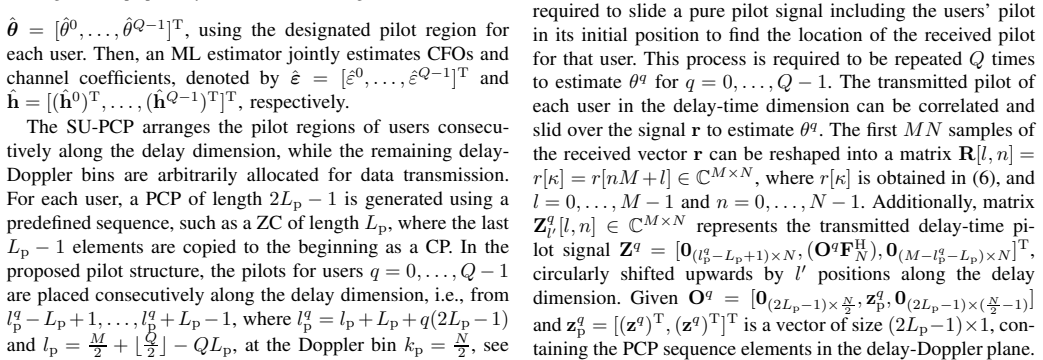
The machinery has four parts: the PCP pilot, a Zadoff-Chu sequence whose last $L_p-1$ samples are copied to form a cyclic prefix and give the pilot a periodic structure that survives sliding correlation; the timing metric $p_q[l']$ in (9)/(14); the derived threshold range in (20)-(21) that sits between the partial-alignment minor peak and the first full-alignment major peak; and the CPF-BEM expansion $h^q[\ell,\kappa]=\sum_{\gamma=0}^{\beta-1} B[\kappa',\gamma] c^q_\ell[\gamma]$ used to fold time variation into basis functions so the ML cost separates per user.
What would settle it
Compute the correlation values at the two positions $l'_a$ and $l'_b$ of Eq. (20) under a TDL-C channel with weak first tap and finite data-to-pilot power ratio; if the derived lower bound exceeds the upper bound, the threshold range is empty and the first-major-peak rule cannot be applied. An experiment where a fake data-induced peak above the threshold occurs before $l'_b$ would produce a discrete jump in TO error that falsifies the method's accuracy claim.
Extended reading notes
Core claim
The paper's central claim is that in an asynchronous uplink multiuser OTFS system over a linear time-varying channel, timing and frequency offsets should be estimated and corrected as separate stages before channel estimation, rather than absorbed into the channel. For timing, the received pilots are located by sliding a per-user cyclic-prefix pilot—built from a Zadoff-Chu sequence—and threshold-selecting the first major peak of the correlation function; the paper derives an interval for this threshold and reports that this first-peak rule lowers mean timing error by two orders of magnitude relative to choosing the maximum correlation peak. For frequency, the paper models the compound CFO-and-channel matrix and applies a Chebyshev-polynomial basis expansion model so that each user's CFO can be found by its own one-dimensional maximum-likelihood search, replacing a joint multidimensional search. The payoff stated by the paper is that separating CFO correction from channel estimation avoids an error floor and improves channel-estimation NMSE by up to 5 dB compared with absorbing CFO into the channel, while the proposed MU-PCP pilot keeps spectral efficiency high by letting all users share one pilot region.
Load-bearing premise
The whole timing-accuracy gain rests on the assumption that the first fully aligned half-sequence correlation peak is reliably taller than every partial-alignment and data-interference peak before it, so one threshold can separate them even in channels where the first tap is not the strongest.
Editorial extensions
If this is right
- Using the first major peak rather than the maximum peak reduces mean timing error by roughly two orders of magnitude in the simulated EVA channel, and this holds for both SU-PCP and MU-PCP.
- MU-PCP preserves spectral efficiency as the number of users grows, whereas SU-PCP with full guards degrades; the paper derives conditions on Doppler spread and channel length under which MU-PCP is the more efficient choice.
- Estimating and compensating CFOs before channel estimation avoids an NMSE error floor and yields gains up to about 5 dB over absorbing CFO into the channel estimate.
- The multidimensional ML CFO search becomes Q parallel one-dimensional searches, so complexity scales linearly with users instead of jointly.
- Both proposed TO methods work without closed-loop feedback to the mobile terminals, avoiding outdated TO estimates in the next uplink frame.
Reading between the lines
- A natural extension is to set the threshold per user from its power-delay profile rather than a single global range, since the paper's own TDL-C results show the first-peak margin shrinks when the first channel tap is weak.
- The same first-major-peak logic could be ported to downlink or sidelink OTFS and to non-orthogonal multiple access, where pilot regions overlap by design; the filter-bank separation in MU-PCP is a template for that.
- The 5 dB channel-estimation gain argues for a protocol change: reserve a short synchronization preamble before channel estimation even at some spectral cost, instead of always absorbing CFO into the channel.
- A testable prediction is that the threshold range in (20)-(21) becomes empty as the data-to-pilot power ratio $\sigma_s/\sigma_p$ grows; the estimator should then fail abruptly, not gracefully, unless the PCP power is boosted.
Editorial analysis
A structured set of objections, weighed in public.
Referee Report
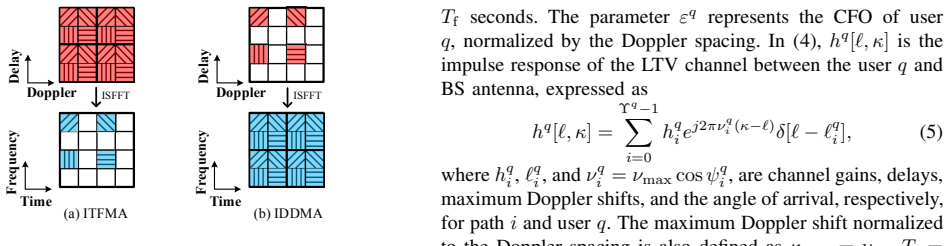
Summary. The paper addresses uplink synchronization for multiuser OTFS (MU-OTFS) in high-mobility scenarios. It derives a compound channel model that incorporates timing offsets (TOs) and carrier frequency offsets (CFOs) in the delay-Doppler domain, and then proposes two TO estimation techniques based on two pilot structures: SU-PCP, which assigns different ZC sequences to users in non-overlapping delay regions, and MU-PCP, which lets all users share a common pilot region and separates users with a bank of bandpass filters. The TO estimators use a correlation-based timing metric and detect the 'first major peak' via a threshold, for which a mathematical threshold range is derived in Section IV-C and Appendix B. After TO correction, a maximum-likelihood CFO estimator is developed using a Chebyshev-polynomial basis expansion model (CPF-BEM), reducing the multiuser CFO search to multiple one-dimensional searches. The paper also analyzes spectral efficiency and computational complexity, and presents simulations claiming a two-orders-of-magnitude TO accuracy improvement over maximum-peak detection and up to 5 dB channel-estimation NMSE gains over absorbing CFO into the channel.
Significance. If the claims hold, the paper makes a substantial contribution to an under-explored problem: open-loop synchronization for MU-OTFS uplink. The compound channel model, the two pilot structures, the filter-bank separation, and the CPF-BEM-based ML CFO estimator are coherent and practically motivated. The paper includes explicit complexity and spectral-efficiency analyses, and the simulation study covers both EVA and TDL-C channels. The central quantitative claim, however, is the two-orders-of-magnitude TO accuracy improvement of first-peak detection over max-peak detection, which rests on the threshold-range derivation. That derivation has a load-bearing gap concerning per-tap peak scaling, and the simulations do not disclose the exact threshold values used. These issues must be addressed before the main claim can be considered supported.
major comments (3)
- [Section IV-C and Appendix B, Eqs. (38)-(43)] The threshold range is derived using the factor sum_{ell=0}^{Lch-1} rho_ch[ell] = 1, effectively assuming that all channel taps contribute to the first major peak at l'_b = theta - Lp. However, the first major peak is created by the alignment of the two identical ZC halves for a specific received path; other delays have low ZC cross-correlation. Thus the peak amplitude scales with the power of the tap that creates that alignment, not with the total channel power. Under TDL-C, where the first tap is not the strongest, the intended first major peak can fall below the threshold while a later strong tap produces a peak above it, causing the estimator to lock to the later tap and incur a bias equal to that tap's delay. The derivation should condition on the tap that generates the first major peak, or the threshold range must be shown to hold on a per-tap basis.
- [Section VII, Fig. 10] The claimed 'two orders of magnitude' improvement of first-peak detection over maximum-peak detection is not verifiable from the information provided, because the simulation threshold T is not reported. The text states that thresholds are selected 'within the derived range,' but does not specify which values are used for each channel model (EVA, TDL-C), number of users, and SNR. Please provide the exact threshold values used, or a sensitivity plot of the mean TO error versus T, to confirm that the plotted curves correspond to thresholds inside the derived range.
- [Section IV-C, Eq. (21) and Fig. 12] The normalized threshold range in (21) is obtained by dividing by the expected full-alignment peak amplitude, (2Lp-1)/M * sigma_p^2. This normalization assumes that the full-alignment peak is the maximum of the timing metric. Under TDL-C, a later, stronger tap can produce a higher peak, so the normalized threshold mapping may no longer hold. In addition, the paper observes in Fig. 12 that increasing M narrows the threshold range, but it does not verify that the range in (20) is nonempty for the simulation parameters used (M=128, Lp=10, 16-QAM, with a finite sigma_s/sigma_p ratio). The authors should demonstrate, for the simulated scenarios, that the derived threshold interval is nonempty and that a single threshold in that interval yields the plotted first-peak performance.
minor comments (5)
- [Section IV-B] The phrase 'as shown in Appendix A of the revised manuscript' is a revision artifact and should be changed to refer to Appendix A of the current manuscript.
- [Table I and Eqs. (11)-(12)] The notation (.)_M is used in Eqs. (11) and (12) for the modulo-M operation, but the table entries for '( (·) )i' and '(·)i' are ambiguous; please clarify at the point of use that the subscript M denotes modulo M, not multiplication by M.
- [Fig. 10] The legend contains duplicate entries (e.g., 'MU-PCP: Q = 4 (TDL-C)' appears more than once); the legend should be cleaned up to avoid confusion.
- [Section IV-A, Eq. (12)] The channel mean delay lambda_q_ch is used in Eq. (12) but is not included in the notation table; please add a definition in the table or in the text.
- [Section VIII] The phrase 'for the first time in literature' is a strong claim that is not fully supported by the literature review; please soften or qualify it.
Circularity Check
No significant circularity: the TO threshold range and the CPF-BEM-based ML CFO estimator are derived from the stated system model, and the self-citations are contextual rather than load-bearing.
full rationale
The central derivations are self-contained. The TO timing metric in (14) and the threshold range in (20)-(21) follow from the received-signal model (4)-(7), the PCP/ZC pilot definitions, and the triangle-inequality bounds in Appendix B; the threshold range is not fitted to the simulation curves in Figs. 10-12. The CFO estimator (27)-(31) is a standard ML projection onto the CPF-BEM basis, with the channel coefficients treated as nuisance parameters; the reduction from a multidimensional search to parallel one-dimensional searches is obtained by the filter-bank separation in (13) and the per-user pilot extraction, not by assuming the answer. The paper's self-citations, e.g., [16], [17], and [27], supply pilot structures and single-user synchronization concepts, but the multiuser extension, the mathematical threshold derivation, and the CFO decomposition are developed in this manuscript. No step reduces to an imported uniqueness theorem or to a parameter fitted to the claimed output. The paper even concedes that under TDL-C or severely time-varying channels, fake peaks can appear, which is an honest limitation of the first-major-peak approach rather than a hidden circularity.
Assumptions & free parameters
free parameters (3)
- Threshold T =
not specified; derived range (21) gives 0.25 to 0.5 asymptotically
- Dominant Doppler spread factor alpha =
0.5
- CPF-BEM order beta =
1 to 12, dependent on kappa_max (beta >= ceil(2*kappa_max+1))
assumptions (4)
- domain assumption The LTV channel per user is accurately represented by CPF-BEM with beta >= ceil(2*kappa_max+1) basis functions, and the basis order is known at the receiver.
- domain assumption The PCP correlation produces a detectable first major peak at l'_b = theta - Lp, with a distinct minor peak at l'_a, and the threshold range (20) separates them under the operating channel.
- domain assumption All users are quasi-synchronous in time, with TOs bounded such that Lcp = max_q L_ch^q + theta_max - 1 suffices.
- domain assumption Distinct-root ZC sequences provide sufficient separability between users' pilots in SU-PCP; residual cross-correlation is treated as negligible.
Cite this review
Pith. "Pith review of Time and Frequency Synchronization for Multiuser OTFS in Uplink." pith.science (2026). https://pith.science/paper/XJN6FG7R
@misc{pith2026250717966,
  author       = {Pith},
  title        = {Pith review of: Time and Frequency Synchronization for Multiuser OTFS in Uplink},
  year         = {2026},
  howpublished = {\url{https://pith.science/paper/XJN6FG7R}},
  note         = {Machine review of arXiv:2507.17966}
}
read the original abstract
In this paper, we propose time and frequency synchronization techniques for uplink multiuser OTFS (MU-OTFS) systems in high-mobility scenarios. This work focuses on accurately estimating and correcting timing offsets (TOs) and carrier frequency offsets (CFOs). Specifically, TO estimation is essential for locating users' pilots on the delay-time plane, while CFO estimation enhances channel estimation accuracy. First, we propose a TO estimation technique for an existing multiuser pilot structure in MU-OTFS. We replace the impulse pilot (IMP) in this pilot structure with a more practical pilot with a cyclic prefix (PCP), referred to as single-user-inspired PCP (SU-PCP). This structure employs different Zadoff-Chu (ZC) sequences, which enables pilot separation via correlation at the receiver side. Consequently, we introduce a correlation-based TO estimation technique for uplink MU-OTFS using this pilot structure. Next, a spectrally efficient and practical pilot pattern is proposed, where each user transmits a PCP within a shared pilot region on the delay-Doppler plane, referred to as MU-PCP. At the receiver, the second TO estimation technique utilizes a bank of filters to separate different users' signals and accurately estimate their TOs. Then, we derive a mathematical threshold range to enhance TO estimation accuracy by finding the first major peak in the correlation function rather than relying solely on the highest peak. After locating the received users' pilot signals using one of the proposed TO estimation techniques, our proposed CFO estimation technique reduces the multi-dimensional maximum likelihood (ML) search problem into multiple one-dimensional search problems. In this technique, we apply the Chebyshev polynomials of the first kind basis expansion model (CPF-BEM) to effectively handle the time-variations of the channel in obtaining the CFO estimates for all the users.
Figures


Figures from the paper (10 more)



Reference graph
Works this paper leans on
-
[1]
Synchronization for m ultiuser uplink OTFS,
M. Bayat, S. P . S., and A. Farhang, “Synchronization for m ultiuser uplink OTFS,” in IEEE Wireless Commun. and Netw. Conf. , 2025, pp. 1–6
work page 2025
-
[2]
Jakes, Microwave Mobile Communications
W. Jakes, Microwave Mobile Communications. New Y ork, Wiley, 1974
work page 1974
-
[3]
Goldsmith, Wireless Communications
A. Goldsmith, Wireless Communications. Cambridge University Press, 2005
2005
-
[4]
Performan ce degradation of OFDM systems due to Doppler spreading,
T. Wang, J. Proakis, E. Masry, and J. Zeidler, “Performan ce degradation of OFDM systems due to Doppler spreading,” IEEE Trans. on Wireless Commun., vol. 5, no. 6, pp. 1422–1432, 2006
work page 2006
-
[5]
Orthogonal time-frequency space modulation: A p romising next-generation waveform,
Z. Wei, W. Y uan, S. Li, J. Y uan, G. Bharatula, R. Hadani, an d L. Hanzo, “Orthogonal time-frequency space modulation: A p romising next-generation waveform,” IEEE Wireless Commun., vol. 28, no. 4, pp. 136–144, 2021
work page 2021
-
[6]
Embedde d delay- Doppler channel estimation for orthogonal time frequency s pace modu- lation,
P . Raviteja, K. T. Phan, Y . Hong, and E. Viterbo, “Embedde d delay- Doppler channel estimation for orthogonal time frequency s pace modu- lation,” in IEEE V eh. Technol. Conf., 2018, pp. 1–5
work page 2018
-
[7]
Impact of timing and frequency offsets on multi carrier waveform candidates for 5G,
A. Aminjavaheri, A. Farhang, A. RezazadehReyhani, and B . Farhang- Boroujeny, “Impact of timing and frequency offsets on multi carrier waveform candidates for 5G,” in IEEE Signal Process. and Signal Process. Educ. W orkshop, 2015, pp. 178–183
work page 2015
-
[8]
S. S. Das, V . Rangamgari, S. Tiwari, and S. C. Mondal, “Tim e do- main channel estimation and equalization of CP-OTFS under m ultiple fractional Dopplers and residual synchronization errors, ” IEEE Access , vol. 9, pp. 10 561–10 576, 2021
work page 2021
Show all 33 references
-
[9]
Synchronizatio n techniques for orthogonal frequency division multiple access (OFDMA) : A tutorial review,
M. Morelli, C.-C. J. Kuo, and M.-O. Pun, “Synchronizatio n techniques for orthogonal frequency division multiple access (OFDMA) : A tutorial review,” Proc. of the IEEE , vol. 95, no. 7, pp. 1394–1427, 2007
2007
-
[10]
D own- link synchronization for OTFS-based cellular systems in hi gh Doppler environments,
M. S. Khan, Y . J. Kim, Q. Sultan, J. Joung, and Y . S. Cho, “D own- link synchronization for OTFS-based cellular systems in hi gh Doppler environments,” IEEE Access , vol. 9, pp. 73 575–73 589, 2021
2021
-
[11]
Primary synchronizat ion signal design and low-complexity detection for OTFS cellular syst ems,
M. S. Khan and A. K. Reddy Chavva, “Primary synchronizat ion signal design and low-complexity detection for OTFS cellular syst ems,” in IEEE Global Commun. Conf. , 2023, pp. 4122–4127
2023
-
[12]
Initial time syn chronization for OTFS,
C.-D. Chung, M.-Z. Xu, and W.-C. Chen, “Initial time syn chronization for OTFS,” IEEE Trans. on V eh. Technol., pp. 1–16, 2024
2024
-
[13]
Coarse initial t ime synchro- nization for OTFS,
M.-Z. Xu, C.-D. Chung, and W.-C. Chen, “Coarse initial t ime synchro- nization for OTFS,” in IEEE V eh. Technol. Conf., 2023, pp. 1–7
2023
-
[14]
Pilot- aided joint time synchronization and channel estimation fo r OTFS,
J. Sun, P . Y ang, X. Cao, Z. Xiong, H. Zhang, and T. Q. Quek, “Pilot- aided joint time synchronization and channel estimation fo r OTFS,” arXiv preprint arXiv:2408.04192 , 2024
2024 arXiv
-
[15]
Downlink carrier frequency offset estimation for OTFS-ba sed LEO satellite communication system,
S. Li, M. Zhang, C. Ju, D. Wang, W. Chen, P . Zhou, and D. Wan g, “Downlink carrier frequency offset estimation for OTFS-ba sed LEO satellite communication system,” IEEE Commun. Lett. , vol. 28, no. 1, pp. 163–167, 2024
2024
-
[16]
Time and frequency synchroniz ation for OTFS,
M. Bayat and A. Farhang, “Time and frequency synchroniz ation for OTFS,” IEEE Wireless Commun. Lett. , vol. 11, no. 12, pp. 2670–2674, 2022
2022
-
[17]
Practical synchroni zation for OTFS,
M. Bayat, S. P .S., and A. Farhang, “Practical synchroni zation for OTFS,” in IEEE Int. Conf. on Commun. , 2023, pp. 735–740
2023
-
[18]
Maximum-likelih ood syn- chronization and channel estimation for OFDMA uplink trans missions,
M.-O. Pun, M. Morelli, and C.-C. Kuo, “Maximum-likelih ood syn- chronization and channel estimation for OFDMA uplink trans missions,” IEEE Trans. on Commun. , vol. 54, no. 4, pp. 726–736, 2006
2006
-
[19]
Iterative dete ction and frequency synchronization for OFDMA uplink transmissions ,
M.-O. Pun, M. Morelli, and C.-C. J. Kuo, “Iterative dete ction and frequency synchronization for OFDMA uplink transmissions ,” IEEE Trans. on Wireless Commun. , vol. 6, no. 2, pp. 629–639, 2007
2007
-
[20]
OTFS based random access preamble transmission for high mo bility scenarios,
A. K. Sinha, S. K. Mohammed, P . Raviteja, Y . Hong, and E. V iterbo, “OTFS based random access preamble transmission for high mo bility scenarios,” IEEE Trans. on V eh. Technol. , vol. 69, no. 12, pp. 15 078– 15 094, 2020
2020
-
[21]
SC-FDMA as a delay-Doppler dom ain modulation technique,
A. Farhang and M. Bayat, “SC-FDMA as a delay-Doppler dom ain modulation technique,” in IEEE Int. Conf. on Commun. W orkshops , 2024, pp. 69–74
2024
-
[22]
Multiple access in an orthogo nal time frequency space communication system,
R. Hadani and S. S. Rakib, “Multiple access in an orthogo nal time frequency space communication system,” Oct. 2 2018, US Pate nt 10,090,973
2018
-
[23]
Interleaved time -frequency multiple access using OTFS modulation,
R. M. Augustine and A. Chockalingam, “Interleaved time -frequency multiple access using OTFS modulation,” in IEEE V eh. Technol. Conf., 2019, pp. 1–5
2019
-
[24]
OTFS-based multip le-access in high Doppler and delay spread wireless channels,
V . Khammammetti and S. K. Mohammed, “OTFS-based multip le-access in high Doppler and delay spread wireless channels,” IEEE Wireless Commun. Lett. , vol. 8, no. 2, pp. 528–531, 2019
2019
-
[25]
Spectral efficiency of OTFS based orthogonal multi ple access with rectangular pulses,
——, “Spectral efficiency of OTFS based orthogonal multi ple access with rectangular pulses,” IEEE Trans. on V eh. Technol., vol. 71, no. 12, pp. 12 989–13 006, 2022
2022
-
[26]
Performanc e analysis of multi-user OTFS, OTSM, and single carrier in uplink,
B. V . S. Reddy, C. V elampalli, and S. S. Das, “Performanc e analysis of multi-user OTFS, OTSM, and single carrier in uplink,” IEEE Trans. on Commun., vol. 72, no. 3, pp. 1428–1443, 2024
2024
-
[27]
A practical pilot for channel es timation of OTFS,
S. P . S. and A. Farhang, “A practical pilot for channel es timation of OTFS,” in IEEE Int. Conf. on Commun. , 2023, pp. 1319–1325
2023
-
[28]
Orthogonal time frequency spa ce modu- lation,
R. Hadani, S. Rakib, M. Tsatsanis, A. Monk, A. J. Goldsmi th, A. F. Molisch, and R. Calderbank, “Orthogonal time frequency spa ce modu- lation,” in IEEE Wireless Commun. and Netw. Conf. , 2017, pp. 1–6
2017
-
[29]
5G; system architecture for the 5G system (relea se 16),
3GPP , “5G; system architecture for the 5G system (relea se 16),” 3rd Generation Partnership Project (3GPP), TS 123.501 V16.6.0 , 2020
2020
-
[30]
Joint ML estimation of CFO an d channel, and a low complexity turbo equalization technique for high m obility OFDMA uplinks,
P . Muneer and S. M. Sameer, “Joint ML estimation of CFO an d channel, and a low complexity turbo equalization technique for high m obility OFDMA uplinks,” IEEE Trans. on Wireless Commun. , vol. 14, no. 7, pp. 3642–3654, 2015
2015
-
[31]
Evolved universal terrestrial radio access (E- UTRA); base station (BS) radio transmission and reception,
3GPP , “Evolved universal terrestrial radio access (E- UTRA); base station (BS) radio transmission and reception,” 3rd Generation Par tnership Project (3GPP), TS 36.104 V15.3.0, 2018
2018
-
[32]
LTE; 5G; study on channel model for frequency spect rum above 6 GHz (release 14),
——, “LTE; 5G; study on channel model for frequency spect rum above 6 GHz (release 14),” 3rd Generation Partnership Project (3G PP), TR 38.900 V14.2.0, 2017
2017
-
[33]
Spatial correl ation for general distributions of scatterers,
P . Teal, T. Abhayapala, and R. Kennedy, “Spatial correl ation for general distributions of scatterers,” IEEE Signal Process. Lett. , vol. 9, no. 10, pp. 305–308, 2002
2002
Reviewed August 6, 2026 · model on record in the stance chip above.
Discussion (0). Sign in to comment.