REVIEW 2 major objections 5 minor 2 cited by
Dimension and Order Bounds for Isometric Embeddings of Graphs into Abelian Cayley Graphs, and the Abelian Dividend
T0 review · 2 major / 5 minor · reviewed 2026-07-10 · grok-4.5
Pith's one-line read Most small graphs pack isometrically into strictly smaller non-binary abelian Cayley hosts than binary ones, while binary dimension is at least max(diameter, log n) and host order at least max(n, 2 diameter).
desk verdict Clean lower bounds, exact star and cycle results, and a certified n≤7 census that documents a real abelian compression phenomenon; the only open piece is isolated and flagged. read the letter →
The pith
A machine-rendered reading of the paper's core claim, the machinery that carries it, and where it could break.
The reading
What carries the argument
The geodesic-independence lemma (subset sums of a geodesic word in a binary Cayley graph are distinct) supplies the diameter half of the binary lower bound; the vertex-transitive diameter bound diam(H) ≤ ⌊|H|/2⌋ supplies the order lower bound; maximum sum-free sets in (Z/2Z)^k give the exact star dimension; and a certified search over Hermite-normal-form sublattice compactifications produces the abelian-dividend census.
What would settle it
Either find an odd cycle of length greater than 17 that embeds isometrically into a binary Cayley graph of dimension less than m-1, or exhibit a counter-example subset that violates the cyclic-interval lemma for some larger odd m.
Extended reading notes
Core claim
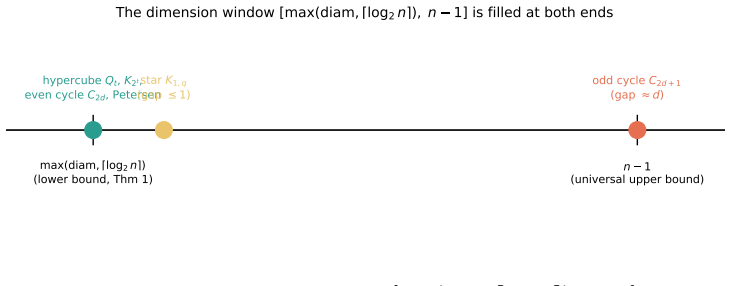
The paper establishes matching lower bounds on binary dimension and abelian host order for isometric embeddings of any connected graph, characterises when the host order equals n, computes exact binary dimensions for stars, cycles and other families that fill the entire dimension window, and documents via a certified census of all 995 connected graphs on 2 to 7 vertices that a majority admit a strictly smaller non-binary abelian host than their best binary host.
Load-bearing premise
The claim that every odd cycle needs the full naive binary dimension rests on a cyclic-interval lemma that is only proved for covering arcs and verified by computer for cycles of length at most 17.
Signed reviews
Editorial analysis
A structured set of objections, weighed in public.
Referee Report
Summary. The paper studies the minimal binary dimension k_min(G) and the minimal abelian host order ν(G) for isometric embeddings of a finite connected graph G into Cayley graphs of finite abelian groups. It proves the lower bounds k_min(G) ≥ max(diam(G), ⌈log_{2} n⌉) and ν(G) ≥ max(n, 2 diam(G)), and the characterization that ν(G) = n if and only if G itself is an abelian Cayley graph (Theorems 1–3). Exact binary dimensions are obtained for hypercubes, complete graphs of order 2^t, even cycles (all attaining the lower bound), stars (k_min(K_{1,q}) = ⌈log_{2} q⌉ + 1 via maximal sum-free sets in ℤ_{2}^k), and odd cycles (k_min(C_m) = m-1 for odd m ≤ 17, reduced in general to a cyclic-interval lemma). An exhaustive certified census of all 995 connected graphs on 2 ≤ n ≤ 7 vertices documents an “abelian dividend”: 57% admit a certified abelian host strictly smaller than the best binary host found, and 71% admit an optimal host with a cyclic factor ℤ_m, m > 2.
Significance. The lower bounds and the equality characterization (Theorems 1–3) are clean, self-contained, and fill a natural gap left by the classical partial-cube and Hamming-embedding literature. The star result gives a sharp exponential gap even for trees, correctly reducing to the classical maximal sum-free size 2^{k-1}. The census is a genuine contribution: every reported abelian host is certified by exact BFS distance checks, the methodology and its limitations (algorithmic upper bounds on both sides, restricted Hermite search) are stated honestly, and the direction of the dividend is therefore robust. The work supplies concrete, reproducible data that non-binary abelian hosts are typical rather than exceptional on small graphs, while binary hosts remain the universal construction. These strengths make the paper a solid addition to metric graph theory and abelian Cayley embeddings.
major comments (2)
- Section 4 / Lemma 3 / Conjecture 1: the exact claim k_min(C_m) = m-1 for all odd m rests on the cyclic-interval lemma, which is proved only in the covering-arc regime and verified by exhaustive search for m ≤ 17. The manuscript already isolates this as Conjecture 1 and does not use it for Theorems 1–3 or the census; the limitation should be kept explicit in the abstract and introduction so that the unconditional results are not overstated.
- Section 5.1: both sides of the dividend comparison are algorithmic upper bounds (binary pipeline vs. portfolio of certified abelian hosts). The paper correctly notes that every abelian win is a genuine isometric embedding, so the direction is robust, but the abstract and Figure 2 should state more prominently that the reported percentages are lower bounds on the true dividend rather than exact optima.
minor comments (5)
- Abstract vs. body: the abstract writes floor(log_{2} n) and 2^{diam(G)}; the body (Theorem 1, Theorem 2) correctly uses ⌈log_{2} n⌉ and 2 diam(G). Align the abstract with the theorems.
- Table 1: the Petersen entry claims k_min = 4 attained; a one-line reference or sketch of the embedding (or a pointer to the companion) would help the reader.
- Figure 1 caption and surrounding text: the window is written both as [max(diam, log_{2} n), n-1] and with ceilings; make the notation uniform with Theorem 1.
- Section 2.2, Lemma 2: the appeal to 2-connectivity of vertex-transitive graphs of degree ≥ 2 is standard; a precise citation to Godsil–Royle (already in the bibliography) would be cleaner than the parenthetical sketch.
- Data availability: the census records and runner scripts are said to be available from the authors; for a computational centerpiece of this kind, a public repository or permanent archive link would strengthen reproducibility.
Circularity Check
No significant circularity: lower bounds and exact dimensions are self-contained classical arguments; companion [35] supplies an independent constructive upper bound, not a fitted or definitional input.
full rationale
Theorems 1–3 rest on geodesic independence over F2 (Lemma 1), injectivity, and the classical diameter bound for vertex-transitive graphs (Lemma 2 via Menger); the equality characterization is a direct isomorphism argument. Exact dimensions for hypercubes, K_{2^t}, even cycles, and stars follow from these bounds plus the classical maximal sum-free density in Z_2^k (Rhemtulla–Street / Green–Ruzsa). The odd-cycle claim is reduced to a cyclic-interval lemma that is proved in one regime, exhaustively verified for m≤17, and honestly left as Conjecture 1 for the general case; it is not required for the strongest claims. The universal upper bound k_min≤n-1 and the embedding pipeline are cited from the companion [35], which is an independent constructive theorem (Smith-normal-form quotient labeling), not a parameter fitted to the present data. The census reports certified algorithmic upper bounds on both sides and already states its own caveats; the reported “abelian dividend” is therefore a computational observation, not a tautology. No step reduces a claimed prediction or first-principles result to its own inputs by construction.
Assumptions & free parameters
assumptions (4)
- standard math Every connected vertex-transitive graph on N>=3 vertices has diameter at most floor(N/2) (Lemma 2, citing Godsil-Royle).
- standard math The maximal size of a sum-free subset of Z_2^k is 2^{k-1}, attained by the odd-weight vectors (Rhemtulla-Street, Green-Ruzsa).
- domain assumption Every connected graph on n vertices embeds isometrically into the binary Cayley graph of dimension at most n-1 (companion [35]).
- ad hoc to paper Cyclic-interval lemma: for odd m and nonempty proper x subset Z_m there exists an arc W with |W Delta x| < min(|W|,m-|W|) (Lemma 3 / Conjecture 1).
invented entities (2)
-
abelian dividend
independent evidence
-
k_min(G) and nu(G)
independent evidence
Cite this review
Pith. "Pith review of Dimension and Order Bounds for Isometric Embeddings of Graphs into Abelian Cayley Graphs, and the Abelian Dividend." pith.science (2026). https://pith.science/paper/XKEJUDVI
@misc{pith2026260707939,
  author       = {Pith},
  title        = {Pith review of: Dimension and Order Bounds for Isometric Embeddings of Graphs into Abelian Cayley Graphs, and the Abelian Dividend},
  year         = {2026},
  howpublished = {\url{https://pith.science/paper/XKEJUDVI}},
  note         = {Machine review of arXiv:2607.07939}
}
read the original abstract
We investigate the minimum size of finite abelian Cayley graphs that admit an isometric embedding of a finite connected graph. While every connected graph on n vertices embeds isometrically into a binary Cayley graph of dimension at most n-1, the smallest possible abelian host has remained largely unexplored. We establish fundamental lower bounds showing that every binary host has dimension at least max(diam(G), floor(log2 n)), whereas every finite abelian host has order at least max(n, 2^diam(G)). Moreover, we prove that the minimum host order equals n if and only if G is itself an abelian Cayley graph. Exact binary dimensions are obtained for several important graph families. Hypercubes, complete graphs of order 2^k, and even cycles attain the lower bound. For stars we prove k_min(K1,q)=floor(log2 q)+1 using maximum sum-free sets, yielding an exponential improvement over the naive and isometric dimensions. For odd cycles we prove k_min(Cm)=m-1 for all m<17 and reduce the general case to a cyclic-interval lemma, showing that the universal upper bound is tight. Our computational contribution is a certified exhaustive census of all 995 connected graphs with 2<=n<=7 vertices under general abelian compactifications. The data reveal an "abelian dividend": 569 graphs (57 percent) admit a strictly smaller abelian host than the best binary host, 707 (71 percent) admit an optimal host containing a cyclic factor Zm with m>2, and only 17 graphs attain the theoretical order floor max(n,2^diam(G)). These results demonstrate that compact non-binary abelian hosts are typical rather than exceptional, while binary hosts remain the universal worst-case construction. 2020 MSC:05C12, 05C25, 05C30, 11B75, 20K01
Figures


Figures from the paper (2 more)


Forward citations
Cited by 2 Pith papers
-
Tight Wavelet Frames on Graphs via Isometric Group Embedding
A spectral band-pass wavelet construction on an isometric abelian-Cayley host gives exact tight-frame reconstruction for any graph signal, with a harmonic-extension completion rule.
-
Harmonic Analysis on Graphs via Isometric Group Embedding: A Canonical Fourier Transform, Shift, and Convolution for Network Signals
By embedding any network into a symmetric group graph, graph Fourier analysis becomes exact and translation-like, at the cost of host size.
Reference graph
Works this paper leans on
-
[1]
D. Ž. Djoković, Distance-preserving subgraphs of hypercubes, J. Com- bin. Theory Ser. B 14 (1973) 263–267
work page 1973
-
[2]
P. M. Winkler, Isometric embedding in products of complete graphs, Discrete Appl. Math. 7 (1984) 221–225
work page 1984
-
[3]
R. L. Graham, H. O. Pollak, On the addressing problem for loop switch- ing, Bell System Tech. J. 50 (1971) 2495–2519
work page 1971
-
[4]
P. M. Winkler, Proof of the squashed cube conjecture, Combinatorica 3 (1983) 135–139. 20
work page 1983
-
[5]
V. V. Firsov, Isometric embedding of a graph in a Boolean cube, Cy- bernetics 1 (1965) 112–113
work page 1965
-
[6]
R. L. Graham, P. M. Winkler, On isometric embeddings of graphs, Trans. Amer. Math. Soc. 288 (1985) 527–536
work page 1985
-
[7]
Wilkeit, Isometric embeddings in Hamming graphs, J
E. Wilkeit, Isometric embeddings in Hamming graphs, J. Combin. The- ory Ser. B 50 (1990) 179–197
work page 1990
-
[8]
F. Aurenhammer, J. Hagauer, Recognizing binary Hamming graphs in O(n2 logn)time, Math. Systems Theory 28 (1995) 387–395
work page 1995
Show all 38 references
-
[9]
Imrich, S
W. Imrich, S. Klavžar, On the complexity of recognizing Hamming graphs and related classes of graphs, European J. Combin. 17 (1996) 209–221
1996
-
[10]
Ovchinnikov, Partial cubes: structures, characterizations, and con- structions, Discrete Math
S. Ovchinnikov, Partial cubes: structures, characterizations, and con- structions, Discrete Math. 308 (2008) 5597–5621
2008
-
[11]
Eppstein, The lattice dimension of a graph, European J
D. Eppstein, The lattice dimension of a graph, European J. Combin. 26 (2005) 585–592
2005
-
[12]
Imrich, S
W. Imrich, S. Klavžar, Product Graphs: Structure and Recognition, Wiley, New York, 2000
2000
-
[13]
Hammack, W
R. Hammack, W. Imrich, S. Klavžar, Handbook of Product Graphs, 2nd ed., CRC Press, Boca Raton, 2011
2011
-
[14]
S. V. Shpectorov, On scale embeddings of graphs into hypercubes, Eu- ropean J. Combin. 14 (1993) 117–130. 21
1993
-
[15]
M. Deza, S. Shpectorov, Recognition of theℓ1-graphs with complexity O(nm), or football in a hypercube, European J. Combin. 17 (1996) 279– 289
1996
-
[16]
M. Deza, M. Laurent, Geometry of Cuts and Metrics, Springer, Berlin, 1997
1997
-
[17]
Laurent, Hypercube embedding of distances with few values, in: H
M. Laurent, Hypercube embedding of distances with few values, in: H. Barcelo, G. Kalai (Eds.), Jerusalem Combinatorics ’93, Contemp. Math. 178, Amer. Math. Soc., Providence, 1994, pp. 179–207
1994
-
[18]
Bandelt, V
H.-J. Bandelt, V. Chepoi, Metric graph theory and geometry: a survey, in: J. E. Goodman, J. Pach, R. Pollack (Eds.), Surveys on Discrete and Computational Geometry: Twenty Years Later, Contemp. Math. 453, Amer. Math. Soc., Providence, 2008, pp. 49–86
2008
-
[19]
Bandelt, Retracts of hypercubes, J
H.-J. Bandelt, Retracts of hypercubes, J. Graph Theory 8 (1984) 501– 510
1984
-
[20]
Bandelt, H
H.-J. Bandelt, H. M. Mulder, Distance-hereditary graphs, J. Combin. Theory Ser. B 41 (1986) 182–208
1986
-
[21]
J.Berleant, K.Sheridan, A.Condon, V.VassilevskaWilliams, M.Bathe, Isometric Hamming embeddings of weighted graphs, Discrete Appl. Math. 332 (2023) 119–128
2023
-
[22]
Sheridan, J
K. Sheridan, J. Berleant, M. Bathe, A. Condon, V. Vassilevska Williams, Factorization and pseudofactorization of weighted graphs, arXiv:2112.06990, 2021. 22
2021 arXiv
-
[23]
Ebrahimi Boroojeni, M
J. Ebrahimi Boroojeni, M. Oghbaei Bonab, Binary stretch embedding of weighted graphs, Des. Codes Cryptogr. 93 (2025) 2741–2760
2025
-
[24]
Green, I
B. Green, I. Z. Ruzsa, Sum-free sets in abelian groups, Israel J. Math. 147 (2005) 157–188
2005
-
[25]
A. H. Rhemtulla, A. P. Street, Maximal sum-free sets in finite abelian groups, Bull. Austral. Math. Soc. 2 (1970) 289–297
1970
-
[26]
R. P. Stanley, Smith normal form in combinatorics, arXiv:1602.00166, 2016
2016 arXiv
-
[27]
Godsil, G
C. Godsil, G. Royle, Algebraic Graph Theory, Graduate Texts in Math- ematics 207, Springer, New York, 2001
2001
-
[28]
B. D. McKay, C. E. Praeger, Vertex-transitive graphs which are not Cayley graphs, I, J. Austral. Math. Soc. Ser. A 56 (1994) 53–63
1994
-
[29]
R. C. Read, R. J. Wilson, An Atlas of Graphs, Clarendon Press, Oxford, 1998
1998
-
[30]
F. R. K. Chung, Spectral Graph Theory, CBMS Regional Conference Series in Mathematics 92, Amer. Math. Soc., Providence, 1997
1997
-
[31]
D. I. Shuman, S. K. Narang, P. Frossard, A. Ortega, P. Vandergheynst, The emerging field of signal processing on graphs: extending high- dimensional data analysis to networks and other irregular domains, IEEE Signal Process. Mag. 30 (3) (2013) 83–98
2013
-
[32]
Sandryhaila, J
A. Sandryhaila, J. M. F. Moura, Discrete signal processing on graphs, IEEE Trans. Signal Process. 61 (7) (2013) 1644–1656. 23
2013
-
[33]
Ortega, P
A. Ortega, P. Frossard, J. Kovačević, J. M. F. Moura, P. Vandergheynst, Graph signal processing: overview, challenges, and applications, Proc. IEEE 106 (5) (2018) 808–828
2018
-
[34]
D. K. Hammond, P. Vandergheynst, R. Gribonval, Wavelets on graphs via spectral graph theory, Appl. Comput. Harmon. Anal. 30 (2011) 129– 150
2011
-
[35]
Fokam Souop, L
R. Fokam Souop, L. Bitjoka, Minimal isometric embeddings of graphs intoCayleygraphsoffiniteabeliangroups, companionmanuscript, 2026
2026
-
[36]
Fokam Souop, L
R. Fokam Souop, L. Bitjoka, Group-embedding graph Fourier trans- forms: exact spectral analysis on abelian hosts, companion manuscript, submitted to IEEE Trans. Signal Inform. Process. Netw., 2026
2026
-
[37]
Signal Process., 2026
R.FokamSouop, L.Bitjoka, Tightwaveletframesfromisometricabelian embeddings, companion manuscript, submitted to IEEE Trans. Signal Process., 2026
2026
-
[38]
Fokam Souop, L
R. Fokam Souop, L. Bitjoka, Minimal Isometric Embeddings of Graphs into Abelian Groups: Theory, Algorithms, and Applications to Signal Processing over Networks, arXiv:2606.29391 [math.CO], 2026. 24
2026 arXiv
Reviewed July 10, 2026 · model on record in the stance chip above.
Discussion (0). Continue with ORCID to comment.