REVIEW 2 major objections 40 references
Gaussian kinetic representations of rarefied nonequilibrium flows
T0 review · 2 major / 0 minor · reviewed 2026-07-11 · grok-4.5
Pith's one-line read A log-density Gaussian model of shock velocity distributions recovers heat flux, stress, and higher moments without ever training on those moments.
desk verdict Solid M=3 log-density compression that really recovers transport moments; M=5 and cavity are thinner, novelty is incremental but the numbers are honest. read the letter →
The pith
A machine-rendered reading of the paper's core claim, the machinery that carries it, and where it could break.
The reading
What carries the argument
Positive log-density Gaussian mixture in joint space–velocity: log f̂ is a sum of Gaussians whose amplitudes, centers, and widths are optimized by a Huber loss on log f; moments are always recomputed by the same discrete-velocity quadrature as the reference, so fidelity is judged on kinetic observables rather than on stored low-order fields alone.
What would settle it
Train only on log f for the Mach-5 shock with the same diagonal mixture and full quadrature: if heat flux, stress, and third- and fourth-order deviations stay near the few-percent Mach-3 level rather than rising to the reported 7–8% moment-informed band, the claim holds; if they do not, pure log-density recovery fails at higher Mach.
Extended reading notes
Core claim
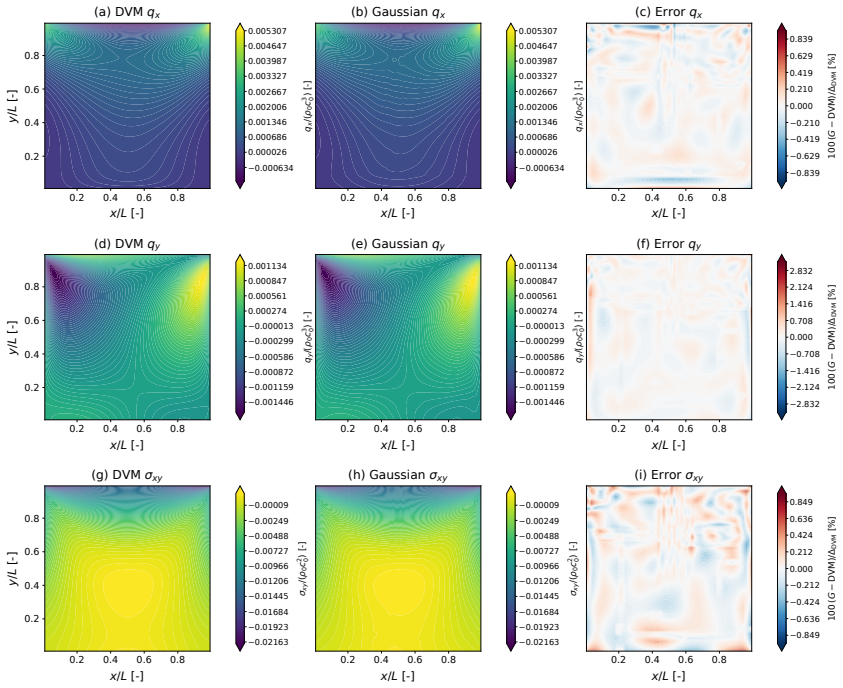
When a positive log-density Gaussian mixture is trained only on log f for DVM-Shakhov normal shocks, full-quadrature recovery of heat flux, stress, and third- and fourth-order streamwise moments follows without explicit moment supervision; a separate normalized Gaussian moment-field map then supplies a compact continuous representation of wall-bounded cavity transport.
Load-bearing premise
Fitting the log of the distribution with the chosen kernels and sampling is assumed to weight the high-speed tails well enough that heat flux and higher moments come out right—an assumption the paper already finds strained at Mach 5.
Editorial extensions
If this is right
- A converged DVM or DSMC state can be stored as a few thousand Gaussian parameters instead of a full phase-space array while still exposing heat flux and stress on demand.
- Compression quality for rarefied data should be scored on odd and high-order moments, not only on density and temperature.
- The same continuous representation supplies a differentiable, grid-independent diagnostic layer for wall heat flux and shear without re-running the kinetic solver.
- Kernel centers and widths become an interpretable map of where kinetic information is concentrated across a shock or cavity.
Reading between the lines
- If pure log-density recovery weakens systematically with Mach number, hybrid objectives that lightly regularize only the most fragile moments may be more reliable than either pure log f or noisy full-moment penalties.
- Extending the phase-space mixture to full wall-bounded VDFs would test whether positivity and realizability can be kept while still matching cavity heat flux and thermal stress.
- The same compression idea could serve as a storage or transfer layer between kinetic solvers and continuum closures that need consistent higher-moment input.
Editorial analysis
A structured set of objections, weighed in public.
Referee Report
Summary. The paper proposes compact Gaussian kinetic representations of rarefied nonequilibrium flows obtained from DVM–Shakhov reference solutions. For monatomic normal shocks (M = 3 and M = 5), a positive log-density Gaussian mixture in normalized phase space (Eq. 7) is trained primarily with a Huber loss on log f (Eq. 9); moments including heat flux, stress, and third- and fourth-order deviations are then recovered by the same truncated velocity quadrature used for the DVM reference (Eqs. 3–6). For a lid-driven cavity at Kn = 0.075, a separate normalized Gaussian moment-field map (Eq. 10) compresses a 20-channel wall-transport state. The strongest reported result is the M = 3 case with N = 512 diagonal kernels trained only on log f, which yields relative L2 errors of order 10^{-3} for ρ, ux, and T and about 2% for qx, σxx, Mneq300, and Mneq400 (Fig. 1). The M = 5 case is shown under a moment-informed loss with 7–8% nonequilibrium-moment errors (Fig. 2), and pure log-density M = 5 is deferred. Cavity compression–fidelity results are summarized in Table I and Figs. 3–4.
Significance. If the M = 3 log-density result generalizes, the work supplies a practical, storage-grid-independent compression layer for rarefied kinetic data that preserves transport-sensitive moments rather than only smooth macroscopic fields. That target is well motivated: heat flux, stress, and higher moments control wall loading and closure sensitivity, yet are often lost under field-only reduction. Strengths include deterministic DVM–Shakhov references free of DSMC noise, full-quadrature moment evaluation aligned with the reference, explicit disclosure that pure log-density M = 5 is deferred, and a clear distinction between the positive phase-space shock model and the non-realizable cavity moment-field map. The contribution is complementary to operator-learning surrogates and to prior Gaussian/GMM kinetic approximations; its value is as a compact, interrogable kinetic database layer rather than a replacement solver.
major comments (2)
- Abstract and opening claim that log-density training recovers heat flux, stress, and third- and fourth-order shock moments without explicit moment supervision. The manuscript fully supports this only for M = 3 (Fig. 1, N = 512, pure log f). For M = 5 the reported case uses a sampled moment-informed loss, nonequilibrium errors rise to 7–8% (Fig. 2), and pure log-density M = 5 is deferred to an extended article. The abstract-level claim should be scoped to the demonstrated M = 3 regime, or pure log-density M = 5 results (even if weaker) should be added so the high-Mach reach of the central claim is evidence-based rather than deferred.
- Weakest load-bearing assumption for the shock claim: that Huber log-density training with the chosen phase-space sampling and diagonal (or lightly correlated) kernels adequately weights high-velocity tails that dominate qx, Mneq300, and Mneq400. The paper already shows this assumption is strained at M = 5. A short, quantitative tail-weighting or sampling-density diagnostic (e.g., error stratified by |c| or by contribution to heat flux) would make the limit of the method falsifiable and would strengthen the M = 3 result by showing where capacity is actually spent.
Circularity Check
No significant circularity: moments are recomputed from a log-density fit by independent quadrature, not recovered by construction of the loss.
full rationale
The load-bearing M=3 claim is that a positive log-density Gaussian mixture (Eq. 7) trained only with Huber loss on log f (Eq. 9) yields, after full DVM-style quadrature of the trained ˆf (Eqs. 3–6), heat flux, stress, and third-/fourth-order moments within ~2% without moment supervision. That is an empirical fidelity test of the phase-space fit against an external DVM-Shakhov reference, not a definitional identity: the loss does not contain those moments, and evaluation uses the same truncated quadrature as the solver so comparison is aligned rather than tautological. The M=5 case that does use a sampled moment-informed loss is explicitly labeled as such and still reports 7–8% nonequilibrium errors, so even that weaker objective is not forced to zero. The cavity model (Eq. 10) is openly a non-realizable moment-field compressor, not a first-principles derivation. Self-citations (author’s related rarefied ML and cavity papers) supply complementary context and established benchmarks; none is a uniqueness theorem or ansatz that forces the present Gaussian construction. The paper is therefore self-contained against its DVM references, with no step that reduces the central claim to its inputs by construction.
Assumptions & free parameters
free parameters (5)
- N (number of Gaussian kernels) =
512 (shocks); 64/128/256/512 (cavity)
- Kernel centers, log-amplitudes, and widths (and optional x–ξx correlation r_m) =
learned per case (thousands of params)
- Huber threshold δ and log floor ε
- Optimizer and sampling hyperparameters (Adam, minibatches, width bounds)
- DVM velocity cutoffs and grids =
|ξ|max=16 (M=3), 22 (M=5); cavity [-5,5]^3
assumptions (4)
- domain assumption DVM-Shakhov solutions with Pr=2/3 and μ∝T^0.81 are adequate deterministic ground truth for judging kinetic-observable fidelity.
- ad hoc to paper A finite diagonal (or lightly correlated) Gaussian mixture in normalized phase space can approximate nonequilibrium shock VDFs well enough that truncated quadrature moments match the reference.
- ad hoc to paper For the cavity, a normalized Gaussian RBF map on physical space can represent the 20-channel moment vector without built-in realizability or conservation constraints.
- domain assumption Relative L2 or range-normalized field errors on selected moments are the right fidelity metrics for rarefied compression quality.
invented entities (2)
-
Positive log-density phase-space Gaussian kinetic representation for shocks
-
Gaussian moment-field wall-transport map for the cavity
Cite this review
Pith. "Pith review of Gaussian kinetic representations of rarefied nonequilibrium flows." pith.science (2026). https://pith.science/paper/XKV3DBJR
@misc{pith2026260705753,
  author       = {Pith},
  title        = {Pith review of: Gaussian kinetic representations of rarefied nonequilibrium flows},
  year         = {2026},
  howpublished = {\url{https://pith.science/paper/XKV3DBJR}},
  note         = {Machine review of arXiv:2607.05753}
}
read the original abstract
Compact representations of rarefied flows must preserve kinetic observables, not only smooth macroscopic fields. We introduce Gaussian kinetic representations for discrete velocity method (DVM)-Shakhov solutions of normal shocks and a lid-driven cavity. A positive log-density phase-space model reconstructs shock velocity distribution functions (VDFs) and their moments, while a moment-field model compresses wall-bounded cavity structure. Log-density training recovers heat flux, stress, and third- and fourth-order shock moments without explicit moment supervision; the cavity representation gives a compact continuous wall-transport map.
Figures


Figures from the paper (1 more)
Reference graph
Works this paper leans on
-
[1]
Bird, G. A. , title=
- [2]
-
[3]
Scanlon, T. J. and Roohi, E. and White, C. and Darbandi, M. and Reese, J. M. , title=. Comput. Fluids , volume=
-
[4]
Bhatnagar, P. L. and Gross, E. P. and Krook, M. , title=. Phys. Rev. , volume=
-
[5]
Shakhov, E. M. , title=. Fluid Dyn. , volume=
- [6]
- [7]
- [8]
Show all 40 references
-
[9]
and Roohi, E
Akhlaghi, H. and Roohi, E. and Stefanov, S. , title=. Phys. Rep. , volume=
-
[10]
Mott-Smith, H. M. , title=. Phys. Rev. , volume=
-
[11]
and Grandilli, A
Alekseenko, A. and Grandilli, A. and Wood, A. W. , title=. Results Appl. Math. , volume=
-
[13]
Shenoy, D. V. and Frankel, S. H. , title=. Comput. Fluids , volume=
-
[14]
and Jin, P
Lu, L. and Jin, P. and Pang, G. and Zhang, Z. and Karniadakis, G. E. , title=. Nat. Mach. Intell. , volume=
-
[15]
and Mahdavi, A
Roohi, E. and Mahdavi, A. , title=. Microfluid. Nanofluid. , volume=
-
[16]
and Shoja-Sani, A
Roohi, E. and Shoja-Sani, A. and Ebrahimzadeh Azghadi, F. , title=. Phys. Fluids , volume=
-
[17]
and Shoja-Sani, A
Roohi, E. and Shoja-Sani, A. and Stefanov, S. , title=. Phys. Fluids , volume=
-
[20]
and Roohi, E
Zhu, M. and Roohi, E. and Ebrahimi, A. , title=. Phys. Fluids , volume=
-
[21]
and Roohi, E
Rafieenasab, S. and Roohi, E. and Manela, A. , title=. Phys. Fluids , volume=
-
[22]
G. A. Bird, Molecular Gas Dynamics and the Direct Simulation of Gas Flows (Clarendon, Oxford, 1994)
1994
-
[23]
Cercignani, Rarefied Gas Dynamics: From Basic Concepts to Actual Calculations (Cambridge University Press, Cambridge, 2000)
C. Cercignani, Rarefied Gas Dynamics: From Basic Concepts to Actual Calculations (Cambridge University Press, Cambridge, 2000)
2000
-
[24]
Sone, Molecular Gas Dynamics: Theory, Techniques, and Applications (Birkh\"auser, Boston, 2007)
Y. Sone, Molecular Gas Dynamics: Theory, Techniques, and Applications (Birkh\"auser, Boston, 2007)
2007
-
[25]
T. J. Scanlon, E. Roohi, C. White, M. Darbandi, and J. M. Reese, ``An open source, parallel DSMC code for rarefied gas flows in arbitrary geometries,'' Comput. Fluids 39, 2078--2089 (2010)
-
[26]
P. L. Bhatnagar, E. P. Gross, and M. Krook, ``A model for collision processes in gases. I. Small amplitude processes in charged and neutral one-component systems,'' Phys. Rev. 94, 511--525 (1954)
1954
-
[27]
E. M. Shakhov, ``Generalization of the Krook kinetic relaxation equation,'' Fluid Dyn. 3, 95--96 (1968)
1968
-
[28]
Mieussens, ``Discrete-velocity models and numerical schemes for the Boltzmann-BGK equation in plane and axisymmetric geometries,'' J
L. Mieussens, ``Discrete-velocity models and numerical schemes for the Boltzmann-BGK equation in plane and axisymmetric geometries,'' J. Comput. Phys. 162, 429--466 (2000)
2000
-
[29]
Xu and J.-C
K. Xu and J.-C. Huang, ``A unified gas-kinetic scheme for continuum and rarefied flows,'' J. Comput. Phys. 229, 7747--7764 (2010)
2010
-
[30]
Roohi and S
E. Roohi and S. Stefanov, ``Collision partner selection schemes in DSMC: From micro/nano flows to hypersonic flows,'' Phys. Rep. 656, 1--38 (2016)
2016
-
[31]
Akhlaghi, E
H. Akhlaghi, E. Roohi, and S. Stefanov, ``A comprehensive review on micro- and nano-scale gas flow effects: Slip-jump phenomena, Knudsen paradox, thermally-driven flows, and Knudsen pumps,'' Phys. Rep. 997, 1--60 (2023)
2023
-
[32]
H. M. Mott-Smith, ``The solution of the Boltzmann equation for a shock wave,'' Phys. Rev. 82, 885--892 (1951)
1951
-
[33]
Alekseenko, A
A. Alekseenko, A. Grandilli, and A. W. Wood, ``An ultra-sparse approximation of kinetic solutions to spatially homogeneous flows of non-continuum gas,'' Results Appl. Math. 5, 100085 (2020)
2020
-
[34]
A. Hu, L. Pennati, I. Peng, and S. Markidis, ``Physics-aware compression of plasma distribution functions with GPU-accelerated Gaussian mixture models,'' arXiv:2504.14897 (2025)
2025 arXiv
-
[35]
D. V. Shenoy and S. H. Frankel, ``Gaussian field representations for turbulent flow: Compression, scale separation, and physical fidelity,'' Comput. Fluids 318, 107202 (2026)
2026
-
[36]
L. Lu, P. Jin, G. Pang, Z. Zhang, and G. E. Karniadakis, ``Learning nonlinear operators via DeepONet based on the universal approximation theorem of operators,'' Nat. Mach. Intell. 3, 218--229 (2021)
2021
-
[37]
Roohi and A
E. Roohi and A. Mahdavi, ``Analysis of the rarefied flow at micro-step using a DeepONet surrogate model with a physics-guided zonal loss function,'' Microfluid. Nanofluid. 30, 44 (2026)
2026
-
[38]
Roohi, A
E. Roohi, A. Shoja-Sani, and F. Ebrahimzadeh Azghadi, ``Neural networks for rarefied gas dynamics: Relaxation problem, polyatomic shock waves, and hypersonic cylinder flow,'' Phys. Fluids 38, 057108 (2026)
2026
-
[39]
Roohi, A
E. Roohi, A. Shoja-Sani, and S. Stefanov, ``Physics constrained neural collision operators for variable hard sphere surrogates and ab initio angle prediction in direct simulation Monte Carlo (DSMC),'' Phys. Fluids 38, 057123 (2026)
2026
-
[40]
Mahdavi and E
A. Mahdavi and E. Roohi, ``Prescribed wall-heat-flux control of blockage and impulse in a rarefied micro-nozzle,'' arXiv:2605.19286 (2026)
2026 arXiv
-
[41]
Roohi and A
E. Roohi and A. Mahdavi, ``Shock-centered low-rank structure and neural-operator representation of rarefied micro-nozzle flows,'' arXiv:2605.12723 (2026)
2026 arXiv
-
[42]
M. Zhu, E. Roohi, and A. Ebrahimi, ``Computational study of rarefied gas flow and heat transfer in lid-driven cylindrical cavities,'' Phys. Fluids 35, 052012 (2023)
2023
-
[43]
Rafieenasab, E
S. Rafieenasab, E. Roohi, and A. Manela, ``Thermal edge animation in a two-dimensional micro-cavity: Effect of nonuniform boundary smoothness in the entire range of gas rarefaction rates,'' Phys. Fluids 38, 022013 (2026)
2026
Reviewed July 11, 2026 · model on record in the stance chip above.
Discussion (0). Sign in to comment.