REVIEW 2 major objections 4 minor 2 cited by
The effect of fluctuating fuzzy axion haloes on stellar dynamics: a stochastic model
T0 review · 2 major / 4 minor · reviewed 2026-08-14 · deepseek-v4-flash
Pith's one-line read The paper predicts that fuzzy dark matter axions lighter than about $2\times10^{-22}$ eV would overheat the Milky Way disk, placing a lower bound on the axion mass from galactic dynamics.
desk verdict A careful stochastic re-derivation of FDM diffusion that recovers Bar-Or et al., with a real but order-unity approximation in the white-noise step and a disk bound worth taking seriously but not paradigm-shifting. read the letter →
The pith
A machine-rendered reading of the paper's core claim, the machinery that carries it, and where it could break.
The reading
What carries the argument
The load-bearing machinery is the sweeping ansatz from turbulence theory, extended so that each Fourier mode of the density fluctuation is advected by a velocity tied to its wavenumber through the Schrödinger dispersion relation. Mass conservation forces $\rho_k(t)=\rho_k(0)e^{-ik\cdot vt}$; for a free axion field the wavefunction evolves with $\omega=\hbar k^2/2m$, so a mode's phase velocity is $\hbar k/2m$ while the group velocity is $\hbar k/m$. With wavefunction modes drawn from a complex Gaussian random field, this yields a two-time density power spectrum, then a force correlation function, and finally, in the diffusion limit, the effective mass $m_{\rm eff}=8\pi^{3/2}\rho_0/(m_\hbar^3\sigma^3)$ and effective distribution $f_{\rm eff}\propto f^2$. A Coulomb logarithm $\Lambda=v_{dx}/v_{dm}$ sets the range of white-noise modes contributing to heating; the paper evaluates $\ln\Lambda\simeq 3.6$ at the solar neighbourhood.
What would settle it
A self-consistent simulation of a Milky Way-like stellar disk in a fuzzy dark matter halo with $m<2\times10^{-22}$ eV could test the predicted heating rate $\sigma_R\simeq 4.5\,\mathrm{km\,s^{-1}}\,(10^{-22}\,\mathrm{eV}/m)^{3/2}(8\,\mathrm{kpc}/r)^2(T/10\,\mathrm{Gyr})^{1/2}\sqrt{\ln\Lambda}$; if the measured growth is much slower, the constraint fails. A measurement of the density power spectrum on scales larger than the de Broglie wavelength that is not white noise would also break the quasi-particle equivalence at the core of the argument.
Extended reading notes
Core claim
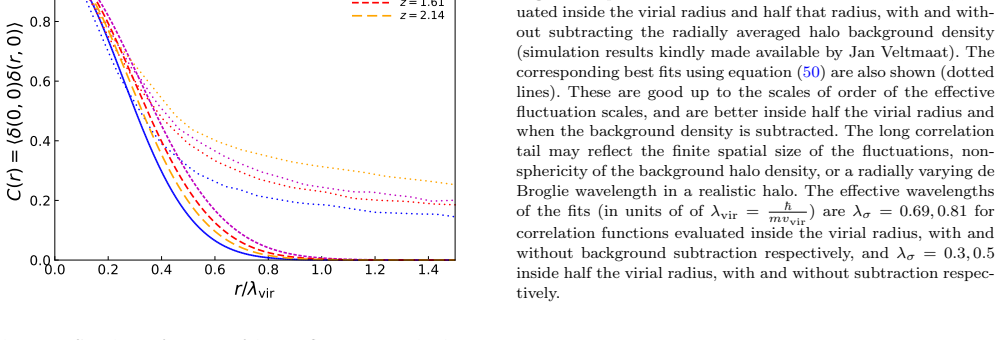
The paper's central claim is that the gravitational effect of fuzzy dark matter fluctuations on a classical test particle is equivalent, in the diffusion limit, to relaxation by classical quasi-particles of mass $m_{\rm eff}$ and velocity distribution $f_{\rm eff}$, defined through integrals of the squared axion velocity distribution. The equivalence holds because the axion density field, treated as a stationary Gaussian random field under the Jeans-Chandrasekhar swindle, has a white-noise spatial power spectrum on scales larger than the de Broglie wavelength and a cutoff on smaller scales, while the quantum dispersion relation fixes the sweeping velocity of each mode. The resulting density power spectra and correlation functions match published numerical simulations outside the solitonic core. The paper then uses the equivalence to compute disk heating: the vertical and radial velocity dispersions grow as $\sigma_z\simeq 2.4\,\mathrm{km\,s^{-1}}\,(10^{-22}\,\mathrm{eV}/m)^{3/2}(8\,\mathrm{kpc}/r)^2(T/10\,\mathrm{Gyr})^{1/2}\sqrt{\ln\Lambda}$ and $\sigma_R=\sigma_z/0.53$. Because this diffusive growth is $\sim t^{1/2}$ while the observed radial dispersion grows as $\sim t^{1/3}$, the FDM contribution must be small, and requiring it to lie within the observational scatter gives $m\gtrsim 2\times10^{-22}\,\mathrm{eV}$.
Load-bearing premise
The derivation assumes the axion field is free and statistically homogeneous, neglecting the self-gravity of the density fluctuations, so the de Broglie wavelength must be much shorter than the Jeans length (effectively the system size); if that fails, the diffusion picture and the disk constraint do not apply.
Editorial extensions
If this is right
- If $m\lesssim 2\times10^{-22}\,\mathrm{eV}$, fuzzy dark matter fluctuations alone would heat the solar-neighbourhood radial velocity dispersion beyond the scatter of the observed age-velocity relation, so such masses are disfavoured by disk dynamics.
- The predicted disk heating scales as $r^{-4}m^{-3}$ and is independent of the circular speed, so the constraint is strongest at small galactocentric radii and for light axions.
- Because the model predicts $\sigma_R\sim t^{1/2}$ whereas the observed radial dispersion grows roughly as $t^{1/3}$, fuzzy dark matter fluctuations cannot be the dominant source of disk thickening unless the observed relation is wrong.
- Attributing all vertical heating to fuzzy dark matter gives only the weaker constraint $m\gtrsim 0.3\times10^{-22}\,\mathrm{eV}$, showing that the radial age-velocity relation carries most of the constraining power.
- For Eridanus II, the model reproduces a strong constraint around $m\gtrsim 8.8\times10^{-20}\,\mathrm{eV}$ under the same assumptions as the earlier cluster-expansion analysis, but the limitation that the cluster lies inside the solitonic core for smaller masses keeps the excluded range narrow.
Reading between the lines
- If the white-noise equivalence holds, the same effective-mass diffusion coefficients should apply to any classical tracer, so combining stellar streams, globular clusters, and satellite dwarf galaxies could sharpen the lower bound on $m$ beyond the disk alone.
- A testable extension is to include the disk's self-gravitating response; if that response amplifies stochastic forcing the way halo breathing modes do in the gaseous case, the effective heating could be larger than computed, strengthening the bound.
- The long spatial correlation tail seen in some simulated haloes could indicate large-scale coherence beyond the de Broglie wavelength; if real, that would enhance low-frequency forcing and could push the disk constraint to higher masses.
- For Eridanus II at $m\sim10^{-20}\,\mathrm{eV}$, the effective axion granule mass exceeds the cluster mass, so the cluster should be kicked as a whole rather than heated internally; measuring its centre-of-mass offset from the galaxy centre could constrain low masses, a possibility the authors note is beyond this paper's scope.
Signed reviews
Editorial analysis
A structured set of objections, weighed in public.
Referee Report
Summary. The paper develops a stochastic model for the dynamical effect of density fluctuations in fuzzy dark matter (FDM) haloes on classical test particles. It first generalizes the sweeping ansatz of El-Zant et al. (2016) to a distribution of mode velocities, showing that white-noise density fluctuations in a classical particle system reproduce the standard two-body relaxation time. It then applies the same framework to a free Schrödinger field with Gaussian random modes, deriving the equal-time power spectrum, two-time correlation function, and force correlation function of the density fluctuations. In the diffusion limit, the FDM force fluctuations are argued to be equivalent to those of classical quasi-particles with effective mass m_eff and effective distribution f_eff, recovering the diffusion coefficients of Bar-Or et al. (2019). The model's power spectra and correlation functions are compared with Chan et al. and Veltmaat et al. simulations, a Coulomb logarithm is evaluated, and the model is applied to disk heating in the Milky Way, yielding a nominal constraint m ≳ 2×10^-22 eV, and to Eridanus II, confirming a stronger but restricted constraint. The central mathematical steps in Sections 2 and 3 are internally consistent, but the quantitative accuracy of a key approximation in going from Eq. (40) to Eq. (43) is not demonstrated.
Significance. If the central derivation holds, the paper provides an independent and conceptually transparent route to the FDM diffusion coefficients previously derived by Bar-Or et al. (2019), and it makes a concrete, falsifiable prediction for the axion mass from disk heating. The analytic treatment of the force correlation function and the explicit connection between the quantum interference spectrum and classical relaxation are valuable. The comparisons to published simulations support the shape of the density-fluctuation spectrum, and the paper is honest about the limitations of the Eridanus II application. However, the headline mass bound is not parameter-free: it depends on an arbitrary tolerable radial-velocity-dispersion threshold, and the derivation of the diffusion coefficient relies on an approximation whose accuracy is not quantified. These issues affect the central astrophysical claim and need to be addressed before the result can be considered robust.
major comments (2)
- [Section 3.1, Eqs. (40)–(43)] The replacement f(v1)f(v2) ≈ f^2(vc) in going from Eq. (40) to Eq. (41) is not quantitatively justified for a Maxwellian distribution. The exact product is f^2(vc) exp(-vd^2/σ^2), and the Gaussian cutoff is not negligible over the range that contributes to the Coulomb logarithm. With the Appendix E parameters, vdx is several σ while vdm ≈ 0.16σ, so the contribution to lnΛ from vd ≳ σ is comparable to the full lnΛ ≈ 3.6. The diffusion coefficient in Eq. (43) is therefore overestimated by an order-unity factor, and the mass bound in Section 4.2 shifts correspondingly. Because the same white-noise approximation is used in Appendix E to define both m_eff and Λ, this is not a small correction absorbed into lnΛ. I recommend that the authors evaluate the time-integrated form of Eq. (40) numerically for a Maxwellian f and report the resulting diffusion coefficient and constraint on m.
- [Section 4.2, Eqs. (71)–(72)] The headline constraint m ≳ 2×10^-22 eV rests on the judgement that FDM-induced radial heating cannot exceed the observational scatter of roughly 3 km/s in the Mackereth et al. age–velocity data, and that any significant t^{1/2} component would have been detected. Since the predicted σ_R scales as m^{-3/2}, the derived mass bound scales approximately as (3 km/s / σ_R)^{2/3}; choosing σ_R = 1 or 5 km/s changes the bound by a factor of about four. The paper should state this sensitivity explicitly and ideally fit a model with an FDM t^{1/2} component plus the observed secular and formation contributions, rather than impose a hard cap at the data scatter.
minor comments (4)
- [Section 4.1, before Eq. (66)] The sentence preceding Eq. (66) contains a duplicated 'for for'; please correct the typo.
- [Appendix E, Eq. (E3)] The text says 'we therefore just set Tp = vcirc/2πR', which is dimensionally a frequency, not a period. The subsequent derivation appears to use the period 2πR/vcirc, so the text should be corrected to avoid confusion.
- [Section 3.2, Figs. 1–3] The comparisons to simulations are shape-only: the Chan et al. power spectra are arbitrarily normalized, and the Veltmaat et al. correlation functions are normalized by construction, since Eq. (50) gives ⟨δ²(0,0)⟩ = 1. The text should state clearly that these fits do not test the absolute amplitude that enters the force fluctuations and the diffusion coefficient.
- [Appendix E, Eq. (E1)] The derivation of λmin from m_eff = (4π/3)ρ0 λmin^3 would benefit from showing the intermediate algebra, since the factor (3/4)^{1/3}π^{1/6} is otherwise not immediately traceable to Eq. (59).
Circularity Check
No significant circularity: the FDM diffusion derivation is an explicit calculation from stated assumptions, benchmarked against external simulations and Bar-Or et al. (2019).
full rationale
The central result, Eq. (43), is obtained by explicit computation: Eq. (37) gives the Gaussian-random-field density power spectrum from the free Schroedinger dispersion relation; Eq. (40) gives the force correlation; Eq. (41) takes the stated vd << vc white-noise limit; and the diffusion limit then gives Eq. (43). Each step is a stated approximation, not an identity with the output. The effective mass in Eq. (45) is defined to express Eq. (43) in the classical relaxation form, so the 'quasi-particle' mapping is a bookkeeping device, not a fitted parameter. The model is tested against Chan et al. (2018) power spectra and Veltmaat et al. (2018) correlation functions, and the diffusion coefficients reproduce the independent Bar-Or et al. (2019) result. Self-citations to El-Zant et al. (2016) supply the sweeping ansatz, but the present paper re-derives the relevant equations rather than importing an unverified theorem. The paper also states its own validity limits, including the requirement that the de Broglie wavelength be much smaller than the Jeans length, the strict validity outside solitonic cores, and the Eridanus II caveats, so the load-bearing assumptions are transparent. The Eq. (40) to Eq. (41) approximation and the Appendix E Coulomb-logarithm calibration are accuracy and modeling concerns, not circular reductions.
Assumptions & free parameters
free parameters (4)
- Power-spectrum width and normalization in fits to Chan et al. simulations =
not quoted; least-squares fits in Fig. 1
- Effective correlation wavelength lambda_sigma in fits to Veltmaat et al. correlation functions =
0.3 to 0.81 lambda_vir depending on radial bin and background subtraction
- Coulomb logarithm argument lambda =
lambda = 36.9 for solar neighborhood parameters; lambda = 3.57 for Eridanus II
- Tolerable FDM-induced radial velocity dispersion sigma_R =
approximately 3 km/s
assumptions (7)
- domain assumption Jeans-Chandrasekhar swindle: the potential affecting the test particle comes only from fluctuations around a subtracted mean field, and the self-gravity of the fluctuations is neglected.
- domain assumption The axion wavefunction modes phi_k form a complex Gaussian random field with ensemble averages <phi_k> = 0 and <phi_k phi*_k'> = f_k(k) delta(k-k').
- domain assumption The FDM axion velocity distribution is Maxwellian and the halo is isothermal with rho_0 proportional to 1/r^2 outside the solitonic core.
- domain assumption The long-wavelength white-noise approximation that replaces f(v1) f(v2) with f^2(v_c) when passing from Eq. (40) to Eq. (41).
- domain assumption The diffusion limit applies only to fluctuations whose timescales are shorter than the test particle's orbital period, fixing the maximal wavelength in Appendix E.
- domain assumption The disk response is modeled with a vertical virial relation E_z = 1.5 sigma_z^2, and the self-gravitating response of the disk is neglected.
- domain assumption For Eridanus II, the cluster expands in virial equilibrium while preserving a cored Sersic profile with alpha = 0.4 and beta = 10, with all fluctuation energy going into expansion.
invented entities (1)
-
Effective quasi-particles of mass m_eff and distribution f_eff
Cite this review
Pith. "Pith review of The effect of fluctuating fuzzy axion haloes on stellar dynamics: a stochastic model." pith.science (2026). https://pith.science/paper/XL2QUMZP
@misc{pith2026190809061,
  author       = {Pith},
  title        = {Pith review of: The effect of fluctuating fuzzy axion haloes on stellar dynamics: a stochastic model},
  year         = {2026},
  howpublished = {\url{https://pith.science/paper/XL2QUMZP}},
  note         = {Machine review of arXiv:1908.09061}
}
abstract
Fuzzy dark matter of ultra-light axions has gained attention, largely in light of the galactic scale problems associated with cold dark matter. But the large de Broglie wavelength, believed to possibly alleviate these problems, also leads to fluctuations that place constraints on ultra-light axions. We adapt and extend a method, previously devised to describe the effect of gaseous fluctuations on cold dark matter cusps, in order to determine the imprints of ultra-light axion haloes on the motion of classical test particles. We first evaluate the effect of fluctuations in a statistically homogeneous medium of classical particles, then in a similar system of ultra light axions. In the first case, one recovers the classical two body relaxation time (and diffusion coefficients) from white noise density fluctuations. In the second situation, the fluctuations are not born of discreteness noise but from the finite de Broglie wavelength; correlation therefore exists over this scale, while white noise is retained on larger scales, elucidating the correspondence with classical relaxation. The resulting density power spectra and correlation functions are compared with those inferred from numerical simulations, and the relaxation time arising from the associated potential fluctuations is evaluated. We then apply our results to estimate the heating of disks embedded in axion dark haloes. We find that this implies an axion mass $m \ga 2 \times 10^{-22} {\rm eV}$. We finally apply our model to the case of the central cluster of Eridanus II, confirming that far stronger constraints on $m$ may in principle be obtained, and discussing the limitations associated with the assumptions leading to these.
Figures


Forward citations
Cited by 2 Pith papers
-
Fuzzy Axions and Associated Relics
In explicit string theory compactifications, fuzzy axion dark matter is rare and typically requires fine-tuning of initial axion displacements or a non-standard reheating epoch to avoid overproducing heavier axions.
-
Lensed fast radio bursts as a probe of time-varying gravitational potential induced by wave dark matter
Wave dark matter halo fluctuations would stretch lensed FRB signals by about 10^-10, a drift that one year of monitoring lensed repeating bursts could detect.
Reference graph
Works this paper leans on
-
[1]
C., Loeb A., 2018, arXiv e-prints, p
Amorisco N. C., Loeb A., 2018, arXiv e-prints, p. arXiv:1808.00464
arXiv 2018
-
[2]
S., 2018, @doi [European Physical Journal C] 10.1140/epjc/s10052-018-5662-y , 78, 203
Arcadi G., Dutra M., Ghosh P., Lindner M., Mambrini Y., Pierre M., Profumo S., Queiroz F. S., 2018, @doi [European Physical Journal C] 10.1140/epjc/s10052-018-5662-y , 78, 203
-
[3]
Bar-Or B., Fouvry J.-B., Tremaine S., 2019, @doi [ ] 10.3847/1538-4357/aaf28c , 871, 28
-
[4]
Bar N., Blum K., Lacroix T., Panci P., 2019, arXiv e-prints, p. arXiv:1905.11745
arXiv 2019
-
[5]
Binney J., Tremaine S., 2008, Galactic dynamics
2008
-
[6]
P., Turok N., 2001, @doi [ ] 10.1086/321541 , 556, 93
Bode P., Ostriker J. P., Turok N., 2001, @doi [ ] 10.1086/321541 , 556, 93
doi:10.1086/321541 2001
-
[7]
Bottema R., 1993, , 275, 16
1993
-
[8]
G., Martig M., 2009, @doi [ ] 10.1088/0004-637X/707/1/L1 , 707, L1
Bournaud F., Elmegreen B. G., Martig M., 2009, @doi [ ] 10.1088/0004-637X/707/1/L1 , 707, L1
Show all 98 references
-
[9]
Boveia A., Doglioni C., 2018, @doi [Annual Review of Nuclear and Particle Science] 10.1146/annurev-nucl-101917-021008 , 68, annurev
2018 doi
-
[10]
D., 2016, @doi [ ] 10.3847/2041-8205/824/2/L31 , 824, L31
Brandt T. D., 2016, @doi [ ] 10.3847/2041-8205/824/2/L31 , 824, L31
2016 doi
-
[11]
S., Boylan-Kolchin M., 2017, @doi [Annual Review of Astronomy and Astrophysics] 10.1146/annurev-astro-091916-055313 , 55, 343
Bullock J. S., Boylan-Kolchin M., 2017, @doi [Annual Review of Astronomy and Astrophysics] 10.1146/annurev-astro-091916-055313 , 55, 343
2017 doi
-
[12]
Burkert A., 2000, @doi [ ] 10.1086/312674 , 534, L143
2000 doi
-
[13]
Chan J. H. H., Schive H.-Y., Woo T.-P., Chiueh T., 2018, @doi [ ] 10.1093/mnras/sty900 , 478, 2686
2018 doi
-
[14]
Chavanis P.-H., 2011, @doi [ ] 10.1103/PhysRevD.84.043531 , 84, 043531
2011 doi
-
[15]
Chavanis P.-H., 2012, @doi [Physica A Statistical Mechanics and its Applications] 10.1016/j.physa.2012.02.019 , 391, 3680
2012 doi
-
[16]
H., 2013, @doi [ ] 10.1051/0004-6361/201220607 , 556, A93
Chavanis P. H., 2013, @doi [ ] 10.1051/0004-6361/201220607 , 556, A93
2013 doi
-
[17]
Chavanis P.-H., 2018, arXiv e-prints
2018
-
[18]
V., Ostriker J
Church B. V., Ostriker J. P., Mocz P., 2018, arXiv e-prints, p. arXiv:1809.04744
2018 arXiv
-
[19]
69, Dynamics of the Solar Systems
Cohen L., 1975, in Hayli A., ed., IAU Symposium Vol. 69, Dynamics of the Solar Systems. p. 33
1975
-
[20]
R., Dehnen W., Wilkinson M
Cole D. R., Dehnen W., Wilkinson M. I., 2011, @doi [ ] 10.1111/j.1365-2966.2011.19110.x , 416, 1118
2011
-
[21]
Col \' n P., Avila-Reese V., Valenzuela O., 2000, @doi [ ] 10.1086/317057 , 542, 622
2000 doi
-
[22]
J., Zaritsky D., Spekkens K., Willman B., Hargis J
Crnojevi \'c D., Sand D. J., Zaritsky D., Spekkens K., Willman B., Hargis J. R., 2016, @doi [ ] 10.3847/2041-8205/824/1/L14 , 824, L14
2016 doi
- [23]
-
[24]
B., 2019, arXiv e-prints, p
Davoudiasl H., Denton P. B., 2019, arXiv e-prints, p. arXiv:1904.09242
2019 arXiv
-
[25]
Del Popolo A., Le Delliou M., 2017, @doi [Galaxies] 10.3390/galaxies5010017 , 5, 17
2017 doi
-
[26]
Del Popolo A., Lima J. A. S., Fabris J. C., Rodrigues D. C., 2014, @doi [ ] 10.1088/1475-7516/2014/04/021 , 4, 21
2014 doi
-
[27]
P., Namjoo M
Deng H., Hertzberg M. P., Namjoo M. H., Masoumi A., 2018, @doi [ ] 10.1103/PhysRevD.98.023513 , 98, 023513
2018 doi
- [28]
-
[29]
El-Zant A., Shlosman I., Hoffman Y., 2001, @doi [ ] 10.1086/322516 , 560, 636
2001 doi
-
[30]
A., Hoffman Y., Primack J., Combes F., Shlosman I., 2004, @doi [ ] 10.1086/421938 , 607, L75
El-Zant A. A., Hoffman Y., Primack J., Combes F., Shlosman I., 2004, @doi [ ] 10.1086/421938 , 607, L75
2004 doi
-
[31]
El-Zant A., Khalil S., Sil A., 2015, @doi [ ] 10.1103/PhysRevD.91.035030 , 91, 035030
2015 doi
-
[32]
A., Freundlich J., Combes F., 2016, @doi [ ] 10.1093/mnras/stw1398 , 461, 1745
El-Zant A. A., Freundlich J., Combes F., 2016, @doi [ ] 10.1093/mnras/stw1398 , 461, 1745
2016 doi
-
[33]
D., Bullock J
Elbert O. D., Bullock J. S., Garrison-Kimmel S., Rocha M., O \ n orbe J., Peter A. H. G., 2015, @doi [ ] 10.1093/mnras/stv1470 , 453, 29
2015 doi
-
[34]
S., White S
Frenk C. S., White S. D. M., 2012, @doi [Annalen der Physik] 10.1002/andp.201200212 , 524, 507
2012 doi
-
[35]
A., Maccio A
Freundlich J., Dekel A., Jiang F., Ishai G., Cornuault N., Lapiner S., Dutton A. A., Maccio A. V., 2019, arXiv e-prints, p. arXiv:1907.11726
2019 arXiv
-
[36]
I., Stadel J., 2010, @doi [ ] 10.1088/0004-637X/725/2/1707 , 725, 1707
Goerdt T., Moore B., Read J. I., Stadel J., 2010, @doi [ ] 10.1088/0004-637X/725/2/1707 , 725, 1707
2010 doi
-
[37]
Goodman J., 2000, @doi [ ] 10.1016/S1384-1076(00)00015-4 , 5, 103
2000 doi
-
[39]
E., 1996, @doi [ ] 10.1086/118116 , 112, 1487
Harris W. E., 1996, @doi [ ] 10.1086/118116 , 112, 1487
1996 doi
-
[40]
Heyvaerts J., 2010, @doi [ ] 10.1111/j.1365-2966.2010.16899.x , 407, 355
2010
-
[41]
Hu W., Barkana R., Gruzinov A., 2000, @doi [Physical Review Letters] 10.1103/PhysRevLett.85.1158 , 85, 1158
2000 doi
-
[42]
P., Tremaine S., Witten E., 2017, @doi [ ] 10.1103/PhysRevD.95.043541 , 95, 043541
Hui L., Ostriker J. P., Tremaine S., Witten E., 2017, @doi [ ] 10.1103/PhysRevD.95.043541 , 95, 043541
2017 doi
-
[43]
V., Piskunov A
Kharchenko N. V., Piskunov A. E., R \"o ser S., Schilbach E., Scholz R. D., 2005, @doi [ ] 10.1051/0004-6361:20042523 , 438, 1163
2005 doi
-
[44]
Kobayashi T., Murgia R., De Simone A., Ir s i c V., Viel M., 2017, @doi [ ] 10.1103/PhysRevD.96.123514 , 96, 123514
2017 doi
-
[45]
S., White M., 2000, @doi [ ] 10.1086/317149 , 543, 514
Kochanek C. S., White M., 2000, @doi [ ] 10.1086/317149 , 543, 514
2000 doi
-
[46]
H., 1964, @doi [Physics of Fluids] 10.1063/1.2746572 , 7, 1723
Kraichnan R. H., 1964, @doi [Physics of Fluids] 10.1063/1.2746572 , 7, 1723
1964 doi
-
[48]
C., Freeman K
Kregel M., van der Kruit P. C., Freeman K. C., 2005, @doi [ ] 10.1111/j.1365-2966.2005.08855.x , 358, 503
2005
-
[49]
Kubo R., 1966, @doi [Reports on Progress in Physics] 10.1088/0034-4885/29/1/306 , 29, 255
1966 doi
- [50]
-
[51]
Lee J.-W., 2018, in European Physical Journal Web of Conferences. p. 06005 ( @eprint arXiv 1704.05057 ), @doi 10.1051/epjconf/201816806005
2018 arXiv
-
[52]
S., et al., 2017, @doi [ ] 10.3847/1538-4357/aa6113 , 838, 8
Li T. S., et al., 2017, @doi [ ] 10.3847/1538-4357/aa6113 , 838, 8
2017 doi
-
[53]
Lidz A., Hui L., 2018, @doi [ ] 10.1103/PhysRevD.98.023011 , 98, 023011
2018 doi
-
[54]
Lin S.-C., Schive H.-Y., Wong S.-K., Chiueh T., 2018, @doi [ ] 10.1103/PhysRevD.97.103523 , 97, 103523
2018 doi
-
[55]
R., Frenk C
Lovell M. R., Frenk C. S., Eke V. R., Jenkins A., Gao L., Theuns T., 2014, @doi [ ] 10.1093/mnras/stt2431 , 439, 300
2014 doi
-
[57]
T., et al., 2019, arXiv e-prints, p
Mackereth J. T., et al., 2019, arXiv e-prints, p. arXiv:1901.04502
2019 arXiv
-
[58]
Madau P., Shen S., Governato F., 2014, @doi [ ] 10.1088/2041-8205/789/1/L17 , 789, L17
2014 doi
-
[59]
Marsh D. J. E., 2016, @doi [ ] 10.1016/j.physrep.2016.06.005 , 643, 1
2016 doi
-
[60]
Marsh D. J. E., 2017, arXiv e-prints, p. arXiv:1712.03018
2017 arXiv
-
[61]
Marsh D. J. E., Niemeyer J. C., 2018, arXiv e-prints, p. arXiv:1810.08543
2018 arXiv
-
[62]
Marsh D. J. E., Silk J., 2014, @doi [ ] 10.1093/mnras/stt2079 , 437, 2652
2014 doi
-
[63]
J., Saar E., 2002, Statistics of the Galaxy Distribution
Mart \' nez V. J., Saar E., 2002, Statistics of the Galaxy Distribution . Chapman
2002
-
[64]
Martizzi D., Teyssier R., Moore B., 2013, @doi [ ] 10.1093/mnras/stt297 , 432, 1947
2013 doi
-
[65]
Mashchenko S., Couchman H. M. P., Wadsley J., 2006, @doi [ ] 10.1038/nature04944 , 442, 539
2006 doi
-
[66]
Mashchenko S., Wadsley J., Couchman H. M. P., 2008, @doi [Science] 10.1126/science.1148666 , 319, 174
2008 doi
-
[67]
Miralda-Escud \'e J., 2002, @doi [ ] 10.1086/324138 , 564, 60
2002 doi
-
[68]
C., White S., 2010, ``Galaxy Formation and Evolution''
Mo H., van den Bosch F. C., White S., 2010, ``Galaxy Formation and Evolution''
2010
-
[69]
Mocz P., et al., 2019, @doi [ ] 10.1103/PhysRevLett.123.141301 , 123, 141301
2019 doi
-
[70]
F., Frenk C
Navarro J. F., Frenk C. S., White S. D. M., 1996, @doi [ ] 10.1086/177173 , 462, 563
1996 doi
-
[71]
arXiv:1812.09760
Nebrin O., Ghara R., Mellema G., 2018, arXiv e-prints, p. arXiv:1812.09760
2018 arXiv
-
[72]
Nipoti C., Binney J., 2015, @doi [ ] 10.1093/mnras/stu2217 , 446, 1820
2015 doi
-
[73]
Nori M., Murgia R., Ir s i c V., Baldi M., Viel M., 2019, @doi [ ] 10.1093/mnras/sty2888 , 482, 3227
2019 doi
-
[74]
E., 1952, @doi [ ] 10.1086/145600 , 116, 164
Osterbrock D. E., 1952, @doi [ ] 10.1086/145600 , 116, 164
1952 doi
-
[75]
Peebles P. J. E., 2000, @doi [ ] 10.1086/312677 , 534, L127
2000 doi
-
[76]
Peirani S., Kay S., Silk J., 2008, @doi [ ] 10.1051/0004-6361:20077956 , 479, 123
2008 doi
-
[77]
Peter A. H. G., Rocha M., Bullock J. S., Kaplinghat M., 2013, @doi [ ] 10.1093/mnras/sts535 , 430, 105
2013 doi
-
[79]
Pontzen A., Governato F., 2014, @doi [ ] 10.1038/nature12953 , 506, 171
2014 doi
-
[80]
I., Gilmore G., 2005, @doi [ ] 10.1111/j.1365-2966.2004.08424.x , 356, 107
Read J. I., Gilmore G., 2005, @doi [ ] 10.1111/j.1365-2966.2004.08424.x , 356, 107
2005
-
[81]
H., Bullock J
Robles V. H., Bullock J. S., Boylan-Kolchin M., 2019, @doi [ ] 10.1093/mnras/sty3190 , 483, 289
2019 doi
-
[82]
Romano-D \' az E., Shlosman I., Hoffman Y., Heller C., 2008, @doi [ ] 10.1086/592687 , 685, L105
2008 doi
-
[83]
M., Trojanowski S., 2018, @doi [Reports on Progress in Physics] 10.1088/1361-6633/aab913 , 81, 066201
Roszkowski L., Sessolo E. M., Trojanowski S., 2018, @doi [Reports on Progress in Physics] 10.1088/1361-6633/aab913 , 81, 066201
2018 doi
-
[84]
Ruffini R., Bonazzola S., 1969, @doi [Physical Review] 10.1103/PhysRev.187.1767 , 187, 1767
1969 doi
-
[85]
N., 2019, arXiv e-prints, p
Safarzadeh M., Spergel D. N., 2019, arXiv e-prints, p. arXiv:1906.11848
2019 arXiv
-
[86]
Schive H.-Y., Chiueh T., Broadhurst T., 2014a, @doi [Nature Physics] 10.1038/nphys2996 , 10, 496
-
[87]
P., 2014b, @doi [Physical Review Letters] 10.1103/PhysRevLett.113.261302 , 113, 261302
Schive H.-Y., Liao M.-H., Woo T.-P., Wong S.-K., Chiueh T., Broadhurst T., Hwang W.-Y. P., 2014b, @doi [Physical Review Letters] 10.1103/PhysRevLett.113.261302 , 113, 261302
-
[88]
E., Macci \`o A
Schneider A., Smith R. E., Macci \`o A. V., Moore B., 2012, @doi [ ] 10.1111/j.1365-2966.2012.21252.x , 424, 684
2012
-
[89]
S., 2013, @doi [ ] 10.1093/mnras/stt053 , 430, 2346
Shao S., Gao L., Theuns T., Frenk C. S., 2013, @doi [ ] 10.1093/mnras/stt053 , 430, 2346
2013 doi
-
[90]
N., Steinhardt P
Spergel D. N., Steinhardt P. J., 2000, @doi [Physical Review Letters] 10.1103/PhysRevLett.84.3760 , 84, 3760
2000 doi
-
[91]
I., 1938, @doi [Proceedings of the Royal Society of London A: Mathematical, Physical and Engineering Sciences] 10.1098/rspa.1938.0032 , 164, 476
Taylor G. I., 1938, @doi [Proceedings of the Royal Society of London A: Mathematical, Physical and Engineering Sciences] 10.1098/rspa.1938.0032 , 164, 476
1938
-
[92]
Tennekes H., 1975, @doi [Journal of Fluid Mechanics] 10.1017/S0022112075000468 , 67, 561
1975 doi
-
[93]
I., 2013, @doi [ ] 10.1093/mnras/sts563 , 429, 3068
Teyssier R., Pontzen A., Dubois Y., Read J. I., 2013, @doi [ ] 10.1093/mnras/sts563 , 429, 3068
2013 doi
-
[94]
Tonini C., Lapi A., Salucci P., 2006, @doi [ ] 10.1086/506431 , 649, 591
2006 doi
-
[95]
C., Schwabe B., 2018, @doi [ ] 10.1103/PhysRevD.98.043509 , 98, 043509
Veltmaat J., Niemeyer J. C., Schwabe B., 2018, @doi [ ] 10.1103/PhysRevD.98.043509 , 98, 043509
2018 doi
-
[96]
Vincenzo F., Kobayashi C., Yuan T., 2019, @doi [ ] 10.1093/mnras/stz2065 , 488, 4674
2019 doi
- [97]
-
[98]
D., 1993, @doi [ ] 10.1086/172773 , 410, 543
Weinberg M. D., 1993, @doi [ ] 10.1086/172773 , 410, 543
1993 doi
-
[99]
Wilczek M., Narita Y., 2012, @doi [ ] 10.1103/PhysRevE.86.066308 , 86, 066308
2012 doi
-
[100]
Wilczek M., Xu H., Narita Y., 2014, @doi [Nonlinear Processes in Geophysics] 10.5194/npg-21-645-2014 , 21, 645
2014 doi
-
[101]
G., 2013, @doi [ ] 10.1093/mnrasl/sls053 , 431, L20
Zavala J., Vogelsberger M., Walker M. G., 2013, @doi [ ] 10.1093/mnrasl/sls053 , 431, L20
2013 doi
-
[102]
Zolotov A., et al., 2012, @doi [ ] 10.1088/0004-637X/761/1/71 , 761, 71
2012 doi
Reviewed August 14, 2026 · model on record in the stance chip above.
Discussion (0). Continue with ORCID to comment.