REVIEW 3 major objections 4 minor 14 references
The tunnel number of all 11 and 12 crossing alternating knots
T0 review · 3 major / 4 minor · reviewed 2026-08-14 · deepseek-v4-flash
Pith's one-line read The tunnel number of every 11- or 12-crossing alternating knot has been computed, along with 142 non-alternating knots.
desk verdict The tunnel-number table is built on an enumeration that omits ±1/2, so the main result is unsupported unless the code does more than the paper says. read the letter →
The pith
A machine-rendered reading of the paper's core claim, the machinery that carries it, and where it could break.
The reading
What carries the argument
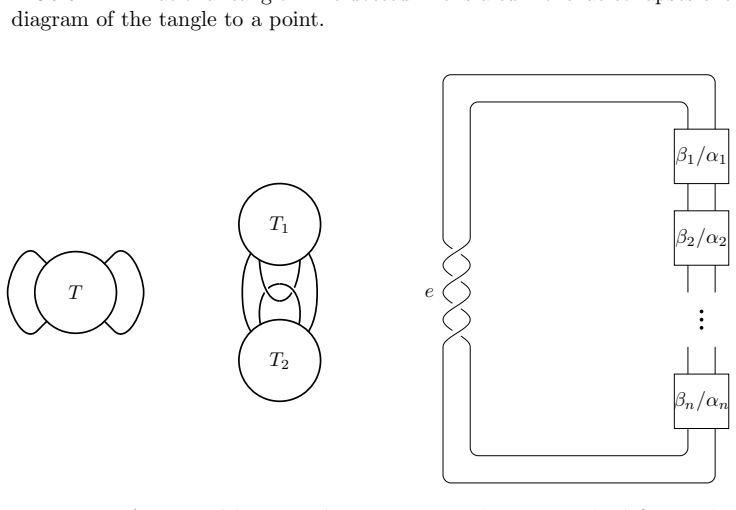
The load-bearing object is the Montesinos knot $M(e; \beta_1/\alpha_1, \ldots, \beta_r/\alpha_r)$, built by summing $r$ rational tangles and taking the numerator closure; the clasp case has exactly one tangle equal to $1/2$. The mechanism is a chain: an algorithm enumerates all rational tangles with $\ell$ crossings as continued-fraction values of integer partitions of $\ell$, then constructs all Montesinos knots with $n$ crossings by partitioning $n$ among $3 \le r$ tangles; a classification theorem says an alternating knot has tunnel number one exactly when it is a 2-bridge knot or a clasp Montesinos knot with three tangles; and a separate theorem gives $t(K) = r - 1$ when the tangle denominators share a nontrivial common divisor. Bridge number data, at most 4 for all knots in this range, chooses which theorem applies.
What would settle it
Run a computer search over all integers e and all rational tangles whose crossing counts sum to 11 or 12, construct the Montesinos knots M(e; ...), and check whether any resulting knot is absent from the paper's list; even one such knot would break the claimed exhaustiveness and could change the tunnel number assigned to it.
Extended reading notes
Core claim
The paper's central claim is Theorem 1.1: the tunnel number of all 1655 alternating 11- or 12-crossing knots has been calculated, along with the tunnel number of 142 non-alternating knots in the same crossing range. The method is exhaustive: every such knot is sorted by bridge number, which is at most 4 in this range, and for 3- and 4-bridge knots the paper identifies whether it is a clasp Montesinos knot using an algorithm that constructs every Montesinos knot with n crossings from integer partitions and rational-tangle fractions. Known theorems then determine the tunnel number: 2-bridge knots have tunnel number 1; alternating 3-bridge knots have tunnel number 1 if clasp Montesinos and 2 otherwise; alternating 4-bridge clasp Montesinos knots have tunnel number 2; and the two remaining 12-crossing alternating knots are non-clasp Montesinos knots whose tangle denominators share a divisor, giving tunnel number 3.
Load-bearing premise
The whole table rests on the assumption that the algorithm that partitions the 11 or 12 crossings only among the rational tangles, with the extra integer twist parameter set to zero, catches every Montesinos knot in this range.
Editorial extensions
If this is right
- Every alternating 11- or 12-crossing knot now has tunnel number 1, 2, or 3, with 1 and 2 covering all but the two knots 12a0554 and 12a0750.
- The table of 1797 exact tunnel numbers provides a concrete data set for testing conjectures that relate tunnel number to hyperbolic volume, bridge number, or connected sums.
- The exhaustive enumeration identifies all 5525 Montesinos knots with 14 or fewer crossings, which is exactly the family needed to apply the classification theorem in this range.
- For the 931 non-alternating 11- and 12-crossing knots whose tunnel number is not fixed, the paper gives the bound that each has tunnel number 1 or 2.
- The method extends the prior complete table for knots with at most 10 crossings to the alternating 11- and 12-crossing range.
Reading between the lines
- If the algorithm's exhaustiveness holds, the same partition-based recipe could be run at 13 and 14 crossings; the main obstacle is not the classification theorems but the size of the rational-tangle enumeration and the reliability of knot identification.
- The paper leaves only two alternating 12-crossing knots at tunnel number 3; a natural next test is whether this sparsity persists at 13 crossings or whether higher tunnel numbers begin to appear among alternating knots.
- A direct check of the e=0 assumption would be to search for Montesinos diagrams with a nonzero integer twist whose total crossing count is 11 or 12 and compare the resulting knots against the paper's list; this would settle the enumeration's completeness without relying on computer identification.
- The method's dependence on bridge number data implies that any larger alternating knot with known bridge number at most 4 would automatically receive a tunnel number, making enumeration the limiting step for further extension.
Signed reviews
Editorial analysis
A structured set of objections, weighed in public.
Referee Report
Summary. The paper claims to compute the tunnel number of all 1655 alternating 11- and 12-crossing knots, and of 142 non-alternating 11- and 12-crossing knots, by combining Lackenby's classification of tunnel-number-one alternating knots, Boileau–Zieschang bridge numbers for Montesinos knots, Lustig–Moriah's theorem for Montesinos knots with nontrivial gcd of denominators, and KnotInfo bridge-number data. The central tool is an enumeration of all Montesinos knots with at most 14 crossings, based on partitioning the crossing number among rational tangles and using SnapPy for identification. The main theorem then assigns tunnel numbers case by case according to bridge number and Montesinos/clasp status.
Significance. If correct, the paper would supply the first complete tunnel-number table for alternating knots with 11 and 12 crossings, a useful data resource for testing conjectures about tunnel number. The methodology is attractive: it relies on established theorems (Lackenby, Lustig–Moriah, Boileau–Zieschang), external bridge-number data from KnotInfo, and reproducible code on GitHub, with no fitted parameters or circular dependencies. The case split in Proposition 5.1 is natural once the Montesinos classification is trusted. However, the exhaustiveness of the Montesinos enumeration is not established as written, and the manuscript's own examples use fractions that the stated algorithm cannot generate; these gaps are load-bearing for the main theorem.
major comments (3)
- [Theorem 4.1] The enumeration in Theorem 4.1 is incomplete. It forms fractions from partitions of ℓ into positive integers using the positive continued fraction p/q = a1 + 1/(a2 + ... ), and then adds negatives. But rational tangles with fraction of absolute value less than 1, such as 1/2, 2/3, and 1/3, have standard continued fractions with a zero first entry, e.g. 1/2 = [0,2] and 2/3 = [0,1,2]. Such fractions are not produced by partitions into positive integers. For ℓ=2, RT(2) contains only 2 and -2, not ±1/2; for ℓ=3, RT(3) contains 3 and 3/2, not ±1/3 or ±2/3. The one-line justification that every alternating diagram is minimal does not address the zero-coefficient issue. This is not merely a proof gap: Proposition 5.1 explicitly names the Montesinos knots M(0; 2/3, 2/3, 2/3, 1/3) and M(0; 2/3, 1/3, 1/3, 1/3), whose fractions 2/3 and 1/3 are absent from RT(3) as defined. Hence the stated algorithm cannot be the one that produced the list behind Theorem 4.3, and the described enumeration would miss exactly the clasp tangles on which the tunnel-number classification depends.
- [Theorem 4.2] Theorem 4.2 does not account for the e parameter in the Montesinos notation. The algorithm writes M(e; p1/q1, ..., pr/qr) but never specifies what integer values of e are considered, and the partitions of n into the tangle crossing numbers leave no room for the |e| crossings of the extra twist region. The proof does not show that every Montesinos knot with n crossings admits a presentation with e=0 and with rational tangles whose crossing numbers sum to n. Since Lackenby's classification in Theorem 3.6 explicitly includes the parameter e in the clasp Montesinos form M(e; ±1/2, β1/α1, β2/α2), a nontrivial e can arise in the very class the paper needs to enumerate completely. Without an argument covering e, the exhaustiveness claim in Theorem 4.3 is unsupported.
- [Proposition 5.1, Case 3] In Case 3 of Proposition 5.1, the sentence 'Every knot in this case is a Montesinos knot' is asserted without proof or citation. This is not a trivial fact: alternating 4-bridge knots are not in general Montesinos. The paper gives no theorem or detailed SnapPy procedure establishing that, among the 1655 alternating knots with 11 or 12 crossings, every bridge-number-4 example is Montesinos. If the Montesinos list generated by Theorems 4.1–4.3 is incomplete, this assertion and the identification of 12a0554 and 12a0750 as the only two exceptions are not reliable. The proof needs either a rigorous argument or a precise description of how the exhaustive SnapPy identification was performed and why it is complete.
minor comments (4)
- [Abstract] The abstract states that the paper computes the tunnel number of '881 non-alternating 11 and 12 crossing knots', while Theorem 1.1 and the body consistently report 142 non-alternating knots. This mismatch should be corrected.
- [Throughout] There are many typographical errors, for example 'al ternating' in the title, 'm any' in the abstract, and 'kn ots' in Theorem 1.1. A careful proofreading pass is needed.
- [Table 1] The formatting in Table 1 is difficult to parse, for instance the line 'Non-clasp: 37 α = 1: 35 Tunnel number 2: 37α ⁄= 1: 2' runs multiple entries together without clear separation. The table should be restructured so that each count (α=1, α≠1, tunnel number) is visually distinct.
- [Theorem 4.2, step (3)] The phrase 'construct a Montesinos link by tangle summing together all rational tangles from the tuple in order, and then taking the numerator closure of the sum' is ambiguous, and the formula 'M(e; p1/q1, ..., pr/qr)' introduces e without defining how e is chosen. The construction should be stated precisely, including the role of e and the crossing count of the resulting diagram.
Circularity Check
No circularity: tunnel numbers are outputs of external classification theorems, external knot data, and an independent enumeration; no fitted parameter is renamed as a prediction.
full rationale
The derivation chain is self-contained with respect to circularity in the sense defined here. The paper enumerates rational tangles from integer partitions (Theorem 4.1), assembles them into Montesinos links (Theorem 4.2), identifies the resulting knots with SnapPy, reads bridge numbers from KnotInfo, and then applies external theorems: Lackenby's classification of alternating tunnel-number-one knots (Theorem 3.6), the Boileau-Zieschang bridge-number result (Theorem 3.2), and Lustig-Moriah's tunnel-number result for Montesinos knots with nontrivial gcd of the denominators (Theorem 3.5). The tunnel numbers reported in Propositions 5.1 and 5.2 are conclusions drawn from these theorems and identified knot data; they are not used to define or fit any parameter that is then presented as a prediction. There are no free constants, no self-citation chain supporting the central claim, and no quantity is defined in terms of the target tunnel number. The cited results are independent external mathematics, and the software and database citations are used only for identification and bridge-number lookup. The skeptical concern about Theorem 4.1's enumeration possibly omitting fractions such as 1/2 is a correctness or exhaustiveness question about the algorithm and its implementation, not a circularity: even if the enumeration is incomplete, the logical direction of the paper remains one-way, from a computed list of Montesinos knots to tunnel numbers via external theorems. Therefore no circular step is exhibited, and the appropriate score is 0.
Assumptions & free parameters
assumptions (8)
- domain assumption Lackenby's classification of tunnel number one alternating knots (Theorem 3.6): an alternating knot K has t(K)=1 iff K is 2-bridge or a clasp Montesinos knot M(e; ±1/2, β1/α1, β2/α2) with α1, α2 odd.
- domain assumption Boileau-Zieschang: the bridge number of a Montesinos knot M(e; β1/α1, ..., βr/αr) with α_i ≠ 1 equals r (Theorem 3.2).
- domain assumption Lustig-Moriah: if α = gcd(α1, ..., αr) ≠ 1, then t(K) = b(K)-1 = r-1 for a Montesinos knot (Theorem 3.5).
- domain assumption KnotInfo provides correct bridge numbers for all 11 and 12 crossing knots, and every such knot has bridge number at most 4.
- domain assumption SnapPy's identify() correctly identifies each constructed rational tangle and Montesinos link as the standard named knot.
- ad hoc to paper The enumeration in Theorem 4.2 captures every Montesinos knot with n crossings.
- ad hoc to paper Every 11 or 12 crossing alternating 4-bridge knot is Montesinos.
- standard math Proposition 3.1: t(K) ≤ b(K) - 1, stated as a 'well known proposition'.
Cite this review
Pith. "Pith review of The tunnel number of all 11 and 12 crossing alternating knots." pith.science (2026). https://pith.science/paper/XL3VVDP7
@misc{pith2026190801693,
  author       = {Pith},
  title        = {Pith review of: The tunnel number of all 11 and 12 crossing alternating knots},
  year         = {2026},
  howpublished = {\url{https://pith.science/paper/XL3VVDP7}},
  note         = {Machine review of arXiv:1908.01693}
}
read the original abstract
Using exhaustive techniques and results from Lackenby and many others, we compute the tunnel number of all 1655 alternating 11 and 12 crossing knots and of 881 non-alternating 11 and 12 crossing knots. We also find all 5525 Montesinos knots with 14 crossings or fewer.
Figures


Figures from the paper (1 more)
Reference graph
Works this paper leans on
-
[1]
M. Boileau and H. Zieschang, Nombre de ponts et gnrateurs mridiens des entrelacs de Monte sinos Comment. Math. Helv. 60 (1985), no. 2, 270–279
work page 1985
-
[2]
G. Burde and H. Zieschang, Knots, De Gruyter studies in mathematics, W. De Gruyter, 1985
work page 1985
-
[3]
J. C. Cha and C. Livingston, KnotInfo: Table of Knot Invariants , http://www.indiana.edu/~knotinfo, February 15, 2019
work page 2019
-
[4]
B. Clark, The Heegaard genus of manifolds obtained by surgery on links and knots, Interna- tional Journal of Mathematics and Mathematical Sciences, v ol. 3, no. 3, pp. 583-589, 1980. https://doi.org/10.1155/S0161171280000440
-
[5]
M. Culler, N. M. Dunfield, M. Goerner, and J. R. Weeks, SnapPy, a computer program for studying the geometry and topology of 3-manifolds , http://snappy.computop.org. THE TUNNEL NUMBER OF ALL 11 AND 12 CROSSING ALTERNATING KNOTS 9 Non-alternating: 1073 11 crossings: 185 3-bridge: 176 Montesinos: 58 Clasp: 32 α = 1: 32 Tunnel number 1: 32 Non-clasp: 26 α = ...
-
[6]
T. Kobayashi, Y. Rieck, A linear bound on the tetrahedral number of manifolds of boun ded volume (after Jørgensen and Thurston). Topology and geometry in dimension three, 27–42, Contemp. M ath., 560, Amer. Math. Soc., Providence, RI, 2011
work page 2011
-
[7]
Lackenby, Classification of alternating knots with tunnel number one
M. Lackenby, Classification of alternating knots with tunnel number one. Comm. Anal. Geom. 13 (2005), no. 1, 151–185
work page 2005
- [8]
Show all 14 references
-
[9]
J. M. Montesinos, Seifert manifolds that are ramified two-sheeted cyclic cove rings. Bol. Soc. Mat. Mex- icana (2) 18 (1973), 1–32
1973
-
[10]
Morimoto, Tunnel numbers of knots
K. Morimoto, Tunnel numbers of knots. Knot theory and its applications, 327–335, Contemp. Math., 670, Amer. Math. Soc., Providence, RI, 2016
2016
-
[11]
Morimoto, M
K. Morimoto, M. Sakuma,Y. Yokota, Examples of tunnel number one knots which have the property ”1+1=3”. Math. Proc. Cambridge Philos. Soc. 119 (1996), no. 1, 113–11 8
1996
-
[12]
Morimoto, M
K. Morimoto, M. Sakuma,Y. Yokota, Identifying tunnel number one knots. J. Math. Soc. Japan 48 (1996), no. 4, 667–688
1996
-
[13]
Rolfsen, Knots and links , Publish or Perish, 1976
D. Rolfsen, Knots and links , Publish or Perish, 1976
1976
-
[14]
Schubert, ¨Uber eine numerische Knoteninvariante , Math
H. Schubert, ¨Uber eine numerische Knoteninvariante , Math. Z. 61 (1954), 245 – 288. Northeastern University, Boston, MA 02115, USA, and, Topol ogy and Geometry of Man- ifolds Unit, Okinaw a Institute of Science and Technology Gr aduate University, Okinaw a, Japan 904-0495 E-m...
1954
Reviewed August 14, 2026 · model on record in the stance chip above.
Discussion (0). Continue with ORCID to comment.