REVIEW 1 major objections
Beyond Network Topology: Biological Evidence Integration and Reproducible Benchmarking for Protein Complex Detection
T0 review · 1 major / 0 minor · reviewed 2026-06-28 · grok-4.3
Pith's one-line read Evidence-aware graph methods best balance plausibility and reproducibility in protein complex detection, but evaluation protocols are now the main limit.
desk verdict A review of evidence-aware protein complex detection that flags evaluation protocols as the main remaining bottleneck, but whose claim rests on the reviewed methods being a fair sample. read the letter →
The pith
A machine-rendered reading of the paper's core claim, the machinery that carries it, and where it could break.
The reading
What carries the argument
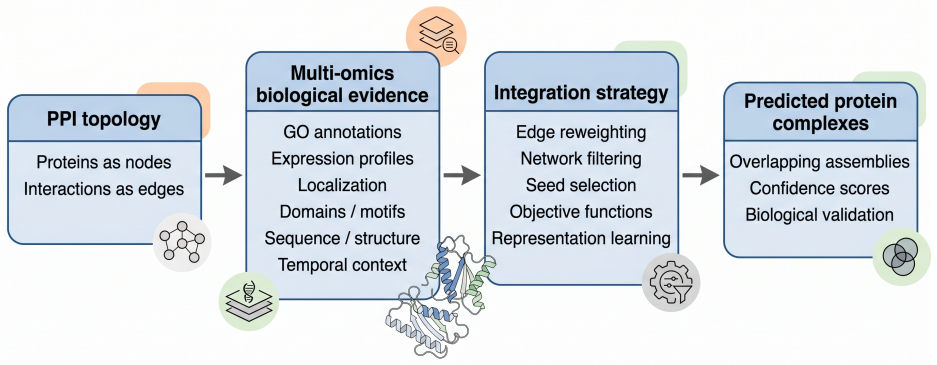
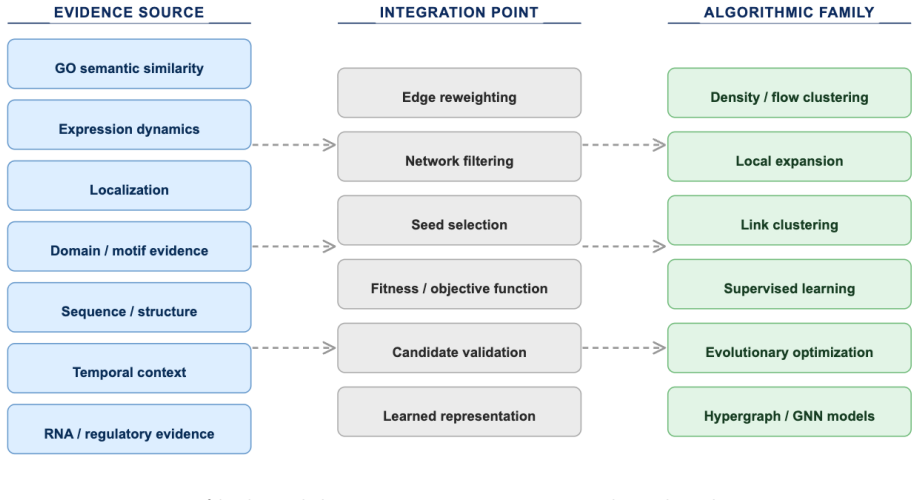
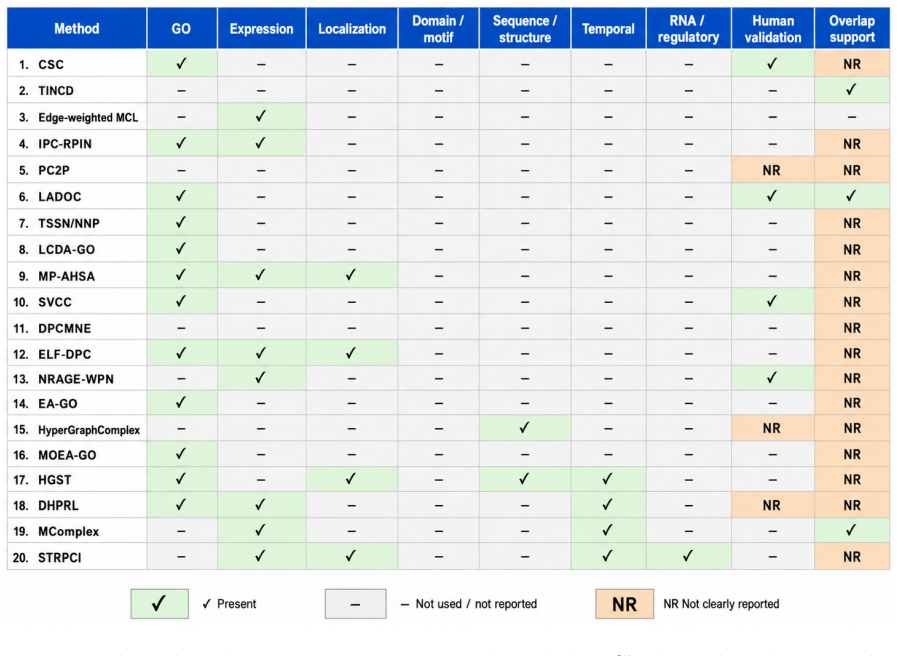
Evidence-aware approaches that combine PPI topology with Gene Ontology annotations, expression profiles, subcellular localization, and other supporting data sources.
What would settle it
A broader survey that includes many post-2018 methods omitted here and finds that non-evidence-aware or highly complex models achieve superior reproducible performance would undermine the tradeoff claim; implementing the recommended unified benchmarks and seeing no shift in which methods rank highest would falsify the bottleneck claim.
Extended reading notes
Core claim
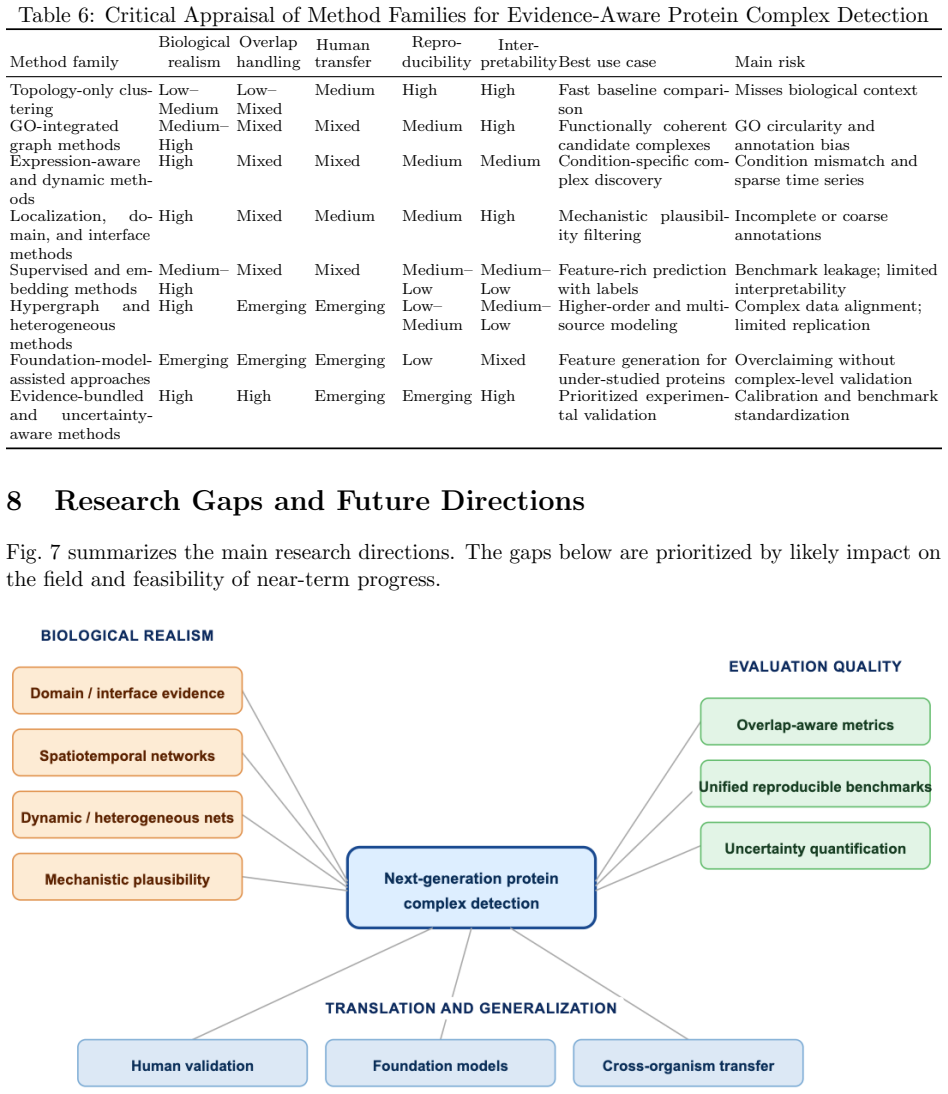
Transparent evidence-aware graph methods currently offer the strongest tradeoff between biological plausibility and reproducibility, while deep, hypergraph, and dynamic heterogeneous models expand biological realism but require stronger benchmark control. The central bottleneck is no longer only the lack of algorithms, but the lack of harmonized, overlap-aware, and reproducible evaluation protocols.
Load-bearing premise
The post-2018 methods and selected historical baselines reviewed are representative enough of the literature to establish that evaluation protocols rather than new algorithms are the primary limiting factor.
Editorial extensions
If this is right
- Unified benchmark versions would enable direct comparison of methods without hidden differences in data processing.
- Explicit controls for circular use of Gene Ontology information would reduce inflated performance scores.
- Overlap-aware metrics would produce rankings that better match the biological reality of shared subunits in complexes.
- Routine reporting of uncertainty estimates would make performance claims more trustworthy across independent runs.
- Releasing executable software packages would allow other groups to verify and extend reported results.
Reading between the lines
- Harmonized protocols developed here could be adapted to improve reproducibility in related tasks such as protein function prediction from networks.
- If evaluation standards tighten, researchers might test whether evidence-aware methods maintain their edge when applied to context-specific or tissue-specific interaction maps.
- The emphasis on transparent methods suggests that future work could prioritize interpretable models over black-box ones when integrating new data types like single-cell expression.
- Adopting the recommended controls might narrow the gap between computational predictions and what can be validated in targeted experiments.
Signed reviews
Editorial analysis
A structured set of objections, weighed in public.
Referee Report
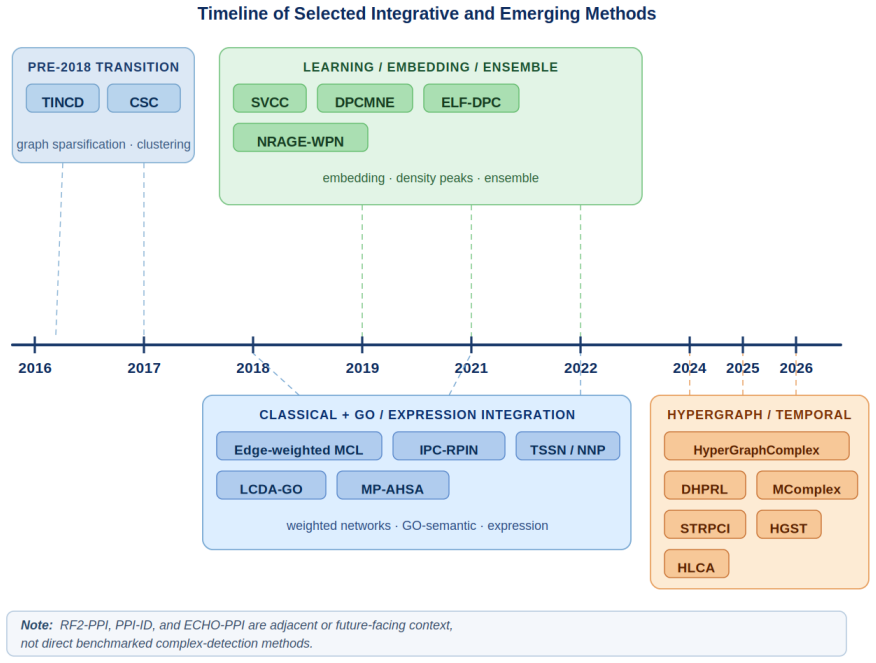
Summary. This manuscript is a focused methodological review of evidence-aware protein complex detection from PPI networks. It surveys methods that integrate network topology with GO annotations, expression profiles, subcellular localization, sequence/domain evidence, temporal data, and representation learning, with particular attention to post-2018 approaches and selected earlier baselines. The central synthesis states that transparent evidence-aware graph methods currently provide the strongest tradeoff between biological plausibility and reproducibility, whereas deep, hypergraph, and dynamic heterogeneous models increase realism at the cost of requiring tighter benchmark controls. The paper concludes that the primary remaining bottleneck is the absence of harmonized, overlap-aware, and reproducible evaluation protocols, and therefore advocates unified benchmark versions, explicit GO-circularity controls, overlap-aware metrics, uncertainty estimates, and executable software packages.
Significance. If the synthesis holds, the review would be useful in redirecting community effort from isolated algorithmic novelty toward standardized, reproducible evaluation practices. The explicit recommendations for overlap-aware metrics and GO-circularity controls, together with the call for executable packages, constitute concrete, actionable guidance that could improve comparability across studies. The paper also usefully distinguishes the strengths of simpler evidence-aware graph methods from the added complexity of newer architectures.
major comments (1)
- [Abstract] Abstract: The claim that 'the central bottleneck is no longer only the lack of algorithms, but the lack of harmonized, overlap-aware, and reproducible evaluation protocols' is load-bearing for the central synthesis. This generalization requires that the reviewed post-2018 methods plus selected baselines are representative of the broader literature; without an explicit statement of literature search strategy, inclusion/exclusion criteria, or a systematic sampling frame (none provided in the abstract or visible in the synthesis), it remains possible that recent deep or hypergraph methods already incorporating overlap-aware or uncertainty-aware evaluation were omitted, which would undermine the conclusion that evaluation protocols are now the dominant issue.
Simulated Author's Rebuttal
We thank the referee for the constructive feedback. The major comment concerns the need for explicit documentation of literature selection to support the central claim in the abstract. We address this below and will revise the manuscript accordingly.
read point-by-point responses
-
Referee: [Abstract] Abstract: The claim that 'the central bottleneck is no longer only the lack of algorithms, but the lack of harmonized, overlap-aware, and reproducible evaluation protocols' is load-bearing for the central synthesis. This generalization requires that the reviewed post-2018 methods plus selected baselines are representative of the broader literature; without an explicit statement of literature search strategy, inclusion/exclusion criteria, or a systematic sampling frame (none provided in the abstract or visible in the synthesis), it remains possible that recent deep or hypergraph methods already incorporating overlap-aware or uncertainty-aware evaluation were omitted, which would undermine the conclusion that evaluation protocols are now the dominant issue.
Authors: We acknowledge the referee's point. The manuscript is presented as a focused methodological review of evidence-aware methods (explicitly combining PPI topology with GO, expression, localization, sequence/domain, temporal, or representation-learning evidence), not a systematic review. Selection was guided by coverage of post-2018 approaches meeting these criteria plus key baselines, drawn from recent surveys and field knowledge. To strengthen the paper, we will add an explicit 'Scope and Selection Criteria' paragraph (in the Introduction or a new subsection) describing the search strategy (PubMed, arXiv, Google Scholar; keywords combining 'protein complex detection', 'PPI network', 'evidence integration' or specific evidence types; post-2018 filter; inclusion of methods reporting benchmark performance). This will clarify the scope without altering the synthesis for the reviewed class of methods. We maintain that the central claim holds within this focused scope but agree explicit documentation is warranted. revision: yes
Circularity Check
Literature synthesis review with no derivation chain or self-referential reductions
full rationale
This is a methodological review paper synthesizing existing literature on protein complex detection methods, with emphasis on evidence-aware approaches and evaluation protocols. No equations, fitted parameters, predictions, or mathematical derivations are present that could reduce to inputs by construction. The central synthesis—that evaluation protocols are now the primary bottleneck—rests on a survey of post-2018 methods and baselines rather than any self-definitional, fitted-input, or self-citation load-bearing step. Representativeness of the selected methods is a sampling/validity concern external to the paper's internal logic, not a circularity pattern. The paper is self-contained as a literature synthesis against external benchmarks.
Assumptions & free parameters
Cite this review
Pith. "Pith review of Beyond Network Topology: Biological Evidence Integration and Reproducible Benchmarking for Protein Complex Detection." pith.science (2026). https://pith.science/paper/XLHRP6CK
@misc{pith2026260603178,
  author       = {Pith},
  title        = {Pith review of: Beyond Network Topology: Biological Evidence Integration and Reproducible Benchmarking for Protein Complex Detection},
  year         = {2026},
  howpublished = {\url{https://pith.science/paper/XLHRP6CK}},
  note         = {Machine review of arXiv:2606.03178}
}
read the original abstract
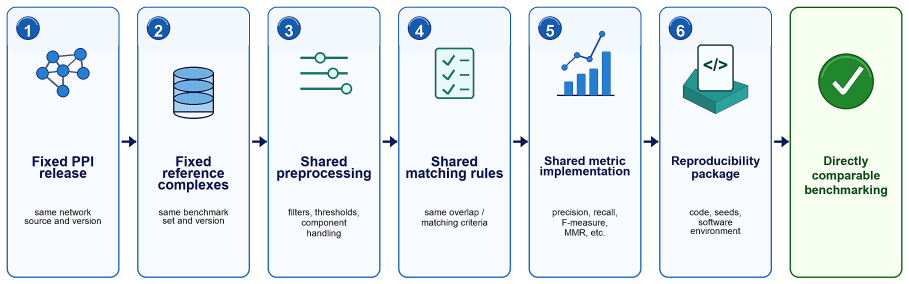
Protein complexes are molecular assemblies that coordinate cellular regulation, signaling, metabolism, and disease-relevant protein function. Detecting such assemblies from protein-protein interaction (PPI) networks remains challenging because network topology is an incomplete abstraction: an edge may represent direct binding, functional association, co-complex evidence, co-expression, co-localization, or a computationally predicted interaction. This focused critical methodological review examines how biological evidence can improve protein-complex detection beyond dense-subgraph discovery. We consider Gene Ontology, expression, localization, domains and motifs, sequence and structure, interface evidence, temporal context, RNA or regulatory evidence, and representation learning, while retaining classical graph-clustering methods as historical baselines. Interpretable evidence-aware graph methods currently provide a strong balance between biological plausibility and reproducibility, whereas structure-aware, temporal, heterogeneous, and hypergraph models offer greater biological realism but require stronger independent benchmarking. Reported F-measures cannot be directly compared across incompatible PPI releases, reference sets, matching thresholds, preprocessing pipelines, and metric implementations. Progress therefore requires fixed dataset versions, explicit controls for Gene Ontology circularity, overlap-aware metrics, uncertainty estimates, and executable software packages. Reliable protein-complex detection ultimately depends on connecting graph-based predictions to molecular structure, interaction mechanisms, cellular context, and functional assembly.
Figures
Figures from the paper (4 more)
Reviewed June 28, 2026 · model on record in the stance chip above.
Discussion (0). Continue with ORCID to comment.