REVIEW 4 major objections 5 minor 33 references
Real-Time Graph-based Point Cloud Networks on FPGAs via Stall-Free Deep Pipelining
T0 review · 4 major / 5 minor · reviewed 2026-08-06 · deepseek-v4-flash
Pith's one-line read A stall-free FPGA dataflow architecture can run a complete graph-based point cloud network within 10 µs and 8 MEPS, beating a GPU by up to 5.25x on the Belle II ECL trigger.
desk verdict A credible FPGA systems contribution with real measured speedups, but the claim of meeting real-time trigger requirements is under-supported: the quantized model's physics performance is never evaluated and the hard real-time guarantee rests on silently dropping any event that exceeds the configured size bound. read the letter →
The pith
A machine-rendered reading of the paper's core claim, the machinery that carries it, and where it could break.
The reading
What carries the argument
The load-bearing object is the stall-free deep-pipelined dataflow actor library, made of Point Processing Elements (PPE), Graph Processing Elements (GPE), and Topology Elements. Every actor is a single-rate dataflow node with the same initiation interval $I_{\mathrm{init}} = \lceil N/\mathrm{PAR} \rceil$, all child pipelines share one initiation interval, and no actor is allowed to stall. The GraVNetConv GPE fuses dynamic graph building (all-nearest-neighbor plus hierarchical top-K sort) with distance-weighted message passing using exp, multiplication, max-reduce, sum-reduce, unicast/multicast, and combine operators; the Condensation Point Selection GPE maps candidate selection, isolation selection, and cluster selection onto the same actor pattern. The PAR parameter trades parallelism against resource use, and deployment follows a FINN-like pattern-matching flow that replaces network layers with these templates.
What would settle it
Measure, on real Belle II ECL data, the fraction of events whose number of hits exceeds the configured N (32 or 64). If that fraction is non-negligible, the accelerator will silently drop points and its trigger decision will diverge from the full point cloud; the paper provides no fallback for this case. A second check is to feed one event of N+1 points into the firmware and compare the output with the same event truncated to N points—the design specification says the extra point is dropped, so any difference in the selected clusters demonstrates that over-threshold events corrupt the result.
Extended reading notes
Core claim
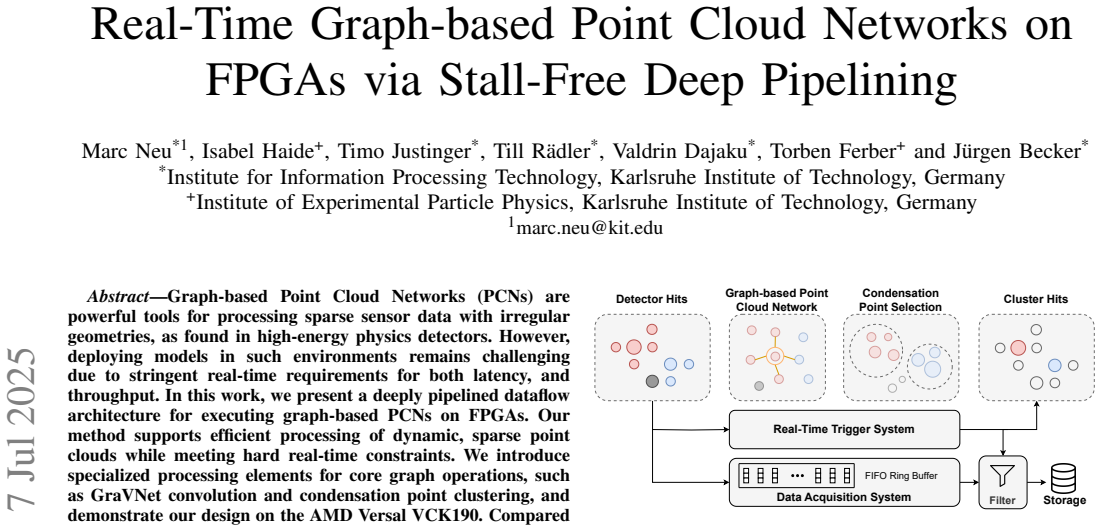
Earlier FPGA work had implemented only individual pieces, such as a single GravNetConv layer, and fell short of the full pipeline. The central discovery here is that the two historically hard steps—dynamic graph building and condensation point clustering—can be cast as single-rate dataflow actors and pipelined back-to-back without stalls. The authors implement the GraVNetConv operator as an all-nearest-neighbor search followed by a hierarchical top-K sort feeding message passing, and the condensation point selection as candidate selection, isolation selection, and cluster selection, all expressed with the same actor pattern. The resulting end-to-end design runs on an FPGA at 249-312 MHz and gives deterministic, cycle-accurate execution times that meet the 10 µs latency and 8 MEPS throughput targets for N=32 and N=64, while N=128 falls short of throughput due to the O($N^{2}$) graph-building complexity.
Load-bearing premise
The hard real-time guarantee rests on setting a detector energy threshold so the number of hits per event never exceeds the chosen bound N, because the accelerator drops any points beyond the bound with no fallback, so an over-threshold event yields a trigger decision from an incomplete point cloud.
Editorial extensions
If this is right
- Belle II's ECL trigger can run a full graph-based PCN on FPGAs at 8 MEPS with sub-10 µs latency for events up to 64 points, replacing or augmenting the current FPGA-based clustering logic.
- The actor library can be reused to deploy other PCN architectures that fit the PPE/GPE/topology template, without re-deriving the pipelining or stall-free scheduling.
- Because execution time is cycle-accurate and deterministic, the same design can be certified for hard real-time use in other detectors with comparable sparsity, not just Belle II.
- The open-source implementation gives other experiments a starting point for real-time graph-based ML triggers, lowering the barrier for adoption in future collider upgrades.
- The O(N^2) graph-building complexity sets a scaling limit: meeting the trigger rate for larger event sizes requires either more parallelism or approximate-neighbor search, which the architecture does not yet provide.
Reading between the lines
- The energy-threshold bound N is the real design lever: the same hardware could support higher occupancy if the threshold were raised, but only at the cost of dropping more high-multiplicity events; a production trigger would likely need a slow-path fallback for over-threshold events.
- The reported GPU comparison may understate the GPU's capabilities on this workload, since the baseline uses a compiled engine with batching; the durable FPGA advantage is deterministic latency and per-event worst-case time, not raw FLOPS.
- The same stall-free dataflow pattern could extend to dynamic-graph transformers or set transformers on sparse data, where the bottleneck is also variable-length neighbor aggregation rather than fixed tensor contraction.
- A natural next test is to replace the exact all-nearest-neighbor search with an approximate version and measure the trigger-efficiency loss against the throughput gain; the paper's architecture makes this swap straightforward because ANN is isolated inside one GPE.
Editorial analysis
A structured set of objections, weighed in public.
Referee Report
Summary. The manuscript proposes a deeply pipelined dataflow architecture for executing graph-based point cloud networks on FPGAs, with custom processing elements for the GraVNetConv layer and condensation point clustering, including dynamic all-nearest-neighbor graph building and Top-K selection. Five configurations are implemented on an AMD Versal VCK190 at 8-bit and 16-bit precision for event sizes 32, 64, and 128, and the authors report throughput, latency, and resource utilization against an NVIDIA L40S GPU baseline. The paper reports up to a 5.25x throughput improvement and sub-10 us latencies for N=32 and 64, and releases an open-source implementation.
Significance. If the hardware claims hold, this is a valuable demonstration: it appears to be the first end-to-end FPGA implementation of a graph-based PCN that includes dynamic graph building and condensation clustering at trigger-level latency. The measurement methodology is careful in several respects, including 1000 repeated runs, 95% quantiles, and deterministic compute-only timings, and the open-source release supports reproducibility. The main reservations concern not the raw hardware measurements but whether the 'satisfying real-time trigger requirements' claim is justified given the silent input-dropping behavior described in Section III-A and the absence of any physics-performance or overflow-tail analysis.
major comments (4)
- [III-A] Section III-A states that an energy threshold is chosen so that an upper bound N on hits can be derived and that 'if an event contains more than N hits, we drop additional points from the input set.' This is load-bearing for the hard real-time and Belle II trigger claims: for any real detector occupancy distribution, P(N_event > N) is nonzero, and silently discarding points changes the input to the GraVNetConv and condensation stages, potentially corrupting the trigger decision. The manuscript provides no estimate of P(N>32) or P(N>64), no overflow flag, and no fallback such as routing the event to a software trigger. Please either add over-threshold handling and occupancy-tail analysis, or revise the central claim to a conditional statement about successfully bounded inputs.
- [V-A / Table I] Table I reports 8-bit and 16-bit quantized weights with 40% weight sparsity, but the evaluation contains no comparison of the quantized/sparse model's output against the floating-point model or against physics truth on Belle II ECL data. A trigger system must preserve signal efficiency and background rejection, so meeting latency and throughput alone does not establish that the deployed model satisfies trigger requirements. Please report at least one physics-performance metric, such as clustering efficiency versus fake rate, or state explicitly that physics validation is out of scope and soften the 'satisfying the demands' wording in the abstract and conclusion.
- [V-B / Fig. 6] The FPGA throughput is measured with a batch size of 16384, whereas the GPU baseline in Figure 3 is obtained by varying the batch size from 1 to 4096. If the compared GPU point was not measured at the same batch size and with the same end-to-end transfer protocol, the 3.46x, 5.25x, and 2.40x speedups may partly reflect batching or protocol differences rather than architecture efficiency. Please report the exact GPU configuration used for each speedup and, if possible, measure both platforms under the same batch-size and transfer protocol.
- [V-B / V-C] Hard real-time is claimed on the basis of 95% quantiles for end-to-end measurements and deterministic compute-only timings. For a hard real-time trigger, a worst-case or statistically certified bound is needed for the full deployed path, including AXI transfers and any host interaction; the paper currently does not state whether the 10 us latency budget applies to the compute-only path or to the end-to-end system. Please clarify the budget and provide a WCRT-style analysis for the deployed path, or explicitly delimit the claim to the compute core.
minor comments (5)
- [III-B] In the paragraph on Graph Processing Elements, 'Ni, Nj' should presumably be 'Ni, No' to match the inputs/outputs notation introduced earlier in the section.
- [Table I] Version F has no clock frequency listed, and the text says five of six versions were successfully implemented; please state explicitly in the table caption or surrounding text that Version F did not close timing or fit, so the reader is not left to infer this from the dash.
- [References] Reference [21] contains a malformed URL in which '\url{}' appears literally; please fix the bibliographic entry.
- [V-D / Fig. 7] The statement that CLB utilization is much larger than both FF and LUT utilization is confusing, since CLBs are composed of LUTs and FFs; please clarify whether this is total CLB tile count and why it exceeds the summed primitive utilization.
- [Fig. 3] The Pareto-front labels '1' and '2' are not defined in the caption; please spell out the two DAQ design spaces being compared.
Circularity Check
No significant circularity: the FPGA throughput and latency results are direct hardware measurements against an external GPU baseline, and the only self-citation is contextual rather than load-bearing.
full rationale
The paper's central claims are empirical hardware results: throughput up to 5.25x over an NVIDIA L40S GPU and latencies below 10 us, measured on an AMD Versal VCK190 via XRT trace files and cycle-accurate profiling. These are external performance benchmarks, not quantities derived from the paper's own assumptions or fitted parameters. The only self-citation is [24], the authors' prior single-layer GravNetConv FPGA work, used for context and comparison ('The GravNetConv layer was explored in prior work [24], which implemented only a single layer and fell short of meeting the required throughput') and as a contrast to dynamic graph building ('our approach differs significantly from previous static graph building approaches on FPGAs [24]'). This citation is not used to justify the current architecture's performance or to supply a load-bearing theorem. The Section III-A bound on event size ('we choose the energy threshold such that we are able to derive an upper bound N of simultaneously hit sensors in a given event. If an event contains more than N hits, we drop additional points') is a stated design assumption and a genuine operational limitation, but it is not circular: it does not make the measured results equivalent to the assumption. No fitted input is renamed as a prediction, no uniqueness theorem is imported from the authors' prior work, and no known result is repackaged as a derivation. The implementation is also released as open source, and the evaluation is self-contained against an external baseline, so the derivation chain is not circular.
Assumptions & free parameters
free parameters (4)
- Maximum points per event N =
32, 64, 128
- Parallelization factor PAR =
1 or 2
- Weight sparsity =
40%
- Quantization bitwidth =
8-bit or 16-bit
assumptions (3)
- domain assumption The detector energy threshold can be set so that the number of points N is bounded and points above the bound are dropped.
- domain assumption The entire network can be mapped to PPE/GPE/Topology modules with single-rate actors and no stalls.
- domain assumption The quantized and pruned model retains adequate physics performance.
Cite this review
Pith. "Pith review of Real-Time Graph-based Point Cloud Networks on FPGAs via Stall-Free Deep Pipelining." pith.science (2026). https://pith.science/paper/XLM5JA7J
@misc{pith2026250705099,
  author       = {Pith},
  title        = {Pith review of: Real-Time Graph-based Point Cloud Networks on FPGAs via Stall-Free Deep Pipelining},
  year         = {2026},
  howpublished = {\url{https://pith.science/paper/XLM5JA7J}},
  note         = {Machine review of arXiv:2507.05099}
}
read the original abstract
Graph-based Point Cloud Networks (PCNs) are powerful tools for processing sparse sensor data with irregular geometries, as found in high-energy physics detectors. However, deploying models in such environments remains challenging due to stringent real-time requirements for both latency, and throughput. In this work, we present a deeply pipelined dataflow architecture for executing graph-based PCNs on FPGAs. Our method supports efficient processing of dynamic, sparse point clouds while meeting hard real-time constraints. We introduce specialized processing elements for core graph operations, such as GraVNet convolution and condensation point clustering, and demonstrate our design on the AMD Versal VCK190. Compared to a GPU baseline, our FPGA implementation achieves up to 5.25x speedup in throughput while maintaining latencies below 10 {\mu}s, satisfying the demands of real-time trigger systems in particle physics experiments. An open-source reference implementation is provided.
Figures


Figures from the paper (3 more)


Reference graph
Works this paper leans on
-
[1]
Deep Learning for 3D Point Clouds: A Survey
Yulan Guo et al. “Deep Learning for 3D Point Clouds: A Survey”. In: IEEE TPAMI (2021). DOI: 10 . 1109 / TPAMI.2020.3005434
arXiv 2021
-
[2]
Review: Deep Learning on 3D Point Clouds
Saifullahi Aminu Bello et al. “Review: Deep Learning on 3D Point Clouds”. In: Remote Sensing (2020). DOI: 10.3390/rs12111729
-
[3]
PointNet: Deep Learning on Point Sets for 3D Classification and Segmentation
Charles R. Qi et al. “PointNet: Deep Learning on Point Sets for 3D Classification and Segmentation”. In: CVPR. arXiv, 2016. DOI: 10.48550/arXiv.1612.00593
-
[4]
Dynamic graph cnn for learning on point clouds
Yue Wang et al. “Dynamic graph cnn for learning on point clouds”. In: ACM Transactions on Graphics (tog) 38.5 (2019), pp. 1–12
work page 2019
-
[5]
AGConv: Adaptive Graph Con- volution on 3D Point Clouds
Mingqiang Wei et al. “AGConv: Adaptive Graph Con- volution on 3D Point Clouds”. In: IEEE TPAMI (2023)
work page 2023
-
[6]
Photon Reconstruction in the Belle II Calorimeter Using Graph Neural Networks
F. Wemmer et al. “Photon Reconstruction in the Belle II Calorimeter Using Graph Neural Networks”. In: Com- put. Softw. Big Sci. 7.1 (2023), p. 13. DOI: 10.1007/ s41781-023-00105-w. eprint: 2306.04179
work page Pith review arXiv 2023
-
[7]
Jet Tagging via Par- ticle Clouds
Huilin Qu and Loukas Gouskos. “Jet Tagging via Par- ticle Clouds”. In: Physical Review D (2020)
work page 2020
-
[8]
Yutaro Iiyama et al. “Distance-Weighted Graph Neural Networks on FPGAs for Real-Time Particle Reconstruc- tion in High Energy Physics”. In: Front. Big Data 3 (2020), p. 598927. DOI: 10.3389/fdata.2020.598927. eprint: 2008.03601
Show all 33 references
-
[9]
Abe et al
T. Abe et al. Belle II Technical Design Report . Nov
-
[10]
CMS Physics: Technical Design Report V olume 1: Detector Performance and Software
G. L. Bayatian et al. “CMS Physics: Technical Design Report V olume 1: Detector Performance and Software”. In: (2006). DOI: 10.2172/2510878
2006 doi
-
[11]
Design of the Global Reconstruction Logic in the Belle II Level-1 Trigger system
Y . -T. Lai et al. “Design of the Global Reconstruction Logic in the Belle II Level-1 Trigger system”. In: (Mar. 2025). arXiv: 2503.02192
2025 arXiv
-
[12]
CMS. The TriDAS project. Technical design report, vol. 1: The trigger systems
S. Dasu et al. “CMS. The TriDAS project. Technical design report, vol. 1: The trigger systems”. In: (Dec. 2000)
2000
-
[13]
Object condensation: one-stage grid-free multi-object reconstruction in physics detectors, graph and image data
Jan Kieseler. “Object condensation: one-stage grid-free multi-object reconstruction in physics detectors, graph and image data”. In: Eur. Phys. J. C 80.9 (2020), p. 886. DOI: 10.1140/epjc/s10052-020-08461-2. arXiv: 2002. 03605
2020 doi
-
[14]
FINN-R: An end-to-end deep- learning framework for fast exploration of quantized neural networks
Michaela Blott et al. “FINN-R: An end-to-end deep- learning framework for fast exploration of quantized neural networks”. In: ACM Transactions on Reconfig- urable Technology and Systems (TRETS) 11.3 (2018), pp. 1–23
2018
-
[15]
fastmachinelearning/hls4ml
FastML Team. fastmachinelearning/hls4ml. Version v1.1.0. 2025. DOI: 10.5281/zenodo.1201549. URL: https://github.com/fastmachinelearning/hls4ml
2025 doi
-
[16]
Learning Representations of Irregu- lar Particle-Detector Geometry With Distance-Weighted Graph Networks
S. R. Qasim et al. “Learning Representations of Irregu- lar Particle-Detector Geometry With Distance-Weighted Graph Networks”. In: Eur. Phys. J. C 79.7 (2019), p. 608. DOI: 10.1140/epjc/s10052-019-7113-9. arXiv: 1902.07987
2019 arXiv
-
[17]
The Belle II Physics Book
E. Kou et al. “The Belle II Physics Book”. In: (2018). DOI: 10 . 48550 / arXiv . 1808 . 10567. (Visited on 04/24/2025)
2018
-
[18]
PyTorch 2: Faster Machine Learn- ing Through Dynamic Python Bytecode Transformation and Graph Compilation
Jason Ansel et al. “PyTorch 2: Faster Machine Learn- ing Through Dynamic Python Bytecode Transformation and Graph Compilation”. In: 29th ACM International Conference on Architectural Support for Programming Languages and Operating Systems, Volume 2 (ASPLOS ’24). ACM, Apr. 2024...
2024
-
[19]
https://github.com/NVIDIA/TensorRT
NVIDIA. https://github.com/NVIDIA/TensorRT. 2025
2025
-
[20]
https : / / github
AMD. https : / / github . com / amd / ZenDNN - pytorch - plugin. 2025
2025
-
[21]
Fast Graph Compute
Jan Kieseler and Shah Qasim. Fast Graph Compute
-
[22]
Status of the electromagnetic calorimeter trigger system at Belle II
SungHyun Kim et al. “Status of the electromagnetic calorimeter trigger system at Belle II.” In: J. Phys. Conf. Ser. 928.1 (2017), p. 012022. DOI: 10.1088/1742-6596/ 928/1/012022
2017 doi
-
[23]
The Belle II Detector Upgrades Frame- work Conceptual Design Report
H. Aihara et al. “The Belle II Detector Upgrades Frame- work Conceptual Design Report”. In: (June 2024). arXiv: 2406.19421
2024
-
[24]
Real-Time Graph Building on FPGAs for Machine Learning Trigger Applications in Particle Physics
Marc Neu et al. “Real-Time Graph Building on FPGAs for Machine Learning Trigger Applications in Particle Physics”. In: Comput Softw Big Sci (2024). DOI: 10. 1007/s41781-024-00117-0
2024
-
[25]
Point-X: A Spatial-Locality-Aware Architecture for Energy- Efficient Graph-Based Point-Cloud Deep Learning
Jie-Fang Zhang and Zhengya Zhang. “Point-X: A Spatial-Locality-Aware Architecture for Energy- Efficient Graph-Based Point-Cloud Deep Learning”. In: MICRO. IEE/ACM, 2021
2021
-
[26]
DeepBurning-GL: An Auto- mated Framework for Generating Graph Neural Net- work Accelerators
Shengwen Liang et al. “DeepBurning-GL: An Auto- mated Framework for Generating Graph Neural Net- work Accelerators”. In: ICCAD. IEEE, 2020
2020
-
[27]
FlowGNN: A Dataflow Architec- ture for Real-Time Workload-Agnostic Graph Neural Network Inference
Rishov Sarkar et al. “FlowGNN: A Dataflow Architec- ture for Real-Time Workload-Agnostic Graph Neural Network Inference”. In: IEEE HPCA, 2023
2023
-
[28]
GNNBuilder: An Automated Framework for Generic Graph Neu- ral Network Accelerator Generation, Simulation, and Optimization
Stefan Abi-Karam and Cong Hao. “GNNBuilder: An Automated Framework for Generic Graph Neu- ral Network Accelerator Generation, Simulation, and Optimization”. In: 2023 33nd International Confer- ence on Field-Programmable Logic and Applications (FPL). 2023 33nd International Con...
2023
-
[29]
Real-Time Graph-based Point Cloud Networks on FPGAs via Stall-Free Deep Pipelining
Marc Neu et al. Real-Time Graph-based Point Cloud Networks on FPGAs via Stall-Free Deep Pipelining
-
[352]
(Visited on 04/24/2025)
2025
- [2010]
-
[2024]
com / jkiesele/FastGraphCompute%7D%7D
URL: %5Curl % 7B % 7Bhttps : / / github . com / jkiesele/FastGraphCompute%7D%7D
-
[2025]
5281 / zenodo
DOI: 10 . 5281 / zenodo . 15614800. URL: https : //github.com/Choocie/pcnhlslib
Reviewed August 6, 2026 · model on record in the stance chip above.
Discussion (0). Sign in to comment.