REVIEW 3 major objections 8 minor 2 cited by
Radio Halo Detection in MWA Data using Deep Neural Networks and Generative Data Augmentation
T0 review · 3 major / 8 minor · reviewed 2026-08-12 · deepseek-v4-flash
Pith's one-line read This paper claims that synthetic radio halo images produced by a denoising diffusion probabilistic model can train a neural classifier to find diffuse halos in MWA/GLEAM data without X-ray or SZ preselection, reaching about 96% validation…
desk verdict A plausible small-data ML recipe with an uncalibrated detection claim: the internal classifier comparison is fine, but the external halo detection rates need a false-positive baseline before they mean anything. read the letter →
The pith
A machine-rendered reading of the paper's core claim, the machinery that carries it, and where it could break.
The reading
What carries the argument
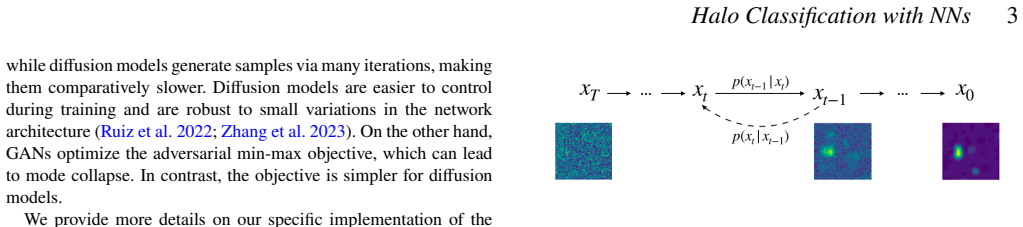
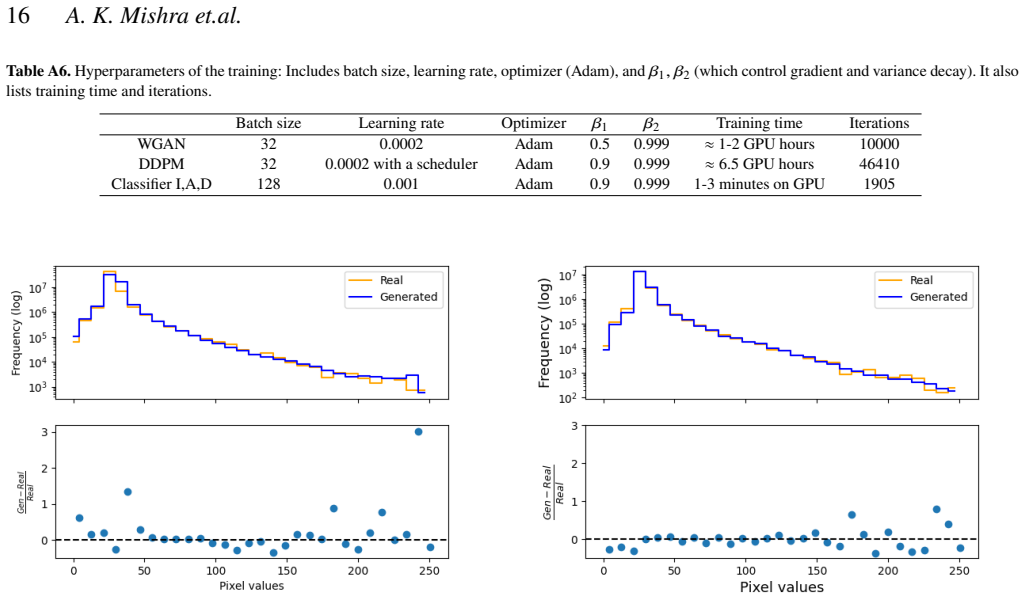
The load-bearing mechanism is generative data augmentation with a Denoising Diffusion Probabilistic Model (DDPM): the model corrupts images by adding Gaussian noise in a forward Markov chain and learns to reverse the process with a U-Net, producing synthetic (64, 64, 4) multi-frequency halo cutouts that are added to the training set. The classifier is a convolutional network augmented with a multi-head self-attention block, which captures correlations between distant pixels with fewer trainable parameters than a plain CNN. The paper uses the FID and KID metrics to show DDPM-generated halos are closer to real images than WGAN-generated ones, and shows that adding diffusion samples improves every classifier variant, with the attention variant benefiting most.
What would settle it
Run the trained classifier on hundreds of random blank sky patches and known non-halo radio galaxies; if the fraction scoring above 0.95 approaches the claimed detection rates (75% and 63%), then the threshold is not specific to halos and the rediscovery numbers would not demonstrate halo detection.
Extended reading notes
Core claim
The paper establishes that a small real sample of MWA halo images can be supplemented with DDPM-generated multi-frequency images to train a classifier that distinguishes halos from non-halos, and that this classifier generalizes to sources it was never trained on. The best variant, a convolutional network with a multi-head attention block, achieves 95.93% average validation accuracy and an F1 score of 0.965 over ten runs, using 36 clusters for training and 10 for testing with no hyperparameter tuning. Applied to external catalogues, it recovers 9/12 halos from the MeerKAT Galaxy Cluster Legacy Survey and 5/8 halos from the Planck SZ Catalogue 2 within GLEAM, and it proposes 11 XMM-Chandra-detected COSMOS clusters as new halo, minihalo, or candidate-halo sources.
Load-bearing premise
The load-bearing premise is that a classifier score of at least 0.95 marks a real halo rather than a compact source, artifact, or unrelated diffuse feature; the paper does not measure how often the same score occurs on empty or non-halo positions.
Editorial extensions
If this is right
- A classifier trained on low-resolution MWA data can screen higher-resolution surveys for diffuse halo candidates without requiring X-ray or SZ preselection.
- The 11 COSMOS candidates become a concrete follow-up target list; confirming any of them would show the tool discovers new objects rather than merely re-finding known ones.
- Generative augmentation with diffusion models can be reused for other radio-source classification problems where labeled samples number in the tens.
- The validation accuracy is measured on a deliberately simple binary task; extending the same pipeline to more diverse non-halo classes and multi-survey images is the paper's own stated next step.
- The generated halo images themselves are released as a labeled dataset, giving the community a resource for further classifier development.
Reading between the lines
- Beyond the paper, the detection rates at the 0.95 threshold are upper envelopes until the false-positive rate on empty fields and compact non-halo sources is measured, since the paper does not report that calibration.
- Beyond the paper, the fixed ratio of generated to real training samples (about 0.5) is left untuned, so both higher and lower synthetic-to-real ratios could change the accuracy and the generalization to faint halos.
- Beyond the paper, applying the same classifier to native-resolution MGCLS or LOFAR images would test whether diffusion augmentation transfers across resolution regimes, which the current GLEAM-only training does not directly establish.
- Beyond the paper, moving classification from the image plane to the u-v plane, as the conclusion suggests, would make the method independent of imaging artifacts and could enable blind all-sky searches.
Signed reviews
Editorial analysis
A structured set of objections, weighed in public.
Referee Report
Summary. The paper trains binary classifiers (a LeNet-style CNN, a dense network, and a CNN with multi-head attention) to detect radio halos in 64x64 4-frequency cutouts from MWA/GLEAM observations, using a small labeled sample of 23 halo and 23 non-halo sources. To overcome the paucity of real examples, the authors compare WGAN- and DDPM-generated halo images as data augmentation, report that DDPM images are more realistic by FID/KID, and find that a diffusion-augmented attention classifier achieves 95.93% accuracy on a held-out test partition. The classifier is then applied to catalog-selected cluster centers, rediscovering 9/12 MGCLS and 5/8 PSZ2 halos in GLEAM and flagging 11 XMM-Chandra clusters in the COSMOS field as candidate halos. The paper concludes that generative augmentation can support ML-based detection of diffuse emission.
Significance. If the results hold, this is a useful methodological demonstration: DDPM-based generative augmentation appears to help a simple classifier on a very small astronomical image dataset, and the problem (low-frequency halo detection without X-ray/SZ preselection) is timely. The systematic comparison of WGAN versus DDPM, the ablation across three classifier architectures, and the authors' explicit caveat that their detections indicate central diffuse emission rather than confirmed halos (Section 5.5.3) are strengths. The reproducible-code commitment is also a strength, though the repository link is not actually given in this version. However, the externally-facing claims -- the 9/12 and 5/8 rediscovery rates and the COSMOS candidate list -- are uncalibrated: no negative-control false-positive measurement is presented for the score>=0.95 threshold, and the PSZ2 denominator is adjusted post hoc. These issues currently prevent the paper from supporting the 'unbiased detection' language in the abstract and from establishing the specific detection fractions as reliable.
major comments (3)
- [5.4] The detection threshold of classification score >= 0.95 is introduced 'to minimize false positives', but no false-positive rate is ever measured. The classifier is applied only to catalog-selected cluster centers (MGCLS, PSZ2, XMM-Chandra), and the paper's own Section 5.5.3 states that the detections should be seen as 'identification of a central source of diffuse emission in the cluster' rather than confirmed halos. Without a negative-control sample -- random sky positions, cluster centers with no known diffuse halo, or artifact-rich fields -- the reported 9/12 and 5/8 rediscovery rates and the 11 COSMOS candidates do not demonstrate that the threshold is specific to halos rather than to compact or central diffuse emission at MWA resolution. I recommend adding null-field and non-halo cluster-center tests and reporting precision-recall as a function of the score threshold.
- [5.4.1] The denominator for the PSZ2 detection rate is chosen post hoc. The paper analyzes 17 PSZ2 halos in GLEAM, then excludes 9 (3 truncated, 4 noisy, 2 small) and reports 5/8. If all 17 are counted, the detection rate is 5/17 approximately 29%. The exclusion criteria ('truncated', 'high noise', 'smaller-sized') are not pre-registered and may be correlated with detectability, so the reported 63% detection rate is not robust. Please report the full-sample result and present the exclusions as a sensitivity analysis with quantitative definitions for each exclusion category.
- [5.3.2, Table 3] The held-out test set contains only 5 halo and 5 non-halo real sources, from which 1280 and 960 images are created by augmentation. The 10-run mean and standard deviation of accuracy and F1 therefore reflect repeated, highly correlated views of the same few sources, not generalization to new clusters. The paper acknowledges in Section 6 that k-fold validation is needed, but as it stands the headline accuracy of 95.93% is not supported as a generalizable performance metric. Please add source-level cross-validation (e.g., leave-one-cluster-out) and report per-source predictions.
minor comments (8)
- [Abstract, Table 5] The abstract reports 'best average validation accuracy of 95.93%', but Table 5 and Section 5.3.2 describe metrics calculated on the held-out test set; please use consistent terminology. Also, 'without further hyperparameter tuning' should be qualified by the early stopping and checkpoint selection based on validation accuracy.
- [Table 3] With 8 rotations x 2 flips x 10 brightness scalings, 18 training halo sources should yield 2880 images, not the listed 5440; similarly the other counts do not match the stated augmentation factors. Please clarify whether multiple frequency channels are treated as separate images or whether side cutouts are included, and correct the table so the counts are reproducible.
- [Figure 10 caption] The caption states 'Class 0 and Class 1, represent halos and non-halos respectively', which is reversed relative to Section 4.1 where class 1 is halos and class 0 is non-halos; the caption should be corrected.
- [5.4.2, Table 8] Several COSMOS candidates are within approximately 1-2 arcminutes of each other (e.g., CXOC J100024.9+023956, CXOC J100022.7+023801, CXOC J100024.6+023748), suggesting duplicate detections of the same system; the count of '11 potential new halos' should be de-duplicated with a matching radius.
- [Data Availability] The GitHub repository is listed as '(github-radio-halo-classification)' rather than a working URL; please provide the actual repository address and, if available, a dataset DOI.
- [2.2] The notation theta in [0,9] intersect Z is undefined and is not used later in the paper; either define it or remove it.
- [Abstract, Section 1] The abstract's 'capable of unbiased detection of diffuse emission' conflicts with Section 1's statement that the tool is 'designed for halo searches specifically in MWA data, using cataloged sources as references', since the external application is only to catalog-selected cluster centers. Please remove or limit the 'unbiased' claim to the labeling methodology rather than the survey strategy.
- [5.2] The FID/KID values for multi-frequency generated images are computed against the training set 'as is the standard practice', so they do not measure how well generated images match held-out halos; please state this limitation explicitly or evaluate on a held-out set.
Circularity Check
No significant circularity: external benchmark sources (MGCLS, PSZ2, XMM-Chandra) are absent from training, so the detection claims are not forced by construction; the main caveats are calibration and test-set pseudoreplication, not input-output equivalence.
full rationale
No load-bearing step in the derivation reduces to its own inputs. The WGAN and DDPM generators are trained on real GLEAM halo cutouts, and the classifier is trained on classic plus generative augmentations of 18 halo and 18 non-halo sources (Table 3). The external evaluation uses MGCLS, PSZ2, and XMM-Chandra cluster images that are not in the training set, so the reported 9/12, 5/8, and 11-candidate results are not equal by construction to the training labels. The Section 5.4 score-threshold of 0.95 is an analyst-chosen operating point and is not fitted to the external catalogs, so it is a calibration concern rather than a fitted input renamed as a prediction. The post-hoc exclusion of 9 of 17 PSZ2 sources (3 truncated, 4 high-noise, 2 small) changes the denominator and weakens the 5/8 figure as an unbiased detection rate, but this is a sample-selection limitation, not circularity. The 95.93% validation accuracy is computed on augmented copies of the same 5 halo and 5 non-halo test sources, creating source-level pseudoreplication and overstating the independence of the 10-run benchmark; the paper itself states in Section 6 that k-fold validation is left for future work. Section 5.5.3 explicitly downgrades the external detections to identification of central diffuse emission rather than confirmed halos, which limits the astrophysical claim but does not make the pipeline circular. No self-citation chain, imported uniqueness theorem, or ansatz smuggled via citation is present.
Assumptions & free parameters
free parameters (4)
- detection score threshold =
0.95
- generated-to-real augmentation ratio Gamma =
text says about 0.5; counts imply about 1.07
- 3-sigma background clipping threshold =
3
- 64 by 64 pixel cutout size =
64
assumptions (4)
- domain assumption The literature labels used as ground truth (H, cH, mH, cmH vs non-halo) are correct, and candidate labels represent true diffuse emission.
- domain assumption Diffusion-generated halo images are realistic enough that training on them improves generalization instead of teaching generator artifacts.
- domain assumption MWA/GLEAM images after preprocessing are representative of the cluster fields the classifier is applied to.
- domain assumption InceptionV3 features trained on ImageNet provide a valid quality metric for single-channel radio images.
Cite this review
Pith. "Pith review of Radio Halo Detection in MWA Data using Deep Neural Networks and Generative Data Augmentation." pith.science (2026). https://pith.science/paper/XLZRNPEW
@misc{pith2026241115559,
  author       = {Pith},
  title        = {Pith review of: Radio Halo Detection in MWA Data using Deep Neural Networks and Generative Data Augmentation},
  year         = {2026},
  howpublished = {\url{https://pith.science/paper/XLZRNPEW}},
  note         = {Machine review of arXiv:2411.15559}
}
read the original abstract
Detecting diffuse radio emission, such as from halos, in galaxy clusters is crucial for understanding large-scale structure formation in the universe. Traditional methods, which rely on X-ray and Sunyaev-Zeldovich (SZ) cluster pre-selection, introduce biases that limit our understanding of the full population of diffuse radio sources. In this work, we provide a possible resolution for this astrophysical tension by developing a machine learning (ML) framework capable of unbiased detection of diffuse emission, using a limited real dataset like those from the Murchison Widefield Array (MWA). We generate for the first time radio halo images using Wasserstein Generative Adversarial Networks (WGANs) and Denoising Diffusion Probabilistic Models (DDPMs), and apply them to train a neural network classifier independent of pre-selection methods. The halo images generated by DDPMs are of higher quality than those produced by WGANs. The diffusion-supported classifier with a multi-head attention block achieved the best average validation accuracy of 95.93% over 10 runs, using 36 clusters for training and 10 for testing, without further hyperparameter tuning. Using our classifier, we rediscovered 9/12 halos (75% detection rate) from the MeerKAT Galaxy Cluster Legacy Survey (MGCLS) Catalogue, and 5/8 halos (63% detection rate) from the Planck Sunyaev-Zeldovich Catalogue 2 (PSZ2) within the GaLactic and Extragalactic All-sky MWA (GLEAM) survey. In addition, we identify 11 potential new halos, minihalos, or candidates in the COSMOS field using XMM-chandra-detected clusters in GLEAM data. This work demonstrates the potential of ML for unbiased detection of diffuse emission and provides labeled datasets for further study.
Figures


Figures from the paper (8 more)



Forward citations
Cited by 2 Pith papers
-
Simulating realistic radio continuum survey maps with diffusion models
A diffusion-model pipeline generates realistic simulated LOFAR survey maps with controllable galaxy sizes, closely matching real flux and size distributions.
-
A Guided Unconditional Diffusion Model to Synthesize and Inpaint Radio Galaxies from FIRST, MGCLS and Radio Zoo
A masked-guided diffusion model generates and inpaints radio galaxy images from a combined FIRST, MGCLS, and Radio Galaxy Zoo dataset.
Reference graph
Works this paper leans on
-
[1]
Abadi M., et al., 2016, @doi [arXiv e-prints] 10.48550/arXiv.1603.04467 , https://ui.adsabs.harvard.edu/abs/2016arXiv160304467A p. arXiv:1603.04467
-
[2]
Ackermann M., et al., 2014, @doi [The Astrophysical Journal] 10.1088/0004-637x/787/1/18 , 787, 18
-
[3]
Adam R., et al., 2017, @doi [ ] 10.1051/0004-6361/201629810 , https://ui.adsabs.harvard.edu/abs/2017A&A...606A..64A 606, A64
-
[4]
Alhassan W., Taylor A. R., Vaccari M., 2018, @doi [Monthly Notices of the Royal Astronomical Society] 10.1093/mnras/sty2038 , 480, 2085
-
[5]
Ananthakrishnan S., 1995, Journal of Astrophysics and Astronomy Supplement, https://ui.adsabs.harvard.edu/abs/1995JApAS..16..427A 16, 427
1995
-
[6]
Andrade-Santos F., et al., 2017, @doi [The Astrophysical Journal] 10.3847/1538-4357/aa7461 , 843, 76
-
[7]
Aniyan A. K., Thorat K., 2017, @doi [ ] 10.3847/1538-4365/aa7333 , https://ui.adsabs.harvard.edu/abs/2017ApJS..230...20A 230, 20
-
[8]
pp 214--223
Arjovsky M., Chintala S., Bottou L., 2017, in Proceedings of the 34th International Conference on Machine Learning (ICML 2017). pp 214--223
2017
Show all 94 references
-
[9]
Arora S., Zhang Y., 2017, Do GANs actually learn the distribution? An empirical study ( @eprint arXiv 1706.08224 )
2017 arXiv
-
[10]
Bairouk A., Chaumont M., Fouchez D., Paquet J., Comby F., Bautista J., 2023, @doi [ ] 10.1051/0004-6361/202244657 , https://ui.adsabs.harvard.edu/abs/2023A&A...673A.141B 673, A141
2023 doi
-
[11]
Balakrishnan V., Champion D., Barr E., Kramer M., Sengar R., Bailes M., 2021, @doi [Monthly Notices of the Royal Astronomical Society] 10.1093/mnras/stab1308 , 505, 1180
2021 doi
-
[12]
J., Scaife A
Bastien D. J., Scaife A. M. M., Tang H., Bowles M., Porter F., 2021, @doi [Monthly Notices of the Royal Astronomical Society] 10.1093/mnras/stab588 , 503, 3351
2021 doi
-
[13]
et al., 2024, @doi [A&A] 10.1051/0004-6361/202348045 , 686, A82
Biava, N. et al., 2024, @doi [A&A] 10.1051/0004-6361/202348045 , 686, A82
2024 doi
-
[14]
J., Arbel M., Gretton A., 2018, in International Conference on Learning Representations
Bińkowski M., Sutherland D. J., Arbel M., Gretton A., 2018, in International Conference on Learning Representations
2018
-
[15]
B., 2010, @doi [ ] 10.1051/0004-6361/200913696 , https://ui.adsabs.harvard.edu/abs/2010A&A...513A..30B 513, A30
Bonafede A., Feretti L., Murgia M., Govoni F., Giovannini G., Dallacasa D., Dolag K., Taylor G. B., 2010, @doi [ ] 10.1051/0004-6361/200913696 , https://ui.adsabs.harvard.edu/abs/2010A&A...513A..30B 513, A30
2010 doi
-
[16]
Boone F., 2013, @doi [Experimental Astronomy] 10.1007/s10686-012-9322-1 , https://ui.adsabs.harvard.edu/abs/2013ExA....36...77B 36, 77
2013 doi
-
[17]
Botteon A., et al., 2022, @doi [ ] 10.1051/0004-6361/202143020 , https://ui.adsabs.harvard.edu/abs/2022A&A...660A..78B 660, A78
2022 doi
-
[18]
Bowles M., Bromley M., Allen M., Scaife A., 2021, E(2) Equivariant Self-Attention for Radio Astronomy ( @eprint arXiv 2111.04742 ), https://arxiv.org/abs/2111.04742
2021 arXiv
-
[19]
S., 1995, in American Astronomical Society Meeting Abstracts
Briggs D. S., 1995, in American Astronomical Society Meeting Abstracts. p. 112.02
1995
-
[20]
W., 2014, International Journal of Modern Physics D, 23, 1430007
Brunetti G., Jones T. W., 2014, International Journal of Modern Physics D, 23, 1430007
2014
-
[21]
Brunetti G., Lazarian A., 2016, @doi [Monthly Notices of the Royal Astronomical Society] 10.1093/mnras/stw496 , 458, 2584
2016 doi
-
[22]
Brunetti G., Zimmer S., Zandanel F., 2017, @doi [Monthly Notices of the Royal Astronomical Society] 10.1093/mnras/stx2092 , 472, 1506
2017 doi
-
[23]
M., Scaife A
Cantwell T. M., Scaife A. M. M., Oozeer N., Wen Z. L., Han J. L., 2016, @doi [Monthly Notices of the Royal Astronomical Society] 10.1093/mnras/stw419 , 458, 1803
2016 doi
-
[24]
Cassano R., Ettori S., Giacintucci S., Brunetti G., Markevitch M., Venturi T., Gitti M., 2010, @doi [ ] 10.1088/2041-8205/721/2/L82 , https://ui.adsabs.harvard.edu/abs/2010ApJ...721L..82C 721, L82
2010 doi
-
[25]
E., Kronberg P
Clarke T. E., Kronberg P. P., B \"o hringer H., 2001, @doi [ ] 10.1086/318896 , https://ui.adsabs.harvard.edu/abs/2001ApJ...547L.111C 547, L111
2001 doi
-
[26]
Cuciti V., Cassano R., Brunetti G., Dallacasa D., Kale R., Ettori S., Venturi T., 2015, @doi [ ] 10.1051/0004-6361/201526420 , https://ui.adsabs.harvard.edu/abs/2015A&A...580A..97C 580, A97
2015 doi
- [27]
-
[28]
W., Johnston-Hollitt M., Bartalucci I., 2021b, @doi [Publications of the Astronomical Society of Australia] 10.1017/pasa.2021.45 , 38
Duchesne S. W., Johnston-Hollitt M., Bartalucci I., 2021b, @doi [Publications of the Astronomical Society of Australia] 10.1017/pasa.2021.45 , 38
2021 doi
-
[29]
W., Johnston-Hollitt M., Wilber A
Duchesne S. W., Johnston-Hollitt M., Wilber A. G., 2021a, @doi [Publications of the Astronomical Society of Australia] 10.1017/pasa.2021.24 , 38
2021 doi
-
[30]
W., Johnston-Hollitt M., Offringa A
Duchesne S. W., Johnston-Hollitt M., Offringa A. R., Pratt G. W., Zheng Q., Dehghan S., 2021c, @doi [ ] 10.1017/pasa.2021.7 , https://ui.adsabs.harvard.edu/abs/2021PASA...38...10D 38, e010
2021 doi
-
[31]
Feretti L., Giovannini G., Govoni F., Murgia M., 2012, Astronomy & Astrophysics Review, 20, 54
2012
-
[32]
Forman W., Jones C., 1982, @doi [ ] 10.1146/annurev.aa.20.090182.002555 , https://ui.adsabs.harvard.edu/abs/1982ARA&A..20..547F 20, 547
1982
-
[33]
T., et al., 2017, @doi [ ] 10.1093/mnras/stx155 , https://ui.adsabs.harvard.edu/abs/2017MNRAS.467..936G 467, 936
George L. T., et al., 2017, @doi [ ] 10.1093/mnras/stx155 , https://ui.adsabs.harvard.edu/abs/2017MNRAS.467..936G 467, 936
2017 doi
-
[34]
E., Brunetti G., 2017, @doi [ ] 10.3847/1538-4357/aa7069 , https://ui.adsabs.harvard.edu/abs/2017ApJ...841...71G 841, 71
Giacintucci S., Markevitch M., Cassano R., Venturi T., Clarke T. E., Brunetti G., 2017, @doi [ ] 10.3847/1538-4357/aa7069 , https://ui.adsabs.harvard.edu/abs/2017ApJ...841...71G 841, 71
2017 doi
-
[35]
Giovannini G., Tordi M., Feretti L., 1999, @doi [ ] 10.1016/S1384-1076(99)00018-4 , https://ui.adsabs.harvard.edu/abs/1999NewA....4..141G 4, 141
1999 doi
-
[36]
Goodfellow I., Pouget-Abadie J., Mirza M., Xu B., Warde-Farley D., Ozair S., Courville A., Bengio Y., 2014, Advances in neural information processing systems, 27
2014
-
[37]
C., 2017, Advances in neural information processing systems, 30
Gulrajani I., Ahmed F., Arjovsky M., Dumoulin V., Courville A. C., 2017, Advances in neural information processing systems, 30
2017
-
[38]
Hackstein S., Kinakh V., Bailer C., Melchior M., 2023, @doi [Astronomy and Computing] https://doi.org/10.1016/j.ascom.2022.100685 , 42, 100685
2023
-
[39]
pp 6626--6637
Heusel M., Ramsauer H., Unterthiner T., Nessler B., Hochreiter S., 2017, in Advances in Neural Information Processing Systems. pp 6626--6637
2017
- [40]
-
[41]
W., et al., 2021, @doi [ ] 10.1017/pasa.2021.1 , https://ui.adsabs.harvard.edu/abs/2021PASA...38....9H 38, e009
Hotan A. W., et al., 2021, @doi [ ] 10.1017/pasa.2021.1 , https://ui.adsabs.harvard.edu/abs/2021PASA...38....9H 38, e009
2021 doi
- [42]
-
[43]
Hurley-Walker N., et al., 2017, @doi [ ] 10.1093/mnras/stw2337 , https://ui.adsabs.harvard.edu/abs/2017MNRAS.464.1146H 464, 1146
2017 doi
-
[44]
Springer, New York
James G., Witten D., Hastie T., Tibshirani R., 2013, An Introduction to Statistical Learning: with Applications in R. Springer, New York
2013
-
[45]
Jonas J., MeerKAT Team 2016, in MeerKAT Science: On the Pathway to the SKA. p. 1, @doi 10.22323/1.277.0001
2016 doi
-
[46]
P., Ba J., 2017, Adam: A Method for Stochastic Optimization ( @eprint arXiv 1412.6980 )
Kingma D. P., Ba J., 2017, Adam: A Method for Stochastic Optimization ( @eprint arXiv 1412.6980 )
2017 arXiv
-
[47]
Knowles K., et al., 2021, @doi [Monthly Notices of the Royal Astronomical Society] 10.1093/mnras/stab939 , 504, 1749
2021 doi
-
[48]
Knowles K., et al., 2022, @doi [ ] 10.1051/0004-6361/202141488 , https://ui.adsabs.harvard.edu/abs/2022A&A...657A..56K 657, A56
2022 doi
-
[49]
V., Borgani S., 2012, @doi [ ] 10.1146/annurev-astro-081811-125502 , https://ui.adsabs.harvard.edu/abs/2012ARA&A..50..353K 50, 353
Kravtsov A. V., Borgani S., 2012, @doi [ ] 10.1146/annurev-astro-081811-125502 , https://ui.adsabs.harvard.edu/abs/2012ARA&A..50..353K 50, 353
2012 doi
- [50]
-
[51]
Lecun Y., Bottou L., Bengio Y., Haffner P., 1998, @doi [Proceedings of the IEEE] 10.1109/5.726791 , 86, 2278
1998 doi
-
[52]
Lukic V., de Gasperin F., Br \"u ggen M., 2019, @doi [Galaxies] 10.3390/galaxies8010003 , https://ui.adsabs.harvard.edu/abs/2019Galax...8....3L 8, 3
2019 doi
- [53]
-
[54]
Maslej-Kre s n \'a kov \'a V., El Bouchefry K., Butka P., 2021, @doi [ ] 10.1093/mnras/stab1400 , https://ui.adsabs.harvard.edu/abs/2021MNRAS.505.1464M 505, 1464
2021 doi
-
[55]
N., 2017, @doi [ ] 10.1093/mnras/stx007 , https://ui.adsabs.harvard.edu/abs/2017MNRAS.466.4346M 466, 4346
Miraghaei H., Best P. N., 2017, @doi [ ] 10.1093/mnras/stx007 , https://ui.adsabs.harvard.edu/abs/2017MNRAS.466.4346M 466, 4346
2017 doi
-
[56]
Mirza M., Osindero S., 2014, Conditional Generative Adversarial Nets ( @eprint arXiv 1411.1784 )
2014 arXiv
-
[57]
J., Culhane J
Mitchell R. J., Culhane J. L., Davison P. J. N., Ives J. C., 1976, @doi [ ] 10.1093/mnras/175.1.29P , https://ui.adsabs.harvard.edu/abs/1976MNRAS.175P..29M 175, 29P
1976 doi
-
[58]
F., 1950, @doi [Proceedings of the National Academy of Science] 10.1073/pnas.36.1.48 , https://ui.adsabs.harvard.edu/abs/1950PNAS...36...48N 36, 48
Nash J. F., 1950, @doi [Proceedings of the National Academy of Science] 10.1073/pnas.36.1.48 , https://ui.adsabs.harvard.edu/abs/1950PNAS...36...48N 36, 48
1950 doi
-
[59]
E., 2021, @doi [ ] 10.1093/mnras/stab271 , https://ui.adsabs.harvard.edu/abs/2021MNRAS.502.3417N 502, 3417
Ntwaetsile K., Geach J. E., 2021, @doi [ ] 10.1093/mnras/stab271 , https://ui.adsabs.harvard.edu/abs/2021MNRAS.502.3417N 502, 3417
2021 doi
-
[60]
Paul S., et al., 2023, @doi [Journal of Astrophysics and Astronomy] 10.1007/s12036-023-09914-2 , 44
2023 doi
-
[61]
B., Babul A., McCarthy I
Poole G. B., Babul A., McCarthy I. G., Fardal M. A., Bildfell C. J., Quinn T., Mahdavi A., 2007, @doi [Monthly Notices of the Royal Astronomical Society] 10.1111/j.1365-2966.2007.12107.x , 380, 437
2007
-
[62]
Radford A., Metz L., Chintala S., 2016, Unsupervised Representation Learning with Deep Convolutional Generative Adversarial Networks ( @eprint arXiv 1511.06434 )
2016 arXiv
-
[63]
J., Intema H
Raja R., Rahaman M., Datta A., van Weeren R. J., Intema H. T., Paul S., 2020, @doi [Monthly Notices of the Royal Astronomical Society] 10.1093/mnras/staa3432 , 500, 2236–2249
2020 doi
- [64]
-
[65]
W., Sarazin C
Randall S. W., Sarazin C. L., Ricker P. M., 2002, @doi [The Astrophysical Journal] 10.1086/342239 , 577, 579
2002 doi
- [66]
- [67]
-
[68]
Rustige L., et al., 2023, @doi [RAS Techniques and Instruments] 10.1093/rasti/rzad016 , 2, 264
2023 doi
-
[69]
Sadeghi M., Javaherian M., Miraghaei H., 2021, @doi [The Astronomical Journal] 10.3847/1538-3881/abd314 , 161, 94
2021 doi
-
[70]
T., Bansal M., Wadadekar Y., 2022, @doi [ ] 10.1093/mnras/stab3144 , https://ui.adsabs.harvard.edu/abs/2022MNRAS.509.2269S 509, 2269
Samudre A., George L. T., Bansal M., Wadadekar Y., 2022, @doi [ ] 10.1093/mnras/stab3144 , https://ui.adsabs.harvard.edu/abs/2022MNRAS.509.2269S 509, 2269
2022 doi
-
[71]
Sanderson A., Ponman T., Finoguenov A., Lloyd-Davies E., Markevitch M., 2003, @doi [Monthly Notices of the Royal Astronomical Society] 10.1046/j.1365-8711.2003.06401.x , 340, 989
2003
-
[72]
Scaife A. M. M., Porter F., 2021, @doi [ ] 10.1093/mnras/stab530 , https://ui.adsabs.harvard.edu/abs/2021MNRAS.503.2369S 503, 2369
2021 doi
-
[73]
K., 2017, @doi [Monthly Notices of the Royal Astronomical Society: Letters] 10.1093/mnrasl/slx008 , 467, L110
Schawinski K., Zhang C., Zhang H., Fowler L., Santhanam G. K., 2017, @doi [Monthly Notices of the Royal Astronomical Society: Letters] 10.1093/mnrasl/slx008 , 467, L110
2017 doi
-
[74]
Schlickeiser R., Sievers A., Thiemann H., 1987, Astronomy and Astrophysics (ISSN 0004-6361), vol. 182, no. 1, Aug. 1987, p. 21-35., 182, 21
1987
-
[75]
J., Smith B
Serlemitsos P. J., Smith B. W., Boldt E. A., Holt S. S., Swank J. H., 1977, @doi [ ] 10.1086/182342 , https://ui.adsabs.harvard.edu/abs/1977ApJ...211L..63S 211, L63
1977 doi
-
[76]
Smithsonian Astrophysical Observatory 2000, SAOImage DS9: A Utility for Displaying Astronomical Images in the X11 Window Environment, Astrophysics Source Code Library, record ascl:0003.002, https://ui.adsabs.harvard.edu/abs/2000ascl.soft03002S
2000
-
[77]
37, Proceedings of the 32nd International Conference on Machine Learning
Sohl-Dickstein J., Weiss E., Maheswaranathan N., Ganguli S., 2015, in Bach F., Blei D., eds, Proceedings of Machine Learning Research Vol. 37, Proceedings of the 32nd International Conference on Machine Learning. PMLR, Lille, France, pp 2256--2265, https://proceedings.mlr.pres...
2015
- [78]
-
[79]
A., Zeldovich Y
Sunyaev R. A., Zeldovich Y. B., 1972, Comments on Astrophysics and Space Physics, https://ui.adsabs.harvard.edu/abs/1972CoASP...4..173S 4, 173
1972
-
[80]
pp 2818--2826
Szegedy C., Vanhoucke V., Ioffe S., Shlens J., Wojna Z., 2016, in Proceedings of the IEEE Conference on Computer Vision and Pattern Recognition. pp 2818--2826
2016
-
[81]
Tang H., Scaife A. M. M., Leahy J. P., 2019, @doi [ ] 10.1093/mnras/stz1883 , https://ui.adsabs.harvard.edu/abs/2019MNRAS.488.3358T 488, 3358
2019 doi
-
[82]
J., et al., 2013, @doi [ ] 10.1017/pasa.2012.007 , https://ui.adsabs.harvard.edu/abs/2013PASA...30....7T 30, e007
Tingay S. J., et al., 2013, @doi [ ] 10.1017/pasa.2012.007 , https://ui.adsabs.harvard.edu/abs/2013PASA...30....7T 30, e007
2013 doi
-
[83]
Butterworth-Heinemann, London
Van Rijsbergen C., 1979, Information Retrieval. Butterworth-Heinemann, London
1979
-
[84]
N., Kaiser L., Polosukhin I., 2017, @doi [arXiv e-prints] 10.48550/arXiv.1706.03762 , https://ui.adsabs.harvard.edu/abs/2017arXiv170603762V p
Vaswani A., Shazeer N., Parmar N., Uszkoreit J., Jones L., Gomez A. N., Kaiser L., Polosukhin I., 2017, @doi [arXiv e-prints] 10.48550/arXiv.1706.03762 , https://ui.adsabs.harvard.edu/abs/2017arXiv170603762V p. arXiv:1706.03762
-
[85]
S., Van Speybroeck L., 2006, @doi [ ] 10.1086/500288 , https://ui.adsabs.harvard.edu/abs/2006ApJ...640..691V 640, 691
Vikhlinin A., Kravtsov A., Forman W., Jones C., Markevitch M., Murray S. S., Van Speybroeck L., 2006, @doi [ ] 10.1086/500288 , https://ui.adsabs.harvard.edu/abs/2006ApJ...640..691V 640, 691
2006 doi
-
[86]
B., et al., 2015, @doi [ ] 10.1017/pasa.2015.26 , https://ui.adsabs.harvard.edu/abs/2015PASA...32...25W 32, e025
Wayth R. B., et al., 2015, @doi [ ] 10.1017/pasa.2015.26 , https://ui.adsabs.harvard.edu/abs/2015PASA...32...25W 32, e025
2015 doi
-
[87]
R., Sarazin C
Wik D. R., Sarazin C. L., Ricker P. M., Randall S. W., 2008, @doi [The Astrophysical Journal] 10.1086/587790 , 680, 17
2008 doi
-
[88]
G., Johnston-Hollitt M., Duchesne S
Wilber A. G., Johnston-Hollitt M., Duchesne S. W., Tasse C., Akamatsu H., Intema H., Hodgson T., 2020, @doi [Publications of the Astronomical Society of Australia] 10.1017/pasa.2020.34 , 37, e040
2020 doi
-
[89]
Wu D., Cao H., Lv N., Fan J., Tan X., Yang S., 2019, @doi [The Astrophysical Journal Letters] 10.3847/2041-8213/ab595e , 887, L10
2019 doi
-
[90]
Zhang W., Li X., Chen Y., Wang X., 2023, arXiv preprint arXiv:2310.08442
2023 arXiv
-
[91]
T., Frail D
de Gasperin F., Intema H. T., Frail D. A., 2017, @doi [Monthly Notices of the Royal Astronomical Society] 10.1093/mnras/stx3125 , 474, 5008
2017 doi
-
[92]
P., et al., 2013, @doi [ ] 10.1051/0004-6361/201220873 , https://ui.adsabs.harvard.edu/abs/2013A&A...556A...2V 556, A2
van Haarlem M. P., et al., 2013, @doi [ ] 10.1051/0004-6361/201220873 , https://ui.adsabs.harvard.edu/abs/2013A&A...556A...2V 556, A2
2013 doi
-
[93]
u ggen M., R \
van Weeren R. J., Br \"u ggen M., R \"o ttgering H. J. A., Hoeft M., Nuza S. E., Intema H. T., 2011, @doi [ ] 10.1051/0004-6361/201117149 , https://ui.adsabs.harvard.edu/abs/2011A&A...533A..35V 533, A35
2011 doi
-
[94]
van Weeren R. J., de Gasperin F., Akamatsu H., Br \"u ggen M., Feretti L., Kang H., Stroe A., Zandanel F., 2019, @doi [ ] 10.1007/s11214-019-0584-z , https://ui.adsabs.harvard.edu/abs/2019SSRv..215...16V 215, 16
2019 doi
Reviewed August 12, 2026 · model on record in the stance chip above.
Discussion (0). Continue with ORCID to comment.