Emergent transfinite topological dynamics
Pith reviewed 2026-05-23 05:15 UTC · model grok-4.3
The pith
Finitely convergent sequences of self-maps on compact metric spaces induce unique maximal transfinite orbits isomorphic to countable ordinals.
A machine-rendered reading of the paper's core claim, the machinery that carries it, and where it could break.
Core claim
Given a finitely convergent sequence F = {f_n} of self-maps on a compact metric space X, the f_n-orbits at each point exhibit an emergent poset structure whose maximal initial segment is isomorphic to a countable ordinal at least omega. Every such sequence induces at each point a unique maximal transfinite orbit that is independent of finite initial segments of the sequence and invariant under step-by-step conjugacy at each n. For any countable limit ordinal lambda, the paper studies orbits, recurrence, limit sets and attractors at level lambda, and shows that transfinite conjugacy refines conjugacy of the limit map while being strictly weaker than step-by-step conjugacy, with new invariants
What carries the argument
The emergent poset structure on the orbits of a finitely convergent sequence, which is canonically isomorphic to a countable ordinal and independent of finite prefixes.
If this is right
- Orbits, recurrence, and attractors become definable at every countable limit ordinal beyond the usual finite or omega iterations.
- Transfinite conjugacy supplies a strictly intermediate equivalence that distinguishes more dynamical features than limit-map conjugacy alone.
- A family of new invariants appears that detect recurrence and attraction phenomena separately at each ordinal level.
- The standard theory of topological dynamics at omega is recovered as the base case of the construction.
Where Pith is reading between the lines
- The framework may apply directly to numerical or approximation schemes in which maps stabilize only after long but finite computation times.
- It could link to well-founded structures in set theory or recursion theory by treating ordinal height as a measure of stabilization depth.
- Explicit examples on the interval or circle could be computed to exhibit distinct recurrence types at omega and at omega+1.
Load-bearing premise
The sequence of maps must be finitely convergent, so that for every point there is some N after which all further maps in the sequence send the point to the same image.
What would settle it
Construct a finitely convergent sequence on a compact metric space for which the induced orbit structure at some point fails to be a poset isomorphic to a countable ordinal or depends on the choice of finite initial segment.
Figures



read the original abstract
We present a canonical extension of topological dynamics to transfinite iterations, which makes precise the idea of dynamical phenomena stabilizing at different time-scales. Specifically, consider a sequence of self-maps $F=\{f_n\}$ of a compact metric space $X$. If $F$ is finitely convergent, i.e. $f_n(x)=f(x)$ for $n>N(x)$, the $f_n$-orbits exhibit an emergent poset structure. A maximal initial segment of this poset is isomorphic to a countable ordinal $\ge\omega$. The construction is canonical: every finitely convergent sequence induces, at each point, a unique maximal transfinite orbit that is independent of any finite initial segment of the sequence and invariant under step-by-step conjugacy at each $n$. For $\lambda$ a countable limit ordinal, we study orbits, recurrence, limit sets and attractors at level $\lambda$, and the interplay of different ordinal levels. Moreover, we introduce the natural notion of transfinite conjugacy, that sharply refines conjugacy of limit maps alone but is strictly weaker than step-by-step conjugacy. We describe a family of new invariants of transfinite conjugacy that detect recurrence and attraction phenomena at each ordinal level. Particularizing to $\lambda=\omega$ recovers (and in some cases strengthens) classical results of topological dynamics, revealing that the standard theory is the first level of a richer structural landscape.
Editorial analysis
A structured set of objections, weighed in public.
Referee Report
Summary. The manuscript proposes a canonical extension of topological dynamics to transfinite iterations. For a finitely convergent sequence of self-maps F={f_n} on a compact metric space X (i.e., f_n(x)=f(x) for all n>N(x)), the f_n-orbits at each point induce an emergent poset whose maximal initial segment is isomorphic to a countable ordinal ≥ω. The construction is asserted to be independent of any finite initial segment of F and invariant under step-by-step conjugacy. The paper introduces transfinite conjugacy (strictly between conjugacy of the limit map and step-by-step conjugacy), defines orbits/recurrence/limit sets/attractors at each countable limit ordinal λ, and shows that the ω-level recovers and sometimes strengthens classical results.
Significance. If the central construction and its invariance properties hold, the work supplies an explicit, parameter-free hierarchy that embeds standard topological dynamics as the first nontrivial level of a transfinite landscape, together with new invariants of transfinite conjugacy that detect recurrence and attraction at each ordinal. Credit is given for the definitional grounding in the openly stated finite-convergence precondition and for the poset-isomorphism claim, which furnishes a concrete, falsifiable structural prediction.
minor comments (1)
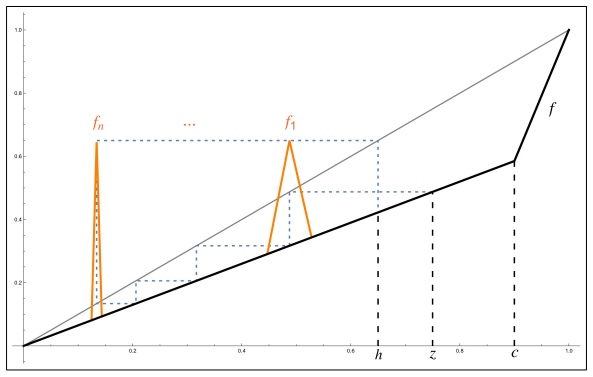
- The abstract and introduction would benefit from a single concrete low-dimensional example (e.g., on the circle or interval) that explicitly exhibits the poset for a sequence converging at different rates, to make the transfinite orbit construction immediately verifiable.
Simulated Author's Rebuttal
We thank the referee for the positive summary, significance assessment, and recommendation of minor revision. No major comments appear in the report, so there are no specific points requiring point-by-point rebuttal. We will incorporate any minor editorial or presentational suggestions in the revised manuscript.
Circularity Check
No significant circularity; explicit definitional construction
full rationale
The paper defines transfinite orbits and the induced poset directly from the given finitely convergent sequence F on the compact metric space X. The claimed canonicity, uniqueness of the maximal transfinite orbit, independence from finite initial segments, and invariance under step-by-step conjugacy are properties asserted of this explicit construction itself rather than derived from external results or fitted data. No equations reduce a claimed prediction to a fitted input by construction, no load-bearing uniqueness theorems are imported via self-citation, and no ansatz is smuggled through prior work. The finite-convergence precondition is stated openly as the enabling assumption, and the development of level-λ notions and transfinite conjugacy proceeds by further definitions on this foundation. The work is therefore self-contained against external benchmarks.
Axiom & Free-Parameter Ledger
axioms (2)
- domain assumption X is a compact metric space
- domain assumption The sequence F is finitely convergent at each point x
invented entities (2)
-
maximal transfinite orbit
no independent evidence
-
transfinite conjugacy
no independent evidence
Lean theorems connected to this paper
-
IndisputableMonolith/Foundation/RealityFromDistinction.lean; Cost/FunctionalEquation.lean (J-uniqueness)reality_from_one_distinction; washburn_uniqueness_aczel unclear?
unclearRelation between the paper passage and the cited Recognition theorem.
λ-attractors, phase transitions at ω² and ω^ω, transfinite conjugacy refining conjugacy of limit maps
What do these tags mean?
- matches
- The paper's claim is directly supported by a theorem in the formal canon.
- supports
- The theorem supports part of the paper's argument, but the paper may add assumptions or extra steps.
- extends
- The paper goes beyond the formal theorem; the theorem is a base layer rather than the whole result.
- uses
- The paper appears to rely on the theorem as machinery.
- contradicts
- The paper's claim conflicts with a theorem or certificate in the canon.
- unclear
- Pith found a possible connection, but the passage is too broad, indirect, or ambiguous to say the theorem truly supports the claim.
Reference graph
Works this paper leans on
-
[1]
Akin.The general topology of dynamical systems, volume 1
E. Akin.The general topology of dynamical systems, volume 1. American Mathematical Soc., 1993
work page 1993
-
[2]
L. Alsed` a, M. Chas, and J. Sm´ ıtal. On the structure of theω-limit sets for continuous maps of the interval.International Journal of Bifurcation and Chaos, 9(09):1719–1729, 1999
work page 1999
- [3]
-
[4]
G. D. Birkhoff and P. A. Smith. Structure analysis of surface transformations.Journal de Math´ ematiques pures et appliqu´ ees, 7:345–379, 1928
work page 1928
-
[5]
D. Burguet and K. McGoff. Orders of accumulation of entropy.Fundamenta Mathematicae, 216(1):1–53, 2012
work page 2012
-
[6]
J. Carr and R. L. Pego. Metastable patterns in solutions ofu t =ϵ 2uxx −f(u).Communi- cations on pure and applied mathematics, 42(5):523–576, 1989
work page 1989
-
[7]
Ciesielski.Set theory for the working mathematician
K. Ciesielski.Set theory for the working mathematician. Number 39. Cambridge University Press, 1997
work page 1997
-
[8]
A. Della Corte, M. Farotti, and S. R. Mart` ın. Competing holes in open dynamical systems. Proceedings of the American Mathematical Society, 152(12):5163–5173, 2024
work page 2024
-
[9]
Changming Ding. Chain prolongation and chain stability.Nonlinear Analysis: Theory, Methods & Applications, 68(9):2719–2726, 2008
work page 2008
-
[10]
T. Downarowicz. Entropy structure.Journal d’Analyse Mathematique, 96(1):57–116, 2005
work page 2005
-
[11]
D. B. Ellis, R. Ellis, and M. Nerurkar. The topological dynamics of semigroup actions. Transactions of the American Mathematical Society, pages 1279–1320, 2001
work page 2001
-
[12]
C. D. A. Evans and J. D. Hamkins. Transfinite game values in infinite chess.arXiv preprint arXiv:1302.4377, 2013
work page internal anchor Pith review Pith/arXiv arXiv 2013
-
[13]
C. D. A. Evans, J. D. Hamkins, and N. L. Perlmutter. A position in infinite chess with game valueω 4.arXiv preprint arXiv:1510.08155, 2015
work page internal anchor Pith review Pith/arXiv arXiv 2015
-
[14]
Helffer.Semi-classical analysis for the Schr¨ odinger operator and applications, volume
B. Helffer.Semi-classical analysis for the Schr¨ odinger operator and applications, volume
-
[15]
Jech.Set theory: The third millennium edition, revised and expanded
T. Jech.Set theory: The third millennium edition, revised and expanded. Springer, 2003
work page 2003
-
[16]
Kurka.Topological and symbolic dynamics
P. Kurka.Topological and symbolic dynamics. Soci´ et´ e math´ ematique de France Paris, France, 2003
work page 2003
-
[17]
Attractors and chain recurrence for semigroup of continuous maps
Kushal Lalwani. Attractors and chain recurrence for semigroup of continuous maps. 2022
work page 2022
-
[18]
T. Laux and F. Otto. Convergence of the thresholding scheme for multi-phase mean- curvature flow.Calculus of Variations and Partial Differential Equations, 55(5):129, 2016
work page 2016
-
[19]
P. D. Lax and C. David Levermore. The small dispersion limit of the korteweg-de vries equation. i.Communications on Pure and Applied Mathematics, 36(3):253–290, 1983. 79
work page 1983
- [20]
-
[21]
A. R. D. Mathias. Long delays in dynamics.CRM Preprint, (334), 1996
work page 1996
-
[22]
K. McGoff. Orders of accumulation of entropy on manifolds.Journal d’Analyse Math´ ematique, 114(1):157–206, 2011
work page 2011
-
[23]
B. Merriman, J. K. Bence, and S. Osher.Diffusion generated motion by mean curvature. Department of Mathematics, University of California, Los Angeles, 1992
work page 1992
-
[24]
J. R. Munkres.Topology (2nd edn). Pearson Modern Classic, 2000
work page 2000
-
[25]
D. Richeson and J. Wiseman. Chain recurrence rates and topological entropy.Topology and its Applications, 156(2):251–261, 2008
work page 2008
-
[26]
H. Schlichting and K. Gersten.Boundary-Layer Theory. Springer, 9th edition, 2016
work page 2016
- [27]
-
[28]
Sone.Kinetic Theory and Fluid Dynamics
Y. Sone.Kinetic Theory and Fluid Dynamics. Birkh¨ auser, 2002
work page 2002
- [29]
discussion (0)
Sign in with ORCID, Apple, or X to comment. Anyone can read and Pith papers without signing in.