From reflection to scattering: polarimetric signatures of funnel-type outflows. Modeling obscured ultraluminous X-ray sources
Pith reviewed 2026-06-29 06:17 UTC · model grok-4.3
The pith
Low-albedo funnel surfaces are required for high X-ray polarization in obscured super-Eddington accretors, at the expense of reduced collimation.
A machine-rendered reading of the paper's core claim, the machinery that carries it, and where it could break.
Core claim
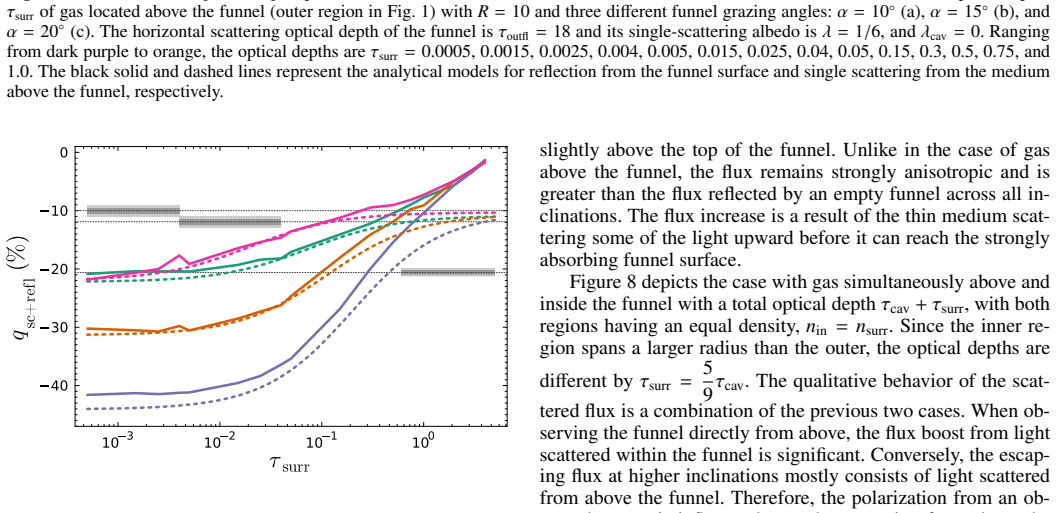
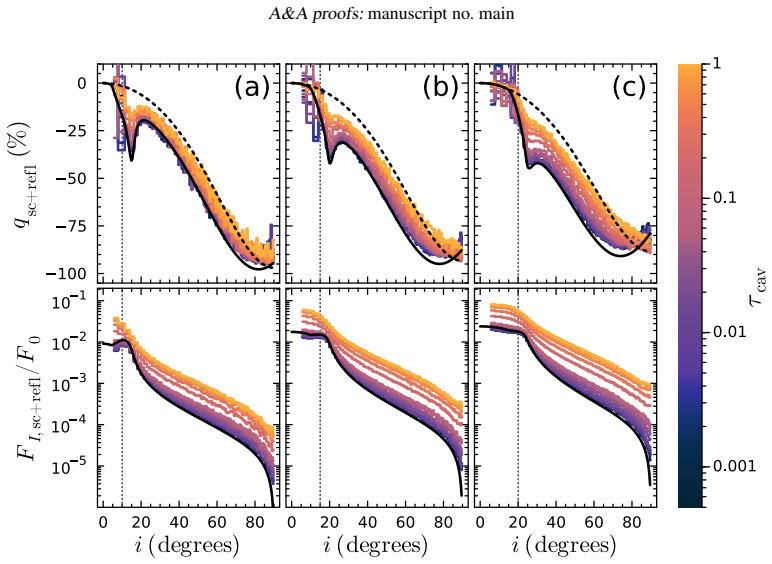
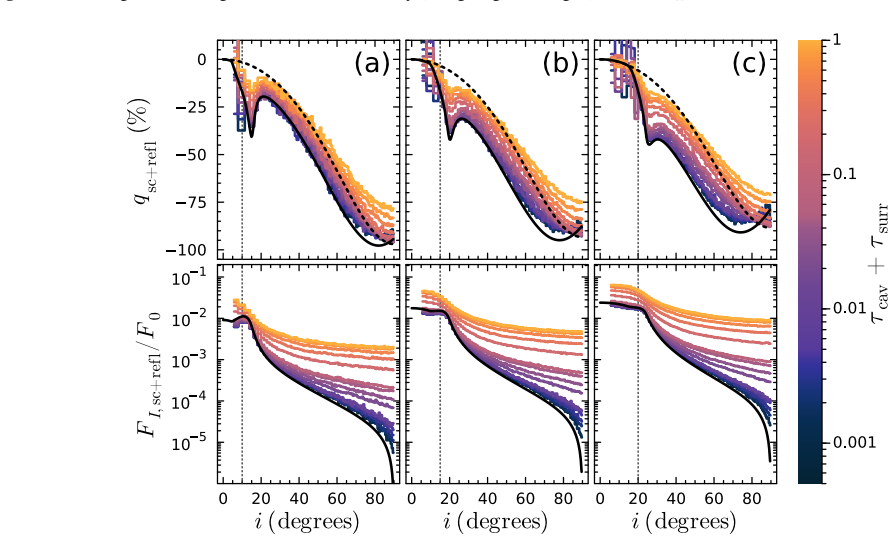
At inclinations above the funnel grazing angle the observed emission consists entirely of radiation scattered or reflected from the funnel walls and a diffuse medium above it. Both the polarization degree and the degree of collimation depend sensitively on the albedo of the funnel surface. Significant absorption (low albedo) is required to reach high polarization, yet the same absorption reduces collimation. Nearly pure scattering (high albedo) allows modest collimation but substantially lowers the polarization. The treatment supplies a general framework for interpreting IXPE observations of obscured accretors such as Cygnus X-3.
What carries the argument
The albedo of the funnel surface, which sets the fraction of incident radiation that is absorbed versus scattered and thereby trades off between polarization generation and radiation collimation.
If this is right
- Polarization degree directly constrains the albedo and therefore the absorption properties of the outflow.
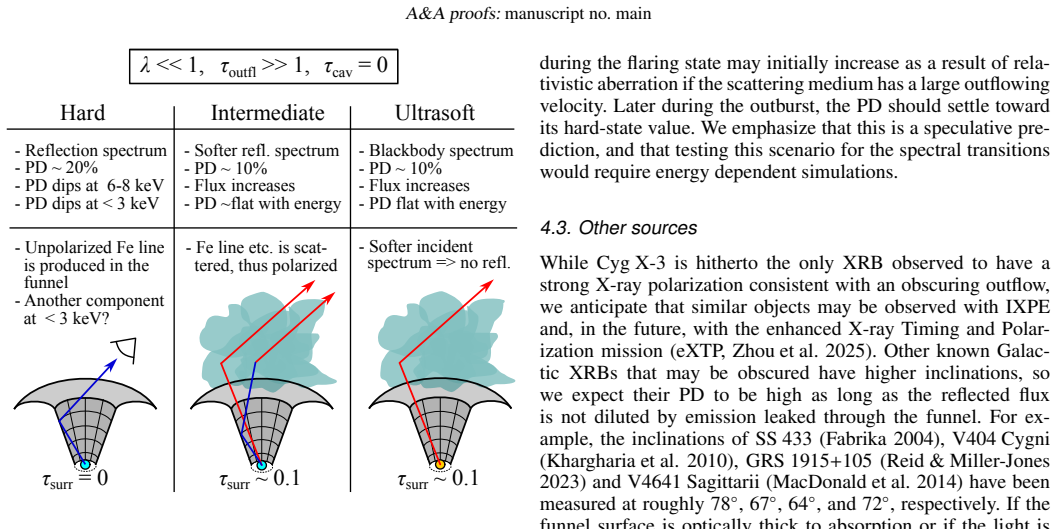
- A combination of surface reflection and diffuse scattering can reproduce the polarization and state transitions seen in Cygnus X-3.
- The same geometry supplies a template for interpreting polarimetric data from other obscured ultraluminous X-ray sources.
- Monte Carlo tracking of multiple scatterings shows that single-scattering approximations underestimate the albedo sensitivity.
- Inclination-dependent signatures allow observers to distinguish funnel reflection from isotropic scattering components.
Where Pith is reading between the lines
- Very high polarization detections would imply that the funnel walls contain significant absorbing material rather than being pure scatterers.
- The predicted trade-off suggests that the most beamed sources should show comparatively low polarization, providing a testable selection effect for future surveys.
- Extending the model to include time-variable funnel opening angles could link polarization swings to changes in accretion rate.
Load-bearing premise
At inclinations higher than the funnel grazing angle the central source is completely obscured, so all observed flux is scattered or reflected light from the funnel and overlying medium.
What would settle it
An observation of polarization degree exceeding the maximum value predicted by the albedo-dependent curves at the measured inclination, or strong collimation accompanied by polarization higher than the high-albedo limit.
Figures
read the original abstract
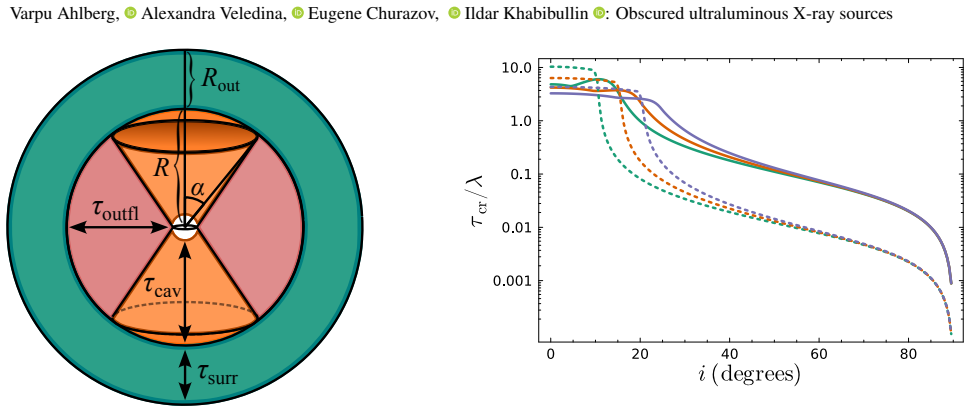
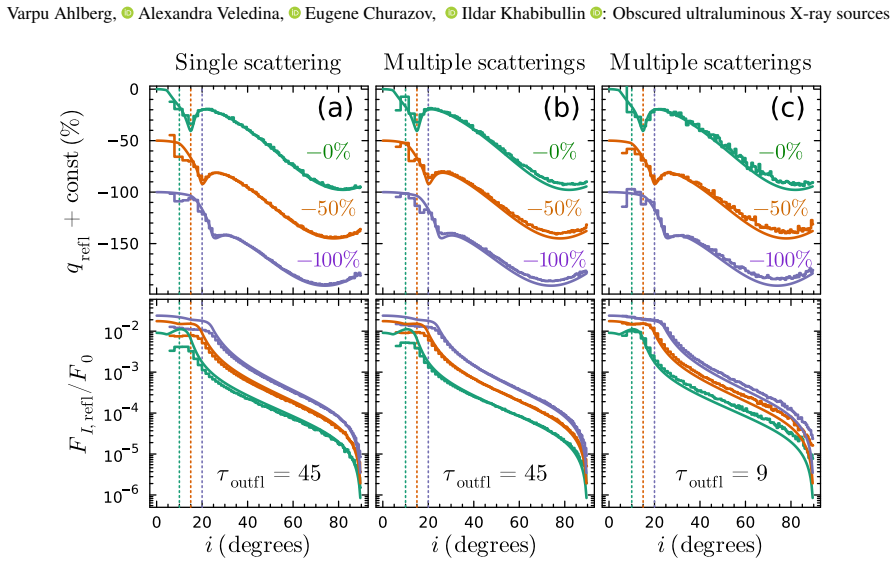
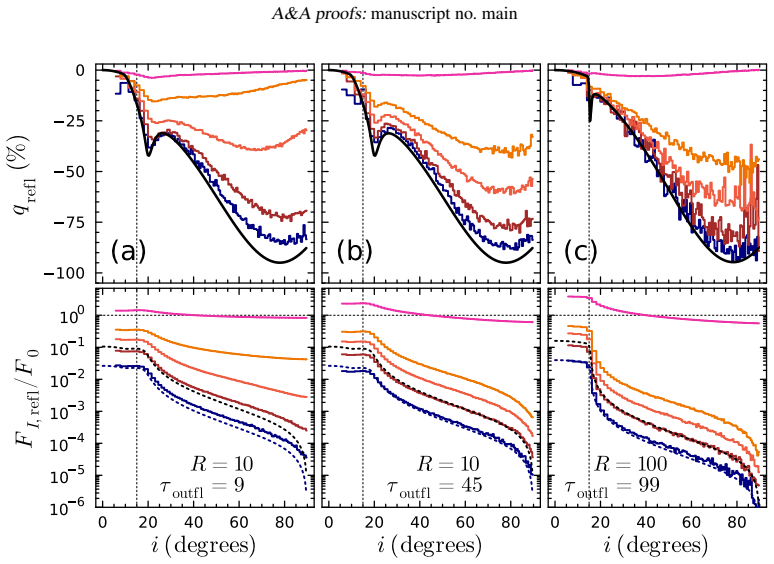
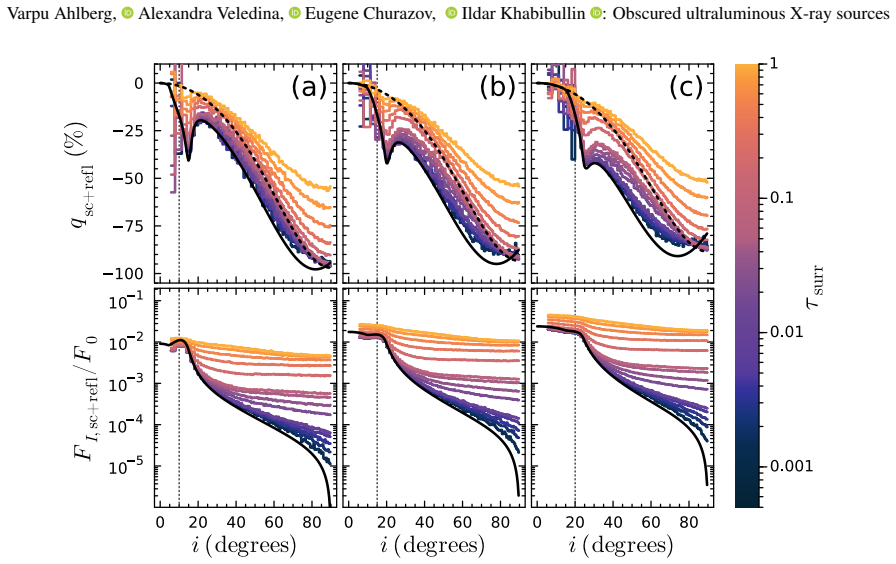
Super-Eddington accretion onto compact objects is expected to produce optically thick outflows with a funnel-shaped cavity that may collimate the emission. At inclinations higher than the grazing angle of the funnel, the central source is obscured. Accordingly, the observed emission is dominated by scattered and reflected radiation, which can therefore be strongly polarized. The detection of strong X-ray polarization in the Galactic X-ray binary Cygnus X-3 provides the first direct probe of this geometry. In this work, we present a systematic study of the inclination-dependent radiative signatures of such systems using a combination of semi-analytical methods and Monte Carlo simulations. Our treatment explicitly accounts for multiple scatterings and demonstrates that both the polarization degree and the degree of collimation are highly sensitive to the albedo of the funnel surface. We find that a low albedo (significant absorption) is essential for producing high polarization, yet it simultaneously suppresses the collimation of the emission. Conversely, a high-albedo medium (nearly pure scattering) can modestly collimate radiation, but at the cost of substantially reducing the polarization degree. We discuss our results in the context of Imaging X-ray Polarimetry Explorer observations of Cygnus X-3 and propose a physical scenario for its spectral state transitions, considering a combination of reflection from the funnel surface and scattering by a diffuse medium above the funnel. Our model provides a general framework for interpreting X-ray polarimetric signatures of obscured accretors.
Editorial analysis
A structured set of objections, weighed in public.
Referee Report
Summary. The manuscript models the inclination-dependent polarimetric signatures of funnel-type outflows in super-Eddington accretors using semi-analytical methods combined with Monte Carlo radiative transfer simulations that explicitly include multiple scatterings. The central claim is a trade-off driven by the albedo of the funnel surface: low albedo produces high polarization but suppresses collimation, while high albedo permits modest collimation at the cost of substantially lower polarization degree. Results are applied to explain IXPE observations of Cygnus X-3 via a scenario combining funnel-surface reflection and scattering in a diffuse medium above the funnel.
Significance. If the modeled trade-off holds, the work supplies a useful interpretive framework for X-ray polarimetry of obscured accretors. The explicit treatment of multiple scatterings is a methodological strength that aligns with standard expectations in polarized radiative transfer. No parameter-free derivations or machine-checked proofs are claimed, which is appropriate for this simulation-based study.
minor comments (2)
- The manuscript would benefit from an explicit table or section listing the explored ranges of albedo, funnel opening angle, and other geometry parameters, together with the number of Monte Carlo photons used per run, to facilitate reproducibility.
- Clarify in the methods section how the semi-analytical component is coupled to the Monte Carlo runs and whether any validation tests against known analytic limits (e.g., single-scattering polarization) are presented.
Simulated Author's Rebuttal
We thank the referee for the constructive summary and for recommending minor revision. The assessment correctly identifies the core trade-off between albedo, polarization degree, and collimation, as well as the methodological value of explicitly including multiple scatterings. No major comments were provided in the report, so we have no specific points to address point-by-point. We will incorporate any minor editorial or clarification requests in the revised manuscript.
Circularity Check
No significant circularity detected
full rationale
The paper's central results on the albedo-dependent trade-off between polarization and collimation are obtained from Monte Carlo radiative transfer simulations and semi-analytical methods applied to a funnel geometry. These outcomes follow from the implemented physics of absorption versus scattering (absorption reduces multiple scatterings that dilute polarization; scattering enables redirection but randomizes it) without any reduction of predictions to fitted inputs, self-definitional loops, or load-bearing self-citations. The obscuration assumption at high inclinations is an explicit geometric boundary condition for applying the model to obscured sources, not a circular premise. The derivation chain is self-contained against external benchmarks of polarized radiative transfer.
Axiom & Free-Parameter Ledger
free parameters (2)
- albedo of the funnel surface
- funnel opening angle and geometry parameters
axioms (2)
- domain assumption Super-Eddington accretion produces optically thick funnel-shaped outflows with a central cavity
- domain assumption At high inclinations the central emission is fully obscured and observed flux is dominated by scattered/reflected radiation
Reference graph
Works this paper leans on
-
[1]
2009, PASJ, 61, 213
Abolmasov, P., Karpov, S., & Kotani, T. 2009, PASJ, 61, 213
2009
-
[2]
A., Czerny, B., Lasota, J
Abramowicz, M. A., Czerny, B., Lasota, J. P., & Szuszkiewicz, E. 1988, ApJ, 332, 646
1988
-
[3]
2025, A&A, 704, A127
Ahlberg, V ., Bocharova, A., & Veledina, A. 2025, A&A, 704, A127
2025
-
[4]
I., Cherepashchuk, A
Antokhin, I. I., Cherepashchuk, A. M., Antokhina, E. A., & Tatarnikov, A. M. 2022, ApJ, 926, 123
2022
-
[5]
Antonucci, R. R. J. & Miller, J. S. 1985, ApJ, 297, 621
1985
-
[6]
M., Sunyaev, R
Basko, M. M., Sunyaev, R. A., & Titarchuk, L. G. 1974, A&A, 31, 249
1974
-
[7]
2024, A&A, 688, A217
Bobrikova, A., Di Marco, A., La Monaca, F., et al. 2024, A&A, 688, A217
2024
-
[8]
C., McLean, I
Brown, J. C., McLean, I. S., & Emslie, A. G. 1978, A&A, 68, 415
1978
-
[9]
K., Mall, G., Dhaka, R., Misra, R., & Pathak, A
Chaurasia, S. K., Mall, G., Dhaka, R., Misra, R., & Pathak, A. 2025, ApJ, 986, 97
2025
-
[10]
2017, MNRAS, 468, 165
Churazov, E., Khabibullin, I., Ponti, G., & Sunyaev, R. 2017, MNRAS, 468, 165
2017
-
[11]
2017, MNRAS, 466, 2236 Díaz Trigo, M., Sidoli, L., Boirin, L., & Parmar, A
Dauser, T., Middleton, M., & Wilms, J. 2017, MNRAS, 466, 2236 Díaz Trigo, M., Sidoli, L., Boirin, L., & Parmar, A. N. 2012, A&A, 543, A50
2017
-
[12]
2004, Astrophysics and Space Physics Reviews, 12, 1
Fabrika, S. 2004, Astrophysics and Space Physics Reviews, 12, 1
2004
-
[13]
P., Belloni, T
Fender, R. P., Belloni, T. M., & Gallo, E. 2004, MNRAS, 355, 1105
2004
-
[14]
C., Middleton, M
Fragile, P. C., Middleton, M. J., Bollimpalli, D. A., & Smith, Z. 2025, MNRAS, 540, 2820
2025
-
[15]
1994, MNRAS, 267, 743
Ghisellini, G., Haardt, F., & Matt, G. 1994, MNRAS, 267, 743
1994
-
[16]
A., Larsson, S., et al
Hjalmarsdotter, L., Zdziarski, A. A., Larsson, S., et al. 2008, MNRAS, 384, 278
2008
-
[17]
A., Szostek, A., & Hannikainen, D
Hjalmarsdotter, L., Zdziarski, A. A., Szostek, A., & Hannikainen, D. C. 2009, MNRAS, 392, 251
2009
-
[18]
Kaaret, P., Feng, H., & Roberts, T. P. 2017, ARA&A, 55, 303
2017
-
[19]
A., & Middleton, M
Karmakar, S., Mushtukov, A. A., & Middleton, M. 2025, MNRAS, 543, 1447
2025
-
[20]
2016, MNRAS, 455, 1414
Khabibullin, I., Medvedev, P., & Sazonov, S. 2016, MNRAS, 455, 1414
2016
-
[21]
S., & Robinson, E
Khargharia, J., Froning, C. S., & Robinson, E. L. 2010, ApJ, 716, 1105
2010
-
[22]
2023, New A Rev., 96, 101672
King, A., Lasota, J.-P., & Middleton, M. 2023, New A Rev., 96, 101672
2023
-
[23]
R., Davies, M
King, A. R., Davies, M. B., Ward, M. J., Fabbiano, G., & Elvis, M. 2001, ApJ, 552, L109
2001
-
[24]
2021, PASJ, 73, 450
Kitaki, T., Mineshige, S., Ohsuga, K., & Kawashima, T. 2021, PASJ, 73, 450
2021
-
[25]
Koljonen, K. I. I. & Maccarone, T. J. 2017, MNRAS, 472, 2181
2017
-
[26]
Koljonen, K. I. I. & Tomsick, J. A. 2020, A&A, 639, A13
2020
-
[27]
1996, PASJ, 48, 619
Kotani, T., Kawai, N., Matsuoka, M., & Brinkmann, W. 1996, PASJ, 48, 619
1996
-
[28]
Lightman, A. P. 1974, ApJ, 194, 419
1974
-
[29]
MacDonald, R. K. D., Bailyn, C. D., Buxton, M., et al. 2014, ApJ, 784, 2
2014
-
[30]
L., Canizares, C
Marshall, H. L., Canizares, C. R., & Schulz, N. S. 2002, ApJ, 564, 941 Martí, J., Paredes, J. M., & Peracaula, M. 2000, ApJ, 545, 939
2002
-
[31]
& Fabrika, S
Medvedev, A. & Fabrika, S. 2010, MNRAS, 402, 479
2010
-
[32]
S., Khabibullin, I
Medvedev, P. S., Khabibullin, I. I., & Sazonov, S. Y . 2019, AstL, 45, 299
2019
-
[33]
S., Khabibullin, I
Medvedev, P. S., Khabibullin, I. I., Sazonov, S. Y ., Churazov, E. M., & Tsy- gankov, S. S. 2018, AstL, 44, 390
2018
-
[34]
J., Walton, D
Middleton, M. J., Walton, D. J., Alston, W., et al. 2021, MNRAS, 506, 1045
2021
-
[35]
Middleton, M. J., Walton, D. J., Roberts, T. P., & Heil, L. 2014, MNRAS, 438, L51 Mikušincová, R., Veledina, A., Muleri, F., et al. 2025, arXiv e-prints, arXiv:2512.12879
-
[36]
M., Zoghbi, A., Raymond, J., et al
Miller, J. M., Zoghbi, A., Raymond, J., et al. 2020, ApJ, 904, 30
2020
-
[37]
Miller-Jones, J. C. A., Blundell, K. M., Rupen, M. P., et al. 2004, ApJ, 600, 368
2004
-
[38]
E., Kajava, J
Motta, S. E., Kajava, J. J. E., Sánchez-Fernández, C., et al. 2017, MNRAS, 471, 1797
2017
-
[39]
Mushtukov, A. A. & Portegies Zwart, S. 2023, MNRAS, 518, 5457
2023
-
[40]
2021, MNRAS, 501, 2424
Poutanen, J. 2021, MNRAS, 501, 2424
2021
-
[41]
2015, ARA&A, 53, 365 Podgorný, J
Netzer, H. 2015, ARA&A, 53, 365 Podgorný, J. 2025, A&A, 702, A43 Podgorný, J., Marin, F., & Dovˇciak, M. 2023, MNRAS, 526, 4929
2015
-
[42]
Pogge, R. W. 1989, ApJ, 345, 730
1989
-
[43]
G., & Abolmasov, P
Poutanen, J., Lipunova, G., Fabrika, S., Butkevich, A. G., & Abolmasov, P. 2007, MNRAS, 377, 1187
2007
-
[44]
2024, ApJ, 964, 77
Ratheesh, A., Dovˇciak, M., Krawczynski, H., et al. 2024, ApJ, 964, 77
2024
-
[45]
2021, A&A, 655, A96
Ratheesh, A., Matt, G., Tombesi, F., et al. 2021, A&A, 655, A96
2021
-
[46]
Reid, M. J. & Miller-Jones, J. C. A. 2023, ApJ, 959, 85
2023
-
[47]
2002, A&A, 391, 1013 Rodriguez Cavero, N., Marra, L., Krawczynski, H., et al
Revnivtsev, M., Gilfanov, M., Churazov, E., & Sunyaev, R. 2002, A&A, 391, 1013 Rodriguez Cavero, N., Marra, L., Krawczynski, H., et al. 2023, ApJ, 958, L8
2002
-
[48]
Rybicki, G. B. & Lightman, A. P. 1986, Radiative Processes in Astrophysics (Wiley-VCH)
1986
-
[49]
Shakura, N. I. & Sunyaev, R. A. 1973, A&A, 24, 337
1973
-
[50]
A., & McCollough, M
Szostek, A., Zdziarski, A. A., & McCollough, M. L. 2008, MNRAS, 388, 1001
2008
-
[51]
S., Doroshenko, V ., Mushtukov, A
Tsygankov, S. S., Doroshenko, V ., Mushtukov, A. A., Lutovinov, A. A., & Pouta- nen, J. 2018, MNRAS, 479, L134
2018
-
[52]
C., McCollough, M., & Koljonen, K
Vilhu, O., Hakala, P., Hannikainen, D. C., McCollough, M., & Koljonen, K. 2009, A&A, 501, 679
2009
-
[53]
G., Stewart, G
Watson, M. G., Stewart, G. C., Brinkmann, W., & King, A. R. 1986, MNRAS, 222, 261
1986
-
[54]
C., Soffitta, P., Baldini, L., et al
Weisskopf, M. C., Soffitta, P., Baldini, L., et al. 2022, JATIS, 8, 026002 Xrism Collaboration, Audard, M., Awaki, H., et al. 2025, Nature, 646, 57
2022
-
[55]
2023, MNRAS, 526, L1
Yang, J., García, F., del Palacio, S., et al. 2023, MNRAS, 526, L1
2023
-
[56]
A., Maitra, C., Frankowski, A., Skinner, G
Zdziarski, A. A., Maitra, C., Frankowski, A., Skinner, G. K., & Misra, R. 2012, MNRAS, 426, 1031
2012
-
[57]
A., Mikolajewska, J., & Belczynski, K
Zdziarski, A. A., Mikolajewska, J., & Belczynski, K. 2013, MNRAS, 429, L104
2013
-
[58]
Zhang, L., Stone, J. M., White, C. J., et al. 2025, arXiv e-prints, arXiv:2509.10638
-
[59]
Zhou, P., Mao, J., Zhang, L., et al. 2025, Science China Physics, Mechanics, and Astronomy, 68, 119507 Article number, page 12 Varpu Ahlberg, Alexandra Veledina, Eugene Churazov, Ildar Khabibullin : Obscured ultraluminous X-ray sources Appendix A: Surface integral for the reflected flux To calculate the reflection from the surface of the funnel, we employ...
2025
discussion (0)
Sign in with ORCID, Apple, or X to comment. Anyone can read and Pith papers without signing in.