Singularity Collisions through Homotopical Dynamical cancellation
Pith reviewed 2026-05-20 00:39 UTC · model grok-4.3
The pith
A spectral sequence analysis of the GGS chain complex establishes a bijective correspondence between algebraic cancellations and homotopical dynamical cancellations in singular flows.
A machine-rendered reading of the paper's core claim, the machinery that carries it, and where it could break.
Core claim
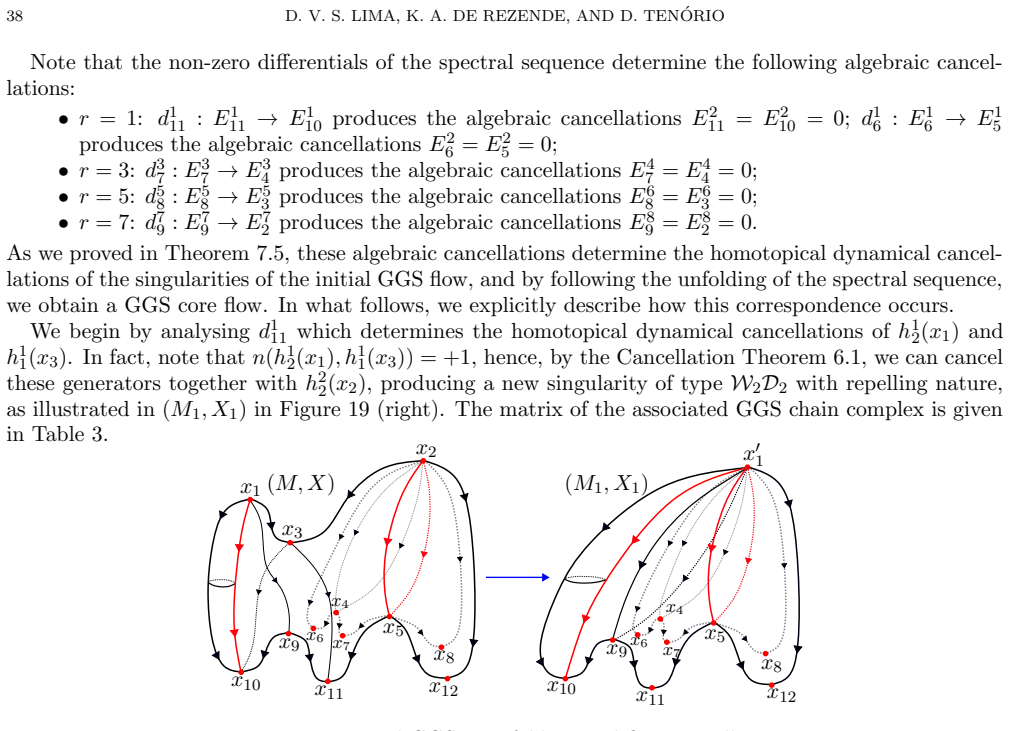
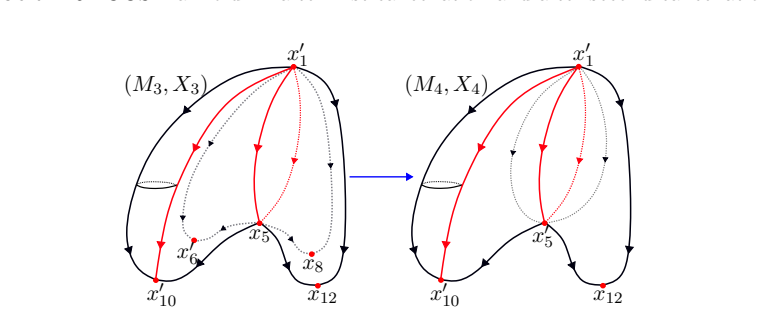
We introduce collisions of invariant sets and homotopical dynamical cancellations that preserve the homotopy type of the underlying singular manifold for generalized Gutierrez-Sotomayor flows on GGS manifolds. By developing a GGS chain complex that encodes essential dynamical and algebraic-topological information and providing a spectral sequence analysis of its filtered version, we establish a bijective correspondence between algebraic cancellations of the modules and the homotopical dynamical cancellations in the flow.
What carries the argument
The GGS chain complex and its filtered spectral sequence, which together capture the dynamical and homotopical information to establish the bijective correspondence between algebraic and dynamical cancellations.
If this is right
- The classical cancellation theory of Morse flows extends to the singular setting via homotopical dynamical cancellations.
- Collisions of invariant sets can be tracked algebraically without altering the homotopy type of the manifold.
- The spectral sequence provides a tool to analyze and predict these cancellations in GGS flows.
- Examples demonstrate how this correspondence applies to specific flows with singularities.
Where Pith is reading between the lines
- This approach could generalize to other types of singular dynamical systems beyond GGS flows.
- Computational implementations of the chain complex might enable simulation of singularity collisions.
- The correspondence suggests new ways to compute topological invariants from flow data.
- Further work could explore higher-dimensional cases or different filtrations on the complex.
Load-bearing premise
The GGS chain complex and its spectral sequence accurately encode the essential dynamical and homotopical information of the flows, so that algebraic cancellations match the actual dynamical ones.
What would settle it
Finding a concrete GGS flow on a manifold where a homotopical cancellation of singularities occurs but the corresponding module cancellation does not appear in the spectral sequence of the GGS chain complex, or vice versa.
Figures










read the original abstract
We introduce collisions of invariant sets and, in particular, consider dynamical homotopical cancellations that preserve the homotopy type of the underlying singular manifold. We develop the theory of homotopical dynamical cancellation for generalized Gutierrez-Sotomayor (GGS) flows defined on GGS manifolds. This framework extends the classical cancellation theory of Morse flows to the singular setting. To effectively capture these homotopical cancellations, we introduce a GGS chain complex, which encodes essential dynamical and algebraic-topological information. Furthermore, we provide a spectral sequence analysis of a filtered GGS chain complex, demonstrating a bijective correspondence between algebraic cancellations of the modules of the spectral sequence and homotopical dynamical cancellations in the GGS flow. Several illustrative examples are presented, highlighting the practical applicability of the proposed framework.
Editorial analysis
A structured set of objections, weighed in public.
Referee Report
Summary. The paper introduces collisions of invariant sets and homotopical dynamical cancellations that preserve the homotopy type of the underlying singular manifold for generalized Gutierrez-Sotomayor (GGS) flows on GGS manifolds. It extends classical Morse cancellation theory to this singular setting by defining a GGS chain complex that encodes dynamical and algebraic-topological information, then analyzes a filtered version of this complex via spectral sequences to demonstrate a bijective correspondence between algebraic cancellations of the spectral sequence modules and homotopical dynamical cancellations in the GGS flow, with several illustrative examples.
Significance. If the bijective correspondence is rigorously established without residual extensions or interfering differentials, the work would supply a useful algebraic-topological tool for tracking singularity collisions and homotopy-preserving cancellations in singular dynamical systems, extending Morse theory in a concrete way. The introduction of the GGS chain complex and its spectral sequence filtration represents a potentially reusable framework if the encoding of dynamical information is shown to be faithful.
major comments (1)
- [Spectral sequence analysis of the filtered GGS chain complex] The central claim of a bijective correspondence between algebraic cancellations on the spectral sequence modules and homotopical dynamical cancellations requires that the filtration on the GGS chain complex isolates each cancellation so that no non-trivial extensions or higher differentials on later pages identify distinct dynamical events. The manuscript states the correspondence but supplies no explicit computation of the differentials or proof that the associated graded pieces contain no hidden relations; this is load-bearing for the bijection and could fail on manifolds with non-trivial homotopy in the singular strata.
minor comments (1)
- The abstract refers to 'several illustrative examples' but does not indicate in the introduction or statement of results how each example explicitly verifies the bijective correspondence rather than merely illustrating the setup.
Simulated Author's Rebuttal
We thank the referee for their careful reading and constructive comments on our manuscript. We address the major comment point by point below.
read point-by-point responses
-
Referee: [Spectral sequence analysis of the filtered GGS chain complex] The central claim of a bijective correspondence between algebraic cancellations on the spectral sequence modules and homotopical dynamical cancellations requires that the filtration on the GGS chain complex isolates each cancellation so that no non-trivial extensions or higher differentials on later pages identify distinct dynamical events. The manuscript states the correspondence but supplies no explicit computation of the differentials or proof that the associated graded pieces contain no hidden relations; this is load-bearing for the bijection and could fail on manifolds with non-trivial homotopy in the singular strata.
Authors: We thank the referee for highlighting this crucial requirement for rigor. The bijective correspondence relies on the filtration of the GGS chain complex isolating cancellations such that extensions and higher differentials do not mix distinct dynamical events. The manuscript establishes the correspondence by showing that the spectral sequence converges to the homology encoding the preserved homotopy type, with the algebraic cancellations corresponding to the dynamical ones via the chain complex construction. However, we agree that explicit computations of the differentials and a proof that the associated graded pieces contain no hidden relations are needed to fully confirm isolation, especially to address potential issues with non-trivial homotopy in singular strata. In the revised manuscript we will add these explicit computations for the relevant pages of the spectral sequence together with a lemma establishing the absence of interfering relations under the GGS manifold and flow hypotheses. We will also include a short discussion clarifying why the controlled nature of singularities in GGS manifolds prevents such homotopy-related interferences from affecting the bijection. revision: yes
Circularity Check
No significant circularity; derivation builds on external Morse theory and introduces new objects independently
full rationale
The paper introduces the GGS chain complex and filtered spectral sequence as new constructions to capture homotopical cancellations in generalized Gutierrez-Sotomayor flows, then claims a bijective correspondence via spectral sequence analysis. This extends classical Morse cancellation theory without reducing any central equation or prediction to a fitted parameter or self-citation by construction. The definitions of GGS manifolds and flows are presented as extensions of prior literature rather than tautological redefinitions of the claimed bijection. No load-bearing step equates the algebraic cancellation modules directly to dynamical events via self-reference alone; the correspondence is asserted as a theorem to be proven from the filtered complex. The derivation remains self-contained against external benchmarks such as standard spectral sequence theory and Morse homology.
Axiom & Free-Parameter Ledger
axioms (1)
- standard math Standard results from algebraic topology and classical Morse cancellation theory apply to the underlying singular manifolds and flows.
invented entities (1)
-
GGS chain complex
no independent evidence
Lean theorems connected to this paper
-
IndisputableMonolith/Cost/FunctionalEquation.leanwashburn_uniqueness_aczel unclear?
unclearRelation between the paper passage and the cited Recognition theorem.
Definition 5.1 (GGS chain complex) … △k⟨hi_k(x)⟩ := … n(hi_k(x), hj_{k-1}(y)) · ⟨hj_{k-1}(y)⟩
What do these tags mean?
- matches
- The paper's claim is directly supported by a theorem in the formal canon.
- supports
- The theorem supports part of the paper's argument, but the paper may add assumptions or extra steps.
- extends
- The paper goes beyond the formal theorem; the theorem is a base layer rather than the whole result.
- uses
- The paper appears to rely on the theorem as machinery.
- contradicts
- The paper's claim conflicts with a theorem or certificate in the canon.
- unclear
- Pith found a possible connection, but the passage is too broad, indirect, or ambiguous to say the theorem truly supports the claim.
Reference graph
Works this paper leans on
-
[1]
M. A. Bertolim, D. V. S. Lima, M. P. Mello, K. A. De Rezende, and M. R. Da Silveira,A global two-dimensional version of Smale’s cancellation theorem via spectral sequences, Ergodic Theory and Dynamical Systems36(2016), no. 6, 1795–1838
work page 2016
-
[2]
M. A. Bertolim, D. V. S. Lima, M. P. Mello, K. A. de Rezende, and M. R. da Silveira,Algebraic and dynamical cancellations associated to spectral sequence, European Journal of Mathematics3(2017), 387–428
work page 2017
-
[3]
M.R. Candido and D.D. Novaes,On the torus bifurcation in averaging theory, Journal of Differential Equations268 (2020), no. 8, 4555–4576
work page 2020
-
[4]
C. C. Conley,Isolated invariant sets and the Morse index, CBMS Regional Conference Series in Mathematics, no. 38, American Mathematical Society, 1978
work page 1978
- [5]
-
[6]
H. Edelsbrunner and J. Harer,Computational topology: an introduction, American Mathematical Society, 2010
work page 2010
-
[7]
C. Gutierrez and J. Sotomayor,Stable vector fields on manifolds with simple singularities, Proceedings of the London Mathematical Societys3-45(1982), no. 1, 97–112
work page 1982
-
[8]
Kuznetsov,Elements of applied bifurcation theory, Springer, 1998
Y.A. Kuznetsov,Elements of applied bifurcation theory, Springer, 1998
work page 1998
-
[9]
G.G.E. Ledesma, D.V.S. Lima, M.P. Mello, K.A. de Rezende, and M.R. da Silveira,Homotopical dynamics for gradient- like flows, IMPA, 2023
work page 2023
-
[10]
John M Lee,Introduction to topological manifolds, Springer, 2000
work page 2000
-
[11]
Leray,L’anneau d’homologie d’une repr´ esentation, C
J. Leray,L’anneau d’homologie d’une repr´ esentation, C. R. Acad. Sci. Paris222(1946), 1366–1368
work page 1946
-
[12]
,Structure de l’anneau d’homologie d’une repr´ esentation, C. R. Acad. Sci. Paris222(1946), 1419–1422
work page 1946
-
[13]
,L’anneau spectral et l’anneau filtr´ e d’homologie d’un espace localement compact et d’une application continue, J. Math. Pures Appl.29(1950), 1–139
work page 1950
-
[14]
D. Lima and D. Ten´ orio,On Conley theory for generalized Gutierrez-Sotomayor flows, Topological Methods in Nonlinear Analysis (2025), 1–40
work page 2025
-
[15]
D. V. S. Lima, O. M. Neto, K. A. de Rezende, and M. R. da Silveira,Cancellations for circle-valued Morse functions via spectral sequences, Topological Methods in Nonlinear Analysis51(2018), no. 1, 259–311
work page 2018
-
[16]
D. V. S. Lima, S. A. Raminelli, and K. A. de Rezende,Homotopical cancellation theory for Gutierrez-Sotomayor singular flows, Journal of Singularities23(2021), 33
work page 2021
-
[17]
D. V. S. Lima, D. Ten´ orio, and N. G. Grulha,A chain complex for computing intersection homology of GS manifolds with n-sheet cone singularities, Bulletin of the Brazilian Mathematical Society, New Series57(2026), 25
work page 2026
-
[18]
Milnor,Lectures on the H-Cobordism Theorem, Princeton University Press, 1965
J. Milnor,Lectures on the H-Cobordism Theorem, Princeton University Press, 1965
work page 1965
-
[19]
J. W. Milnor,Topology from the differentiable viewpoint, Princeton University Press, 1965
work page 1965
-
[20]
H. Mont´ ufar and K. A. de Rezende,Conley theory for Gutierrez-Sotomayor fields, Journal of Singularities22(2020), 241–277
work page 2020
-
[21]
M. Morse,The existence of polar non-degenerate functions on differentiable manifolds, Annals of Mathematics71(1960), no. 2, 352–383
work page 1960
-
[22]
,The elimination of critical points of a non-degenerate function on a differentiable manifold, Journal d’Analyse Math´ ematique13(1964), no. 1, 257–316
work page 1964
-
[23]
27, Princeton Univer- sity Press, 1965
,Differential and Combinatorial Topology: A Symposium in Honor of Marston Morse, vol. 27, Princeton Univer- sity Press, 1965. 42 D. V. S. LIMA, K. A. DE REZENDE, AND D. TEN ´ORIO
work page 1965
-
[24]
M. C. Peixoto and M. M. Peixoto,Structural stability in the plane with enlarged boundary conditions, Anais da Academia Brasileira de Ciˆ encias31(1959), no. 2, 135–160
work page 1959
-
[25]
M. M. Peixoto,Structural stability on two-dimensional manifolds, Topology1(1962), no. 2, 101–120
work page 1962
-
[26]
Serre,Homologie singuli` ere des espaces fibr´ es, Ann
J.P. Serre,Homologie singuli` ere des espaces fibr´ es, Ann. of Math. (2)54(1951), no. 3, 425–505
work page 1951
-
[27]
,Groupes d’homotopie et classes de groupes ab´ eliens, Ann. of Math. (2)58(1953), no. 2, 258–294
work page 1953
-
[28]
S. Smale,Generalized Poincar´ e’s Conjecture in dimensions greater than four, Annals of Mathematics74(1961), no. 2, 391–406
work page 1961
-
[29]
Edwin H Spanier,Algebraic topology, Springer Science & Business Media, 1966
work page 1966
-
[30]
A. J. Zomorodian,Topology for computing, vol. 16, Cambridge University Press, 2005. Center for Mathematics, Computing and Cognition, Federal University of ABC, S ˜ao Paulo, Brazil. Email address:dahisy.lima@ufabc.edu.br Institute of Mathematics, Statistics and Scientific Computing, University of Campinas, S ˜ao Paulo, Brazil. Email address:ketty@ime.unica...
work page 2005
discussion (0)
Sign in with ORCID, Apple, or X to comment. Anyone can read and Pith papers without signing in.