REVIEW 3 major objections 6 minor 47 references
Learning Neural Vocoder from Range-Null Space Decomposition
T0 review · 3 major / 6 minor · reviewed 2026-08-06 · deepseek-v4-flash
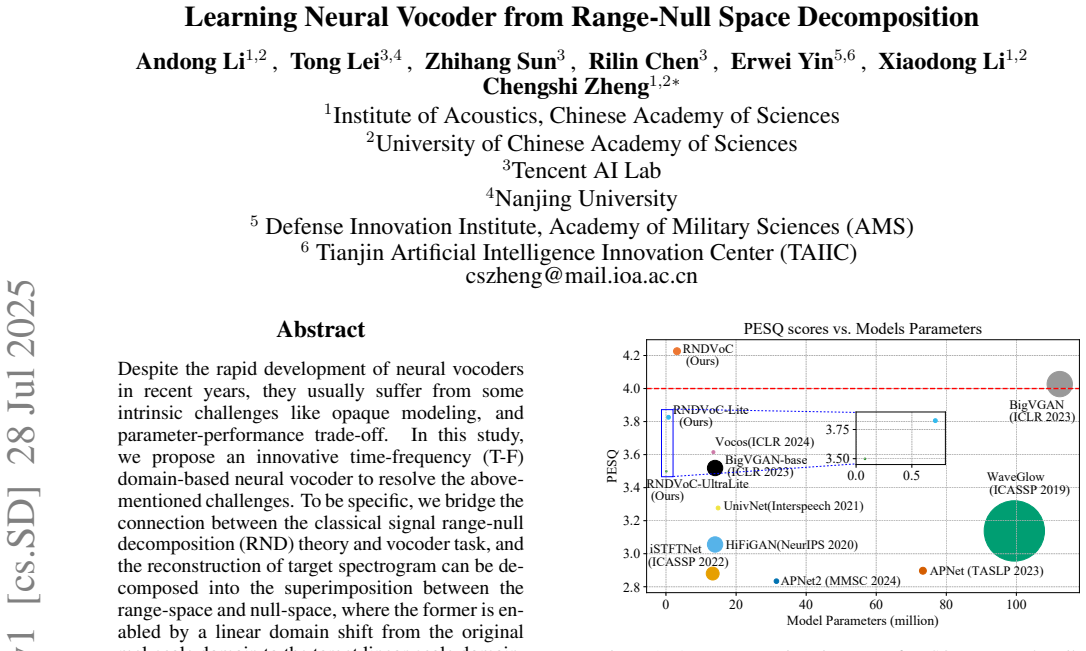
Pith's one-line read The paper claims that a neural vocoder built on range-null space decomposition can rival BigVGAN at 112M parameters using only 3.14M, and that a 0.08M ultra-light version remains competitive.
desk verdict Lightweight T-F vocoder with a real efficiency win; the RND theory is overclaimed as written and needs a fix, but the empirical core merits a serious referee. read the letter →
The pith
A machine-rendered reading of the paper's core claim, the machinery that carries it, and where it could break.
The reading
What carries the argument
The carrying object is the range-null space decomposition identity $x = A^\dagger A x + (I - A^\dagger A)x$, applied to magnitude spectrograms with $A$ the mel-filter bank and $A^\dagger$ its pseudo-inverse. The range-space term $A^\dagger X_{\mathrm{mel}}$ shifts the conditioning feature from mel scale to linear scale; the null-space term $(I - A^\dagger A)|\tilde{S}|_{\mathrm{null}}$ is produced by a dual-path network that alternates cross-band modules (group convolution along sub-bands plus a band-mixer) and narrow-band modules (shared ConvNeXt v2 blocks over frames), with hierarchical region-wise encoding and decoding. A separate mechanism, the omnidirectional phase loss, computes eight directional phase differences plus instantaneous phase using nine fixed $3\times 3$ convolution kernels, replacing the sparse-matrix anti-wrapping loss of prior work. The fixed, orthogonal $A^\dagger A$ construction is what guarantees the mel content survives reconstruction; the ablation shows making $A$ and $A^\dagger$ learnable breaks orthogonality and hurts performance.
What would settle it
Take a recorded utterance, compute its log-mel $X_{\mathrm{mel}} = \log(A|S|)$ with the same filter bank, and evaluate the projection residual $\|(I - A^\dagger A)A^\dagger X_{\mathrm{mel}}\|$ relative to $\|A^\dagger X_{\mathrm{mel}}\|$. If the implementation feeds the log-domain value $X_{\mathrm{mel}}$ into the range-space module, this residual is nonzero for typical speech and the orthogonal decomposition in Eq. (8) is not what the network actually computes; inspecting the released code determines which input the pseudo-inverse receives.
Extended reading notes
Core claim
The central claim is that the mel-spectrogram condition can be treated as a linear compression of the target magnitude spectrum, so reconstruction decomposes into an exact range-space term and a learned null-space term. With fixed mel-filter matrix $A$ and pseudo-inverse $A^\dagger$, the reconstructed magnitude is $|\tilde{S}| = A^\dagger X_{\mathrm{mel}} + (I - A^\dagger A)|\tilde{S}|_{\mathrm{null}}$, where the first term preserves the mel content and the second, produced by a dual-path network that also estimates phase, supplies the missing spectral detail. The paper reports that this construction at 3.14M parameters yields PESQ 3.987 on LJSpeech and 4.226 on LibriTTS, comparable to or better than BigVGAN (4.107 and 4.027 at 1M steps), wins a MUSHRA test over BigVGAN (80.74 vs 79.33, $p<0.05$), and that shrinking to 0.08M parameters still beats HiFiGAN-V2.
Load-bearing premise
The load-bearing premise is that the mel input is exactly the linear compression of the target magnitude spectrum after undoing the logarithm, so the fixed matrix inversion recovers the true range-space part; the paper never states that its code applies the inversion to the exponentiated mel, and if it applies it to the log-mel instead, the claimed guarantee that the mel content is preserved does not follow.
Editorial extensions
If this is right
- With 3.14M parameters and 34.10 GMACs per 5 seconds, RNDVoC runs about 10 times faster than BigVGAN on CPU and more than 233 times real-time on GPU, so near-BigVGAN quality no longer requires a large time-domain generator.
- The 0.08M RNDVoC-UltraLite beats HiFiGAN-V2 on PESQ and VISQOL, making the smallest reported end-to-end neural vocoder viable on edge devices.
- Fixing the mel filter and its pseudo-inverse and keeping the two subspaces orthogonal outperforms making them learnable, so the decomposition itself, not extra capacity, drives the gain.
- On LibriTTS, RNDVoC reaches PESQ 4.226 after 1M steps, above BigVGAN's 4.027 at the same step count and close to its 4.269 after 5M steps, indicating gains in training efficiency as well as parameter efficiency.
- A MUSHRA listening test with 35 participants preferred RNDVoC over BigVGAN on LibriTTS with statistical significance ($p<0.05$), so the parameter reduction does not come at a perceived quality cost.
Reading between the lines
- If the released code applies the pseudo-inverse to the exponential of the log-mel rather than to the log-mel itself, the RND term is a true projection and the method is a principled extension of the pseudo-inverse mel-filter idea used in FreeV; if it applies the pseudo-inverse to the log-mel, the Table 4 ablation shows only that injecting a fixed filtered copy of the input helps, not that range-nu
- The 0.08M UltraLite result suggests that raw parameter count is not the binding constraint for vocoder quality once the conditioning feature is made exact, a hypothesis that could be tested by applying the same decomposition to other mel-conditioned generators such as speech-enhancement or text-to-audio backbones.
- The omnidirectional phase loss, which uses nine fixed $3\times 3$ kernels to capture eight directional phase differences plus instantaneous phase, transfers directly to any phase-estimation task where a differentiable angular distance is needed, including phase-aware speech enhancement.
Editorial analysis
A structured set of objections, weighed in public.
Referee Report
Summary. The paper proposes RNDVoC, a time-frequency-domain neural vocoder whose magnitude reconstruction is decomposed into a fixed range-space term obtained by applying the pseudo-inverse of the mel-filter matrix to the input mel feature and a learned null-space term projected by (I−A†A). The architecture uses hierarchical spectral encoding/decoding with cross-band and narrow-band modules, and training includes an omnidirectional phase loss and GAN losses. The paper reports objective and subjective results on LJSpeech and LibriTTS, showing near-BigVGAN quality at much smaller parameter counts, plus an 0.08M-parameter ultra-light variant, and provides ablations supporting the fixed-matrix RND design.
Significance. If the theoretical claim were fully supported, the paper would be a strong contribution: it would show near-BigVGAN synthesis quality with 3% of the parameters, roughly 10x CPU speed-up, and an unprecedentedly small end-to-end vocoder, with public code and pretrained weights. The empirical evidence is substantial: two benchmarks, a MUSHRA test with confidence intervals and a t-test, and ablations that isolate the RND mode, fixed matrices, and phase loss. However, the central theoretical guarantee in Section 3.2 is not established as written because the log compression in Eq. (4) invalidates the linear pseudo-inverse argument. The contribution is therefore conditional on a corrected or substantially reframed theoretical story.
major comments (3)
- [§3.2, Eqs. (4)–(9)] The central RND derivation does not apply to the actual input. Eq. (4) defines X_mel = log(A|S|), a nonlinear quantity, while Eq. (6) sets |tilde S|_range = A† X_mel and Eq. (8) concludes |tilde S| = A†A|S| + (I−A†A)|tilde S|null. Since A† log(A|S|) is not A†A|S|, the identity in Eq. (8) and the degradation-consistency property A tilde S = y do not follow. The sentence 'if the log-operation is absorbed ... exp(X_mel) = A|X|' is not a derivation and leaves unspecified whether the implementation feeds log-mel or its exponential to the pseudo-inverse. If the implementation applies A† to exp(X_mel), the network input is not the standard log-mel feature and the claim that the original acoustic feature is well preserved needs verification; if it applies A† to the log-mel, the theoretical guarantee is simply false. This is load-bearing because the claimed information-preservation guarantee in §3.2 is the basis for the interpretability and lightweight-design arguments.
- [§3.2, paragraph after Eq. (8)] The statement that the proposed reconstruction 'fully utilize[s] the linear degradation of mel-spectrum as the prior' is internally inconsistent with Eq. (4), which defines a log-scale mel-spectrogram. Footnote 1 even says the mel-spectrogram is 'linearly compressed in the spectral magnitude,' but Eq. (4) applies a logarithm after the linear compression. Thus the interpretability advantage asserted in the same paragraph is not supported by the derivation as written; the authors need either to prove a modified consistency statement for the log-domain feature or to explicitly reposition the RND construction as an empirical inductive bias rather than a theoretical guarantee.
- [§4.3, Table 4, id4] The conclusion that setting A and A† as learnable 'break[s] the orthogonality between the two sub-spaces' is not directly supported. Unless the parameterization enforces A† to be the pseudo-inverse of A throughout training, making both matrices learnable does not necessarily break the algebraic projection structure; the observed performance drop and the non-sparse null-space visualization in Figure 6 are consistent with several alternative explanations, such as optimization difficulty or convergence to a different effective projection. The ablation would be more convincing with a direct measure of the pseudo-inverse residual, e.g., ||AA†A − A||, or with a constrained parameterization that provably maintains A† = pinv(A) while still allowing learning.
minor comments (6)
- [§3.2] The sentence 'if the log-operation is absorbed into the left of Eq. (4), i.e., X_mel = exp(X_mel) = A|X|' is garbled and uses X_mel on both sides of the equality; it should be rewritten and the notation fixed (|X| should be |S|).
- [Eq. (8)] The final equality writes the target |S| on both sides; it should be |tilde S| = |tilde S|_range + (I−A†A)|tilde S|null = A†A|S| + (I−A†A)|tilde S|null to avoid the appearance of defining the target as the estimate.
- [Throughout] Typos and spacing issues should be corrected, including 'opertion', 'duffusion', 'Diffferent', 'matrice', 'valiation', and 'only only'.
- [Table 3] The note '∗∗p < 0.05, ∗p < 0.1' is confusing because only a single pairwise comparison is reported; clarify the convention and the number of comparisons.
- [Abstract and §4.3] The abstract claim of 'comparable and even better performance over BigVGAN-112M' should be qualified relative to Table 1, where RNDVoC has lower PESQ than BigVGAN on LJSpeech while being better on several other metrics; the current wording overstates the LJSpeech comparison.
- [Figure 5] The text says the clip is a singing voice from the MUSDB18 test set, but the evaluation section only describes speech datasets; clarify whether MUSDB18 is used solely for visualization and whether the model was trained only on speech.
Circularity Check
No significant circularity: the range-null decomposition is an explicit residual parameterization tested by ablation, not a fitted quantity renamed as a prediction; the log-mel inconsistency is a correctness issue, not a circularity.
full rationale
I traced the derivation chain from Eq. (1) through Eq. (9). The reconstruction is parameterized as |S| = A†X_mel + (I - A†A)|S|null, with the null-space network trained against the target spectrogram. This is a standard residual/pseudo-inverse decomposition: the range-space branch is a fixed linear map and the null-space branch is a learned network, so the final output is not obtained by re-inserting the predicted quantity into its own definition. The paper explicitly compares with FreeV [Lv et al., 2024] and acknowledges that the pseudo-inverse operation already exists there; presenting the same operation under a range-null-space interpretation is a framing choice, not a derivation that reduces to its input. The ablation study in Table 4 (removing RND mode, making A and A† learnable) tests the components rather than assuming them, and the main performance claims are evaluated against external baselines (BigVGAN, HiFiGAN, APNet2, Vocos) on LJSpeech and LibriTTS, so there is no fitted-input-called-prediction pattern. The self-citations in the introduction ([Li et al., 2022], [Li et al., 2025]) are contextual and not load-bearing. The genuine weakness is formal correctness: Eq. (4) defines X_mel = log(A|S|), while Eq. (6) sets |S|_range = A†X_mel and Eq. (8) then replaces A†X_mel with A†A|S|, which would require X_mel = A|S|. The manuscript's bridging sentence ('if the log-operation is absorbed into the left of Eq. (4), i.e., X_mel = exp(X_mel) = A|X|') does not resolve this. That is an invalid or unsupported step in the proof of degradation consistency, but it is a mathematical inconsistency rather than a circular reduction: the model's output is not defined as the quantity it is supposed to predict. I therefore find no significant circularity and assign a low score, while noting the theoretical gap as a separate correctness risk.
Assumptions & free parameters
free parameters (3)
- loss weights λ_a, λ_p, λ_ri, λ_mel, λ_c, λ_g, λ_fm =
not stated in paper (deferred to supplementary)
- network width and depth (C=256, B=6, P=2, I=3, N=24, group size 8) =
C=256, B=6, P=2, I=3, N=24
- frequency region split pattern for HSEM =
not quantified
assumptions (4)
- standard math Moore-Penrose pseudo-inverse algebra, including AA†A = A and the orthogonal decomposition of Eq. (2)-(3)
- domain assumption The vocoder input is the log-scale mel spectrogram X_mel = log(A|S|), with phase discarded, and the linear mel filterbank A is known and fixed
- ad hoc to paper The log nonlinearity can be 'absorbed' so that the inverse problem is the linear compressive-sensing form exp(X_mel) = A|S|, making Eqs. (6)-(8) a legitimate RND decomposition
- domain assumption STFT/iSTFT with 1024-point FFT and 256-hop framing, plus MPD/MRSD adversarial discriminators, is a sufficient representation and perceptual proxy for vocoder quality
Cite this review
Pith. "Pith review of Learning Neural Vocoder from Range-Null Space Decomposition." pith.science (2026). https://pith.science/paper/XOIZRS5V
@misc{pith2026250720731,
  author       = {Pith},
  title        = {Pith review of: Learning Neural Vocoder from Range-Null Space Decomposition},
  year         = {2026},
  howpublished = {\url{https://pith.science/paper/XOIZRS5V}},
  note         = {Machine review of arXiv:2507.20731}
}
read the original abstract
Despite the rapid development of neural vocoders in recent years, they usually suffer from some intrinsic challenges like opaque modeling, and parameter-performance trade-off. In this study, we propose an innovative time-frequency (T-F) domain-based neural vocoder to resolve the above-mentioned challenges. To be specific, we bridge the connection between the classical signal range-null decomposition (RND) theory and vocoder task, and the reconstruction of target spectrogram can be decomposed into the superimposition between the range-space and null-space, where the former is enabled by a linear domain shift from the original mel-scale domain to the target linear-scale domain, and the latter is instantiated via a learnable network for further spectral detail generation. Accordingly, we propose a novel dual-path framework, where the spectrum is hierarchically encoded/decoded, and the cross- and narrow-band modules are elaborately devised for efficient sub-band and sequential modeling. Comprehensive experiments are conducted on the LJSpeech and LibriTTS benchmarks. Quantitative and qualitative results show that while enjoying lightweight network parameters, the proposed approach yields state-of-the-art performance among existing advanced methods. Our code and the pretrained model weights are available at https://github.com/Andong-Li-speech/RNDVoC.
Figures


Figures from the paper (4 more)


Reference graph
Works this paper leans on
-
[1]
[Ai and Ling, 2023] Yang Ai and Zhen-Hua Ling. APNet: An all-frame-level neural vocoder incorporating direct prediction of amplitude and phase spectra.IEEE/ACM Trans. Audio, Speech, Lang. Process., 31:2145–2157,
work page 2023
-
[3]
Model-based com- pressive sensing.IEEE Trans
[Baraniuket al., 2010 ] Richard G Baraniuk, V olkan Cevher, Marco F Duarte, and Chinmay Hegde. Model-based com- pressive sensing.IEEE Trans. Inf. Theory, 56(4):1982– 2001,
work page 2010
-
[7]
Delving Deep into Rectifiers: Sur- passing Human-Level Performance on Imagenet Classifi- cation
[Heet al., 2015 ] Kaiming He, Xiangyu Zhang, Shaoqing Ren, and Jian Sun. Delving Deep into Rectifiers: Sur- passing Human-Level Performance on Imagenet Classifi- cation. InProc. ICCV, pages 1026–1034,
work page 2015
-
[10]
[Juvelaet al., 2019 ] Lauri Juvela, Bajibabu Bollepalli, Vas- silis Tsiaras, and Paavo Alku. Glotnet—a raw waveform model for the glottal excitation in statistical parametric speech synthesis.IEEE/ACM Trans. Audio, Speech, Lang. Process., 27(6):1019–1030,
work page 2019
-
[13]
[Kawahara, 2006] Hideki Kawahara. STRAIGHT, exploita- tion of the other aspect of VOCODER: Perceptually iso- morphic decomposition of speech sounds.Acoustical sci- ence and technology, 27(6):349–353,
work page 2006
-
[16]
Hifi-GAN: Generative adversarial networks for efficient and high fidelity speech synthesis
[Konget al., 2020 ] Jungil Kong, Jaehyeon Kim, and Jaeky- oung Bae. Hifi-GAN: Generative adversarial networks for efficient and high fidelity speech synthesis. InProc. NeurIPS, pages 17022–17033,
work page 2020
-
[18]
BeaqleJS: HTML5 and JavaScript based framework for the subjective evaluation of audio quality
[Kraft and Z¨olzer, 2014] Sebastian Kraft and Udo Z ¨olzer. BeaqleJS: HTML5 and JavaScript based framework for the subjective evaluation of audio quality. InLinux Audio Conference, Karlsruhe, DE,
work page 2014
-
[21]
PriorGrad: Improv- ing Conditional Denoising Diffusion Models with Data- Dependent Adaptive Prior
[Leeet al., 2022 ] Sang-gil Lee, Heeseung Kim, Chaehun Shin, Xu Tan, Chang Liu, Qi Meng, Tao Qin, Wei Chen, Sungroh Yoon, and Tie-Yan Liu. PriorGrad: Improv- ing Conditional Denoising Diffusion Models with Data- Dependent Adaptive Prior. InProc. ICLR,
work page 2022
Show all 47 references
-
[22]
BigVGAN: A Uni- versal Neural Vocoder with Large-Scale Training
[Leeet al., 2023 ] Sang-gil Lee, Wei Ping, Boris Ginsburg, Bryan Catanzaro, and Sungroh Yoon. BigVGAN: A Uni- versal Neural Vocoder with Large-Scale Training. InProc. ICLR,
2023
-
[23]
Layer normalization.ArXiv e-prints, pages arXiv–1607,
[Lei Baet al., 2016 ] Jimmy Lei Ba, Jamie Ryan Kiros, and Geoffrey E Hinton. Layer normalization.ArXiv e-prints, pages arXiv–1607,
2016
-
[24]
Taylor, Can You Hear Me Now? A Taylor-Unfolding Framework for Monaural Speech Enhancement
[Liet al., 2022 ] Andong Li, Shan You, Guochen Yu, Cheng- shi Zheng, and Xiaodong Li. Taylor, Can You Hear Me Now? A Taylor-Unfolding Framework for Monaural Speech Enhancement. InProc. IJCAI, pages 4193–4200,
2022
-
[25]
Neural vocoders as speech enhancers.arXiv preprint arXiv:2501.13465,
[Liet al., 2025 ] Andong Li, Zhihang Sun, Fengyuan Hao, Xiaodong Li, and Chengshi Zheng. Neural vocoders as speech enhancers.arXiv preprint arXiv:2501.13465,
2025 arXiv
-
[27]
Decoupled weight decay regularization.arXiv preprint arXiv:1711.05101,
[Loshchilov and Hutter, 2017] Ilya Loshchilov and Frank Hutter. Decoupled weight decay regularization.arXiv preprint arXiv:1711.05101,
2017 arXiv
-
[28]
DPM-solver: A fast ode solver for diffusion probabilistic model sampling in around 10 steps.Proc
[Luet al., 2022 ] Cheng Lu, Yuhao Zhou, Fan Bao, Jianfei Chen, Chongxuan Li, and Jun Zhu. DPM-solver: A fast ode solver for diffusion probabilistic model sampling in around 10 steps.Proc. NeurIPS, 35:5775–5787,
2022
-
[29]
FreeV: Free Lunch For Vocoders Through Pseudo Inversed Mel Filter
[Lvet al., 2024 ] Yuanjun Lv, Hai Li, Ying Yan, Junhui Liu, Danming Xie, and Lei Xie. FreeV: Free Lunch For Vocoders Through Pseudo Inversed Mel Filter. InProc. Interspeech, pages 3869–3873,
2024
-
[31]
Chunked Autoregressive GAN for Condi- tional Waveform Synthesis
[Morrisonet al., 2022 ] Max Morrison, Rithesh Kumar, Kun- dan Kumar, Prem Seetharaman, Aaron Courville, and Yoshua Bengio. Chunked Autoregressive GAN for Condi- tional Waveform Synthesis. InProc. ICLR,
2022
-
[32]
Parallel wavenet: Fast high-fidelity speech synthesis
[Oordet al., 2018 ] Aaron Oord, Yazhe Li, Igor Babuschkin, Karen Simonyan, Oriol Vinyals, Koray Kavukcuoglu, George Driessche, Edward Lockhart, Luis Cobo, Florian Stimberg, et al. Parallel wavenet: Fast high-fidelity speech synthesis. InProc. ICML, pages 3918–3926. PMLR,
2018
-
[33]
Waveflow: A compact flow-based model for raw audio
[Pinget al., 2020 ] Wei Ping, Kainan Peng, Kexin Zhao, and Zhao Song. Waveflow: A compact flow-based model for raw audio. InProc. ICML, pages 7706–7716. PMLR,
2020
-
[34]
Waveglow: A flow-based generative network for speech synthesis
[Prengeret al., 2019 ] Ryan Prenger, Rafael Valle, and Bryan Catanzaro. Waveglow: A flow-based generative network for speech synthesis. InProc. ICASSP, pages 3617–3621. IEEE,
2019
-
[35]
Spa- tialNet: Extensively learning spatial information for multi- channel joint speech separation, denoising and dereverber- ation.IEEE/ACM Trans
[Quan and Li, 2024] Changsheng Quan and Xiaofei Li. Spa- tialNet: Extensively learning spatial information for multi- channel joint speech separation, denoising and dereverber- ation.IEEE/ACM Trans. Audio, Speech, Lang. Process., 32:1310–1323,
2024
-
[36]
The MUSDB18 corpus for music separation
[Rafiiet al., 2017 ] Zafar Rafii, Antoine Liutkus, Fabian- Robert St ¨oter, Stylianos Ioannis Mimilakis, and Rachel Bittner. The MUSDB18 corpus for music separation
2017
-
[37]
Searching for activation functions
[Ramachandranet al., 2017 ] Prajit Ramachandran, Barret Zoph, and Quoc V Le. Searching for activation functions. arXiv preprint arXiv:1710.05941,
2017 arXiv
-
[38]
[Rec, 2005] ITUT Rec. P. 862.2: Wideband extension to recommendation p. 862 for the assessment of wideband telephone networks and speech codecs.International Telecommunication Union, CH–Geneva, 41:48–60,
2005
-
[40]
LPCNet: Improving neural speech synthesis through linear prediction
[Valin and Skoglund, 2019] Jean-Marc Valin and Jan Skoglund. LPCNet: Improving neural speech synthesis through linear prediction. InProc. ICASSP, pages 5891–5895. IEEE,
2019
-
[41]
Wavenet: A generative model for raw audio.arXiv preprint arXiv:1609.03499, 12,
[Van Den Oordet al., 2016 ] Aaron Van Den Oord, Sander Dieleman, Heiga Zen, Karen Simonyan, Oriol Vinyals, Alex Graves, Nal Kalchbrenner, Andrew Senior, Koray Kavukcuoglu, et al. Wavenet: A generative model for raw audio.arXiv preprint arXiv:1609.03499, 12,
2016 arXiv
-
[42]
Tacotron: Towards End-to-End Speech Synthesis
[Wanget al., 2017 ] Yuxuan Wang, RJ Skerry-Ryan, Daisy Stanton, Yonghui Wu, Ron J Weiss, Navdeep Jaitly, Zongheng Yang, Ying Xiao, Zhifeng Chen, Samy Bengio, et al. Tacotron: Towards End-to-End Speech Synthesis. In Proc. Interspeech, pages 4006–4010,
2017
-
[43]
Convnext v2: Co-designing and scaling convnets with masked autoencoders
[Wooet al., 2023 ] Sanghyun Woo, Shoubhik Debnath, Ronghang Hu, Xinlei Chen, Zhuang Liu, In So Kweon, and Saining Xie. Convnext v2: Co-designing and scaling convnets with masked autoencoders. InProc. CVPR, pages 16133–16142,
2023
-
[44]
Parallel WaveGAN: A fast wave- form generation model based on generative adversarial networks with multi-resolution spectrogram
[Yamamotoet al., 2020 ] Ryuichi Yamamoto, Eunwoo Song, and Jae-Min Kim. Parallel WaveGAN: A fast wave- form generation model based on generative adversarial networks with multi-resolution spectrogram. InProc. ICASSP, pages 6199–6203. IEEE,
2020
-
[45]
High Fidelity Speech En- hancement with Band-split RNN
[Yuet al., 2023 ] Jianwei Yu, Yi Luo, Hangting Chen, Rongzhi Gu, and Chao Weng. High Fidelity Speech En- hancement with Band-split RNN. InProc. Interspeech, pages 2483–2487,
2023
-
[46]
LibriTTS: A Corpus Derived from Lib- riSpeech for Text-to-Speech
[Zenet al., 2019 ] Heiga Zen, Viet Dang, Rob Clark, Yu Zhang, Ron J Weiss, Ye Jia, Zhifeng Chen, and Yonghui Wu. LibriTTS: A Corpus Derived from Lib- riSpeech for Text-to-Speech. InProc. Interspeech, pages 1526–1530,
2019
-
[47]
Mel-FullSubNet: Mel-Spectrogram Enhance- ment for Improving Both Speech Quality and ASR.arXiv preprint arXiv:2402.13511, 2024
[Zhouet al., 2024 ] Rui Zhou, Xian Li, Ying Fang, and Xi- aofei Li. Mel-FullSubNet: Mel-Spectrogram Enhance- ment for Improving Both Speech Quality and ASR.arXiv preprint arXiv:2402.13511, 2024
2024 arXiv
-
[1993]
Melgan: Generative adversarial networks for conditional waveform synthesis.Proc
[Kumaret al., 2019 ] Kundan Kumar, Rithesh Kumar, Thibault De Boissiere, Lucas Gestin, Wei Zhen Teoh, Jose Sotelo, Alexandre De Brebisson, Yoshua Bengio, and Aaron C Courville. Melgan: Generative adversarial networks for conditional waveform synthesis.Proc. NeurIPS, 32,
2019
-
[2005]
V ocos: Closing the gap be- tween time-domain and fourier-based neural vocoders for high-quality audio synthesis
[Siuzdak, 2024] Hubert Siuzdak. V ocos: Closing the gap be- tween time-domain and fourier-based neural vocoders for high-quality audio synthesis. InProc. ICLR,
2024
-
[2006]
Keith and J
[Keith and Linda, 2017] I. Keith and J. Linda. The LJ Speech Dataset. https://keithito.com/LJ-Speech-Dataset/,
2017
-
[2010]
WaveGrad: Estimating Gradients for Waveform Genera- tion
[Chenet al., 2021 ] Nanxin Chen, Yu Zhang, Heiga Zen, Ron J Weiss, Mohammad Norouzi, and William Chan. WaveGrad: Estimating Gradients for Waveform Genera- tion. InProc. ICLR,
2021
-
[2014]
Mel-cepstral distance measure for objective speech quality assessment
[Kubichek, 1993] Robert Kubichek. Mel-cepstral distance measure for objective speech quality assessment. InPro- ceedings of IEEE pacific rim conference on communica- tions computers and signal processing, volume 1, pages 125–128. IEEE,
1993
-
[2015]
ViSQOL: an objective speech quality model.EURASIP J
[Hineset al., 2015 ] Andrew Hines, Jan Skoglund, Anil C Kokaram, and Naomi Harte. ViSQOL: an objective speech quality model.EURASIP J. Audio Speech Music Process., 2015:1–18,
2015
-
[2016]
APNet2: High-Quality and High- Efficiency Neural Vocoder with Direct Prediction of Am- plitude and Phase Spectra
[Duet al., 2023 ] Hui-Peng Du, Ye-Xin Lu, Yang Ai, and Zhen-Hua Ling. APNet2: High-Quality and High- Efficiency Neural Vocoder with Direct Prediction of Am- plitude and Phase Spectra. InProc. NCMSC, pages 66–80. Springer,
2023
-
[2017]
[Kimet al., 2019 ] Sungwon Kim, Sang-gil Lee, Jongyoon Song, Jaehyeon Kim, and Sungroh Yoon
Accessed: 2025-01-12. [Kimet al., 2019 ] Sungwon Kim, Sang-gil Lee, Jongyoon Song, Jaehyeon Kim, and Sungroh Yoon. FloWaveNet: A Generative Flow for Raw Audio. InProc. ICML, pages 3370–3378. PMLR,
2025
-
[2018]
iSTFTNet: Fast and lightweight mel-spectrogram vocoder incorporating in- verse short-time fourier transform
[Kanekoet al., 2022 ] Takuhiro Kaneko, Kou Tanaka, Hi- rokazu Kameoka, and Shogo Seki. iSTFTNet: Fast and lightweight mel-spectrogram vocoder incorporating in- verse short-time fourier transform. InProc. ICASSP, pages 6207–6211. IEEE,
2022
-
[2019]
Efficient neural au- dio synthesis
[Kalchbrenneret al., 2018 ] Nal Kalchbrenner, Erich Elsen, Karen Simonyan, Seb Noury, Norman Casagrande, Ed- ward Lockhart, Florian Stimberg, Aaron Oord, Sander Dieleman, and Koray Kavukcuoglu. Efficient neural au- dio synthesis. InProc. ICML, pages 2410–2419. PMLR,
2018
-
[2020]
DiffWave: A Versa- tile Diffusion Model for Audio Synthesis
[Konget al., 2021 ] Zhifeng Kong, Wei Ping, Jiaji Huang, Kexin Zhao, and Bryan Catanzaro. DiffWave: A Versa- tile Diffusion Model for Audio Synthesis. InProc. ICLR,
2021
-
[2021]
Density estimation using real nvp.arXiv preprint arXiv:1605.08803,
[Dinhet al., 2016 ] Laurent Dinh, Jascha Sohl-Dickstein, and Samy Bengio. Density estimation using real nvp.arXiv preprint arXiv:1605.08803,
2016 arXiv
-
[2022]
UnivNet: A neural Vocoder with Multi-resolution Spectrogram Discriminators for High-Fidelity Waveform Generation
[Janget al., 2021 ] Won Jang, Dan Lim, Jaesam Yoon, Bong- wan Kim, and Juntae Kim. UnivNet: A neural Vocoder with Multi-resolution Spectrogram Discriminators for High-Fidelity Waveform Generation. InProc. Interspeech, pages 2207–2211,
2021
-
[2023]
Avocodo: Generative adversarial network for artifact-free vocoder
[Baket al., 2023 ] Taejun Bak, Junmo Lee, Hanbin Bae, Jin- hyeok Yang, Jae-Sung Bae, and Young-Sun Joo. Avocodo: Generative adversarial network for artifact-free vocoder. InProc. AAAI, volume 37, pages 12562–12570,
2023
-
[2024]
World: a vocoder-based high-quality speech synthesis system for real-time applications.IEICE Trans Inf Syst, 99(7):1877–1884,
[Moriseet al., 2016 ] Masanori Morise, Fumiya Yokomori, and Kenji Ozawa. World: a vocoder-based high-quality speech synthesis system for real-time applications.IEICE Trans Inf Syst, 99(7):1877–1884,
2016
-
[2025]
AudioLDM: Text-to-Audio Genera- tion with Latent Diffusion Models
[Liuet al., 2023 ] Haohe Liu, Zehua Chen, Yi Yuan, Xin- hao Mei, Xubo Liu, Danilo Mandic, Wenwu Wang, and Mark D Plumbley. AudioLDM: Text-to-Audio Genera- tion with Latent Diffusion Models. InProc. ICML, pages 21450–21474. PMLR,
2023
Reviewed August 6, 2026 · model on record in the stance chip above.
Discussion (0). Continue with ORCID to comment.