REVIEW 5 major objections 5 minor 27 references
Energy-efficient Deep Reinforcement Learning-based Network Function Disaggregation in Hybrid Non-terrestrial Open Radio Access Networks
T0 review · 5 major / 5 minor · reviewed 2026-08-07 · deepseek-v4-flash
Pith's one-line read A deep Q-network can choose where O-RAN base station functions run across LEO satellites, HAPS, and ground gateways, and which CU-DU split to use, cutting normalized power consumption by about 20% versus a Seq-to-Seq baseline.
desk verdict The DQN's reward omits the power objective, so the headline 20% saving isn't tied to the learning signal; the NTN split idea is plausible but the paper needs major revision. read the letter →
The pith
A machine-rendered reading of the paper's core claim, the machinery that carries it, and where it could break.
The reading
What carries the argument
The load-bearing object is the functional split option $o \in \{0,\ldots,6\}$ together with a binary placement variable $x^o_{c,d}$ that says whether split $o$ is deployed with the CU on node $c$ and the DU on node $d$, where the nodes are the gateway, the LEO satellite, and the HAPS. The DQN agent's action set has two parts: choosing one of five disaggregation placements, or keeping the current one, and moving the split point one step up, one step down, or not at all. The reward function converts the three hard constraints, latency, feeder traffic capacity, and compute capacity, into plus-one and minus-one signals, and it penalizes unnecessary reconfiguration. A ResNet-based Q-network with 128-neuron hidden layers, experience replay, a target network refreshed every $T$ steps, and $\epsilon$-greedy exploration approximates the Q-function, and the policy selects the action with the maximum Q-value.
What would settle it
Re-run the same setup over a simulated LEO pass with time-varying slant range, Doppler, and feeder link capacity while holding traffic fixed; if the DQN policy then violates latency or capacity constraints or loses the 20% saving, the paper's central claim of adaptability to dynamic NTN conditions fails. Alternatively, compute the optimal split by exhaustive search for each traffic snapshot; if the DQN's chosen actions frequently differ from the optimum, the claim that it selects the most energy-efficient split is unsupported.
Extended reading notes
Core claim
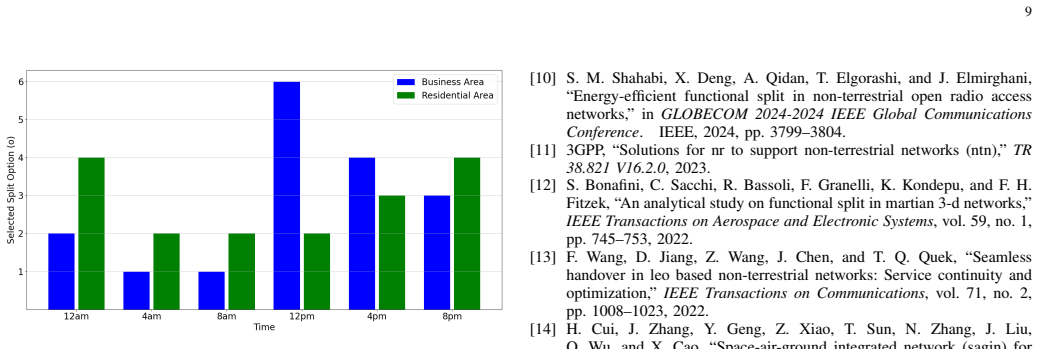
The paper's central claim is that a DQN-based framework can jointly choose a disaggregation mode and a CU-DU functional split option for an NTN O-RAN at each time step, and that this policy is more energy-efficient than a Seq-to-Seq approach. The objective minimized is total power, the sum of node processing power and feeder-link transmission power, under latency, traffic-capacity, and computational constraints. The numerical results in Section V show the proposed policy achieves about a 20% reduction in normalized power consumption relative to the Seq-to-Seq approach for both business-area and residential-area daily traffic patterns, and it reaches a stable policy in fewer episodes. The paper also claims that the agent's behavior matches intuition: at peak traffic hours it selects higher split options, meaning more functions are centralized, while at low traffic it selects lower split options.
Load-bearing premise
The evaluation fixes the LEO satellite at a constant 600 km distance with a constant 100 Mbps feeder link, so the only dynamics the agent must handle are traffic fluctuations; if the satellite link itself varies in real deployments, the measured power savings and latency compliance are not guaranteed.
Editorial extensions
If this is right
- A near-real-time RIC could use the same DQN controller to switch functional split options on the fly as traffic rises and falls, without manual reconfiguration.
- The reported 20% reduction in normalized power consumption suggests meaningful energy savings on power-limited satellite and HAPS payloads.
- Because the reward function maps latency, traffic, and compute constraints into penalties, the learned policy is expected to respect those constraints while minimizing power.
- The same action design, five placements plus three split movements, could transfer to other O-RAN deployments with different node sets or split tables.
Reading between the lines
- A natural extension not tested in the paper is feeding time-varying link state into the state set; with variable slant range and Doppler, the optimal split would shift even at constant traffic, and the same reward structure could learn that adaptation.
- Since only two fixed daily traffic patterns are used in training and evaluation, the paper does not demonstrate robustness to unseen demand profiles; a transfer-learning check would tell whether one training run generalizes.
- The negative reward for changing placement biases the policy toward stability, which under fast LEO handover could delay needed reconfiguration; a handover-aware cost term is a plausible next test.
- The claimed 20% saving is relative to one Seq-to-Seq baseline; comparing against exhaustive search over all placements and splits for each traffic snapshot would directly measure how close the learned policy is to the true optimum.
Editorial analysis
A structured set of objections, weighed in public.
Referee Report
Summary. The paper formulates a CU/DU functional-split and disaggregation selection problem for hybrid non-terrestrial/terrestrial O-RAN, with objectives and constraints involving power consumption, latency, feeder-link capacity, and computational load. It proposes a Deep Q-Network (DQN) with a ResNet Q-network, a state vector containing traffic and power information, and a reward composed of constraint-satisfaction indicators and switching penalties. Numerical results claim a 20% reduction in normalized power consumption relative to a Seq-to-Seq baseline in business and residential traffic scenarios.
Significance. The problem is timely and relevant, and the paper makes a useful effort to connect O-RAN functional-split flexibility with LEO/HAPS/gateway deployments. A clear strength is the use of realistic hardware power and compute parameters from Nvidia Jetson TX2, AGX Xavier, and L4 platforms, together with measured daily traffic patterns. If the central learning objective were correctly matched to the power-minimization problem, the proposed DQN framework could be a constructive step toward energy-aware near-real-time RIC control in NTN-O-RAN. However, as written, the reward function does not explicitly optimize the stated power objective, the feasibility constraints are internally inconsistent, and the numerical evidence is presented without statistical support, so the main claimed contribution is not yet established.
major comments (5)
- [§IV-C, Eq. (14)] The reward in Eq. (14) is r[n] = sum_{j=1}^5 nu_j R_j[n], where R1-R3 are binary indicators for the latency, feeder-link, and computational constraints, and R4-R5 penalize changing the CU/DU placement or split point. No term proportional to P^o_Total[n] or any monotone transformation of it appears in the reward, even though P^o_Total is the objective of problem (11) and appears only as an observation in the state vector (12). Since observations do not directly shape the policy, the DQN has no training pressure to prefer lower-power configurations among constraint-satisfying actions. The 20% power reduction reported in Section V is therefore not tied to the stated optimization objective and must be re-established with a reward that explicitly includes the power term or a clearly justified surrogate.
- [§III, Eqs. (1)-(4)] Constraints (1)-(4) are internally inconsistent as written. Eq. (1) requires sum_o x^o_{c,d} = 7 for c=d, which forces all seven split options to be simultaneously active for each monolithic gNB placement; it should presumably be sum_o x^o_{c,c} = 1. Eq. (2) contains the impossible condition "forall c != d, c = d in N". These errors propagate into the power model: with Eq. (1), x^o_{c,c} = 1 for all o, so the idle-power weights in Eqs. (7)-(8) become fixed at 0.5 and no meaningful distinction remains among monolithic split options. The feasibility set of problem (11) is therefore not well defined.
- [Table I and §II] Table I contains conflicting split definitions. Split option 0 and split option 5 both list the same functions (PHY, MAC, RLC, PDCP) in the DU with no CU functions, while option 6 lists the same functions in the CU with no DU functions. The peak-traffic column is also not consistent with the latency ordering: options 0-2 have peak traffic lambda_RU, options 4-5 have 1.02 lambda_RU + 1.5, and option 6 has a constant 2500 Mbps. Since these values feed directly into P^o_T in Eq. (9) and the computational loads in Table II, the numerical evaluations inherit these inconsistencies. The authors should correct Table I or explicitly explain the intended mapping between split options, functions, latency, and traffic.
- [§V, Figs. 5-6; §IV-C] The central 20%-reduction claim is supported only by single learning curves without error bars, confidence intervals, or multiple random seeds, even though DQN training is stochastic. No comparison is made against an exhaustive search or an optimal solver for problem (11), so the optimality gap of the learned policy is unknown. Additionally, the penalty weights nu_j in Eq. (14) are described only as "set during training" and are never reported, making the training reward non-reproducible. The authors should report all reward weights and hyperparameters, run multiple seeds, and present mean and variance measures for the power-consumption comparison.
- [Table III and §V] The simulation fixes the LEO satellite at a single 600 km distance from the gateway and a constant 100 Mbps feeder-link capacity for the entire evaluation. Orbital motion, Doppler shift, link variability, and handovers are absent. The abstract and Section V claim adaptability to "dynamic network environments," but the demonstrated dynamics consist only of traffic variation. Since the target scenario is LEO/HAPS with near-real-time RIC operation, the authors should either include a time-varying feeder-link model or explicitly restrict the claim to traffic-driven dynamics.
minor comments (5)
- [§II and §IV-B] There are several typos: "General in O-RAN" should be "Generally in O-RAN," and "Monthilic" should be "Monolithic" in the action list.
- [Algorithm 1] The pseudocode line "if t/T == 0 then F = 1 else F = 0" should be written as a modulo condition (e.g., "if t mod T == 0") to periodically refresh the target network; as written, the update occurs only at the initial time step.
- [Table III] The HAPS energy-per-operation value is written as "5,64 J/TO" and should be "5.64 J/TO."
- [Fig. 7] The text describing Fig. 7 refers to an "optimized pilot assignment policy," which appears to be a copy-paste from a different problem; this paper is about functional-split and disaggregation selection.
- [Eq. (12)] The state notation P^o[n]_Total and L^o[n]_Total is ambiguous because the superscript o is mixed with the time index n; the authors should define units and use consistent subscript/superscript placement.
Circularity Check
No material circularity: the energy model and RAN split tables are independent standards/hardware inputs, and the 20% power reduction is an empirical simulation result rather than a restatement of the training reward. The main weakness is that the reward in Eq. (14) omits the power term, but that is an objective-mismatch/correctness issue, not a circular reduction.
full rationale
The paper's derivation chain is: construct power, latency, and computation models from external hardware specifications (Nvidia Jetson TX2, AGX Xavier, L4) and 3GPP split-option tables; pose the power-minimization problem (11); train a DQN using state (12), action (13), reward (14); and finally report normalized power against a Seq-to-Seq baseline. No step reduces a claimed result to its own input by construction. The power model P^o_Total depends on externally parameterized quantities, and the baseline is the independently published A2C method [7]. The one self-citation, [10], is used only to ground the prior NTN O-RAN platform architecture and is not load-bearing for the DQN contribution. The most serious concern, raised by the skeptic's headline, is that the reward in Eq. (14) is a weighted sum of feasibility indicators R1-R3 and switching penalties R4-R5, with no explicit term proportional to P^o_Total, even though problem (11) minimizes P^o_Total. This is an internal inconsistency between the stated objective and the learning signal, and it weakens the causal claim that the agent is trained to minimize power. However, it is not circularity: the reported energy savings are computed by an evaluation model that is independent of the reward weights, not by a fitted parameter renamed as a prediction or by a self-citation chain. The finding is therefore a correctness/verifiability gap, not a circular derivation.
Assumptions & free parameters
free parameters (2)
- Reward penalty coefficients nu_1 to nu_5 =
Not reported
- DQN hyperparameters (learning rate rho, episode count) =
Learning rate not reported
assumptions (4)
- domain assumption LEO satellite is modeled as a fixed node at 600 km from the gateway with a constant 100 Mbps feeder link (Table III), with no orbital dynamics.
- domain assumption The split option parameters in Table I (latency, peak traffic) and computational loads in Table II accurately represent 3GPP/O-RAN functional splits.
- domain assumption The hardware proxies (Jetson TX2, AGX Xavier, Nvidia L4) and their energy-per-operation values represent processing on HAPS, LEO, and gateway nodes.
- standard math DQN with experience replay and a target network converges to a good approximation of the optimal Q-function for this MDP.
Cite this review
Pith. "Pith review of Energy-efficient Deep Reinforcement Learning-based Network Function Disaggregation in Hybrid Non-terrestrial Open Radio Access Networks." pith.science (2026). https://pith.science/paper/XOLBRCVK
@misc{pith2026250606876,
  author       = {Pith},
  title        = {Pith review of: Energy-efficient Deep Reinforcement Learning-based Network Function Disaggregation in Hybrid Non-terrestrial Open Radio Access Networks},
  year         = {2026},
  howpublished = {\url{https://pith.science/paper/XOLBRCVK}},
  note         = {Machine review of arXiv:2506.06876}
}
read the original abstract
This paper explores the integration of Open Radio Access Network (O-RAN) principles with non-terrestrial networks (NTN) and investigates the optimization of the functional split between Centralized Units (CU) and Distributed Units (DU) to improve energy efficiency in dynamic network environments. Given the inherent constraints of NTN platforms, such as Low Earth Orbit (LEO) satellites and high-altitude platform stations (HAPS), we propose a reinforcement learning-based framework utilizing Deep Q-Network (DQN) to intelligently determine the optimal RAN functional split. The proposed approach dynamically adapts to real-time fluctuations in traffic demand, network conditions, and power limitations, ensuring efficient resource allocation and enhanced system performance.The numerical results demonstrate that the proposed policy effectively adapts to network traffic flow by selecting an efficient network disaggregation strategy and corresponding functional split option based on data rate and latency requirements.
Figures


Figures from the paper (4 more)


Reference graph
Works this paper leans on
-
[1]
Hybrid centralized and distributed learning for mec-equipped satellite 6g networks,
T. K. Rodrigues and N. Kato, “Hybrid centralized and distributed learning for mec-equipped satellite 6g networks,” IEEE Journal on Selected Areas in Communications , vol. 41, no. 4, pp. 1201–1211, 2023
work page 2023
-
[2]
X. Zhu and C. Jiang, “Delay optimization for cooperative multi-tier computing in integrated satellite-terrestrial networks,” IEEE Journal on Selected Areas in Communications , vol. 41, no. 2, pp. 366–380, 2022
work page 2022
-
[3]
O-ran based non- terrestrial networks: Trends and challenges,
R. Campana, C. Amatetti, and A. Vanelli-Coralli, “O-ran based non- terrestrial networks: Trends and challenges,” in 2023 Joint European Conference on Networks and Communications & 6G Summit (Eu- CNC/6G Summit) . IEEE, 2023, pp. 264–269
work page 2023
-
[4]
Small cell virtualization functional splits and use cases,
S. C. Forum, “Small cell virtualization functional splits and use cases,” 2016
2016
-
[5]
A survey of the functional splits proposed for 5g mobile crosshaul networks,
L. M. Larsen, A. Checko, and H. L. Christiansen, “A survey of the functional splits proposed for 5g mobile crosshaul networks,” IEEE Communications Surveys & Tutorials , vol. 21, no. 1, pp. 146–172, 2018
work page 2018
-
[6]
An optimal deployment framework for multi-cloud virtualized radio access networks,
F. W. Murti, J. A. Ayala-Romero, A. Garcia-Saavedra, X. Costa-P ´erez, and G. Iosifidis, “An optimal deployment framework for multi-cloud virtualized radio access networks,” IEEE Transactions on Wireless Communications, vol. 20, no. 4, pp. 2251–2265, 2021
work page 2021
-
[7]
Energy-aware dynamic vnf splitting in o-ran using deep reinforcement learning,
E. Amiri, N. Wang, M. Shojafar, and R. Tafazolli, “Energy-aware dynamic vnf splitting in o-ran using deep reinforcement learning,” IEEE wireless communications letters , 2023
work page 2023
-
[8]
Ran functional split options for integrated terrestrial and non-terrestrial 6g networks,
M. Rihan, T. D ¨ue, M. Vakilifard, D. W ¨ubben, and A. Dekorsy, “Ran functional split options for integrated terrestrial and non-terrestrial 6g networks,” in 2023 11th International Japan-Africa Conference on Electronics, Communications, and Computations (JAC-ECC) . IEEE, 2023, pp. 152–158
work page 2023
Show all 27 references
-
[9]
Functional split evaluation in ntn for leo satellites,
R. Khouli, L. Frank, and A. Hofmann, “Functional split evaluation in ntn for leo satellites,” in IET Conference Proceedings CP873 , vol. 2023, no. 48. IET, 2023, pp. 1–9
2023
-
[10]
Energy-efficient functional split in non-terrestrial open radio access networks,
S. M. Shahabi, X. Deng, A. Qidan, T. Elgorashi, and J. Elmirghani, “Energy-efficient functional split in non-terrestrial open radio access networks,” in GLOBECOM 2024-2024 IEEE Global Communications Conference. IEEE, 2024, pp. 3799–3804
2024
-
[11]
Solutions for nr to support non-terrestrial networks (ntn),
3GPP, “Solutions for nr to support non-terrestrial networks (ntn),” TR 38.821 V16.2.0 , 2023
2023
-
[12]
An analytical study on functional split in martian 3-d networks,
S. Bonafini, C. Sacchi, R. Bassoli, F. Granelli, K. Kondepu, and F. H. Fitzek, “An analytical study on functional split in martian 3-d networks,” IEEE Transactions on Aerospace and Electronic Systems , vol. 59, no. 1, pp. 745–753, 2022
2022
-
[13]
Seamless handover in leo based non-terrestrial networks: Service continuity and optimization,
F. Wang, D. Jiang, Z. Wang, J. Chen, and T. Q. Quek, “Seamless handover in leo based non-terrestrial networks: Service continuity and optimization,” IEEE Transactions on Communications , vol. 71, no. 2, pp. 1008–1023, 2022
2022
-
[14]
Space-air-ground integrated network (sagin) for 6g: Requirements, architecture and challenges,
H. Cui, J. Zhang, Y . Geng, Z. Xiao, T. Sun, N. Zhang, J. Liu, Q. Wu, and X. Cao, “Space-air-ground integrated network (sagin) for 6g: Requirements, architecture and challenges,” China Communications, vol. 19, no. 2, pp. 90–108, 2022
2022
-
[15]
Study on new radio access technology: Radio access architecture and interfaces, technical specification group radio access network, 38.801
“Study on new radio access technology: Radio access architecture and interfaces, technical specification group radio access network, 38.801.” 3GPP, 2016
2016
-
[16]
Study on new radio (nr) to support non-terrestrial networks, technical specification group radio access network, 38.811
“Study on new radio (nr) to support non-terrestrial networks, technical specification group radio access network, 38.811.” 3GPP, 2017
2017
-
[17]
Reinforcement learning: An introduction,
R. S. Sutton and A. G. Barto, “Reinforcement learning: An introduction,” MIT press, 2018
2018
-
[18]
Human-level control through deep reinforcement learning ,
V . Mnih, K. Kavukcuoglu, D. Silver, A. A. Rusu, J. Veness, M. G. Bellemare, A. Graves, M. Riedmiller, A. K. Fidjeland, G. Ostrovski, S. Petersen, C. Beattie, A. Sadik, I. Antonoglou, H. King, D. Kumaran, D. Wierstra, S. Legg, and D. Hassabis, “ Human-level control through dee...
2015
-
[19]
Towards zero grid electricity networking: Powering bss with renewable energy sources,
M. A. Marsan, G. Bucalo, A. Di Caro, M. Meo, and Y . Zhang, “Towards zero grid electricity networking: Powering bss with renewable energy sources,” in 2013 IEEE international conference on communications workshops (ICC) . IEEE, 2013, pp. 596–601
2013
-
[20]
Accessed May 30, 2025
Nvidia jetson tx2 module. Accessed May 30, 2025. [Online]. Available: https://developer.nvidia.com/embedded/jetson-tx2
2025
-
[21]
Accessed May 30,
Nvidia jetson agx xavier series. Accessed May 30,
-
[22]
Accessed May 30, 2025
Nvidia l4 tensor core gpu. Accessed May 30, 2025. [Online]. Available: https://www.nvidia.com/en-gb/data-center/l4
2025
-
[23]
Haps in the non- terrestrial network nexus: Prospective architectures and performance insights,
Z. Lou, B. E. Y . Belmekki, and M.-S. Alouini, “Haps in the non- terrestrial network nexus: Prospective architectures and performance insights,” IEEE Wireless Communications , vol. 30, no. 6, pp. 52–58, 2023
2023
-
[24]
5g ran: Functional split orchestration optimization,
S. Matoussi, I. Fajjari, S. Costanzo, N. Aitsaadi, and R. Langar, “5g ran: Functional split orchestration optimization,” IEEE Journal on Selected Areas in Communications , vol. 38, no. 7, pp. 1448–1463, 2020
2020
-
[25]
Deep residual learning for image recognition,
K. He, X. Zhang, S. Ren, and J. Sun, “Deep residual learning for image recognition,” in Proceedings of the IEEE conference on computer vision and pattern recognition , 2016, pp. 770–778
2016
-
[26]
Goodfellow, Y
I. Goodfellow, Y . Bengio, and A. Courville, Deep learning. MIT press, 2016
2016
-
[2025]
Available: https://www.nvidia.com/en-gb/autonomous- machines/embedded-systems/jetson-agx-xavier
[Online]. Available: https://www.nvidia.com/en-gb/autonomous- machines/embedded-systems/jetson-agx-xavier
Reviewed August 7, 2026 · model on record in the stance chip above.
Discussion (0). Continue with ORCID to comment.