REVIEW 3 major objections 5 minor 1 cited by
LIGO/Virgo/KAGRA neutron star merger candidate S250206dm: Zwicky Transient Facility observations
T0 review · 3 major / 5 minor · reviewed 2026-08-06 · deepseek-v4-flash
Pith's one-line read ZTF's nine-night search for the optical counterpart of neutron-star merger candidate S250206dm found nothing, and the non-detection excludes up to 35% of the brightest kilonova models in the authors' BNS grid.
desk verdict Solid GW follow-up with careful candidate vetting, but the abstract oversells the kilonova exclusions by dropping the optimistic-distance and non-overlapping-coverage caveats. read the letter →
The pith
A machine-rendered reading of the paper's core claim, the machinery that carries it, and where it could break.
The reading
What carries the argument
The load-bearing machinery is the comparison of ZTF's observed upper limits (dominated by the first-night r-band limit of $\sim20.5$ mag at 1.2 days after the trigger) to a grid of 3,072 possis three-dimensional Monte Carlo radiative-transfer kilonova models spanning six ejecta parameters — dynamical mass, velocity, and electron fraction plus wind mass, velocity, and electron fraction — each viewed at 11 angles, together with 407 NSBH models. The ejection-mass and velocity space is the quantity being constrained, and the exclusion percentages are read off the fraction of grid models whose predicted light curves exceed the limits.
What would settle it
A confirmed kilonova associated with a BNS merger at comparable distance, with wind ejecta mass near $0.13\,M_\odot$, viewed nearly face-on, and peaking around $-17.5$ absolute magnitude or brighter, detected inside a similarly covered footprint would directly contradict the paper's exclusion claim; the same test could be run computationally by sampling the six ejecta parameters more finely and at the nominal $373$ Mpc distance to see whether the excluded fraction collapses.
Extended reading notes
Core claim
Using 300-second exposures in g, r, and i bands repeated over nine nights, ZTF imaged 68% of the S250206dm localization (64% twice) and found no transient that survived vetting as a kilonova. The paper quantifies the significance of this absence two ways: frequentist simulations (simsurvey) show detection efficiency above 10% for kilonovae brighter than $-17.5$ absolute magnitude at the nominal $373\pm104$ Mpc distance, and Bayesian inference (nimbus) disfavors models with $M_0\lesssim -17.5$ and slow decay ($\alpha<0.2$ mag/day). Comparing the survey's photometric upper limits to 3,072 possis radiative-transfer BNS models and 407 NSBH models, pinned at the closest 1-$\sigma$ distance of 269 Mpc, the authors find no NSBH model is bright enough to be ruled out, while face-on BNS models with wind ejecta mass near $0.13\,M_\odot$ and high electron fraction are excluded at up to 35%; the joint ZTF plus DECam limits raise that to 55% for high-mass face-on models.
Load-bearing premise
The exclusion percentages are fractions of the authors' own finite model grids and assume the merger sits at 269 Mpc — the closest 1-sigma end of the distance distribution — with the kilonova inside the 68% of the localization that ZTF covered.
Editorial extensions
If this is right
- For S250206dm, ZTF alone rules out up to 35% of face-on BNS kilonova models with high wind ejecta mass ($M_{\rm wind}\approx0.13\,M_\odot$) at 269 Mpc.
- None of the NSBH kilonova models in the grid are bright enough to be excluded by the ZTF limits.
- Combining ZTF with DECam/GW-MMADS coverage (73% of the localization) raises the excluded fraction to 55% for the same face-on high-mass models and pushes recovery efficiency near 60% for rising and slowly fading kilonovae.
- The survey's efficiency for recovering a GW170817-like kilonova in this event is below 1%, so this non-detection mainly sharpens limits on the bright end of the kilonova luminosity function.
- The nimbus analysis disfavors kilonovae with peak absolute magnitude $M_0$ below about $-17.5$ and slow evolution, pointing future searches toward earlier and deeper first-epoch observations.
Reading between the lines
- The 35% and 55% exclusion fractions are relative to the authors' discrete model grids and to the optimistic 269 Mpc distance; at the nominal 373 Mpc the simulated light curves are fainter, so a denser grid or more probable distance would likely shrink the excluded fraction.
- The strongest leverage comes from the very first night of coverage, so a survey that begins within hours of a merger — or a network distributing fields by probability — could convert similar non-detections into substantially tighter ejecta-mass limits.
- If future events give overlapping wide-field coverage from ZTF and DECam, the paper's joint-analysis exercise becomes directly applicable, and the 55% exclusion could be realized without the present assumption of overlapping footprints.
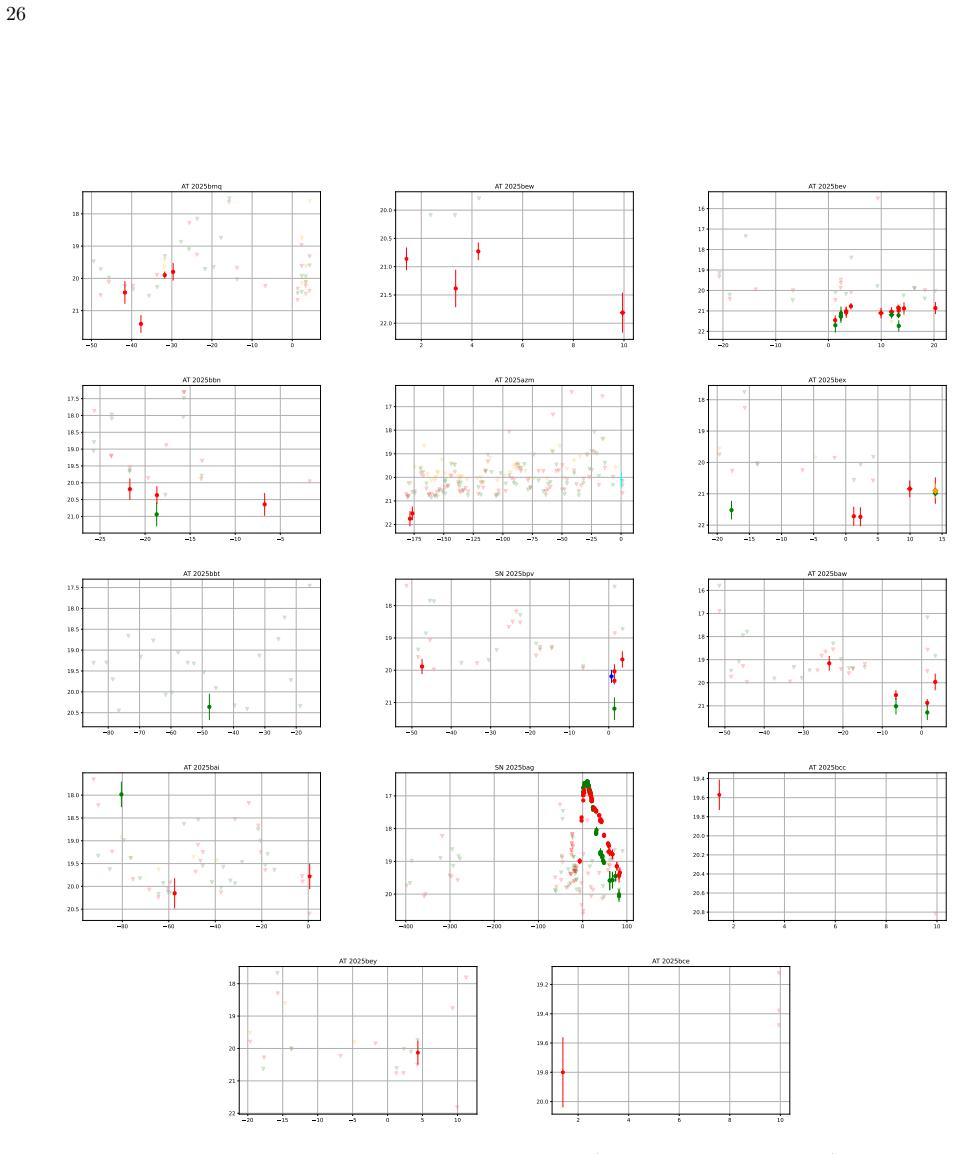
- Seven candidates (including AT2025bcc and AT2025bey) could not be individually ruled out; if any were actually the counterpart and simply fainter than the KN models, the parameter-space constraints would need to be relaxed.
Signed reviews
Editorial analysis
A structured set of objections, weighed in public.
Referee Report
Summary. The paper reports the Zwicky Transient Facility (ZTF) search for an optical counterpart to the gravitational-wave event S250206dm, a high-significance compact-binary merger candidate with at least one neutron star. ZTF observed 68% of the localization region over nine nights, identified 13 candidate transients from its own alert stream, and vetted an additional 22 candidates circulated by other facilities; all 13 ZTF candidates were rejected and seven external candidates could not be ruled out, so the paper proceeds under the explicit assumption that none is the kilonova. The authors quantify the search efficiency with the simsurvey and nimbus pipelines, compare ZTF upper limits to new POSSIS radiative-transfer model grids for BNS and NSBH mergers, and report that up to 35% of BNS models with high wind ejecta mass viewed face-on are ruled out at the optimistically assumed distance of 269 Mpc. Finally, they combine ZTF and DECam/GW-MMADS observations in a joint analysis, reporting 73.3% combined coverage, improved efficiency for rising and slowly fading models, and up to 55% exclusion of face-on high-wind-mass BNS models. The central scientific result is a non-detection and the associated constraints on the brightest end of kilonova parameter space.
Significance. If the stated constraints are taken at face value, the paper provides a useful upper limit on optical emission from a nearby NS-involved merger and demonstrates the current capability of wide-field optical follow-up for LIGO/Virgo/KAGRA events. The strengths are the very careful candidate vetting, the use of forced-photometry history, the combination of several independent alert-filtering pipelines, and the application of established efficiency tools (simsurvey and nimbus) together with new POSSIS model grids that are promised to be public. The ZTF-only non-detection and its efficiency statement for KNe brighter than about -17.5 mag are defensible. The significance is diminished, however, by the fact that the headline joint 55% exclusion is explicitly hypothetical, because ZTF and DECam did not overlap in sky coverage for this event, and by the distance and viewing-angle conditions attached to the model-exclusion numbers. The paper is a solid observational contribution, but its abstract overstates the actual constraining power of the joint analysis.
major comments (3)
- [Abstract; §5] The 55% joint-exclusion figure is not an actual constraint for S250206dm. Section 5 explicitly states 'Although this approach assumes joint coverage, which is not the case for S250206dm', and the 73.3% coverage quoted in the abstract is the union of the ZTF and DECam footprints, not the region where both instruments have upper limits. The abstract nevertheless presents 'allowing us to rule out 55% of the high-mass KN models viewed face-on' as a result of this event's joint observations, which is an overstatement. Please remove the 55% number from the abstract or clearly label it as a hypothetical forecast for overlapping wide-field coverage, and report separately what the actual non-overlapping data constrain.
- [§4.2; Fig. 14; abstract] The ZTF-only exclusion of 35% is computed at 269 Mpc, which the text calls the 'optimistically assumed' closest 1-sigma distance, and for face-on viewing (cos θobs = 1.0). At the nominal LVK distance of 373 ± 104 Mpc the number of excluded models is smaller, as Fig. 14 demonstrates with its distance-sensitivity corner plot. The abstract states 'Up to 35% of the models with high wind ejecta mass ... are ruled out when viewed face-on' without mentioning the 269 Mpc pin, so the claim as written is stronger than what the observations establish. Please state the distance and viewing-angle assumptions wherever the 35% and 55% exclusion percentages appear, and clarify that the excluded fractions are fractions of a finite model grid rather than a continuous measure of parameter-space volume.
- [§3.3; Appendix C] Seven candidates (AT2025bcc, AT2025bey, AT2025bbp, AT2025bah, AT2025bam, AT2025bce, AT2025baf) cannot be ruled out by the stated rejection criteria, and the paper assumes they are not counterparts. This assumption is reasonable and is stated in the text, but it should be carried through explicitly in the abstract and conclusion, where the language 'no likely optical counterpart' is stronger than the candidate evidence alone supports; the constraint results depend on this assumption.
minor comments (5)
- [Fig. 3; §6] The event name is misspelled as 'S250602dm' in the Fig. 3 caption and in Section 6; it should be S250206dm throughout.
- [Fig. 15 caption] The Fig. 15 caption says 'a fixed distance of 269 Mpc' while the panel label reads 'd = 373Mpc'; one of these is incorrect and should be fixed.
- [§3.3] The text refers to 'Table D' for the summary of follow-up of candidates from other facilities, but the relevant summary appears to be in Appendix C and Table 2; please correct the cross-reference.
- [§4.2; Figs. 5, 12-15] The notation for the wind electron fraction is inconsistent: the text and some axis labels use Ye,wind while the corner-plot colorbars use \bar{Y}_{e,wind}; please standardize.
- [§5] The sentence beginning 'The simsurvey approach accounts for the fact that the two instruments cover different areas' is correct, but it sits directly next to the joint-coverage assumption that contradicts it; consider restructuring so the reader can distinguish the efficiency calculation, which uses the actual union of pointings, from the model-exclusion calculation, which assumes overlapping coverage.
Circularity Check
No significant circularity: the exclusion limits are forward-model comparisons against observed upper limits, not fits to the data; the only flagged issue is an abstract/body mismatch on the hypothetical 55% joint exclusion, which the body itself discloses.
full rationale
The paper's derivation chain is self-contained. The central claim is that ZTF's non-detection, under the explicit assumption that a kilonova lies within the imaged footprint, rules out some bright BNS model light curves. The model grids (3072 BNS and 407 NSBH possis models) are forward-simulated from ejecta parameters (Section 4.2) and are compared to observed g/r/i upper limits; no model parameter is fitted to the S250206dm observations, and the '35% ruled out' figure is literally the fraction of grid models exceeding the observed limits at 269 Mpc and face-on viewing (Figures 4-5), so the output is not an input by construction. The nimbus and simsurvey efficiencies are software tools cited from earlier work (Ahumada et al. 2024; Mohite et al. 2022), and the possis radiative-transfer code (Bulla 2023) provides externally validated physics; these self-citations are methodological continuity, not load-bearing uniqueness arguments or smuggled ansatze. One flagged limitation: the abstract reports the joint DECam+ZTF '55%' exclusion without the caveat that Section 5 states 'Although this approach assumes joint coverage, which is not the case for S250206dm'; the body correctly labels that number as a hypothetical obtained under an overlap assumption, and the simsurvey joint efficiency analysis in the same section does account for the instruments covering different areas. The issue is therefore an abstract-level overstatement or internal-consistency concern, not circular reasoning: no step reduces to its own input, and no fitted parameter is renamed as a prediction.
Assumptions & free parameters
free parameters (4)
- BNS grid ejecta parameter ranges =
Mdyn = 0.001-0.02 Msun; vdyn = 0.12-0.25c; Ye,dyn = 0.15-0.30; Mwind = 0.01-0.13 Msun; vwind = 0.03-0.15c; Ye,wind =…
- Distance pin for model exclusion =
269 Mpc (closest 1-sigma of 373 +/- 104 Mpc)
- Tophat grid (M0, alpha) sampling =
M0 roughly -18 to -12 mag; alpha roughly -0.5 to 1.5 mag per day
- Candidate selection cuts =
5-sigma residual threshold; real-bogus score greater than 0.3; two detections separated by at least 15 minutes
assumptions (5)
- domain assumption The possis radiative-transfer models (Bulla 2023) with Rosswog and Korobkin (2024) heating rates faithfully represent real BNS and NSBH kilonova light curves.
- domain assumption The LVK event parameters are accurate inputs: skymap, FAR of 1 in 25 years, pastro = 0.92, and distance 373 +/- 104 Mpc.
- domain assumption Kilonovae from this event are described by the two-component (dynamical plus disk-wind) ejecta parameterization sampled by the grids.
- ad hoc to paper The seven candidates that passed all rejection tests are not counterparts to S250206dm.
- domain assumption simsurvey and nimbus correctly estimate detection efficiency and posteriors.
Cite this review
Pith. "Pith review of LIGO/Virgo/KAGRA neutron star merger candidate S250206dm: Zwicky Transient Facility observations." pith.science (2026). https://pith.science/paper/XP27UTR3
@misc{pith2026250700357,
  author       = {Pith},
  title        = {Pith review of: LIGO/Virgo/KAGRA neutron star merger candidate S250206dm: Zwicky Transient Facility observations},
  year         = {2026},
  howpublished = {\url{https://pith.science/paper/XP27UTR3}},
  note         = {Machine review of arXiv:2507.00357}
}
abstract
We present the searches conducted with the Zwicky Transient Facility (ZTF) in response to S250206dm, a bona fide event with a false alarm rate of one in 25 years, detected by the International Gravitational Wave Network (IGWN). Although the event is significant, the nature of the compact objects involved remains unclear, with at least one likely neutron star. ZTF covered 68% of the localization region, though we did not identify any likely optical counterpart. We describe the ZTF strategy, potential candidates, and the observations that helped rule out candidates, including sources circulated by other collaborations. Similar to Ahumada et al. 2024, we perform a frequentist analysis, using simsurvey, as well as Bayesian analysis, using nimbus, to quantify the efficiency of our searches. We find that, given the nominal distance to this event of 373$\pm$104 Mpc, our efficiencies are above 10% for KNe brighter than $-17.5$ absolute magnitude. Assuming the optical counterpart known as kilonova (KN) lies within the ZTF footprint, our limits constrain the brightest end of the KN parameter space. Through dedicated radiative transfer simulations of KNe from binary neutron star (BNS) and black hole-neutron star (BHNS) mergers, we exclude parts of the BNS KN parameter space. Up to 35% of the models with high wind ejecta mass ($M_{\rm wind} \approx 0.13$ M$_{\odot}$) are ruled out when viewed face-on ($\cos\theta_{\rm obs} = 1.0$). Finally, we present a joint analysis using the combined coverage from ZTF and the Gravitational Wave Multimessenger Dark Energy Camera Survey (GW-MMADS). The joint observations cover 73% of the localization region, and the combined efficiency has a stronger impact on rising and slowly fading models, allowing us to rule out 55% of the high-mass KN models viewed face-on.
Figures


Figures from the paper (12 more)




Forward citations
Cited by 1 Pith paper
-
Black hole-neutron star binaries with high spins and large mass asymmetries: III. Properties of the ejected material and its electromagnetic signatures
High-spin, high-mass-ratio black hole–neutron star mergers eject 0.02–0.06 solar masses of neutron-rich (Y_e≈0.05) debris whose kilonovae are infrared-bright, optically dark, and match late-time AT2017gfo while stayin...
Reference graph
Works this paper leans on
-
[1]
- [1] #1 = = ^ ^ ^ .\!\!^ d .\!\!^ h .\!\!^ m .\!\!^ s .\!\!^ @mss
thebibliography [1] 20pt to REFERENCES 6pt =0pt 10pt plus 3pt =0pt =0pt =1pt plus 1pt =0pt =0pt -12pt =13pt plus 1pt =20pt =13pt plus 1pt \@M =10000 =-1.0em =0pt =0pt 0pt =0pt =1.0em @enumiv\@empty 10000 10000 `\.\@m \@noitemerr \@latex@warning Empty `thebibliography' environment \@ifnextchar \@reference \@latexerr Missing key on reference command Each re...
2017
-
[2]
, " * write output.state after.block = add.period write newline
ENTRY address archivePrefix author booktitle chapter doi edition editor eprint howpublished institution journal key month note number organization pages publisher school series title type volume year label extra.label sort.label short.list INTEGERS output.state before.all mid.sentence after.sentence after.block FUNCTION init.state.consts #0 'before.all :=...
-
[3]
write newline
" write newline "" before.all 'output.state := FUNCTION format.doi doi empty "" "doi:" doi * if FUNCTION format.eprint eprint empty "" archivePrefix empty "" archivePrefix ":" * if eprint field.or.null * if FUNCTION format.pid eprint empty format.doi format.eprint if FUNCTION n.dashify 't := "" t empty not t #1 #1 substring "-" = t #1 #2 substring "--" = ...
-
[4]
Abbott , B. P., Abbott , R., Abbott , T. D., et al. 2017, , 848, L13, 10.3847/2041-8213/aa920c
-
[5]
Abbott , R., Abbott , T. D., Acernese , F., et al. 2023, Physical Review X, 13, 041039, 10.1103/PhysRevX.13.041039
-
[6]
Abbott et al. 2017, Phys. Rev. Lett., 119, 161101, 10.1103/PhysRevLett.119.161101
-
[7]
2025, GRB Coordinates Network, 39197, 1
Ackley , K., Belkin , S., Steeghs , D., et al. 2025, GRB Coordinates Network, 39197, 1
2025
-
[8]
Ahumada , T., Singer , L. P., Anand , S., et al. 2021, Nature Astronomy, 5, 917, 10.1038/s41550-021-01428-7
Show all 150 references
-
[9]
W., et al
Ahumada , T., Anand , S., Coughlin , M. W., et al. 2022, , 932, 40, 10.3847/1538-4357/ac6c29
2022 doi
-
[10]
2024, , 136, 114201, 10.1088/1538-3873/ad8265
---. 2024, , 136, 114201, 10.1088/1538-3873/ad8265
2024 doi
-
[11]
2025, GRB Coordinates Network, 39228, 1
Ahumada , T., Karambelkar , V., Bellm , E., et al. 2025, GRB Coordinates Network, 39228, 1
2025
-
[12]
R., & Ravenhall , D
Akmal , A., Pandharipande , V. R., & Ravenhall , D. G. 1998, , 58, 1804, 10.1103/PhysRevC.58.1804
1998 doi
-
[13]
D., Schroeder , G., Paterson , K., et al
Alexander , K. D., Schroeder , G., Paterson , K., et al. 2021, , 923, 66, 10.3847/1538-4357/ac281a
2021 doi
-
[14]
W., Kasliwal , M
Anand , S., Coughlin , M. W., Kasliwal , M. M., et al. 2020, Nature Astronomy, 10.1038/s41550-020-1183-3
2020 doi
- [15]
-
[16]
A., Anand , S., et al
Andreoni , I., Goldstein , D. A., Anand , S., et al. 2019, , 881, L16, 10.3847/2041-8213/ab3399
2019 doi
-
[17]
A., Kasliwal , M
Andreoni , I., Goldstein , D. A., Kasliwal , M. M., et al. 2020, , 890, 131, 10.3847/1538-4357/ab6a1b
2020 doi
-
[18]
W., Kool , E
Andreoni , I., Coughlin , M. W., Kool , E. C., et al. 2021, , 918, 63, 10.3847/1538-4357/ac0bc7
2021 doi
-
[19]
2020, , 497, 5518, 10.1093/mnras/staa1846
Antier , S., Agayeva , S., Almualla , M., et al. 2020, , 497, 5518, 10.1093/mnras/staa1846
2020 doi
-
[20]
2018, , 855, L23, 10.3847/2041-8213/aab267
Arcavi , I. 2018, , 855, L23, 10.3847/2041-8213/aab267
2018 doi
-
[21]
D., et al
Ashton , G., H \"u bner , M., Lasky , P. D., et al. 2019, , 241, 27, 10.3847/1538-4365/ab06fc
2019 doi
-
[22]
P., et al
Balasubramanian , A., Corsi , A., Mooley , K. P., et al. 2022, , 938, 12, 10.3847/1538-4357/ac9133
2022 doi
-
[23]
2022, , 934, 117, 10.3847/1538-4357/ac7565
Banerjee , S., Tanaka , M., Kato , D., et al. 2022, , 934, 117, 10.3847/1538-4357/ac7565
2022 doi
-
[24]
L., Dichiara , S., Watson , A
Becerra , R. L., Dichiara , S., Watson , A. M., et al. 2025, GRB Coordinates Network, 39208, 1
2025
-
[25]
S., & Csabai , I
Beck , R., Dobos , L., Budav \'a ri , T., Szalay , A. S., & Csabai , I. 2016, , 460, 1371, 10.1093/mnras/stw1009
2016 doi
-
[26]
C., & Sesar , B
Bellm , E. C., & Sesar , B. 2016, pyraf-dbsp: Reduction pipeline for the Palomar Double Beam Spectrograph . 1602.002
2016
-
[27]
C., Kulkarni , S
Bellm , E. C., Kulkarni , S. R., Graham , M. J., et al. 2019, , 131, 018002, 10.1088/1538-3873/aaecbe
2019 doi
-
[28]
2010, SExtractor: Source Extractor , Astrophysics Source Code Library
Bertin , E., & Arnouts , S. 2010, SExtractor: Source Extractor , Astrophysics Source Code Library. 1010.064
2010
-
[29]
D., Walters , R., et al
Blagorodnova , N., Neill , J. D., Walters , R., et al. 2018, , 130, 035003, 10.1088/1538-3873/aaa53f
2018 doi
-
[30]
2019, , 489, 5037, 10.1093/mnras/stz2495
Bulla , M. 2019, , 489, 5037, 10.1093/mnras/stz2495
2019 doi
- [31]
-
[32]
2025 a , GRB Coordinates Network, 39214, 1
Busmann , M., Gruen , D., O'Connor , B., et al. 2025 a , GRB Coordinates Network, 39214, 1
2025
-
[33]
2025 b , arXiv e-prints, arXiv:2503.14588, 10.48550/arXiv.2503.14588
Busmann , M., O'Connor , B., Sommer , J., et al. 2025 b , arXiv e-prints, arXiv:2503.14588, 10.48550/arXiv.2503.14588
2025 doi
-
[34]
2025, GRB Coordinates Network, 39318, 1
Cabrera , T., Hu , L., Hall , X., et al. 2025, GRB Coordinates Network, 39318, 1
2025
-
[35]
2024, , 110, 123029, 10.1103/PhysRevD.110.123029
Cabrera , T., Palmese , A., Hu , L., et al. 2024, , 110, 123029, 10.1103/PhysRevD.110.123029
2024 doi
-
[36]
C., Magnier , E
Chambers , K. C., Magnier , E. A., Metcalfe , N., et al. 2016, arXiv e-prints, arXiv:1612.05560. 1612.05560
2016 arXiv
-
[37]
R., et al
Chatterjee , D., Ghosh , S., Brady , P. R., et al. 2020, , 896, 54, 10.3847/1538-4357/ab8dbe
2020 doi
-
[38]
C., Vinko , J., & Lighetr Collaboration
Chen , H.-Y., Zeimann , G., Wheeler , J. C., Vinko , J., & Lighetr Collaboration . 2025 a , GRB Coordinates Network, 39785, 1
2025
-
[39]
W., Aryan , A., Yang , S., et al
Chen , T. W., Aryan , A., Yang , S., et al. 2025 b , GRB Coordinates Network, 39285, 1
2025
-
[40]
2025, GRB Coordinates Network, 39216, 1
Chime/Frb Collaboration . 2025, GRB Coordinates Network, 39216, 1
2025
-
[41]
W., T., A., S., A., et al
Coughlin, M. W., T., A., S., A., et al. 2019 a , Astrophys. J. Lett., 885, L19, 10.3847/2041-8213/ab4ad8
2019 doi
-
[42]
W., Tao, D., Chan, M
Coughlin, M. W., Tao, D., Chan, M. L., et al. 2018, Monthly Notices of the Royal Astronomical Society, 478, 692, 10.1093/mnras/sty1066
2018 doi
-
[43]
W., Ahumada, T., Cenko, S
Coughlin, M. W., Ahumada, T., Cenko, S. B., et al. 2019 b , Publications of the Astronomical Society of the Pacific, 131, 048001, 10.1088/1538-3873/aaff99
2019 doi
-
[44]
W., Bloom , J
Coughlin , M. W., Bloom , J. S., Nir , G., et al. 2023, , 267, 31, 10.3847/1538-4365/acdee1
2023 doi
-
[45]
A., Kilpatrick , C
Coulter , D. A., Kilpatrick , C. D., Macias , P., et al. 2025, GRB Coordinates Network, 39234, 1
2025
-
[46]
A., Foley , R
Coulter , D. A., Foley , R. J., Kilpatrick , C. D., et al. 2017, Science, 358, 1556, 10.1126/science.aap9811
2017 doi
-
[47]
J., Bloemen , S., et al
de Wet , S., Groot , P. J., Bloemen , S., et al. 2021, , 649, A72, 10.1051/0004-6361/202040231
2021 doi
-
[48]
M., Riddle , R., et al
Dekany , R., Smith , R. M., Riddle , R., et al. 2020, , 132, 038001, 10.1088/1538-3873/ab4ca2
2020 doi
-
[49]
W., Pang , P
Dietrich , T., Coughlin , M. W., Pang , P. T. H., et al. 2020, arXiv e-prints, arXiv:2002.11355. 2002.11355
2020 arXiv
-
[50]
2022, , 510, 3794, 10.1093/mnras/stab3628
Dobie , D., Stewart , A., Hotokezaka , K., et al. 2022, , 510, 3794, 10.1093/mnras/stab3628
2022 doi
-
[51]
2014, , 90, 065809, 10.1103/PhysRevC.90.065809
Drago , A., Lavagno , A., Pagliara , G., & Pigato , D. 2014, , 90, 065809, 10.1103/PhysRevC.90.065809
2014 doi
-
[52]
R., Piro , A
Drout , M. R., Piro , A. L., Shappee , B. J., et al. 2017, Science, 358, 1570, 10.1126/science.aaq0049
2017 doi
-
[53]
A., Mahabal , A., Masci , F
Duev , D. A., Mahabal , A., Masci , F. J., et al. 2019, , 489, 3582, 10.1093/mnras/stz2357
2019 doi
-
[54]
A., Cenko , S
Evans , P. A., Cenko , S. B., Kennea , J. A., et al. 2017, Science, 358, 1565, 10.1126/science.aap9580
2017 doi
-
[55]
M., Antier , S., et al
Fortin , F., Watson , A. M., Antier , S., et al. 2025, GRB Coordinates Network, 39226, 1
2025
-
[56]
2025, GRB Coordinates Network, 39196, 1
Freeburn , J., Carney , J., Andreoni , I., & Cook , D. 2025, GRB Coordinates Network, 39196, 1
2025
-
[57]
2016, , 593, A68, 10.1051/0004-6361/201628275
Fremling , C., Sollerman , J., Taddia , F., et al. 2016, , 593, A68, 10.1051/0004-6361/201628275
2016 doi
-
[58]
R., Stein , R
Frostig , D., Karambelkar , V. R., Stein , R. D., et al. 2025, arXiv e-prints, arXiv:2504.12384, 10.48550/arXiv.2504.12384
2025 doi
-
[59]
2018, VizieR Online Data Catalog, I/345
Gaia Collaboration . 2018, VizieR Online Data Catalog, I/345
2018
-
[60]
Gaia Collaboration , Vallenari , A., Brown , A. G. A., et al. 2023, , 674, A1, 10.1051/0004-6361/202243940
2023 doi
-
[61]
2017, The Astrophysical Journal, 848, L14, 10.3847/2041-8213/aa8f41
Goldstein, A., Veres, P., Burns, E., et al. 2017, The Astrophysical Journal, 848, L14, 10.3847/2041-8213/aa8f41
2017 doi
-
[62]
A., Andreoni , I., Nugent , P
Goldstein , D. A., Andreoni , I., Nugent , P. E., et al. 2019, , 881, L7, 10.3847/2041-8213/ab3046
2019 doi
-
[63]
P., Cutter , R., Steeghs , D., et al
Gompertz , B. P., Cutter , R., Steeghs , D., et al. 2020, , 497, 726, 10.1093/mnras/staa1845
2020 doi
-
[64]
A., & Riffeser , A
G \"o ssl , C. A., & Riffeser , A. 2002, , 381, 1095, 10.1051/0004-6361:20011522
2002 doi
-
[65]
J., Kulkarni , S
Graham , M. J., Kulkarni , S. R., Bellm , E. C., et al. 2019, , 131, 078001, 10.1088/1538-3873/ab006c
2019 doi
-
[66]
2017, Dguevel/Pyzogy: Initial Release , v0.0.1, Zenodo, 10.5281/zenodo.1043973
Guevel , D., & Hosseinzadeh , G. 2017, Dguevel/Pyzogy: Initial Release , v0.0.1, Zenodo, 10.5281/zenodo.1043973
2017 doi
-
[67]
J., et al
Haggard , D., Nynka , M., Ruan , J. J., et al. 2017, , 848, L25, 10.3847/2041-8213/aa8ede
2017 doi
-
[68]
P., et al
Hallinan , G., Corsi , A., Mooley , K. P., et al. 2017, Science, 358, 1579, 10.1126/science.aap9855
2017 doi
-
[69]
2010, , 837, 210, 10.1016/j.nuclphysa.2010.02.010
Hempel , M., & Schaffner-Bielich , J. 2010, , 837, 210, 10.1016/j.nuclphysa.2010.02.010
2010 doi
-
[70]
2014, in Society of Photo-Optical Instrumentation Engineers (SPIE) Conference Series, Vol
Hopp , U., Bender , R., Grupp , F., et al. 2014, in Society of Photo-Optical Instrumentation Engineers (SPIE) Conference Series, Vol. 9145, Ground-based and Airborne Telescopes V, ed. L. M. Stepp , R. Gilmozzi , & H. J. Hall , 91452D, 10.1117/12.2054498
2014 doi
-
[71]
J., et al
Hosseinzadeh , G., Shrestha , M., Sand , D. J., et al. 2025, GRB Coordinates Network, 39191, 1
2025
-
[72]
Hu , L., et al. 2025
2025
-
[73]
D., Fern \'a ndez-Garc \' a , E., Caballero-Garc \' a , M
Hu , Y. D., Fern \'a ndez-Garc \' a , E., Caballero-Garc \' a , M. D., et al. 2023, Frontiers in Astronomy and Space Sciences, 10, 952887, 10.3389/fspas.2023.952887
2023
-
[74]
E., Gillanders , J
Huber , M. E., Gillanders , J. H., Chambers , K., et al. 2025 a , GRB Coordinates Network, 39272, 1
2025
-
[75]
E., Gillanders , J
Huber , M. E., Gillanders , J. H., Chambers , K. C., et al. 2025 b , GRB Coordinates Network, 39195, 1
2025
-
[76]
2025, GRB Coordinates Network, 39176, 1
IceCube Collaboration . 2025, GRB Coordinates Network, 39176, 1
2025
-
[77]
2025 a , GRB Coordinates Network, 39229, 1
Karambelkar , V., Ahumada , T., Kasliwal , M., Ztf Collaboration , & Growth Collaboration . 2025 a , GRB Coordinates Network, 39229, 1
2025
-
[78]
2025 b , GRB Coordinates Network, 39273, 1
Karambelkar , V., Ahumada , T., Rose , S., et al. 2025 b , GRB Coordinates Network, 39273, 1
2025
-
[79]
2017, , 551, 80, 10.1038/nature24453
Kasen , D., Metzger , B., Barnes , J., Quataert , E., & Ramirez-Ruiz , E. 2017, , 551, 80, 10.1038/nature24453
2017 doi
-
[80]
M., Nakar , E., Singer , L
Kasliwal , M. M., Nakar , E., Singer , L. P., et al. 2017, Science, 358, 1559, 10.1126/science.aap9455
2017 doi
-
[81]
M., Kasen, D., Lau, R
Kasliwal, M. M., Kasen, D., Lau, R. M., et al. 2019, Monthly Notices of the Royal Astronomical Society: Letters, 10.1093/mnrasl/slz007
2019 doi
-
[82]
M., Cannella , C., Bagdasaryan , A., et al
Kasliwal , M. M., Cannella , C., Bagdasaryan , A., et al. 2019, , 131, 038003, 10.1088/1538-3873/aafbc2
2019 doi
-
[84]
2020 b , , 905, 145, 10.3847/1538-4357/abc335
---. 2020 b , , 905, 145, 10.3847/1538-4357/abc335
2020 doi
-
[85]
2020, , 889, 171, 10.3847/1538-4357/ab61f6
Kawaguchi , K., Shibata , M., & Tanaka , M. 2020, , 889, 171, 10.3847/1538-4357/ab61f6
2020 doi
-
[86]
D., Coulter , D
Kilpatrick , C. D., Coulter , D. A., Arcavi , I., et al. 2021, , 923, 258, 10.3847/1538-4357/ac23c6
2021 doi
-
[87]
L., Rigault , M., Neill , J
Kim , Y. L., Rigault , M., Neill , J. D., et al. 2022, , 134, 024505, 10.1088/1538-3873/ac50a0
2022 doi
-
[88]
C., et al
Kumar , H., Bhalerao , V., Anupama , G. C., et al. 2022, , 164, 90, 10.3847/1538-3881/ac7bea
2022 doi
-
[89]
2016, in Society of Photo-Optical Instrumentation Engineers (SPIE) Conference Series, Vol
Lang-Bardl , F., Bender , R., Goessl , C., et al. 2016, in Society of Photo-Optical Instrumentation Engineers (SPIE) Conference Series, Vol. 9908, Ground-based and Airborne Instrumentation for Astronomy VI, ed. C. J. Evans , L. Simard , & H. Takami , 990844, 10.1117/12.2232039
2016 doi
-
[90]
2020, PoS, Asterics2019, 044, 10.22323/1.357.0044
Levan, A. 2020, PoS, Asterics2019, 044, 10.22323/1.357.0044
2020 doi
-
[91]
Y., Hu , J
Li , D. Y., Hu , J. W., Wu , Q. Y., et al. 2025, GRB Coordinates Network, 39545, 1
2025
-
[92]
2025 a , GRB Coordinates Network, 39178, 1
Ligo Scientific Collaboration , VIRGO Collaboration , & Kagra Collaboration . 2025 a , GRB Coordinates Network, 39178, 1
2025
-
[93]
2025 b , GRB Coordinates Network, 39175, 1
---. 2025 b , GRB Coordinates Network, 39175, 1
2025
-
[94]
2025 c , GRB Coordinates Network, 39231, 1
---. 2025 c , GRB Coordinates Network, 39231, 1
2025
-
[95]
2025, GRB Coordinates Network, 39265, 1
Lipunov , V., Gorbovskoy , E., Kuznetsov , A., et al. 2025, GRB Coordinates Network, 39265, 1
2025
-
[96]
M., Gorbovskoy , E., Kornilov , V
Lipunov , V. M., Gorbovskoy , E., Kornilov , V. G., et al. 2017, , 850, L1, 10.3847/2041-8213/aa92c0
2017 doi
-
[97]
Y., He , L., Zhao , W., et al
Liu , Z. Y., He , L., Zhao , W., et al. 2025, GRB Coordinates Network, 39249, 1
2025
-
[98]
J., Paterson , K., Fong , W., et al
Lundquist , M. J., Paterson , K., Fong , W., et al. 2019, , 881, L26, 10.3847/2041-8213/ab32f2
2019 doi
-
[99]
P., Brightman , M., et al
Makhathini , S., Mooley , K. P., Brightman , M., et al. 2021, , 922, 154, 10.3847/1538-4357/ac1ffc
2021 doi
-
[100]
2017, , 848, L20, 10.3847/2041-8213/aa9057
Margutti , R., Berger , E., Fong , W., et al. 2017, , 848, L20, 10.3847/2041-8213/aa9057
2017 doi
-
[101]
J., Laher , R
Masci , F. J., Laher , R. R., Rusholme , B., et al. 2019, , 131, 018003, 10.1088/1538-3873/aae8ac
2019 doi
-
[102]
Mathias , L. W. P., Di Clemente , F., Bulla , M., & Alessandro , D. 2024, , 527, 11053, 10.1093/mnras/stad3919
2024 doi
-
[103]
R., Rajkumar, P., Anand, S., et al
Mohite, S. R., Rajkumar, P., Anand, S., et al. 2022, The Astrophysical Journal, 925, 58, 10.3847/1538-4357/ac3981
2022 doi
-
[104]
P., Anderson , J., & Lu , W
Mooley , K. P., Anderson , J., & Lu , W. 2022, , 610, 273, 10.1038/s41586-022-05145-7
2022 doi
-
[105]
P., Deller , A
Mooley , K. P., Deller , A. T., Gottlieb , O., et al. 2018, , 561, 355, 10.1038/s41586-018-0486-3
2018 doi
-
[106]
2020, , 901, 83, 10.3847/1538-4357/abafaa
Morgan , R., Soares-Santos , M., Annis , J., et al. 2020, , 901, 83, 10.3847/1538-4357/abafaa
2020 doi
-
[107]
2023, , 108, 123040, 10.1103/PhysRevD.108.123040
Morisaki , S., Smith , R., Tsukada , L., et al. 2023, , 108, 123040, 10.1103/PhysRevD.108.123040
2023 doi
-
[108]
2020, , 886, 1, 10.1016/j.physrep.2020.08.008
Nakar , E. 2020, , 886, 1, 10.1016/j.physrep.2020.08.008
2020 doi
-
[109]
2019, , 631, A147, 10.1051/0004-6361/201935634
Nordin , J., Brinnel , V., van Santen , J., et al. 2019, , 631, A147, 10.1051/0004-6361/201935634
2019 doi
-
[110]
Paek , G. S. H., Im , M., Kim , J., et al. 2024, , 960, 113, 10.3847/1538-4357/ad0238
2024 doi
-
[111]
Paek , G. S. H., Im , M., Jeong , M., et al. 2025, GRB Coordinates Network, 39241, 1
2025
-
[112]
T., Bellm , E
Patterson , M. T., Bellm , E. C., Rusholme , B., et al. 2019, , 131, 018001, 10.1088/1538-3873/aae904
2019 doi
-
[113]
2017, , 850, L37, 10.3847/2041-8213/aa9ab9
Perego , A., Radice , D., & Bernuzzi , S. 2017, , 850, L37, 10.3847/2041-8213/aa9ab9
2017 doi
-
[114]
Perley , D. A. 2019, , 131, 084503, 10.1088/1538-3873/ab215d
2019 doi
-
[115]
A., Ho , A
Perley , D. A., Ho , A. Y. Q., Fausnaugh , M., et al. 2025, , 537, 1, 10.1093/mnras/staf125
2025 doi
-
[116]
2025, arXiv e-prints, arXiv:2503.15422, 10.48550/arXiv.2503.15422
Pillas , M., Antier , S., Ackley , K., et al. 2025, arXiv e-prints, arXiv:2503.15422, 10.48550/arXiv.2503.15422
2025 doi
-
[117]
S., Barkov, M
Pozanenko, A. S., Barkov, M. V., Minaev, P. Y., et al. 2018, The Astrophysical Journal, 852, L30, 10.3847/2041-8213/aaa2f6
2018 doi
-
[118]
X., Hennawi , J
Prochaska , J. X., Hennawi , J. F., Westfall , K. B., et al. 2020 a , arXiv e-prints, arXiv:2005.06505. 2005.06505
2020 arXiv
-
[119]
X., Hennawi , J., Cooke , R., et al
Prochaska , J. X., Hennawi , J., Cooke , R., et al. 2020 b , pypeit/PypeIt: Release 1.0.0 , v1.0.0, Zenodo, 10.5281/zenodo.3743493
2020 doi
-
[120]
X., Hennawi, J
Prochaska, J. X., Hennawi, J. F., Westfall, K. B., et al. 2020, Journal of Open Source Software, 5, 2308, 10.21105/joss.02308
2020 doi
-
[121]
2018, , 869, 130, 10.3847/1538-4357/aaf054
Radice , D., Perego , A., Hotokezaka , K., et al. 2018, , 869, 130, 10.3847/1538-4357/aaf054
2018 doi
-
[122]
C., Paterson, K., Fong, W., et al
Rastinejad, J. C., Paterson, K., Fong, W., et al. 2022, The Astrophysical Journal, 927, 50, 10.3847/1538-4357/ac4d34
2022 doi
-
[123]
D., Blagorodnova , N., et al
Rigault , M., Neill , J. D., Blagorodnova , N., et al. 2019, , 627, A115, 10.1051/0004-6361/201935344
2019 doi
-
[124]
2024, Annalen der Physik, 536, 2200306, 10.1002/andp.202200306
Rosswog , S., & Korobkin , O. 2024, Annalen der Physik, 536, 2200306, 10.1002/andp.202200306
2024 doi
-
[125]
N., Peiris , H
Setzer , C. N., Peiris , H. V., Korobkin , O., & Rosswog , S. 2023, , 520, 2829, 10.1093/mnras/stad257
2023 doi
-
[126]
J., Prieto , J
Shappee , B. J., Prieto , J. L., Grupe , D., et al. 2014, The Astrophysical Journal, 788, 48, 10.1088/0004-637X/788/1/48
2014 doi
-
[127]
P., & Price, L
Singer, L. P., & Price, L. R. 2016, Physical Review D, 93, 024013, 10.1103/PhysRevD.93.024013
2016 doi
-
[128]
W., Angus , C
Smith , K. W., Angus , C. R., Young , D. R., et al. 2025, GRB Coordinates Network, 39211, 1
2025
-
[129]
2017, Astrophys
Soares-Santos, M., Holz, D., Annis, J., Chornock, R., & Herner, K. 2017, Astrophys. J. Lett., 848, L16, 10.3847/2041-8213/aa9059
2017 doi
-
[130]
2025, GRB Coordinates Network, 39215, 1
Steeghs , D., Ackley , K., Kennedy , M., et al. 2025, GRB Coordinates Network, 39215, 1
2025
-
[131]
A., Smith, R
Steele, I. A., Smith, R. J., Rees, P. C., et al. 2004, in Ground-based Telescopes, Vol. 5489, International Society for Optics and Photonics, 679--692
2004
-
[132]
2025, GRB Coordinates Network, 39256, 1
Stein , R., Karambelkar , V., Frostig , D., et al. 2025, GRB Coordinates Network, 39256, 1
2025
-
[133]
2023, Zenodo, 10.5281/zenodo.7990902
Stein, R., Reusch, S., & Necker, J. 2023, Zenodo, 10.5281/zenodo.7990902
2023 doi
-
[134]
2023, , 521, 5046, 10.1093/mnras/stad767
Stein , R., Reusch , S., Franckowiak , A., et al. 2023, , 521, 5046, 10.1093/mnras/stad767
2023 doi
-
[135]
2018, Publications of the Astronomical Society of the Pacific, 130, 128001, 10.1088/1538-3873/aae3d9
Tachibana & Miller . 2018, Publications of the Astronomical Society of the Pacific, 130, 128001, 10.1088/1538-3873/aae3d9
2018 doi
-
[136]
L., Dichiara , S., Troja , E., et al
Thakur , A. L., Dichiara , S., Troja , E., et al. 2021, , 501, 2821, 10.1093/mnras/staa3872
2021 doi
-
[137]
L., Denneau, L., Heinze, A
Tonry, J. L., Denneau, L., Heinze, A. N., et al. 2018, Publications of the Astronomical Society of the Pacific, 130, 064505. http://stacks.iop.org/1538-3873/130/i=988/a=064505
2018
-
[138]
2017, , 551, 71, 10.1038/nature24290
Troja , E., Piro , L., van Eerten , H., et al. 2017, , 551, 71, 10.1038/nature24290
2017 doi
-
[139]
L., Wiesner , M
Tucker , D. L., Wiesner , M. P., Allam , S. S., et al. 2022, , 929, 115, 10.3847/1538-4357/ac5b60
2022 doi
-
[140]
2017, , 69, 101, 10.1093/pasj/psx118
Utsumi , Y., Tanaka , M., Tominaga , N., et al. 2017, , 69, 101, 10.1093/pasj/psx118
2017 doi
-
[141]
S., Yang, S., et al
Valenti, S., David, J. S., Yang, S., et al. 2017, The Astrophysical Journal, 848, L24, 10.3847/2041-8213/aa8edf
2017 doi
-
[142]
J., Crellin-Quick, A., & Bloom, J
van der Walt, S. J., Crellin-Quick, A., & Bloom, J. S. 2019, Journal of Open Source Software, 4, 1247, 10.21105/joss.01247
2019 doi
-
[143]
J., Haggard , D., et al
Vieira , N., Ruan , J. J., Haggard , D., et al. 2020, , 895, 96, 10.3847/1538-4357/ab917d
2020 doi
-
[144]
M., Ducoin , J.-G., Antier , S., et al
Watson , A. M., Ducoin , J.-G., Antier , S., et al. 2025, GRB Coordinates Network, 39193, 1
2025
- [145]
-
[146]
L., Eisenhardt, P
Wright, E. L., Eisenhardt, P. R. M., Mainzer, A. K., et al. 2010, The Astronomical Journal, 140, 1868. http://stacks.iop.org/1538-3881/140/i=6/a=1868
2010
-
[147]
D., Tohuvavohu , A., Arcavi , I., et al
Wyatt , S. D., Tohuvavohu , A., Arcavi , I., et al. 2020, , 894, 127, 10.3847/1538-4357/ab855e
2020 doi
-
[148]
M., et al
Yao , Y., De , K., Kasliwal , M. M., et al. 2020, arXiv e-prints, arXiv:2005.12922. 2005.12922
2020 arXiv
-
[149]
R., Gillanders , J
Young , D. R., Gillanders , J. H., Huber , M. E., et al. 2025, GRB Coordinates Network, 39210, 1
2025
-
[150]
O., & Gal-Yam, A
Zackay, B., Ofek, E. O., & Gal-Yam, A. 2016, The Astrophysical Journal, 830, 27, 10.3847/0004-637x/830/1/27
2016 doi
-
[151]
A., Mao , Y.-Y., et al
Zhou , R., Newman , J. A., Mao , Y.-Y., et al. 2021, , 501, 3309, 10.1093/mnras/staa3764
2021 doi
Reviewed August 6, 2026 · model on record in the stance chip above.
Discussion (0). Continue with ORCID to comment.