REVIEW 3 major objections 6 minor 31 references
A parallel priority queue with fast updates for GPU architectures
T0 review · 3 major / 6 minor · reviewed 2026-08-14 · deepseek-v4-flash
Pith's one-line read This paper claims that a parallel bucket heap with bulk updates gives GPUs a work-efficient priority queue, making parallel Dijkstra up to 5.3x faster than nvGRAPH on dense high-diameter graphs.
desk verdict A worthwhile GPU bucket heap with bulk updates and a mostly coherent theory, but the schedule implementation is not demonstrated and the empirical claims need artifacts. read the letter →
The pith
A machine-rendered reading of the paper's core claim, the machinery that carries it, and where it could break.
The reading
What carries the argument
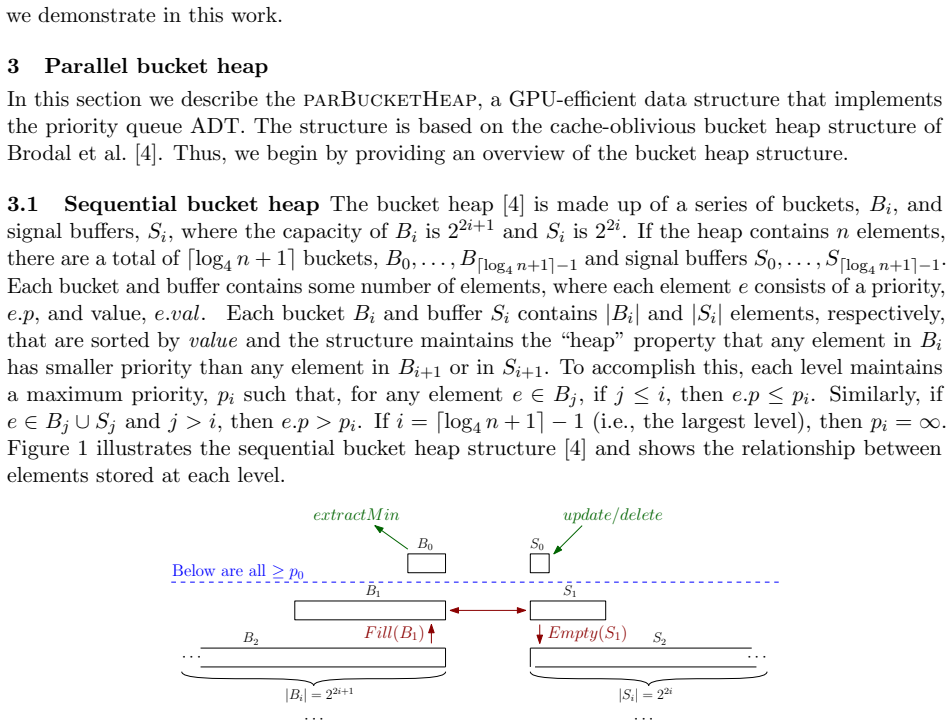
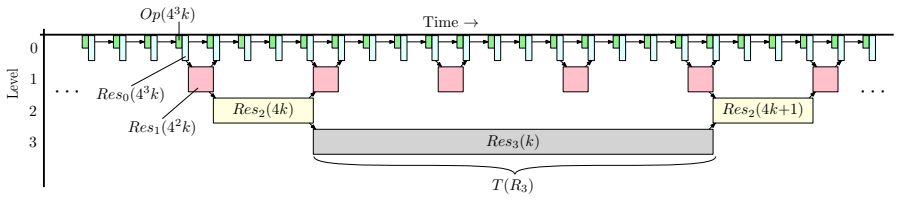
The central object is the parBucketHeap: levels consisting of a bucket $B_i$ of capacity $d2^{2i+1}$ and a signal buffer $S_i$ of capacity $d2^{2i}$, with extractMin scanning $B_0$, update and bulkUpdate inserting into $S_0$, and Resolve(i) merging, deleting duplicates, and moving elements between levels to maintain the heap property. The mechanism that carries the argument is the resolution schedule: for every $i>0$, Resolve(i) is triggered by the fourth Resolve(i-1), non-adjacent levels may resolve at the same time, and the recurrence for start and end times shows that with Resolve(0) in one timestep and $T(R_i)\le 2^{2i}$, $n$ operations complete in $O(n)$ timesteps. This is what converts a data structure with exponentially large levels into constant-time per-operation behavior.
What would settle it
Instrument the implementation so that each Resolve(i) records start and end wall-clock times as operations are issued at a steady rate; if the duration of Resolve(i) grows faster than its $2^{2i}$-timestep allowance, or if extractMin or update begins waiting for a high-level Resolve to finish, then the schedule's background-resolution premise fails and the claimed per-operation bounds do not transfer to the GPU.
Extended reading notes
Core claim
The paper's central claim is that the parBucketHeap gives GPU priority queues a combination not achieved before: constant-time per-operation cost (or $O(\log d)$ with bulk updates), optimal parallel work, and cache efficiency. The structure keeps the bucket heap's hierarchy of buckets $B_i$ and signal buffers $S_i$, scales their capacities by a parameter $d$, and replaces the sequential Fill/Empty triggers with a precomputed resolution schedule. Under that schedule, Resolve(i) runs after every fourth Resolve(i-1), non-adjacent levels resolve concurrently, and each operation touches only the first level while larger levels finish in the background. The consequence the authors draw is that a Dijkstra-based SSSP algorithm becomes work-optimal on GPUs and outruns the leading Bellman-Ford-based GPU SSSP implementation on dense, high-diameter graphs, while drawing less power.
Load-bearing premise
The load-bearing premise is that one operation plus the smallest level's cleanup step always fits in a single fixed time unit, while each larger level may take exponentially longer, and the GPU actually runs those larger cleanup steps in the background without stalling the operation stream.
Editorial extensions
If this is right
- With $d=1$, extractMin, update, and delete each take $O(1)$ amortized time and $O(\log n)$ work in the EREW PRAM model, matching the best prior parallel priority queue while adding cache efficiency.
- With $d>1$, bulkUpdate of up to $d$ elements takes $O(\log d)$ time and $O(d\log(n/d))$ work, so large batches of edge relaxations can be inserted as a single operation.
- In the PEM model, extractMin, update, and delete take $O(\log(n/M)/(PB)+1/B)$ parallel I/Os, so the structure is cache-efficient when each processor has internal memory $M$ and block size is $B$.
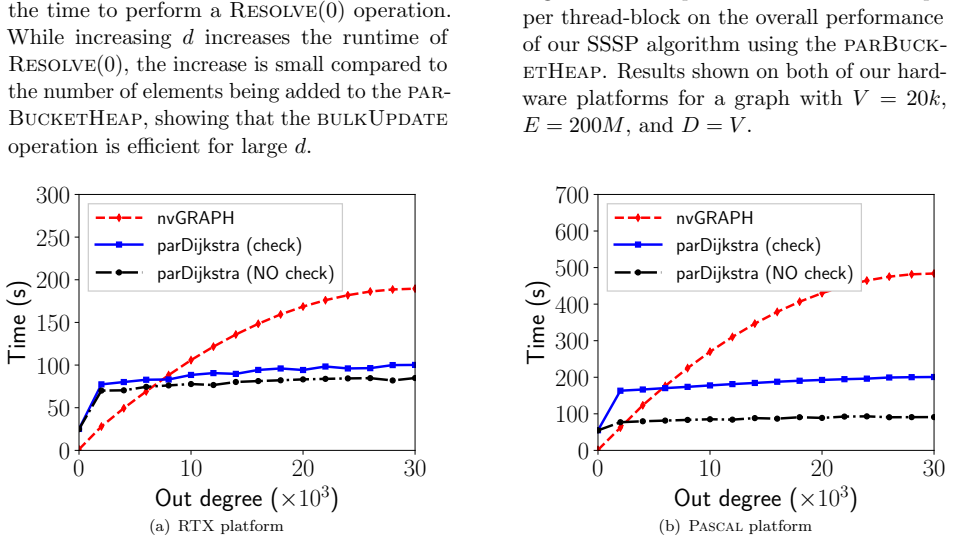
- parDijkstra is work-optimal, and on sufficiently dense high-diameter graphs it finishes up to 5.3x faster than the leading GPU SSSP implementation while drawing less power.
Reading between the lines
- The same bulk-update design could help other GPU algorithms that currently avoid priority queues because updates arrive in batches; A* search and incremental graph algorithms are natural candidates, though the paper does not test them.
- The schedule's slack could be exploited for energy control: if high-level resolutions genuinely hide behind operations, lowering thread occupancy or clock rate at those levels might reduce power without hurting wall-clock time; the paper measures power but does not propose this operating mode.
- A stress test with graphs whose edge weights are nearly uniform, forcing many updates into the same bucket, would reveal whether the $O(\log d)$ bulk-update bound is robust in practice; synthetic complete graphs are used, so real-world road-network or social-graph variants remain open.
Signed reviews
Editorial analysis
A structured set of objections, weighed in public.
Referee Report
Summary. The paper presents parBucketHeap, a parallel bucket heap designed for GPU architectures, derived from the cache-oblivious bucket heap of Brodal et al. It supports extractMin, update, delete, and a bulkUpdate of up to d elements. The theoretical sections analyze the structure in the EREW PRAM and PEM models, claiming O(1) amortized operation time for d=1, O(log d) time per operation for d>1, and corresponding parallel-I/O bounds. The authors implement parBucketHeap in CUDA and use it in parDijkstra, an SSSP solver, reporting speedups over nvGRAPH on dense, high-diameter graphs and lower GPU power consumption. The central correctness argument is the resolution schedule of Section 3.2, which determines how Resolve(i) calls at different levels are ordered and overlapped.
Significance. If the resolution schedule is sound, the paper makes a useful contribution: it combines cache-efficient bucket heaps with bulk updates, gives a self-contained PRAM/PEM analysis with no fitted parameters, and identifies a practical regime (dense, high-diameter graphs) where a work-optimal Dijkstra variant can beat the Bellman-Ford-based SSSP implementation in nvGRAPH. The power-consumption measurements add an interesting dimension that is rarely reported. The theoretical results are not circular: they are derived from the published bucket heap and standard parallel primitives. However, the correctness of the operation bounds and of the reported speedups rests entirely on the schedule in Theorem 3.1/Lemma 3.3, and that part of the manuscript currently contains an indexing error and an implementation trigger that does not obviously implement the analyzed schedule. These issues are local and likely fixable, but they are load-bearing.
major comments (3)
- [§3.3, Lemma 3.3 proof] In the derivation of the dependence on the larger level, the text writes end_{i+1}((k-1)/4) = start_{i-1}((k-1)/4) + T(R_{i+1}); the first term should be start_{i+1}((k-1)/4). As printed, the induction does not compute the quantity it claims, so the closed-form expression for start_i(k) is not justified. With the corrected index the algebra appears to close, but please fix the typo and re-verify the proof.
- [§4.1, trigger condition vs. Theorem 3.1] The implementation trigger 'each thread-block i > 0 performs Resolve(i) when c_{i-1} = 4·c_i and c_{i+1} ≥ 4·c_i' is not the schedule proved in Theorem 3.1 under the natural reading of c_i as the number of completed Resolve(i) calls. For the next Resolve(i) to satisfy its preconditions, it must wait until c_{i-1} ≥ 4(c_i+1), and the adjacent-level exclusion requires a completion dependency rather than count comparisons alone. With the printed trigger, level i can fire when c_{i-1}=c_i=0, before B_i and S_i meet the Resolve preconditions. Please define c_i precisely, prove that the trigger enforces the Theorem 3.1 schedule, and adjust the implementation accordingly; this is load-bearing because the O(1)/O(log d) operation bounds and the parDijkstra speedups presuppose the schedule.
- [Table 1 vs. Theorem 3.3] Table 1 lists extractMin as O(1) for 'This work' in the RAM/PRAM column, but Theorem 3.3 states that with d>1 extractMin takes O(log d) time, and Section 3.2 explains that increasing the capacity of S0 forces extractMin to scan B0. Please reconcile the table entry with the theorem, or state explicitly that the O(1) entry applies only to the d=1 case.
minor comments (6)
- [Abstract vs. Section 4] The abstract reports experiments on an RTX 2080 Ti and a Quadro M4000, but Section 4 says the second platform is a Pascal-generation GTX 1080. Please correct the hardware description.
- [Introduction and experimental claims] The introduction reports a speedup 'by up to 5.3×' while the abstract reports factors of 2.8 and 5.4 on the two platforms; Section 4.3 and 4.4 give additional crossing points. Please quote consistent numbers and explain which graph family gives which speedup.
- [Experimental reproducibility] No source code, input graph generators, or raw measurements are provided, which makes the experimental claims difficult to reproduce. At minimum, please state where artifacts will be made available and give precise graph-generation parameters (weight distributions, directed/undirected, D=V construction).
- [Introduction, page 3] The sentence 'using nvGRAPH results int he GPU drawing up to 3.1× more power' contains a typo ('int he'); it should read 'results in the GPU drawing up to 3.1× more power'.
- [References] References [1] and [28] are the same JaJa textbook; please merge or cite only once.
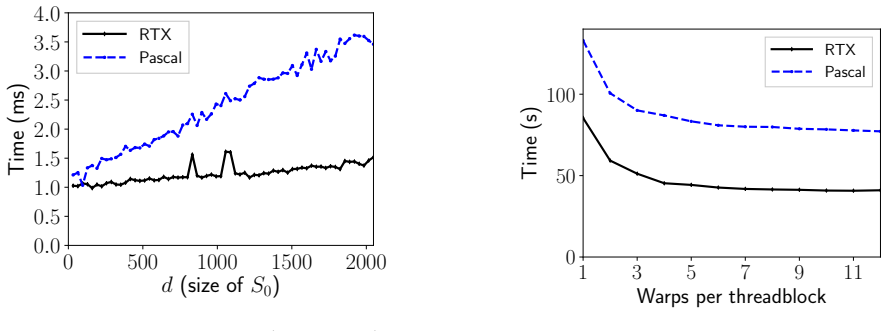
- [Section 4.2, Figures 3 and 4] The plots show single average values with no error bars or variance information even though Section 4 states that experiments were repeated five times; please report the spread.
Circularity Check
No significant circularity; the theoretical bounds are derived from the stated Resolve schedule and capacity invariants, not from the experimental results.
full rationale
The paper's central theoretical results (Theorems 3.2, 3.3, and Lemma 3.4) follow from the capacity invariants, the Resolve operation in Algorithm 5, and the dependency schedule proven in Theorem 3.1 and Lemma 3.3. The parBucketHeap is an extension of the external bucket heap of Brodal et al. [4], and the new parallel resolution schedule is derived in the paper rather than imported. The only self-citation is to [3] for the PEM model, which is used as a computational model for analysis and is not load-bearing for the claimed bounds. No fitted parameter is renamed as a prediction: the experimental section tunes implementation parameters such as d and thread-block size against microbenchmarks and then reports measured comparisons with nvGRAPH, which are empirical evaluations rather than predictions derived from the model. The apparent indexing typo in the proof of Lemma 3.3 and the possible divergence between the implementation trigger in Section 4.1 and the analyzed schedule are correctness risks, not evidence of circularity. The derivation chain is therefore self-contained with respect to its inputs.
Assumptions & free parameters
free parameters (2)
- d (bucket capacity multiplier and max bulkUpdate size) =
max out-degree of the input graph in experiments
- number of warps per thread-block =
8 warps (256 threads)
assumptions (5)
- standard math Sequential bucket heap invariants of Brodal et al. (heap property across levels, Fill/Empty semantics)
- standard math Complexities of parallel Merge, Select, DeleteDuplicates (parallel scan and prefix sums) in the EREW PRAM model
- standard math The PEM model definitions and cost accounting
- domain assumption Updates only decrease priority (p < p')
- domain assumption Non-negative edge weights for SSSP
Cite this review
Pith. "Pith review of A parallel priority queue with fast updates for GPU architectures." pith.science (2026). https://pith.science/paper/XPKBFH2R
@misc{pith2026190809378,
  author       = {Pith},
  title        = {Pith review of: A parallel priority queue with fast updates for GPU architectures},
  year         = {2026},
  howpublished = {\url{https://pith.science/paper/XPKBFH2R}},
  note         = {Machine review of arXiv:1908.09378}
}
abstract
The single-source shortest path (SSSP) problem is a well-studied problem that is used in many applications. In the parallel setting, a work-efficient algorithm that additionally attains $o(n)$ parallel depth has been elusive. Alternatively, various approaches have been developed that take advantage of specific properties of a particular class of graphs. On a graphics processing unit (GPU), the current state-of-the-art SSSP algorithms are implementations of the Delta-stepping algorithm, which does not perform well for graphs with large diameters. The main contribution of this work is to provide an algorithm designed for GPUs that runs efficiently for such graphs. We present the parallel bucket heap, a parallel cache-efficient data structure adapted for modern GPU architectures that supports standard priority queue operations, as well as bulk update. We analyze the structure in several well-known computational models and show that it provides both optimal parallelism and is cache-efficient. We implement the parallel bucket heap and use it in a parallel variant of Dijkstra's algorithm to solve the SSSP problem. Experimental results indicate that, for sufficiently large, dense graphs with high diameter, we outperform the current state-of-the-art SSSP implementations on an NVIDIA RTX 2080 Ti and Quadro M4000 by up to a factor of 2.8 and 5.4, respectively.
Figures
Figures from the paper (3 more)


Reference graph
Works this paper leans on
-
[1]
JaJa, Introduction to Parallel Algorithms
J. JaJa, Introduction to Parallel Algorithms . Reading, MA: Addison-Wesley, 1992
work page 1992
-
[2]
The input/output coplexity of sorting and related problems,
A. Aggarwal and J. Vitter, “The input/output coplexity of sorting and related problems,” Commun. ACM, vol. 31, no. 11, 1988
work page 1988
-
[3]
Fundamental parallel algorithms for private-cache chip multiprocessors,
L. Arge, M. Goodrich, M. Nelson, and N. Sitchinava, “Fundamental parallel algorithms for private-cache chip multiprocessors,” in Proc. of SPAA, Munich, Germany, 6 2008, pp. 235–246
work page 2008
-
[4]
G. S. Brodal, R. Fagerberg, U. Meyer, and N. Zeh, “Cache-oblivious data structures and algorithms for undirected breadth-first search and shortest paths,” in Algorithm Theory - SWAT 2004 , T. Hagerup and J. Katajainen, Eds. Berlin, Heidelberg: Springer Berlin Heidelberg, 2004, pp. 480–492
work page 2004
-
[5]
A parallel priority queue with constant time operations,
G. S. Brodal, J. L. Tr¨ aff, and C. D. Zaroliagis, “A parallel priority queue with constant time operations,” J. Parallel Distrib. Comput. , vol. 49, no. 1, pp. 4–21, Feb. 1998
work page 1998
-
[6]
NVIDIA, “CUDA nvgraph library,” 2019. [Online]. Available: https://docs.nvidia.com/cuda/nvgraph/ index.html
work page 2019
-
[7]
T. H. Cormen, C. Stein, R. L. Rivest, and C. E. Leiserson, Introduction to Algorithms , 2nd ed. McGraw-Hill Higher Education, 2001. 18
work page 2001
-
[8]
The pairing heap: A new form of self-adjusting heap,
M. L. Fredman, R. Sedgewick, D. D. Sleator, and R. E. Tarjan, “The pairing heap: A new form of self-adjusting heap,” Algorithmica, vol. 1, no. 1, pp. 111–129, Jan. 1986. [Online]. Available: http://dx.doi.org/10.1007/BF01840439
Show all 31 references
-
[9]
Very fast optimal parallel algorithms for heap construction,
P. F. Dietz and R. Ramant, “Very fast optimal parallel algorithms for heap construction,” in Proceedings of 1994 6th IEEE Symposium on Parallel and Distributed Processing , Oct 1994, pp. 514–521
1994
-
[10]
Fibonacci heaps and their uses in improved network optimization algorithms,
M. L. Fredman and R. E. Tarjan, “Fibonacci heaps and their uses in improved network optimization algorithms,” in 25th Annual Symposium on Foundations of Computer Science , Oct 1984, pp. 338–346
1984
-
[11]
An efficient algorithm for concurrent priority queue heaps,
G. C. Hunt, M. M. Michael, S. Parthasarathy, and M. L. Scott, “An efficient algorithm for concurrent priority queue heaps,” Inf. Process. Lett., vol. 60, no. 3, pp. 151–157, Nov. 1996. [Online]. Available: http://dx.doi.org/10.1016/S0020-0190(96)00148-2
1996 doi
-
[12]
Cache-oblivious shortest paths in graphs using buffer heap,
R. A. Chowdhury and V. Ramachandran, “Cache-oblivious shortest paths in graphs using buffer heap,” in Proceedings of the Sixteenth Annual ACM Symposium on Parallelism in Algorithms and Architectures, ser. SPAA ’04. New York, NY, USA: ACM, 2004, pp. 245–254. [Online]. Available:...
2004
-
[13]
Performance evaluation of priority queues for fine-grained parallel tasks on gpus,
N. Baudis, F. Jacob, and P. Andelfinger, “Performance evaluation of priority queues for fine-grained parallel tasks on gpus,” in 2017 IEEE 25th International Symposium on Modeling, Analysis, and Simulation of Computer and Telecommunication Systems (MASCOTS) , Sep. 2017, pp. 1–11
2017
-
[14]
Design and implementation of a parallel priority queue on many-core architectures,
X. He, D. Agarwal, and S. K. Prasad, “Design and implementation of a parallel priority queue on many-core architectures,” 2012 19th International Conference on High Performance Computing , pp. 1–10, 2012
2012
-
[15]
Undirected single source shortest paths in linear time,
M. Thorup, “Undirected single source shortest paths in linear time,” in Proceedings 38th Annual Symposium on Foundations of Computer Science , Oct 1997, pp. 12–21
1997
-
[16]
A parallelization of dijkstra’s shortest path algorithm,
A. Crauser, K. Mehlhorn, U. Meyer, and P. Sanders, “A parallelization of dijkstra’s shortest path algorithm,” in Proceedings of the 23rd International Symposium on Mathematical Foundations of Computer Science, 1998, pp. 722–731
1998
-
[17]
Delta-stepping: A parallel single source shortest path algorithm,
U. Meyer and P. Sanders, “Delta-stepping: A parallel single source shortest path algorithm,” in Proceedings of the 6th Annual European Symposium on Algorithms , ser. ESA ’98, 1998, pp. 393–404
1998
-
[18]
Handbook of theoretical computer science (vol. a),
R. M. Karp and V. Ramachandran, “Handbook of theoretical computer science (vol. a),” J. van Leeuwen, Ed. Cambridge, MA, USA: MIT Press, 1990, ch. Parallel Algorithms for Shared-memory Machines, pp. 869–941. [Online]. Available: http://dl.acm.org/citation.cfm?id=114872.114889
1990
-
[19]
Arora and B
S. Arora and B. Barak, Computational Complexity: A Modern Approach , 1st ed. New York, NY, USA: Cambridge University Press, 2009
2009
-
[20]
Efficient parallel algorithms for computing all pair shortest paths in directed graphs,
Y. Han, V. Pan, and J. Reif, “Efficient parallel algorithms for computing all pair shortest paths in directed graphs,” in Proceedings of the Fourth Annual ACM Symposium on Parallel Algorithms and Architectures, ser. SPAA ’92. New York, NY, USA: ACM, 1992, pp. 353–362. [Online]. ...
1992
-
[21]
Parallel shortest paths using radius stepping,
G. E. Blelloch, Y. Gu, Y. Sun, and K. Tangwongsan, “Parallel shortest paths using radius stepping,” in Proceedings of the 28th ACM Symposium on Parallelism in Algorithms and Architectures , 2016, pp. 443–454
2016
-
[22]
Accelerating large graph algorithms on the gpu using cuda,
P. Harish and P. J. Narayanan, “Accelerating large graph algorithms on the gpu using cuda,” in Proceedings of the 14th International Conference on High Performance Computing , ser. HiPC’07. Berlin, Heidelberg: Springer-Verlag, 2007, pp. 197–208. [Online]. Available: http://dl....
2007
-
[23]
All-pairs shortest-paths for large graphs on the gpu,
G. J. Katz and J. T. Kider, Jr, “All-pairs shortest-paths for large graphs on the gpu,” in Proceedings of the 23rd ACM SIGGRAPH/EUROGRAPHICS Symposium on Graphics Hardware , ser. GH ’08. Aire-la-Ville, Switzerland, Switzerland: Eurographics Association, 2008, pp. 47–55. [Onlin...
2008
-
[24]
Work-efficient parallel gpu methods for single- source shortest paths,
A. Davidson, S. Baxter, M. Garland, and J. D. Owens, “Work-efficient parallel gpu methods for single- source shortest paths,” in Proceedings of the 2014 IEEE 28th International Parallel and Distributed Processing Symposium, ser. IPDPS ’14, 2014, pp. 349–359
2014
-
[25]
Gunrock: A high-performance 19 graph processing library on the gpu,
Y. Wang, A. Davidson, Y. Pan, Y. Wu, A. Riffel, and J. D. Owens, “Gunrock: A high-performance 19 graph processing library on the gpu,” SIGPLAN Not., vol. 51, no. 8, pp. 11:1–11:12, Feb. 2016
2016
-
[26]
CUDA programming guide 10.0,
NVIDIA, “CUDA programming guide 10.0,” 2019. [Online]. Available: http://docs.nvidia.com/cuda
2019
-
[27]
Merge path - A visually intuitive approach to parallel merging,
O. Green, S. Odeh, and Y. Birk, “Merge path - A visually intuitive approach to parallel merging,” CoRR, vol. abs/1406.2628, 2014
2014 arXiv
-
[28]
JaJa, An Introduction to Parallel Algorithms
J. JaJa, An Introduction to Parallel Algorithms . Reading, Mass.: Addison-Wesley Publishing Co., 1992
1992
-
[29]
Geneva, Switzerland: International Organization for Standardization, Feb
ISO, ISO/IEC 14882:2011 Information technology — Programming languages — C++ . Geneva, Switzerland: International Organization for Standardization, Feb. 2012. [Online]. Available: http://www.iso.org/iso/iso catalogue/catalogue tc/catalogue detail.htm?csnumber=50372
2011
-
[30]
Thrust: A parallel template library,
J. Hoberock and N. Bell, “Thrust: A parallel template library,” 2010, version 1.7.0. [Online]. Available: http://thrust.github.io/
2010
-
[31]
Profiler user’s guide,
NVIDIA, “Profiler user’s guide,” 2019. [Online]. Available: http://docs.nvidia.com/cuda/ profiler-users-guide 20
2019
Reviewed August 14, 2026 · model on record in the stance chip above.
Discussion (0). Continue with ORCID to comment.