REVIEW 3 major objections 5 minor 1 cited by
Phase-space distortion as a key to unraveling galactic bar buckling
T0 review · 3 major / 5 minor · reviewed 2026-08-07 · deepseek-v4-flash
Pith's one-line read During bar buckling, the vertical-resonance phase space keeps only one stable fixed point, near $\theta_\mathrm{res}=\pi$, and flat orbits are channeled upward through that single portal before symmetry is restored.
desk verdict A genuinely new orbit-level mechanism for bar buckling, built on one simulation and a 2D projection the authors admit is approximate; worth refereeing, but the topology is not proven. read the letter →
The pith
A machine-rendered reading of the paper's core claim, the machinery that carries it, and where it could break.
The reading
What carries the argument
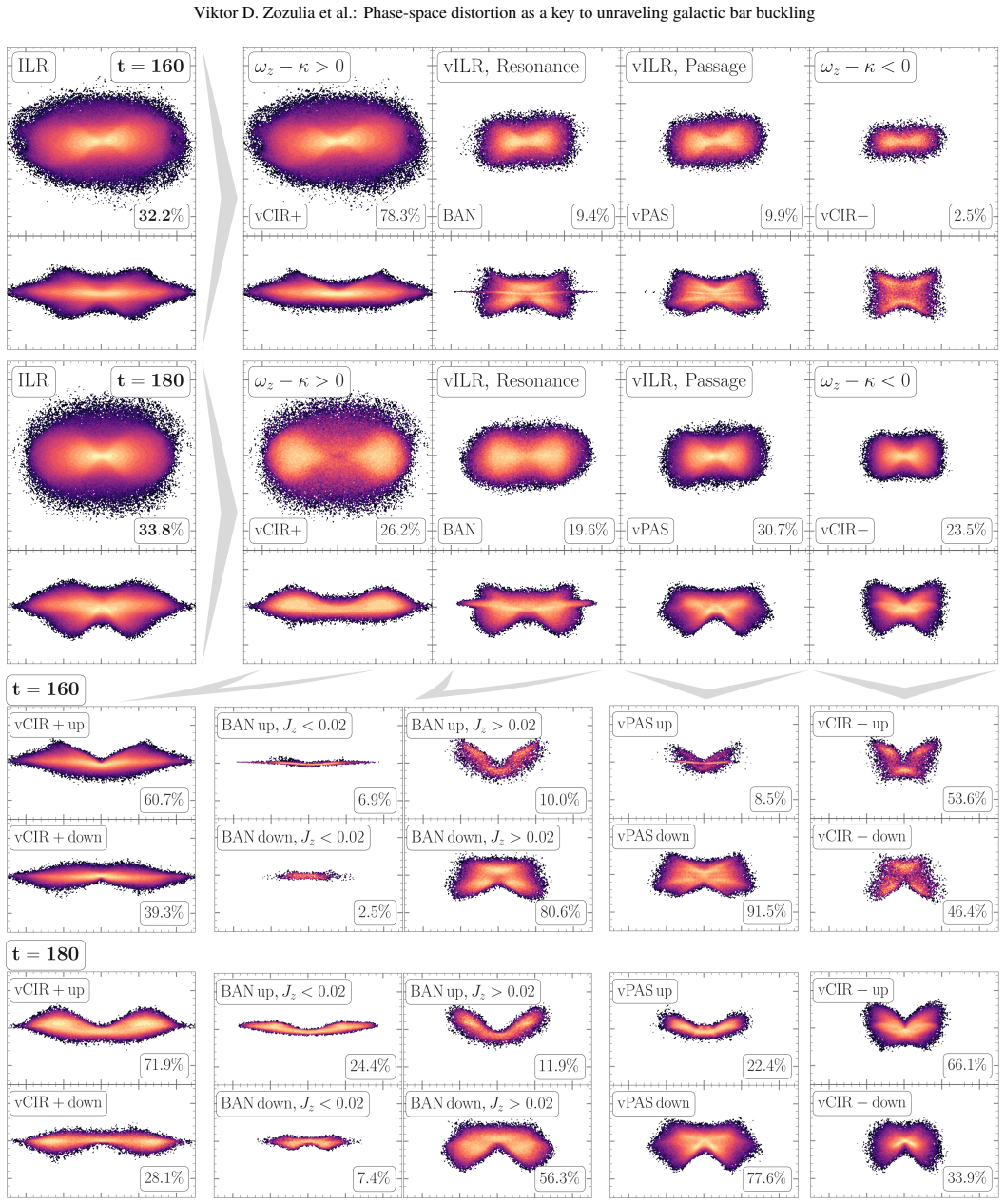
The central object is the resonant angle $\theta_\mathrm{res} = \theta_z - \theta_R$ and its conjugate vertical action $J_z$, which together form a reduced phase space. In a symmetric second-order resonance (perturbation $\sim\cos 2\theta_\mathrm{res}$) there are two stable fixed points, at $\theta_\mathrm{res}=0$ and $\pi$; banana-shaped (BAN) orbits librate around them. The buckling mechanism is the asymmetric first-order perturbation $\sim\cos\theta_\mathrm{res}$, which distorts this phase space and, when strong, removes the $\theta_\mathrm{res}=0$ fixed point entirely. Orbits are classified by the behavior of their resonant angle during the evolution — circulation with increasing (vCIR+) or decreasing (vCIR$-$) angle, libration around a fixed point (BAN), or a single passage through the resonance (vPAS) — and phase portraits are built from orbits along the bar's major axis at fixed Jacobi integral.
What would settle it
In an N-body bar model with a strong central mass concentration (the regime the authors cite as producing symmetric buckling), build the same phase portraits during the thickening epoch: if a stable fixed point at $\theta_\mathrm{res}=0$ with an appreciable libration island is present while the bar thickens symmetrically, the claim that strong first-order perturbations destroy the zero fixed point fails. Conversely, if the single-fixed-point configuration appears without any vertical asymmetry, the link between the one-sided fixed point and buckling asymmetry fails.
Extended reading notes
Core claim
During buckling, the phase space $(J_z,\theta_\mathrm{res})$ is distorted by first- and second-order Hamiltonian perturbations. The first-order term $\sim\cos\theta_\mathrm{res}$ can be strong enough to eliminate the stable fixed point at $\theta_\mathrm{res}=0$, leaving only the fixed point near $\theta_\mathrm{res}=\pi$. Flat bar orbits (vCIR+) then leave the midplane through that one surviving portal: some are captured into high-$J_z$ banana-shaped orbits (BAN down), others pass through the resonance and emerge as heated orbits with decreasing resonant angle (vCIR$-$), while a new population of very flat banana orbits appears near $\theta_\mathrm{res}=0$. Once enough orbits have been transferred, the zero fixed point reappears, orbital transformation proceeds through both portals, and the bar's vertical asymmetry relaxes. The orbital and phase-space transformations are self-consistent: orbits change the phase space, which changes the orbits.
Load-bearing premise
The central claim depends on the two-dimensional phase portraits built from orbits lying exactly along the bar's major axis with a fixed Jacobi integral being a faithful stand-in for the full four-dimensional dynamics of all bar orbits, even though most orbits librate around that axis.
Editorial extensions
If this is right
- During the buckling spike, the vertical asymmetry is carried almost entirely by orbits transformed near $\theta_\mathrm{res}=\pi$: high-$J_z$ BAN-down librators and vCIR$-$ circulators produced by passage through the resonance.
- Resonant heating (vPAS transitions) outweighs resonant capture during buckling, as shown by the sharp spike in vPAS orbits at the moment of maximum asymmetry.
- A new population of very flat BAN orbits appears near $\theta_\mathrm{res}=0$ during buckling and persists while the Laplace plane is curved, reopening the zero portal once the first-order perturbation weakens.
- If the first-order perturbation is weak (e.g., with a strong central mass concentration), both fixed points remain, orbital transformation proceeds through both portals, capture dominates, and the bar buckles symmetrically.
- By $t=300$, the phase space and orbital type fractions are nearly symmetric again, consistent with the restoration of the $\theta_\mathrm{res}=0$ fixed point and the end of the asymmetric phase.
Reading between the lines
- The paper's claim implies that the amplitude of the $\cos\theta_\mathrm{res}$ component of the bar potential sets the maximum vertical asymmetry; a controlled simulation in which this Fourier component is artificially boosted or suppressed before buckling would be a clean test.
- If the single-fixed-point condition is what makes buckling transient, then the same logic predicts that any process that persistently removes the zero portal (e.g., a sustained m=1 perturbation) could keep a bar vertically lopsided beyond the usual buckling epoch.
- The action-angle census of orbital types could in principle be probed observationally through kinematics; the predicted asymmetric phase should leave a distinctive signature (e.g., an asymmetric vertical velocity dispersion in the bar region) that integral-field spectrograph surveys could search for.
- The framework reframes the old instability-versus-resonance debate: instead of asking whether buckling is an instability or a resonance, one should ask what controls the strength of the first-order Hamiltonian perturbation that decides how asymmetric the phase-space distortion becomes.
Editorial analysis
A structured set of objections, weighed in public.
Referee Report
Summary. The manuscript studies the vertical resonance phase space of a self-consistent N-body galactic bar during buckling, using the same model and action-angle machinery as the authors' previous papers (Zozulia et al. 2024a,b). Orbits in the bar (ILR) are classified by the behavior of the resonant angle θ_res = θ_z − θ_R into four types: circulation with increasing angle (vCIR+), circulation with decreasing angle (vCIR−), libration (BAN), and passage (vPAS). The authors track demographic changes from t=100 to t=300 and construct 2D sketches of the (θ_res, J_z) phase space from orbits aligned with the bar major axis and fixed Jacobi integral H_J. Their central claim is that during buckling, first-order Hamiltonian perturbations proportional to cos θ_res distort the phase space so that only one stable fixed point near θ_res = π remains; flat vCIR+ orbits are captured into BAN down orbits or heated into vCIR− orbits near π, while a new layer of low-J_z flat BAN up orbits appears near θ_res = 0. Once most flat orbits have been transformed, a second stable fixed point near 0 reopens and the phase space symmetrizes. The paper interprets buckling as a resonant phase-space phenomenon and contrasts this with fire-hose instability and Laplace-plane forced-oscillation pictures.
Significance. The paper offers a genuinely orbit-level picture of bar buckling in an N-body model, going beyond morphological snapshots by using action-angle variables and a dynamical classification. The demographic curves in Figs. 1–2 are a useful quantitative description, and the phase-space mechanism is concrete and falsifiable: a one-sided fixed point channels flat orbits upward during buckling, and symmetry is restored when the second fixed point reopens. However, the central evidence is conditional. The phase-space topology is read off 2D projections that the authors themselves describe as approximate (Appendix B), the conclusions rest on a single N-body realization, and the orbit classification depends on heuristic thresholds. If the 2D-to-4D step is validated and a second model reproduces the one-sided fixed point, this would be a significant contribution to the buckling debate; in its current form the general claim is not yet established.
major comments (3)
- [Appendix B; §5, Figs. 3–4] The 2D phase portraits are constructed only from orbits whose apocenters lie exactly on the bar major axis, and the text concedes that 'only a part of the orbits in the bar is aligned exactly along its major axis, while most of them librate around it' and that their 4D phase-space behavior is 'complicated'. Every specific topological claim in §5 — the absence of a stable fixed point near θ_res = 0 at t=160–180, the π portal as the only route for vCIR+ orbits, and the reopening of the 0-portal at t=200 — is read off these portraits. Because most bar orbits do not satisfy the on-axis condition, the portraits may not represent the full orbital population. Please validate the reduction, for example by constructing portraits for orbits with small nonzero initial values of the second resonant angle 2θ_φ − θ_R (or small y-offsets at apocenter) and comparing the resulting island structure and separatrix location, or by re-binning the demographic statistics in Figs. 1–2 by the amplitude of libration around the major axis. Without such a check, the central mechanism is demonstrated only for a restricted subset of orbits.
- [§2; abstract] All conclusions are drawn from a single N-body realization, namely the Zozulia et al. (2024a,b) model with one set of initial conditions (M_d = 1, R_d = 1, z_d = 0.05, M_h(R < 4R_d) ≈ 1.5, Q(2R_d) = 1.2). The qualitative claims — disappearance of the θ_res = 0 fixed point, one-sided transfer through π, and later symmetrization — are stated as properties of galactic bar buckling in general, without a second model. Please add at least one additional realization (different random seed, halo concentration, or disk thickness) that also undergoes buckling and show that the same phase-space asymmetry appears; alternatively, explicitly restrict the conclusions to this model and label the general statements as conjectures. This is a correctness-risk concern about genericity, not a disagreement with the literature.
- [§5, Figs. 3–4] The inference that the θ_res = 0 fixed point is absent is based on the apparent lack of librating trajectories in the phase portraits for three values of H_J. Absence of a visible libration island in a sparse orbital plot is not a proof of a topological change, and the portraits are built from orbits launched with a particular set of initial conditions (θ_R = 0, θ_z = 0, θ_φ = 0, apocenters on the major axis). Please provide quantitative support: give the number of orbits per panel, show Poincaré sections for several H_J values, or compute the location and stability of the fixed points from a local Hamiltonian expansion. If this is not feasible in a Letter, soften statements such as 'there is not even a stable fixed point near θ_res = 0' and 'may disappear completely' to observations about the sampled orbits.
minor comments (5)
- [§4, Fig. 1] The classification of 'very flat' BAN up orbits uses the threshold secular J_z < 0.02. Please state how this threshold was chosen and how the demographic fractions in Fig. 2 change for neighboring thresholds (e.g., 0.01 and 0.05).
- [Appendix A] The vPAS type is defined by the resonant angle taking the fixed-point value exactly twice; this binary criterion may be sensitive to the time sampling of the action-angle variables. Please describe how passage events are counted and whether tests with different time resolutions change the reported fractions.
- [§6] The argument that phase-volume conservation (Liouville's theorem) supports the thinning of the vCIR+ layer is applied to the 2D projected layer areas, but Liouville's theorem applies to the full 6D flow in a time-dependent potential; the projected area in (θ_res, J_z) is not necessarily conserved. Please clarify the intended argument.
- [Fig. 3 caption] The caption does not state how many orbits are integrated per panel nor how the three H_J values were selected; adding this information would help the reader assess the robustness of the portraits.
- [References] The reference list contains entries with incomplete bibliographic data (Zozulia et al. 2024a has no volume/page, and Parul et al. 2020 is an arXiv preprint); please update these where possible.
Circularity Check
No circular reduction; self-citation supplies method and model, but the buckling phase-space asymmetry is an independent empirical reading, limited by a conceded 2D projection.
full rationale
The paper's central claim—that during buckling the J_z–theta_res phase space becomes asymmetric, with the theta_res=0 fixed point temporarily absent and a low-J_z banana layer reopening that portal—is an empirical reading of the N-body simulation, not a fitted parameter renamed as a prediction. No equation in the paper defines the claimed phase-space topology in terms of the input orbital classification; the orbital taxonomy tracks libration/circulation of theta_res, while the disappearance and reopening of fixed points are read off separately constructed phase portraits. The self-citations to Zozulia et al. (2024a,b) supply the model, the medium-term action-angle code, and the orbital taxonomy. This is self-citation at the foundation, but the buckling-time analysis is new and is not entailed by the cited late-time results. The genuine weakness is representativeness, not circularity: Appendix B concedes that 'only a part of the orbits in the bar is aligned exactly along its major axis, while most of them librate around it' and that the full behavior is four-dimensional, with the authors only believing 'the general pattern of orbital evolution should be preserved.' That is a projection and external-validity gap, not a reduction-by-construction. Accordingly, no circular step is identified; the score of 2 reflects the minor, non-load-bearing self-citation rather than any equivalence between the derivation and its inputs.
Assumptions & free parameters
free parameters (3)
- N-body initial conditions: disk mass M_d=1, scale length R_d=1, thickness z_d=0.05, halo mass M_h(R<4R_d) about 1.5… =
M_d=1; R_d=1; z_d=0.05; M_h about 1.5; Q=1.2
- Flat-orbit threshold: secular J_z < 0.02 =
0.02
- Libration and passage detection thresholds =
theta_res must hit a fixed point at least 3 times for libration, and exactly 2 times for passage
assumptions (5)
- standard math The pendulum model approximates resonant Hamiltonian dynamics near the vertical resonance.
- domain assumption Averaged medium-term action-angle variables eliminate short-period oscillations while preserving resonant behavior.
- domain assumption For ILR bar orbits, 2*theta_phi - Omega_p * t is approximately theta_R, so theta_res = theta_z - theta_R is equivalent to Quillen's phi.
- domain assumption Phase portraits from orbits exactly on the bar major axis represent the bar's full 4D phase space.
- domain assumption The single Zozulia et al. (2024a,b) N-body model is representative of galactic bar buckling in general.
Cite this review
Pith. "Pith review of Phase-space distortion as a key to unraveling galactic bar buckling." pith.science (2026). https://pith.science/paper/XPYRLLXR
@misc{pith2026250600631,
  author       = {Pith},
  title        = {Pith review of: Phase-space distortion as a key to unraveling galactic bar buckling},
  year         = {2026},
  howpublished = {\url{https://pith.science/paper/XPYRLLXR}},
  note         = {Machine review of arXiv:2506.00631}
}
abstract
For the first time, we investigate the resonant structure of $N$-body galactic bar at the stage of buckling using action-angle variables. We studied the evolution of vertical actions ($J_z$) and angles associated with vertical resonance ($\theta_\mathrm{res}=\theta_z - \theta_R$) for all orbits in the bar. For this purpose, we divide the orbits into types according to the behavior (libration or circulation) of their resonant angle with respect to fixed points $\theta_\mathrm{res}=0$ and $\pi$ (vertical resonance). We show that during buckling, flat bar orbits circulating with increasing $\theta_\mathrm{res}$ transformed into banana-shaped librating orbits (resonant capture) or circulating orbits with decreasing $\theta_\mathrm{res}$ (resonant heating). The orbital transformation is accompanied by an increase in $J_z$ and the formation of a boxy/peanut-shaped (B/PS) bulge. During buckling, the phase space $J_z - \theta_\mathrm{res}$ undergoes a distortion creating an asymmetry in the position of the fixed points $\theta_\mathrm{res}=0$ and $\pi$ and in banana-shaped orbits near these points. The fixed point $\theta_\mathrm{res}=0$ may disappear completely. This also breaks the symmetry between the orbits, which are captured into resonance or go into circulation with decreasing $\theta_\mathrm{res}$ near $\theta_\mathrm{res}=0$ and $\pi$. At the same time, near $\theta_\mathrm{res}=0$, banana-shaped orbits with low vertical action $J_z$ appear. This reopens the path of orbital transformation through the fixed point $\theta_\mathrm{res}=0$. The phase space transformation and orbit transformation occur in a coordinated manner and lead to smoothing of phase space perturbations and restoration of symmetry between orbits.
Figures


Figures from the paper (1 more)

Forward citations
Cited by 1 Pith paper
-
GalPort: Investigation of the bar in action-angle space
GalPort computes multi-timescale action-angle variables and orbital classifications for evolving barred galaxy simulations, with specialised bar phase-space analysis tools.
Reference graph
Works this paper leans on
-
[1]
, " * write output.state after.block = add.period write newline
ENTRY address archiveprefix author booktitle chapter edition editor howpublished institution eprint journal key month note number organization pages publisher school series title type volume year label extra.label sort.label short.list INTEGERS output.state before.all mid.sentence after.sentence after.block FUNCTION init.state.consts #0 'before.all := #1 ...
-
[2]
write newline
" write newline "" before.all 'output.state := FUNCTION n.dashify 't := "" t empty not t #1 #1 substring "-" = t #1 #2 substring "--" = not "--" * t #2 global.max substring 't := t #1 #1 substring "-" = "-" * t #2 global.max substring 't := while if t #1 #1 substring * t #2 global.max substring 't := if while FUNCTION word.in bbl.in " " * FUNCTION format....
-
[3]
Binney J., 2020, @doi [ ] 10.1093/mnras/staa092 , https://ui.adsabs.harvard.edu/abs/2020MNRAS.495..886B 495, 886
-
[4]
Collier A., 2020, @doi [ ] 10.1093/mnras/stz3625 , https://ui.adsabs.harvard.edu/abs/2020MNRAS.492.2241C 492, 2241
- [5]
-
[6]
Combes F., Debbasch F., Friedli D., Pfenniger D., 1990, , 233, 82
work page 1990
-
[7]
Friedli D., Pfenniger D., 1990, in Jarvis B. J., Terndrup D. M., eds, European Southern Observatory Conference and Workshop Proceedings Vol. 35, European Southern Observatory Conference and Workshop Proceedings. pp 265--268
work page 1990
-
[8]
Kataria S. K., 2024, @doi [ ] 10.1093/mnras/stae2311 , https://ui.adsabs.harvard.edu/abs/2024MNRAS.534.3565K 534, 3565
Show all 32 references
-
[9]
Li X., Shlosman I., Pfenniger D., Heller C., 2023, @doi [ ] 10.1093/mnras/stad076 , 520, 1243
2023 doi
-
[10]
Lichtenberg A., Lieberman M., 1992, Regular and Chaotic Dynamics
1992
-
[11]
L., 2019, @doi [ ] 10.1051/0004-6361/201936056 , 629, A52
okas E. L., 2019, @doi [ ] 10.1051/0004-6361/201936056 , 629, A52
2019 doi
- [12]
-
[13]
Martinez-Valpuesta I., Shlosman I., Heller C., 2006, @doi [ ] 10.1086/498338 , 637, 214
2006 doi
-
[14]
L., Beane A., D'Onghia E., Filion C., Daniel K
McClure R. L., Beane A., D'Onghia E., Filion C., Daniel K. J., 2025, @doi [ ] 10.1093/mnras/staf107 , https://ui.adsabs.harvard.edu/abs/2025MNRAS.537.1475M 537, 1475
2025 doi
-
[15]
F., Frenk C
Navarro J. F., Frenk C. S., White S. D. M., 1996, @doi [ ] 10.1086/177173 , 462, 563
1996 doi
-
[16]
D., Smirnov A
Parul H. D., Smirnov A. A., Sotnikova N. Y., 2020, arXiv e-prints, p. arXiv:2002.06627
2020 arXiv
-
[17]
Pfenniger D., Friedli D., 1991, , 252, 75
1991
-
[18]
Portail M., Wegg C., Gerhard O., 2015, @doi [ ] 10.1093/mnrasl/slv048 , 450, L66
2015 doi
-
[19]
C., 2002, @doi [ ] 10.1086/341753 , 124, 722
Quillen A. C., 2002, @doi [ ] 10.1086/341753 , 124, 722
2002 doi
-
[20]
C., 2006, @doi [ ] 10.1111/j.1365-2966.2005.09826.x , https://ui.adsabs.harvard.edu/abs/2006MNRAS.365.1367Q 365, 1367
Quillen A. C., 2006, @doi [ ] 10.1111/j.1365-2966.2005.09826.x , https://ui.adsabs.harvard.edu/abs/2006MNRAS.365.1367Q 365, 1367
2006
-
[21]
C., Minchev I., Sharma S., Qin Y.-J., Di Matteo P., 2014, @doi [ ] 10.1093/mnras/stt1972 , 437, 1284
Quillen A. C., Minchev I., Sharma S., Qin Y.-J., Di Matteo P., 2014, @doi [ ] 10.1093/mnras/stt1972 , 437, 1284
2014 doi
-
[22]
A., James R
Raha N., Sellwood J. A., James R. A., Kahn F. D., 1991, @doi [ ] 10.1038/352411a0 , 352, 411
1991 doi
-
[23]
A., 2022, @doi [Solar Energy] 10.1016/j.solener.2022.10.038 , https://ui.adsabs.harvard.edu/abs/2022SoEn..248..121R 248, 121
Ruiz-Arias J. A., 2022, @doi [Solar Energy] 10.1016/j.solener.2022.10.038 , https://ui.adsabs.harvard.edu/abs/2022SoEn..248..121R 248, 121
2022 doi
-
[24]
A., Gerhard O., 2020, @doi [ ] 10.1093/mnras/staa1336 , https://ui.adsabs.harvard.edu/abs/2020MNRAS.495.3175S 495, 3175
Sellwood J. A., Gerhard O., 2020, @doi [ ] 10.1093/mnras/staa1336 , https://ui.adsabs.harvard.edu/abs/2020MNRAS.495.3175S 495, 3175
2020 doi
-
[25]
A., Sotnikova N
Smirnov A. A., Sotnikova N. Y., 2018, @doi [ ] 10.1093/mnras/sty2423 , 481, 4058
2018 doi
-
[26]
A., Sotnikova N
Smirnov A. A., Sotnikova N. Y., 2019, @doi [ ] 10.1093/mnras/stz546 , 485, 1900
2019 doi
-
[27]
Y., Rodionov S
Sotnikova N. Y., Rodionov S. A., 2003, @doi [Astronomy Letters] 10.1134/1.1573281 , 29, 321
2003 doi
-
[28]
Valencia-Enr \' quez D., Puerari I., Chaves-Velasquez L., 2023, @doi [ ] 10.1093/mnras/stad2437 , https://ui.adsabs.harvard.edu/abs/2023MNRAS.525.3162V 525, 3162
2023 doi
-
[29]
Vasiliev E., 2019, @doi [ ] 10.1093/mnras/sty2672 , https://ui.adsabs.harvard.edu/abs/2019MNRAS.482.1525V 482, 1525
2019 doi
-
[30]
D., Smirnov A
Zozulia V. D., Smirnov A. A., Sotnikova N. Y., 2024a, @doi [ ] 10.1093/mnras/stae702 , https://ui.adsabs.harvard.edu/abs/2024MNRAS.tmp..730Z
-
[31]
D., Smirnov A
Zozulia V. D., Smirnov A. A., Sotnikova N. Y., Marchuk A. A., 2024b, @doi [ ] 10.1051/0004-6361/202452088 , https://ui.adsabs.harvard.edu/abs/2024A&A...692A.145Z 692, A145
-
[32]
write newline
" write newline "" before.all 'output.state := FUNCTION fin.entry write newline FUNCTION new.block output.state before.all = 'skip after.block 'output.state := if FUNCTION new.sentence output.state after.block = 'skip output.state before.all = 'skip after.sentence 'output.stat...
Reviewed August 7, 2026 · model on record in the stance chip above.
Discussion (0). Sign in to comment.