Energy transfer, Intermittency and Mixing in Shear-Driven Stratified Turbulence
Pith reviewed 2026-07-03 05:11 UTC · model grok-4.3
The pith
Intermediate Froude numbers in shear-driven stratified turbulence produce energetically significant vertically sheared horizontal flows and steepened perpendicular energy spectra.
A machine-rendered reading of the paper's core claim, the machinery that carries it, and where it could break.
Core claim
As the Froude number is varied in shear-driven stratified turbulence, the flow passes through a buoyancy-dominated regime at strong stratification, an intermediate regime with Kelvin-Helmholtz instabilities where vertically sheared horizontal flows emerge and the reduced one-dimensional perpendicular kinetic energy spectra steepen, and a nearly isotropic regime at weak stratification. The spectral energy transfer stays predominantly forward, although the perpendicular flux becomes negative at large horizontal scales due to anisotropic energy redistribution rather than an inverse cascade. Strong stratification enhances intermittency, producing non-Gaussian vertical velocity fluctuations and l
What carries the argument
Vertically sheared horizontal flows (VSHFs) that emerge as energetically significant structures in the intermediate stratification range and produce the observed steepening of reduced one-dimensional perpendicular kinetic energy spectra.
If this is right
- The sequence of regimes is controlled primarily by the Froude number.
- Perpendicular energy flux turns negative at large horizontal scales due to anisotropic redistribution rather than a true inverse cascade.
- Intermittency grows with stronger stratification, producing increasingly non-Gaussian vertical velocities and higher kurtosis from localized bursts.
- The mixing coefficient remains order 0.1 over the full parameter range, with modest increase near the Kelvin-Helmholtz regime.
Where Pith is reading between the lines
- If the Froude number alone sets the regimes, repeating the simulations at different Reynolds numbers should recover the same progression from buoyancy-dominated to isotropic states.
- The negative perpendicular flux at large scales without net inverse cascade implies that energy redistribution in these flows is strictly anisotropic.
- The localized vertical bursts responsible for high kurtosis at strong stratification could be directly identified in time-resolved velocity fields.
Load-bearing premise
Stratification strength characterized solely by the Froude number produces the reported sequence of regimes without strong dependence on Reynolds number or domain size.
What would settle it
Direct numerical simulations at fixed intermediate Froude numbers but substantially higher Reynolds number that show no emergence of energetically significant VSHFs or no steepening of the perpendicular spectra.
Figures



read the original abstract
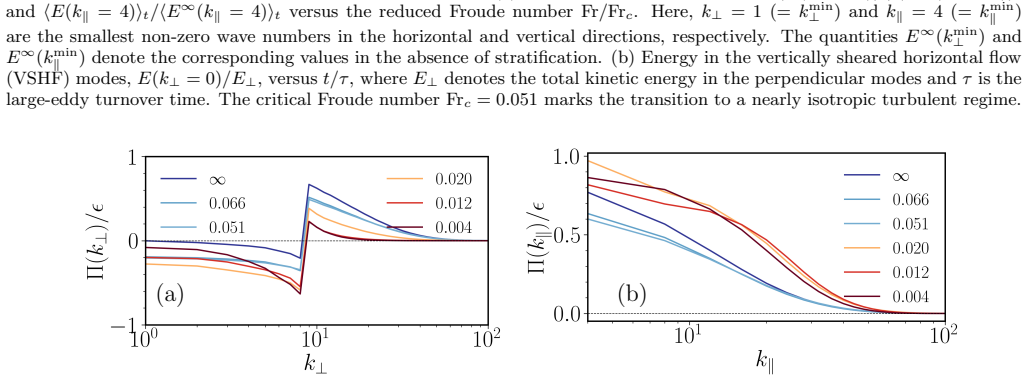
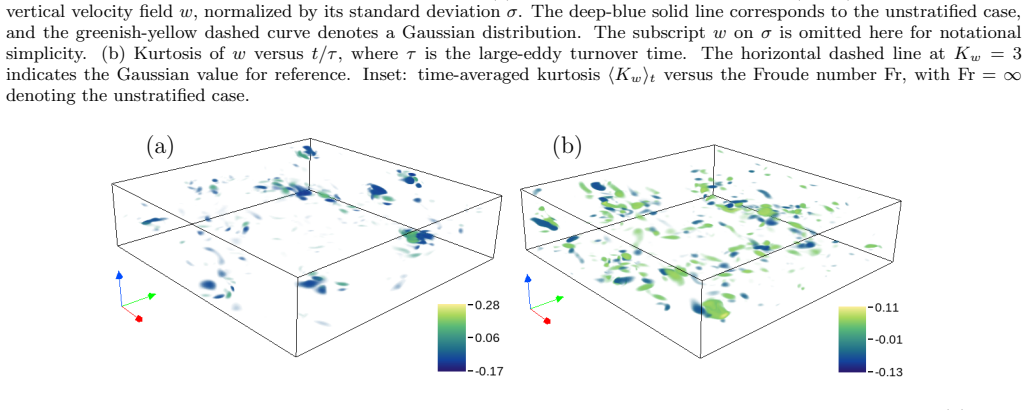
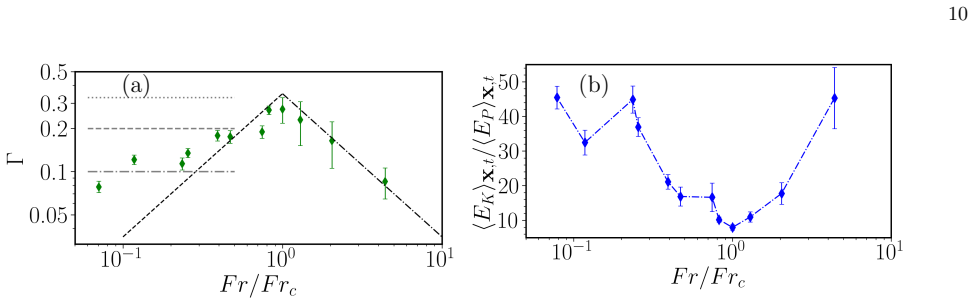
We investigate a stably stratified flow driven by deterministic Kolmogorov forcing that generates horizontal shear, using direct numerical simulations over a broad range of stratification strengths characterized by the Froude number $Fr$. As the stratification is progressively weakened, the flow exhibits a sequence of regimes: a buoyancy-dominated, strongly stratified regime, an intermediate regime characterized by Kelvin--Helmholtz instabilities and enhanced mixing, and a nearly isotropic turbulent regime. A key feature of the intermediate stratification range is the emergence of energetically significant vertically sheared horizontal flows (VSHFs), accompanied by a marked steepening of the reduced one-dimensional perpendicular kinetic energy spectra. The spectral energy transfer remains predominantly forward, although the perpendicular flux becomes negative at large horizontal scales; this apparent upscale transfer reflects anisotropic energy redistribution rather than a true inverse cascade. Strong stratification enhances intermittency, producing increasingly non-Gaussian vertical velocity fluctuations and large kurtosis associated with localized vertical bursts. The energetics-based mixing coefficient remains of order $10^{-1}$ over the parameter range investigated, with a modest enhancement near the Kelvin--Helmholtz instability regime.
Editorial analysis
A structured set of objections, weighed in public.
Referee Report
Summary. The paper reports DNS results for stably stratified turbulence driven by horizontal Kolmogorov shear forcing. Varying the Froude number Fr produces a sequence of regimes (buoyancy-dominated, KH-enhanced with VSHF emergence and perpendicular spectral steepening, near-isotropic), predominantly forward energy transfer with some anisotropic redistribution, increased intermittency at strong stratification, and a mixing coefficient of order 0.1.
Significance. If the reported regime sequence and VSHF/spectral features prove robust, the work would contribute concrete diagnostics of energy transfer and mixing transitions in shear-driven stratified turbulence, relevant to geophysical flows.
major comments (2)
- Abstract: the sequence of regimes and the emergence of VSHFs with perpendicular spectral steepening are presented as functions of Fr alone, yet the text gives no indication that Reynolds number (or buoyancy Reynolds number Re_b = Re Fr^2) or horizontal/vertical domain aspect ratio were varied at fixed Fr. Because VSHF formation and spectral anisotropy are known to depend on these quantities, the Fr-only regime map requires explicit checks to be load-bearing.
- Abstract: no grid resolution, domain size, time-stepping details, or validation tests (e.g., resolution criteria, energy balance checks) are supplied, preventing assessment of whether the reported spectra, VSHF energetics, and kurtosis values are numerically converged.
Simulated Author's Rebuttal
We thank the referee for the positive assessment of the significance of our work and for the detailed comments. We address each major comment below and indicate the revisions we will make.
read point-by-point responses
-
Referee: Abstract: the sequence of regimes and the emergence of VSHFs with perpendicular spectral steepening are presented as functions of Fr alone, yet the text gives no indication that Reynolds number (or buoyancy Reynolds number Re_b = Re Fr^2) or horizontal/vertical domain aspect ratio were varied at fixed Fr. Because VSHF formation and spectral anisotropy are known to depend on these quantities, the Fr-only regime map requires explicit checks to be load-bearing.
Authors: We thank the referee for this important point. The present work focuses on the variation with Fr at fixed Reynolds number and fixed domain aspect ratio. We have not varied Re or the aspect ratio at fixed Fr, which means the regime boundaries may shift with these parameters. We will revise the abstract to indicate that the regimes are reported for fixed Re and aspect ratio, and add discussion in the text acknowledging the known dependence on Re_b and aspect ratio, as well as plans for future exploration. This is a partial revision as we will not perform new simulations but will improve the presentation of the parameter space. revision: partial
-
Referee: Abstract: no grid resolution, domain size, time-stepping details, or validation tests (e.g., resolution criteria, energy balance checks) are supplied, preventing assessment of whether the reported spectra, VSHF energetics, and kurtosis values are numerically converged.
Authors: The numerical methods, including grid resolutions, domain sizes, time-stepping scheme, and validation tests such as resolution criteria based on Kolmogorov scale and energy balance checks, are detailed in Section 2 of the manuscript. We will add a brief statement in the revised abstract referencing these details and ensure that the methods section includes explicit convergence tests for the key diagnostics (spectra, VSHF energy, kurtosis). This will allow readers to assess numerical convergence directly. revision: yes
Circularity Check
No circularity detected; results from direct DNS
full rationale
The manuscript reports outcomes of direct numerical simulations varying only the Froude number Fr as control parameter. No fitted quantities, self-referential definitions, or load-bearing self-citations appear in the abstract or described claims. Regime identification, VSHF emergence, spectral steepening, and mixing coefficient values are presented as simulation outputs rather than predictions that reduce to inputs by construction. The analysis is self-contained against external benchmarks with no derivation chain that collapses to its own assumptions.
Axiom & Free-Parameter Ledger
axioms (1)
- domain assumption Stratification strength is characterized by the Froude number Fr
Reference graph
Works this paper leans on
-
[1]
P. A. Davidson,Turbulence in rotating, stratified and electrically conducting fluids(Cambridge University Press, 2013)
work page 2013
-
[2]
M. K. Verma,Physics of buoyant flows: from instabilities to turbulence(World Scientific, 2018)
work page 2018
-
[3]
P. Billant and J.-M. Chomaz, Journal of Fluid Mechanics418, 167 (2000)
work page 2000
-
[4]
D. K. Lilly, Journal of Atmospheric Sciences40, 749 (1983)
work page 1983
-
[5]
Lindborg, Journal of Fluid Mechanics550, 207 (2006)
E. Lindborg, Journal of Fluid Mechanics550, 207 (2006)
work page 2006
-
[6]
G. Brethouwer, P. Billant, E. Lindborg, and J.-M. Chomaz, Journal of Fluid Mechanics585, 343 (2007)
work page 2007
-
[7]
J. J. Riley and E. Lindborg, Journal of the Atmospheric Sciences65, 2416 (2008)
work page 2008
-
[8]
Lindborg, Geophysical Research Letters35(2008)
E. Lindborg, Geophysical Research Letters35(2008)
work page 2008
-
[9]
S. Almalkie and S. M. de Bruyn Kops, Journal of Turbulence , N29 (2012)
work page 2012
-
[10]
A. M. Obukhov, Doklady Akademii Nauk SSSR125, 1246 (1959), (in Russian). 12
work page 1959
-
[11]
Bolgiano Jr, Journal of Geophysical Research64, 2226 (1959)
R. Bolgiano Jr, Journal of Geophysical Research64, 2226 (1959)
work page 1959
- [12]
-
[13]
D. Rosenberg, A. Pouquet, R. Marino, and P. D. Mininni, Physics of Fluids27(2015)
work page 2015
- [14]
-
[15]
J. J. Riley, R. W. Metcalfe, and M. A. Weissman, inAIP Conference Proceedings, Vol. 76 (American Institute of Physics,
- [16]
-
[17]
Bartello, Journal of the atmospheric sciences52(1995)
P. Bartello, Journal of the atmospheric sciences52(1995)
work page 1995
-
[18]
L. M. Smith and F. Waleffe, Journal of Fluid Mechanics451, 145 (2002)
work page 2002
-
[19]
M. L. Waite and P. Bartello, Journal of Fluid Mechanics568, 89 (2006)
work page 2006
-
[20]
C. Herbert, R. Marino, D. Rosenberg, and A. Pouquet, Journal of Fluid Mechanics806, 165 (2016)
work page 2016
-
[21]
M. L. Waite, Physics of Fluids23(2011)
work page 2011
- [22]
-
[23]
J. G. Fitzgerald and B. F. Farrell, Journal of Fluid Mechanics854, 544 (2018)
work page 2018
-
[24]
J. G. Fitzgerald and B. F. Farrell, Journal of the Atmospheric Sciences75, 4201 (2018)
work page 2018
- [25]
-
[26]
Turner, Journal of Fluid Mechanics33, 639 (1968)
J. Turner, Journal of Fluid Mechanics33, 639 (1968)
work page 1968
-
[27]
Y.-G. Park, J. Whitehead, and A. Gnanadeskian, Journal of Fluid Mechanics279, 279 (1994)
work page 1994
-
[28]
J. Olsthoorn and S. B. Dalziel, Journal of Fluid Mechanics781, 113 (2015)
work page 2015
-
[29]
W. Munk, L. Armi, K. Fischer, and F. Zachariasen, Proceedings of the Royal Society of London. Series A: Mathematical, Physical and Engineering Sciences456, 1217 (2000)
work page 2000
-
[30]
C.-c. P. Caulfield and W. R. Peltier, Journal of Fluid Mechanics413, 1 (2000)
work page 2000
- [31]
- [32]
-
[33]
P. D. Mininniet al., Parallel computing37, 316 (2011)
work page 2011
-
[34]
L. M. Smith, J. R. Chasnov, and F. Waleffe, Physical review letters77, 2467 (1996)
work page 1996
-
[35]
Chandrasekhar,Hydrodynamic and hydromagnetic stability(Clarendon, 1961)
S. Chandrasekhar,Hydrodynamic and hydromagnetic stability(Clarendon, 1961)
work page 1961
- [36]
-
[37]
T. R. Osborn, Journal of physical oceanography10, 83 (1980)
work page 1980
-
[38]
A. Maffioli, G. Brethouwer, and E. Lindborg, Journal of Fluid Mechanics794, R3 (2016)
work page 2016
-
[39]
Y. R. Yi and J. R. Koseff, Physical Review Fluids8, 084803 (2023)
work page 2023
-
[40]
M. L. Waite and P. Bartello, Journal of Fluid Mechanics517, 281 (2004)
work page 2004
- [41]
-
[42]
W. Peltier and C. Caulfield, Annual review of fluid mechanics35, 135 (2003)
work page 2003
-
[43]
H. Salehipour and W. Peltier, Journal of Fluid Mechanics775, 464 (2015)
work page 2015
discussion (0)
Sign in with ORCID, Apple, or X to comment. Anyone can read and Pith papers without signing in.