REVIEW 4 major objections 4 minor 150 references
A MaNGA view of isolated galaxy mergers in the star-forming Main Sequence
T0 review · 4 major / 4 minor · reviewed 2026-08-07 · deepseek-v4-flash
Pith's one-line read Isolated galaxy mergers trigger star formation, show no mass-matched AGN enhancement, and leave post-starburst remnants that quench from the outside in, according to spatially resolved spectra of 137 galaxies.
desk verdict The outside-in quenching claim is probably selection-driven, but the isolated merger sample is a useful contribution that deserves a careful revision. read the letter →
The pith
A machine-rendered reading of the paper's core claim, the machinery that carries it, and where it could break.
The reading
What carries the argument
The argument rests on a four-stage merger classification — close pairs, pre-mergers, mergers, and post-mergers — anchored by projected separation ($d \leq 100$ kpc) and a tidal-strength threshold, with post-mergers further split by post-starburst spectral features. The machinery that carries the quantitative claims is spaxel-by-spaxel spectro-photometric SED fitting of MaNGA cubes, which yields star-formation rate and stellar mass surface-density maps, together with spatially resolved WHAN diagrams (an emission-line classification using [N II]/Hα and Hα equivalent width that separates pure star-forming, strong-AGN, weak-AGN, retired, and passive spaxels). The outside-in quenching claim is carried specifically by radial profiles of the $D_n(4000)$ index (a 4000 Å break age indicator, with values below 1.67 marking younger populations): post-merger post-starburst galaxies have positive slopes, meaning younger cores and older outskirts.
What would settle it
Measure the radial $D_n(4000)$ gradient and the spatial extent of post-starburst emission in a larger, mass-matched sample of isolated post-merger galaxies with estimated burst ages; if the outside-in quenching claim is correct, younger cores and older outskirts should be present only in post-mergers with interaction signatures, and the gradient should steepen as the burst ages, whereas non-interacting post-starburst galaxies selected by the same emission-line criteria should not show the same signature.
Extended reading notes
Core claim
The paper reports that, for 137 galaxies in isolated systems classified into close pairs, pre-mergers, mergers, and post-mergers, integrated specific star formation rate is elevated in the merger and post-merger stages relative to close pairs and pre-mergers; that in the merger stage the fraction of strong-AGN spaxels is comparable to the fraction of pure star-forming spaxels, while close pairs and strongly interacting galaxies of the same stellar mass show no difference in AGN activity; and that the seven post-merger galaxies with post-starburst emission are quenching outside-in, with younger stellar populations in the inner regions and older populations in the outskirts, which the authors present as observational evidence that interactions can set the direction of quenching. The paper also argues that AGN feedback plays a minor role in quenching after a merger and that post-merger transformation proceeds slowly in isolated environments.
Load-bearing premise
The classification of galaxies into close pairs, pre-mergers, mergers, and post-mergers by visual inspection of images is assumed to be accurate and to represent one evolutionary timeline, so that differences between categories can be read as how an individual galaxy evolves through a merger.
Editorial extensions
If this is right
- If the merger-stage ordering is a true timeline, the observed rise in integrated sSFR at the merger and post-merger stages means the interaction itself, not the pre-existing galaxy population, drives the star-formation enhancement.
- The comparable strong-AGN and pure-star-forming fractions during the merger stage, together with the lack of a mass-matched AGN difference between close pairs and mergers, implies that nuclear activity and star formation are triggered together and that AGN feedback is not the dominant quenching channel after a merger.
- Post-merger galaxies without post-starburst emission remain on the star-forming main sequence and appear to be minor-merger products, so only the major-merger branch of the sequence leads to rapid outside-in shutdown.
- The positive $D_n(4000)$ radial slope in post-starburst post-mergers, opposite to the inside-out gradients of quenched close pairs, directly ties the direction of quenching to the interaction if the classification is correct.
- The placement of post-starburst post-mergers between the main sequence and the quenched region, often with lenticular morphologies, implies that major mergers in isolation can build S0-like remnants and that the transformation takes hundreds of Myr to Gyr in low-density environments.
Reading between the lines
- A testable extension of the outside-in quenching claim is that the radial extent of the post-starburst region should shrink with time since the burst; stacking MaNGA-like IFU data by estimated burst age would show the young-core/old-halo gradient steepening as quenching progresses.
- Because the paper's AGN minority conclusion rests on WHAN classifications that can mislabel weak recent star formation as AGN, an independent check with [O III]/Hβ-based BPT or other emission-line ratio maps on the same spaxels would either confirm that the merger-stage AGN fraction is real or reduce it.
- The same selection applied to post-starburst galaxies in clusters would isolate whether outside-in quenching is specific to isolated mergers or a general post-starburst phenomenon; cluster harassment might erase the signature.
- If isolated post-mergers evolve slowly, then the scatter in quenching stage at fixed stellar mass should be larger in isolated systems than in denser environments, a prediction the current 137-galaxy sample is too small to test.
Editorial analysis
A structured set of objections, weighed in public.
Referee Report
Summary. This manuscript classifies 137 galaxies from isolated systems (SIG/SIP/SIT/SIM catalogues) into merger stages: close pairs (CP, 40), pre-mergers (PrM, 21), mergers (M, 6), and post-mergers (PsM, 63), of which 7 are classified as post-starburst (PSB). Using MaNGA integral-field data, the authors perform spaxel-by-spaxel CIGALE spectrophotometric SED fitting, construct spatially resolved WHAN diagrams, and study integrated sSFR, AGN fractions, and radial Dn4000 profiles as functions of merger stage. The main claims are that mergers enhance star formation, that AGN plays only a minor role in post-merger quenching, and that the quenching in post-merger PSB galaxies proceeds outside-in, as inferred from a positive mean radial Dn4000 gradient (m = 0.12 ± 0.03) for the seven PSB galaxies. The paper includes a public visualization tool, detailed CIGALE parameter tables, and a data catalogue, and it compares its visual classification with independent merger indicators (DS18 p_merger and CAS parameters).
Significance. If the outside-in quenching result were robust, it would provide spatially resolved evidence connecting mergers to rapid quenching in low-density environments, a scenario that is plausible and of broad interest. The study uses standard public data, documents the SED-fitting setup, and makes a visualization tool available, which are useful for reproducibility. However, the central gradient result rests on only seven PSB galaxies selected via central-spaxel spectral criteria, and the analysis does not account for the resulting selection bias on Dn4000 or for galaxy-to-galaxy variance. The phrase 'observational proof' in the abstract and conclusions substantially overstates the evidentiary weight of a small, visually classified, descriptive study. The paper's other findings (e.g., enhanced sSFR in the merger/post-merger stages) are consistent with existing literature but would benefit from formal significance testing on galaxy-level samples.
major comments (4)
- [Sect. 3.1.1 and Sect. 5.2 (Fig. 10)] The outside-in quenching claim rests on the positive mean Dn4000 gradient (m = 0.12 ± 0.03) for the seven PSB galaxies. Because PSB selection is made using the central spaxel only (candidates must fall in the PSB region of the WHα vs. (HδA+HγA)/2 diagram at the nucleus), the central Dn4000 is biased low by construction: a post-starburst population has low Dn4000, while older outer regions have high Dn4000. The observed gradient may therefore reflect selection conditioning rather than a quenching front propagating outside-in. In addition, the quoted slope uncertainty comes from the scatter in the mean radial profile, not from galaxy-to-galaxy variance, and the seven PSB galaxies span log M* from 8.7 to 11.1 with both early- and late-type morphologies. I recommend: (1) plotting individual Dn4000 profiles for the seven PSB galaxies; (2) reporting a galaxy-level bootstrap or mixed-effects test of the gradient against zero; (3) constructing a control sample matched in central Dn4000 or PSB strength from non-interacting MaNGA galaxies to demonstrate that the gradient is not a selection artifact; and (4) removing or substantially qualifying the phrase 'observational proof'.
- [Sect. 5.1] The manuscript states that 'some galaxies were re-classified or removed' after quality control, with removal when the MaNGA FoV was too small, centered only on the bulge, or lacking good coverage, but it does not report how many galaxies were affected or the exact criteria. Since Table 1 presents only the final counts (CP=40, PrM=21, M=6, PsM=63, PSB=7), the reader cannot assess whether the removals introduce selection bias correlated with the very properties under study. Please provide a full exclusion/reclassification log (galaxy IDs, original and final classifications, reason), and show that the main conclusions are stable under reasonable alternative treatments of the excluded galaxies.
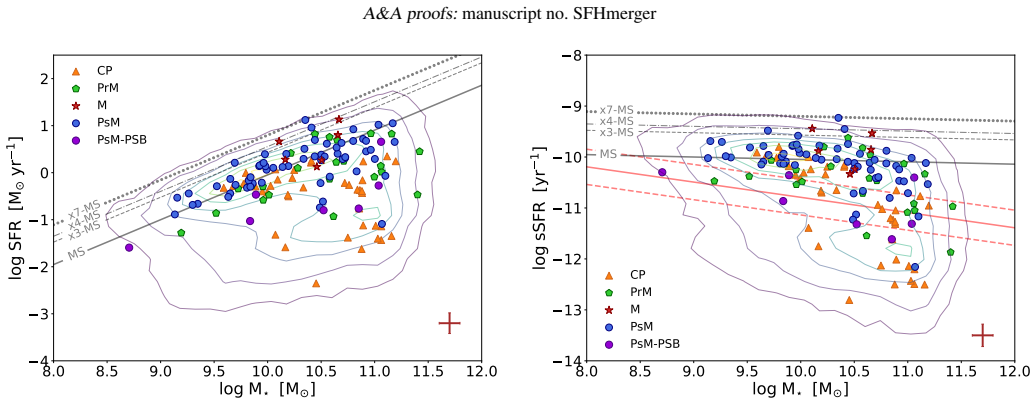
- [Sect. 5.3, Figs. 13–15, Table 5] The claim that 'merger and post-merger stages present higher star formation activity (measured by their integrated sSFR)' is based on descriptive medians for six M and seven PSB galaxies. The interquartile ranges in Table 5 overlap substantially (e.g., CP: −10.85 ± 1.42; M: −9.87 ± 0.53; PsM: −10.09 ± 0.46), and no formal significance test is reported for the galaxy-level distributions. Please add significance tests that treat galaxies (not spaxels) as independent units, state the effective sample sizes, and clarify whether the enhancement survives mass matching or a control-sample comparison. The same applies to the AGN-fraction comparison in Fig. 11, where the M-category percentages are computed from six galaxies.
- [Abstract and Sect. 6] The phrase 'observational proof of the effect of interactions on the quenching process' overstates what a small, visually classified, single-survey sample can establish. Even if the Dn4000 gradient is robust to the selection effect described above, it is one observable consistent with outside-in quenching, not a proof. Please rephrase to 'consistent with' or 'provides evidence for', and explicitly mention the central-spaxel selection and the small sample sizes as caveats in the conclusions.
minor comments (4)
- [Sect. 5.2] Typographical and grammatical errors should be corrected, including 'shon' -> 'shown', 'di fferent' -> 'different' (appears throughout), and 'W AHN' -> 'WHAN' in Sect. 3.4.
- [Sect. 2.2 / Fig. 1] The text introduces the QA parameter but does not define it explicitly for the SIP case; please provide the definition or a precise reference to Argudo-Fernández et al. (2015) so that the threshold QA < −2 is self-contained.
- [Sect. 5.3] The main-sequence reference 'Argudo-Fernández et al. 2025, submitted' is used as the grey dashed line in Figs. 13 and 14; since it is not yet public, please add a footnote with the functional form or make the calibration publicly available so that the offset of the sample from the main sequence can be evaluated.
- [Fig. 10] The linear-fit slopes in the legend are quoted with uncertainties but without significance levels or goodness-of-fit values; please report p-values or confidence intervals for each slope, or state explicitly that the fits are purely descriptive.
Circularity Check
No substantial circularity: merger-stage classes, SFRs, and WHAN classifications are independently measured, and the only self-citations are non-load-bearing thresholds and reference lines.
full rationale
The paper's central inferences—enhanced integrated sSFR in merger/post-merger galaxies, similar AGN fractions at fixed stellar mass, and outside-in quenching in post-merger post-starburst galaxies—are derived from MaNGA DAP measurements and CIGALE spectro-photometric SED fitting, not from the same quantities used to define the merger-stage categories. The merger-stage classification is visual and tidal (Sect. 3.1), using the QA threshold from Vásquez-Bustos et al. (2023) and Argudo-Fernández et al. (2015); this prior work supplies a selection criterion, not the measured outcome, so no fitted parameter is renamed as a prediction. The submitted Argudo-Fernández et al. (2025) main sequence is used only as a reference line in Figs. 13–14 and does not enter the statistical comparisons. The most arguable self-referential element is the PSB identification (Sect. 3.1.1), which uses the central-spaxel WHα versus (HδA+HγA)/2 diagram, while the outside-in claim (Sect. 5.2, Fig. 10) uses the Dn4000 radial gradient of the same seven galaxies. Because PSB selection and Dn4000 are different spectral indices, the positive gradient is not equal to the selection criterion by construction; however, central-spaxel selection could bias the central Dn4000 downward, making the outside-in interpretation partly selection-dependent. That is a statistical/selection-bias concern, not a derivation-equivalence circularity, and the paper does not claim to predict a quantity that was fitted. The paper also acknowledges WHAN limitations (Sect. 6) and reports quality-control removals in Sect. 5.1 without exact counts, but these omissions affect robustness rather than circularity. Overall, no load-bearing argument reduces to its own input; the minor self-citations merely point to the source of the isolated-system catalogues and thresholds.
Assumptions & free parameters
free parameters (4)
- SFH grid: Age, tau_main, Age_bq, rSFR =
Grid in Table 4: Age 11-13 Gyr, tau 1-9 Gyr, Age_bq 20-300 Myr, rSFR 0-10
- Dust attenuation grid: E(B-V)_lines, E(B-V)_factor, UV bump amplitude, delta =
Grid in Table 4
- Dn4000 young/old threshold =
1.67
- Main sequence/quenched separation from two-Gaussian fit =
Not reported explicitly
assumptions (6)
- domain assumption Isolation criterion from Argudo-Fernandez et al. (2015) ensures that no external perturber drives the observed evolution.
- domain assumption Visual classification of galaxies into CP, PrM, M, and PsM is accurate and complete.
- domain assumption The CIGALE delayed plus burst/quench SFH and modified Calzetti attenuation model adequately represent the observed galaxies.
- domain assumption WHAN diagram classes trace the dominant ionizing mechanism in each spaxel.
- domain assumption Dn4000 with a threshold of 1.67 separates young from old stellar populations.
- domain assumption MaNGA's 1.5-2.5 effective radius coverage is sufficient to measure the radial gradients and integrated properties used.
Cite this review
Pith. "Pith review of A MaNGA view of isolated galaxy mergers in the star-forming Main Sequence." pith.science (2026). https://pith.science/paper/XQXYQ5MA
@misc{pith2026250210078,
  author       = {Pith},
  title        = {Pith review of: A MaNGA view of isolated galaxy mergers in the star-forming Main Sequence},
  year         = {2026},
  howpublished = {\url{https://pith.science/paper/XQXYQ5MA}},
  note         = {Machine review of arXiv:2502.10078}
}
read the original abstract
In this work we carry out an analysis of star-formation and nuclear activity in the different stages during a galaxy merger identified in isolated systems (isolated galaxies, isolated pairs, and isolated triplets) using integral field spectroscopy from the SDSS-IV/MaNGA project. We classify galaxies into close pairs, pre-mergers, mergers, and post-mergers (including galaxies with post-starburst spectroscopic features), for a total sample of 137 galaxies. We constrained their star formation history from spectrophotometric SED fitting with CIGALE, and used spatially resolved WHAN diagrams, with other MaNGA data products to explore if there is any connection of their physical properties with their merging stage. In general, galaxies show characteristic properties intrinsically related to each stage of the merger process. Galaxies in the merger and post-merger stages present higher star formation activity (measured by their integrated sSFR). In the merger stage, the fraction of strong AGN spaxels is comparable to the fraction of spaxels with pure star-formation emission, with no difference between AGN activity in close pairs and strongly interacting galaxies with the same stellar mass. Our results support the scenario where galaxy interactions trigger star-formation and nuclear activity on galaxies. Nonetheless, AGN has a minor role in quenching galaxies following a merger, as AGN feedback might not have had sufficient time to inhibit star formation. In addition, we found that the quenching process in post-mergers galaxies with post-starburst emission is happening outside-in, being an observational proof of the effect of interactions on the quenching process. The transforming processes after a recent major galaxy interaction may happen slowly on isolated environments, where the system evolves in a common dark matter halo without any perturbation of external galaxies.
Figures


Figures from the paper (12 more)




Reference graph
Works this paper leans on
-
[1]
2022, ApJS, 259, 35
Abdurro’uf, Accetta, K., Aerts, C., et al. 2022, ApJS, 259, 35
2022
-
[2]
S., Lambas, D
Alonso, M. S., Lambas, D. G., Tissera, P., & Coldwell, G. 2007, MNRAS, 375, 1017 Argudo-Fernández, M., Verley, S., Bergond, G., et al. 2015, A&A, 578, A110 Astropy Collaboration, Robitaille, T. P., Tollerud, E. J., et al. 2013, A&A, 558, A33
2007
-
[3]
1999, in Astronomical Society of the Pacific Conference Series, V ol
Athanassoula, E. 1999, in Astronomical Society of the Pacific Conference Series, V ol. 160, Astrophysical Discs - an EC Summer School, ed. J. A. Sellwood & J. Goodman, 351
1999
-
[4]
H., Sancisi, R., & del Burgo, C
Balcells, M., van Gorkom, J. H., Sancisi, R., & del Burgo, C. 2001, AJ, 122, 1758
2001
-
[5]
A., Phillips, M
Baldwin, J. A., Phillips, M. M., & Terlevich, R. 1981, PASP, 93, 5
1981
-
[6]
L., Miller, C., Nichol, R., Zabludoff, A., & Goto, T
Balogh, M. L., Miller, C., Nichol, R., Zabludoff, A., & Goto, T. 2005, MNRAS, 360, 587
2005
-
[7]
L., Morris, S
Balogh, M. L., Morris, S. L., Yee, H. K. C., Carlberg, R. G., & Ellingson, E. 1999, ApJ, 527, 54
1999
-
[8]
K., Heckman, T
Barrera-Ballesteros, J. K., Heckman, T. M., Zhu, G. B., et al. 2016, MNRAS, 463, 2513
2016
Show all 150 references
-
[9]
J., Arnold, J
Barton, E. J., Arnold, J. A., Zentner, A. R., Bullock, J. S., & Wechsler, R. H. 2007, ApJ, 671, 1538
2007
-
[10]
J., Geller, M
Barton, E. J., Geller, M. J., & Kenyon, S. J. 2000, ApJ, 530, 660 Barton Gillespie, E., Geller, M. J., & Kenyon, S. J. 2003, ApJ, 582, 668
2000
-
[11]
2001, Ap&SS, 276, 847
Bekki, K. 2001, Ap&SS, 276, 847
2001
-
[12]
2016, MNRAS, 461, 3111
Belfiore, F., Maiolino, R., Maraston, C., et al. 2016, MNRAS, 461, 3111
2016
-
[13]
B., Schaefer, A., et al
Belfiore, F., Westfall, K. B., Schaefer, A., et al. 2019, AJ, 158, 160
2019
-
[14]
F., Phleps, S., Somerville, R
Bell, E. F., Phleps, S., Somerville, R. S., et al. 2006, ApJ, 652, 270
2006
-
[15]
F., van der Wel, A., Papovich, C., et al
Bell, E. F., van der Wel, A., Papovich, C., et al. 2012, ApJ, 753, 167
2012
-
[16]
2003, A&A, 405, 31
Bergvall, N., Laurikainen, E., & Aalto, S. 2003, A&A, 405, 31
2003
-
[17]
J., et al
Bergvall, N., Marquart, T., Way, M. J., et al. 2016, A&A, 587, A72
2016
-
[18]
R., Bershady, M
Blanton, M. R., Bershady, M. A., Abolfathi, B., et al. 2017, AJ, 154, 28
2017
-
[19]
2022, A&A, 663, A50
Boquien, M., Buat, V ., Burgarella, D., et al. 2022, A&A, 663, A50
2022
-
[20]
2014, A&A, 571, A72
Boquien, M., Buat, V ., & Perret, V . 2014, A&A, 571, A72
2014
-
[21]
2019, A&A, 622, A103
Boquien, M., Burgarella, D., Roehlly, Y ., et al. 2019, A&A, 622, A103
2019
-
[22]
A., Galliano, F., et al
Boquien, M., Duc, P. A., Galliano, F., et al. 2010, AJ, 140, 2124
2010
-
[23]
A., Wu, Y ., et al
Boquien, M., Duc, P. A., Wu, Y ., et al. 2009, AJ, 137, 4561
2009
-
[24]
A., et al
Boquien, M., Lisenfeld, U., Duc, P. A., et al. 2011, A&A, 533, A19
2011
-
[25]
J., & Combes, F
Bournaud, F., Jog, C. J., & Combes, F. 2005, A&A, 437, 69
2005
-
[26]
2008, MNRAS, 383, 93
Boylan-Kolchin, M., Ma, C.-P., & Quataert, E. 2008, MNRAS, 383, 93
2008
-
[27]
& Charlot, S
Bruzual, G. & Charlot, S. 2003, MNRAS, 344, 1000 Bruzual A., G. 1983, ApJ, 273, 105
2003
-
[28]
2011, A&A, 533, A93
Buat, V ., Giovannoli, E., Heinis, S., et al. 2011, A&A, 533, A93
2011
-
[29]
A., Law, D
Bundy, K., Bershady, M. A., Law, D. R., et al. 2015, ApJ, 798, 7
2015
-
[30]
2005, MNRAS, 360, 1413
Burgarella, D., Buat, V ., & Iglesias-Páramo, J. 2005, MNRAS, 360, 1413
2005
-
[31]
M., Gaskell, C
Burstein, D., Faber, S. M., Gaskell, C. M., & Krumm, N. 1984, ApJ, 287, 586 Calderón-Castillo, P. & Smith, R. 2024, A&A, 691, A82
1984
-
[32]
C., et al
Calzetti, D., Armus, L., Bohlin, R. C., et al. 2000, ApJ, 533, 682
2000
-
[33]
C., Magnier, E
Chambers, K. C., Magnier, E. A., Metcalfe, N., et al. 2016, arXiv e-prints, arXiv:1612.05560
2016 arXiv
-
[34]
2022, ApJ, 937, 97
Chang, Y .-Y ., Lin, L., Pan, H.-A., et al. 2022, ApJ, 937, 97
2022
-
[35]
2024, arXiv e-prints, arXiv:2409.05064
Chen, P.-B., Wang, J., Chen, Y .-M., Xu, X.-Y ., & Cao, T.-W. 2024, arXiv e-prints, arXiv:2409.05064
2024 arXiv
-
[36]
2019, MNRAS, 489, 5709
Chen, Y .-M., Shi, Y ., Wild, V ., et al. 2019, MNRAS, 489, 5709
2019
-
[37]
H., Sánchez-Gallego, J., et al
Cherinka, B., Andrews, B. H., Sánchez-Gallego, J., et al. 2019, AJ, 158, 74 Cid Fernandes, R., Stasi ´nska, G., Mateus, A., & Vale Asari, N. 2011, MNRAS, 413, 1687
2019
-
[38]
2016, A&A, 585, A43
Ciesla, L., Boselli, A., Elbaz, D., et al. 2016, A&A, 585, A43
2016
-
[39]
2017, A&A, 608, A41
Ciesla, L., Elbaz, D., & Fensch, J. 2017, A&A, 608, A41
2017
-
[40]
J., et al
Cisternas, M., Jahnke, K., Inskip, K. J., et al. 2011, ApJ, 726, 57
2011
-
[41]
L., et al
Coccato, L., Fraser-McKelvie, A., Jaffé, Y . L., et al. 2022, MNRAS, 515, 201
2022
-
[42]
L., Cortesi, A., et al
Coccato, L., Jaffé, Y . L., Cortesi, A., et al. 2020, MNRAS, 492, 2955
2020
-
[43]
M., Nevin, R., Negus, J., et al
Comerford, J. M., Nevin, R., Negus, J., et al. 2024, ApJ, 963, 53
2024
-
[44]
Conselice, C. J. 2003, ApJS, 147, 1
2003
-
[45]
W., Kaviraj, S., Lintott, C
Darg, D. W., Kaviraj, S., Lintott, C. J., et al. 2010, MNRAS, 401, 1043 de Mello, D. F., Smith, L. J., Sabbi, E., et al. 2008, AJ, 135, 548 Di Matteo, P., Combes, F., Melchior, A. L., & Semelin, B. 2007, A&A, 468, 61 Di Teodoro, E. M. & Fraternali, F. 2014, A&A, 567, A68 Domín...
2010
-
[46]
Fischer, J. L. 2018, MNRAS, 476, 3661
2018
-
[47]
A., et al
Drory, N., MacDonald, N., Bershady, M. A., et al. 2015, AJ, 149, 77 Duarte Puertas, S., Vilchez, J. M., Iglesias-Páramo, J., et al. 2017, A&A, 599, A71
2015
-
[48]
& Renaud, F
Duc, P.-A. & Renaud, F. 2013, in Lecture Notes in Physics, Berlin Springer Ver- lag, ed. J. Souchay, S. Mathis, & T. Tokieda, V ol. 861, 327
2013
-
[49]
& Martel, H
Dumont, A. & Martel, H. 2021, MNRAS, 503, 2866
2021
-
[50]
C., González-García, A
Eliche-Moral, M. C., González-García, A. C., Aguerri, J. A. L., et al. 2012, A&A, 547, A48
2012
-
[51]
C., Prieto, M., Gallego, J., & Zamorano, J
Eliche-Moral, M. C., Prieto, M., Gallego, J., & Zamorano, J. 2011, in Highlights of Spanish Astrophysics VI, ed. M. R. Zapatero Osorio, J. Gorgas, J. Maíz Apellániz, J. R. Pardo, & A. Gil de Paz, 173–179
2011
-
[52]
C., Rodríguez-Pérez, C., Borla ff, A., Querejeta, M., & Tapia, T
Eliche-Moral, M. C., Rodríguez-Pérez, C., Borla ff, A., Querejeta, M., & Tapia, T. 2018, A&A, 617, A113
2018
-
[53]
L., Mendel, J
Ellison, S. L., Mendel, J. T., Scudder, J. M., Patton, D. R., & Palmer, M. J. D. 2013, MNRAS, 430, 3128
2013
-
[54]
L., Patton, D
Ellison, S. L., Patton, D. R., Mendel, J. T., & Scudder, J. M. 2011, MNRAS, 418, 2043
2011
-
[55]
L., Teimoorinia, H., Rosario, D
Ellison, S. L., Teimoorinia, H., Rosario, D. J., & Mendel, J. T. 2016, MNRAS, 458, L34
2016
-
[56]
L., Viswanathan, A., Patton, D
Ellison, S. L., Viswanathan, A., Patton, D. R., et al. 2019, MNRAS, 487, 2491
2019
-
[57]
L., Wilkinson, S., Woo, J., et al
Ellison, S. L., Wilkinson, S., Woo, J., et al. 2022, MNRAS, 517, L92
2022
-
[58]
M., Friel, E
Faber, S. M., Friel, E. D., Burstein, D., & Gaskell, C. M. 1985, ApJS, 57, 711
1985
-
[59]
M., Willmer, C
Faber, S. M., Willmer, C. N. A., Wolf, C., et al. 2007, ApJ, 665, 265
2007
-
[60]
& Merritt, D
Ferrarese, L. & Merritt, D. 2000, ApJ, 539, L9
2000
-
[61]
Gallazzi, A., Charlot, S., Brinchmann, J., White, S. D. M., & Tremonti, C. A. 2005, MNRAS, 362, 41
2005
-
[62]
2011, A&A, 525, A150
Giovannoli, E., Buat, V ., Noll, S., Burgarella, D., & Magnelli, B. 2011, A&A, 525, A150
2011
-
[63]
2005, MNRAS, 357, 937
Goto, T. 2005, MNRAS, 357, 937
2005
-
[64]
C., Okamura, S., et al
Goto, T., Nichol, R. C., Okamura, S., et al. 2003, PASJ, 55, 771 Article number, page 17 of 30 A&A proofs: manuscript no. SFHmerger
2003
-
[65]
D., Greene, J
Goulding, A. D., Greene, J. E., Bezanson, R., et al. 2018, PASJ, 70, S37
2018
-
[66]
2023, A&A, 669, A23
Grajales-Medina, D., Argudo-Fernández, M., Vásquez-Bustos, P., et al. 2023, A&A, 669, A23
2023
-
[67]
& Bekki, K
Henderson, B. & Bekki, K. 2016, ApJ, 822, L33 Hernández-Toledo, H. M., Cortes-Suárez, E., Vázquez-Mata, J. A., et al. 2023, MNRAS, 523, 4164
2016
-
[68]
F., Bundy, K., Croton, D., et al
Hopkins, P. F., Bundy, K., Croton, D., et al. 2010, ApJ, 715, 202
2010
-
[69]
F., Hernquist, L., Cox, T
Hopkins, P. F., Hernquist, L., Cox, T. J., & Kereš, D. 2008, ApJS, 175, 356
2008
-
[70]
Hunter, J. D. 2007, Computing In Science & Engineering, 9, 90
2007
-
[71]
Ji, I., Peirani, S., & Yi, S. K. 2014, A&A, 566, A97
2014
-
[72]
S., Pan, H.-A., et al
Jin, G., Dai, Y . S., Pan, H.-A., et al. 2021, ApJ, 923, 6
2021
-
[73]
H., Penner, K., et al
Jogee, S., Miller, S. H., Penner, K., et al. 2009, ApJ, 697, 1971
2009
-
[74]
2001, SciPy: Open source scientific tools for Python, [Online; accessed 2016-01-15]
Jones, E., Oliphant, T., Peterson, P., et al. 2001, SciPy: Open source scientific tools for Python, [Online; accessed 2016-01-15]
2001
-
[75]
Joseph, R. D. & Wright, G. S. 1985, MNRAS, 214, 87
1985
-
[76]
M., Tremonti, C., et al
Kauffmann, G., Heckman, T. M., Tremonti, C., et al. 2003, MNRAS, 346, 1055
2003
-
[77]
S., Deller, A
Kaviraj, S., Shabala, S. S., Deller, A. T., & Middelberg, E. 2015, MNRAS, 452, 774
2015
-
[78]
C., van der Hulst, J
Kennicutt, Robert C., J., Keel, W. C., van der Hulst, J. M., Hummel, E., & Roet- tiger, K. A. 1987, AJ, 93, 1011
1987
-
[79]
J., Groves, B., Kauffmann, G., & Heckman, T
Kewley, L. J., Groves, B., Kauffmann, G., & Heckman, T. 2006, MNRAS, 372, 961
2006
-
[80]
Knapen, J. H. & Cisternas, M. 2015, ApJ, 807, L16
2015
-
[81]
Kormendy, J. & Ho, L. C. 2013, ARA&A, 51, 511
2013
-
[82]
2011, ApJ, 739, 57
Koss, M., Mushotzky, R., Veilleux, S., et al. 2011, ApJ, 739, 57
2011
-
[83]
Lacerda, E. A. D., Sánchez, S. F., Cid Fernandes, R., et al. 2020, MNRAS, 492, 3073
2020
-
[84]
Lacerna, I., Rodríguez-Puebla, A., Avila-Reese, V ., & Hernández-Toledo, H. M. 2014, ApJ, 788, 29
2014
-
[85]
N., Silverman, J
Lackner, C. N., Silverman, J. D., Salvato, M., et al. 2014, AJ, 148, 137
2014
-
[86]
G., Alonso, S., Mesa, V ., & O’Mill, A
Lambas, D. G., Alonso, S., Mesa, V ., & O’Mill, A. L. 2012, A&A, 539, A45
2012
-
[87]
G., Tissera, P
Lambas, D. G., Tissera, P. B., Alonso, M. S., & Coldwell, G. 2003, MNRAS, 346, 1189
2003
-
[88]
2022, ApJ, 940, 31
Laufman, L., Scarlata, C., Hayes, M., & Skillman, E. 2022, ApJ, 940, 31
2022
-
[89]
R., Cherinka, B., Yan, R., et al
Law, D. R., Cherinka, B., Yan, R., et al. 2016, AJ, 152, 83
2016
-
[90]
R., Westfall, K
Law, D. R., Westfall, K. B., Bershady, M. A., et al. 2021, AJ, 161, 52
2021
-
[91]
H., Calzetti, D., & Heckman, T
Leitherer, C., Li, I. H., Calzetti, D., & Heckman, T. M. 2002, ApJS, 140, 303
2002
-
[92]
2023, MNRAS, 523, 720
Li, W., Nair, P., Rowlands, K., et al. 2023, MNRAS, 523, 720
2023
-
[93]
C., Jian, H.-Y ., et al
Lin, L., Cooper, M. C., Jian, H.-Y ., et al. 2010, ApJ, 718, 1158
2010
-
[94]
C., Weiner, B
Lin, L., Koo, D. C., Weiner, B. J., et al. 2007, ApJ, 660, L51
2007
-
[95]
R., Koo, D
Lin, L., Patton, D. R., Koo, D. C., et al. 2008, ApJ, 681, 232
2008
-
[96]
M., Jonsson, P., Cox, T
Lotz, J. M., Jonsson, P., Cox, T. J., & Primack, J. R. 2008, MNRAS, 391, 1137
2008
-
[97]
M., Jonsson, P., Cox, T
Lotz, J. M., Jonsson, P., Cox, T. J., & Primack, J. R. 2010, MNRAS, 404, 590
2010
-
[98]
M., Primack, J., & Madau, P
Lotz, J. M., Primack, J., & Madau, P. 2004, AJ, 128, 163
2004
-
[99]
1998, AJ, 115, 2285
Magorrian, J., Tremaine, S., Richstone, D., et al. 1998, AJ, 115, 2285
1998
-
[100]
Mancillas, B., Combes, F., & Duc, P. A. 2019, A&A, 630, A112
2019
-
[101]
2004, MNRAS, 351, 169
Marconi, A., Risaliti, G., Gilli, R., et al. 2004, MNRAS, 351, 169
2004
-
[102]
2019, ApJ, 882, 141
Marian, V ., Jahnke, K., Mechtley, M., et al. 2019, ApJ, 882, 141
2019
-
[103]
2006, MNRAS, 370, 721 Méndez-Abreu, J., Debattista, V
Mateus, A., Sodré, L., Cid Fernandes, R., et al. 2006, MNRAS, 370, 721 Méndez-Abreu, J., Debattista, V . P., Corsini, E. M., & Aguerri, J. A. L. 2014, A&A, 572, A25
2006
-
[104]
G., & Nilo Castellon, J
Mesa, V ., Alonso, S., Coldwell, G., Lambas, D. G., & Nilo Castellon, J. L. 2021, MNRAS, 501, 1046
2021
-
[105]
2016, PASJ, 68, 96
Michiyama, T., Iono, D., Nakanishi, K., et al. 2016, PASJ, 68, 96
2016
-
[106]
Mihos, J. C. & Hernquist, L. 1996, ApJ, 464, 641
1996
-
[107]
P., Macciò, A
Moster, B. P., Macciò, A. V ., Somerville, R. S., Naab, T., & Cox, T. J. 2011, MNRAS, 415, 3750
2011
-
[108]
R., Alexander, D
Mullaney, J. R., Alexander, D. M., Aird, J., et al. 2015, MNRAS, 453, L83
2015
-
[109]
1999, ApJ, 523, L133
Naab, T., Burkert, A., & Hernquist, L. 1999, ApJ, 523, L133
1999
-
[110]
Nair, P. B. & Abraham, R. G. 2010, ApJS, 186, 427
2010
-
[111]
2019, ApJ, 872, 76
Nevin, R., Blecha, L., Comerford, J., & Greene, J. 2019, ApJ, 872, 76
2019
-
[112]
2023, MNRAS, 522, 1
Nevin, R., Blecha, L., Comerford, J., et al. 2023, MNRAS, 522, 1
2023
-
[113]
2009, A&A, 507, 1793
Noll, S., Burgarella, D., Giovannoli, E., et al. 2009, A&A, 507, 1793
2009
-
[114]
G., et al
Pasha, I., Lokhorst, D., van Dokkum, P. G., et al. 2021, ApJ, 923, L21
2021
-
[115]
M., Wild, V ., Walcher, C
Pawlik, M. M., Wild, V ., Walcher, C. J., et al. 2016, MNRAS, 456, 3032
2016
-
[116]
J., Wang, L., Alpaslan, M., et al
Pearson, W. J., Wang, L., Alpaslan, M., et al. 2019, A&A, 631, A51
2019
-
[117]
J., Kovaˇc, K., et al
Peng, Y .-j., Lilly, S. J., Kovaˇc, K., et al. 2010, ApJ, 721, 193 Pérez, F. & Granger, B. E. 2007, Computing in Science and Engineering, 9, 21
2010
-
[118]
2023, MNRAS, 518, 3261
Petersson, J., Renaud, F., Agertz, O., Dekel, A., & Duc, P.-A. 2023, MNRAS, 518, 3261
2023
-
[119]
Poggianti, B. M. & Barbaro, G. 1997, A&A, 325, 1025
1997
-
[120]
D., Hogg, D
Quintero, A. D., Hogg, D. W., Blanton, M. R., et al. 2004, ApJ, 602, 190 Ramos Almeida, C., Bessiere, P. S., Tadhunter, C. N., et al. 2012, MNRAS, 419, 687
2004
-
[121]
2022, MNRAS, 516, 4922
Renaud, F., Segovia Otero, Á., & Agertz, O. 2022, MNRAS, 516, 4922
2022
-
[122]
R., Bell, E
Robaina, A. R., Bell, E. F., Skelton, R. E., et al. 2009, ApJ, 704, 324
2009
-
[123]
2015, MNRAS, 449, 49
Rodriguez-Gomez, V ., Genel, S., V ogelsberger, M., et al. 2015, MNRAS, 449, 49
2015
-
[124]
F., Quinn, P
Roukema, B. F., Quinn, P. J., Peterson, B. A., & Rocca-V olmerange, B. 1997, MNRAS, 292, 835
1997
-
[125]
Salpeter, E. E. 1955, ApJ, 121, 161 Sánchez, S. F., Avila-Reese, V ., Hernandez-Toledo, H., et al. 2018, Rev. Mexi- cana Astron. Astrofis., 54, 217 Sánchez, S. F., Pérez, E., Sánchez-Blázquez, P., et al. 2016a, Rev. Mexicana Astron. Astrofis., 52, 171 Sánchez, S. F., Pérez, E....
1955
-
[126]
Sanders, D. B. & Mirabel, I. F. 1996, ARA&A, 34, 749
1996
-
[127]
J., Shao, L., et al
Santini, P., Rosario, D. J., Shao, L., et al. 2012, A&A, 540, A109
2012
-
[128]
L., McAlpine, W., et al
Satyapal, S., Ellison, S. L., McAlpine, W., et al. 2014, MNRAS, 441, 1297
2014
-
[129]
2021, ApJ, 919, 134
Sazonova, E., Alatalo, K., Rowlands, K., et al. 2021, ApJ, 919, 134
2021
-
[130]
2007, MNRAS, 382, 1415
Schawinski, K., Thomas, D., Sarzi, M., et al. 2007, MNRAS, 382, 1415
2007
-
[131]
D., et al
Silva, A., Marchesini, D., Silverman, J. D., et al. 2021, ApJ, 909, 124
2021
-
[132]
D., Mainieri, V ., Lehmer, B
Silverman, J. D., Mainieri, V ., Lehmer, B. D., et al. 2008, ApJ, 675, 1025
2008
-
[133]
F., Cox, T
Snyder, G. F., Cox, T. J., Hayward, C. C., Hernquist, L., & Jonsson, P. 2011, ApJ, 741, 77
2011
-
[134]
M., Perea, J
Solanes, J. M., Perea, J. D., & Valentí-Rojas, G. 2018, A&A, 614, A66
2018
-
[135]
L., Fu, H., Brownstein, J
Steffen, J. L., Fu, H., Brownstein, J. R., et al. 2023, ApJ, 942, 107
2023
-
[136]
C., Aceves, H., et al
Tapia, T., Eliche-Moral, M. C., Aceves, H., et al. 2017, A&A, 604, A105
2017
-
[137]
Taylor, M. B. 2005, in Astronomical Society of the Pacific Conference Se- ries, V ol. 347, Astronomical Data Analysis Software and Systems XIV , ed. P. Shopbell, M. Britton, & R. Ebert, 29
2005
-
[138]
& Toomre, J
Toomre, A. & Toomre, J. 1972, ApJ, 178, 623
1972
-
[139]
A., Thuan, T
Trevisan, M., Mamon, G. A., Thuan, T. X., et al. 2021, MNRAS, 502, 4815 Vásquez-Bustos, P., Argudo-Fernandez, M., Grajales-Medina, D., Duarte Puer- tas, S., & Verley, S. 2023, A&A, 670, A63
2021
-
[140]
2007, A&A, 472, 121
Verley, S., Leon, S., Verdes-Montenegro, L., et al. 2007, A&A, 472, 121
2007
-
[141]
M., et al
Villforth, C., Hamilton, T., Pawlik, M. M., et al. 2017, MNRAS, 466, 812
2017
-
[142]
Walt, S. v. d., Colbert, S. C., & Varoquaux, G. 2011, Computing in Science & Engineering, 13, 22
2011
-
[143]
K., Schawinski, K., Treister, E., Trakhtenbrot, B., & Sanders, D
Weigel, A. K., Schawinski, K., Treister, E., Trakhtenbrot, B., & Sanders, D. B. 2018, MNRAS, 476, 2308
2018
-
[144]
B., Cappellari, M., Bershady, M
Westfall, K. B., Cappellari, M., Bershady, M. A., et al. 2019, AJ, 158, 231
2019
-
[145]
E., McIntosh, D
Weston, M. E., McIntosh, D. H., Brodwin, M., et al. 2017, MNRAS, 464, 3882
2017
-
[146]
L., Bottrell, C., et al
Wilkinson, S., Ellison, S. L., Bottrell, C., et al. 2022, MNRAS, 516, 4354
2022
-
[147]
W., Lintott, C
Willett, K. W., Lintott, C. J., Bamford, S. P., et al. 2013, MNRAS, 435, 2835
2013
-
[148]
2020, ApJ, 901, 66
Woo, J.-H., Son, D., & Rakshit, S. 2020, ApJ, 901, 66
2020
-
[149]
2018, A&A, 613, A13
Yuan, F.-T., Argudo-Fernández, M., Shen, S., et al. 2018, A&A, 613, A13
2018
-
[150]
2020, MNRAS, 498, 1259 Article number, page 18 of 30 P
Zheng, Y ., Wild, V ., Lahén, N., et al. 2020, MNRAS, 498, 1259 Article number, page 18 of 30 P. Vásquez-Bustos et al.: A MaNGA view of isolated galaxy mergers in the star-forming Main Sequence Appendix A: Spatially resolved maps For this study, we selected a total of 12 produ...
2023
Reviewed August 7, 2026 · model on record in the stance chip above.
Discussion (0). Continue with ORCID to comment.