REVIEW 3 major objections 5 minor 33 references
Optical characterization of WISE selected blazar candidates
T0 review · 3 major / 5 minor · reviewed 2026-08-14 · deepseek-v4-flash
Pith's one-line read Optical spectroscopy of 1830 WISE-selected candidates shows that only about 30% of each catalog is made of confirmed blazars, with quasars and galaxies as the main contaminants.
desk verdict A solid spectroscopic characterization of two new blazar catalogs; the headline efficiency numbers need a caveat about the fainter unobserved sources. read the letter →
The pith
A machine-rendered reading of the paper's core claim, the machinery that carries it, and where it could break.
The reading
What carries the argument
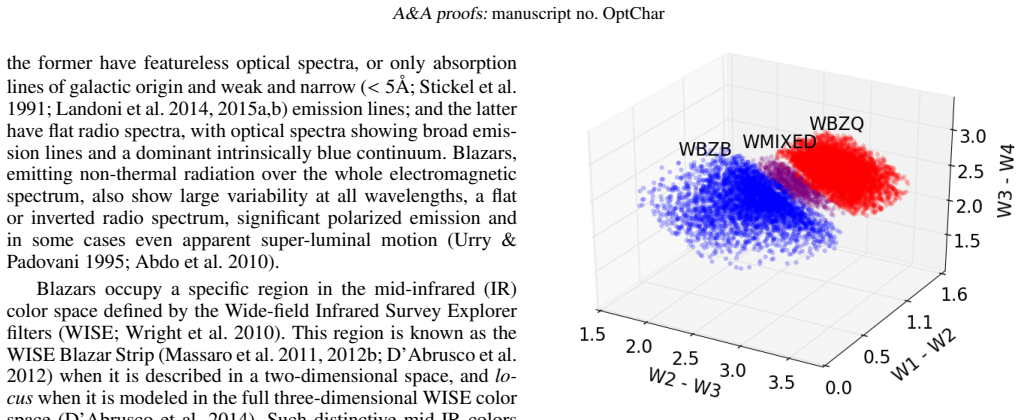
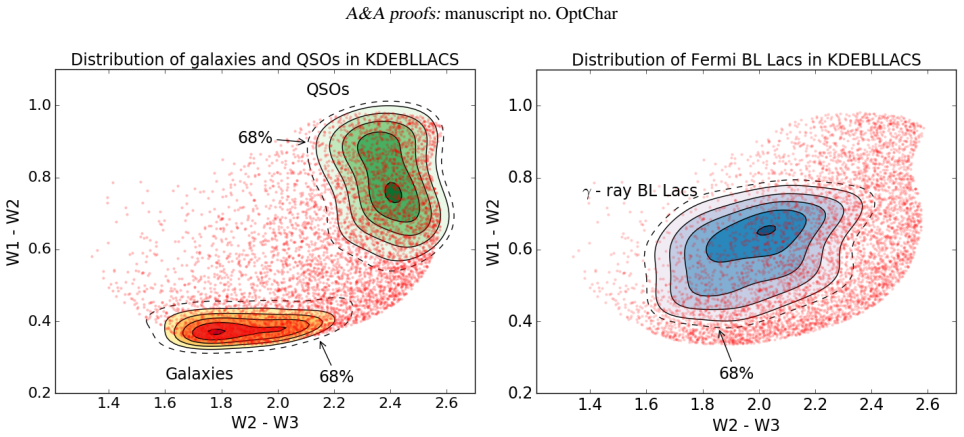
The central machinery is the WISE Blazar Strip and its three-dimensional WISE color locus: WIBRaLS2 selects sources whose W1-W2 and W2-W3 colors match confirmed Fermi blazars and that are radio-loud, while KDEBLLACS applies a kernel density estimate to the two-dimensional WISE color diagram and keeps sources within the 90% isodensity contour of known BL Lacs, also requiring radio loudness. To test these selections, the authors classify SDSS DR15 optical spectra using established diagnostics: featureless blue continuum for BL Lacs, broad emission lines plus radio luminosity for quasars, the Ca II break depression parameter $C_B$ with threshold 0.25 to separate BL Lac-host galaxies from normal galaxies, and BPT line ratios to separate low-luminosity AGNs from star-forming galaxies. Kernel density estimates applied to contaminants and to 4FGL gamma-ray blazars in the WISE color space localize the contamination to the edges of the selection region.
What would settle it
Take a random or complete sample of the WIBRaLS2 and KDEBLLACS sources in the SDSS footprint that currently lack spectra, obtain deep optical spectra for them, and compare the confirmed-blazar fraction with the reported ~30% lower limit; if the faint missing sources are predominantly normal galaxies, the true blazar fraction will fall below ~30%.
Extended reading notes
Core claim
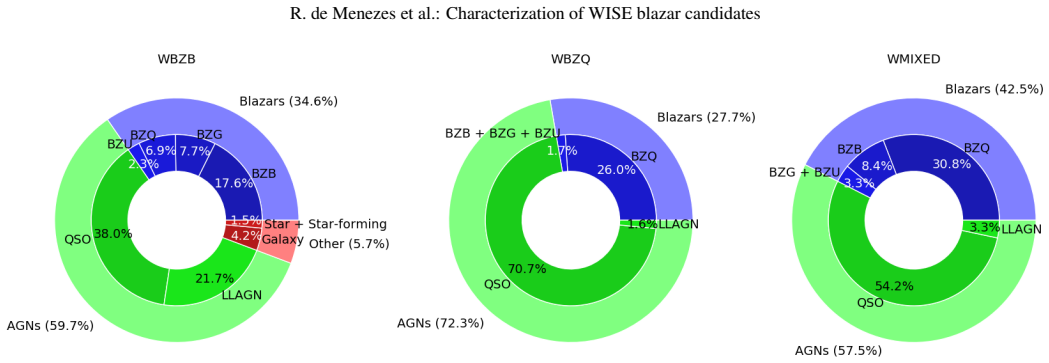
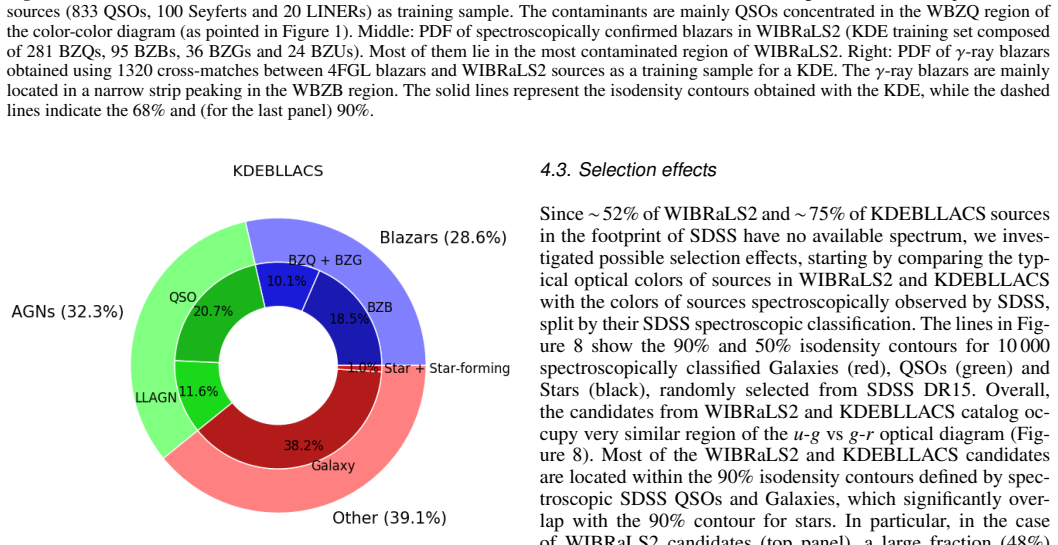
The paper reports that WIBRaLS2 and KDEBLLACS, though built from WISE mid-infrared colors similar to known gamma-ray blazars, are not highly pure: for the SDSS-observed subsample, the confirmed-blazar fraction is about 31% for WIBRaLS2 (34.6% of candidate BZBs, 27.7% of candidate BZQs, 42.5% of mixed-color candidates) and about 30% for KDEBLLACS; the authors treat these as lower limits for the whole catalogs. Quasars are the main contaminant of WIBRaLS2 (~58%) and normal galaxies of KDEBLLACS (~38.2%), with contaminants concentrated toward the edges of the infrared color-color diagram. In addition, optical spectra yield classifications for 11 4FGL blazar candidates of uncertain type and reveal 25 new BL Lac objects not previously cataloged.
Load-bearing premise
The results treat the SDSS-observed subsample as giving a lower limit for the whole catalog, which requires that the unobserved sources (about half of WIBRaLS2 and three-quarters of KDEBLLACS in the SDSS footprint, mostly fainter) are not more galaxy-dominated than the observed ones.
Editorial extensions
If this is right
- WIBRaLS2 and KDEBLLACS can be used to propose counterparts for unassociated Fermi-LAT sources, but with a known purity floor around 30%; candidates lying in the more contaminated regions of the WISE color-color diagram should be treated with lower confidence.
- Contaminants are not random: quasars cluster in the WBZQ region of WIBRaLS2 and galaxies and quasars sit at the edges of the KDEBLLACS selection, so targeted cuts could improve the purity of future catalog releases.
- The 25 newly identified BL Lac objects expand the spectroscopic census of this class and can serve as training samples for future infrared- or radio-based selection techniques.
- The 11 classified 4FGL blazar candidates of uncertain type reduce the uncertain fraction of the gamma-ray catalog, sharpening population studies of the gamma-ray sky.
Reading between the lines
- If the fainter unobserved KDEBLLACS sources are mostly galaxies, the catalog's true blazar fraction could fall below 30%; testing this requires spectroscopy of a magnitude-limited sample beyond SDSS's current depth.
- Some of the WIBRaLS2 QSO contaminants may actually be flat-spectrum radio quasars, which are a subclass of blazars; if so, the effective blazar content could be higher than 30%, and radio spectral indices of those contaminants would discriminate.
- The $u-r<1.4$ criterion used to vet the new BL Lacs is stated to fail at redshifts above 0.5, so a few of the 25 new objects at higher redshift could be misclassified; redshift-resolved spectroscopy would settle their nature.
- The edge-concentration pattern of contaminants suggests a reusable test: applying the same kernel-density contamination mapping to future color-selected AGN catalogs could reveal where their purity drops before committing to large follow-up campaigns.
Signed reviews
Editorial analysis
A structured set of objections, weighed in public.
Referee Report
Summary. The paper characterizes two WISE-selected blazar candidate catalogs, WIBRaLS2 and KDEBLLACS, using optical spectra from SDSS DR15. The authors cross-match catalog sources to SDSS spectra, visually classify the spectra into blazars, QSOs, galaxies, stars, and other classes, and report the fraction of confirmed blazars in each catalog. They find that the spectroscopically observed subsamples contain roughly 30% confirmed blazars, with QSOs being the main contaminants in WIBRaLS2 and normal galaxies in KDEBLLACS. They also classify 11 Fermi 4FGL BCUs and report 25 new BL Lac objects. The paper's headline claim is that 'at least ~30%' of each full catalog consists of confirmed blazars, presented as a lower limit on selection efficiency.
Significance. If the result holds, this is a useful benchmark for the community, because WIBRaLS2 and KDEBLLACS are widely used for Fermi counterpart identification and blazar population studies. The analysis is independent of the catalogs' construction: it relies on external SDSS DR15 spectra and the Roma-BZCAT catalog as benchmarks, so the core classification test is not circular. The identification of 11 BCU counterparts and 25 new BZBs is a concrete contribution. The main weakness is that the lower-limit interpretation of the blazar fraction is not rigorously supported by the data, which means the headline quantitative claim needs revision or additional analysis. The observed-subample fractions are still valuable, but they should be reported as such unless the selection-effect issue is addressed.
major comments (3)
- [Section 5 (first two bullets) and Section 4.3, Figure 9] The abstract and summary claim that 'at least ~30%' of each catalog is composed of confirmed blazars, but this lower-limit interpretation is not supported by the analysis. Only 1424 of 9541 WIBRaLS2 sources (~15%) and 406 of 5580 KDEBLLACS sources (~7%) have SDSS spectra, and the paper's own Figure 9 shows that KDEBLLACS sources lacking spectra are systematically fainter than those with spectra. Section 4.3 also notes that KDEBLLACS candidates are intrinsically fainter in WISE bands. Fainter sources are more likely to be host-galaxy-dominated or normal galaxies, and the spectroscopically classified KDEBLLACS sample already contains 155 normal galaxies versus only 75 BZBs. The statement that contamination estimates are 'upper limits' does not imply that the blazar efficiency is a lower limit; a lower bound would require an explicit argument that the unobserved sources are not more blazar-rich than the observed ones, which is absent. The reported fractions (34.6%, 27.7%, and 42.5% for WBZB, WBZQ, and WMIXED in WIBRaLS2, and ~30% for KDEBLLACS) should be presented as observed-subample fractions, or the lower-limit claim needs a quantitative treatment of the magnitude-dependent incompleteness.
- [Sections 4.1 and 4.2] The classification fractions are reported without statistical uncertainties. For example, '17.6% of WBZBs show a featureless optical spectrum' and '26.1% of WBZQs are confirmed BZQs' are point estimates based on subsamples of 471 and 833 objects, respectively; without binomial or Poisson confidence intervals, the reader cannot assess the significance of differences such as the 30.8% versus 26.1% BZQ fractions between WMIXED and WBZQ sources. Adding uncertainties would strengthen the quantitative claims about the dominant contaminant classes and the relative purity of the color-selected subregions.
- [Section 4.3, Figure 8] The color-based selection-effect test concludes that 'we can rule out the existence of significant selection effects due to the colors of the optical counterparts,' but the analysis only compares isodensity contours in optical color-color space; it does not directly probe the joint color-magnitude selection function that determines SDSS spectroscopic targeting. Given that Figure 9 demonstrates a magnitude-dependent incompleteness, a test that does not incorporate magnitude cannot fully rule out selection effects that correlate with color and magnitude simultaneously. At minimum, the conclusion should be restricted to 'no strong color-only selection effect' rather than the current broader statement.
minor comments (5)
- [Figure 1 caption] The caption lists 'W1, W1, W3 and W4' but should read 'W1, W2, W3 and W4'.
- [Section 4, first paragraph] The word 'splitted' should be 'split'.
- [Abstract and Section 5] The abstract reports 'at least ~30%' while the summary gives a weighted lower limit of ~31% for WIBRaLS2 and ~30% for KDEBLLACS; these numbers should be made consistent and, if the lower-limit language is removed as suggested above, the abstract and summary should be reworded to describe the observed-subample fractions.
- [Section 2.2] The text says 'This sample corresponds to 7% of the whole KDEBLLACS' after stating the final sample is 406 sources; 406/5580 is approximately 7.3%, so the rounding is acceptable but could be clarified.
- [Appendix A caption] The captions for Figures A.1 and A.2 state that 'all sources present featureless spectra with color index u− r < 1.4,' but Table 2 lists one source with u− r = 1.38 and another with 1.32; the criterion should be described as 'u− r ≲ 1.4' or the threshold should be clarified to avoid an apparent inconsistency.
Circularity Check
No circularity: the test of WIBRaLS2 and KDEBLLACS uses external SDSS DR15 spectra and Roma-BZCAT as benchmarks, so the characterization is independent of the catalogs' own selection criteria.
full rationale
The paper's central claim is an efficiency test of two blazar-candidate catalogs against independent optical spectroscopy. The classifications rely on SDSS DR15 spectra and Roma-BZCAT classifications, both external to the WIBRaLS2 and KDEBLLACS construction. The fact that several authors of the present paper also built the catalogs being tested is not circular; the benchmark data are not derived from those catalogs. The 'at least ~30%' phrasing is an extrapolation from the spectroscopically observed subsamples (about 15% of WIBRaLS2 and 7% of KDEBLLACS), and the paper explicitly states that the contamination estimates are upper limits because of selection effects. That is a statistical limitation rather than a self-definitional or fitted-input circularity: the observed fractions are computed by direct spectral classification, not by construction from the catalog selection rules. No equation or fitted parameter is reused as a prediction, and no load-bearing argument reduces to a self-citation. Therefore no circular step can be exhibited under the required standard.
Assumptions & free parameters
assumptions (3)
- domain assumption SDSS DR15 spectra with SNR > 5 are sufficient for reliable optical classification of the selected sources.
- domain assumption The 'featureless blue continuum' criterion identifies BL Lacs, and the CB < 0.25 threshold separates BZGs from normal galaxies.
- ad hoc to paper The spectroscopically observed subsample yields a lower limit on the blazar fraction of the full catalogs; unobserved sources cannot have a lower blazar fraction.
Cite this review
Pith. "Pith review of Optical characterization of WISE selected blazar candidates." pith.science (2026). https://pith.science/paper/XRAOWB2C
@misc{pith2026190805229,
  author       = {Pith},
  title        = {Pith review of: Optical characterization of WISE selected blazar candidates},
  year         = {2026},
  howpublished = {\url{https://pith.science/paper/XRAOWB2C}},
  note         = {Machine review of arXiv:1908.05229}
}
read the original abstract
Over the last decade more than five thousand gamma-ray sources were detected by the Large Area Telescope (LAT) on board Fermi Gamma-ray Space Telescope. Given the positional uncertainty of the telescope, nearly 30% of these sources remain without an obvious counterpart in lower energies. This motivated the release of new catalogs of gamma-ray counterpart candidates and several follow up campaigns in the last decade. Recently, two new catalogs of blazar candidates were released, they are the improved and expanded version of the WISE Blazar-Like Radio-Loud Sources (WIBRaLS2) catalog and the Kernel Density Estimation selected candidate BL Lacs (KDEBLLACS) catalog, both selecting blazar-like sources based on their infrared colors from the Wide-field Infrared Survey Explorer (WISE). In this work we characterized these two catalogs, clarifying the true nature of their sources based on their optical spectra from SDSS data release 15, thus testing how efficient they are in selecting true blazars. We first selected all WIBRaLS2 and KDEBLLACS sources with available optical spectra in the footprint of Sloan Digital Sky Survey data release 15. Then we analyzed these spectra to verify the nature of each selected candidate and see which fraction of the catalogs is composed by spectroscopically confirmed blazars. Finally, we evaluated the impact of selection effects, specially those related to optical colors of WIBRaLS2/KDEBLLACS sources and their optical magnitude distributions. We found that at least ~ 30% of each catalog is composed by confirmed blazars, with quasars being the major contaminants in the case of WIBRaLS2 (~ 58%) and normal galaxies in the case of KDEBLLACS (~ 38.2%). The spectral analysis also allowed us to identify the nature of 11 blazar candidates of uncertain type (BCUs) from the Fermi-LAT 4th Point Source Catalog (4FGL) and to find 25 new BL Lac objects.
Figures


Figures from the paper (5 more)


Reference graph
Works this paper leans on
-
[1]
2010, The Astrophysical Journal, 716, 30
Abdo, A., Ackermann, M., Agudo, I., et al. 2010, The Astrophysical Journal, 716, 30
2010
-
[2]
2015, The Astrophysical Journal Supplement Series, 218, 23
Acero, F., Ackermann, M., Ajello, M., et al. 2015, The Astrophysical Journal Supplement Series, 218, 23
2015
-
[3]
2015, The Astrophysical Journal, 810, 14
Ackermann, M., Ajello, M., Atwood, W., et al. 2015, The Astrophysical Journal, 810, 14
work page 2015
-
[4]
2019, The Astrophysical Journal Supplement Series, 240, 23
Aguado, D., Ahumada, R., Almeida, A., et al. 2019, The Astrophysical Journal Supplement Series, 240, 23
work page 2019
-
[5]
Baldwin, J. A., Phillips, M. M., & Terlevich, R. 1981, Publications of the Astro- nomical Society of the Pacific, 93, 5
work page 1981
-
[6]
1978, AM Wolfe, Ed, 328 Böttcher, M
Blandford, R., Rees, M., & Wolfe, A. 1978, AM Wolfe, Ed, 328 Böttcher, M. 2007, in The Multi-Messenger Approach to High-Energy Gamma- Ray Sources (Springer), 95–104
work page 1978
-
[7]
J., Cotton, W., Greisen, E., et al
Condon, J. J., Cotton, W., Greisen, E., et al. 1998, The Astronomical Journal, 115, 1693
work page 1998
-
[8]
2013, Explanatory Supplement to the AllWISE Data Release Products, by RM Cutri et al
Cutri, R., Wright, E., Conrow, T., et al. 2013, Explanatory Supplement to the AllWISE Data Release Products, by RM Cutri et al
work page 2013
Show all 33 references
-
[9]
Cutri, R. e. et al. 2014, VizieR Online Data Catalog, 2328 D’Abrusco, R., Crespo, N. Á., Massaro, F., et al. 2019, The Astrophysical Jour- nal Supplement Series, 242, 4 Article number, page 8 of 11 R. de Menezes et al.: Characterization of WISE blazar candidates D’Abrusco, R.,...
2014
-
[10]
& Shectman, S
Dressler, A. & Shectman, S. A. 1987, The Astronomical Journal, 94, 899 Fermi-LAT Collaboration, T. et al. 2019, arXiv preprint arXiv:1902.10045
1987 arXiv
-
[11]
J., White, R
Helfand, D. J., White, R. L., & Becker, R. H. 2015, The Astrophysical Journal, 801, 26
2015
-
[12]
J., Groves, B., Kauffmann, G., & Heckman, T
Kewley, L. J., Groves, B., Kauffmann, G., & Heckman, T. 2006, Monthly Notices of the Royal Astronomical Society, 372, 961
2006
-
[13]
2014, Astronomy & As- trophysics, 570, A126
Landoni, M., Falomo, R., Treves, A., & Sbarufatti, B. 2014, Astronomy & As- trophysics, 570, A126
2014
-
[14]
P., Donzelli, C
Madrid, J. P., Donzelli, C. J., Rodríguez-Ardila, A., et al. 2018, The Astrophysi- cal Journal Supplement Series, 238, 31
2018
-
[15]
2011, The Astrophysical Journal, 743, 156
Mainzer, A., Grav, T., Bauer, J., et al. 2011, The Astrophysical Journal, 743, 156
2011
-
[16]
Á., et al
Marchesini, E., Peña-Herazo, H., Crespo, N. Á., et al. 2019, Astrophysics and Space Science, 364, 5
2019
-
[17]
Massaro, F., D’Abrusco, R., Ajello, M., Grindlay, J., & Smith, H. A. 2011, The Astrophysical Journal Letters, 740, L48
2011
-
[18]
2009, The Astrophysical Journal, 696, 980
Massaro, F., Harris, D., Chiaberge, M., et al. 2009, The Astrophysical Journal, 696, 980
2009
-
[19]
2010, The Astrophysical Journal, 714, 589
Massaro, F., Harris, D., Tremblay, G., et al. 2010, The Astrophysical Journal, 714, 589
2010
-
[20]
2014, The Astro- nomical Journal, 148, 66
Massaro, F., Masetti, N., D’Abrusco, R., Paggi, A., & Funk, S. 2014, The Astro- nomical Journal, 148, 66
2014
-
[21]
2003, Monthly Notices of the Royal Astronomical Society, 342, 1117
Mauch, T., Murphy, T., Buttery, H., et al. 2003, Monthly Notices of the Royal Astronomical Society, 342, 1117
2003
-
[22]
1993, Monthly Notices of the Royal Astronomical Society, 263, 1023
Morganti, R., Killeen, N., & Tadhunter, C. 1993, Monthly Notices of the Royal Astronomical Society, 263, 1023
1993
-
[23]
2014, The Astronomical Journal, 147, 112 Peña-Herazo, H., Massaro, F., Chavushyan, V ., et al
Paggi, A., Milisavljevic, D., Masetti, N., et al. 2014, The Astronomical Journal, 147, 112 Peña-Herazo, H., Massaro, F., Chavushyan, V ., et al. 2019, Astrophysics and Space Science, 364, 85 Peña-Herazo, H. A., Marchesini, E. J., Crespo, N. Á., et al. 2017, Astrophysics and Sp...
2014
-
[24]
2015, The Astronomical Journal, 149, 160
Ricci, F., Massaro, F., Landoni, M., et al. 2015, The Astronomical Journal, 149, 160
2015
-
[25]
1965, The Astrophysical Journal, 141, 1
Schmidt, M. 1965, The Astrophysical Journal, 141, 1
1965
-
[26]
1991, The Astrophysical Journal, 374, 431
Stickel, M., Padovani, P., Urry, C., Fried, J., & Kühr, H. 1991, The Astrophysical Journal, 374, 431
1991
-
[27]
T., Morris, S
Stocke, J. T., Morris, S. L., Gioia, I., et al. 1991, The Astrophysical Journal Supplement Series, 76, 813
1991
-
[28]
Taylor, M. B. 2005, in Astronomical Data Analysis Software and Systems XIV , V ol. 347, 29
2005
-
[29]
A., Blanton, M
Tegmark, M., Strauss, M. A., Blanton, M. R., et al. 2004, Physical Review D, 69, 103501
2004
-
[30]
Urry, C. M. & Padovani, P. 1995, Publications of the Astronomical Society of the Pacific, 107, 803
1995
-
[31]
L., Becker, R
White, R. L., Becker, R. H., Helfand, D. J., & Gregg, M. D. 1997, The Astro- physical Journal, 475, 479
1997
-
[32]
L., Eisenhardt, P
Wright, E. L., Eisenhardt, P. R., Mainzer, A. K., et al. 2010, The Astronomical Journal, 140, 1868
2010
-
[33]
G., Adelman, J., Anderson Jr, J
York, D. G., Adelman, J., Anderson Jr, J. E., et al. 2000, The Astronomical Jour- nal, 120, 1579 Appendix A: New BZB candidates During the spectral classification process described in Section 3, we found 25 new BZBs not available in Roma-BZCAT or during our follow up spectrosco...
2000
Reviewed August 14, 2026 · model on record in the stance chip above.
Discussion (0). Continue with ORCID to comment.