REVIEW 3 major objections 5 minor 41 references
Virtual Polarization Elements for Spatially Varying Jones Matrix Transformations on a Free-Space Plane
T0 review · 3 major / 5 minor · reviewed 2026-08-07 · deepseek-v4-flash
Pith's one-line read A metasurface can impose a prescribed Jones-matrix transformation on a plane suspended in free space, with no device at the target.
desk verdict Sound for plane-wave inputs, overclaimed for structured beams; worth reviewing but needs a locality analysis. read the letter →
The pith
A machine-rendered reading of the paper's core claim, the machinery that carries it, and where it could break.
The reading
What carries the argument
The load-bearing object is the matrix-valued plane-wave superposition $\tilde{M}(x,y)=\sum_{u,v}\tilde{A}(k_x^u,k_y^v)e^{i(k_x^u x+k_y^v y)}e^{-ik_z^{(u,v)}z_0}$, where $\tilde{A}(k_x,k_y)$ is the Fourier weight of the desired Jones matrix $\tilde{F}(x,y)$ (Eq. 1) and $\tilde{F}$ is a $2\times2$ matrix describing how a device transforms input polarization into output polarization. Each weight is a $2\times2$ Jones matrix rather than a scalar amplitude, so polarization information is carried in the coefficients of the plane-wave expansion. The propagation phase $e^{-ik_z z_0}$ is chosen so that it cancels exactly at the target plane, turning the sum back into $\tilde{F}(x,y)$. Because a metasurface pixel can only produce a symmetric unitary local Jones matrix, the paper then uses dual-matrix holography—checkerboard sampling of two unit-determinant matrices obtained from an SVD—to encode the general $\tilde{M}(x,y)$.
What would settle it
Illuminate a VPE with a Gaussian beam whose waist is comparable to or smaller than the 0.5 µm grid spacing, measure the output polarization across the target plane at $z=z_0$, and compare it with the pointwise prediction $|E_{\mathrm{out}}\rangle=\tilde{F}(x,y)|E_{\mathrm{in}}\rangle$. If the measured output matches the convolution of the input angular spectrum with $\tilde{F}$ rather than the local product—or if the retrieved Jones matrix shifts with the input beam size—the locality assumption breaks.
Extended reading notes
Core claim
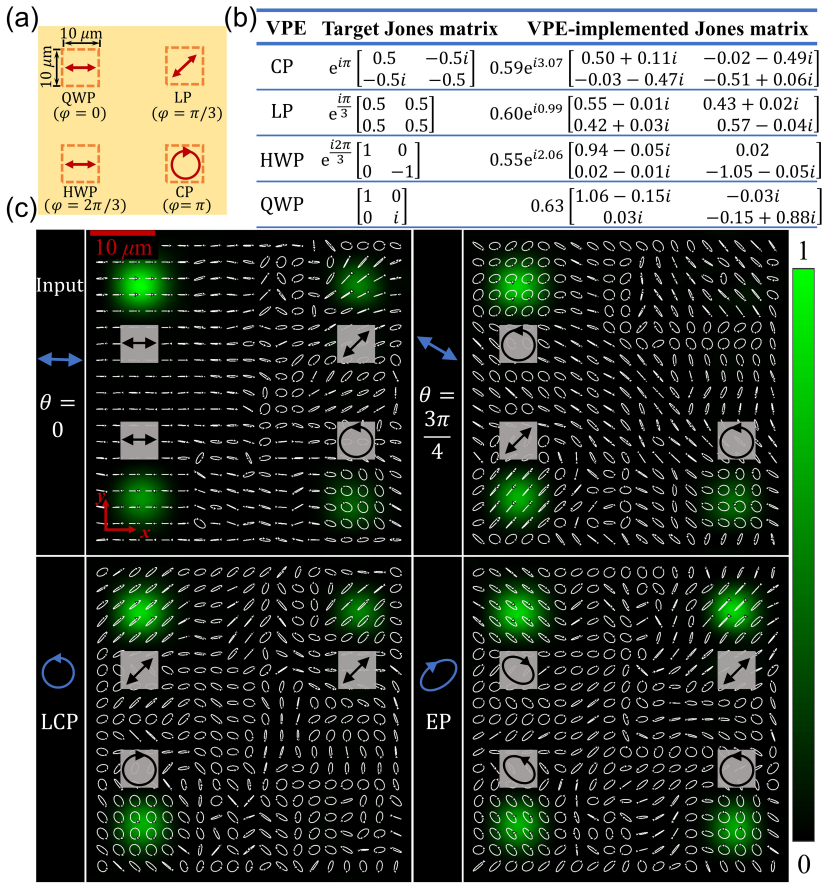
The discovery is that a free-space Jones matrix distribution can be built by synthesis, not by contact. Each plane-wave component of the target distribution is assigned a $2\times2$ Jones matrix weight $\tilde{A}(k_x,k_y)$ through a matrix-valued Fourier transform; the metasurface encodes their sum at $z=0$ with propagation phases chosen so that at $z=z_0$ the phase terms cancel and the field equals the target operation applied to the input. To make this realizable with birefringent nanopillars, the paper combines singular-value decomposition and dual-matrix (checkerboard) holography to approximate the required matrix by a symmetric unitary local Jones matrix. Simulated single-function VPEs reach matrix fidelities of 0.993–0.997; a four-region multifunction VPE reaches 0.983–0.997 with relative phase errors below 6%; and vortex waveplate designs generate radial, azimuthal, and higher-order vector vortex beams.
Load-bearing premise
The derivation assumes the input is a single plane wave with fixed polarization; the structured-beam demonstrations assume the VPE acts pointwise at the target plane, even though propagation from $z=0$ to $z_0$ is a convolution that mixes neighboring values of $\tilde{F}(x,y)$.
Editorial extensions
If this is right
- Polarization operations such as polarizers and waveplates can be projected onto a plane with no physical structure, enabling contactless control in high-power, vacuum, or bio-sensitive environments.
- One metasurface can implement several different Jones matrices in separate regions of the same target plane with arbitrary relative phase offsets, enabling region-specific multifunctional polarization control.
- VPE-based vortex waveplates can generate structured vector vortex beams, including radial/azimuthal polarization and dual-mode hybrid beams, from a single planar device.
- The working distance is not fixed near the metasurface: the paper validates operation at $z_0=300\,\mu\mathrm{m}$ by scaling the modulation plane, so the approach extends to macroscopic separations.
- Enlarging the designated function area raises conversion efficiency toward the theoretical limit, with simulated $C$ values of 0.75, 0.67, 0.71, and 0.68 for a $60\,\mu\mathrm{m}\times60\,\mu\mathrm{m}$ CP, LP, HWP, and QWP design.
Reading between the lines
- If the assumed pointwise action fails for beams with large angular spread, a VPE would behave as a spatially dispersive filter rather than a true element; measuring the retrieved Jones matrix as a function of input beam waist would settle this directly.
- The same Fourier-synthesis idea could be applied to scalar degrees of freedom, producing virtual phase plates or virtual amplitude masks in free space, though the paper does not explore that direction.
- Because the propagation phase depends on $k_z$, a single metasurface might be designed to present different effective Jones matrices at different distances $z_0$, making propagation itself a switching or multiplexing degree of freedom.
- Wavelength-dependent $k_z$ also suggests dispersive virtual elements; the paper's demonstrations are at a single wavelength and do not address this.
Editorial analysis
A structured set of objections, weighed in public.
Referee Report
Summary. The paper introduces "virtual polarization elements" (VPEs): a metasurface at z=0 whose spatially varying Jones matrix distribution M(x,y) is designed by Fourier synthesis so that, after free-space propagation to a target plane z=z0, the output field approximates F(x,y)|Ein>, where F is a prescribed spatially varying Jones matrix. The design is implemented with TiO2 nanopillars using dual-matrix holography. Numerical FDTD demonstrations include single-function circular/linear polarizers and half- and quarter-wave plates, a multifunction element with independent phase offsets, and vortex-waveplate configurations generating vector vortex beams. The paper also reports an extended-range design at z0=300 um and compares non-contact VPE operation with conventional contact-based designs.
Significance. If the claimed locality property holds for non-plane-wave inputs, the VPE concept is a useful extension of Jones-matrix holography and propagation-based metasurface polarization control, enabling prescribed polarization operations on a contactless free-space plane. The paper's concrete strengths are the explicit inverse-design formula in Eq. (2), the FDTD verification with reported matrix fidelities between 0.983 and 0.997, and the demonstrations of multifunction and vortex-beam operation. The main caveat is that the supplied proof is restricted to plane-wave incidence, so the significance for structured illumination hinges on a quantitative locality analysis that is not currently provided.
major comments (3)
- [S1, Eqs. (S1)-(S5)] The proof of the central relation |Eout>|z=z0 ~ F(x,y)|Ein> assumes the incident field is a single plane wave with a fixed Jones vector |Ein>, so that |Ein> can be factored out of the matrix-valued superposition. For a structured input with angular spectrum G(q), the transmitted field is M(r)e_in(r), and propagation to z0 gives a phase e^{i[kz(K+Q)-kz(K)]z0} for each pair (K,Q), whereas the desired local operation would require e^{ikz(Q)z0}; the mismatch phase is approximately -(K*Q/k0)z0. This term is not bounded anywhere in the paper. Figure 4's vortex-waveplate demonstrations use Gaussian beams with waists down to 10 um and z0=10 um, and S5 extends to z0=300 um; for these parameters the correction is not negligible a priori, and no structured-beam fidelity metric or bound is supplied. The central claim therefore needs either a restriction to plane-wave or sufficiently collimated illumination, or a quantitative locality condition in terms of beam divergence, z0, and the bandwidth of F.
- [Results, Single-function VPEs] The target operation F is defined on a 0.5 um grid of delta functions, and the realized Jones matrix is retrieved by spatially averaging over the full 10 um x 10 um region. The paper repeatedly calls the target a local Jones matrix, but the demonstrated operation is a region-averaged transformation with a finite point-spread function set by the plane-wave cutoff. This should be stated explicitly, because the multifunction and vortex claims involve features at the 10 um scale, and the resolution limit bears directly on how strictly the word 'local' can be used.
- [S5, Extended-range multifunction VPE] The extended-range design at z0=300 um increases the phase-mismatch term -(K*Q/k0)z0 by a factor of 30 relative to z0=10 um, yet the supporting simulation appears to use plane-wave illumination only. No estimate or test is given for Gaussian-beam or other structured illumination at this distance. Given that the abstract advertises action at a distance for general input fields, the authors should either demonstrate structured-beam operation at z0=300 um or explicitly limit the extended-range claim to plane-wave incidence.
minor comments (5)
- [Throughout] There are several typos and awkward phrases, including 'spacial' for 'spatial', 'adpots' for 'adopts', and 'convinced' for 'conceived'; the phrase 'high-dimensional plane waves' is also confusing because the waves are ordinary plane waves with matrix-valued weights.
- [Eq. (3)] The rotation matrix R(phi) is written with equal off-diagonal signs; for a rotated birefringent element the standard convention has opposite signs. Please check whether this sign convention affects the retrieved fast-axis orientation and the vortex-waveplate handedness.
- [S2, Spectral filtering conditions] The condition 'Delta x >= 2*max(k_u_x)' mixes spatial and frequency quantities; please define whether Delta x is a spatial filter half-width or a spectral window, and use consistent k-space notation.
- [S6, Table S3] The QWP fidelity for the VPE is listed as 0.997 in S6 but as 0.994 in the main text for the same design; please harmonize the reported values.
- [Figure 4 caption] The caption says the dual-mode combines (1,0) and (-2,1), while the main text describes the outer ring as containing (1,0) and (-2,1) with some redundancy; please clarify the intended topological-charge layout.
Circularity Check
No significant circularity: the VPE design is an inverse Fourier-synthesis construction verified by independent FDTD simulations; no fitted quantity is renamed as a prediction.
full rationale
The central relation |Eout>|_{z=z0} ≈ F(x,y)|Ein> (main-text Eq. 2 and SI S5) is a construction identity. The metasurface matrix M is defined as the superposition of plane waves with phase factors e^{-ik_z z0} so that after propagation to the target plane z0 each plane wave arrives with the transverse Fourier phase; the Fourier relation in SI S4 then reconstructs the target F. This is exact for plane-wave incidence with a fixed Jones vector, because |Ein> then factors out of the matrix-weighted sum. No free parameter is fitted to make the FDTD results match: the target matrices, distances, grid sizes, and truncation orders are design inputs, and the reported matrix fidelities are evaluated after simulation rather than used to adjust the design. The least-squares decomposition of the retrieved Jones matrix into a global amplitude, phase, and normalized matrix is a post-processing representation, not a fitted model parameter. The Gaussian-beam demonstrations in Fig. 4 do rely on a locality assumption beyond the plane-wave proof, so the SI proof does not strictly cover them; this is an assumption or validity gap, not circularity, because the claim does not reduce to its own input by construction. The extended-range design in S5 (z0 = 300 um) uses a spectral-filtering size constraint, again a design rule rather than a fitted output. References to prior work are external and not self-citations by the present authors, and no uniqueness theorem is invoked to force the chosen construction. The inverse-design identity is tautological in the ideal limit, but the paper's load-bearing content, that a physical TiO2 metasurface approximately implements M and that the achieved remote-plane operation is validated numerically, is independently supported.
Assumptions & free parameters
assumptions (5)
- domain assumption The metasurface at z=0 can be represented as a thin, pointwise Jones matrix M(x,y) for the transmitted field.
- standard math Angular-spectrum plane-wave propagation with the dispersion relation kz=(k0^2-kx^2-ky^2)^(1/2) accurately describes the field evolution between z=0 and z=z0.
- domain assumption The truncated set of (2N1+1)x(2N2+1) plane waves that pass the evanescent cutoff reconstructs F(x,y) with negligible error over the target region.
- domain assumption The target operations are symmetric, or modified to be symmetric, so that the local Jones matrix I(x,y) realizable by rotated nanopillars is symmetric.
- domain assumption For non-plane-wave incident fields, the output at z0 is still well approximated by pointwise F(x,y) applied to the local input field.
invented entities (1)
-
Virtual polarization element (VPE)
Cite this review
Pith. "Pith review of Virtual Polarization Elements for Spatially Varying Jones Matrix Transformations on a Free-Space Plane." pith.science (2026). https://pith.science/paper/XSMTWNVJ
@misc{pith2026250604580,
  author       = {Pith},
  title        = {Pith review of: Virtual Polarization Elements for Spatially Varying Jones Matrix Transformations on a Free-Space Plane},
  year         = {2026},
  howpublished = {\url{https://pith.science/paper/XSMTWNVJ}},
  note         = {Machine review of arXiv:2506.04580}
}
read the original abstract
Precise control over the spatial and polarization properties of light is foundational for advanced photonic systems, yet most conventional approaches are constrained to local, contact-based manipulation at physical interfaces. To overcome these constraints, here we introduce a fundamentally new framework for action-at-a-distance polarization control using virtual polarization elements (VPEs). VPEs apply prescribed local Jones matrix transformations between an input field at the modulation plane and an output field at a remote, contactless free-space plane, enabling polarization transformations without physical interaction at the target. We demonstrate VPEs, in metasurface platform, realizing diverse polarization functionalities, including single-function VPEs for circular polarizer, linear polarizer, half-wave plate, and quarter-wave plate operations; a multifunction VPE simultaneously implementing distinct polarization functions with arbitrary phase difference across spatial regions; and vortex waveplate configurations generating structured vector vortex beams. By decoupling the modulation and target planes, VPEs open new opportunities for remote polarization shaping, non-invasive beam engineering, and contactless polarization manipulation in challenging optical environments.
Figures


Figures from the paper (1 more)

Reference graph
Works this paper leans on
-
[1]
Martinelli, M.; Martelli, P.; Pietralunga, S. M. Polarization Stabilization in Optical Communications Systems. J. Lightwave Technol. 2006, 24, 4172--4183
work page 2006
-
[2]
Circular Polarization Shift Keying with Direct Detection for Free-Space Optical Communication
Zhao, X.; Yao, Y.; Sun, Y.; Liu, C. Circular Polarization Shift Keying with Direct Detection for Free-Space Optical Communication. J. Opt. Commun. Netw. 2009, 1, 307--312
work page 2009
-
[3]
General Review of Optical Polarization Remote Sensing
Yan, L.; Li, Y.; Chandrasekar, V.; Mortimer, H.; Peltoniemi, J.; Lin, Y. General Review of Optical Polarization Remote Sensing. Int. J. Remote Sens. 2020, 41, 4853--4864
work page 2020
-
[4]
Tyo, J. S.; Goldstein, D. L.; Chenault, D. B.; Shaw, J. A. Review of Passive Imaging Polarimetry for Remote Sensing Applications. Appl. Opt. 2006, 45, 5453--5469
work page 2006
-
[5]
Chenault, D. B.; Pezzaniti, J. L. Polarization Imaging through Scattering Media. Polar. Anal. Meas. Remote Sens. III. 2000; pp 124--133
work page 2000
-
[6]
Demos, S.; Alfano, R. Optical Polarization Imaging. Appl. Opt. 1997, 36, 150--155
work page 1997
-
[7]
Polarimetric Imaging for Cancer Diagnosis and Staging
Novikova, T.; Pierangelo, A.; De Martino, A.; Benali, A.; Validire, P. Polarimetric Imaging for Cancer Diagnosis and Staging. Opt. Photonics News 2012, 23, 26--33
work page 2012
-
[8]
H.; Manhas, S.; Fallet, C.; Antonelli, M.-R
Pierangelo, A.; Nazac, A.; Benali, A.; Validire, P.; Cohen, H.; Novikova, T.; Ibrahim, B. H.; Manhas, S.; Fallet, C.; Antonelli, M.-R. Polarimetric Imaging of Uterine Cervix: A Case Study. Opt. Express 2013, 21, 14120--14130
work page 2013
Show all 41 references
-
[9]
Revealing the Invariance of Vectorial Structured Light in Complex Media
Nape, I.; Singh, K.; Klug, A.; Buono, W.; Rosales-Guzman, C.; McWilliam, A.; Franke-Arnold, S.; Kritzinger, A.; Forbes, P.; Dudley, A. Revealing the Invariance of Vectorial Structured Light in Complex Media. Nat. Photonics 2022, 16, 538--546
2022
-
[10]
o derholm, J.; Bj \
S \"o derholm, J.; Bj \"o rk, G.; Klimov, A. B.; S \'a nchez-Soto, L. L.; Leuchs, G. Quantum Polarization Characterization and Tomography. New J. Phys. 2012, 14, 115014
2012
-
[11]
Laser Processing of Chalcogenide Glasses Using Laser Fields With a Spatially Varying Polarization Distribution
Porfirev, A.; Khonina, S.; Ivliev, N.; Porfirev, D. Laser Processing of Chalcogenide Glasses Using Laser Fields With a Spatially Varying Polarization Distribution. Opt. Laser Technol. 2023, 167, 109716
2023
-
[12]
Material Processing with Pulsed Radially and Azimuthally Polarized Laser Radiation
Meier, M.; Romano, V.; Feurer, T. Material Processing with Pulsed Radially and Azimuthally Polarized Laser Radiation. Appl. Phys. A 2007, 86, 329--334
2007
-
[13]
Topological Optical Differentiator
Zhu, T.; Guo, C.; Huang, J.; Wang, H.; Orenstein, M.; Ruan, Z.; Fan, S. Topological Optical Differentiator. Nat. Commun. 2021, 12, 680
2021
-
[14]
Metasurface-Enabled On-Chip Multiplexed Diffractive Neural Networks in the Visible
Luo, X.; Hu, Y.; Ou, X.; Li, X.; Lai, J.; Liu, N.; Cheng, X.; Pan, A.; Duan, H. Metasurface-Enabled On-Chip Multiplexed Diffractive Neural Networks in the Visible. Light Sci. Appl. 2022, 11, 158
2022
-
[15]
Plasmonic Computing of Spatial Differentiation
Zhu, T.; Zhou, Y.; Lou, Y.; Ye, H.; Qiu, M.; Ruan, Z.; Fan, S. Plasmonic Computing of Spatial Differentiation. Nat. Commun. 2017, 8, 15391
2017
-
[16]
Nonlocal Metasurfaces for Optical Signal Processing
Kwon, H.; Sounas, D.; Cordaro, A.; Polman, A.; Al \`u , A. Nonlocal Metasurfaces for Optical Signal Processing. Phys. Rev. Lett. 2018, 121, 173004
2018
-
[17]
I.; Valentine, J
Zhou, Y.; Zheng, H.; Kravchenko, I. I.; Valentine, J. Flat Optics for Image Differentiation. Nat. Photonics 2020, 14, 316--323
2020
-
[18]
Metasurface Enabled Quantum Edge Detection
Zhou, J.; Liu, S.; Qian, H.; Li, Y.; Luo, H.; Wen, S.; Zhou, Z.; Guo, G.; Shi, B.; Liu, Z. Metasurface Enabled Quantum Edge Detection. Sci. Adv. 2020, 6, eabc4385
2020
-
[19]
J.; Agrawal, A.; Lu, Y
Huo, P.; Zhang, C.; Zhu, W.; Liu, M.; Zhang, S.; Zhang, S.; Chen, L.; Lezec, H. J.; Agrawal, A.; Lu, Y. Photonic Spin-Multiplexing Metasurface for Switchable Spiral Phase Contrast Imaging. Nano Lett. 2020, 20, 2791--2798
2020
-
[20]
Optical Polarization Manipulations with Anisotropic Nanostructures
Li, Z.; Liu, W.; Zhang, Y.; Cheng, H.; Zhang, S.; Chen, S. Optical Polarization Manipulations with Anisotropic Nanostructures. PhotoniX 2024, 5, 30
2024
-
[21]
J.; Yu, N
Chen, H.-T.; Taylor, A. J.; Yu, N. A Review of Metasurfaces: Physics and Applications. Rep. Prog. Phys. 2016, 79, 076401
2016
-
[22]
H.; Rubin, N
Dorrah, A. H.; Rubin, N. A.; Zaidi, A.; Tamagnone, M.; Capasso, F. Metasurface Optics for On-Demand Polarization Transformations Along the Optical Path. Nat. Photonics 2021, 15, 287--296
2021
-
[23]
A.; Zaidi, A.; Dorrah, A
Rubin, N. A.; Zaidi, A.; Dorrah, A. H.; Shi, Z.; Capasso, F. Jones Matrix Holography with Metasurfaces. Sci. Adv. 2021, 7, eabg7488
2021
-
[24]
A.; D’Aversa, G.; Chevalier, P.; Shi, Z.; Chen, W
Rubin, N. A.; D’Aversa, G.; Chevalier, P.; Shi, Z.; Chen, W. T.; Capasso, F. Matrix Fourier Optics Enables a Compact Full-Stokes Polarization Camera. Science 2019, 365, eaax1839
2019
-
[25]
A.; Devlin, R
Balthasar Mueller, J.; Rubin, N. A.; Devlin, R. C.; Groever, B.; Capasso, F. Metasurface Polarization Optics: Independent Phase Control of Arbitrary Orthogonal States of Polarization. Phys. Rev. Lett. 2017, 118, 113901
2017
-
[26]
Dielectric Metasurfaces for Complete Control of Phase and Polarization with Subwavelength Spatial Resolution and High Transmission
Arbabi, A.; Horie, Y.; Bagheri, M.; Faraon, A. Dielectric Metasurfaces for Complete Control of Phase and Polarization with Subwavelength Spatial Resolution and High Transmission. Nat. Nanotechnol. 2015, 10, 937--943
2015
-
[27]
I.; Miroshnichenko, A.; Neshev, D
Kruk, S.; Hopkins, B.; Kravchenko, I. I.; Miroshnichenko, A.; Neshev, D. N.; Kivshar, Y. S. Invited Article: Broadband Highly Efficient Dielectric Metadevices for Polarization Control. Apl Photonics 2016, 1, 030801
2016
-
[28]
Y.; Li, Z.; Huang, Y.-W.; Chen, W
Shi, Z.; Zhu, A. Y.; Li, Z.; Huang, Y.-W.; Chen, W. T.; Qiu, C.-W.; Capasso, F. Continuous Angle-Tunable Birefringence with Freeform Metasurfaces for Arbitrary Polarization Conversion. Sci. Adv. 2020, 6, eaba3367
2020
-
[29]
C.; Khorasaninejad, M.; Chen, W
Devlin, R. C.; Khorasaninejad, M.; Chen, W. T.; Oh, J.; Capasso, F. Broadband High-Efficiency Dielectric Metasurfaces for the Visible Spectrum. Proc. Natl. Acad. Sci. U.S.A. 2016, 113, 10473--10478
2016
-
[30]
E.; Teich, M
Saleh, B. E.; Teich, M. C. Fundamentals of Photonics; john Wiley & sons, 2019
2019
-
[31]
J.; Kim, J.; Kudenov, M
Escuti, M. J.; Kim, J.; Kudenov, M. W. Controlling Light with Geometric-Phase Holograms. Opt. Photonics News 2016, 27, 22--29
2016
-
[32]
Encoding Complex Fields by Using a Phase-Only Optical Element
Mendoza-Yero, O.; M \' nguez-Vega, G.; Lancis, J. Encoding Complex Fields by Using a Phase-Only Optical Element. Opt. Lett. 2014, 39, 1740--1743
2014
-
[33]
Hsueh, C.-K.; Sawchuk, A. A. Computer-Generated Double-Phase Holograms. Appl. Opt. 1978, 17, 3874--3883
1978
-
[34]
Carter, W. H. Electromagnetic Field of a Gaussian Beam with an Elliptical Cross Section. J. Opt. Soc. Am. A 1972, 62, 1195--1201
1972
-
[35]
Analytical Vectorial Structure of Radially Polarized Light Beams
Deng, D.; Guo, Q. Analytical Vectorial Structure of Radially Polarized Light Beams. Opt. Lett. 2007, 32, 2711--2713
2007
-
[36]
A.; Johnson, C
Horn, R. A.; Johnson, C. R. Matrix Analysis; Cambridge university press, 2012
2012
-
[37]
H.; Van Loan, C
Golub, G. H.; Van Loan, C. F. Matrix Computations; JHU press, 2013
2013
-
[38]
A.; Ambrosio, A.; Shi, Z.; Devlin, R
Huang, Y.-W.; Rubin, N. A.; Ambrosio, A.; Shi, Z.; Devlin, R. C.; Qiu, C.-W.; Capasso, F. Versatile Total Angular Momentum Generation Using Cascaded J-Plates. Opt. Express 2019, 27, 7469--7484
2019
-
[39]
Cylindrical Vector Beams: From Mathematical Concepts to Applications
Zhan, Q. Cylindrical Vector Beams: From Mathematical Concepts to Applications. Adv. Opt. Photonics 2009, 1, 1--57
2009
-
[40]
Generation of Arbitrary Vector Beams with a Spatial Light Modulator and a Common Path Interferometric Arrangement
Wang, X.-L.; Ding, J.; Ni, W.-J.; Guo, C.-S.; Wang, H.-T. Generation of Arbitrary Vector Beams with a Spatial Light Modulator and a Common Path Interferometric Arrangement. Opt. Lett. 2007, 32, 3549--3551
2007
-
[41]
o derholm, J and Bj \
Bliokh, K. Y.; Rodr \' guez-Fortu \ n o, F. J.; Nori, F.; Zayats, A. V. Spin-Orbit Interactions of Light. Nat. Photonics 2015, 9, 796--808 mcitethebibliography achemso-demo.bib0000664000000000000000000010007515020201600012562 0ustar rootroot@book goldstein2017polarized, title=...
2015
Reviewed August 7, 2026 · model on record in the stance chip above.
Discussion (0). Sign in to comment.