REVIEW 2 major objections 4 minor 1 cited by
Interpreting the stacked kinetic SZ effect I: velocity reconstruction and non-linear velocity effects
T0 review · 2 major / 4 minor · reviewed 2026-07-31 · deepseek-v4-flash
Pith's one-line read Velocity errors bias stacked kinetic-SZ signal by 10-20 percent
desk verdict Useful simulation-based result: RSD in velocity reconstruction creates a ~10% scale-dependent kSZ suppression, nearly baryon-independent, but the satellite-FoG attribution depends on an unverified stripping assumption. read the letter →
The pith
A machine-rendered reading of the paper's core claim, the machinery that carries it, and where it could break.
The reading
What carries the argument
The key object is the exact decomposition of the velocity-weighted stacked kSZ estimator into three contributions: the mean bulk-flow term (proportional to the mean optical depth times the rms halo velocity), the density–bulk-flow correlation term, and the velocity-decorrelation term. The central identity is the linearized continuity equation used to reconstruct velocities from the smoothed galaxy density field, with the density field built either in real space or redshift space. The argument turns on how these terms couple to the stacking velocity: linear real-space reconstruction filters out the small-scale density–velocity correlations that source the non-linear terms, while redshift-spac
What would settle it
A direct simulation test would compare the stacked kSZ signal computed when gas bound to satellite subhaloes keeps its own velocity instead of being forced to the host-halo velocity; a change larger than ~10 percent on small scales would falsify the correction mechanism. Alternatively, a future survey achieving sub-3-percent statistical errors on the small-scale profile could check for the predicted ~10 percent suppression (or ~5 percent with large smoothing); its absence would rule out the model.
Extended reading notes
Core claim
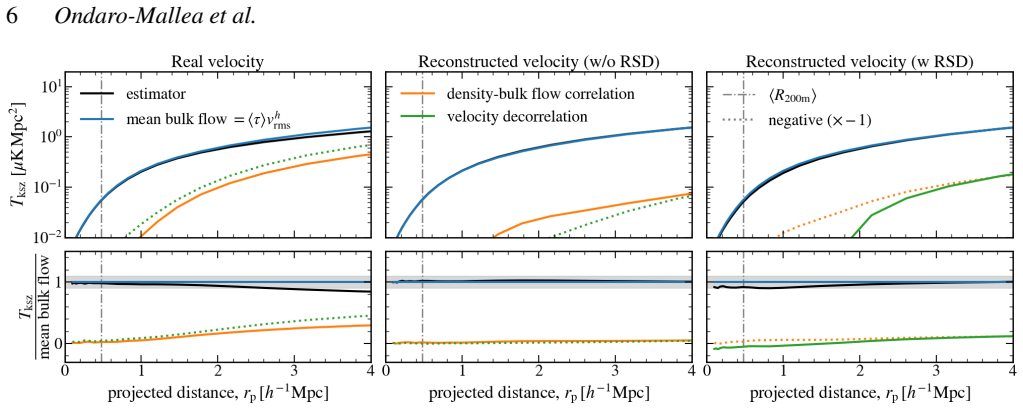
The central discovery is the identification of the two non-linear velocity terms in the stacked kSZ estimator—the density–bulk-flow correlation and the velocity-decorrelation term—and the demonstration that both are dominated by non-linear gravitational dynamics rather than by baryonic physics. When stacking with true halo velocities, each of these terms individually reaches up to half the total signal but largely cancels, leaving a residual 10–20 percent contribution. When velocities are reconstructed linearly in real space, the reconstructed velocity carries no small-scale non-linear information, so both terms vanish and the signal traces the mean optical depth within a few percent. When r
Load-bearing premise
The result rests on the assumption that ionized gas around satellite galaxies is largely stripped and therefore moves with the host halo rather than with the satellite's orbital velocity; if satellites retain significant bound gas that moves with them, the predicted small-scale suppression changes.
Editorial extensions
If this is right
- Current measurements are consistent with the mean bulk-flow approximation at the 1–2 sigma level; next-generation CMB surveys will make the non-linear suppression statistically significant, so models must account for it.
- The mean optical depth can be recovered unbiasedly either by smoothing the reconstruction to large scales (which reduces the suppression to about 5 percent) or by jointly modelling the two non-linear terms with simulations.
- Because the non-linear terms are gravitational in origin, they can be calibrated with gravity-only simulations including baryon-painted densities; the baryonic contribution through gas velocities alone is below 1 percent.
- The two non-linear terms must be modelled together; modelling only one introduces errors of roughly 50 percent, while neglecting both introduces errors of only 10–20 percent.
- There is a direct trade-off between signal-to-noise and modelling simplicity: aggressive reconstructions boost S/N but require simulation-based modelling, while conservative reconstructions simplify interpretation.
Reading between the lines
- If the satellite gas-stripping assumption is wrong—if satellites retain enough bound gas to share their orbital motion—the small-scale suppression would be larger and depend more strongly on the satellite population; this could be tested directly in simulations that resolve gas around infalling satellites.
- A practical strategy for upcoming surveys might be to run two reconstructions, one aggressive for maximizing signal and one conservative for estimation, and to treat the difference as a systematic error budget.
- The near-cancellation of the two non-linear terms suggests that analytic models of the stacked kSZ effect that capture only one term may be less accurate than models that ignore both; future effective models should either omit both or include both consistently.
- The insensitivity to baryonic feedback implies that any measured disagreement between stacked kSZ and X-ray-based gas fractions cannot be attributed to the non-linear velocity correction, strengthening the case that the discrepancy reflects real baryonic physics.
Editorial analysis
A structured set of objections, weighed in public.
Referee Report
Summary. This paper studies the velocity-weighted stacked kinetic Sunyaev-Zel'dovich (kSZ) signal using the FLAMINGO hydrodynamical simulations and DESI-like mock galaxy samples (LRG, BGS, ELG). The authors derive an exact decomposition of the estimator into a mean bulk-flow term, a density-bulk flow correlation term, and a velocity-decorrelation term. They then evaluate each term for three stacking-velocity choices: true halo velocities, linearly reconstructed velocities in real space, and linearly reconstructed velocities in redshift space. They find that the two non-linear terms individually can be large but cancel substantially; with real-space linear reconstruction the non-linear terms become negligible, while including redshift-space distortions produces a scale-dependent ~10% suppression on small scales that they attribute primarily to satellite Fingers-of-God. They further show that the non-linear terms are insensitive to baryonic feedback at the 5-10% level, with gas-velocity effects below 1%, and they discuss the implications for current and future kSZ analyses, including a trade-off between smoothing scale and signal-to-noise.
Significance. If the results hold, this is a valuable and timely contribution to the interpretation of stacked kSZ measurements. The algebraic decomposition in Eq. (7) is exact and clarifies which physical effects can enter the estimator, and the use of realistic FLAMINGO mocks with multiple feedback variants gives the main conclusions a solid basis. The paper is careful to compute all non-linear terms directly from simulation fields rather than fitting them to the target observable: there are no free parameters tuned to the kSZ signal. The main strength is the clear demonstration that the modelling strategy must depend on how the stacking velocity is constructed, and that real-space linear reconstruction provides a useful theoretical benchmark. The sensitivity of the non-linear terms to baryonic feedback is quantified explicitly. However, the paper's headline result, the ~10% RSD-driven small-scale suppression attributed to satellite Fingers-of-God, rests on a satellite-gas assumption that is not directly verified in the same simulations, and the ELG sample is acknowledged to be under-resolved. These issues need to be addressed before the central quantitative claim can be fully accepted.
major comments (2)
- [Section 3.3.1 / Eq. (4) / Section 4.3.2] The headline small-scale suppression in the RSD case is attributed to satellite Fingers-of-God, and the decomposition that leads to this attribution uses v0 = v_h for satellite galaxies in Eq. (4). The justification is that ionized gas around satellites is largely stripped and therefore moves with the host halo, but this is supported only by citations to He et al. (2026) and Contreras et al. (2026) and is not checked in FLAMINGO, the same simulation used to produce the stacks. If a non-negligible fraction of gas retains the satellite's orbital velocity, v' in Eq. (4) contains a coherent satellite-velocity component, changing the velocity-decorrelation term Cov(p', v_stack) in Eq. (7) and thereby both the amplitude of the ~10% suppression and its satellite attribution. Appendix A tests the alternative subhalo-velocity choice only for the true-velocity stack, where it changes the profile b
- [Section 3.2 / Section 3.3.2 / Section 5] The ELG-like sample is explicitly acknowledged to be under-resolved in FLAMINGO: the adopted mean halo mass is 10^12.4 h^-1 M_sun rather than the target 10^12.2 h^-1 M_sun, and the reconstructed-velocity cross-correlation is r ~ 0.74, differing from the r ~ 0.55 obtained with Abacus HOD catalogs. Despite these caveats, Figure 6 and the reported 0.31-sigma consistency for ELGs are presented as part of the main cross-sample results. The statement that the ELG signal is consistent with the mean bulk-flow model is therefore not robust. The authors should either calibrate the ELG mock against a higher-resolution simulation or an updated HOD model, or explicitly downgrade the ELG-specific quantitative conclusions to indicative rather than quantitative.
minor comments (4)
- [Sections 4.1-4.4 / Figures 1, 4, 5] No error bars or finite-volume uncertainties are shown for the simulated stacked profiles. Given that the paper makes percent-level quantitative claims, a statement about the statistical precision of the mock stacks (e.g., from bootstrap or realization scatter) would be helpful.
- [Section 5.1.1] The sentence 'One might expect RSD to simply reduce the overall amplitude of the stacked kSZ signal through the lower r' is confusing because Eq. (2) is explicitly normalized by r, and the mean bulk-flow term in Eq. (7) is independent of r. Consider rephrasing to clarify that the concern is about the raw stacked amplitude before normalization.
- [Section 3.3.1] The statement that using the centre-of-mass velocity of gas particles produces no appreciable difference should specify that this verification applies to host haloes. For satellites, the corresponding check is not provided, which is directly related to the major comment above.
- [Section 3.2] The ELG sample caveat should be stated more prominently, ideally in the abstract or the introduction of the cross-sample results, since the current text in Section 3.2 somewhat understates the impact on the ELG-related conclusions.
Circularity Check
No significant circularity: non-linear kSZ terms are direct simulation measurements; satellite-stripping prior is an input, not a fitted prediction.
full rationale
The paper's derivation chain is an exact decomposition of the stacked kSZ estimator (Eqs. 2-7) into a mean bulk-flow term and two non-linear terms. These terms are computed directly from FLAMINGO simulation fields and reconstructed velocities; no parameter is fitted to the target kSZ signal, and the DESI/ACT covariance enters only to quantify the statistical significance of the deviations, not to shape them. The main claims that real-space linear reconstruction suppresses non-linear terms to <~2% and that RSD reintroduce a ~10% small-scale suppression, primarily through satellite FoG distortions, are simulation measurements (Figs. 1, 4, 7), not consequences of the definitions. The only externally loaded physical prior is the satellite velocity assignment in Sec. 3.3.1: 'For satellite galaxies, we use the velocity of their host halo rather than that of the subhalo or satellite itself... However, the ionized gas surrounding satellites is largely stripped and therefore does not follow this orbital motion (He et al. 2026; Contreras et al. 2026).' This is a physical assumption rather than a circular reduction: the total simulated kSZ profile is computed from the gas momentum field, so the prior affects only the term-by-term decomposition and the interpretation, not the total signal. Even if this prior were wrong, the paper's quantitative RSD result would remain a definite simulation output; the stripping assumption is therefore a robustness/correctness concern, not a self-consistent derivation loop. Self-citations are used for standard reconstruction methods and previous measurements, but the central results are derived in this paper from published simulations and do not reduce to those citations. Accordingly, no prediction is equivalent to its input by construction; score 1 reflects one non-load-bearing self-citation-supported physical assumption.
Assumptions & free parameters
assumptions (6)
- domain assumption The linearised continuity equation (Eq. 9) with constant linear bias b recovers the large-scale velocity field sufficiently accurately.
- domain assumption The ionized gas around satellite galaxies is stripped and follows the host halo velocity rather than satellite orbital motion.
- domain assumption FLAMINGO simulations faithfully reproduce the gas density and velocity fields around the three galaxy samples at scales 0.5–10 h⁻¹Mpc.
- domain assumption Projecting gas within a 20 h⁻¹Mpc shell is equivalent to full line-of-sight projection for the stacked signal.
- standard math In linear theory, density and velocity are uncorrelated on scales r<50 h⁻¹Mpc so Cov(τ,v0 vstack)=0 and v'=0.
- standard math The mean optical depth is proportional to the projected gas mass with a fixed constant at low redshift.
Cite this review
Pith. "Pith review of Interpreting the stacked kinetic SZ effect I: velocity reconstruction and non-linear velocity effects." pith.science (2026). https://pith.science/paper/XVJOOTIH
@misc{pith2026260723339,
  author       = {Pith},
  title        = {Pith review of: Interpreting the stacked kinetic SZ effect I: velocity reconstruction and non-linear velocity effects},
  year         = {2026},
  howpublished = {\url{https://pith.science/paper/XVJOOTIH}},
  note         = {Machine review of arXiv:2607.23339}
}
abstract
The stacked kinetic Sunyaev-Zel'dovich (kSZ) signal probes the velocity-weighted projected gas momentum around galaxies, and is emerging as a powerful probe of gas fractions and baryonic feedback. Its interpretation, however, rests on several assumptions that we test in this pair of companion papers. Using the FLAMINGO hydrodynamical simulations and DESI-like galaxy mocks for luminous red galaxies (LRGs), the bright galaxy sample (BGS), and emission-line galaxies (ELGs), we identify the ingredients required to model the signal to better than $10\%$. This first paper focuses on velocities. We decompose the signal into a dominant bulk-flow term, proportional to the mean optical depth, plus non-linear terms arising from the small-scale gas momentum and its coupling to the stacking velocity. When the stacking velocities are reconstructed from linear information in real space alone -- an idealisation which is not possible in practice -- the non-linear terms cancel and the signal traces the mean optical depth to within a few per cent. When the stacking velocity instead retains non-linear information or is affected by redshift-space distortions, the non-linear terms suppress the signal by $10-20\%$: a $1-2\sigma$ effect for current data that is expected to be statistically significant for upcoming surveys, and one that depends only weakly on baryonic feedback. Our results reveal a trade-off: velocity estimators that retain small-scale information boost signal-to-noise but require simulation-based modelling, whereas conservative reconstructions simplify the interpretation at the cost of signal-to-noise.
Figures


Figures from the paper (4 more)


Forward citations
Cited by 1 Pith paper
-
Shear-kSZ: A New Estimator for the Matter-Electron Power Spectrum from kSZ Tomography and Weak Lensing
Shear–kSZ correlates kSZ, tomographic line-of-sight velocity, and lensing convergence to measure P_me(k) and thereby the baryonic matter-power suppression S(k) at high forecast significance.
Reference graph
Works this paper leans on
-
[1]
The Simons Observatory: science goals and forecasts for the enhanced Large Aperture Telescope. , keywords =. doi:10.1088/1475-7516/2025/08/034 , archivePrefix =. 2503.00636 , primaryClass =
arXiv 2025
-
[2]
Baryonification: an alternative to hydrodynamical simulations for cosmological studies. , keywords =. doi:10.1088/1475-7516/2025/12/043 , archivePrefix =. 2507.07892 , primaryClass =
arXiv 2025
-
[3]
Constraining cosmological parameters using the pairwise kinematic Sunyaev-Zel'dovich effect with CMB-S4 and future galaxy cluster surveys. , keywords =. doi:10.1103/PhysRevD.111.063541 , archivePrefix =. 2409.18368 , primaryClass =
-
[4]
Thornton, R. J. and Ade, P. A. R. and Aiola, S. and others , title =. The Astrophysical Journal Supplement Series , volume =. 2016 , doi =
2016
-
[5]
and Aiola, S
Naess, S. and Aiola, S. and Battaglia, N. and others , title =. Journal of Cosmology and Astroparticle Physics , volume =. 2020 , doi =
2020
-
[7]
and Schlegel, David J
Dawson, Kyle S. and Schlegel, David J. and Ahn, Christopher P. and others , title =. The Astronomical Journal , volume =. 2013 , doi =
2013
-
[8]
and Aguirre, J
Ade, P. and Aguirre, J. and Ahmed, Z. and others , title =. Journal of Cosmology and Astroparticle Physics , volume =. 2019 , doi =
2019
-
[9]
2016 , doi =
The Dark Energy Survey: more than dark energy -- an overview , journal =. 2016 , doi =
2016
Show all 177 references
-
[10]
and Andritschke, R
Predehl, P. and Andritschke, R. and Arefiev, V. and others , title =. Astronomy & Astrophysics , volume =. 2021 , doi =
2021
-
[11]
2022 , doi =
Euclid: Forecasts from the Euclid Cosmological Probe , journal =. 2022 , doi =
2022
-
[12]
LSST: From Science Drivers to Reference Design and Anticipated Data Products , journal =
Ivezi\'c,. LSST: From Science Drivers to Reference Design and Anticipated Data Products , journal =. 2019 , doi =
2019
-
[13]
de Jong, J. T. A. and Verdoes Kleijn, G. A. and Boxhoorn, D. R. and others , title =. Astronomy and Astrophysics , volume =. 2015 , doi =
2015
-
[14]
and Kodaira, K
Iye, M. and Kodaira, K. and Takami, H. and others , title =. Publications of the Astronomical Society of Japan , volume =. 2004 , doi =
2004
-
[15]
Sunyaev, R. A. and Zel'dovich, Ya. B. , title =. Comments on Astrophysics and Space Physics , volume =
-
[16]
Sunyaev, R. A. and Zel'dovich, Ya. B. , title =. Monthly Notices of the Royal Astronomical Society , volume =. 1980 , doi =
1980
-
[17]
, keywords =
The MillenniumTNG Project: the hydrodynamical full physics simulation and a first look at its galaxy clusters. , keywords =. doi:10.1093/mnras/stac3620 , archivePrefix =. 2210.10060 , primaryClass =
-
[18]
, keywords =
The FLAMINGO project: cosmological hydrodynamical simulations for large-scale structure and galaxy cluster surveys. , keywords =. doi:10.1093/mnras/stad2419 , archivePrefix =. 2306.04024 , primaryClass =
-
[19]
, keywords =
SWIFT: A modern highly-parallel gravity and smoothed particle hydrodynamics solver for astrophysical and cosmological applications. , keywords =. doi:10.1093/mnras/stae922 , archivePrefix =. 2305.13380 , primaryClass =
-
[20]
Peculiar velocity decomposition, redshift space distortion, and velocity reconstruction in redshift surveys. II. Dark matter velocity statistics. , keywords =. doi:10.1103/PhysRevD.88.103510 , archivePrefix =. 1308.0886 , primaryClass =
-
[21]
, keywords =
Cosmic web anisotropy is the primary indicator of halo assembly bias. , keywords =. doi:10.1093/mnras/stz2344 , archivePrefix =. 1903.02007 , primaryClass =
1903 arXiv
-
[22]
, keywords =
Assembly Bias and the Dynamical Structure of Dark Matter Halos. , keywords =. doi:10.1088/0004-637X/708/1/469 , archivePrefix =. 0909.4302 , primaryClass =
-
[23]
, keywords =
Anisotropic halo assembly bias and redshift-space distortions. , keywords =. doi:10.1088/1475-7516/2019/10/020 , archivePrefix =. 1906.11823 , primaryClass =
2019 arXiv
-
[24]
, keywords =
Determination of the large scale volume weighted halo velocity bias in simulations. , keywords =. doi:10.1103/PhysRevD.91.123512 , archivePrefix =. 1410.1256 , primaryClass =
- [25]
- [26]
-
[27]
, keywords =
Confirmation of the Copernican Principle at Gpc Radial Scale and above from the Kinetic Sunyaev-Zel'dovich Effect Power Spectrum. , keywords =. doi:10.1103/PhysRevLett.107.041301 , archivePrefix =. 1009.3967 , primaryClass =
-
[28]
, keywords =
Secondary CMB anisotropies from the kinetic SZ effect. , keywords =. doi:10.1051/0004-6361:20000403 , archivePrefix =. astro-ph/0009040 , primaryClass =
-
[29]
, keywords =
Precision era of the kinetic Sunyaev-Zel'dovich effect: simulations, analytical models and observations and the power to constrain reionization. , keywords =. doi:10.1111/j.1365-2966.2004.07298.x , archivePrefix =. astro-ph/0304534 , primaryClass =
2004
-
[30]
, keywords =
Constraining the baryonic feedback with cosmic shear using the DES Year-3 small-scale measurements. , keywords =. doi:10.1093/mnras/stac3213 , archivePrefix =. 2206.08591 , primaryClass =
-
[31]
, keywords =
Determining the baryon impact on the matter power spectrum with galaxy clusters. , keywords =. doi:10.1093/mnras/stae259 , archivePrefix =. 2309.02920 , primaryClass =
-
[32]
, keywords =
The BACCO simulation project: a baryonification emulator with neural networks. , keywords =. doi:10.1093/mnras/stab1911 , archivePrefix =. 2011.15018 , primaryClass =
2011 arXiv
- [33]
-
[34]
, keywords =
The evolution of the baryonic content and mass profiles of satellite galaxies in MTNG simulations. , keywords =. doi:10.1051/0004-6361/202660666 , archivePrefix =. 2604.24837 , primaryClass =
-
[35]
, keywords =
Cosmic shear with small scales: DES-Y3, KiDS-1000 and HSC-DR1. , keywords =. doi:10.1088/1475-7516/2024/08/024 , archivePrefix =. 2403.13794 , primaryClass =
2024 arXiv
-
[36]
, keywords =
DES Y3 cosmic shear down to small scales: Constraints on cosmology and baryons. , keywords =. doi:10.1051/0004-6361/202346539 , archivePrefix =. 2303.05537 , primaryClass =
-
[37]
, keywords =
Quantifying baryon effects on the matter power spectrum and the weak lensing shear correlation. , keywords =. doi:10.1088/1475-7516/2019/03/020 , archivePrefix =. 1810.08629 , primaryClass =
2019 arXiv
-
[38]
, keywords =
Constraining baryonic feedback and cosmology with weak-lensing, X-ray, and kinematic Sunyaev-Zeldovich observations. , keywords =. doi:10.1093/mnras/stac1493 , archivePrefix =. 2110.02228 , primaryClass =
-
[39]
, keywords =
Weak lensing combined with the kinetic Sunyaev-Zel'dovich effect: a study of baryonic feedback. , keywords =. doi:10.1093/mnras/stae2100 , archivePrefix =. 2404.06098 , primaryClass =
-
[40]
, keywords =
Simultaneous modelling of matter power spectrum and bispectrum in the presence of baryons. , keywords =. doi:10.1093/mnras/stab699 , archivePrefix =. 2009.14225 , primaryClass =
2009 arXiv
-
[41]
, keywords =
Baryonification extended to thermal Sunyaev Zel'dovich. , keywords =. doi:10.1051/0004-6361/202451055 , archivePrefix =. 2406.01672 , primaryClass =
-
[42]
, keywords =
Modelling the large-scale mass density field of the universe as a function of cosmology and baryonic physics. , keywords =. doi:10.1093/mnras/staa1478 , archivePrefix =. 1911.08471 , primaryClass =
1911 arXiv
-
[43]
, keywords =
A new method to quantify the effects of baryons on the matter power spectrum. , keywords =. doi:10.1088/1475-7516/2015/12/049 , archivePrefix =. 1510.06034 , primaryClass =
2015 arXiv
-
[44]
, keywords =
Evidence for large baryonic feedback at low and intermediate redshifts from kinematic Sunyaev-Zel'dovich observations with ACT and DESI photometric galaxies. , keywords =. doi:10.1103/kclp-x5j1 , archivePrefix =. 2407.07152 , primaryClass =
-
[45]
, keywords =
Peculiar velocity decomposition, redshift space distortion, and velocity reconstruction in redshift surveys: The methodology. , keywords =. doi:10.1103/PhysRevD.87.063526 , archivePrefix =. 1207.2722 , primaryClass =
-
[46]
, keywords =
Generation of vorticity and velocity dispersion by orbit crossing. , keywords =. doi:10.1103/PhysRevD.80.043504 , archivePrefix =. 0809.4606 , primaryClass =
-
[47]
arXiv e-prints , keywords =
Probing the optical depth with galaxy number counts. arXiv e-prints , keywords =
-
[48]
The Astronomical Journal , keywords =
Forward Modeling of Large-scale Structure: An Open-source Approach with Halotools. The Astronomical Journal , keywords =. doi:10.3847/1538-3881/aa859f , archivePrefix =. 1606.04106 , primaryClass =
-
[49]
, keywords =
Evolution of Mass and Velocity Field in the Cosmic Web: Comparison between Baryonic and Dark Matter. , keywords =. doi:10.3847/1538-4357/aa61f9 , archivePrefix =. 1702.06768 , primaryClass =
-
[50]
, keywords =
A hydrodynamical halo model for weak-lensing cross correlations. , keywords =. doi:10.1051/0004-6361/202038308 , archivePrefix =. 2005.00009 , primaryClass =
2005 arXiv
-
[51]
, keywords =
FLAMINGO: calibrating large cosmological hydrodynamical simulations with machine learning. , keywords =. doi:10.1093/mnras/stad2540 , archivePrefix =. 2306.05492 , primaryClass =
-
[52]
Velocity reconstruction in the era of DESI and Rubin/LSST. I. Exploring spectroscopic, photometric, and hybrid samples. , keywords =. doi:10.1103/PhysRevD.109.103533 , archivePrefix =. 2312.12435 , primaryClass =
-
[53]
Velocity reconstruction in the era of DESI and Rubin/LSST. II. Realistic samples on the light cone. , keywords =. doi:10.1103/PhysRevD.109.103534 , archivePrefix =. 2312.12434 , primaryClass =
-
[54]
, keywords =
Exploring KSZ velocity reconstruction with N-body simulations and the halo model. , keywords =. doi:10.1088/1475-7516/2022/09/028 , archivePrefix =. 2010.07193 , primaryClass =
2022 arXiv
-
[55]
, keywords =
Breaking baryon-cosmology degeneracy with the electron density power spectrum. , keywords =. doi:10.1088/1475-7516/2022/04/046 , archivePrefix =. 2201.04142 , primaryClass =
2022 arXiv
- [56]
-
[57]
, keywords =
Projected-field kinetic Sunyaev-Zel'dovich Cross-correlations: halo model and forecasts. , keywords =. doi:10.1088/1475-7516/2023/03/039 , archivePrefix =. 2208.07847 , primaryClass =
2023 arXiv
-
[58]
, keywords =
Evidence of Galaxy Cluster Motions with the Kinematic Sunyaev-Zel'dovich Effect. , keywords =. doi:10.1103/PhysRevLett.109.041101 , archivePrefix =. 1203.4219 , primaryClass =
- [59]
-
[60]
, keywords =
Reconstructing cosmic growth with kinetic Sunyaev-Zel'dovich observations in the era of stage IV experiments. , keywords =. doi:10.1103/PhysRevD.94.043522 , archivePrefix =. 1604.01382 , primaryClass =
- [61]
-
[62]
, keywords =
First results from the IllustrisTNG simulations: matter and galaxy clustering. , keywords =. doi:10.1093/mnras/stx3304 , archivePrefix =. 1707.03397 , primaryClass =
-
[63]
, year = 2017, month = jul, volume =
Detecting Patchy Reionization in the Cosmic Microwave Background. , year = 2017, month = jul, volume =. doi:10.1103/PhysRevLett.119.021301 , adsurl =
2017 doi
-
[64]
, keywords =
How closely do baryons follow dark matter on large scales?. , keywords =. doi:10.1093/mnras/stt1135 , archivePrefix =. 1301.7426 , primaryClass =
-
[65]
, keywords =
Higher order initial conditions for mixed baryon-CDM simulations. , keywords =. doi:10.1093/mnras/staa3773 , archivePrefix =. 2008.09124 , primaryClass =
2008 arXiv
-
[66]
, keywords =
The properties of cosmic velocity fields. , keywords =. doi:10.1093/mnras/stv2179 , archivePrefix =. 1404.2280 , primaryClass =
-
[67]
, keywords =
Imprint of baryons and massive neutrinos on velocity statistics. , keywords =. doi:10.1051/0004-6361/202039115 , archivePrefix =. 2010.05911 , primaryClass =
2010 arXiv
-
[68]
, keywords =
Information content in mean pairwise velocity and mean relative velocity between pairs in a triplet. , keywords =. doi:10.1051/0004-6361/202140552 , archivePrefix =. 2102.06709 , primaryClass =
-
[69]
, keywords =
Streaming Velocities as a Dynamical Estimator of. , keywords =. doi:10.1086/311959 , archivePrefix =. astro-ph/9812456 , primaryClass =
-
[70]
, keywords =
Measuring the evolution of intergalactic gas from z = 0 to 5 using the kinematic Sunyaev-Zel'dovich effect. , keywords =. doi:10.1093/mnras/staa3782 , archivePrefix =. 1911.10690 , primaryClass =
1911 arXiv
-
[71]
, keywords =
Evidence for the kinematic Sunyaev-Zel'dovich effect with the Atacama Cosmology Telescope and velocity reconstruction from the Baryon Oscillation Spectroscopic Survey. , keywords =. doi:10.1103/PhysRevD.93.082002 , archivePrefix =. 1510.06442 , primaryClass =
-
[72]
, keywords =
Subtracting the kinetic Sunyaev-Zeldovich effect from the cosmic microwave background with surveys of large-scale structure. , keywords =. doi:10.1103/PhysRevD.107.083502 , archivePrefix =. 2209.03973 , primaryClass =
-
[73]
Kinematic Sunyaev-Zel'dovich effect with projected fields. II. Prospects, challenges, and comparison with simulations. , keywords =. doi:10.1103/PhysRevD.94.123526 , archivePrefix =. 1605.02722 , primaryClass =
-
[74]
and others
Soergel, B. and others. Detection of the kinematic Sunyaev--Zel'dovich effect with DES Year 1 and SPT. Mon. Not. Roy. Astron. Soc. 2016. doi:10.1093/mnras/stw1455. arXiv:1603.03904
2016 arXiv
-
[75]
and others
De Bernardis, F. and others. Detection of the pairwise kinematic Sunyaev-Zel'dovich effect with BOSS DR11 and the Atacama Cosmology Telescope. JCAP. 2017. doi:10.1088/1475-7516/2017/03/008. arXiv:1607.02139
2017 arXiv
-
[76]
Ade, P. A. R. and others. Planck intermediate results. XXXVII. Evidence of unbound gas from the kinetic Sunyaev-Zeldovich effect. Astron. Astrophys. 2016. doi:10.1051/0004-6361/201526328. arXiv:1504.03339
2016 arXiv
-
[77]
Colin and Krolewski, Alex
Kusiak, Aleksandra and Bolliet, Boris and Ferraro, Simone and Hill, J. Colin and Krolewski, Alex. Constraining the baryon abundance with the kinematic Sunyaev-Zel'dovich effect: Projected-field detection using Planck, WMAP, and unWISE. Phys. Rev. D. 2021. doi:10.1103/PhysRevD....
2021 arXiv
-
[78]
and others
Vavagiakis, Eve M. and others. The Atacama Cosmology Telescope: Probing the baryon content of SDSS DR15 galaxies with the thermal and kinematic Sunyaev-Zel'dovich effects. Phys. Rev. D. 2021. doi:10.1103/PhysRevD.104.043503. arXiv:2101.08373
2021 arXiv
-
[79]
, keywords =
Atacama Cosmology Telescope: Combined kinematic and thermal Sunyaev-Zel'dovich measurements from BOSS CMASS and LOWZ halos. , keywords =. doi:10.1103/PhysRevD.103.063513 , archivePrefix =. 2009.05557 , primaryClass =
2009 arXiv
-
[80]
, keywords =
Atacama Cosmology Telescope: Modeling the gas thermodynamics in BOSS CMASS galaxies from kinematic and thermal Sunyaev-Zel'dovich measurements. , keywords =. doi:10.1103/PhysRevD.103.063514 , archivePrefix =. 2009.05558 , primaryClass =
2009 arXiv
-
[81]
Backlighting extended gas halos around luminous red galaxies: Kinematic Sunyaev-Zel'dovich effect from DESI Y1 and ACT data
Ried Guachalla, Bernardita and others. Backlighting extended gas halos around luminous red galaxies: Kinematic Sunyaev-Zel'dovich effect from DESI Y1 and ACT data. Phys. Rev. D. 2025. doi:10.1103/lqbj-wcqj. arXiv:2503.19870
2025
-
[82]
, keywords =
The kinetic Sunyaev Zeldovich effect as a benchmark for AGN feedback models in hydrodynamical simulations: insights from DESI + ACT. , keywords =. doi:10.1093/mnras/stag1314 , archivePrefix =. 2510.15822 , primaryClass =
- [83]
-
[84]
, keywords =
Joint X-Ray, Kinetic Sunyaev─Zeldovich, and Weak Lensing Measurements: Toward a Consensus Picture of Efficient Gas Expulsion from Groups and Clusters. , keywords =. doi:10.3847/1538-4357/ae5dc2 , archivePrefix =. 2509.10455 , primaryClass =
- [86]
-
[88]
and Seo, Hee-jong and Sirko, Edwin and Spergel, David
Eisenstein, Daniel J. and Seo, Hee-jong and Sirko, Edwin and Spergel, David. Improving Cosmological Distance Measurements by Reconstruction of the Baryon Acoustic Peak. Astrophys. J. 2007. doi:10.1086/518712. arXiv:astro-ph/0604362
2007 arXiv
-
[89]
and Howlett, Cullan
Burden, Angela and Percival, Will J. and Howlett, Cullan. Reconstruction in Fourier space. Mon. Not. Roy. Astron. Soc. 2015. doi:10.1093/mnras/stv1581. arXiv:1504.02591
2015 arXiv
-
[90]
The Atacama Cosmology Telescope: Large-scale velocity reconstruction with the kinematic Sunyaev-Zel'dovich effect and DESI LRGs
McCarthy, Fiona and others. The Atacama Cosmology Telescope: Large-scale velocity reconstruction with the kinematic Sunyaev-Zel'dovich effect and DESI LRGs. JCAP. 2025. doi:10.1088/1475-7516/2025/05/057. arXiv:2410.06229
2025 arXiv
-
[91]
Taking measurements of the kinematic Sunyaev-Zel'dovich effect forward: including uncertainties from velocity reconstruction with forward modeling
Nguyen, Nhat-Minh and Jasche, Jens and Lavaux, Guilhem and Schmidt, Fabian. Taking measurements of the kinematic Sunyaev-Zel'dovich effect forward: including uncertainties from velocity reconstruction with forward modeling. JCAP. 2020. doi:10.1088/1475-7516/2020/12/011. arXiv:...
2020 arXiv
-
[92]
The DESI Experiment Part I: Science, Targeting, and Survey Design
Aghamousa, Amir and others. The DESI Experiment Part I: Science, Targeting, and Survey Design. arXiv e-prints. 2016. arXiv:1611.00036
2016 arXiv
-
[93]
Target Selection and Validation of DESI Luminous Red Galaxies
Zhou, Rongpu and others. Target Selection and Validation of DESI Luminous Red Galaxies. Astron. J. 2023. doi:10.3847/1538-3881/aca5fb. arXiv:2208.08515
2023 arXiv
-
[94]
and others
Raichoor, A. and others. Target Selection and Validation of DESI Emission Line Galaxies. Astron. J. 2023. doi:10.3847/1538-3881/acb213. arXiv:2208.08513
2023 arXiv
-
[95]
The DESI Bright Galaxy Survey: Final Target Selection, Design, and Validation
Hahn, ChangHoon and others. The DESI Bright Galaxy Survey: Final Target Selection, Design, and Validation. Astron. J. 2023. doi:10.3847/1538-3881/accff8. arXiv:2208.08512
2023 arXiv
-
[96]
Adame, A. G. and others. DESI 2024 VI: cosmological constraints from the measurements of baryon acoustic oscillations. JCAP. 2025. doi:10.1088/1475-7516/2025/02/021. arXiv:2404.03002
2024 arXiv
-
[97]
, keywords =
How to identify and weigh virialized clusters of galaxies in a complete redshift catalog. , keywords =. doi:10.1086/160183 , adsurl =
-
[98]
, keywords =
Assessing subhalo finders in cosmological hydrodynamical simulations. , keywords =. doi:10.1093/mnras/staf1478 , archivePrefix =. 2502.06932 , primaryClass =
-
[99]
, keywords =
HOD-dependent systematics in Emission Line Galaxies for the DESI 2024 BAO analysis. , keywords =. doi:10.1088/1475-7516/2025/01/132 , archivePrefix =. 2404.03009 , primaryClass =
2024 arXiv
-
[100]
Halo Models of Large Scale Structure
Cooray, Asantha and Sheth, Ravi K. Halo Models of Large Scale Structure. Phys. Rept. 2002. doi:10.1016/S0370-1573(02)00276-4. arXiv:astro-ph/0206508
2002 arXiv
-
[101]
and Weinberg, David H
Berlind, Andreas A. and Weinberg, David H. The Halo occupation distribution: Towards an empirical determination of the relation between galaxies and mass. Astrophys. J. 2002. doi:10.1086/341469. arXiv:astro-ph/0109001
2002 arXiv
-
[102]
and Weinberg, David H
Zheng, Zheng and Berlind, Andreas A. and Weinberg, David H. and Benson, Andrew J. and Baugh, Carlton M. and Cole, Shaun and Dave, Romeel and Frenk, Carlos S. and Katz, Neal and Lacey, Cedric G. Theoretical models of the halo occupation distribution: Separating central and sate...
2005 arXiv
-
[103]
and Zehavi, Idit
Zheng, Zheng and Coil, Alison L. and Zehavi, Idit. Galaxy Evolution from Halo Occupation Distribution Modeling of DEEP2 and SDSS Galaxy Clustering. Astrophys. J. 2007. doi:10.1086/521074. arXiv:astro-ph/0703457
2007 arXiv
-
[104]
and Kravtsov, Andrey V
Conroy, Charlie and Wechsler, Risa H. and Kravtsov, Andrey V. Modeling luminosity-dependent galaxy clustering through cosmic time. Astrophys. J. 2006. doi:10.1086/503602. arXiv:astro-ph/0512234
2006 arXiv
-
[105]
and Tinker, Jeremy L
Wechsler, Risa H. and Tinker, Jeremy L. The Connection between Galaxies and their Dark Matter Halos. Ann. Rev. Astron. Astrophys. 2018. doi:10.1146/annurev-astro-081817-051756. arXiv:1804.03097
2018 arXiv
-
[106]
The DESI one-per cent survey: exploring the halo occupation distribution of luminous red galaxies and quasi-stellar objects with AbacusSummit
Yuan, Sihan and others. The DESI one-per cent survey: exploring the halo occupation distribution of luminous red galaxies and quasi-stellar objects with AbacusSummit. Mon. Not. Roy. Astron. Soc. 2024. doi:10.1093/mnras/stae359. arXiv:2306.06314
2024 arXiv
-
[107]
The DESI One-Percent survey: exploring the Halo Occupation Distribution of Emission Line Galaxies with AbacusSummit simulations
Rocher, Antoine and others. The DESI One-Percent survey: exploring the Halo Occupation Distribution of Emission Line Galaxies with AbacusSummit simulations. JCAP. 2023. doi:10.1088/1475-7516/2023/10/016. arXiv:2306.06319
2023 arXiv
-
[108]
Extensions to models of the galaxy-halo connection
Hadzhiyska, Boryana and Bose, Sownak and Eisenstein, Daniel and Hernquist, Lars. Extensions to models of the galaxy-halo connection. Mon. Not. Roy. Astron. Soc. 2021. doi:10.1093/mnras/staa3776. arXiv:2008.04913
2021 arXiv
-
[109]
and Ca \ n as, Rodrigo and Poulton, Rhys J
Elahi, Pascal J. and Ca \ n as, Rodrigo and Poulton, Rhys J. J. and Tobar, Rodrigo J. and Willis, James S. and Lagos, Claudia del P. and Power, Chris and Robotham, Aaron S. G. Hunting for galaxies and halos in simulations with VELOCIraptor. Publ. Astron. Soc. Austral. 2019. do...
2019 arXiv
-
[110]
and van Daalen, Marcel P
Schaller, Matthieu and Schaye, Joop and Kugel, Roi and Broxterman, Jeger C. and van Daalen, Marcel P. The FLAMINGO project: baryon effects on the matter power spectrum. Mon. Not. Roy. Astron. Soc. 2025. doi:10.1093/mnras/staf569. arXiv:2410.17109
2025 arXiv
-
[111]
and Aric \`o , Giovanni and Schaye, Joop and McCarthy, Ian G
Ondaro-Mallea, Lurdes and Angulo, Raul E. and Aric \`o , Giovanni and Schaye, Joop and McCarthy, Ian G. and Schaller, Matthieu. FLAMINGO: Galaxy formation and feedback effects on the gas density and velocity fields. Astron. Astrophys. 2025. doi:10.1051/0004-6361/202453480. arX...
2025 arXiv
-
[112]
and others
McCarthy, Ian G. and others. FLAMINGO: combining kinetic SZ effect and galaxy-galaxy lensing measurements to gauge the impact of feedback on large-scale structure. Mon. Not. Roy. Astron. Soc. 2025. doi:10.1093/mnras/staf731. arXiv:2410.19905
2025 arXiv
-
[113]
and Schaye, Joop and Bird, Simeon and Le Brun, Amandine M
McCarthy, Ian G. and Schaye, Joop and Bird, Simeon and Le Brun, Amandine M. C. The BAHAMAS project: Calibrated hydrodynamical simulations for large-scale structure cosmology. Mon. Not. Roy. Astron. Soc. 2017. doi:10.1093/mnras/stw2792. arXiv:1603.02702
2017 arXiv
-
[114]
The EAGLE project: Simulating the evolution and assembly of galaxies and their environments
Schaye, Joop and others. The EAGLE project: Simulating the evolution and assembly of galaxies and their environments. Mon. Not. Roy. Astron. Soc. 2015. doi:10.1093/mnras/stu2058. arXiv:1407.7040
2015 arXiv
-
[115]
Simulating Galaxy Formation with the IllustrisTNG Model
Pillepich, Annalisa and others. Simulating Galaxy Formation with the IllustrisTNG Model. Mon. Not. Roy. Astron. Soc. 2018. doi:10.1093/mnras/stx2656. arXiv:1703.02970
2018 arXiv
-
[116]
and Appleby, Sarah
Dav \'e , Romeel and Angl \'e s-Alc \'a zar, Daniel and Narayanan, Desika and Li, Qi and Rafieferantsoa, Mika H. and Appleby, Sarah. Simba: Cosmological Simulations with Black Hole Growth and Feedback. Mon. Not. Roy. Astron. Soc. 2019. doi:10.1093/mnras/stz937. arXiv:1901.10203
2019 arXiv
-
[117]
and Bond, J
Battaglia, N. and Bond, J. R. and Pfrommer, C. and Sievers, J. L. and Sijacki, D. Simulations of the Sunyaev-Zel'dovich Power Spectrum with AGN Feedback. Astrophys. J. 2010. doi:10.1088/0004-637X/725/1/91. arXiv:1003.4256
2010 arXiv
-
[118]
and Bond, J
Battaglia, N. and Bond, J. R. and Pfrommer, C. and Sievers, J. L. On the Cluster Physics of Sunyaev-Zel'dovich Surveys II: Deconstructing the Thermal SZ Power Spectrum. Astrophys. J. 2012. doi:10.1088/0004-637X/758/2/75. arXiv:1109.3711
2012 arXiv
-
[119]
Yang, Xiaohu and Mo, H. J. and van den Bosch, Frank C. and Jing, Y. P. A halo-based galaxy group finder: calibration and application to the 2dFGRS. Mon. Not. Roy. Astron. Soc. 2005. doi:10.1111/j.1365-2966.2005.08560.x. arXiv:astro-ph/0405234
2005
-
[120]
and van den Bosch, Frank C
Skibba, Ramin A. and van den Bosch, Frank C. and Yang, Xiaohu and More, Surhud and Mo, Houjun and Fontanot, Fabio. Are Brightest Halo Galaxies Central Galaxies?. Mon. Not. Roy. Astron. Soc. 2011. doi:10.1111/j.1365-2966.2010.17452.x. arXiv:1001.4533
2011
-
[121]
and Sheldon, Erin S
Johnston, David E. and Sheldon, Erin S. and Wechsler, Risa H. and Rozo, Eduardo and Koester, Benjamin P. and Frieman, Joshua A. and McKay, Timothy A. and Evrard, August E. and Becker, Matthew R. and Annis, James. Cross-correlation Weak Lensing of SDSS galaxy Clusters II: Clust...
2007 arXiv
-
[122]
and others
Bah \'e , Yannick M. and others. The Hydrangea simulations: galaxy formation in and around massive clusters. Mon. Not. Roy. Astron. Soc. 2017. doi:10.1093/mnras/stx1403. arXiv:1703.10610
2017 arXiv
-
[123]
Ram pressure stripping in the EAGLE simulation
Kulier, Andrea and Poggianti, Bianca and Tonnesen, Stephanie and Smith, Rory and Ignesti, Alessandro and Akerman, Nina and Marasco, Antonino and Vulcani, Benedetta and Moretti, Alessia and Wolter, Anna. Ram pressure stripping in the EAGLE simulation. Astrophys. J. 2023. doi:10...
2023 arXiv
-
[124]
and Frenk, Carlos S
McCarthy, Ian G. and Frenk, Carlos S. and Font, Andreea S. and Lacey, Cedric G. and Bower, Richard G. and Mitchell, Nigel L. and Balogh, Michael L. and Theuns, Tom. Ram pressure stripping the hot gaseous halos of galaxies in groups and clusters. Mon. Not. Roy. Astron. Soc. 200...
2008
-
[125]
and others
Madhavacheril, Mathew S. and others. The Atacama Cosmology Telescope: DR6 Gravitational Lensing Map and Cosmological Parameters. Astrophys. J. 2024. doi:10.3847/1538-4357/acff5f. arXiv:2304.05203
2024 arXiv
-
[126]
Cosmological constraints from the cross-correlation of DESI Luminous Red Galaxies with CMB lensing from Planck PR4 and ACT DR6
Sailer, Noah and others. Cosmological constraints from the cross-correlation of DESI Luminous Red Galaxies with CMB lensing from Planck PR4 and ACT DR6. JCAP. 2025. doi:10.1088/1475-7516/2025/06/008. arXiv:2407.04607
2025 arXiv
-
[127]
and Voit, G
Sun, M. and Voit, G. M. and Donahue, M. and Jones, C. and Forman, W. Chandra studies of the X-ray gas properties of galaxy groups. Astrophys. J. 2009. doi:10.1088/0004-637X/693/2/1142. arXiv:0805.2320
2009 arXiv
-
[128]
and others
Eckert, D. and others. The XXL Survey. XIII. Baryon content of the bright cluster sample. Astron. Astrophys. 2016. doi:10.1051/0004-6361/201527293. arXiv:1512.03814
2016 arXiv
-
[129]
and Kwan, Juliana and Upadhye, Amol and Font, Andreea S
Salcido, Jaime and McCarthy, Ian G. and Kwan, Juliana and Upadhye, Amol and Font, Andreea S. SP(k) -- a hydrodynamical simulation-based model for the impact of baryon physics on the non-linear matter power spectrum. Mon. Not. Roy. Astron. Soc. 2023. doi:10.1093/mnras/stad1474....
2023 arXiv
-
[130]
, keywords =
The hot gas mass fraction in halos: From Milky Way-like groups to massive clusters. , keywords =. doi:10.1051/0004-6361/202453256 , archivePrefix =. 2411.16555 , primaryClass =
-
[131]
Nonlinear kinetic Sunyaev-Zeldovich effect
Ma, Chung-Pei and Fry, James N. Nonlinear kinetic Sunyaev-Zeldovich effect. Phys. Rev. Lett. 2002. doi:10.1103/PhysRevLett.88.211301. arXiv:astro-ph/0106342
2002 arXiv
-
[132]
and Koda, Jun and Mao, Yi
Park, Hyunbae and Komatsu, Eiichiro and Shapiro, Paul R. and Koda, Jun and Mao, Yi. The Impact of Nonlinear Structure Formation on the Power Spectrum of Transverse Momentum Fluctuations and the Kinetic Sunyaev-Zel'dovich Effect. Astrophys. J. 2016. doi:10.3847/0004-637X/818/1/...
2016 arXiv
-
[133]
and Okumura, Teppei and Spergel, David N
Sugiyama, Naonori S. and Okumura, Teppei and Spergel, David N. A direct measure of free electron gas via the kinematic Sunyaev-Zel'dovich effect in Fourier-space analysis. Mon. Not. Roy. Astron. Soc. 2018. doi:10.1093/mnras/stx3362. arXiv:1705.07449
2018 arXiv
-
[134]
and Diaferio, Antonaldo
Sheth, Ravi K. and Diaferio, Antonaldo. Peculiar velocities of galaxies and clusters. Mon. Not. Roy. Astron. Soc. 2001. doi:10.1046/j.1365-8711.2001.04202.x. arXiv:astro-ph/0009166
2001
-
[135]
Direct detection of the kinetic Sunyaev-Zel'dovich effect in galaxy clusters
Tanimura, Hideki and Zaroubi, Saleem and Aghanim, Nabila. Direct detection of the kinetic Sunyaev-Zel'dovich effect in galaxy clusters. Astron. Astrophys. 2021. doi:10.1051/0004-6361/202038846. arXiv:2007.02952
2021 arXiv
-
[136]
and Van Waerbeke, Ludovic and Aghanim, Nabila and Ma, Yin-Zhe and Mead, Alexander and Tröster, Tilman and Hojjati, Alireza and Moraes, Bruno , title = "
Tanimura, Hideki and Hinshaw, Gary and McCarthy, Ian G. and Van Waerbeke, Ludovic and Aghanim, Nabila and Ma, Yin-Zhe and Mead, Alexander and Tröster, Tilman and Hojjati, Alireza and Moraes, Bruno , title = ". Mon. Not. Roy. Astron. Soc. 2020. doi:10.1093/mnras/stz3130. arXiv:...
2020 arXiv
-
[137]
and Hill, J
Greco, Johnny P. and Hill, J. Colin and Spergel, David N. and Battaglia, Nicholas. The Stacked Thermal Sunyaev-Zel'dovich Signal of Locally Brightest Galaxies in Planck Full Mission Data: Evidence for Galaxy Feedback?. Astrophys. J. 2015. doi:10.1088/0004-637X/808/2/151. arXiv...
2015 arXiv
-
[138]
and Sailer, Noah and Zhou, Rongpu
Hadzhiyska, Boryana and Ferraro, Simone and Farren, Gerrit S. and Sailer, Noah and Zhou, Rongpu. Missing baryons recovered: a measurement of the gas fraction in galaxies and groups with the kinematic Sunyaev-Zel'dovich effect and CMB lensing. Phys. Rev. D. 2025. doi:10.1103/md...
2025 arXiv
-
[139]
Qu, F. J. and others. Precision Kinematic Sunyaev--Zel'dovich Measurements Across Halo Mass and Redshift with DESI DR2 and ACT DR6: Part I. Luminous Red Galaxies. arXiv e-prints. 2026. arXiv:2604.19744
2026 arXiv
-
[140]
Bright Galaxy Survey and Emission-Line Galaxies
Precision Kinematic Sunyaev--Zel'dovich Measurements Across Halo Mass and Redshift with DESI DR2 and ACT DR6: Part II. Bright Galaxy Survey and Emission-Line Galaxies. arXiv e-prints , keywords =. doi:10.48550/arXiv.2604.19745 , archivePrefix =. 2604.19745 , primaryClass =
-
[141]
Disentangling the halo: joint model for measurements of the kinetic Sunyaev-Zeldovich effect and galaxy-galaxy lensing
Sunseri, James and Amon, Alexandra and Dunkley, Jo and Battaglia, Nicholas and Ferraro, Simone and Hadzhiyska, Boryana and Ried Guachalla, Bernardita and Schaan, Emmanuel. Disentangling the halo: joint model for measurements of the kinetic Sunyaev-Zeldovich effect and galaxy-g...
2026
-
[142]
and Dav \'e , Romeel and Mo, Houjun and Wang, Huiyuan and Yang, Xiaohu
Yang, Tianyi and Cai, Yan-Chuan and Cui, Weiguang and Peacock, John A. and Dav \'e , Romeel and Mo, Houjun and Wang, Huiyuan and Yang, Xiaohu. A measurement of gas rotation in galaxy groups via the kinetic Sunyaev-Zeldovich effect. 2026. arXiv:2603.14494
2026
-
[143]
Forecast constraints on the baryonic feedback effect from the future kinetic Sunyaev-Zel'dovich effect detection
Zheng, Yi and Zhang, Pengjie. Forecast constraints on the baryonic feedback effect from the future kinetic Sunyaev-Zel'dovich effect detection. JCAP. 2024. doi:10.1088/1475-7516/2024/05/061. arXiv:2401.03510
2024 arXiv
-
[144]
and Teyssier, Romain and Schaller, Matthieu and Schaye, Joop
Kova c , Michael and Nicola, Andrina and Bucko, Jozef and Schneider, Aurel and Reischke, Robert and Giri, Sambit K. and Teyssier, Romain and Schaller, Matthieu and Schaye, Joop. Baryonification II: constraining feedback with X-ray and kinematic Sunyaev-Zel'dovich observations....
2025 arXiv
-
[145]
and Cai, Yan-Chuan and Peacock, John A
Roper, Finn A. and Cai, Yan-Chuan and Peacock, John A. Mass dependence of halo baryon fractions from the kinetic Sunyaev-Zeldovich effect. arXiv e-prints. 2025. arXiv:2510.12553
2025
-
[146]
Inferring the impacts of baryonic feedback from kinetic Sunyaev-Zel'dovich cross-correlations
Lagu. Inferring the impacts of baryonic feedback from kinetic Sunyaev-Zel'dovich cross-correlations. Phys. Rev. D. 2026. doi:10.1103/tn2r-by6b. arXiv:2511.20595
2026
-
[147]
Detailed theoretical modelling of the kinetic Sunyaev-Zel'dovich stacking power spectrum
Wayland, Amy and Alonso, David and La Posta, Adrien. Detailed theoretical modelling of the kinetic Sunyaev-Zel'dovich stacking power spectrum. JCAP. 2026. doi:10.1088/1475-7516/2026/01/015. arXiv:2509.18732
2026
-
[148]
and Smith, Kendrick and Kamionkowski, Marc
Anil Kumar, Neha and C al s kan, Mesut and Hotinli, Selim C. and Smith, Kendrick and Kamionkowski, Marc. Electrons Everywhere, All at Once: A Novel kSZ Estimator for Electron-Electron Correlations. arXiv e-prints. 2025. arXiv:2509.18249
2025
-
[149]
Astrophysical constraints from future measurements of the kinetic Sunyaev-Zel'dovich power spectrum
McBride, Lisa and others. Astrophysical constraints from future measurements of the kinetic Sunyaev-Zel'dovich power spectrum. 2025. arXiv:2511.22309
2025
-
[150]
The Sunyaev-Zel'dovich angular power spectrum as a probe of cosmological parameters
Komatsu, Eiichiro and Seljak, Uros. The Sunyaev-Zel'dovich angular power spectrum as a probe of cosmological parameters. Mon. Not. Roy. Astron. Soc. 2002. doi:10.1046/j.1365-8711.2002.05889.x. arXiv:astro-ph/0205468
2002
-
[151]
and Bond, J
Stein, George and Alvarez, Marcelo A. and Bond, J. Richard and van Engelen, Alexander and Battaglia, Nicholas. The Websky Extragalactic CMB Simulations. JCAP. 2020. doi:10.1088/1475-7516/2020/10/012. arXiv:2001.08787
2020 arXiv
-
[152]
and Nagai, Daisuke and Farahi, Arya and Ishiyama, Tomoaki and Miyatake, Hironao and Osato, Ken and Shirasaki, Masato
Lau, Erwin T. and Nagai, Daisuke and Farahi, Arya and Ishiyama, Tomoaki and Miyatake, Hironao and Osato, Ken and Shirasaki, Masato. Baryon Pasting the Uchuu Light-cone Simulation. Astrophys. J. 2025. doi:10.3847/1538-4357/ada940. arXiv:2411.00108
2025 arXiv
-
[153]
Troster, Tilman and others , title = ". Astron. Astrophys. 2022. doi:10.1051/0004-6361/202142197. arXiv:2109.04458
2022 arXiv
-
[154]
FLAMINGO: The thermal history of the Universe from tSZ effect cross-correlations and its dependencies on cosmology and baryon physics
Salcido, Jaime and others. FLAMINGO: The thermal history of the Universe from tSZ effect cross-correlations and its dependencies on cosmology and baryon physics. arXiv e-prints. 2026. arXiv:2605.11083
2026 arXiv
-
[155]
The Open Journal of Astrophysics , keywords =
Map-level baryonification: Efficient modelling of higher-order correlations in the weak lensing and thermal Sunyaev-Zeldovich fields. The Open Journal of Astrophysics , keywords =. doi:10.33232/001c.126788 , archivePrefix =. 2409.03822 , primaryClass =
-
[156]
, keywords =
Baryon pasting algorithm: halo-based and particle-based pasting methods. , keywords =. doi:10.1093/mnras/stac3669 , archivePrefix =. 2201.02632 , primaryClass =
-
[157]
Full Nonlinear Velocity Reconstruction With Transformer and Ensemble Tree Machine Learning
Gong, Yulin and Bean, Rachel. Full Nonlinear Velocity Reconstruction With Transformer and Ensemble Tree Machine Learning. arXiv e-prints. 2026. arXiv:2606.05047
2026 arXiv
-
[158]
, keywords =
Matched filter optimization of kSZ measurements with a reconstructed cosmological flow field. , keywords =. doi:10.1093/mnras/stu1224 , archivePrefix =. 1404.0007 , primaryClass =
- [159]
-
[160]
, keywords =
Mapping the kinetic Sunyaev-Zel'dovich effect toward MACS J0717.5+3745 with NIKA. , keywords =. doi:10.1051/0004-6361/201629182 , archivePrefix =. 1606.07721 , primaryClass =
-
[161]
The Journal of Open Source Software , keywords =
SOAP: A Python Package for Calculating the Properties of Galaxies and Halos Formed in Cosmological Simulations. The Journal of Open Source Software , keywords =. doi:10.21105/joss.08252 , archivePrefix =. 2507.22669 , primaryClass =
-
[162]
, keywords =
HBT+: an improved code for finding subhaloes and building merger trees in cosmological simulations. , keywords =. doi:10.1093/mnras/stx2792 , archivePrefix =. 1708.03646 , primaryClass =
-
[163]
arXiv e-prints , keywords =
CHEX-MATE: Are we getting cluster thermodynamics right?. arXiv e-prints , keywords =. doi:10.48550/arXiv.2603.03440 , archivePrefix =. 2603.03440 , primaryClass =
-
[164]
Astronomy and Computing , keywords =
The FLAMINGO simulations data release. Astronomy and Computing , keywords =. doi:10.1016/j.ascom.2026.101159 , archivePrefix =. 2604.24324 , primaryClass =
2026
-
[165]
, keywords =
Exploring the effects of galaxy formation on matter clustering through a library of simulation power spectra. , keywords =. doi:10.1093/mnras/stz3199 , archivePrefix =. 1906.00968 , primaryClass =
1906 arXiv
-
[167]
, keywords =
The effects of galaxy formation on the matter power spectrum: a challenge for precision cosmology. , keywords =. doi:10.1111/j.1365-2966.2011.18981.x , archivePrefix =. 1104.1174 , primaryClass =
2011
-
[168]
and Hoffman, Yehuda and Gottl \"o ber, Stefan
Kitaura, Francisco-Shu and Angulo, Raul E. and Hoffman, Yehuda and Gottl \"o ber, Stefan. Estimating cosmic velocity fields from density fields and tidal tensors. Mon. Not. Roy. Astron. Soc. 2012. doi:10.1111/j.1365-2966.2012.21589.x. arXiv:1111.6629
2012
-
[169]
Convolutional neural network-reconstructed velocity for kinetic SZ detection
Tanimura, Hideki and Aghanim, Nabila and Bonjean, Victor and Zaroubi, Saleem. Convolutional neural network-reconstructed velocity for kinetic SZ detection. Astron. Astrophys. 2022. doi:10.1051/0004-6361/202243046. arXiv:2201.01643
2022 arXiv
-
[170]
Large-scale density and velocity field reconstructions with neural networks
Veena, Punyakoti Ganeshaiah and Lilow, Robert and Nusser, Adi. Large-scale density and velocity field reconstructions with neural networks. Mon. Not. Roy. Astron. Soc. 2023. doi:10.1093/mnras/stad1222. arXiv:2212.06439
2023 arXiv
-
[171]
Velocity reconstruction with graph neural networks
Tanimura, Hideki and Bonnefous, Albert and Liu, Jia and Ganguly, Sanmay. Velocity reconstruction with graph neural networks. arXiv e-prints. 2024. arXiv:2402.14239
2024 arXiv
-
[172]
Estimation of line-of-sight velocities of individual galaxies using neural networks -- I
Chen, Hongxiang and Wang, Jie and Mao, Tianxiang and Ma, Juntao and Meng, Yuxi and Li, Baojiu and Cai, Yan-Chuan and Neyrinck, Mark and Falck, Bridget and Szalay, Alexander S. Estimation of line-of-sight velocities of individual galaxies using neural networks -- I. Modelling r...
2024 arXiv
-
[173]
Peculiar Velocity Reconstruction from Simulations and Observations Using Deep Learning Algorithms
Wang, Yuyu and Yang, Xiaohu. Peculiar Velocity Reconstruction from Simulations and Observations Using Deep Learning Algorithms. Astrophys. J. 2024. doi:10.3847/1538-4357/ad4d84. arXiv:2406.14101
2024 arXiv
-
[174]
Velocityformer: Broken-Symmetry-Matched Equivariant Graph Transformers for Cosmological Velocity Reconstruction
Tr. Velocityformer: Broken-Symmetry-Matched Equivariant Graph Transformers for Cosmological Velocity Reconstruction. arXiv e-prints. 2026. arXiv:2605.21483
2026 arXiv
-
[175]
, keywords =
Interpreting Sunyaev-Zel'dovich observations with MillenniumTNG: mass and environment scaling relations. , keywords =. doi:10.1093/mnras/stad2751 , archivePrefix =. 2305.00992 , primaryClass =
-
[176]
, keywords =
Cosmological feedback from a halo assembly perspective. , keywords =. doi:10.1103/vh8n-9cr2 , archivePrefix =. 2505.18258 , primaryClass =
-
[177]
The Open Journal of Astrophysics , keywords =
Modelling baryonic feedback for survey cosmology. The Open Journal of Astrophysics , keywords =. doi:10.21105/astro.1905.06082 , archivePrefix =. 1905.06082 , primaryClass =
1905 arXiv
-
[178]
, keywords =
Effect of baryonic feedback on two- and three-point shear statistics: prospects for detection and improved modelling. , keywords =. doi:10.1093/mnras/stt1013 , archivePrefix =. 1210.7303 , primaryClass =
-
[179]
, keywords =
The Impacts of Modeling Choices on the Inference of Circumgalactic Medium Properties from Sunyaev-Zeldovich Observations. , keywords =. doi:10.3847/1538-4357/ac0cea , archivePrefix =. 2103.02469 , primaryClass =
- [180]
-
[181]
, keywords =
On the impacts of halo model implementations in Sunyaev-Zeldovich cross-correlation analyses. , keywords =. doi:10.1088/1475-7516/2025/10/051 , archivePrefix =. 2502.13291 , primaryClass =
2025 arXiv
Reviewed July 31, 2026 · model on record in the stance chip above.
Discussion (0). Continue with ORCID to comment.