Formation of Parallel Stellar Streams through Encounters with Dark Matter Subhalos and Intermediate-Mass Black Holes
Pith reviewed 2026-06-27 12:47 UTC · model grok-4.3
The pith
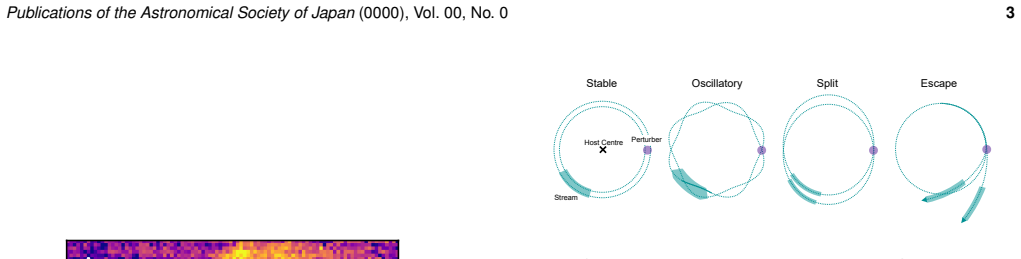
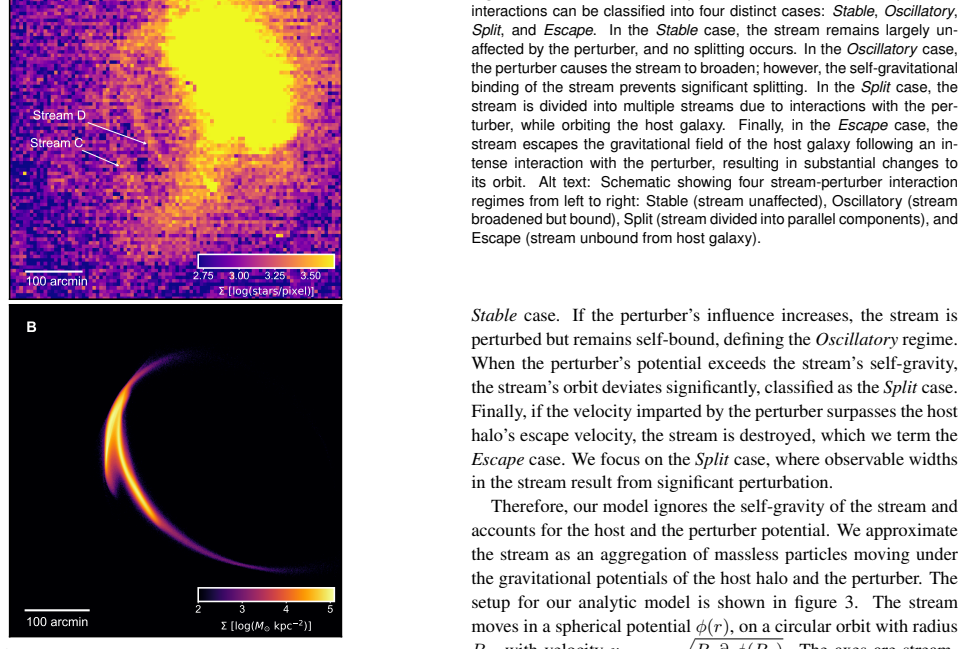
A single encounter with a dark perturber can split one stellar stream into two parallel structures.
A machine-rendered reading of the paper's core claim, the machinery that carries it, and where it could break.
Core claim
Encounters with dark perturbers generate density depletions perpendicular to the stream elongation, leading to parallel stellar stream morphologies beyond conventional gap-like signatures.
What carries the argument
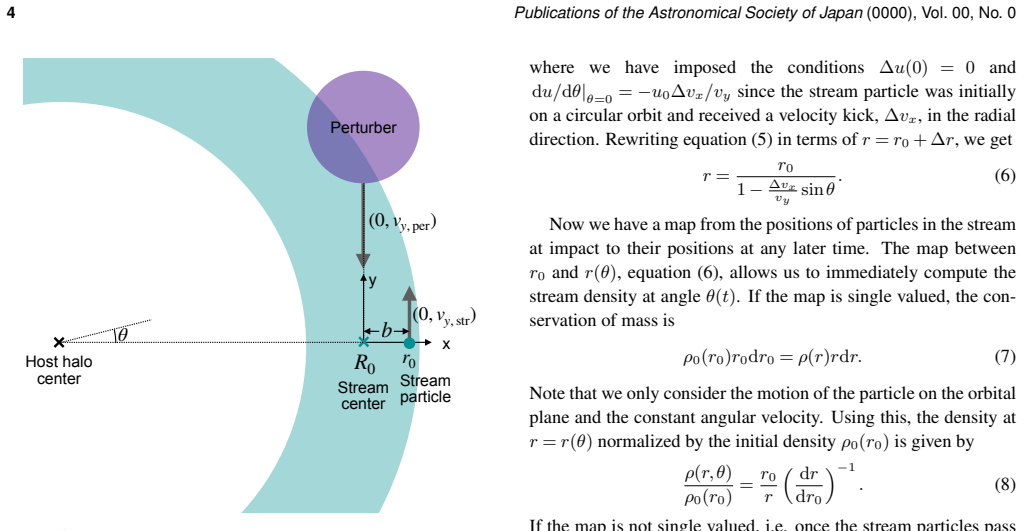
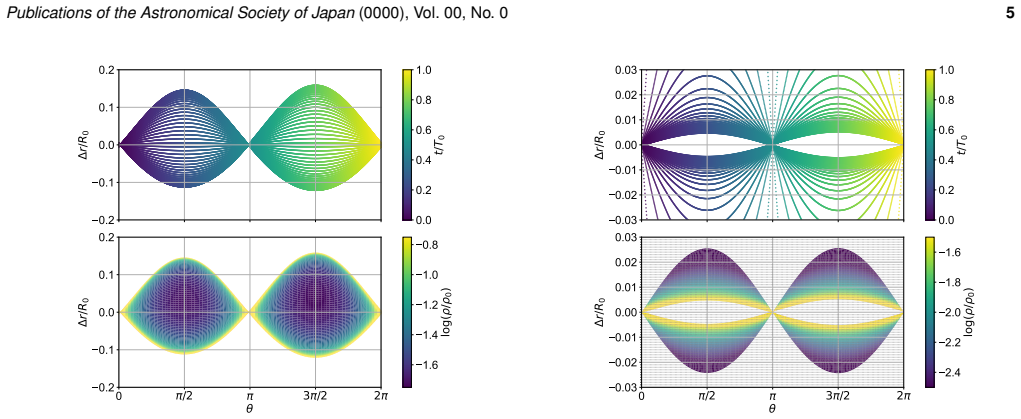
Perpendicular density depletions created by a single encounter with a dark matter subhalo or intermediate-mass black hole.
If this is right
- Parallel streams act as dynamical imprints of dark perturbers in galaxies.
- These structures can be distinguished from other formation processes using specific observables.
- The mechanism applies to stellar streams in both the Milky Way and Andromeda.
- Analytical modeling combined with simulations supports the splitting scenario.
Where Pith is reading between the lines
- Surveys targeting parallel features in streams could place limits on the number of wandering intermediate-mass black holes.
- The perpendicular depletion effect may combine with other stream evolution processes to produce more complex morphologies in real galaxies.
- Detection of such pairs would provide an independent probe of subhalo abundance at small scales.
Load-bearing premise
The perpendicular density depletions from one encounter dominate over other dynamical effects and remain observable and distinguishable from alternative channels without later evolution erasing them.
What would settle it
High-resolution maps of known stellar streams that show no parallel pairs, or N-body runs where all parallel features arise only when multiple encounters or other processes are included.
Figures
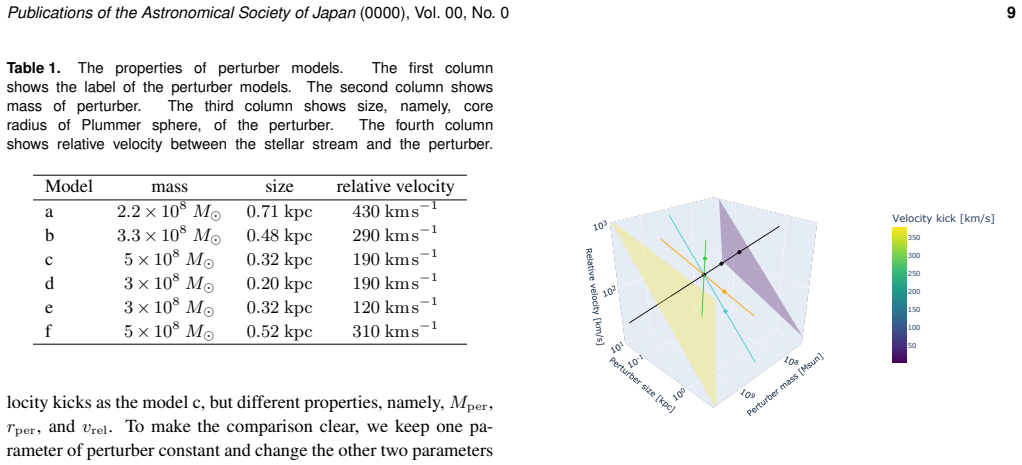
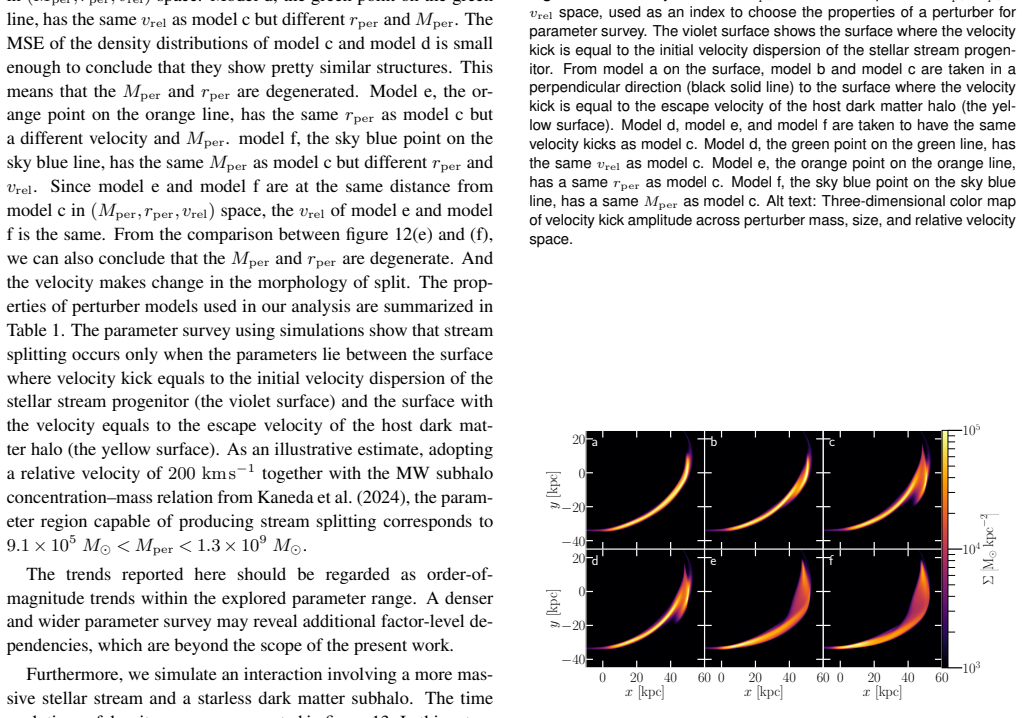
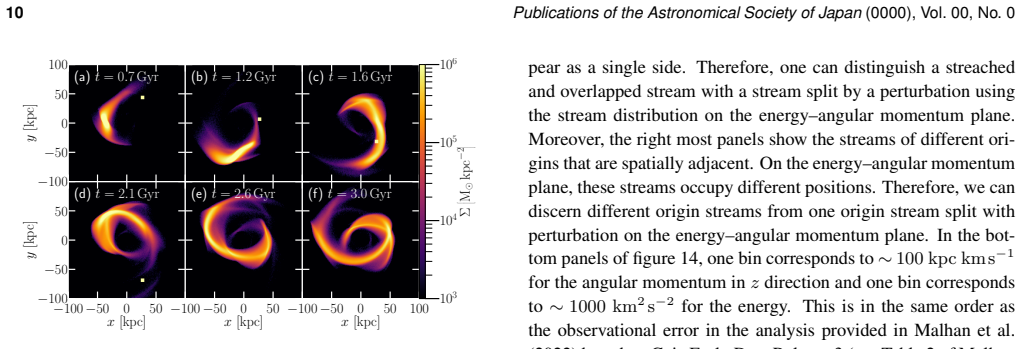
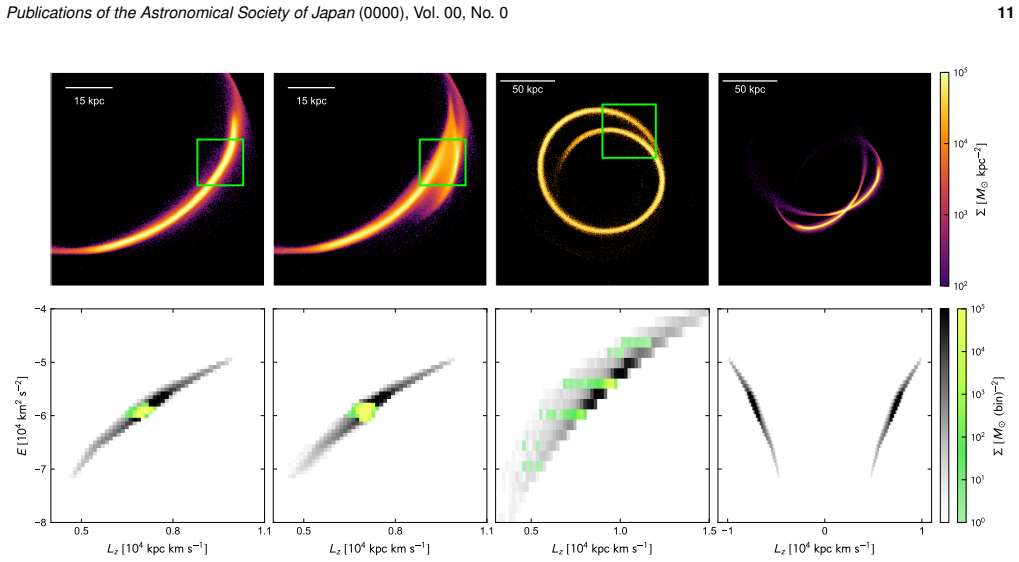
read the original abstract
Dark matter subhalos and intermediate-mass black holes wandering in the Milky Way and the Andromeda galaxy are difficult to directly detect through electromagnetic observations, yet knowing their abundance is essential for understanding galaxy formation and evolution. We propose parallel stellar streams as dynamical imprints left on stellar streams by dark perturbers, including starless dark matter subhalos and wandering intermediate-mass black holes. We report that a single stream can split into two parallel structures after an encounter with a dark perturber. This scenario is supported by analytical modelling and N-body simulations. We also discuss how we can distinguish parallel stellar streams from other formation processes based on observables. We extend the theoretical picture of stream-subhalo interactions by showing that encounters with dark perturbers can generate density depletions perpendicular to the stream elongation, leading to parallel stellar stream morphologies beyond conventional gap-like signatures.
Editorial analysis
A structured set of objections, weighed in public.
Referee Report
Summary. The manuscript claims that encounters with dark matter subhalos or intermediate-mass black holes can split a single stellar stream into two parallel structures via perpendicular density depletions. This mechanism is demonstrated through analytical modeling and N-body simulations and is positioned as an extension of conventional gap-like signatures in stream-subhalo interactions. The authors also address observational distinguishability from alternative formation channels.
Significance. If the central result holds, the work identifies a new dynamical imprint that could constrain the abundance and properties of otherwise invisible dark perturbers in the Milky Way and Andromeda. The dual use of analytical modeling and N-body simulations provides independent support for the proposed morphology and broadens the set of observable signatures beyond density gaps.
minor comments (2)
- The abstract states that the scenario is 'supported by analytical modelling and N-body simulations,' but the provided text does not include the specific equations, initial conditions, or parameter ranges used in either component; adding these details (e.g., in a dedicated methods section) would strengthen verifiability.
- The discussion of distinguishability from other formation processes is mentioned but not quantified; including concrete observables (e.g., velocity dispersion differences or surface-brightness profiles) with example values would improve clarity.
Simulated Author's Rebuttal
We thank the referee for their supportive summary of the manuscript and for recommending minor revision. The referee's description accurately reflects the scope and claims of our work on parallel stellar streams as a new signature of dark perturbers.
Circularity Check
No significant circularity detected
full rationale
The paper's derivation chain relies on analytical modeling of stream-perturber encounters followed by N-body simulations to demonstrate perpendicular density depletions and parallel stream morphologies. No equations, fitted parameters, or self-citations are presented that reduce the central prediction to a definition, input fit, or prior author result by construction. The simulations serve as independent numerical verification of the dynamical mechanism, and the abstract explicitly frames distinguishability from other channels as an observational question rather than an internal tautology. The result is therefore self-contained against external benchmarks with no load-bearing circular steps.
Axiom & Free-Parameter Ledger
Reference graph
Works this paper leans on
-
[1]
G., et al
Abac, A. G., et al. 2025, ApJL, 993, L25
2025
-
[2]
2020, Phys
Abbott, R., et al. 2020, Phys. Rev. Lett., 125, 101102
2020
-
[3]
C., Gómez, F
Amorisco, N. C., Gómez, F. A., Vegetti, S., & White, S. D. M. 2016, MNRAS, 463, L17
2016
-
[4]
2021, ApJ, 906, 96
Shen, S., & Tremmel, M. 2021, ApJ, 906, 96
2021
-
[5]
Banik, N., Bovy, J., Bertone, G., Erkal, D., & de Boer, T. J. L. 2021a, Journal of Cosmology and Astroparticle Physics, 2021, 043
2021
-
[6]
Barmby, P., & Huchra, J. P. 2001, AJ, 122, 2458
2001
-
[7]
2022, MNRAS, 510, 3531
Baumgardt, H., Faller, J., Meinhold, N., McGovern-Greco, C., & Hilker, M. 2022, MNRAS, 510, 3531
2022
-
[8]
2019, MNRAS, 482, 5138
Baumgardt, H., Hilker, M., Sollima, A., & Bellini, A. 2019, MNRAS, 482, 5138
2019
-
[9]
2020, MNRAS, 498, 4887
Benitez-Llambay, A., & Frenk, C. 2020, MNRAS, 498, 4887
2020
-
[10]
K., & Kallivayalil, N
Bovy, J., Bahmanyar, A., Fritz, T. K., & Kallivayalil, N. 2016, ApJ, 833, 31
2016
-
[11]
Bowden, A., Belokurov, V ., & Evans, N. W. 2015, MNRAS, 449, 1391
2015
-
[12]
M., Kuhlen, M., Zolotov, A., & Hooper, D
Brooks, A. M., Kuhlen, M., Zolotov, A., & Hooper, D. 2013, ApJ, 765, 22
2013
-
[13]
M., & Zolotov, A
Brooks, A. M., & Zolotov, A. 2014, ApJ, 786, 87
2014
-
[14]
R., & Hooper, D
Buckley, M. R., & Hooper, D. 2010, Phys. Rev. D, 82, 063501
2010
-
[15]
Caldwell, N., & Romanowsky, A. J. 2016, ApJ, 824, 42
2016
-
[16]
Carlberg, R. G. 2012, ApJ, 748, 20
2012
-
[17]
Carlberg, R. G. 2016, ApJ, 820, 45
2016
-
[18]
Carlberg, R. G. 2018, ApJ, 861, 69
2018
-
[19]
G., & Grillmair, C
Carlberg, R. G., & Grillmair, C. J. 2013, ApJ, 768, 171
2013
-
[20]
G., Grillmair, C
Carlberg, R. G., Grillmair, C. J., & Hetherington, N. 2012, ApJ, 760, 75
2012
-
[21]
G., et al
Carlberg, R. G., et al. 2011, ApJ, 731, 124
2011
-
[22]
C., et al
Chapman, S. C., et al. 2008, MNRAS, 390, 1437
2008
-
[23]
2024, MNRAS, 532, 4340
Chen, Y ., Mo, H., & Wang, H. 2024, MNRAS, 532, 4340
2024
-
[24]
N., & Quillen, A
Comparetta, J. N., & Quillen, A. C. 2010, 41, 5.04
2010
-
[25]
R., et al
Conn, A. R., et al. 2016, MNRAS, 458, 3282 D’Onghia, E., Springel, V ., Hernquist, L., & Keres, D. 2010, ApJ, 709, 1138
2016
-
[26]
E., & Belokurov, V
Erkal, D., Koposov, S. E., & Belokurov, V . 2017, MNRAS, 470, 60
2017
-
[27]
L., & Belokurov, V
Erkal, D., Sanders, J. L., & Belokurov, V . 2016, MNRAS, 461, 1590
2016
-
[28]
A., Babul, A., Guhathakurta, P., Gilbert, K
Fardal, M. A., Babul, A., Guhathakurta, P., Gilbert, K. M., & Dodge, C. 2008, ApJL, 682, L33
2008
-
[29]
2009, A&A, 508, 1285
Galleti, S., Bellazzini, M., Buzzoni, A., Federici, L., & Fusi Pecci, F. 2009, A&A, 508, 1285
2009
-
[30]
E., Strader, J., & Ho, L
Greene, J. E., Strader, J., & Ho, L. C. 2020, ARA&A, 58, 257
2020
-
[31]
J., & Johnson, R
Grillmair, C. J., & Johnson, R. 2006, ApJL, 639, L17 Grudi´c, M. Y ., Guszejnov, D., Offner, S. S. R., Rosen, A. L., Raju, A. N., Faucher-Giguère, C.-A., & Hopkins, P. F. 2022, MNRAS, 512, 216
2006
-
[32]
Harris, W. E. 2010, arXiv e-prints, arXiv:1012.3224
Pith/arXiv arXiv 2010
-
[33]
2008, ApJ, 686, 829
Holley-Bockelmann, K., Gültekin, K., Shoemaker, D., & Yunes, N. 2008, ApJ, 686, 829
2008
-
[34]
2021, ApJ, 914, 123 14Publications of the Astronomical Society of Japan(0000), Vol
Ibata, R., et al. 2021, ApJ, 914, 123 14Publications of the Astronomical Society of Japan(0000), Vol. 00, No. 0
2021
-
[35]
A., Lewis, G
Ibata, R. A., Lewis, G. F., Irwin, M. J., & Quinn, T. 2002, MNRAS, 332, 915
2002
-
[36]
2009, ApJ, 696, 2115
Ishiyama, T., Fukushige, T., & Makino, J. 2009, ApJ, 696, 2115
2009
-
[37]
V ., Spergel, D
Johnston, K. V ., Spergel, D. N., & Haydn, C. 2002, ApJ, 570, 656
2002
-
[38]
2024, ApJ, 964, 123
Jung, M., et al. 2024, ApJ, 964, 123
2024
-
[39]
2024, PASJ, 76, 1026
Kaneda, Y ., Mori, M., & Otaki, K. 2024, PASJ, 76, 1026
2024
-
[40]
2014, ApJL, 789, L13
Kawaguchi, T., Saito, Y ., Miki, Y ., & Mori, M. 2014, ApJL, 789, L13
2014
-
[41]
2017, MNRAS, 469, 3390
Kirihara, T., Miki, Y ., & Mori, M. 2017, MNRAS, 469, 3390
2017
-
[42]
2018, ApJ, 853, 29
Komiyama, Y ., et al. 2018, ApJ, 853, 29
2018
-
[43]
E., Rix, H.-W., & Hogg, D
Koposov, S. E., Rix, H.-W., & Hogg, D. W. 2010, ApJ, 712, 260
2010
-
[44]
B., Ishigaki, M
Kuzma, P. B., Ishigaki, M. N., Kirihara, T., & Ogami, I. 2025, AJ, 170, 157
2025
-
[45]
S., et al
Li, T. S., et al. 2021, ApJ, 911, 149
2021
-
[46]
R., Frenk, C
Lovell, M. R., Frenk, C. S., Eke, V . R., Jenkins, A., Gao, L., & Theuns, T. 2014, MNRAS, 439, 300
2014
-
[47]
2019, Nature, 574, 69
Mackey, D., et al. 2019, Nature, 574, 69
2019
-
[48]
Malhan, K., & Ibata, R. A. 2019, MNRAS, 486, 2995
2019
-
[49]
Martin, N. F. 2019, ApJL, 886, L7
2019
-
[50]
2018, MNRAS, 478, 3862
Chambers, K. 2018, MNRAS, 478, 3862
2018
-
[51]
2022, ApJ, 926, 107
Malhan, K., et al. 2022, ApJ, 926, 107
2022
-
[52]
W., et al
McConnachie, A. W., et al. 2018, ApJ, 868, 55
2018
-
[53]
2024, MNRAS, 528, 5252
Mezcua, M., & Domínguez Sánchez, H. 2024, MNRAS, 528, 5252
2024
-
[54]
2014, ApJ, 783, 87
Miki, Y ., Mori, M., Kawaguchi, T., & Saito, Y . 2014, ApJ, 783, 87
2014
-
[55]
1999, ApJL, 524, L19
Moore, B., Ghigna, S., Governato, F., Lake, G., Quinn, T., Stadel, J., & Tozzi, P. 1999, ApJL, 524, L19
1999
-
[56]
F., Frenk, C
Navarro, J. F., Frenk, C. S., & White, S. D. M. 1996, ApJ, 462, 563
1996
-
[57]
2025, MNRAS, 536, 530 O’Leary, R
Ogami, I., et al. 2025, MNRAS, 536, 530 O’Leary, R. M., & Loeb, A. 2009, MNRAS, 395, 781 O’Leary, R. M., & Loeb, A. 2012, MNRAS, 421, 2737
2025
-
[58]
2025, submitted to New Astronomy
Otaki, K., Kazuno, Y ., & Mori, M. 2025, submitted to New Astronomy
2025
-
[59]
Pearson, S., Bonaca, A., Chen, Y ., & Gnedin, O. Y . 2024, ApJ, 976, 54
2024
-
[60]
M., & Johnston, K
Pearson, S., Price-Whelan, A. M., & Johnston, K. V . 2017, Nature Astronomy, 1, 633
2017
-
[61]
M., Bridges, T
Perrett, K. M., Bridges, T. J., Hanes, D. A., Irwin, M. J., Brodie, J. P., Carter, D., Huchra, J. P., & Watson, F. G. 2002, AJ, 123, 2490
2002
-
[62]
E., & Carballo-Bello, J
Piatti, A. E., & Carballo-Bello, J. A. 2020, A&A, 637, L2
2020
-
[63]
M., Ibata, R., Martin, N
Preston, J., Collins, M., Rich, R. M., Ibata, R., Martin, N. F., & Fardal, M. 2021, MNRAS, 504, 3098
2021
-
[64]
C., & Comparetta, J
Quillen, A. C., & Comparetta, J. 2010, Jeans Instability of Palomar 5’s Tidal Tail, arXiv,
2010
-
[65]
2014, ApJ, 780, 187
Rashkov, V ., & Madau, P. 2014, ApJ, 780, 187
2014
-
[66]
E., & V olonteri, M
Reines, A. E., & V olonteri, M. 2015, ApJ, 813, 82
2015
-
[67]
2021, MNRAS, 503, 6098
Ricarte, A., Tremmel, M., Natarajan, P., Zimmer, C., & Quinn, T. 2021, MNRAS, 503, 6098
2021
-
[68]
L., Hafen, Z., Grudi ´c, M
Rodriguez, C. L., Hafen, Z., Grudi ´c, M. Y ., Lamberts, A., Sharma, K., Faucher-Giguère, C.-A., & Wetzel, A. 2023, MNRAS, 521, 124
2023
-
[69]
2015, MNRAS, 448, 2941
Sawala, T., et al. 2015, MNRAS, 448, 2941
2015
-
[70]
2011, MNRAS, 415, 1569
Schneider, A., & Moore, B. 2011, MNRAS, 415, 1569
2011
-
[71]
2018, ApJ, 862, 114
Shipp, N., et al. 2018, ApJ, 862, 114
2018
-
[72]
Tremmel, M., Governato, F., V olonteri, M., Pontzen, A., & Quinn, T. R. 2018, ApJL, 857, L22
2018
-
[73]
2024, MNRAS van Donkelaar, F., Mayer, L., Capelo, P
Untzaga, J., Bonoli, S., Izquierdo-Villalba, D., Mezcua, M., & Spinoso, D. 2024, MNRAS van Donkelaar, F., Mayer, L., Capelo, P. R., & Tamfal, T. 2025, MNRAS, 538, 2255
2024
-
[74]
2019, MNRAS, 484, 2832
Vasiliev, E. 2019, MNRAS, 484, 2832
2019
-
[75]
Vegetti, S., & Koopmans, L. V . E. 2009, MNRAS, 392, 945
2009
-
[76]
2014, MNRAS, 442, 2929
Veljanoski, J., et al. 2014, MNRAS, 442, 2929
2014
-
[77]
2015, MNRAS, 452, 320
Veljanoski, J., et al. 2015, MNRAS, 452, 320
2015
-
[78]
2011, VERITAS observations of the Segue 1 dwarf spheroidal galaxy,
Vivier, M. 2011, VERITAS observations of the Segue 1 dwarf spheroidal galaxy,
2011
-
[79]
J., Pacucci, F., Hernquist, L., & Bose, S
Weller, E. J., Pacucci, F., Hernquist, L., & Bose, S. 2022, MNRAS, 511, 2229
2022
-
[80]
R., Hopkins, P
Wetzel, A. R., Hopkins, P. F., Kim, J.-h., Faucher-Giguère, C.-A., Kereš, D., & Quataert, E. 2016, ApJL, 827, L23
2016
discussion (0)
Sign in with ORCID, Apple, or X to comment. Anyone can read and Pith papers without signing in.