Natural Term Logic
Pith reviewed 2026-05-24 04:19 UTC · model grok-4.3
The pith
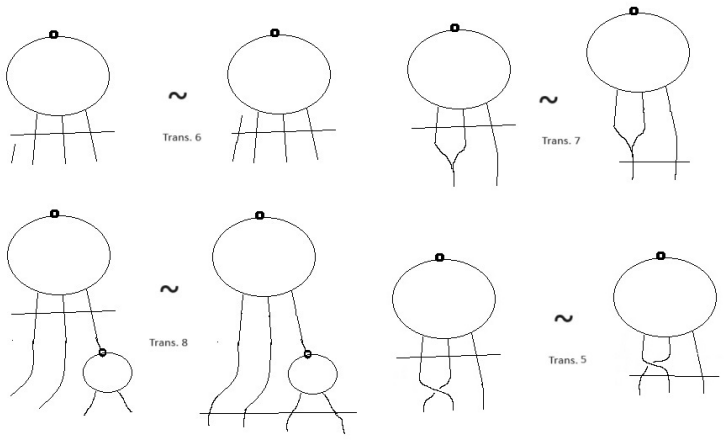
Every Natural Term Logic term reduces to a unique normal form through structural, predicative and pushing-in reductions.
A machine-rendered reading of the paper's core claim, the machinery that carries it, and where it could break.
Core claim
Each NTL term T reduces to a unique normal term N; the reductions fall into structural, predicative and pushing-in categories, and beta nu N = N when N is normal. A canonical NTL term can be associated to a BL term t by calculating beta t and then applying structural and pushing-in reductions until obtaining the unique normal term N such that nu N = t.
What carries the argument
The reduction system on NTL terms consisting of structural, predicative and pushing-in rules that together produce unique normal forms.
If this is right
- Predicative reductions produce prenormal terms to which further structural and pushing-in reductions apply.
- The maps nu and beta establish a many-to-one correspondence between normal NTL terms and closed BL terms.
- Normal forms serve as canonical representatives that preserve the minimal logical content of the original term.
Where Pith is reading between the lines
- The normalization procedure could serve as a decision method for equivalence of expressions under the allowed transformations.
- The framework might extend to additional grammatical operations while maintaining uniqueness of normal forms.
- It supplies a concrete mechanism for associating minimal logical content to natural-language-style terms.
Load-bearing premise
The three classes of reductions are terminating and confluent on the syntax of NTL terms.
What would settle it
An NTL term that reduces to two different normal forms, or a normal term N where beta nu N differs from N.
Figures




read the original abstract
In this paper we develop a formal system called Natural Term Logic (NTL). NTL aims to represent key aspects of the logical and grammatical mechanisms of natural language as well as grammatical transformations which preserve core logical meaning. NTL can be seen as a refinement of the ideas of Quine's paper `Variables Explained Away' and the technical concepts introduced by Bealer and Zalta. NTL is more fine-grained than Bealer's first-order intensional logic (BL): there is a many-to-one correspondence $\nu$ between NTL terms and closed BL terms as well as a canonical map $\beta$ which assigns to each closed BL term a corresponding NTL term. The map $\nu$ can be seen as assigning a core logical content of the NTL term. We define a series of reductions on NTL terms which intuitivelyy speaking capture meaning-preserving syntactic transformations ( transformations which preserved the basic logical meaning of a term) and our main result is that each NTL term $T$ reduces to a unique normal term $N$. The reductions fall into the structural, predicative and pushing-in categories. Predicative reductions decompose NTL terms so that predication is only applied to a primitive term (such terms are called prenormal). A key ingredient in the proof is the fact that $\beta \nu N = N$ when $N$ is normal. This suggests that within NTL the normal form of a term expresses the core logical content of the term.
Editorial analysis
A structured set of objections, weighed in public.
Referee Report
Summary. The paper introduces Natural Term Logic (NTL) as a refinement of Quine's 'Variables Explained Away' and concepts from Bealer and Zalta. NTL provides a finer-grained syntax than Bealer's first-order intensional logic (BL), with a many-to-one map ν from NTL terms to closed BL terms and a map β from BL terms to (prenormal) NTL terms. The central claim is that NTL terms reduce via three classes of reductions (structural, predicative, pushing-in) to a unique normal form N satisfying βνN = N; this normal form then supplies a canonical NTL term for any given BL term t.
Significance. If the reduction system is shown to be terminating and confluent, the result would supply a canonical normal-form representation for terms in a system intended to capture meaning-preserving grammatical transformations in natural language. The construction of ν and β as explicit maps (rather than fitted quantities) and the identification of prenormal terms are positive features that make the normal-form claim potentially falsifiable once the reduction rules are fully specified.
major comments (2)
- [Abstract] Abstract: the main result asserts that every NTL term reaches a unique normal form under the three reduction classes, yet the text supplies neither the precise rewrite rules for structural/predicative/pushing-in reductions nor any termination measure (e.g., a ranking function on term size or prenormal depth) or confluence argument (critical-pair analysis or Newman's lemma).
- [Abstract] Abstract: the key lemma βνN = N for normal N is stated as an ingredient of the proof, but no verification or derivation of this identity is provided; without it the uniqueness claim cannot be established from the given definitions.
minor comments (1)
- [Abstract] Abstract contains two typographical errors: 'intuitivelyy speaking' and 'sytnactic transformations'.
Simulated Author's Rebuttal
We thank the referee for the careful and constructive report. The comments correctly identify that the current manuscript states the main result on unique normal forms but omits the explicit reduction rules, termination and confluence arguments, and verification of the key lemma. We will revise the paper to supply these details.
read point-by-point responses
-
Referee: [Abstract] Abstract: the main result asserts that every NTL term reaches a unique normal form under the three reduction classes, yet the text supplies neither the precise rewrite rules for structural/predicative/pushing-in reductions nor any termination measure (e.g., a ranking function on term size or prenormal depth) or confluence argument (critical-pair analysis or Newman's lemma).
Authors: We accept the observation. The manuscript as submitted states the existence of the three classes of reductions and the uniqueness claim but does not list the individual rewrite rules or supply a termination measure or confluence proof. In the revision we will (i) enumerate the precise rewrite rules for structural, predicative and pushing-in reductions, (ii) define an explicit ranking function on term size and prenormal depth to establish termination, and (iii) provide a confluence argument, either by critical-pair analysis or by appeal to Newman's lemma. revision: yes
-
Referee: [Abstract] Abstract: the key lemma βνN = N for normal N is stated as an ingredient of the proof, but no verification or derivation of this identity is provided; without it the uniqueness claim cannot be established from the given definitions.
Authors: We agree that the verification of βνN = N is absent from the current text. The lemma is invoked but not derived. The revised manuscript will contain a self-contained derivation of the identity for normal terms, thereby grounding the uniqueness claim. revision: yes
Circularity Check
No significant circularity; new system defined from scratch with independent reduction claim
full rationale
The paper defines NTL syntax, the maps β and ν, and the three classes of reductions (structural, predicative, pushing-in) from scratch as new constructions. The central claim that every term reduces to a unique normal form N with βνN = N is presented as a theorem whose proof would rest on termination and confluence arguments internal to the defined rewrite system. No load-bearing step reduces by the paper's own equations to a prior result, fitted parameter, or self-citation chain; the normal-form property is not tautological from the definitions but requires separate verification of the reduction relation. This is the standard case of a self-contained formal development.
Axiom & Free-Parameter Ledger
axioms (1)
- standard math Standard properties of first-order term syntax and rewriting systems (confluence and termination are assumed to hold for the defined reductions).
invented entities (1)
-
NTL terms and the three reduction relations (structural, predicative, pushing-in)
no independent evidence
discussion (0)
Sign in with ORCID, Apple, or X to comment. Anyone can read and Pith papers without signing in.