REVIEW 3 major objections 5 minor 18 references
Finite Element Methods for Elastic Contact: Penalty and Nitsche
T0 review · 3 major / 5 minor · reviewed 2026-08-07 · deepseek-v4-flash
Pith's one-line read The paper claims that the finite-element penalty method for elastic contact, when tuned with $\varepsilon$ proportional to the mesh size $h$, cannot do better than an $O(h^{1/2})$ energy-norm error even for smooth solutions, whereas…
desk verdict A clean, well-written note on why the penalty method caps at O(h^{1/2}) for Poisson mortar problems and Nitsche restores optimality, but the title and abstract overstate the elastic-contact scope. read the letter →
The pith
A machine-rendered reading of the paper's core claim, the machinery that carries it, and where it could break.
The reading
What carries the argument
The engine of the argument is the pair of competing error contributions in the penalty method: the modelling error $\|u-u^\varepsilon\|_E \lesssim \varepsilon^{1/2}\|\partial u/\partial n\|_{0,\Gamma}$ (equation (6)), which shrinks as $\varepsilon \to 0$, and the finite-element interpolation error (8), which contains an $\varepsilon^{-1/2}h^{s-1/2}$ interface term that grows as $\varepsilon$ shrinks. Their trade-off fixes $\varepsilon \approx h$ and caps the total error at order $h^{1/2}$. Nitsche's machinery is the consistency correction: adding $-\int_\Gamma \frac{\partial u_1}{\partial n_1}(v_1-v_2)\,ds$, valid because the exact solution satisfies $u_1=u_2$ on $\Gamma$, followed by its symmetric counterpart, makes the discrete form consistent with the exact problem. Stability then comes from the elementwise trace inverse inequality (28), which controls the boundary normal-derivative trace by the element interior gradient scaled by $h_E^{-1/2}$, and this dictates the local parameter choice $\varepsilon|_E \lesssim h_E$.
What would settle it
In the paper's own Poisson mortar test, measure the energy-norm error $\|u-u^\varepsilon_h\|_E$ for $\varepsilon = ch$ over successive uniform refinements of a smooth solution: the bound (10) predicts a slope of $1/2$, so each halving of $h$ should reduce the error by only about 30%. A measured slope closer to 1 would refute the dominating-modelling-error ceiling. For the contact claim itself, run the same experiment on a genuine two-body unilateral contact problem with a known smooth solution and check whether the penalty error slope remains $1/2$.
Extended reading notes
Core claim
For the penalized Poisson mortar problem, the exact penalized solution $u^\varepsilon$ satisfies the modelling-error bound $\|u-u^\varepsilon\|_E \lesssim \varepsilon^{1/2}\|\partial u/\partial n\|_{0,\Gamma}$ (equation (6)), while the finite-element interpolation bound (8) contains an interface term proportional to $\varepsilon^{-1/2}h^{s-1/2}$; balancing these two forces the choice $\varepsilon \approx h$ and leaves the total error at $h^{1/2}\|\partial u/\partial n\|_{0,\Gamma} + h^s\|u^\varepsilon\|_s$ (equation (10)). Hence optimal order is unattainable for the penalty method. Nitsche's method is derived by adding the flux consistency term $-\int_\Gamma \frac{\partial u_1}{\partial n_1}(v_1-v_2)\,ds$ to the penalty form and then symmetrizing with $-\int_\Gamma \frac{\partial v_1}{\partial n_1}(u_1-u_2)\,ds$; it is consistent by construction and, with $\varepsilon|_E = h_E/(2\gamma)$ for $\gamma > C_I$ (or the explicit ratio (36) for linear elements), coercive with respect to the energy norm, yielding the optimal error bound (32).
Load-bearing premise
The conclusion that penalty cannot be optimal rests on a stated-but-unproved estimate of the modelling error (equation (6)), together with the Section 2 assertion that elasticity and unknown-contact technicalities add only notation to the Poisson interface analysis.
Editorial extensions
If this is right
- For any fixed polynomial degree $p$ and smooth data, the penalty method with $\varepsilon \approx h$ has total energy error $O(h^{1/2})$; halving $h$ reduces the error only by a factor of about $\sqrt{2}$, so the method cannot deliver high accuracy.
- Nitsche's method achieves $O(h^{s-1})$ for $1 \le s \le p+1$, the same rate as the underlying finite-element interpolation, with the penalty-like parameter chosen locally as $\varepsilon|_E = h_E/(2\gamma)$, $\gamma > C_I$.
- For piecewise linear elements the stability constant is explicit: choosing $\varepsilon|_E = \alpha (\int_K dx)/(2\int_E ds)$ with $\alpha < 1$ gives uniform stability without solving an eigenvalue problem.
- The a posteriori error estimate for the penalty method contains the interface term (11), and that term is efficient---bounded by the true error---only when $\varepsilon \approx h$, giving a second, estimator-based justification for the same tuning.
- The Nitsche formulation can be written as a one-sided master-slave method or, by symmetrization with average fluxes, in a form that handles differing material parameters in the two subdomains.
Reading between the lines
- The paper proves the $O(h^{1/2})$ ceiling for the Poisson mortar problem, not for unilateral contact with an unknown contact boundary; the headline claim transfers to elasticity and contact only through the Section 2 assertion, so the transfer should be checked against the referenced contact analysis before relying on it in a production contact code.
- The failure mode suggests a repair the authors do not explore: since the modelling error is concentrated on the interface $\Gamma$, one could keep $\varepsilon \approx h$ only there and refine in space, or drive $\varepsilon$ by the a posteriori estimator; whether this restores optimality is untested here.
- The same consistency-correction recipe should apply to any non-conforming penalty form, such as artificial Robin boundary conditions, yielding a family of Nitsche-like methods from a single template.
- A practical diagnostic follows from the numerics: an adaptive penalty computation refines the entire interface, while Nitsche refines only singular corners, so the refinement pattern itself reveals which method is in use.
Editorial analysis
A structured set of objections, weighed in public.
Referee Report
Summary. The paper discusses the penalty method and Nitsche's method for a problem motivated by elastic contact, but the actual analysis is carried out on a two-domain Poisson 'mortaring' problem. For the penalty method with penalty parameter ε ≈ h, the authors argue that the total error is limited by a modeling error of order O(h^{1/2}), so the method cannot be optimally convergent. They then derive Nitsche's method as a simple consistency correction of the penalty method, prove stability and an optimal a priori error estimate, and present numerical experiments confirming the predicted rates for both methods. The paper positions itself as a short didactic note rather than a comprehensive analysis of contact problems.
Significance. For the Poisson interface model, the paper's analysis is essentially correct and the numerical experiments match the predicted rates. The derivation of Nitsche's method from the penalty formulation is clean and likely useful for teaching, and the explicit constant for linear elements is a practical strength. However, the abstract and title claim results for elastic contact problems, while the analysis and all numerical experiments concern a linear Poisson interface problem with a known interface. The central 'penalty cannot be optimal' conclusion for actual contact problems therefore depends on an unproved transfer from the linear model. This is a significant gap between the presentation and the content, but it is fixable by either narrowing the claims or supplying the missing argument.
major comments (3)
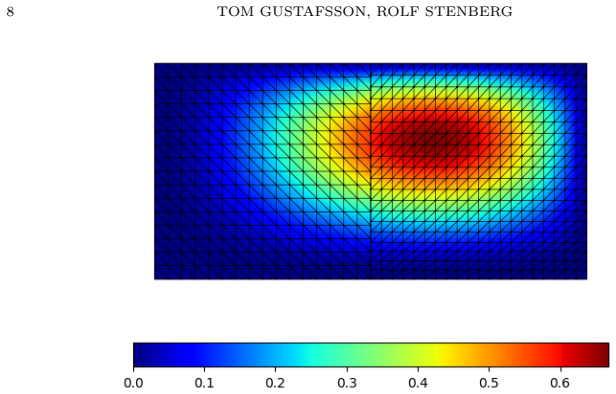
- [Abstract and Section 2] The title and abstract promise results for elastic contact problems, but the analysis in Section 2 is explicitly restricted to the Poisson mortar model: 'All the questions we are going to address can be answered by considering "mortaring" of the Poisson equation.' The numerical experiments in Section 4 also solve Poisson interface problems, not contact problems. For true contact, the constraint is an inequality and the contact set is unknown, and the paper provides no analogue of estimate (6) in that setting. The load-bearing conclusion that the penalty method cannot be optimally convergent for elastic contact therefore rests on an unproved transfer from the linear model. Please either revise the title and abstract to describe the actual scope, or give a rigorous argument (or a precise theorem from [7]) that the Poisson-mortar estimates imply the same scaling for the contact variational inequality.
- [Section 2, Eq. (6)] Equation (6), ||u - u^ε||_E ≲ ε^{1/2} ||∂u/∂n||_{0,Γ}, is the key modeling-error estimate that produces the O(h^{1/2}) ceiling in (10). It is asserted with 'It is not too difficult to show' but no proof or reference is supplied. Since this estimate is load-bearing for the central negative result, please include a short proof (e.g., testing the error equation with u - u^ε and using the interface condition) or provide a precise citation.
- [Section 2, Eqs. (8)-(10)] There is a quantitative error in the interpolation estimate: substituting ε≈h into (8) gives a bound of order h^{s-1}||u^ε||_s, not h^s||u^ε||_s as stated in (9). The same h^s appears in (10). While this correction does not change the O(h^{1/2}) ceiling (for s≥2, h^{s-1} is still smaller than h^{1/2}), the displayed estimates and the phrase 'optimal convergence rate' in (9) should be corrected to h^{s-1}, or the total bound should be stated as O(h^{min(1/2, s-1)}).
minor comments (5)
- [Title and figures] The title contains typographical artifacts ('CONT ACT', 'PENAL TY'); also, in Figures 2, 5, and 8 the convergence-rate labels appear as 'O(N 1/2)' and 'O(N 1)' without minus signs, which is confusing. Please ensure the exponents are displayed correctly.
- [Section 2, paragraph after Eq. (10)] The sentence 'the condition number also increases from O(h^{-2})' is vague; please specify the dependence on ε (or on the ratio γ) so that the reader knows the actual growth for the recommended choice ε ≈ h.
- [Section 2, last paragraph] The a posteriori estimator in Eq. (11) appears to contain a missing factor: the first term should presumably be h_E times a residual or jump norm squared. Please check and clarify the notation.
- [Section 5] In the concluding remarks, 'it is pity' should be 'it is a pity'.
- [Section 2, unknown-contact discussion] The deferral to [7] for variational-inequality technicalities would be more useful if a specific theorem or section number from [7] were cited.
Circularity Check
No circular reduction: the penalty-suboptimality and Nitsche-optimality derivations are self-contained for the Poisson mortar model; the self-citations occur for extensions and a posteriori results, not for the central rates.
full rationale
The paper's central derivation chain is not circular. The penalty error bound (10) follows from the triangle inequality applied to the modeling error (6) and the interpolation estimate (8), with (8) credited to the external source Babuška [1] and (6) asserted as 'not too difficult to show' rather than fitted to any data. No fitted parameter is renamed as a prediction: the choice ε ≈ h is made before the convergence rates are read off, and it is justified by balancing the modeling and interpolation terms (6) and (8), with [8] adding an a posteriori efficiency argument. The Nitsche method is consistent by construction because the flux terms added in (19)-(20) vanish identically for the exact solution; optimality then follows from coercivity via the inverse inequality (28) with the external constant from [17]. This is a standard consistency-and-stability argument, not a definitional equivalence between the result and its inputs. The genuine caveats are scope, proof-omission, and correctness issues rather than circularity: (6) is not proved in the text; the abstract's elastic-contact claim is transferred from the Poisson mortar model by reference to the authors' prior work [7] instead of being derived for the free-boundary variational inequality; and Eq. (9) states h^s where Eq. (8) with ε ≈ h gives h^{s-1}, a typo that does not affect the O(h^{1/2}) ceiling. Because the paper relies on several self-citations ([6], [7], [8]) for the a posteriori results and the elastic-contact extension, a score of 2 is appropriate, but no central prediction reduces to its own input by construction.
Assumptions & free parameters
free parameters (1)
- penalty/stabilization parameter ε =
ε ≈ h for penalty; ε|E = α (∫_K dx)/(2 ∫_E ds), α < 1, for Nitsche
assumptions (5)
- domain assumption Modeling error estimate (6): ||u - u^ε||_E ≲ ε^{1/2} ||∂u/∂n||_{0,Γ}
- standard math Interpolation estimate (8) including ε^{-1/2} h^{s-1/2} term
- standard math Scaled trace inequality (28): C_I ∫_K |∇v|^2 ≥ h_E ∫_E |∂v/∂n|^2
- domain assumption Regularity assumption u^ε ∈ H^s(Ω), 1 ≤ s ≤ p+1
- domain assumption Transfer of the Poisson mortar analysis to elastic contact
Cite this review
Pith. "Pith review of Finite Element Methods for Elastic Contact: Penalty and Nitsche." pith.science (2026). https://pith.science/paper/XYJUDYTA
@misc{pith2026250521776,
  author       = {Pith},
  title        = {Pith review of: Finite Element Methods for Elastic Contact: Penalty and Nitsche},
  year         = {2026},
  howpublished = {\url{https://pith.science/paper/XYJUDYTA}},
  note         = {Machine review of arXiv:2505.21776}
}
read the original abstract
We consider two methods for treating elastic contact problems with the finite element method; the penalty method and Nitsche's method. For the penalty method we discuss how the penalty parameter should be chosen. Both the theoretical analysis and numerical examples show that an optimal convergence rate cannot be achieved. The method is contrasted to that of Nitsche which is optimally convergent. We also give the derivation of Nitsche's method by a very simple consistency correction of the penalty method.
Figures


Figures from the paper (5 more)


Reference graph
Works this paper leans on
-
[7]
On Nitsche’s method for elastic contact problems
Tom Gustafsson, Rolf Stenberg, and Juha Videman. On Nitsche’s method for elastic contact problems. SIAM J. Sci. Comput. , 42(2):B425–B446, 2020. URL: https://doi.org/10.1137/ 19M1246869, doi:10.1137/19M1246869
-
[1]
The finite element method with penalty.Math
Ivo Babuˇ ska. The finite element method with penalty.Math. Comp., 27:221–228, 1973. URL: https://doi.org/10.2307/2005611, doi:10.2307/2005611
-
[2]
Franz Chouly, Patrick Hild, and Yves Renard. Finite element approximation of con- tact and friction in elasticity , volume 48 of Advances in Mechanics and Mathematics . Birkh¨ auser/Springer, Cham, [2023]©2023. Advances in Continuum Mechanics. URL:https: //doi.org/10.1007/978-3-031-31423-0 , doi:10.1007/978-3-031-31423-0
-
[3]
R. Courant. Variational methods for the solution of problems of equilibrium and vibrations. Bull. Amer. Math. Soc. , 49:1–23, 1943. URL: https://doi.org/10.1090/ S0002-9904-1943-07818-4 , doi:10.1090/S0002-9904-1943-07818-4
-
[4]
Space-time finite element methods for second order problems: an algorithmic approach
Jouni Freund. Space-time finite element methods for second order problems: an algorithmic approach. Acta Polytech. Scand. Math. Comput. Manage. Eng. Ser. , 79, 1996
work page 1996
-
[5]
Gill, Walter Murray, and Margaret H
Philip E. Gill, Walter Murray, and Margaret H. Wright. Practical optimization. Academic Press, Inc. [Harcourt Brace Jovanovich, Publishers], London-New York, 1981
work page 1981
-
[6]
Error analysis of Nitsche’s mor- tar method
Tom Gustafsson, Rolf Stenberg, and Juha Videman. Error analysis of Nitsche’s mor- tar method. Numer. Math. , 142(4):973–994, 2019. URL: https://doi.org/10.1007/ s00211-019-01039-5 , doi:10.1007/s00211-019-01039-5
-
[8]
Nitsche’s method for general boundary conditions
Mika Juntunen and Rolf Stenberg. Nitsche’s method for general boundary conditions. Math. Comp., 78(267):1353–1374, 2009. URL: https://doi.org/10.1090/S0025-5718-08-02183-2 , doi:10.1090/S0025-5718-08-02183-2
Show all 18 references
-
[9]
Kˇ r ´ ıˇ zek, P
M. Kˇ r ´ ıˇ zek, P. Neittaanm¨ aki, and R. Stenberg, editors.Finite Element Methods. Fifty years from the Courant element , volume 164 of Lecture notes in pure and applied mathemics . Marcel Dekker, 1994. FINITE ELEMENT METHODS FOR ELASTIC CONTACT: PENALTY AND NITSCHE 13
1994
-
[10]
Tod A. Laursen. Computational contact and impact mechanics. Springer-Verlag, Berlin, 2002. Fundamentals of modeling interfacial phenomena in nonlinear finite element analysis
2002
-
[11]
J. Nitsche. ¨ uber ein Variationsprinzip zur L¨ osung von Dirichlet-Problemen bei Verwendung von Teilr¨ aumen, die keinen Randbedingungen unterworfen sind.Abh. Math. Sem. Univ. Ham- burg, 36:9–15, 1971. URL: https://doi.org/10.1007/BF02995904, doi:10.1007/BF02995904
1971 doi
-
[12]
E. Polak. Computational methods in optimization. A unified approach , volume Vol. 77 of Mathematics in Science and Engineering . Academic Press, New York-London, 1971
1971
-
[13]
New and old finite element methods with approximation of boundary con- ditions
Rolf Stenberg. New and old finite element methods with approximation of boundary con- ditions. In Raino A.E. M¨ akinen and Pekka Neittaanm¨ aki, editors, Proceedings of the 5th Finnish Mechanics Days , pages 191–198, 1994
1994
-
[14]
On some techniques for approximating boundary conditions in the finite el- ement method
Rolf Stenberg. On some techniques for approximating boundary conditions in the finite el- ement method. volume 63, pages 139–148. 1995. International Symposium on Mathemat- ical Modelling and Computational Methods Modelling 94 (Prague, 1994). URL: https: //doi.org/10.1016/0377...
1995 doi
-
[15]
Mortaring by a method of J.A
Rolf Stenberg. Mortaring by a method of J.A. Nitsche. In E. Onate S Idelsohn and E. Dvorkin, editors, COMPUTATIONAL MECHANICS, New Trends and Applications . @CIMNE, Barcelona, Spain, 1998. URL: http://math.aalto.fi/~rstenber/Publications/ wccm-mortar.pdf
1998
-
[16]
Gilbert Strang and George J. Fix. An analysis of the finite element method . Prentice-Hall Series in Automatic Computation. Prentice-Hall, Inc., Englewood Cliffs, NJ, 1973
1973
-
[17]
Warburton and J
T. Warburton and J. S. Hesthaven. On the constants in hp-finite element trace inverse in- equalities. Comput. Methods Appl. Mech. Engrg. , 192(25):2765–2773, 2003. URL: https: //doi.org/10.1016/S0045-7825(03)00294-9 , doi:10.1016/S0045-7825(03)00294-9
2003 doi
-
[18]
Computational Contact Mechanics
Peter Wriggers. Computational Contact Mechanics . Springer, 2 edition, 2006
2006
Reviewed August 7, 2026 · model on record in the stance chip above.
Discussion (0). Continue with ORCID to comment.