REVIEW 4 major objections 5 minor 44 references
Quantifying data needs in surrogate modeling for flow fields in two-dimensional stirred tanks with physics-informed neural networks
T0 review · 4 major / 5 minor · reviewed 2026-08-06 · deepseek-v4-flash
Pith's one-line read Six velocity labels train a stirred-tank flow surrogate to ~3% error
desk verdict A careful, honestly reported benchmark on data needs for PINNs in a 2D stirred-tank setup, whose headline '3% across Re 50-5000' overstates what the paper's own Figure 15 shows at Re=50. read the letter →
The pith
A machine-rendered reading of the paper's core claim, the machinery that carries it, and where it could break.
The reading
What carries the argument
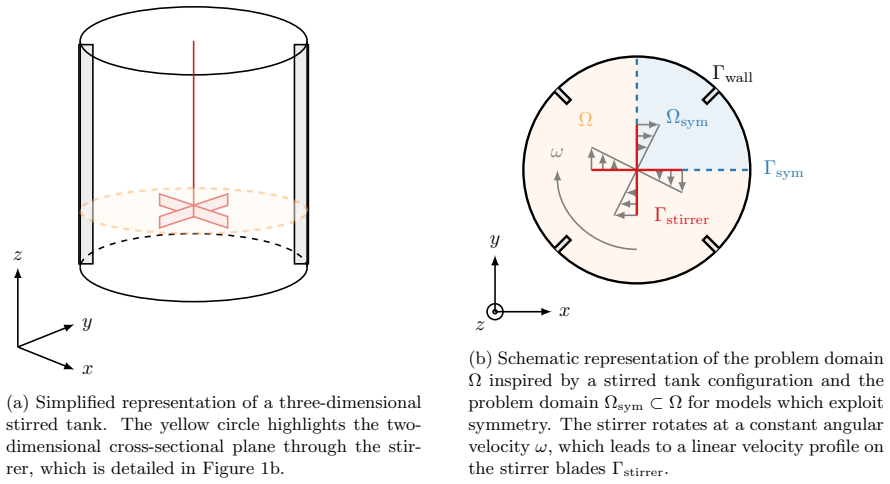
The load-bearing mechanism is the composite loss of a physics-informed neural network: it combines the steady incompressible Navier–Stokes PDE residual evaluated at collocation points, the Dirichlet boundary-condition residuals at the tank wall and stirrer blades, and a data residual against the labeled points. Because the PDE residual constrains every output to be a solution of the physics, the network can interpolate across Reynolds number almost without data; the small data term only has to fix the parametric endpoints and the localized high-error zone. The targeted-label recipe consists of three ingredients: placing velocity labels in the annular region 0.04 m ≤ r ≤ 0.07 m just after the impeller tips, where vanilla PINN errors concentrate; reducing the domain to a symmetric quadrant with an extra symmetry boundary residual; and, in the approximate-data variant, using a piecewise polynomial for the velocity magnitude, scaled by the tip speed, as a stand-in for real velocity labels.
What would settle it
Evaluate the same six-label, two-endpoint PINN at finely resolved intermediate Reynolds numbers (for example Re=250, 750, and 1500) on a converged mesh; if the normalized ℓ1 velocity or pressure error at any of those points exceeds the roughly 6–7% seen at Re=50 rather than staying near 3%, the boundary-only labeling strategy is not working in the interior. The claim would also be tested by applying the recipe to a parameter range known to contain a flow transition, where endpoint labels alone should fail.
Extended reading notes
Core claim
The authors claim that for the 2D stirred-tank benchmark, the solution family over Reynolds numbers 50–5000 is well captured by a vanilla PINN whose data loss is fed only by labels at the extremes of the parameter range. With three targeted velocity labels per boundary Re value, placed where r is between 0.04 m and 0.07 m—the annulus just outside the impeller where base PINN errors peak—and using the problem's four-fold symmetry to train on one quadrant, the model achieves mean normalized errors of 3.15% (velocity) and 2.93% (pressure) at Re=1000. Without labels the same architecture gives 11.00% velocity and 12.35% pressure error at that Reynolds number. If the labels are replaced by 256 points sampled from the paper's polynomial approximation of the velocity magnitude profile, errors settle around 2.5% for both fields for Re between 100 and 6000, including extrapolation beyond the training range. The paper also reports that a supervised neural network reaches comparable accuracy only with on the order of 10,000 labels per Reynolds number, and that a boundary-informed network omitting the PDE residual needs labels from at least four Reynolds numbers.
Load-bearing premise
The six-datapoint claim assumes the solution changes smoothly enough with Reynolds number that physics constraints can fill in the whole interior range from endpoints Re=50 and Re=5000 alone; nothing in the paper proves that smoothness or bounds the interpolation error.
Editorial extensions
If this is right
- With one high-fidelity CFD solution at each end of the Reynolds range, a vanilla PINN can produce a surrogate accurate to about 3% for interior Reynolds numbers, at least for smooth steady laminar regimes.
- Approximate, physics-derived labels are nearly as good as expensive simulation labels, so users can avoid high-fidelity data generation when a rough velocity profile is known.
- The comparison quantifies a practical guideline: choose a classical NN or BINN only when thousands of labels are available; otherwise the PDE residual earns its extra training cost.
- As few as eight labels per Reynolds number already reduce vanilla PINN errors from about 11–12% to about 6–7%, and 64 labels per Reynolds number reach the point of diminishing returns.
Reading between the lines
- Inference: the six-label recipe should transfer to other parametric fluid problems only when the solution manifold is smooth and non-bifurcating in the parameter; the paper's own robustness results show higher variance for models trained at just two Reynolds numbers, so a user should verify smoothness before relying on it.
- Inference: the success of placing labels where the base model errs most suggests an active-learning loop—train without data, locate the largest residuals, label those few points—that could yield nearly the same accuracy with even fewer or better-chosen labels.
- Inference: the approximate-profile result implies that an analytic or empirical prior about the flow can substitute for data labels, which may matter for three-dimensional stirred-tank surrogates, where high-fidelity labels are the main bottleneck.
- Inference: because pressure labels are not needed, the method is compatible with experimental measurement campaigns that only resolve velocity.
Editorial analysis
A structured set of objections, weighed in public.
Referee Report
Summary. The paper quantifies how many labeled data points are needed by a vanilla physics-informed neural network (PINN) to build a surrogate model for steady 2D stirred-tank flow over Reynolds numbers from 50 to 5000, comparing it with classical supervised neural networks and boundary-informed neural networks (BINNs). Using finite element reference solutions as ground truth, the authors report that adding a small number of labels greatly improves the vanilla PINN, that only boundary values of the Reynolds range are needed when PDE residuals are present, that six strategically placed velocity labels give about 3% error at Re=1000, and that approximate velocity labels give about 2.5% error over most of the range. The body of the paper explicitly acknowledges degraded accuracy at Re=50 and below, but this caveat is not reflected in the abstract and conclusion.
Significance. If the central quantitative claims survive revision, the paper is a useful, carefully controlled benchmark: it uses an independent high-resolution FEM reference, reports architecture, sampling, and loss-weight details in the appendix, includes ten-seed robustness experiments for random label placement, and compares PINN, BINN, and supervised NN under a common architecture. The main qualitative finding, that PINNs reduce label requirements for parametric surrogates, is well supported. The headline accuracy claim is currently too broad and needs qualification, and the six-datapoint result lacks a reported variance estimate.
major comments (4)
- [Abstract, Section 4.5, Figure 15] The claim of 'prediction errors around 3% across Reynolds numbers from 50 to 5000 using as few as six datapoints' is not supported by the paper's own evaluation. The targeted-label model achieves 3.15% velocity and 2.93% pressure error at Re_test=1000, but Figure 15 shows velocity error at Re_test=50 of roughly 7%, and Section 4.6 explicitly states that errors for Re_test=30 and Re_test=50 remain significantly larger than for other values because of the impeller-tip discontinuity. The abstract and conclusion should either quote the Re>=100 range or report the full-range error honestly.
- [Section 4.4, Section 4.5] The six-datapoint result is reported as a single training run, while the paper's own robustness analysis for the analogous two-Re configuration (64 labels per Re_train) shows standard deviations reaching 15-20% of the mean error for unseen Re values. Since strategic label placement is the basis of the headline data-efficiency claim, the authors should re-run the 3-labels-per-Re configuration over multiple seeds and report mean and spread. Without this, the reader cannot distinguish a robust finding from a favorable seed.
- [Section 4.6, Eq. (22)] The approximate-label experiment depends on the polynomial profile with R*=0.0875 inherited from prior work, but the paper offers only a visual comparison of the profile and no quantitative error of the approximate labels against the FEM reference in the label region. Because the approximate-label claim (around 2.5%) is a headline contribution, the authors should quantify how far the approximate labels deviate from the true profiles at the actual label locations and for the Re values sampled.
- [Section 4.3, Section 4.4] The conclusion that labels at only the two boundary Re values suffice to train an accurate PINN across the interior range rests on an interpolation assumption that the solution manifold is smooth in Re. The robustness standard deviations in Figure 12b are a partial proxy, but no uncertainty quantification over the Re axis is provided. The authors should either add a brief justification for the assumed smoothness or restrict the claim to the demonstrated range.
minor comments (5)
- [Section 4.6, first paragraph] The text contains a typo: 'sirred tank' should be 'stirred tank'.
- [Section 3.2, Eq. (16)] The phrase 'approaching approaching' contains a duplicated word and should be corrected.
- [Figure 18 caption] The caption describes panel (b) as showing 'velocity prediction error distributions', but the panel shows pressure errors; the caption should say 'pressure'.
- [Table 3 and Figure 4] The training-time comparison uses hyperparameters tuned for the PINN, which is disclosed in the text but should be restated in the table or figure caption so that the timing comparison is not misinterpreted as a hardware-independent measure.
- [Data availability statement] Making the FEM reference solutions and trained model outputs available in a repository, rather than only 'upon reasonable request', would strengthen reproducibility.
Circularity Check
No material circularity: the six-datapoint and approximate-label results are empirical benchmarks against independent FEM solutions; at most a minor non-load-bearing self-citation for R*.
full rationale
The paper's central quantitative claims are not derived from their own inputs: the 3.15% velocity / 2.93% pressure errors with six targeted labels (Section 4.5, Fig. 13) and the ~2.5% errors with approximate labels (Section 4.6, Figs. 17-18) are measured against high-fidelity FEM reference solutions on a separate, much finer mesh (Section 3.3), so they are not equal to the training data by construction. The targeted-label experiment places labels in a region of known high error (r in [0.04,0.07]), but this is an active-learning choice, and accuracy is still evaluated on unseen test data. The approximate-label experiment uses an explicit polynomial ansatz (Eq. 22) with R*=0.0875 m, stated in the text and attributed to the authors' prior work [29]; the profile is an input to the PINN, not a rediscovery of the output, and the subsequent error evaluation is independent. The only self-referential element is the citation of [29] for the choice of R*, but the value is disclosed and is not a predicted quantity, so it does not make the claim circular. The abstract's unqualified 'across Reynolds numbers from 50 to 5000' is internally inconsistent with Fig. 15, which shows ~7% velocity error at Re=50; that is a correctness/consistency concern, not a circularity, and does not affect this verdict.
Assumptions & free parameters
free parameters (3)
- R* (velocity profile tuning parameter) =
0.0875 m
- Targeted label region (r bounds) =
0.04 m to 0.07 m
- Data loss weight alpha_data =
25 (targeted) / 9 (approximate)
assumptions (5)
- domain assumption Steady incompressible Navier-Stokes equations (Eq. 11) adequately describe the 2D stirred-tank flow.
- domain assumption The solution is symmetric about the axes, allowing the domain to be reduced to Omega_sym with the continuity BC of Eq. 16.
- domain assumption The high-fidelity FEM solution on the fine mesh is an accurate ground truth for validation.
- domain assumption Labels from the coarse mesh are accurate enough to train a model that is then validated against the fine mesh.
- ad hoc to paper The polynomial approximation in Eq. 22 with R*=0.0875 is a valid surrogate for the true velocity profile in the label region.
Cite this review
Pith. "Pith review of Quantifying data needs in surrogate modeling for flow fields in two-dimensional stirred tanks with physics-informed neural networks." pith.science (2026). https://pith.science/paper/XZ4XKKLT
@misc{pith2026250711640,
  author       = {Pith},
  title        = {Pith review of: Quantifying data needs in surrogate modeling for flow fields in two-dimensional stirred tanks with physics-informed neural networks},
  year         = {2026},
  howpublished = {\url{https://pith.science/paper/XZ4XKKLT}},
  note         = {Machine review of arXiv:2507.11640}
}
abstract
Stirred tanks are vital in chemical and biotechnological processes, particularly as bioreactors. Although computational fluid dynamics (CFD) is widely used to model the flow in stirred tanks, its high computational cost$-$especially in multi-query scenarios for process design and optimization$-$drives the need for efficient data-driven surrogate models. However, acquiring sufficiently large datasets can be costly. Physics-informed neural networks (PINNs) offer a promising solution to reduce data requirements while maintaining accuracy by embedding underlying physics into neural network (NN) training. This study quantifies the data requirements of vanilla PINNs for developing surrogate models of a flow field in a 2D stirred tank. We compare these requirements with classical supervised neural networks and boundary-informed neural networks (BINNs). Our findings demonstrate that surrogate models can achieve prediction errors around 3% across Reynolds numbers from 50 to 5000 using as few as six datapoints. Moreover, employing an approximation of the velocity profile in place of real data labels leads to prediction errors of around 2.5%. These results indicate that even with limited or approximate datasets, PINNs can be effectively trained to deliver high accuracy comparable to high-fidelity data.
Figures


Figures from the paper (15 more)


Reference graph
Works this paper leans on
-
[1]
Physics Informed Neural Net- works for Modeling of 3D Flow-Thermal Problems with Sparse Domain Data
Saakaar Bhatnagar, Andrew Comerford, and Araz Banaeizadeh. Physics Informed Neural Net- works for Modeling of 3D Flow-Thermal Problems with Sparse Domain Data. Journal of Machine Learning for Modeling and Computing , 2024. ISSN 2689-3967. doi: 10.1615/JMachLearnModel- Comput.2024051540
-
[2]
Xi Chen, Jianchuan Yang, Xu Liu, Yong He, Qiang Luo, Mao Chen, and Wenqi Hu. Hemo- dynamics modeling with physics-informed neural networks: A progressive boundary complexity approach. Computer Methods in Applied Mechanics and Engineering , 438:117851, April 2025. ISSN 0045-7825. doi: 10.1016/j.cma.2025.117851
-
[3]
Scientific Machine Learning Through Physics–Informed Neural Networks: Where we are and What’s Next
Salvatore Cuomo, Vincenzo Schiano Di Cola, Fabio Giampaolo, Gianluigi Rozza, Maziar Raissi, and Francesco Piccialli. Scientific Machine Learning Through Physics–Informed Neural Networks: Where we are and What’s Next. Journal of Scientific Computing , 92(3):88, July 2022. ISSN 1573-
work page 2022
-
[4]
Eulerian formulation of the tensor-based morphology equations for strain-based blood damage modeling
Nico Dirkes, Fabian Key, and Marek Behr. Eulerian formulation of the tensor-based morphology equations for strain-based blood damage modeling. Computer Methods in Applied Mechanics and Engineering, 426:116979, June 2024. ISSN 0045-7825. doi: 10.1016/j.cma.2024.116979. 21
arXiv 2024
-
[5]
Application of CFD to Analyze the Hydrodynamic Behaviour of a Biore- actor with a Double Impeller
Mohammadreza Ebrahimi, Melih Tamer, Ricardo Martinez Villegas, Andrew Chiappetta, and Farhad Ein-Mozaffari. Application of CFD to Analyze the Hydrodynamic Behaviour of a Biore- actor with a Double Impeller. Processes, 7(10):694, October 2019. ISSN 2227-9717. doi: 10.3390/pr7100694
-
[6]
Physics-informed neural networks for solving Reynolds-averaged Navier-Stokes equations
Hamidreza Eivazi, Mojtaba Tahani, Philipp Schlatter, and Ricardo Vinuesa. Physics-informed neural networks for solving Reynolds-averaged Navier-Stokes equations. Physics of Fluids , 34(7): 075117, July 2022. ISSN 1070-6631, 1089-7666. doi: 10.1063/5.0095270
-
[7]
Salah A. Faroughi, Nikhil M. Pawar, C´ elio Fernandes, Maziar Raissi, Subasish Das, Nima K. Kalantari, and Seyed Kourosh Mahjour. Physics-Guided, Physics-Informed, and Physics-Encoded Neural Networks and Operators in Scientific Computing: Fluid and Solid Mechanics. Journal of Computing and Information Science in Engineering , pages 1–45, January 2024. ISS...
-
[8]
F. Garcia-Ochoa, V. E. Santos, and E. Gomez. 2.15 - Stirred Tank Bioreactors. In Murray Moo- Young, editor, Comprehensive Biotechnology (Second Edition) , pages 179–198. Academic Press, Burlington, January 2011. ISBN 978-0-08-088504-9. doi: 10.1016/B978-0-08-088504-9.00108-2
Show all 44 references
-
[9]
Geometry-aware PINNs for Turbulent Flow Prediction, December 2024
Shinjan Ghosh, Julian Busch, Georgia Olympia Brikis, and Biswadip Dey. Geometry-aware PINNs for Turbulent Flow Prediction, December 2024
2024
-
[10]
A physics- informed deep learning framework for inversion and surrogate modeling in solid mechanics
Ehsan Haghighat, Maziar Raissi, Adrian Moure, Hector Gomez, and Ruben Juanes. A physics- informed deep learning framework for inversion and surrogate modeling in solid mechanics. Com- puter Methods in Applied Mechanics and Engineering , 379:113741, June 2021. ISSN 0045-7825. d...
2021
-
[11]
C. Haringa. Through the Organism’s eyes: The interaction between hydrodynamics and metabolic dynamics in industrial-scale fermentation processes. 2017. doi: 10.4233/uuid:441ec955-cd8d-4ae0- b2f0-98fbf91a570a
2017 doi
-
[12]
Flow field reconstruction from sparse sensor mea- surements with physics-informed neural networks
Mohammad Yasin Hosseini and Yousef Shiri. Flow field reconstruction from sparse sensor mea- surements with physics-informed neural networks. Physics of Fluids , 36(7):073606, July 2024. ISSN 1070-6631. doi: 10.1063/5.0211680
2024 doi
-
[13]
A General Review of the Current Development of Mechanically Agitated Vessels
Marek Jaszczur and Anna M lynarczykowska. A General Review of the Current Development of Mechanically Agitated Vessels. Processes, 8(8):982, August 2020. ISSN 2227-9717. doi: 10.3390/pr8080982
2020 doi
-
[14]
NSFnets (Navier-Stokes Flow nets): Physics-informed neural networks for the incompressible Navier-Stokes equa- tions
Xiaowei Jin, Shengze Cai, Hui Li, and George Em Karniadakis. NSFnets (Navier-Stokes Flow nets): Physics-informed neural networks for the incompressible Navier-Stokes equa- tions. Journal of Computational Physics , 426:109951, February 2021. ISSN 00219991. doi: 10.1016/j.jcp.20...
2021
-
[15]
Joshi, Nandkishor K
Jyeshtharaj B. Joshi, Nandkishor K. Nere, Chinmay V. Rane, B. N. Murthy, Channamallikarjun S. Mathpati, Ashwin W. Patwardhan, and Vivek V. Ranade. CFD simulation of stirred tanks: Com- parison of turbulence models. Part I: Radial flow impellers. The Canadian Journal of Chemica...
2011 doi
-
[16]
Fotiadis
Isaac Elias Lagaris, Aristidis Likas, and Dimitrios I. Fotiadis. Artificial neural networks for solving ordinary and partial differential equations.IEEE Transactions on Neural Networks, 9(5):987–1000,
-
[17]
Lorenzen, A
F. Lorenzen, A. Zargaran, and U. Janoske. Potential of physics-informed neural networks for solving fluid flow problems with parametric boundary conditions. Physics of Fluids , 36(3):037143, March 2024. ISSN 1070-6631. doi: 10.1063/5.0193952
2024 doi
-
[18]
Learning nonlinear operators via DeepONet based on the universal approximation theorem of operators
Lu Lu, Pengzhan Jin, Guofei Pang, Zhongqiang Zhang, and George Em Karniadakis. Learning nonlinear operators via DeepONet based on the universal approximation theorem of operators. Nature Machine Intelligence , 3(3):218–229, March 2021. ISSN 2522-5839. doi: 10.1038/s42256- 021-...
2021 doi
-
[19]
McClenny and Ulisses M
Levi D. McClenny and Ulisses M. Braga-Neto. Self-adaptive physics-informed neural net- works. Journal of Computational Physics , 474:111722, February 2023. ISSN 0021-9991. doi: 10.1016/j.jcp.2022.111722
2023
-
[20]
Finite basis physics-informed neural networks (FBPINNs): A scalable domain decomposition approach for solving differential equa- tions
Ben Moseley, Andrew Markham, and Tarje Nissen-Meyer. Finite basis physics-informed neural networks (FBPINNs): A scalable domain decomposition approach for solving differential equa- tions. Advances in Computational Mathematics , 49(4):62, August 2023. ISSN 1019-7168, 1572-
2023
-
[21]
Raissi, P
M. Raissi, P. Perdikaris, and G.E. Karniadakis. Physics-informed neural networks: A deep learn- ing framework for solving forward and inverse problems involving nonlinear partial differential equations. Journal of Computational Physics , 378:686–707, February 2019. ISSN 002199...
2019 doi
-
[22]
Hidden fluid me- chanics: Learning velocity and pressure fields from flow visualizations
Maziar Raissi, Alireza Yazdani, and George Em Karniadakis. Hidden fluid me- chanics: Learning velocity and pressure fields from flow visualizations. Sci- ence, 367(6481):1026–1030, 2020. doi: 10.1126/science.aaw4741. URL https://www.science.org/doi/abs/10.1126/science.aaw4741
2020 doi
-
[23]
CFD simulation of a Rushton turbine stirred-tank using open-source software with critical evaluation of MRF-based rotation modeling
Alfred Reid, Riccardo Rossi, Ciro Cottini, and Andrea Benassi. CFD simulation of a Rushton turbine stirred-tank using open-source software with critical evaluation of MRF-based rotation modeling. Meccanica, July 2024. ISSN 1572-9648. doi: 10.1007/s11012-024-01824-z
2024 doi
-
[24]
Rosseburg, J
A. Rosseburg, J. Fitschen, J. Wutz, T. Wucherpfennig, and M. Schl¨ uter. Hydrodynamic inhomo- geneities in large scale stirred tanks – Influence on mixing time. Chemical Engineering Science , 188:208–220, October 2018. ISSN 0009-2509. doi: 10.1016/j.ces.2018.05.008
2018 doi
-
[25]
PFNN: A penalty-free neural network method for solving a class of second-order boundary-value problems on complex geometries
Hailong Sheng and Chao Yang. PFNN: A penalty-free neural network method for solving a class of second-order boundary-value problems on complex geometries. Journal of Computational Physics , 428:110085, 2021. ISSN 00219991. doi: 10.1016/j.jcp.2020.110085
2021
-
[26]
Jagtap, and George Em Karniadakis
Khemraj Shukla, Ameya D. Jagtap, and George Em Karniadakis. Parallel physics-informed neural networks via domain decomposition. Journal of Computational Physics , 447:110683, December
-
[27]
Steinfurth, A
B. Steinfurth, A. Hassanein, N. A. K. Doan, and F. Scarano. Physics-informed neural networks for dense reconstruction of vortex rings from particle tracking velocimetry. Physics of Fluids , 36 (9):095110, September 2024. ISSN 1070-6631. doi: 10.1063/5.0212585
2024 doi
-
[28]
Shape-optimization of extrusion-dies via parameterized physics-informed neural networks
Steffen Tillmann, Daniel Hilger, Norbert Hosters, and Stefanie Elgeti. Shape-optimization of extrusion-dies via parameterized physics-informed neural networks. PAMM, 23(4):e202300203,
-
[29]
A model hierarchy for predicting the flow in stirred tanks with physics-informed neu- ral networks
Veronika Tr´ avn ´ ıkov´ a, Daniel Wolff, Nico Dirkes, Stefanie Elgeti, Eric von Lieres, and Marek Behr. A model hierarchy for predicting the flow in stirred tanks with physics-informed neu- ral networks. Advances in Computational Science and Engineering , 2(2):91–129, 2024. d...
2024 doi
-
[30]
PACMANN: Point Adaptive Collocation Method for Artificial Neural Networks, November 2024
Coen Visser, Alexander Heinlein, and Bianca Giovanardi. PACMANN: Point Adaptive Collocation Method for Artificial Neural Networks, November 2024
2024
-
[31]
Understanding and Mitigating Gradient Flow Pathologies in Physics-Informed Neural Networks
Sifan Wang, Yujun Teng, and Paris Perdikaris. Understanding and Mitigating Gradient Flow Pathologies in Physics-Informed Neural Networks. SIAM Journal on Scientific Computing , 43(5): A3055–A3081, January 2021. ISSN 1064-8275. doi: 10.1137/20M1318043
2021 doi
-
[32]
An Expert’s Guide to Training Physics-informed Neural Networks, August 2023
Sifan Wang, Shyam Sankaran, Hanwen Wang, and Paris Perdikaris. An Expert’s Guide to Training Physics-informed Neural Networks, August 2023. arXiv:2308.08468
2023 arXiv
-
[33]
Gradient Alignment in Physics-informed Neural Networks: A Second-Order Optimization Perspective, February 2025
Sifan Wang, Ananyae Kumar Bhartari, Bowen Li, and Paris Perdikaris. Gradient Alignment in Physics-informed Neural Networks: A Second-Order Optimization Perspective, February 2025
2025
-
[34]
A comprehensive study of non- adaptive and residual-based adaptive sampling for physics-informed neural networks
Chenxi Wu, Min Zhu, Qinyang Tan, Yadhu Kartha, and Lu Lu. A comprehensive study of non- adaptive and residual-based adaptive sampling for physics-informed neural networks. Computer Methods in Applied Mechanics and Engineering , 403:115671, January 2023. ISSN 0045-7825. doi: 10...
2023
-
[35]
Hy- brid Modeling of Fed-Batch Cell Culture Using Physics-Informed Neural Network
Shu Yang, William Fahey, Brendha Truccollo, Jill Browning, Reza Kamyar, and Huiyi Cao. Hy- brid Modeling of Fed-Batch Cell Culture Using Physics-Informed Neural Network. Industrial & Engineering Chemistry Research, September 2024. ISSN 0888-5885. doi: 10.1021/acs.iecr.4c01459
2024 doi
-
[36]
MultiAdam: Parameter-wise scale-invariant optimizer for multiscale training of physics-informed neural net- works
Jiachen Yao, Chang Su, Zhongkai Hao, Songming Liu, Hang Su, and Jun Zhu. MultiAdam: Parameter-wise scale-invariant optimizer for multiscale training of physics-informed neural net- works. In Proceedings of the 40th International Conference on Machine Learning , volume 202 of I...
2023
-
[37]
Non-intrusive reduced-order modeling for fluid prob- lems: A brief review
Jian Yu, Chao Yan, and Mengwu Guo. Non-intrusive reduced-order modeling for fluid prob- lems: A brief review. Proceedings of the Institution of Mechanical Engineers, Part G: Jour- nal of Aerospace Engineering , 233(16):5896–5912, December 2019. ISSN 0954-4100. doi: 10.1177/095...
2019 doi
-
[38]
Gambaruto
Chengxi Zeng, Tilo Burghardt, and Alberto M. Gambaruto. Training dynamics in Physics- Informed Neural Networks with feature mapping, February 2024
2024
-
[39]
Physics-Informed Neural Networks with Complementary Soft and Hard Constraints for Solving Complex Boundary Navier-Stokes Equations, November 2024
Chuyu Zhou, Tianyu Li, Chenxi Lan, Rongyu Du, Guoguo Xin, Pengyu Nan, Hangzhou Yang, Guoqing Wang, Xun Liu, and Wei Li. Physics-Informed Neural Networks with Complementary Soft and Hard Constraints for Solving Complex Boundary Navier-Stokes Equations, November 2024. 24
2024
- [1998]
-
[2021]
doi: 10.1016/j.jcp.2021.110683
ISSN 00219991. doi: 10.1016/j.jcp.2021.110683
2021
- [2023]
-
[7691]
doi: 10.1007/s10915-022-01939-z
-
[9044]
doi: 10.1007/s10444-023-10065-9
Reviewed August 6, 2026 · model on record in the stance chip above.
Discussion (0). Continue with ORCID to comment.