RespGeomLib: A Reproducible Parametric Engine for Generating Analysis-Ready Human Airway Lumen Geometry
Pith reviewed 2026-06-26 18:29 UTC · model grok-4.3
The pith
RespGeomLib generates analysis-ready human airway lumen surfaces from compact YAML specifications using local implicit blending at junctions.
A machine-rendered reading of the paper's core claim, the machinery that carries it, and where it could break.
Core claim
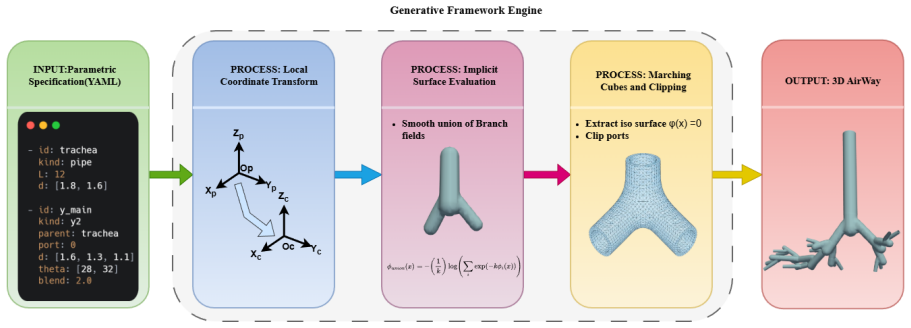
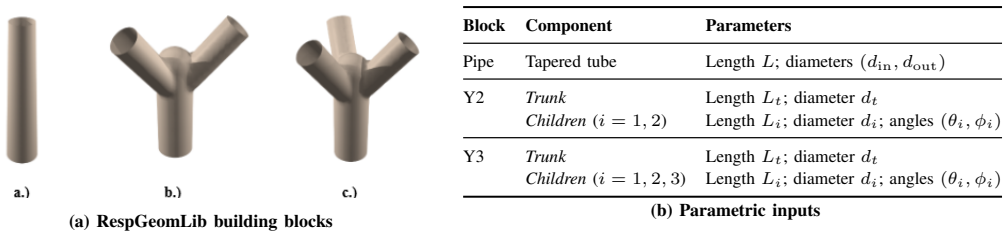
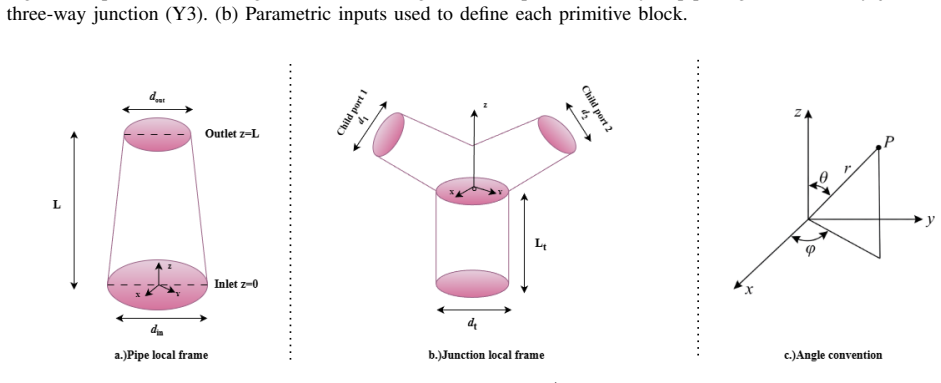
RespGeomLib is a reproducible parametric engine that generates analysis-ready human airway lumen surfaces from compact YAML specifications by combining port-based assembly with implicit smooth-min junction blending, analytic segments, and local implicit extraction around bifurcations instead of whole-tree voxelization.
What carries the argument
Port-based assembly combined with implicit smooth-min junction blending and local implicit extraction around bifurcations, which produces seamless surfaces without full-tree voxelization.
If this is right
- Reproducible airway models can be created from compact YAML files for consistent morphometry across studies.
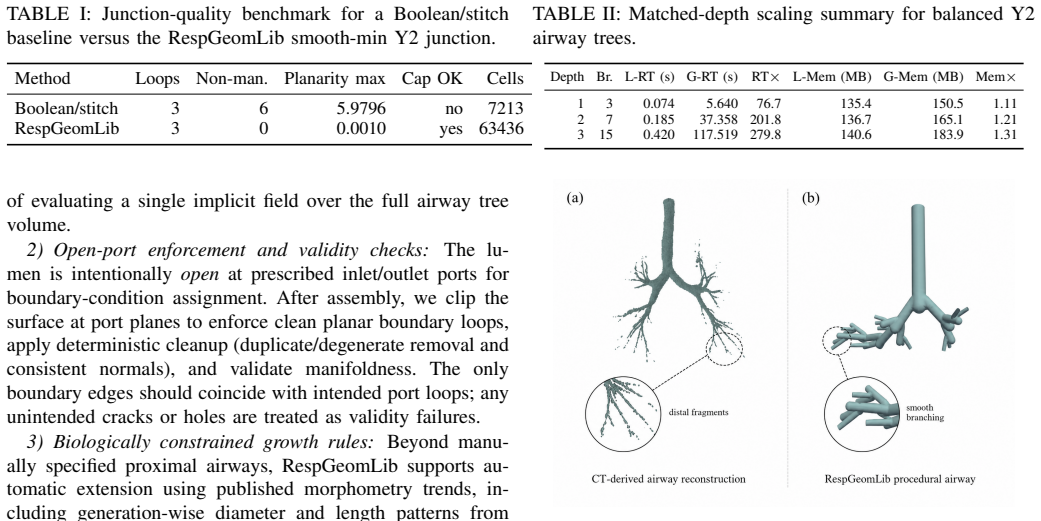
- Junction quality improves over stitched or Boolean baselines, supporting higher-accuracy airflow simulations.
- Reduced memory and runtime allow processing of larger or more branched airway trees.
- Parameter changes in the YAML input enable controlled generation of synthetic airway variants.
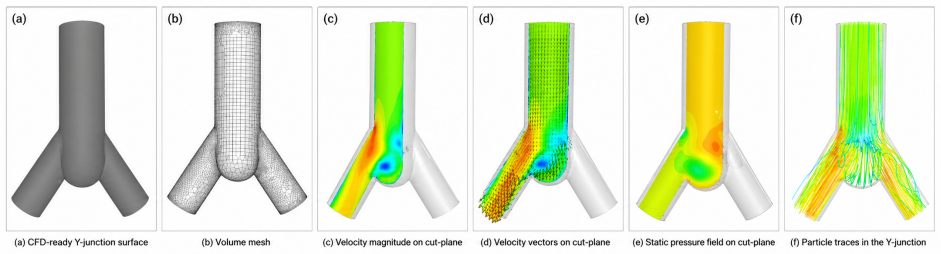
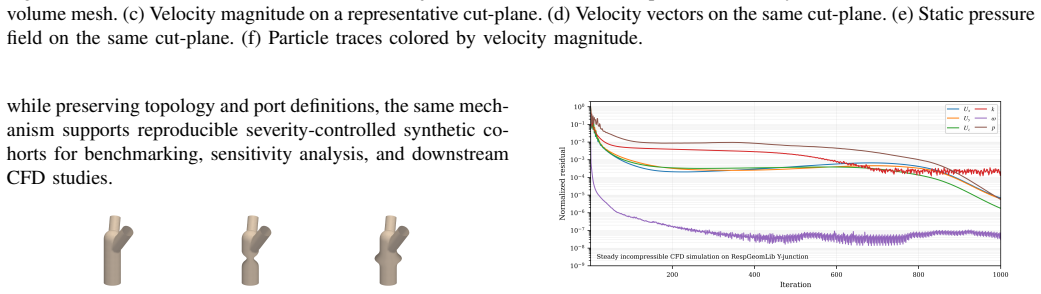
- Direct CFD export produces meshes that run stable simulations without extra cleanup steps.
Where Pith is reading between the lines
- The local extraction technique could apply to other tubular branched systems such as vascular networks.
- If faithfulness holds, the method might reduce dependence on patient CT scans for initial research models.
- The YAML-driven approach could support automated optimization loops that tune tree parameters to target morphometric statistics.
- Wider testing across multiple CT datasets would be required to confirm performance on varied real anatomies.
Load-bearing premise
The generated parametric surfaces are sufficiently faithful to real CT-derived airway anatomy and produce stable CFD results without additional validation or parameter tuning for each tree.
What would settle it
A side-by-side CFD simulation on RespGeomLib-generated models versus high-resolution CT-derived models that shows large differences in flow rates or wall shear stress under identical boundary conditions would falsify the claim.
Figures
read the original abstract
CT-derived airway models support pulmonary morphometry and airflow simulation, but are often limited by distal scan resolution and the need for substantial cleanup near bifurcations. Procedural alternatives are reproducible, yet many rely on stitched tubular primitives that introduce non-smooth junctions and poorly defined open boundaries. We present RespGeomLib, a reproducible parametric engine for generating analysis-ready human airway lumen surfaces from compact YAML specifications. The framework combines port-based assembly with implicit smooth-min junction blending to produce seamless junctions, while avoiding full-tree voxelization through analytic segments and local implicit extraction around bifurcations. Quantitatively, RespGeomLib yields cleaner junctions than a Boolean/stitch baseline and is substantially faster and more memory-efficient than whole-tree global implicit extraction. We further demonstrate morphometry-guided tree generation, controlled synthetic airway variants, and CFD-ready export with stable airflow simulation. RespGeomLib targets biomedical workflows requiring reproducible morphometry, controlled synthetic variants, and simulation-ready lumen geometry. The code is publicly available at https://nichula01.github.io/Respgeomlib/
Editorial analysis
A structured set of objections, weighed in public.
Referee Report
Summary. The manuscript presents RespGeomLib, a reproducible parametric engine for generating analysis-ready human airway lumen geometries from compact YAML specifications. It employs port-based assembly combined with analytic segments and local implicit extraction using smooth-min blending around bifurcations to achieve seamless junctions without requiring full-tree voxelization. The work claims that this approach produces cleaner junctions than a Boolean/stitch baseline and is substantially faster and more memory-efficient than whole-tree global implicit extraction, while also demonstrating applications in morphometry-guided tree generation, synthetic variants, and CFD-ready export with stable simulations.
Significance. If the reported performance advantages hold under controlled comparisons, RespGeomLib would offer a practical, reproducible tool for biomedical workflows involving pulmonary morphometry and airflow simulation. The public availability of the code provides an independent verification path, which strengthens the contribution in the area of procedural geometry generation for medical applications.
minor comments (1)
- [Abstract] Abstract: The abstract asserts quantitative superiority in junction cleanliness, speed, and memory efficiency but does not include specific numerical results, error bars, dataset details, or statistical tests. Including key metrics or referring to a results table would improve the abstract's informativeness.
Simulated Author's Rebuttal
We thank the referee for the positive summary of RespGeomLib, the assessment of its significance, and the recommendation for minor revision. No specific major comments were provided in the report.
Circularity Check
No significant circularity
full rationale
The paper describes a software library implementing port-based assembly, analytic segments, and local implicit extraction with smooth-min blending for airway geometry generation. No equations, fitted parameters, or derivation chain are presented that could reduce any performance claim to a self-referential definition or input. The quantitative comparisons (cleaner junctions vs. Boolean baseline; faster/lower-memory than global implicit) are stated as outcomes of the explicit construction rather than predictions derived from the same data or prior self-citations. This is a standard engineering implementation paper with an independent verification path via released code; no load-bearing self-citation or ansatz smuggling is present.
Axiom & Free-Parameter Ledger
Reference graph
Works this paper leans on
-
[1]
Quantitative analysis of pulmonary airway tree structures,
P. K ´alm´an, “Quantitative analysis of pulmonary airway tree structures,” Computers in Biology and Medicine, vol. 36, no. 9, p. 974–996, sep 2006. [Online]. Available: http://dx.doi.org/10.1016/j.compbiomed. 2005.05.004
-
[2]
Airway remodeling in chronic obstructive pulmonary disease: characteristics and opportunities,
Pan, “Airway remodeling in chronic obstructive pulmonary disease: characteristics and opportunities,”Frontiers in Medicine, vol. 12, jul
-
[3]
Available: http://dx.doi.org/10.3389/fmed.2025.1556868
[Online]. Available: http://dx.doi.org/10.3389/fmed.2025.1556868
-
[4]
Clinical relevance of airway remodelling in airway diseases,
A. L. James and S. Wenzel, “Clinical relevance of airway remodelling in airway diseases,”European Respiratory Journal, vol. 30, no. 1, p. 134–155, jul 2007. [Online]. Available: http: //dx.doi.org/10.1183/09031936.00146905
-
[5]
Computational fluid dynamics modeling of aerosol particle transport through lung airway mucosa,
B. A. Bartlett, Y . Feng, C. A. Fromen, and A. N. Ford Versypt, “Computational fluid dynamics modeling of aerosol particle transport through lung airway mucosa,”Computers & amp; Chemical Engineering, vol. 179, p. 108458, nov 2023. [Online]. Available: http://dx.doi.org/10.1016/j.compchemeng.2023.108458
-
[6]
Computational fluid dynamics simulation of aerosol transport and deposition,
Y . Tang and B. Guo, “Computational fluid dynamics simulation of aerosol transport and deposition,”Frontiers of Environmental Science & amp; Engineering in China, vol. 5, no. 3, p. 362–377, aug 2011. [Online]. Available: http://dx.doi.org/10.1007/s11783-011-0365-8
-
[7]
Lung ct image segmentation: A generalized framework based on u-net architecture and preprocessing models,
W. M. Salama and M. H. Aly, “Lung ct image segmentation: A generalized framework based on u-net architecture and preprocessing models,” pp. 141–146, 2021
2021
-
[8]
Automated lung segmentation on chest computed tomography images with extensive lung parenchymal abnormalities using a deep neural network,
Yoo, “Automated lung segmentation on chest computed tomography images with extensive lung parenchymal abnormalities using a deep neural network,”Korean Journal of Radiology, vol. 22, no. 3, p. 476,
-
[9]
Available: http://dx.doi.org/10.3348/kjr.2020.0318
[Online]. Available: http://dx.doi.org/10.3348/kjr.2020.0318
-
[10]
K. Miranda, “Quantitative ct scan imaging of the airways for diagnosis and management of lung disease,”CHEST, vol. 164, no. 5, p. 1150–1158, nov 2023. [Online]. Available: http://dx.doi.org/10.1016/j. chest.2023.02.044
work page doi:10.1016/j 2023
-
[11]
Morphometry of the human lung,
R. J. Lorenz, “Morphometry of the human lung,”Biometrische Zeitschrift, vol. 8, no. 1, pp. 143–144, 1966, review of the book by E. R. Weibel, Springer-Verlag, 1963. [Online]. Available: http://dx.doi.org/10.1002/bimj.19660080155
-
[12]
Human respiratory tract model for radiological protection,
D. M. Taylor, “Human respiratory tract model for radiological protection,”Journal of Radiological Protection, vol. 16, no. 1, mar
-
[13]
Available: http://dx.doi.org/10.1088/0952-4746/16/1/013
[Online]. Available: http://dx.doi.org/10.1088/0952-4746/16/1/013
-
[14]
Generation of an anatomically based three-dimensional model of the conducting airways,
T. M., “Generation of an anatomically based three-dimensional model of the conducting airways,”Annals of Biomedical Engineering, vol. 28, no. 7, p. 793–802, jul 2000. [Online]. Available: http: //dx.doi.org/10.1114/1.1289457
-
[15]
Influence of morphological parameters on the flow development within human airways,
Espinosa-Moreno, “Influence of morphological parameters on the flow development within human airways,”Fluids, vol. 8, no. 3, p. 78, feb
-
[16]
Available: http://dx.doi.org/10.3390/fluids8030078
[Online]. Available: http://dx.doi.org/10.3390/fluids8030078
-
[17]
A generalization of algebraic surface drawing,
Blinn, “A generalization of algebraic surface drawing,”ACM SIGGRAPH Computer Graphics, vol. 16, no. 3, p. 273, jul 1982. [Online]. Available: http://dx.doi.org/10.1145/965145.801290
-
[18]
Data structure for soft objects,
Wyvill, “Data structure for soft objects,”The Visual Computer, vol. 2, no. 4, pp. 227–234, aug 1986
1986
-
[19]
W. E. Lorensen and H. E. Cline, “Marching cubes: A high resolution 3d surface construction algorithm,”ACM SIGGRAPH Computer Graphics, vol. 21, no. 4, p. 163–169, aug 1987. [Online]. Available: http://dx.doi.org/10.1145/37402.37422
discussion (0)
Sign in with ORCID, Apple, or X to comment. Anyone can read and Pith papers without signing in.