REVIEW 3 major objections 4 minor 50 references
Long-time asymptotics for the integrable nonlocal focusing nonlinear Schr\"odinger equation for a family of step-like initial data
T0 review · 3 major / 4 minor · reviewed 2026-08-14 · deepseek-v4-flash
Pith's one-line read The paper proves that the long-time profile of the nonlocal focusing NLS equation with shifted step-like data splits into 4n+2 alternating sectors of decay and nonzero constants, with constants set by the spectral data.
desk verdict Solid result for the exact shifted step, with an overreaching 'close to' claim that the proof does not actually cover — referee it, but require a scope fix or a perturbation argument. read the letter →
The pith
A machine-rendered reading of the paper's core claim, the machinery that carries it, and where it could break.
The reading
What carries the argument
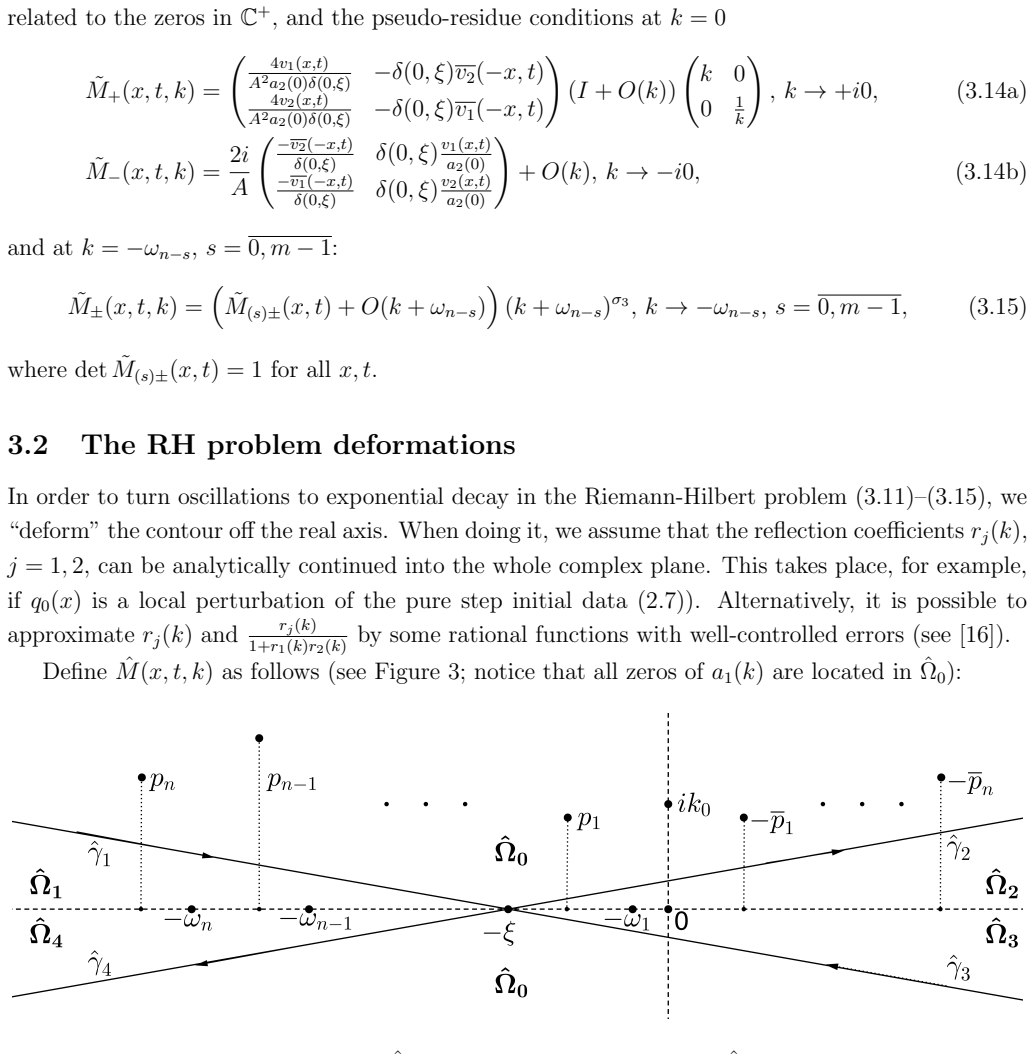
The central object is the solution $M(x,t,k)$ of a $2\times2$ matrix Riemann–Hilbert problem on the real $k$-axis, whose $12$-entry at large $k$ gives $q(x,t)$. Two mechanisms carry the argument. First, a scalar multiplier $\delta(k,\xi)$ is assembled from partial Cauchy integrals over the intervals between consecutive winding points $-\omega_{n-s}$, chosen so that its jump absorbs $1+r_1(k)r_2(k)$ on $(-\infty,-\xi)$ and, crucially, so that $\operatorname{Im}\nu(-\xi)\in(-1/2,1/2)$; this makes the deformed jump matrices converge to the identity as $t\to\infty$. Second, rational factors $\prod_{s=0}^{m-1}((k+\omega_{n-s})/(k-p_{n-s}))^{\sigma_3}$ are inserted to remove the singularities at $k=-\omega_{n-s}$ and to turn the exponentially growing residue conditions at the zeros $p_{n-s}$ into decaying ones. At the stationary phase point $k=-\xi$, a local model problem is solved explicitly with parabolic cylinder functions, which supplies the constants $\alpha_j(\xi)$ and the power corrections.
What would settle it
Compute the scattering coefficient $a_1(k)$ for $q_0(x)=A H(x-R)+\varepsilon e^{-x^2}$ with a small $\varepsilon$; if the zero count in $\mathbb{C}^+$ or the winding integrals (2.33) change, the predicted $4n+2$ sector structure fails. A complementary check is to simulate the NNLS equation numerically from the exact shifted step and compare the plateau constants on each ray with the formula (3.37).
Extended reading notes
Core claim
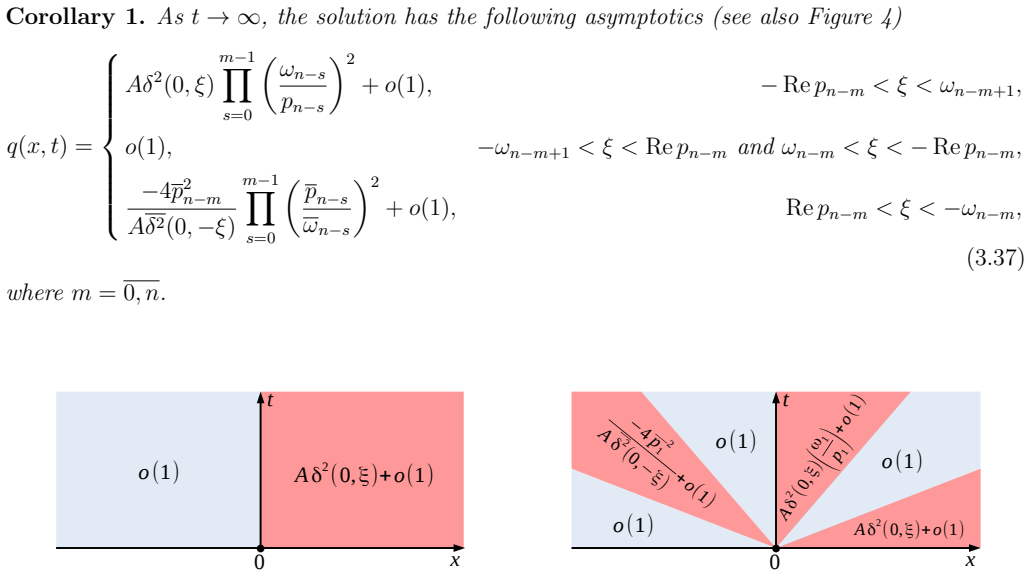
On the paper's own terms, the discovery is Corollary 1 / eq. (3.37): for each $m=0,\dots,n$, the sectors $-\operatorname{Re} p_{n-m}<\xi<\omega_{n-m+1}$ have $q(x,t)=A\delta^2(0,\xi)\prod_{s=0}^{m-1}(\omega_{n-s}/p_{n-s})^2+o(1)$, the sectors $-\omega_{n-m+1}<\xi<-\operatorname{Re} p_{n-m}$ and $\omega_{n-m}<\xi<-\operatorname{Re}p_{n-m}$ have $q(x,t)=o(1)$, and the sectors $\operatorname{Re}p_{n-m}<\xi<-\omega_{n-m}$ have $q(x,t)=-4p_{n-m}^2/(A\delta^2(0,-\xi))\prod_{s=0}^{m-1}(p_{n-s}/\omega_{n-s})^2+o(1)$. The refined Theorem 1 replaces each $o(1)$ by the leading algebraic terms of order $t^{-1/2\pm\operatorname{Im}\nu}$ with constants expressed through parabolic cylinder functions. Here $p_j$ are the zeros of the spectral function $a_1(k)$ in the upper half-plane, $\omega_j$ are the points where the accumulated argument of $a_1 a_2$ crosses odd multiples of $\pi$, and $\delta$ is the scalar factor created by deforming the Riemann–Hilbert problem.
Load-bearing premise
The whole construction rests on the assumption that small perturbations of the exact shifted step keep the same number of discrete-spectrum points and the same winding of the spectral argument, a property that is proved only for the exact step itself.
Editorial extensions
If this is right
- For each fixed $A$ and $R$, the asymptotic landscape is completely determined by the spectral data of the initial profile: no further PDE evolution is needed to predict the leading behavior along any ray.
- Increasing $R$ across $(2n+1)\pi/(2A)$ adds two new sectors, so the number of plateaus grows one step at a time as the step is moved farther from the origin.
- In the constant sectors the limit depends on $\xi=x/(4t)$, so two observers moving at different speeds in the same sector see different limiting amplitudes, not a single global constant.
- The algebraic corrections $t^{-1/2\pm\operatorname{Im}\nu}$ are slow enough that the constants are approached like weak powers of time, which makes the plateau visible but extremely slowly settling when $\operatorname{Im}\nu\approx 0$.
Reading between the lines
- A natural extension, not pursued in the paper, is to nonlocal mKdV or other PT-symmetric integrable equations: the same residue-absorption mechanism should produce analogous alternating plateau sectors once the step is shifted.
- Because the paper verifies Assumptions A only for the exact shifted step, the statement 'close to' carries an implicit stability conjecture; proving a Rouché-type perturbation theorem would either confirm the sector count for small perturbations or reveal that the plateau structure is nongeneric.
- The dependence of the plateaus on $\xi$ suggests a clean experimental signature: in a PT-symmetric optical setting, a scan of $|q|$ along a fixed line at large $t$ should show step-like jumps at the sector boundaries, with heights predicted by (3.37).
Signed reviews
Editorial analysis
A structured set of objections, weighed in public.
Referee Report
Summary. This paper considers the long-time asymptotics of solutions of the integrable nonlocal focusing nonlinear Schrödinger equation iq_t + q_xx + 2 q^2 \bar q(-x,t)=0 with step-like initial data. The advertised result is that when the initial profile is close to the shifted step A H(x-R), with R in ((2n-1)π/(2A),(2n+1)π/(2A)), the (x,t)-plane is divided into 4n+2 sectors, with alternating decay q=o(1) and nonzero constant limits; the constants and the subleading power-log corrections are given explicitly in terms of the scattering data. The main theorem (Theorem 1) is conditional on Assumptions A on the spectral functions, which include an ordering condition (2.32) and winding conditions (2.33). Proposition 2 verifies Assumptions A for the exact shifted step. The proof is based on the inverse scattering transform, a formulation of the problem as a matrix Riemann-Hilbert problem with residues, and a nonlinear steepest descent analysis with a parabolic cylinder local parametrix taken from the authors' earlier paper [42].
Significance. If the asymptotic formulae are correct, the paper gives a concrete illustration of the lack of translation invariance of the NNLS equation: the sector structure itself changes with the location R of the step. Its strengths are the explicit formulas for the leading constants and the precise power-law rates, which make the predictions readily checkable, and the fact that the abstract sector count is tied to winding properties of the scattering data rather than to adjustable parameters. The paper is nevertheless a reduction to a known steepest-descent scheme rather than a fully self-contained proof, and the advertised 'family of step-like initial data close to the shifted step' is not shown to satisfy the assumptions under which the theorem is proved.
major comments (3)
- [Assumptions A / Proposition 2] Theorem 1 is stated under Assumptions A, but Assumptions A(b) (the ordering (2.32) and the winding conditions (2.33)) are verified in Proposition 2 only for the exact shifted-step initial data (2.7), and only in the open interval ((2n-1)π/(2A),(2n+1)π/(2A)). The abstract and introduction advertise data 'close to the shifted step', but no perturbation lemma is given showing that small perturbations preserve (a) the number and simplicity of the zeros of a1 in C+, (b) the ordering Re p_n < -ω_n < ... < Re p_1 < -ω_1 < 0 in (2.32), and (c) the exact values of the winding integrals (2.33). This stability is not automatic: the winding integrals end at spectral-data-dependent points, so a small change of data can in principle change the value of the integral. Since Remark 8 and Proposition 3 show that the sector decomposition relies essentially on this ordering and on the residues growing in specific columns, the advertised class of initial data is not covered by the proof. The authors should either prove such a stability result with a quantitative notion of closeness, or restate the main theorem and abstract for initial data satisfying Assumptions A.
- [§3.2, Proposition 3 and Sketch of proof of Theorem 1] Proposition 3 is central because it converts the full Riemann-Hilbert problem to the model problems (3.25) and (3.27), yet its proof 'ignores' exponentially decaying residue conditions and parts of the jump matrix without giving an explicit error bound for (3.23)-(3.24). The sketch of Theorem 1 likewise imports the parabolic cylinder parametrix and the remainder estimates from [42]; however, the present problem contains m singular points -ω_{n-s}, 2n+1 growing/decaying residue conditions, and an additional residue at k=0, and the constants α_j contain factors (ξ+p_{n-s})^{-2} or (p_{n-s}-ξ)^{-2}. It is therefore not immediate that the estimates of [42] remain uniform as ξ approaches the sector boundaries Re p_{n-m} and ω_{n-m}, where those factors degenerate. A rigorous derivation of the remainders R_j(ξ,t) in (3.42)-(3.43), or a precise statement of the conditions under which the estimates of [42] apply verbatim, is needed.
- [§3.2, paragraph before Eq. (3.16)] The deformation of the Riemann-Hilbert problem from the real axis to the cross Γ assumes that the reflection coefficients r1 and r2 can be analytically continued into the whole complex plane, but this hypothesis does not appear in the statement of Theorem 1. The proof therefore does not cover all data satisfying Assumptions A unless the rational approximation mentioned in the text is carried out with uniform error estimates. The theorem should either include analytic continuation as an explicit hypothesis, or the proof should supply the approximation argument in detail.
minor comments (4)
- [Corollary 1, eq. (3.37)] The sector inequalities mix ξ and -ξ without indicating which variable is used; for ξ>0, intervals such as -ω_{n-m+1}<ξ<Re p_{n-m} are empty, while the intended interval in the first line is -Re p_{n-m}<ξ<ω_{n-m+1}. Please rewrite the sectors in terms of a single variable, or state explicitly the symmetry that covers ξ<0.
- [Section 1] 'Steepest decent' should read 'steepest descent' in the two places where it appears.
- [References] The statement of Theorem 1 from the authors' earlier paper [43] is cited but not summarized; since the present paper compares its results with that theorem, a brief statement of the comparison would help the reader.
- [Proposition 2(iii)] The endpoint case R=(2n+1)π/(2A) is excluded from Theorem 1, but the statement of Proposition 2(iii) does not explain how the extra real zeros ±A/2 interact with the ordering (2.32); a sentence making clear that the open interval is essential would prevent confusion.
Circularity Check
No circularity: the asymptotic constants and sector structure are explicit functionals of the scattering data, and the steepest-descent estimates cited from prior work are independent technical support.
full rationale
The derivation is self-contained in the relevant sense: no parameter is fitted to the predicted quantities. The sector constants in Corollary 1 and Theorem 1, e.g. Aδ²(0,ξ)∏(ω/p)² and −4p²/(Aδ²(0,−ξ))∏(p/ω)², are built explicitly from the spectral data through the scalar function δ, the model RH solution, and the parabolic-cylinder parametrix; they are not inputs to the analysis. Assumption A is a hypothesis on the scattering data (zero count, ordering, winding), not a consequence of the conclusion; Proposition 2 verifies it for the exact shifted step, and the absence of an explicit stability proof for perturbations of the shifted step is a hypothesis-coverage gap, not a circular reduction. The proof relies on the authors' prior papers [42] and [43] for the IST formalism and nonlinear steepest descent estimates, but those are parameter-free prior works with stated assumptions that do not include the shifted-step sector asymptotics, and citing them for standard estimates is legitimate independent support under the reviewing rules. No step reduces, by construction or by self-citation, to its own inputs.
Assumptions & free parameters
assumptions (6)
- domain assumption The solution q(x,t) of (1.1) exists for all t>0 and satisfies the boundary conditions (1.2).
- domain assumption Assumptions A(a-1): a1(k) has 2n+1 simple zeros in C+ at ik0 and ±p_j with Im p_j>0 and Re p_n < ... < Re p_1 <0; (a-2): a2(k) has no zeros in C-.
- domain assumption Assumptions A(b): the ordering (2.32) and winding conditions (2.33) hold for m=0..n.
- domain assumption The reflection coefficients r1 and r2 admit analytic continuation to the complex plane, or can be approximated by rational functions with controlled error.
- standard math The parabolic cylinder parametrix solves the model RH problem and the remainder estimates of [42] apply.
- standard math The scattering formalism of [43] (Proposition 1) applies to the NNLS step-like problem.
Cite this review
Pith. "Pith review of Long-time asymptotics for the integrable nonlocal focusing nonlinear Schr\"odinger equation for a family of step-like initial data." pith.science (2026). https://pith.science/paper/Y2DJBFNQ
@misc{pith2026190806415,
  author       = {Pith},
  title        = {Pith review of: Long-time asymptotics for the integrable nonlocal focusing nonlinear Schr\"odinger equation for a family of step-like initial data},
  year         = {2026},
  howpublished = {\url{https://pith.science/paper/Y2DJBFNQ}},
  note         = {Machine review of arXiv:1908.06415}
}
abstract
We study the Cauchy problem for the integrable nonlocal focusing nonlinear Schr\"odinger (NNLS) equation $ iq_{t}(x,t)+q_{xx}(x,t)+2 q^{2}(x,t)\bar{q}(-x,t)=0 $ with the step-like initial data close to the ``shifted step function'' $\chi_R(x)=AH(x-R)$, where $H(x)$ is the Heaviside step function, and $A>0$ and $R>0$ are arbitrary constants. Our main aim is to study the large-$t$ behavior of the solution of this problem. We show that for $R\in\left(\frac{(2n-1)\pi}{2A},\frac{(2n+1)\pi}{2A}\right)$, $n=1,2,\dots$, the $(x,t)$ plane splits into $4n+2$ sectors exhibiting different asymptotic behavior. Namely, there are $2n+1$ sectors where the solution decays to $0$, whereas in the other $2n+1$ sectors (alternating with the sectors with decay), the solution approaches (different) constants along each ray $x/t=const$. Our main technical tool is the representation of the solution of the Cauchy problem in terms of the solution of an associated matrix Riemann-Hilbert problem and its subsequent asymptotic analysis following the ideas of nonlinear steepest descent method.
Figures


Figures from the paper (2 more)
Reference graph
Works this paper leans on
-
[42]
Ya. Rybalko, D. Shepelsky, Long-time asymptotics for the integrable nonlocal nonlinear Schr¨ odinger equation,J. Math. Phys. 60 031504 (2019)
work page 2019
-
[1]
M. J. Ablowitz and H. Segur, Solitons and Inverse Scattering Transform (SIAM, Philadelphia, 1981)
work page 1981
-
[2]
M. J. Ablowitz, B.-F. Feng, X.-D. Luo, Z. H. Musslimani, General soliton solution to a nonlocal nonlinear Schr¨ odinger equation with zero and nonzero boundary conditions, Nonlinearity 31 5385 (2018)
work page 2018
-
[3]
M. J. Ablowitz, D. J. Kaup, A. C. Newell, and H. Segur, The Inverse Scattering Transform- Fourier Analysis for Nonlinear Problems, Stud. Appl. Math. 53, 249-315 (1974)
work page 1974
-
[4]
M. J. Ablowitz, X.-D. Luo and J. Cole, Solitons, the Korteweg-de Vries equation with step boundary values, and pseudo-embedded eigenvalues, J. Math. Phys. 59 091406 (2018)
work page 2018
-
[5]
M. J. Ablowitz and Z. H. Musslimani, Integrable nonlocal nonlinear Schr¨ odinger equation,Phys. Rev. Lett. 110 064105 (2013)
work page 2013
-
[6]
M. J. Ablowitz and Z. H. Musslimani, Inverse scattering transform for the integrable nonlocal nonlinear Schr¨ odinger equation,Nonlinearity 29 (2016), 915–946
work page 2016
-
[7]
K. Andreiev, I. Egorova, T. L. Lange and G. Teschl, Rarefaction waves of the Korteweg-de Vries equation via nonlinear steepest descent, J. Differential Equations , 261 (2016) 5371–5410. 26
work page 2016
Show all 50 references
-
[8]
C. M. Bender and S. Boettcher, Real spectra in non-Hermitian Hamiltonians having P-T sym- metry, Phys. Rev. Lett. 80 (1998), 5243
1998
-
[9]
Biondini, E
G. Biondini, E. Fagerstrom, B. Prinari, Inverse scattering transform for the defocusing nonlinear Schr¨ odinger equation with fully asymmetric non-zero boundary conditions,Physica D: Nonlinear Phenomena, 333 (2016), 117–136
2016
-
[10]
Biondini, G
G. Biondini, G. Kovacic, Inverse scattering transform for the focusing nonlinear Schr¨ odinger equation with nonzero boundary conditions, J. Math. Phys. 55 031506 (2014)
2014
-
[11]
Bludov, V
Yu. Bludov, V. Konotop, B. Malomed, Stable dark solitons in PT-symmetric dual-core waveg- uides, Phys. Rev. A 87 013816 (2013)
2013
-
[12]
Boutet de Monvel, V
A. Boutet de Monvel, V. P. Kotlyarov and D. Shepelsky, Focusing NLS Equation: Long-Time Dynamics of Step-Like Initial Data,International Mathematics Research Notices, 7, (2011) 1613- 1653
2011
-
[13]
Brody, PT-symmetry, indefinite metric, and nonlinear quantum mechanics, J
D.C. Brody, PT-symmetry, indefinite metric, and nonlinear quantum mechanics, J. Phys. A: Math. Theor. 50 485202 (2017)
2017
-
[14]
Buckingham and S
R. Buckingham and S. Venakides, Long-time asymptotics of the nonlinear Schr¨ odinger equation shock problem, Comm. Pure Appl. Math. 60 (2007), 1349–1414
2007
-
[15]
Chen, D.J
K. Chen, D.J. Zhang, Solutions of the nonlocal nonlinear Schr¨ odinger hierarchy via reduction, Appl. Math. Lett. , 75 (2018) 82-88
2018
-
[16]
P. A. Deift, A. R. Its and X. Zhou, Long-time asymptotics for integrable nonlinear wave equa- tions. In Important developments in Soliton Theory 1980-1990 , edited by A. S. Fokas and V. E. Zakharov, New York: Springer, 181–204, 1993
1980
-
[17]
Kamvissis, T
Deift P, S. Kamvissis, T. Kriecherbauer, X. Zhou, The Toda rarefaction problem, Communica- tions on Pure and Applied Mathematics , Vol. XLIX, 35-83, 1996
1996
-
[18]
P. A. Deift, S. Venakides, and X. Zhou, The collisionless shock region for the long-time behavior of solutions of the KdV equation, Communications on Pure and Applied Mathematics 47, no. 2 (1994), 199–206
1994
-
[19]
P. A. Deift, S. Venakides, and X. Zhou, New results in small dispersion KdV by an extension of the steepest descent method for Riemann–Hilbert problems,International Mathematics Research Notices, no. 6 (1997), 286–99
1997
-
[20]
P. A. Deift and X. Zhou, A steepest descend method for oscillatory Riemann–Hilbert problems. Asymptotics for the MKdV equation, Ann. Math. 137, no. 2 (1993): 295–368
1993
-
[21]
Egorova, Z
I. Egorova, Z. Gladka, V. Kotlyarov and G. Teschl, Long-time asymptotics for the Korteweg-de Vries equation with steplike initial data, Nonlinearity, 26 (2013) 1839–1864. 27
2013
-
[22]
L. D. Faddeev and L. A. Takhtajan, Hamiltonian Methods in the Theory of Solitons . Springer Series in Soviet Mathematics. Springer-Verlag, Berlin, 1987
1987
-
[23]
A. S. Fokas, Integrable multidimensional versions of the nonlocal nonlinear Schr¨ odinger equation, Nonlinearity 29 (2016), 319–324
2016
-
[24]
A. S. Fokas, A.R. Its, A.A. Kapaev and V. Yu. Novokshenov, Painleve Transcendents. The Riemann–Hilbert Approach, AMS, 2006
2006
-
[25]
Gadzhimuradov and A
T. Gadzhimuradov and A. Agalarov, Towards a gauge-equivalent magnetic structure of the nonlocal nonlinear Schr¨ odinger equation, Phys. Rev. A, 93, 062124 (2016)
2016
-
[26]
V. S. Gerdjikov and A. Saxena, Complete integrability of nonlocal nonlinear Schr¨ odinger equa- tion, J. Math. Phys. 58 (2017) 013502
2017
-
[27]
A. V. Gurevich, L. P. Pitaevskii, Nonstationary structure of a collisionless shock wave, Zhurnal Eksperimental’noi i Teoreticheskoi Fiziki 65 590-604 (1973)
1973
-
[28]
G¨ urses, A
M. G¨ urses, A. Pekcan, Nonlocal nonlinear Schr¨ odinger equations and their soliton solutions,J. Math. Phys. 59 051501 (2018)
2018
-
[29]
Jenkins, Regularization of a sharp shock by the defocusing nonlinear Schr¨ odinger equation, Nonlinearity 28 (2015) 2131–2180
R. Jenkins, Regularization of a sharp shock by the defocusing nonlinear Schr¨ odinger equation, Nonlinearity 28 (2015) 2131–2180
2015
-
[30]
F. He, E. Fan, J. Xu, Long-time asymptotics for the Nonlocal mKdV equation,arXiv:1804.10863 (2018)
2018 arXiv
-
[31]
E. J. Hruslov, Asymptotics of the solution of the cauchy problem for the Korteweg-de Vries equation with initial data of step type, Math. USSR-Sb. 28, 229–248 (1976)
1976
-
[32]
A. R. Its, Asymptotic behavior of the solutions to the nonlinear Schr¨ odinger equation, and isomonodromic deformations of systems of linear differential equations, Doklady Akad. Nauk SSSR 261, no. 1 (1981), 14–18
1981
-
[33]
V. V. Konotop, J. Yang and D. A. Zezyulin, Nonlinear waves in PT-symmetric systems, Rev. Mod. Phys. 88, 035002 (2016)
2016
-
[34]
V. P. Kotlyarov and E. Ya. Khruslov, Solitons of the nonlinear Schr¨ odinger equation, which are generated by the continuous spectrum, Teoreticheskaya i Matematicheskaya Fizika 68, no. 2 (1986), 172–86
1986
-
[35]
Kotlyarov, A.M
V.P. Kotlyarov, A.M. Minakov, Riemann–Hilbert problem to the modified Korteveg–deVries equation: Long-time dynamics of the step-like initial data, J. Math. Phys. 51 (2010) 093506
2010
-
[36]
Lenells, The nonlinear steepest descent method for Riemann-Hilbert problems of low regu- larity, Indiana Univ
J. Lenells, The nonlinear steepest descent method for Riemann-Hilbert problems of low regu- larity, Indiana Univ. Math. 66 (2017), 1287–1332. 28
2017
-
[37]
S. V. Manakov, Nonlinear Fraunhofer diffraction, Zhurnal Eksperimental’noi i Teoreticheskoi Fiziki, Pis’ma v Redaktsiyu 65 (1973)
1973
-
[38]
Novikov, S
S. Novikov, S. V. Manakov, L. P. Pitaevskii, V. E. Zakharov, Theory of Solitons: The Inverse Scattering Method (1984) New York Consultants Bureau
1984
-
[39]
K. T.-R. McLaughlin, P. D. Miller, The ¯∂ steepest descent method and the asymptotic behavior of polynomials orthogonal on the unit circle with fixed and exponentially varying nonanalytic weights. Int. Math. Res. Pap. Art. ID 48673, 177 (2006)
2006
-
[40]
Michor and A
J. Michor and A. L. Sakhnovich, GBDT and algebro-geometric approaches to explicit solutions and wave functions for nonlocal NLS, J. Phys. A: Math. Theor. 52 025201 (2018)
2018
-
[41]
Onorato, A
M. Onorato, A. R. Osborne, and M. Serio, Modulational instability in crossing sea states: A possible mechanism for the formation of freak waves, Phys. Rev. Lett. 96, 014503 (2006)
2006
-
[43]
Rybalko, D
Ya. Rybalko, D. Shepelsky, Long-time asymptotics for the integrable nonlocal nonlinear Schr¨ odinger equation with step-like initial data,arXiv:1906.08489
1906 arXiv
-
[44]
Venakides, P
S. Venakides, P. Deift, R. Oba, The Toda shock problem, Comm. Pure Appl. Math. 44 (1991), 1171–1242
1991
-
[45]
P. S. Vinayagam, R. Radha, U. Al Khawaja, L. Ling, New classes of solutions in the coupled PT symmetric nonlocal nonlinear Schr¨ odinger equations with four wave mixing,Commun. Nonlinear Sci. Numer. Simulat. 59 387–395 (2018)
2018
-
[46]
Sarma, M
A. Sarma, M. Miri, Z. Musslimani, D. Christodoulides, Continuous and discrete Schr¨ odinger systems with parity-time-symmetric nonlinearities, Physical Review E 89 (2014)
2014
-
[47]
Yang, General N-solitons and their dynamics in several nonlocal nonlinear Schr¨ odinger equa- tions, Physics Letters A 383, 4 (2019), 328–337
J. Yang, General N-solitons and their dynamics in several nonlocal nonlinear Schr¨ odinger equa- tions, Physics Letters A 383, 4 (2019), 328–337
2019
-
[48]
Yang, Nonlinear Waves in Integrable and Nonintegrable Systems , SIAM, Philadelphia, 2010
J. Yang, Nonlinear Waves in Integrable and Nonintegrable Systems , SIAM, Philadelphia, 2010
2010
-
[49]
Znojil and D.I
M. Znojil and D.I. Borisov, Two patterns of PT-symmetry break- down in a non-numerical six-state simulation, Ann. Phys., NY 394 40-49, (2018)
2018
-
[50]
Yan, Integrable PT-symmetric local and nonlocal vector nonlinear Schr¨ odinger equations: A unified two-parameter model, Appl
Z. Yan, Integrable PT-symmetric local and nonlocal vector nonlinear Schr¨ odinger equations: A unified two-parameter model, Appl. Math. Lett. (2015) 29
2015
Reviewed August 14, 2026 · model on record in the stance chip above.
Discussion (0). Continue with ORCID to comment.