REVIEW 3 major objections 4 minor 25 references
FFI-VTR: Lightweight and Robust Visual Teach and Repeat Navigation based on Feature Flow Indicator and Probabilistic Motion Planning
T0 review · 3 major / 4 minor · reviewed 2026-08-06 · deepseek-v4-flash
Pith's one-line read The paper claims that visual teach-and-repeat navigation can be reduced to a scalar feature-flow minimization, letting a ground robot repeat a taught route and avoid obstacles without metric localization.
desk verdict A lightweight feature-flow-driven teach-and-repeat idea with public code, but the core derivation is shaky and the experiments are single-run, so it needs major revision before it can be trusted. read the letter →
The pith
A machine-rendered reading of the paper's core claim, the machinery that carries it, and where it could break.
The reading
What carries the argument
The central object is the feature flow indicator $f_{q|r}$, a single scalar equal to the mean signed horizontal pixel offset of matched features. It carries the argument because the teaching map is a keyframe graph with one flow value per edge, and the repeating controller turns the current flow into a probabilistic decision over three motion events using Gaussian kernels, then fuses that decision with LiDAR occupancy by scoring a precomputed set of robot trajectories.
What would settle it
Run the robot straight down a corridor whose visible texture lies almost entirely on one side of the camera image and measure $f_{q|r}$; if the flow is consistently large or changes sign with the textured side, the qualitative rule that near-zero flow indicates straight motion fails precisely in the regime the authors flag.
Extended reading notes
Core claim
The paper's load-bearing discovery is a qualitative motion indicator: for features matched between a query image and a reference keyframe, the quantity $f_{q|r} = \frac{1}{N}\sum_{i=1}^N (u_r^i - u_q^i)$ is approximately zero when the robot has moved straight, strongly positive when it has rotated left, and strongly negative when it has rotated right. This follows from a pinhole projection model in which straight motion produces signed pixel shifts that cancel when features are spread evenly across the image, while yaw rotation shifts all matched pixels in one direction. The paper turns this into a complete navigation system: the teaching phase stores a keyframe graph whose edges carry these flow values, and the repeating phase tracks a keyframe, computes flows to the current and next keyframes, converts them into probabilities for forward/left/right motion, and scores candidate trajectories against occupancy grids. The reported end-point distances on a real differential-drive platform show successful route completion with dynamic obstacles present, including cases where odometry-based baselines fail.
Load-bearing premise
The feature flow rule assumes that matched features are plentiful and spread roughly evenly across both halves of the image, so that the signed horizontal shifts cancel when the robot moves straight; the authors themselves note that their matched features are sparse and unevenly distributed, which biases the computed flow.
Editorial extensions
If this is right
- A teach-and-repeat system can operate without any metric pose estimate, so the map can be a compact keyframe graph storing images, features, and one flow number per edge.
- Route repeating degrades gracefully under occlusion: sparse feature matching plus obstacle-aware trajectory scoring lets the robot detour and rejoin the route rather than losing global localization.
- Endpoint repeat accuracy on the tested indoor and outdoor routes is competitive with or better than odometry-based baselines in static scenes and substantially better when dynamic objects block the path.
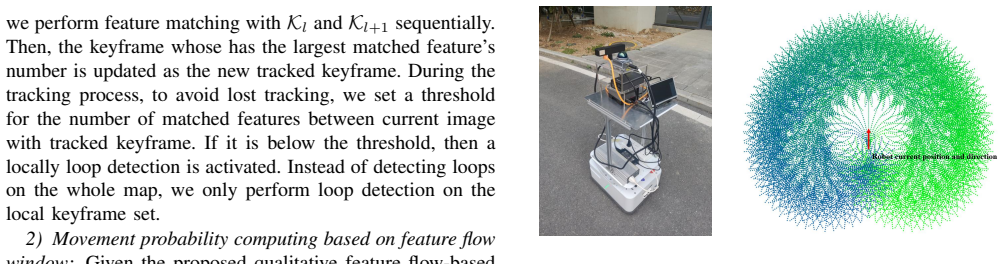
- The main computational load is feature extraction and matching, so the approach can run in real time on an embedded platform at moderate speed.
Reading between the lines
- The flow indicator is not tied to any particular feature extractor; any repeatable matcher could supply the correspondences, so the same mapping and planning layers could be tested with cheaper or more robust features than the one used here.
- The assumption that matched features are abundant and evenly distributed across the image is likely violated on routes where texture concentrates on one side; a corrected indicator using the matched features' centroid or covariance would give the planner a debiased signal in that regime.
- Because flow magnitude is proportional to yaw angle in the qualitative model, the discrete left/straight/right decision could be extended to continuous angular commands, potentially smoothing the trajectory and reducing repeated local direction adjustments.
- The keyframe graph representation could also be reused for global route selection by chaining flows along edges, connecting this local planner to topological map-based navigation.
Editorial analysis
A structured set of objections, weighed in public.
Referee Report
Summary. The paper presents FFI-VTR, a visual teach-and-repeat navigation system that avoids metric localization. The teaching phase builds a keyframe graph whose edges store a scalar feature flow f computed from XFeat matches; in the repeat phase, the robot tracks a map keyframe, computes feature flow between the current image and the next keyframes, converts the flow into probabilities for moving straight/left/right via Eq. (9), and selects a collision-free trajectory from a kinematically feasible candidate set using a 2D LiDAR occupancy grid. Experiments on a differential mobile robot in indoor and outdoor environments compare endpoint distance with QVTR and VT&R3 baselines, using iG-LIO as an independent evaluation odometer. The authors claim that visual repeating navigation can be formulated as feature-flow minimization without accurate localization or dense reconstruction.
Significance. If the underlying feature-flow indicator were reliable, the system would be a useful lightweight VTR solution, and the open-source code plus real-robot experiments are concrete strengths. The evaluation uses an independent LiDAR-inertial odometry for the endpoint metric, which avoids circularity in the headline result. However, the analytical derivation of the indicator rests on an unverified cancellation assumption that the authors themselves concede is violated by sparse XFeat matches, and the sign convention in Eq. (7) is inconsistent with Eqs. (3) and (6). The claimed robustness to biased feature flow is not quantified. These issues affect the load-bearing mechanism, so the paper needs substantial revision before the central claim can be accepted.
major comments (3)
- [Section III-B, Eq. (4)] The cancellation that supports Qualitative Rule 1 is not established for the actual feature set. The summand fx · xi · δ / (zi(zi − δ)) is depth-weighted, so even distribution of x does not imply cancellation unless positive and negative x features are paired with equal depth weights zi(zi − δ). Sparse XFeat matches, one-sided nearby objects, and dynamic occluders violate this condition, and the authors explicitly acknowledge in Section IV-D and the Conclusions that the computed feature flow is biased in their test environment. Because p(E=0) in Eq. (9) is maximized at f=0 and the turning events are selected by the sign of f, a biased f directly changes the movement decision. No measurement of the bias distribution or a sensitivity analysis over σ is provided, so the central mechanism of the system remains unquantified.
- [Section III-B, Eqs. (5)-(7)] The sign convention is internally inconsistent. Eq. (3) defines ∆u = u_q − u_r, and Eq. (6) states that a left rotation produces a positive ∆u. Eq. (7) then defines f_{q|r} = (1/N) Σ (u_r^i − u_q^i) = −mean(∆u), so a left turn should produce a negative f. This contradicts the text after Eq. (7), which says a large positive f means the robot is most likely going left, and it also contradicts Eq. (9), which uses I(f > 0) for the left-turn event. The authors need to fix the sign convention or explicitly define the rotation direction convention so that Qualitative Rule 2 and the planner's event mapping are consistent.
- [Section IV-D and Table I] The core robustness claim is supported only by qualitative plots and single-run endpoint distances. The statement that the probabilistic motion planning module is "highly robust" to biased feature flow is asserted immediately after admitting that the feature flow is biased in the test environment, but no experiment isolates the effect of the bias. In particular, there is no reporting of feature-flow statistics on straight segments, no ablation varying σ and σ_w (which are fixed at 20 and 2), and no repeated trials with statistical summary. Without such evidence, the reported success cannot be attributed to the feature-flow indicator rather than to the LiDAR-based obstacle avoidance and trajectory sampling.
minor comments (4)
- [Table I] The caption reads "END POINT DISTANCE OF THE BASELINES" but the table includes the proposed method's results; please correct the caption.
- [Section III-D1] There is a LaTeX rendering error in the phrase "For new imagemathcalIt+1,"; the math mode is not properly closed.
- [Eq. (11)] The scoring formula S(P_i) = 1 − sqrt(p/0.005 · θ_a) is not clearly typeset and the role of the constant 0.005 is unexplained; please clarify whether p is a probability and whether θ_a is in radians.
- [Throughout] There are several typographical errors that should be corrected, including "sersor", "flatted", "cloest", "Dominate reason", and "out repeating trajectory".
Circularity Check
No significant circularity; the feature-flow indicator is derived from projection geometry and the final endpoint evaluation uses independent LiDAR-inertial odometry, with only a non-load-bearing self-citation.
full rationale
The paper's central derivation is not circular. The feature-flow indicator f_{q|r} is defined directly from pixel-coordinate differences of matched features (Eq. 7), while Qualitative Rules 1 and 2 are obtained from the projective camera model (Eqs. 1-6), not from the target output. The straight-motion cancellation in Eq. 4 is an explicit symmetry assumption, and the paper's own Conclusions acknowledge its failure as a robustness limitation rather than a hidden reuse of the predicted quantity. The probabilities in Eq. 9 are hand-crafted transformations of the same feature-flow signal, explicitly called "fake probability" in the text; they are control inputs, not fitted predictions, and no parameter is learned from the endpoint-distance data. The only self-citation is iG-LIO [25], used "for evaluation only" to record trajectories and compute endpoint distance. It is from the corresponding author's group but is not part of the method's derivation, so it is a minor self-citation that is not load-bearing. Hand-set constants σ=20, σ_w=2, and the 0.005 factor in Eq. (11) are fixed design choices, not fitted values, so the experimental success is not constructed from the inputs. No circular step is exhibited: the headline result depends on an independent metric, namely endpoint distance measured under LiDAR-inertial odometry.
Assumptions & free parameters
free parameters (5)
- σ (feature flow variance, Eq. 9) =
20
- σ_w (keyframe window variance, Eq. 10) =
2
- Keyframe insertion feature-flow threshold
- Keyframe tracking-loss threshold (minimum inlier count)
- Trajectory scoring constant, Eq. (11) =
0.005
assumptions (4)
- domain assumption Robot moves on a ground plane so only x-axis feature flow is used
- ad hoc to paper Matched features are abundant and evenly distributed over the image x-axis
- domain assumption Depth change can be neglected for rotational displacement
- domain assumption Offline sampled trajectory set covers feasible robot motions
Cite this review
Pith. "Pith review of FFI-VTR: Lightweight and Robust Visual Teach and Repeat Navigation based on Feature Flow Indicator and Probabilistic Motion Planning." pith.science (2026). https://pith.science/paper/Y3LPH6LU
@misc{pith2026250712800,
  author       = {Pith},
  title        = {Pith review of: FFI-VTR: Lightweight and Robust Visual Teach and Repeat Navigation based on Feature Flow Indicator and Probabilistic Motion Planning},
  year         = {2026},
  howpublished = {\url{https://pith.science/paper/Y3LPH6LU}},
  note         = {Machine review of arXiv:2507.12800}
}
read the original abstract
Though visual and repeat navigation is a convenient solution for mobile robot self-navigation, achieving balance between efficiency and robustness in task environment still remains challenges. In this paper, we propose a novel visual and repeat robotic autonomous navigation method that requires no accurate localization and dense reconstruction modules, which makes our system featured by lightweight and robustness. Firstly, feature flow is introduced and we develop a qualitative mapping between feature flow and robot's motion, in which feature flow is defined as pixel location bias between matched features. Based on the mapping model, the map outputted by the teaching phase is represented as a keyframe graph, in which the feature flow on the edge encodes the relative motion between adjacent keyframes. Secondly, the visual repeating navigation is essentially modeled as a feature flow minimization problem between current observation and the map keyframe. To drive the robot to consistently reduce the feature flow between current frame and map keyframes without accurate localization, a probabilistic motion planning is developed based on our qualitative feature flow-motion mapping indicator. Extensive experiments using our mobile platform demonstrates that our proposed method is lightweight, robust, and superior to baselines. The source code has been made public at https://github.com/wangjks/FFI-VTR to benefit the community.
Figures


Figures from the paper (4 more)


Reference graph
Works this paper leans on
-
[24]
Krajnik, T., Majer, F., Halodova, L. & Vintr, T. Navigation without localisation: reliable teach and repeat based on the convergence theo- rem. 2018 IEEE/RSJ International Conference On Intelligent Robots And Systems (IROS) . pp. 1657-1664 (2018)
work page 2018
-
[1]
Vaswani, A., Shazeer, N., Parmar, N., Uszkoreit, J., Jones, L., Gomez, A., Kaiser, Ł. & Polosukhin, I. Attention is all you need. Advances In Neural Information Processing Systems . 30 (2017)
work page 2017
-
[2]
Zhang, L., Hao, X., Xu, Q., Zhang, Q., Zhang, X., Wang, P., Zhang, J., Wang, Z., Zhang, S. & Xu, R. MapNav: A Novel Memory Representation via Annotated Semantic Maps for VLM-based Vision- and-Language Navigation. ArXiv Preprint ArXiv:2502.13451 . (2025)
arXiv 2025
-
[3]
Chen, S., Guhur, P., Tapaswi, M., Schmid, C. & Laptev, I. Think global, act local: Dual-scale graph transformer for vision-and-language navigation. Proceedings Of The IEEE/CVF Conference On Computer Vision And Pattern Recognition . pp. 16537-16547 (2022)
work page 2022
-
[4]
Taioli, F., Rosa, S., Castellini, A., Natale, L., Del Bue, A., Farinelli, A., Cristani, M. & Wang, Y . Mind the error! detection and localization of instruction errors in vision-and-language navigation. 2024 IEEE/RSJ International Conference On Intelligent Robots And Systems (IROS) . pp. 12993-13000 (2024)
work page 2024
- [5]
-
[6]
Ren, Y ., Zhu, F., Lu, G., Cai, Y ., Yin, L., Kong, F., Lin, J., Chen, N. & Zhang, F. Safety-assured high-speed navigation for MA Vs. Science Robotics. 10, eado6187 (2025)
work page 2025
- [7]
Show all 25 references
-
[8]
& Kos, A
Raj, R. & Kos, A. Intelligent mobile robot navigation in unknown and complex environment using reinforcement learning technique. Scientific Reports. 14, 22852 (2024)
2024
-
[9]
& Fang, Z
Xu, P., Bai, Z., Liu, H. & Fang, Z. PARE: A Plane-Assisted Au- tonomous Robot Exploration Framework in Unknown and Uneven Ter- rain. 2024 IEEE/RSJ International Conference On Intelligent Robots And Systems (IROS) . pp. 11707-11714 (2024)
2024
-
[10]
& Croon, G
Dijk, T., De Wagter, C. & Croon, G. Visual route following for tiny autonomous robots. Science Robotics. 9, eadk0310 (2024)
2024
-
[11]
& Fischer, T
Nourizadeh, P., Milford, M. & Fischer, T. Teach and Repeat Naviga- tion: A Robust Control Approach. 2024 IEEE International Confer- ence On Robotics And Automation (ICRA) . pp. 2909-2916 (2024) Image at time t Image at time t+1 Tracked keyframe Tracked keyframe Dynamic Dynamic...
2024
-
[12]
& Others MPVO: Motion-Prior based Visual Odometry for PointGoal Navigation
Paul, S., Bhowmick, B. & Others MPVO: Motion-Prior based Visual Odometry for PointGoal Navigation. ArXiv Preprint ArXiv:2411.04796. (2024)
2024 arXiv
-
[13]
Montiel, J
Campos, C., Elvira, R., Rodr ´ıguez, J., M. Montiel, J. & D. Tard ´os, J. ORB-SLAM3: An Accurate Open-Source Library for Visual, Vi- sual–Inertial, and Multimap SLAM. IEEE Transactions On Robotics . 37, 1874-1890 (2021)
2021
-
[14]
& Barfoot, T
Furgale, P. & Barfoot, T. Visual teach and repeat for long-range rover autonomy. Journal Of Field Robotics . 27, 534-560 (2010)
2010
-
[15]
& Milford, M
Dall’Osto, D., Fischer, T. & Milford, M. Fast and robust bio-inspired teach and repeat navigation. 2021 IEEE/RSJ International Conference On Intelligent Robots And Systems (IROS) . pp. 500-507 (2021)
2021
-
[16]
& Reid, I
Garg, S., Rana, K., Hosseinzadeh, M., Mares, L., S ¨underhauf, N., Dayoub, F. & Reid, I. RoboHop: Segment-based Topological Map Representation for Open-World Visual Navigation. 2024 IEEE Inter- national Conference On Robotics And Automation (ICRA) . pp. 4090- 4097 (2024)
2024
-
[17]
& Nascimento, E
Potje, G., Cadar, F., Araujo, A., Martins, R. & Nascimento, E. Xfeat: Accelerated features for lightweight image matching. Proceedings Of The IEEE/CVF Conference On Computer Vision And Pattern Recognition. pp. 2682-2691 (2024)
2024
-
[18]
& Hsu, D
Loo, J. & Hsu, D. Scene Action Maps: Behavioural Maps for Navi- gation without Metric Information. ArXiv Preprint ArXiv:2405.07948. (2024)
2024 arXiv
-
[19]
& Soltani, I
CuiZhu, Z., Charette, F., Ghafourian, A., Shi, D., Cui, M., Krishna- machar, A. & Soltani, I. One-Shot Learning of Visual Path Navigation for Autonomous Vehicles. ArXiv Preprint ArXiv:2306.08865 . (2023)
2023 arXiv
-
[20]
& Reid, I
Garg, S., Rana, K., Hosseinzadeh, M., Mares, L., S ¨underhauf, N., Dayoub, F. & Reid, I. Robohop: Segment-based topological map representation for open-world visual navigation. ArXiv Preprint ArXiv:2405.05792. (2024)
2024 arXiv
-
[21]
& Soltani, I
Ghafourian, A., CuiZhu, Z., Shi, D., Chuang, I., Charette, F., Sachdeva, R. & Soltani, I. Hierarchical End-to-End Autonomous Navigation Through Few-Shot Waypoint Detection. IEEE Robotics And Automa- tion Letters. 9, 3211-3218 (2024)
2024
-
[22]
& Krajn ´ık, T
Rou ˇcek, T., Rozsyp ´alek, Z., Blaha, J., Ulrich, J. & Krajn ´ık, T. Predictive Data Acquisition for Lifelong Visual Teach, Repeat and Learn. IEEE Robotics And Automation Letters. 9, 10042-10049 (2024)
2024
-
[23]
& Krajnik, T
Rozsyp ´alek, Z., Roucek, T., Vintr, T. & Krajnik, T. Multidimensional particle filter for long-term visual teach and repeat in changing environments. IEEE Robotics And Automation Letters . 8, 1951-1958 (2023)
2023
-
[25]
& Xie, L
Chen, Z., Xu, Y ., Yuan, S. & Xie, L. iG-LIO: An Incremental GICP- Based Tightly-Coupled LiDAR-Inertial Odometry. IEEE Robotics And Automation Letters. 9, 1883-1890 (2024)
2024
Reviewed August 6, 2026 · model on record in the stance chip above.
Discussion (0). Continue with ORCID to comment.