HI Galaxy Science with the SKA
Pith reviewed 2026-06-26 03:46 UTC · model grok-4.3
The pith
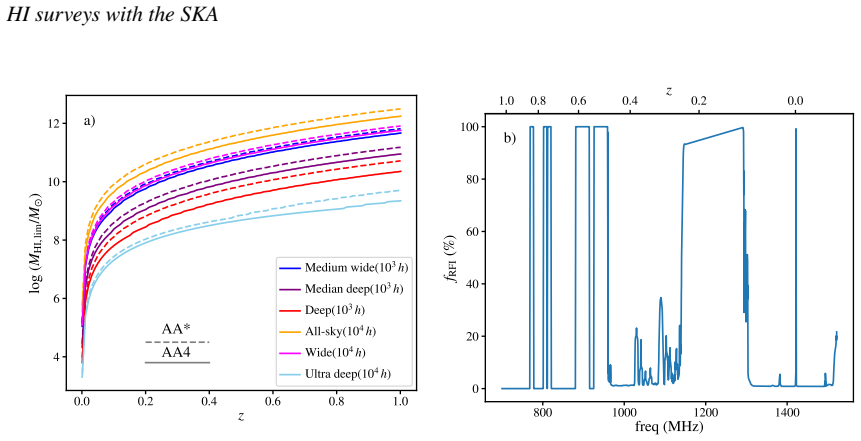
The SKA will enable complete censuses of HI morphologies at sub-kpc resolution and track cosmic HI mass density evolution to z~1.
A machine-rendered reading of the paper's core claim, the machinery that carries it, and where it could break.
Core claim
The key science enabled by the SKA consists of a complete census of HI morphologies and kinematics at sub-kpc and 1 km/s resolution within and around galaxies in the nearby universe, a measurement of the cosmic HI mass density and HI mass function evolution at least up to z~1, and an improved understanding of the universe at z>1 particularly the balance between cold molecular and cool atomic gas, all achieved through an updated three-tiered survey strategy.
What carries the argument
The three-tiered survey strategy with parameters adjusted for AA* and AA4 sensitivity and resolution levels, which structures the observations to deliver the listed science goals while exploiting synergies with southern-hemisphere multi-wavelength surveys from 2028 onward.
If this is right
- A clearer picture of gas accretion, consumption, and removal across a large fraction of cosmic time.
- Quantitative constraints on the effects of AGN and star-formation feedback on the gas reservoir.
- Direct comparison of atomic and molecular gas phases at z>1 to test models of the baryon cycle.
- Joint analysis with optical, infrared, and X-ray data sets available in the southern sky after 2028.
Where Pith is reading between the lines
- The resulting HI maps could be stacked with molecular-line data to test whether star-formation efficiency depends on the atomic-to-molecular ratio at fixed stellar mass.
- Detection of a previously unseen population of gas-rich but optically faint galaxies at intermediate redshifts would alter current estimates of the total baryonic mass density.
- The kinematic data at 1 km/s resolution would allow direct measurement of the frequency of galactic fountains and inflows in a volume-limited sample.
Load-bearing premise
The SKA will be built and operated at the sensitivity and resolution levels assumed when the survey parameters and predictions were adjusted.
What would settle it
Actual on-sky performance of the SKA falling short of the AA* and AA4 models used for the survey design, so that sub-kpc resolution or the reach to z~1 cannot be achieved.
Figures
read the original abstract
This chapter introduces the contributions of the HI galaxy science in this volume reviewing the latest developments and urgent questions in HI galaxy science, providing guiding principles for a layered set of future key science projects. The key science will include: a complete censuses of HI morphologies and kinematics at sub-kpc and 1 km/s resolution within and around galaxies in the nearby Universe; a measurement of the cosmic HI mass density and HI mass function evolution at least up to z~1; an improved understanding of the Universe at z>1, particularly the balance between cold molecular and cool atomic gas. We also provide a view of the synergistic multi-wavelength surveys available in 2028+ in the southern hemisphere. This effort will improve our understanding of the baryon cycle across a significant fraction of the cosmic history, including the processes of gas accretion, consumption and removal as well as AGN and star formation feedback. Based on these science goals, the earlier proposed three-tiered survey strategy remains, but survey parameters and predictions are adjusted according to AA* and AA4 developments. This chapter is an update of the earlier "Advancing Astrophysics with the Square Kilometre Array" chapter 'HI Science with the SKA' by Staveley-Smith & Oosterloo.
Editorial analysis
A structured set of objections, weighed in public.
Referee Report
Summary. This manuscript updates the earlier 'HI Science with the SKA' chapter, reviewing recent developments in HI galaxy science and outlining guiding principles for a layered set of future key science projects with the SKA. The key science cases highlighted are a complete census of HI morphologies and kinematics at sub-kpc and 1 km/s resolution in the nearby Universe, measurement of the cosmic HI mass density and HI mass function evolution to at least z~1, and improved understanding of the gas balance between cold molecular and cool atomic phases at z>1. The three-tiered survey strategy is retained but with parameters and predictions adjusted according to AA* and AA4 developments; synergies with multi-wavelength surveys in the southern hemisphere from 2028+ are discussed to advance understanding of the baryon cycle including accretion, consumption, removal, and feedback processes.
Significance. If the described program is executed, the roadmap would help coordinate SKA observations to substantially improve constraints on gas processes across a significant fraction of cosmic history. The document's value lies in its explicit update of survey parameters to current SKA planning stages and its linkage of HI goals to contemporaneous multi-wavelength efforts; these elements provide concrete guidance for community prioritization even in the absence of new quantitative derivations.
major comments (1)
- [survey strategy section] The survey strategy section (and abstract): the adjustments to the three-tiered survey parameters and predictions 'according to AA* and AA4 developments' are imported as fixed inputs from which the reach of the key science cases (sub-kpc/1 km/s census, HI mass function to z~1, gas balance at z>1) is derived. No sensitivity analysis, error budget, or alternative scenarios are provided for deviations in delivered system temperature, baseline coverage, or survey speed. This assumption is load-bearing for the claimed completeness and redshift reach of the outlined science program.
minor comments (2)
- The manuscript could add a brief explicit definition or reference for the AA* and AA4 sensitivity/resolution levels on first use to aid readers unfamiliar with the SKA planning nomenclature.
- A short table or bullet list comparing the original three-tiered parameters with the AA*-adjusted values would improve clarity of the updates relative to the Staveley-Smith & Oosterloo chapter.
Simulated Author's Rebuttal
We thank the referee for their constructive review and recommendation of major revision. We respond to the single major comment below.
read point-by-point responses
-
Referee: [survey strategy section] The survey strategy section (and abstract): the adjustments to the three-tiered survey parameters and predictions 'according to AA* and AA4 developments' are imported as fixed inputs from which the reach of the key science cases (sub-kpc/1 km/s census, HI mass function to z~1, gas balance at z>1) is derived. No sensitivity analysis, error budget, or alternative scenarios are provided for deviations in delivered system temperature, baseline coverage, or survey speed. This assumption is load-bearing for the claimed completeness and redshift reach of the outlined science program.
Authors: We agree that the three-tiered survey parameters are adopted directly from the AA* and AA4 specifications without an accompanying sensitivity analysis or error budget in this chapter. This manuscript is an update to the earlier science case chapter and is intended to outline guiding principles and adjusted science reach based on current SKA planning documents rather than to perform a technical risk assessment. Detailed performance budgets and alternative scenarios reside in the SKA project technical reports. To address the concern that the assumption is load-bearing, we will add a concise clarifying paragraph in the survey strategy section (and a corresponding sentence in the abstract) that explicitly states the science cases are predicated on AA4 performance being achieved and refers readers to the relevant SKA technical documentation for discussions of uncertainties in system temperature, baseline coverage, and survey speed. revision: partial
Circularity Check
No circularity: review document contains no derivations or fitted predictions.
full rationale
The paper is a review and planning summary that states key science goals and notes that survey parameters are adjusted according to external AA* and AA4 specifications. No equations, derivations, or predictions are presented that reduce to prior fitted values or self-referential definitions. The update reference to an earlier chapter by overlapping authors is a normal citation for continuity and does not bear any load-bearing derivation. The document is self-contained as a forward-looking summary without any internal chain that collapses by construction.
Axiom & Free-Parameter Ledger
Reference graph
Works this paper leans on
-
[1]
doi: 10.3847/ 2041-8213/ab3656. A. Bera, N. Kanekar, J. N. Chengalur, and J. S. Bagla. ApJ, 940(1):L10, Nov
2041
-
[2]
doi: 10.3847/2041-8213/ac9d32. A. Bera, N. Kanekar, J. N. Chengalur, and J. S. Bagla. ApJ, 950(2):L18, June
-
[3]
doi: 10.3847/2041-8213/acd0b3. A. Bianchetti et al. ApJ, 982(2):82, Apr
-
[4]
doi: 10.3847/1538-4357/adb1b8. J. Blue Bird et al. ApJ, 998(2):248, Feb
-
[5]
doi: 10.3847/1538-4357/ae3823. S. Blyth et al. In MeerKAT Science: On the Pathway to the SKA, page 4, Jan
-
[6]
doi: 10.22323/1.277.0004. B.CatinellaandL.Cortese. MNRAS,446(4):3526–3544,Feb.2015. doi: 10.1093/mnras/stu2241. A. Chowdhury et al. Nature, 586(7829):369–372, Oct
-
[7]
doi: 10.1038/s41586-020-2794-7. A. Chowdhury, N. Kanekar, and J. N. Chengalur.The Astrophysical Journal Letters, 941(1):L6, dec
-
[8]
URLhttps://doi.org/10.3847/2041-8213/ ac9d8a
doi: 10.3847/2041-8213/ac9d8a. URLhttps://doi.org/10.3847/2041-8213/ ac9d8a. A. Chowdhury, N. Kanekar, and J. N. Chengalur. ApJ, 966(2):L39, May
-
[9]
doi: 10.3847/ 2041-8213/ad3dfe. E. de Blok et al. InAdvancing Astrophysics with the SKA – II (AASKAII)
2041
-
[10]
doi: 10.3847/2041-8213/ae0d8b. K. J. Duncan et al. InAdvancing Astrophysics with the SKA – II (AASKAII)
-
[11]
& Barniol Duran, R.\ 2010, , 409, 226
doi: 10.1111/j.1365-2966.2010.17742.x. 11 HI surveys with the SKA H. Guo, M. G. Jones, J. Wang, and L. Lin.The Astrophysical Journal, 918(2):53, sep
-
[12]
URL https://doi.org/10.3847/1538-4357/ac062e
doi: 10.3847/1538-4357/ac062e. URL https://doi.org/10.3847/1538-4357/ac062e. I. Heywood et al. MNRAS, 534(1):76–96, Oct
-
[13]
doi: 10.1093/mnras/stae2081. M. J. Jarvis et al. MNRAS, 544(1):193–210, Nov
-
[14]
doi: 10.1093/mnras/staf1702. C. D. Lagos et al. InAdvancing Astrophysics with the SKA – II (AASKAII)
-
[15]
arXiv search: Report number AASKAII/Lagos01. G.Lawrieetal. arXive-prints,art.arXiv:2511.01715,Nov.2025.doi: 10.48550/arXiv.2511.01715. F. Lelli et al. InAdvancing Astrophysics with the SKA – II (AASKAII)
-
[16]
doi: 10.3847/1538-4357/adc715. E. K. Mahony et al. InAdvancing Astrophysics with the SKA – II (AASKAII)
-
[17]
doi: 10.1017/pasa.2017.31. M.-A. Miville-Deschênes et al. InAdvancing Astrophysics with the SKA – II (AASKAII)
-
[18]
doi: 10.1093/mnras/staf1857. H. Pan et al. InAdvancing Astrophysics with the SKA – II (AASKAII)
-
[19]
ISSN 0035-8711. doi: 10.1093/mnras/stw1097. URL https://doi.org/10.1093/mnras/ stw1097. J. Rhee et al.Monthly Notices of the Royal Astronomical Society, 518(3):4646–4671, 10
-
[20]
ISSN 0035-8711. doi: 10.1093/mnras/stac3065. URL https://doi.org/10.1093/mnras/ stac3065. E. Rosolowsky et al. InAdvancing Astrophysics with the SKA – II (AASKAII)
-
[21]
V.Samboco,I.Heywood,andO.Smirnov
arXiv search: Report number AASKAII/Rosolowsky01. V.Samboco,I.Heywood,andO.Smirnov. In 32ndGeneralAssemblyInternationalUnion(IAUGA 2024), page 1907, Aug
2024
-
[22]
doi: 10.3847/2041-8213/ac85ae. F. Sinigaglia et al. A&A, 704:A152, Dec
-
[23]
doi: 10.1051/0004-6361/202555928. L. Staveley-Smith and T. Oosterloo. InAdvancing Astrophysics with the Square Kilometre Array (AASKA14), page 167, Apr
-
[24]
doi: 10.22323/1.215.0167. 12 HI surveys with the SKA M. Verheijen et al. ApJ, 668(1):L9–L13, Oct
-
[25]
doi: 10.1086/522621. J. Wang et al. MNRAS, 460(2):2143–2151, Aug
-
[26]
doi: 10.1093/mnras/stw1099. H. Xi et al. ApJS, 274(1):18, Sept
-
[27]
doi: 10.3847/1538-4365/ad67d5. 13
discussion (0)
Sign in with ORCID, Apple, or X to comment. Anyone can read and Pith papers without signing in.