REVIEW 4 major objections 4 minor 32 references
The RICH Prefetching in Edge Caches for In-Order Delivery to Connected Cars
T0 review · 4 major / 4 minor · reviewed 2026-08-14 · deepseek-v4-flash
Pith's one-line read Roadside edge caches should be prefetched according to the full dwell-time distribution of cars, not just the average dwell time.
desk verdict Distribution-aware prefetching is a real idea and the paper builds a clean model around it, but the headline gains are in-sample—thresholds and dwell-time statistics come from the very trace used for evaluation. read the letter →
The pith
A machine-rendered reading of the paper's core claim, the machinery that carries it, and where it could break.
The reading
What carries the argument
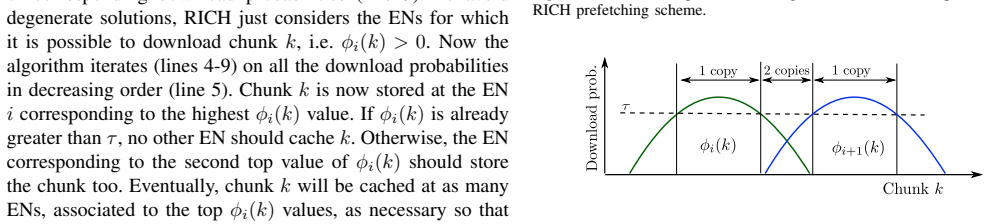
The central object is the chunk-download probability $\varphi_i(k)=P(k\in(Y_{i-1},Y_i])$, where $Y_i$ is the last chunk received after the car has passed $i$ edge nodes. Theorem 1 expresses it as $\varphi_i(k)=\sum_{n=1}^{k-1}P(X_i\ge k-n\mid Y_{i-1}=n)P(Y_{i-1}=n)$, and the distribution of $X_i$ is estimated from dwell time, total bandwidth, chunk size, and the average number of cars under coverage. This probability carries the argument: it ranks chunks, decides how many copies of each chunk to store across edge nodes, and sets the threshold $\tau$ that trades cache occupancy against download probability.
What would settle it
Measure the actual distribution of chunks downloaded per car per edge node in the Bologna scenario or a similar deployment and compare it with the model $X_i = W_i b/(s u_i)$; if the empirical distribution is materially wider or heavier-tailed than the model predicts, for instance at congested intersections where 802.11 contention reduces per-user throughput faster than the $1/u_i$ factor, then the $\varphi_i(k)$ ranking changes and RICH's hit-rate gain over netPredict shrinks or disappears.
Extended reading notes
Core claim
The central claim is that prefetching decisions for streaming content should be driven by the per-edge probability $\varphi_i(k)$ that chunk $k$ will be downloaded at edge node $i$. The paper derives $\varphi_i(k)$ from the distribution of the number of chunks $X_i$ a car downloads at each edge node, and RICH then greedily selects the edge nodes with the highest $\varphi_i(k)$ until the accumulated probability reaches a threshold $\tau$. This yields a placement that stores each chunk in the nodes where it is actually likely to be requested, rather than storing chunks based on average throughput or global popularity. The simulation results show that this distribution-based placement improves cache hit probability, cache throughput, and backhaul traffic compared with the mean-based netPredict policy and the popularity-based POP policy, with the largest gains at small cache sizes, and the scheme remains robust to errors in dwell-time estimates and to cars skipping a predicted edge node.
Load-bearing premise
The load-bearing premise is Eq. (6), $X_i = W_i b/(s u_i)$, which derives the number of chunks a car downloads at an edge node from dwell time, total bandwidth, chunk size, and the average number of cars under coverage; if contention, packet losses, or rate variability make the real per-user download distribution diverge from this approximation, the $\varphi_i(k)$ ranking that drives all placement decisions becomes suboptimal.
Editorial extensions
If this is right
- RICH's cache hit probability exceeds mean-based prefetching by up to 33% and popularity-based caching by up to 190% for small cache sizes.
- Backhaul traffic drops by up to 57% compared with netPredict and by up to 70% compared with POP, reducing core-network load.
- The scheme requires only the sequence of edge nodes and aggregate dwell-time statistics, not per-car trajectories, so it can be deployed with coarse mobility information.
- Performance degrades gracefully when dwell-time estimates are noisy or when 20% to 50% of cars skip the predicted second edge node, with cache throughput falling by about 10% and 23%, respectively.
- Adding a coarse fast/slow car classification further improves RICH, raising cache throughput to about 91 Mbps and cutting backhaul traffic to about 6 Mbps.
Reading between the lines
- RICH's distribution-based placement generalizes to any streaming service with predictable dwell times, such as public-transport WiFi, pedestrians crossing small cells, or passengers on trains passing through station hotspots.
- The copy-count pattern in the paper suggests an online extension: rather than tuning the thresholds $\tau_i$ offline, a deployment could adapt them from observed cache misses as dwell-time statistics drift.
- Because the policy relies on aggregate statistics rather than individual trajectories, it offers a privacy-preserving route to mobility-aware caching, a benefit the paper states implicitly.
- A testable extension would run RICH with the model-based distribution from Eq. (6) versus a measured distribution from the same deployment; the difference in hit probability would isolate how much of the gain depends on the accuracy of that approximation.
Signed reviews
Editorial analysis
A structured set of objections, weighed in public.
Referee Report
Summary. The paper proposes RICH, a prefetching policy for edge caches that serve streaming content to connected cars. RICH uses only coarse mobility information (the sequence of edge nodes a car traverses and the empirical distribution of dwell times under each edge node) to compute, for each content chunk, the probability that it will be downloaded from each edge node (Theorem 1 and Corollary 1). Based on these probabilities, Algorithm 1 places chunks in the caches of the edge nodes so that the cumulative download probability for each chunk exceeds a tunable threshold. The paper describes a full system architecture on top of OMNeT++ and evaluates RICH against popularity-based caching (POP) and the mean-dwell-time-based netPredict policy using a realistic Bologna vehicular trace and a detailed IEEE 802.11a simulation. The reported results claim substantial gains, e.g., up to 33% higher cache hit probability and 57% lower backhaul traffic against netPredict at small cache sizes (Figs. 10 and 11). A robustness study in Section V-A examines the effect of errors in dwell-time and path knowledge.
Significance. The core idea is appealing and relevant: replacing mean-based prefetching with dwell-time-distribution-aware prefetching is a natural step for vehicular streaming, and the paper provides a clean analytical characterization of chunk download probabilities together with a complete architecture and protocol design. The derivation in Theorem 1 is correct and the comparison against netPredict and POP is a meaningful starting point. However, the reported quantitative gains are not yet convincingly demonstrated because the evaluation is in-sample: both the empirical input distributions and the per-edge-node thresholds are derived from the same trace used to produce the performance curves. In addition, the prefetching decisions rely on Eq. (6), a mean-load model that has not been validated against the detailed 802.11a simulator used in the evaluation. If the authors can demonstrate out-of-sample performance and validate or correct the input model, the paper would make a solid contribution to mobility-aware edge caching.
major comments (4)
- [Section V, Table VI] The reported performance gains are in-sample. The threshold values in Table VI are obtained by an exhaustive search that maximizes cache hit probability on the same Bologna trace that is later used to generate Figs. 10 and 11, and the phi_i(k) inputs are computed from empirical dwell-time and load statistics of that same trace (Section IV-B). This gives RICH oracle-like access to the test period and can inflate the gains over netPredict and POP. The robustness study in Section V-A perturbs dwell times after the fact but does not replace the in-sample statistics with a training-period estimate, nor does it fix thresholds independently of the test trace. Please re-evaluate with a training/test split (e.g., estimating dwell-time distributions and optimizing thresholds on one temporal slice and testing on another) and report the out-of-sample gains with confidence intervals.
- [Section IV-B, Eq. (6)] The pdf of Xi used to compute all phi_i(k) is derived from Xi = Wi*b/(s*ui), which assumes that each user's throughput equals the total bandwidth divided by the average number of cars under coverage. This ignores the contention, packet losses, retry limits, and rate adaptation (AARF) of the IEEE 802.11a model that the simulator actually implements (Table II). Since prefetching placements are driven by the resulting phi_i(k), a mismatch between Eq. (6) and the simulator's per-user download distribution can make the chunk ranking suboptimal and weaken the comparison with netPredict, which uses the same mean-load model. Please validate Eq. (6) against simulation-measured Xi distributions, or use the empirical Xi distribution from the simulator as input to RICH.
- [Section III-B, Eq. (5)] The finite-cache truncation in Eq. (5) replaces Xi by the number of cached chunks downloaded from an EN, but in the simulated protocol a cache miss triggers a data recovery phase through the backhaul (Section II-A), so the user's playout position advances beyond the number of cached chunks received. The model does not capture the effect of these backhaul-fetched misses on the chunk numbering at subsequent ENs, while the simulator does. This approximation may bias the phi_i(k) used by RICH. Please justify the approximation or extend the model to account for miss recovery when computing the distribution of Yi.
- [Figs. 10, 11, and 12-14] All performance figures report single point estimates without error bars, confidence intervals, or the number of simulation seeds. Given the stochasticity of car arrivals, content requests, and the 802.11a channel, the claims of 33% higher hit probability and 57% lower backhaul traffic are not yet supported with statistical evidence. Please add error bars or bootstrap confidence intervals over multiple simulation runs or trace resamples.
minor comments (4)
- [Abstract and Section I] The abstract and introduction state that RICH 'optimally caches' content, but Algorithm 1 is a greedy threshold-based heuristic and the thresholds are numerically optimized; please rephrase to 'heuristically selects' or 'approximately optimizes'.
- [Section I and Section III] The paper repeatedly claims that RICH 'ensures in-order delivery', but the algorithm only targets cache hit probability and does not itself implement or guarantee in-order delivery; the architecture assumes a sufficiently large playout buffer and a data recovery phase. Please clarify the precise role of RICH in supporting in-order delivery.
- [Section IV-A and Table II] The text states an ideal radio range of 100 m per EN, while Table II lists a maximum communication range of 110 m; please reconcile these values.
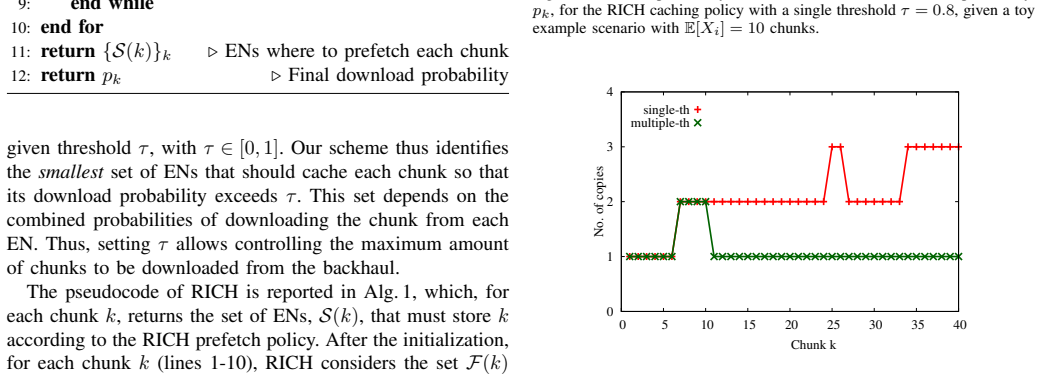
- [Figs. 5, 6, and 8] The labels 'single-th' and 'multiple-th' in Fig. 6 are not defined in the caption, and the y-axis of Fig. 6 has no quantity name; please clarify.
Circularity Check
RICH's reported gains are partly in-sample: thresholds are tuned and dwell-time statistics are taken from the same Bologna trace used for evaluation.
-
fitted input called prediction
[Section V (Numerical Results), first paragraph; Section IV-B (Simulation methodology)]
"As the first step, we use an exhaustive approach to find the combination of the thresholds τi at the three ENs for maximizing the cache hit probability. Table VI shows the values we obtained for different cache sizes, assumed to be the same at all ENs. ... Replacing the empirical values of Wi and ui (given in Table III) in (6), we estimate the distribution of Xi, and then the empirical φi(k) for any EN i and chunk k."
The configuration of RICH is fit to the same dataset on which its performance is then reported. The thresholds τi are chosen by exhaustive search to maximize the cache hit probability, which is precisely the metric plotted in Fig. 10 and used to claim gains up to 33% over netPredict. In addition, the φi(k) values that drive all prefetching decisions are computed from the empirical Wi and ui of the very same Bologna trace that generates the traffic in the performance evaluation. Thus the cache hit probability and backhaul traffic are in-sample, not predicted: the reported superiority of RICH is partly an artifact of optimizing its parameters and feeding it test-period statistics, while the benchmarks are not given the same in-sample tuning.
full rationale
The core analytical derivation is self-contained: Eq. (3) and Corollary 1 relate the chunk download probability φi(k) to the distribution of Xi through a valid convolution recursion, and Eq. (6) is an explicit modeling assumption rather than a disguised form of the target result. I find no load-bearing self-citation: references to the authors' prior work are motivational or identify [33] as a preliminary version, but the uniqueness or correctness of RICH does not rest on an unverified self-citation. However, the central performance claims are circular in the statistical sense. The thresholds in Table VI are explicitly optimized to maximize the cache hit probability on the evaluation scenario, and the dwell-time and load statistics used to build φi(k) are empirical values extracted from the same trace used to measure performance. Consequently, the reported hit-probability and backhaul-traffic advantages of RICH are in-sample fitted outcomes rather than out-of-sample predictions; the robustness study perturbs dwell times after the fact but does not separate training and test periods or fix thresholds independently. This warrants a score of 6: the predictions partially reduce to fitted inputs by construction, while the analytical model itself retains independent content.
Assumptions & free parameters
free parameters (3)
- Thresholds tau_1, tau_2, tau_3 per EN =
e.g., 0.88, 0.67, 0.70 for cache size 2600 chunks (Table VI)
- Fast/slow dwell-time threshold =
10 s
- Exponential utility function parameters =
not specified
assumptions (5)
- domain assumption Per-user throughput at an EN is the total bandwidth divided by the average number of cars under coverage (Eq. (6)).
- domain assumption The sequence of ENs each car will traverse is known to the Prefetcher (from navigation or prediction).
- domain assumption Dwell-time distributions under each EN are stationary and known from historical data.
- domain assumption Users request contents starting from the first chunk and require in-order delivery.
- standard math Xi for different ENs are treated as independent in the i.i.d. case (Corollary 1).
Cite this review
Pith. "Pith review of The RICH Prefetching in Edge Caches for In-Order Delivery to Connected Cars." pith.science (2026). https://pith.science/paper/Y4S6JIFS
@misc{pith2026190807228,
  author       = {Pith},
  title        = {Pith review of: The RICH Prefetching in Edge Caches for In-Order Delivery to Connected Cars},
  year         = {2026},
  howpublished = {\url{https://pith.science/paper/Y4S6JIFS}},
  note         = {Machine review of arXiv:1908.07228}
}
read the original abstract
Content caching on the edge of 5G networks is an emerging and critical feature to quench the thirst for content of future connected cars. However, the tight packaging of 5G cells, the finite storage capacity at the edge, and the need for content availability while driving motivate the need to develop smart edge caching strategies adapted to the mobility characteristics of connected cars. In this paper, we propose a scheme called RICH (RoadsIde CacHe), which optimally caches content at edge nodes where connected vehicles require it most. In particular, our scheme is designed to ensure in-order delivery of content chunks to end users. Unlike blind popularity decisions, the probabilistic caching used by RICH accounts for the user mobility information that the system can realistically acquire. Furthermore, we provide a complete system architecture and define the protocols through which the different system entities can interact. We assess the performance of our approach against state-of-the-art solutions, under realistic mobility datasets and system scenarios. Our RICH edge caching scheme improves significantly the content availability at the caches and reduces the required backhaul bandwidth, with beneficial effects for both the end users and the network operators.
Figures


Figures from the paper (9 more)



Reference graph
Works this paper leans on
-
[1]
Toward fully connected vehicles: Edge computing for advanced auto- motive communications,
“Toward fully connected vehicles: Edge computing for advanced auto- motive communications,” White paper, 5GAA, 2017
work page 2017
-
[2]
The price of fog: A data-driven study on caching architectures in vehicular networks,
F. Malandrino, C. Chiasserini, and S. Kirkpatrick, “The price of fog: A data-driven study on caching architectures in vehicular networks,” in ACM IoV-VoI, 2016
work page 2016
-
[3]
Mobile edge computing A key technology towards 5G,
Y . C. Hu, M. Patel, D. Sabella, N. Sprecher, and V . Young, “Mobile edge computing A key technology towards 5G,” ETSI white paper , vol. 11, no. 11, pp. 1–16, 2015. 14
work page 2015
-
[4]
A survey on Mobile Edge Computing: The communication perspective,
Y . Mao, C. You, J. Zhang, K. Huang, and K. B. Letaief, “A survey on Mobile Edge Computing: The communication perspective,” IEEE Comm. Surveys & Tutorials , vol. 19, no. 4, pp. 2322–2358, 2017
work page 2017
-
[5]
Caching policies for in-network caching,
A. G. Li Zhe, G. Simon, “Caching policies for in-network caching,” IEEE ICCCN, 2012
work page 2012
-
[6]
Mpc: Popularity-based caching strategy for content centric networks,
C. Bernardini, T. Silverston, and O. Festor, “Mpc: Popularity-based caching strategy for content centric networks,” in IEEE ICC, 2013
work page 2013
-
[7]
Proportional replication in peer-to-peer networks,
S. Tewari and L. Kleinrock, “Proportional replication in peer-to-peer networks,” IEEE INFOCOM, 2006
work page 2006
-
[8]
F. Zhang, C. Xu, Y . Zhang, K. Ramakrishnan, S. Mukherjee, R. Yates, and T. Nguyen, “EdgeBuffer: Caching and prefetching content at the edge in the MobilityFirst future internet architecture,” in IEEE WoW- MoM, 2015
work page 2015
Show all 32 references
-
[9]
Sprinkler: distributed content storage for just-in-time streaming,
S. K. Dandapat, S. Pradhan, N. Ganguly, and R. Roy Choudhury, “Sprinkler: distributed content storage for just-in-time streaming,” in ACM CellNet, 2013
2013
-
[10]
Caching strategies based on information density estimation in wireless ad hoc networks,
M. Fiore, C. Casetti, and C. Chiasserini, “Caching strategies based on information density estimation in wireless ad hoc networks,” IEEE Trans. on Vehicular Tech., vol. 60, no. 5, pp. 2194–2208, 2014
2014
-
[11]
Optimal geographic caching in cellular networks,
B. Blaszczyszyn and A. Giovanidis, “Optimal geographic caching in cellular networks,” in IEEE ICC, 2015
2015
-
[12]
Optimal caching and routing in hybrid networks,
M. Dehghan, A. Seetharamz, T. He, T. Salonidis, J. Kurose, and D. Towsley, “Optimal caching and routing in hybrid networks,” in IEEE MILCOM, 2014
2014
-
[13]
5G: Challenges, research priorities, and recommendations,
“5G: Challenges, research priorities, and recommendations,” Joint white paper, NetWorld 2000, 2014
2000
-
[14]
Traffic simulation for all: a real world traffic scenario from the city of Bologna,
L. Bieker, D. Krajzewicz, A. Morra, C. Michelacci, and F. Cartolano, “Traffic simulation for all: a real world traffic scenario from the city of Bologna,” in Modeling Mobility with Open Data . Springer, 2015, pp. 47–60
2015
-
[15]
“ETSI TR 103 319 broadband radio access networks (bran); 5 GHz high performance RLAN; mitigation techniques to enable sharing between RLANs and road tolling and intelligent transport systems in the 5 725 MHz to 5 925 MHz band,” ETSI Standard
-
[16]
Can IEEE 802.11p and WI-FI coexist in the 5.9GHz ITS band?
K. Mohammad Irfan and J. H ¨arri, “Can IEEE 802.11p and WI-FI coexist in the 5.9GHz ITS band?” in IEEE WoWMoM, 2017
2017
-
[17]
Cooperative Intelligent Transportation Systems (C-ITS) Platform,
“Cooperative Intelligent Transportation Systems (C-ITS) Platform,” Fi- nal Report, 2016
2016
-
[18]
OMNet++ discrete event simulator
“OMNet++ discrete event simulator.”
-
[20]
Web caching and Zipf-like distributions: evidence and implications,
L. Breslau, P. Cao, L. Fan, G. Phillips, and S. Shenker, “Web caching and Zipf-like distributions: evidence and implications,” in IEEE INFOCOM, 1999, pp. 126–134
1999
-
[21]
Comparison of caching strategies in modern cellular backhaul networks,
S. Woo, E. Jeong, S. Park, J. Lee, S. Ihm, and K. Park, “Comparison of caching strategies in modern cellular backhaul networks,” in ACM MobiSys, 2013
2013
-
[22]
A cooperation-based caching scheme for heterogeneous networks,
J. Ma, J. Wang, and P. Fan, “A cooperation-based caching scheme for heterogeneous networks,” IEEE Access, 2016
2016
-
[23]
Cooperative caching and transmission design in cluster-centric small cell networks,
Z. Chen, J. Lee, T. Q. Quek, and M. Kountouris, “Cooperative caching and transmission design in cluster-centric small cell networks,” IEEE Trans. on Wireless Comm. , 2017
2017
-
[24]
Mobee: Mobility- aware energy-efficient coded caching in cloud radio access networks,
T. X. Tran, F. Kazemi, E. Karimi, and D. Pompili, “Mobee: Mobility- aware energy-efficient coded caching in cloud radio access networks,” in IEEE MASS, 2017, pp. 461–465
2017
-
[25]
Mobility and popularity-aware coded small- cell caching,
E. Ozfatura and D. Gndz, “Mobility and popularity-aware coded small- cell caching,” IEEE Comm. Lett. , vol. 22, no. 2, pp. 288–291, 2018
2018
-
[26]
MobilityFirst: a robust and trustworthy mobility-centric architecture for the future Internet,
D. Raychaudhuri, K. Nagaraja, and A. Venkataramani, “MobilityFirst: a robust and trustworthy mobility-centric architecture for the future Internet,” ACM Mobile Comp. and Comm. Rev., vol. 16, no. 3, pp. 2–13, 2012
2012
-
[27]
The next generation vehicular networks: a content-centric framework,
Z. Su, Y . Hui, and Q. Yang, “The next generation vehicular networks: a content-centric framework,” IEEE Wireless Comm., vol. 24, no. 1, pp. 60–66, 2017
2017
-
[28]
Saving: socially aware vehicular information-centric networking,
J. A. Khan and Y . Ghamri-Doudane, “Saving: socially aware vehicular information-centric networking,” IEEE Comm. Mag., vol. 54, no. 8, pp. 100–107, 2016
2016
-
[29]
Perceive: Proactive caching in ICN-based vanets,
D. Grewe, M. Wagner, and H. Frey, “Perceive: Proactive caching in ICN-based vanets,” in IEEE VNC, 2016
2016
-
[30]
Optimal content prefetching in ndn vehicle-to-infrastructure scenario,
G. Mauri, M. Gerla, F. Bruno, M. Cesana, and G. Verticale, “Optimal content prefetching in ndn vehicle-to-infrastructure scenario,” IEEE Trans. on Vehicular Tech., vol. 66, no. 3, pp. 2513–2525, 2017
2017
-
[31]
Mobility-aware caching for content-centric wireless networks: modeling and methodology,
R. Wang, X. Peng, J. Zhang, and K. B. Letaief, “Mobility-aware caching for content-centric wireless networks: modeling and methodology,” IEEE Comm. Mag. , vol. 54, no. 8, pp. 77–83, 2016
2016
-
[32]
Cooperative content caching in 5g networks with mobile edge computing,
K. Zhang, S. Leng, Y . He, S. Maharjan, and Y . Zhang, “Cooperative content caching in 5g networks with mobile edge computing,” IEEE Wireless Comm., vol. 25, no. 3, pp. 80–87, 2018
2018
-
[33]
Mobility-aware edge caching for connected cars,
A. Mahmood, C. Casetti, C. F. Chiasserini, P. Giaccone, and J. Harri, “Mobility-aware edge caching for connected cars,” in IEEE WONS , 2016. APPENDIX A PROOF OF COROLLARY 1 Proof: When Xi’s are i.i.d., φi(k) = k−1∑ n=1 P (X≥k−n) P (Yi−1 =n). Thus, (3) can be rewritten as: φi(k...
2016
Reviewed August 14, 2026 · model on record in the stance chip above.
Discussion (0). Continue with ORCID to comment.