Neural Polaron: Learning Quasiparticle Operators in Quantum Many-Body Systems
Pith reviewed 2026-06-26 09:30 UTC · model grok-4.3
The pith
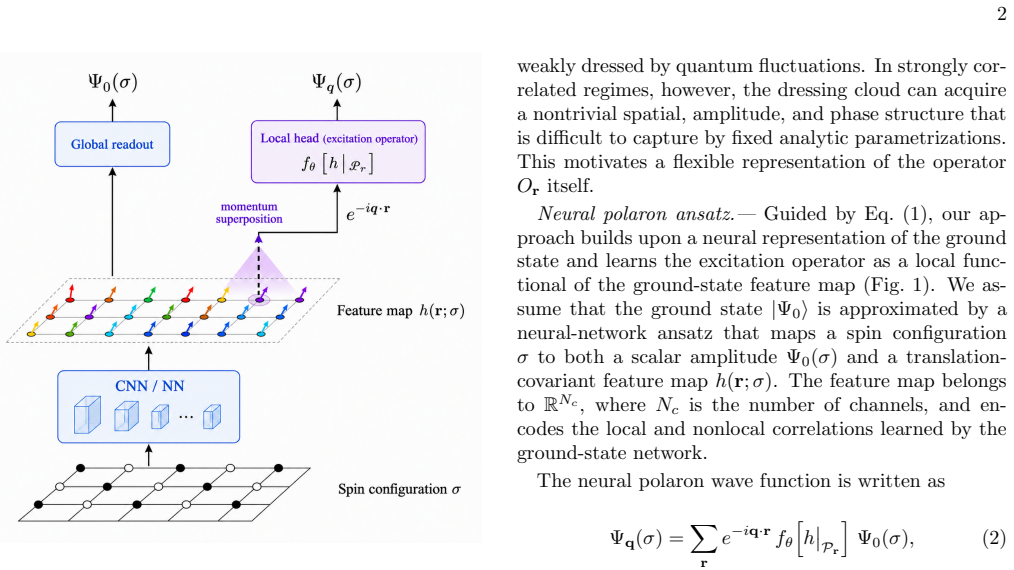
A neural polaron ansatz represents quasiparticle excitations as neural operators acting on a pretrained ground-state wave function.
A machine-rendered reading of the paper's core claim, the machinery that carries it, and where it could break.
Core claim
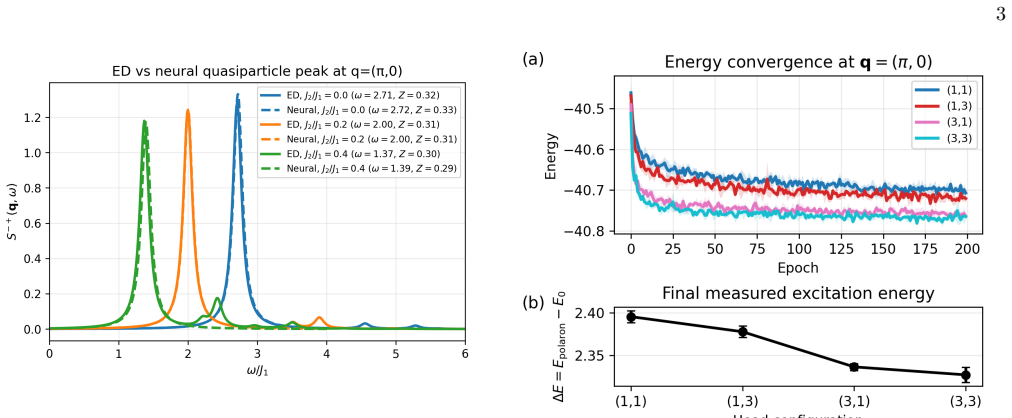
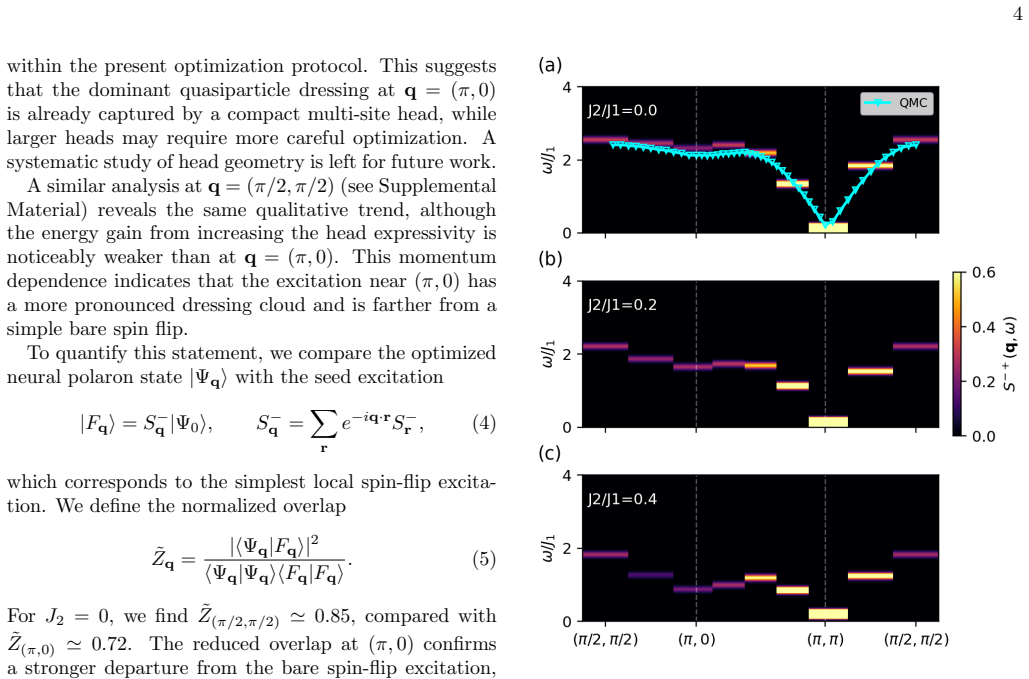
The neural polaron ansatz, which parameterizes a local dressing operator through a compact neural head on the feature map of a pretrained ground-state network, accurately reproduces magnon dispersions and spectral weights over a broad range of frustration in the square-lattice J1-J2 Heisenberg model, including the (π,0) anomaly and its softening with increasing J2/J1.
What carries the argument
The local dressing operator, a neural many-body operator parameterized by a compact neural head on the feature map of a pretrained ground-state network.
Load-bearing premise
A local dressing operator parameterized through a compact neural head on the feature map of a pretrained ground-state network is sufficient to capture the essential quasiparticle physics without independent excited-state wave functions.
What would settle it
If numerical results from the neural polaron ansatz on the J1-J2 model show that the spectral weight at momentum (π,0) does not soften progressively as J2/J1 is increased, the central claim would be falsified.
Figures
read the original abstract
Understanding dynamical properties of quantum many-body systems remains a central challenge because excitations generally require information beyond a ground-state wave function. Here we introduce a neural polaron ansatz that represents quasiparticle excitations by neural many-body operators acting on a correlated ground state. Instead of learning an independent excited-state wave function, the method parameterizes a local dressing operator through a compact neural head defined on the feature map of a pretrained ground-state network. This operator-based construction builds in translation symmetry, momentum resolution, and quasiparticle locality, while separating ground-state correlations from excitation-specific dressing. We benchmark the method on the square-lattice $J_1$-$J_2$ Heisenberg model, where it accurately reproduces magnon dispersions and spectral weights over a broad range of frustration. In particular, it captures nontrivial many-body features including the $(\pi,0)$ anomaly and its progressive softening with increasing $J_2/J_1$. These results establish neural operators as a physically transparent route for extending neural quantum states from ground-state properties to dynamical response.
Editorial analysis
A structured set of objections, weighed in public.
Referee Report
Summary. The paper introduces a neural polaron ansatz that constructs quasiparticle states via a local dressing operator parameterized by a compact neural head on the feature map of a pretrained ground-state neural network. This operator-based approach is applied to the square-lattice J1-J2 Heisenberg model and is asserted to reproduce magnon dispersions, spectral weights, and the progressive softening of the (π,0) anomaly across a range of J2/J1 without requiring independent excited-state wave functions.
Significance. If validated, the separation of ground-state correlations from excitation-specific dressing via a compact neural head on pretrained features would provide a transparent route to extend neural quantum states to dynamical response, with built-in translation symmetry and momentum resolution. This could be particularly useful for frustrated magnets where full variational optimization of excited states is costly.
major comments (2)
- [Method (neural polaron construction)] The central claim that the pretrained ground-state feature map plus compact neural head suffices to encode the dressing for the (π,0) anomaly (without independent excited-state variational freedom) is load-bearing but untested; no ablation against jointly optimized excited-state networks or comparison to methods with explicit excited-state optimization is reported.
- [Results (J1-J2 benchmarks)] The assertion of accurate reproduction of dispersions and spectral weights over a broad range of frustration lacks quantitative support in the form of error bars, dataset sizes, or direct numerical comparisons to exact diagonalization or other benchmarks; this undermines evaluation of how well the (π,0) anomaly softening is captured.
minor comments (2)
- [Method] Notation for the neural head and feature map should be defined with explicit equations early in the method section to clarify how locality and momentum resolution are enforced.
- [Abstract] The abstract states 'accurately reproduces' without referencing any specific metrics or figures; this should be qualified or tied to a results table/figure.
Simulated Author's Rebuttal
We thank the referee for their detailed and constructive report. We address the major comments point by point below.
read point-by-point responses
-
Referee: [Method (neural polaron construction)] The central claim that the pretrained ground-state feature map plus compact neural head suffices to encode the dressing for the (π,0) anomaly (without independent excited-state variational freedom) is load-bearing but untested; no ablation against jointly optimized excited-state networks or comparison to methods with explicit excited-state optimization is reported.
Authors: The neural polaron construction is intentionally designed to use a pretrained ground-state feature map with a compact neural head to parameterize the local dressing operator, thereby separating ground-state correlations from excitation-specific effects. This approach builds in translation symmetry and momentum resolution by construction. While we did not perform an explicit ablation study against jointly optimized excited-state networks in the current manuscript, the successful reproduction of magnon dispersions, spectral weights, and the (π,0) anomaly across frustration values supports the sufficiency of this method. We will revise the manuscript to include a more detailed discussion of this design choice and its advantages, and consider adding a limited comparison if computational resources allow. revision: partial
-
Referee: [Results (J1-J2 benchmarks)] The assertion of accurate reproduction of dispersions and spectral weights over a broad range of frustration lacks quantitative support in the form of error bars, dataset sizes, or direct numerical comparisons to exact diagonalization or other benchmarks; this undermines evaluation of how well the (π,0) anomaly softening is captured.
Authors: We agree that additional quantitative details would strengthen the presentation. In the revised manuscript, we will include error bars on the reported dispersions and spectral weights, specify the sizes of the training datasets used, and provide direct comparisons to exact diagonalization results for small systems or other established benchmarks where available to better quantify the accuracy of the (π,0) anomaly softening. revision: yes
Circularity Check
No significant circularity; neural polaron ansatz is an independent parameterization
full rationale
The paper introduces the neural polaron ansatz as a new operator-based construction that applies a compact neural head (local dressing operator) to the feature map of a separately pretrained ground-state network. This explicitly separates ground-state correlations from excitation-specific dressing and builds in symmetries by design. The central claims (reproduction of magnon dispersions, spectral weights, and the (π,0) anomaly across J2/J1) rest on this parameterization plus numerical benchmarking on the J1-J2 model, with no quoted equations or steps that reduce the output to a fit of the target quantities, a self-citation chain, or a renaming of known results. The method is presented as an independent variational ansatz rather than a tautological re-expression of its inputs.
Axiom & Free-Parameter Ledger
free parameters (1)
- neural head parameters
axioms (1)
- domain assumption Quasiparticle excitations can be represented by local dressing operators acting on a correlated ground state
invented entities (1)
-
neural polaron ansatz
no independent evidence
Reference graph
Works this paper leans on
-
[1]
P. W. Anderson, Science177, 393 (1972)
1972
- [2]
-
[3]
Eisert, M
J. Eisert, M. Cramer, and M. B. Plenio, Rev. Mod. Phys. 82, 277 (2010)
2010
-
[4]
Schollw¨ ock, Annals of physics326, 96 (2011)
U. Schollw¨ ock, Annals of physics326, 96 (2011)
2011
-
[5]
Or´ us, Annals of physics349, 117 (2014)
R. Or´ us, Annals of physics349, 117 (2014)
2014
-
[6]
Sachdev, Physics world12, 33 (1999)
S. Sachdev, Physics world12, 33 (1999)
1999
-
[7]
Sachdev,Quantum phases of matter(Cambridge Uni- versity Press, 2023)
S. Sachdev,Quantum phases of matter(Cambridge Uni- versity Press, 2023)
2023
-
[8]
Wen,Quantum field theory of many-body systems: From the origin of sound to an origin of light and elec- trons(Oxford university press, 2004)
X.-G. Wen,Quantum field theory of many-body systems: From the origin of sound to an origin of light and elec- trons(Oxford university press, 2004)
2004
-
[9]
Abanov, A
A. Abanov, A. V. Chubukov, and J. Schmalian, Advances in Physics52, 119 (2003)
2003
-
[10]
Abanov and A
A. Abanov and A. V. Chubukov, Physical review letters 84, 5608 (2000)
2000
-
[11]
A. W. Sandvik, inAIP Conference Proceedings, Vol. 1297 (American Institute of Physics, 2010) pp. 135–338
2010
-
[12]
Troyer and U.-J
M. Troyer and U.-J. Wiese, Physical review letters94, 170201 (2005)
2005
-
[13]
Laurell, A
P. Laurell, A. Scheie, E. Dagotto, and D. A. Tennant, Advanced Quantum Technologies8, 2400196 (2025)
2025
-
[14]
P. P. Stavropoulos, Y. Yang, I. Rousochatzakis, and N. B. Perkins, Physical Review B110, 214406 (2024)
2024
-
[15]
Carleo, I
G. Carleo, I. Cirac, K. Cranmer, L. Daudet, M. Schuld, N. Tishby, L. Vogt-Maranto, and L. Zdeborov´ a, Reviews of Modern Physics91, 045002 (2019)
2019
-
[16]
Carrasquilla, Advances in Physics: X5, 1797528 (2020)
J. Carrasquilla, Advances in Physics: X5, 1797528 (2020)
2020
-
[17]
Y.-Z. You, Z. Yang, and X.-L. Qi, Physical Review B97, 045153 (2018)
2018
-
[18]
Szab´ o and C
A. Szab´ o and C. Castelnovo, Physical Review Research 2, 033075 (2020)
2020
-
[19]
X.-Q. Sun, T. Nebabu, X. Han, M. O. Flynn, and X.-L. Qi, Physical Review B106, 115138 (2022)
2022
-
[20]
Carleo and M
G. Carleo and M. Troyer, Science355, 602 (2017)
2017
-
[21]
K. Choo, T. Neupert, and G. Carleo, Physical Review B 100, 125124 (2019)
2019
-
[22]
L. L. Viteritti, R. Rende, S. Sachdev, and G. Carleo, arXiv preprint arXiv:2602.02665 (2026)
arXiv 2026
-
[23]
Geier, K
M. Geier, K. Nazaryan, T. Zaklama, and L. Fu, Physical Review B112, 045119 (2025)
2025
-
[24]
W. T. Lou, H. Sutterud, G. Cassella, W. M. C. Foulkes, J. Knolle, D. Pfau, and J. S. Spencer, Physical Review X 14, 021030 (2024)
2024
-
[25]
R. P. Nutakki, A. Shokry, and F. Vicentini, arXiv preprint arXiv:2505.03466 (2025)
arXiv 2025
-
[26]
L. L. Viteritti, R. Rende, and F. Becca, Physical Review Letters130, 236401 (2023). 6
2023
- [27]
-
[28]
Chatterji, inNeutron scattering from magnetic mate- rials(Elsevier, 2006) pp
T. Chatterji, inNeutron scattering from magnetic mate- rials(Elsevier, 2006) pp. 1–24
2006
-
[29]
Christianson, E
A. Christianson, E. Goremychkin, R. Osborn, S. Rosenkranz, M. Lumsden, C. Malliakas, I. Todorov, H. Claus, D. Chung, M. Kanatzidis,et al., Nature456, 930 (2008)
2008
-
[30]
D. A. Tennant, Journal of the Physical Society of Japan 88, 081009 (2019)
2019
-
[31]
Damascelli, Z
A. Damascelli, Z. Hussain, and Z.-X. Shen, Reviews of modern physics75, 473 (2003)
2003
-
[32]
L. J. P. Ament, M. van Veenendaal, T. P. Devereaux, J. P. Hill, and J. van den Brink, Rev. Mod. Phys.83, 705 (2011)
2011
-
[33]
Y. Xu, Y. Yang, J. Teyssier, T. Ohtsuki, Y. Qiu, S. Nakatsuji, D. van der Marel, N. B. Perkins, and N. Drichko, npj Quantum Materials10, 88 (2025)
2025
-
[34]
P. Park, S.-S. Zhang, P. M. Bonetti, A. A. Podlesnyak, D. M. Pajerowski, M. B. Stone, C. Petrovic, C. Stock, S. Sachdev, C. D. Batista,et al., arXiv preprint arXiv:2604.02481 (2026)
Pith/arXiv arXiv 2026
-
[35]
Eisert, M
J. Eisert, M. Friesdorf, and C. Gogolin, Nat. Phys.11, 124 (2015)
2015
-
[36]
K. Choo, G. Carleo, N. Regnault, and T. Neupert, arXiv preprint arXiv:1807.03325 (2018)
Pith/arXiv arXiv 2018
-
[37]
Mendes-Santos, M
T. Mendes-Santos, M. Schmitt, and M. Heyl, Physical Review Letters131, 046501 (2023)
2023
-
[38]
A. Ning, L. Yang, and G.-W. Chern, Physical Review E 113, 015307 (2026)
2026
-
[39]
Dalla Piazza, M
B. Dalla Piazza, M. Mourigal, N. B. Christensen, G. Nilsen, P. Tregenna-Piggott, T. Perring, M. Enderle, D. F. McMorrow, D. Ivanov, and H. M. Rønnow, Nature physics11, 62 (2015)
2015
-
[40]
Powalski, K
M. Powalski, K. P. Schmidt, and G. S. Uhrig, SciPost Physics4, 001 (2018)
2018
-
[41]
H. Shao, Y. Q. Qin, S. Capponi, S. Chesi, Z. Y. Meng, and A. W. Sandvik, Physical Review X7, 041072 (2017)
2017
-
[42]
Ferrari and F
F. Ferrari and F. Becca, Physical Review B98, 100405 (2018)
2018
-
[43]
A. W. Sandvik and R. R. Singh, Physical Review Letters 86, 528 (2001)
2001
-
[44]
Powalski, G
M. Powalski, G. Uhrig, and K. Schmidt, Physical review letters115, 207202 (2015)
2015
-
[45]
R. R. Singh and M. P. Gelfand, Physical Review B52, R15695 (1995)
1995
-
[46]
L. D. Landau, Sov. Phys. JETP3, 920 (1956), see also Sov. Phys. JETP5, 101 (1957)
1956
-
[47]
Tosatti, Quantum theory of the electron liquid (2006)
E. Tosatti, Quantum theory of the electron liquid (2006)
2006
-
[48]
J. T. Devreese and A. S. Alexandrov, Reports on Progress in Physics72, 066501 (2009)
2009
-
[49]
R. P. Feynman, Physical Review94, 262 (1954)
1954
-
[50]
R. P. Feynman and M. Cohen, Physical Review102, 1189 (1956)
1956
-
[51]
A. J. Leggett,Quantum liquids: Bose condensation and Cooper pairing in condensed-matter systems(Oxford uni- versity press, 2006)
2006
-
[52]
Read and S
N. Read and S. Sachdev, Physical review letters66, 1773 (1991)
1991
-
[53]
A. V. Chubukov and O. A. Starykh, Journal of Physics: Condensed Matter11, L169 (1999)
1999
-
[54]
Zhang, E
S.-S. Zhang, E. Ghioldi, L. O. Manuel, A. E. Trumper, and C. D. Batista, Physical Review B105, 224404 (2022)
2022
-
[55]
Liang, W.-Y
X. Liang, W.-Y. Liu, P.-Z. Lin, G.-C. Guo, Y.-S. Zhang, and L. He, Physical Review B98, 104426 (2018)
2018
-
[56]
A. Chen, K. Choo, N. Astrakhantsev, and T. Neupert, Physical Review Research4, L022026 (2022)
2022
-
[57]
C. Roth, A. Szab´ o, and A. H. MacDonald, Physical Re- view B108, 054410 (2023)
2023
-
[58]
Wang and A
L. Wang and A. W. Sandvik, Physical review letters121, 107202 (2018)
2018
-
[59]
J. Yang, A. W. Sandvik, and L. Wang, Physical Review B105, L060409 (2022)
2022
- [60]
-
[61]
K. Choo, A. Mezzacapo, and G. Carleo, Nature Commu- nications11, 2368 (2020)
2020
-
[62]
D. Pfau, J. S. Spencer, A. G. Matthews, and W. M. C. Foulkes, Physical review research2, 033429 (2020)
2020
-
[63]
Hermann, Z
J. Hermann, Z. Sch¨ atzle, and F. No´ e, Nature Chemistry 12, 891 (2020)
2020
-
[64]
D. Luo, D. D. Dai, and L. Fu, Physical Review B113, 165107 (2026)
2026
-
[65]
Marshall, Proceedings of the Royal Society of London
W. Marshall, Proceedings of the Royal Society of London. Series A. Mathematical and Physical Sciences232, 48 (1955)
1955
-
[66]
Richter, N
J. Richter, N. Ivanov, and K. Retzlaff, EPL (Europhysics Letters)25, 545 (1994)
1994
-
[67]
Retzlaff, J
K. Retzlaff, J. Richter, and N. Ivanov, Zeitschrift f¨ ur Physik B Condensed Matter93, 21 (1993)
1993
-
[68]
S.-S. Gong, W. Zhu, D. Sheng, O. I. Motrunich, and M. P. Fisher, Physical review letters113, 027201 (2014)
2014
-
[69]
Neural Polaron: Learning Quasiparticle Operators in Quantum Many-Body Systems
S. Sorella, M. Casula, and D. Rocca, The Journal of chemical physics127(2007). 7 Supplemental Material for “Neural Polaron: Learning Quasiparticle Operators in Quantum Many-Body Systems” Shang-Shun Zhang Department of Physics and Astronomy, University of Tennessee, Knoxville, Tennessee 37996, USA NEURAL-NETWORK W A VEFUNCTION ARCHITECTURE In this section,...
2007
discussion (0)
Sign in with ORCID, Apple, or X to comment. Anyone can read and Pith papers without signing in.